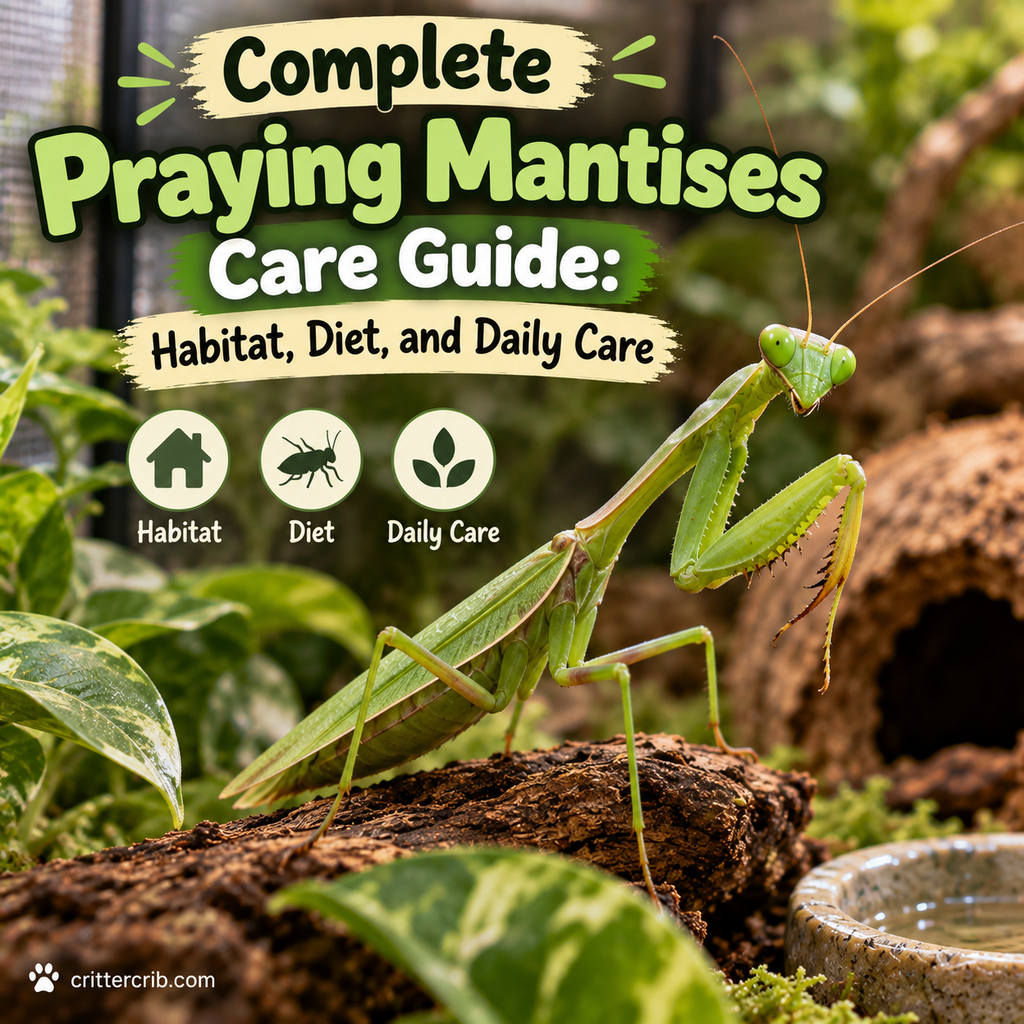
Praying mantises are fascinating pets. They’re quiet, don’t require a huge enclosure, and can spend an impressive amount of time sitting perfectly still before suddenly striking at prey in a fraction of a second.
Their care isn’t particularly complicated once you understand what they need. The challenge is that those needs can vary quite a bit between species.
A hardy beginner mantis and a delicate tropical species shouldn’t automatically receive identical care. Temperature, humidity, ventilation, prey size, and even enclosure design can differ.
There are still some basic principles that apply to most pet mantises.
They need an appropriately sized enclosure, excellent ventilation, access to suitable live prey, safe places to hang, and—perhaps most importantly—enough unobstructed vertical room to molt.
This complete praying mantis care guide covers the essentials you should understand before bringing one home.
Praying Mantis Care at a Glance
Most pet praying mantises need:
- A secure, well-ventilated enclosure
- Adequate vertical space
- Branches or mesh for hanging
- Species-appropriate temperature
- Appropriate humidity
- Regular access to water droplets
- Live insect prey
- Safe molting space
- Routine spot cleaning
- Minimal stressful handling
One of the best things you can do before buying a mantis is identify the exact species.
“Praying mantis” describes thousands of species found in very different environments. Care advice that works beautifully for one may be inappropriate for another.
Choosing a Praying Mantis Species
Praying mantises range from small, relatively straightforward species to spectacular tropical mantises with more specialized requirements.
Popular mantises in the pet hobby can include:
- Ghost mantises
- Giant Asian mantises
- African mantises
- Orchid mantises
- Dead leaf mantises
- Spiny flower mantises
Availability varies depending on where you live.
If you’re a beginner, don’t choose a species based entirely on appearance. That incredible flower-mimicking mantis may also require more precise environmental conditions than a hardier species.
Before purchasing one, research:
- Adult size
- Temperature requirements
- Humidity requirements
- Ventilation needs
- Typical lifespan
- Appropriate prey
- Adult wing development
- Sex differences
- Difficulty level
Buy captive-bred animals from responsible sources when possible.
How Big Should a Praying Mantis Enclosure Be?
Enclosure proportions matter enormously for mantises.
A commonly used guideline is to provide an enclosure at least around three times the mantis’s body length in height and roughly twice its body length in width.
More room can be provided, but the enclosure still needs to make feeding and monitoring practical.
Height is especially important because mantises molt while hanging upside down.
Why Vertical Space Is So Important
When a mantis molts, it attaches itself securely near the top of the enclosure and hangs downward.
It then works its way out of the old exoskeleton.
The newly molted mantis is extremely soft and vulnerable. It needs enough space beneath itself to emerge fully and straighten its legs.
If decorations, substrate, or enclosure walls interfere with this process, a bad molt can occur.
A severe mismolt can permanently deform or even kill a mantis.
When setting up the enclosure, don’t just ask whether your mantis fits inside.
Ask whether it has enough room to molt safely.
What Type of Enclosure Is Best for a Praying Mantis?
Several enclosure styles can work.
Depending on the size and species, keepers may use:
- Mesh enclosures
- Acrylic enclosures
- Modified plastic containers
- Glass terrariums with appropriate ventilation
- Purpose-built invertebrate enclosures
If you’re building an enclosure from scratch, our praying mantis habitat setup guide goes deeper into enclosure dimensions, ventilation, climbing surfaces, substrate, temperature, humidity, furnishings, and leaving enough vertical space for safe molting.
The enclosure needs to be escape-proof.
Young mantises can fit through surprisingly small gaps.
At the same time, ventilation is essential.
A container that retains humidity extremely well but has little airflow can create stagnant conditions that are especially problematic for certain species.
Praying Mantis Ventilation Requirements
Good airflow is one of the most important parts of mantis housing.
This becomes especially important for species that require elevated humidity.
High humidity shouldn’t mean sealing the animal inside a wet container with stale air.
Ideally, an enclosure provides enough ventilation for air exchange while still allowing you to maintain species-appropriate moisture.
Cross-ventilation can be useful because air can move through the enclosure rather than relying solely on ventilation at the top.
The correct balance depends on species.
What Should You Put in a Praying Mantis Enclosure?
A mantis enclosure doesn’t need to look like a miniature jungle.
It does need structure.
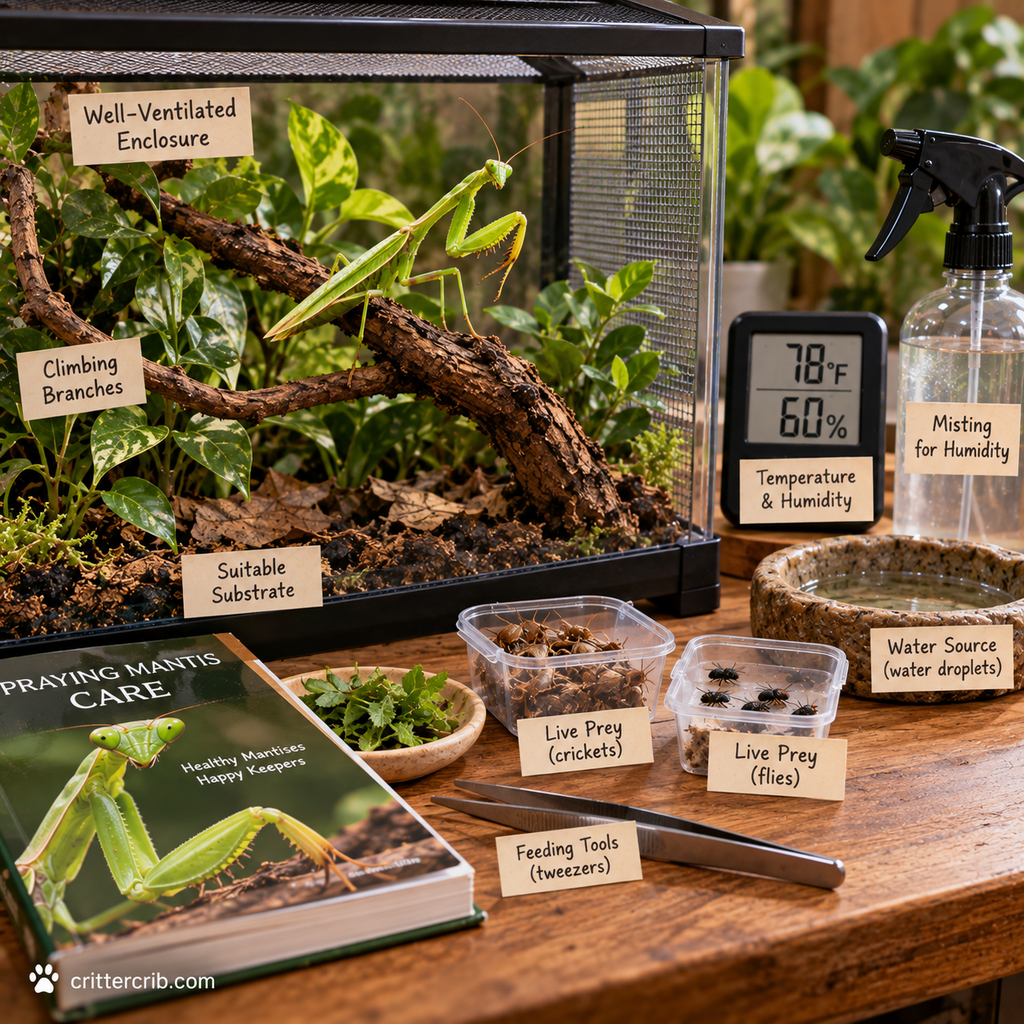
Useful enclosure furnishings include:
- Thin branches
- Twigs
- Artificial plants
- Safe live plants
- Mesh or another suitable gripping surface near the top
- Simple substrate
Arrange branches so the mantis can move around and access elevated perches.
Most importantly, leave open areas underneath preferred hanging locations.
A beautifully decorated enclosure isn’t useful if the mantis can’t molt safely.
Best Substrate for Praying Mantises
Praying mantises don’t depend on substrate in the same way millipedes, isopods, or burrowing tarantulas do.
For many species, substrate primarily helps manage moisture and makes the enclosure easier to maintain.
Possible options include:
- Paper towel
- Coconut-based substrate
- Suitable soil-based substrate
- Other species-appropriate moisture-retaining materials
Paper towel can be particularly convenient in simple setups because it’s easy to replace and allows you to see waste and uneaten prey.
Naturalistic substrate can look better and help maintain moisture, but it also requires more attention to cleanliness.
Whatever you use, avoid substrate containing pesticides, fertilizers, fragrances, or other potentially harmful additives.
Temperature Requirements for Praying Mantises
There’s no universal perfect temperature for all praying mantises.
Some species are comfortable around normal warm room temperatures. Tropical species may prefer warmer conditions.
This is why species identification matters.
Use a digital thermometer to monitor the enclosure rather than guessing.
Do Praying Mantises Need a Heat Lamp?
Not necessarily.
If your home naturally stays within the appropriate temperature range for your species, supplemental heating may not be needed.
When additional heat is required, it should be controlled and monitored carefully.
Small enclosures can heat up quickly.
Avoid placing a mantis enclosure in direct sunlight. Even if the room feels comfortable, sunlight through glass or plastic can cause temperatures inside the enclosure to rise dangerously.
Humidity Requirements for Praying Mantises
Humidity requirements vary considerably.
Some mantises tolerate relatively moderate humidity, while tropical species may require consistently higher levels.
Don’t assume that spraying constantly is the answer.
A good mantis setup balances:
- Humidity
- Ventilation
- Moisture
- Drying between misting when appropriate
Constantly wet surfaces combined with poor airflow can create unhealthy conditions.
A hygrometer can help you monitor general humidity, although your observations of condensation, drying rate, and enclosure conditions are also important.
How Do Praying Mantises Drink Water?
Mantises often drink droplets from leaves, enclosure walls, and other surfaces.
Light misting provides both environmental moisture and drinking opportunities.
You may occasionally see a mantis lower its mouth to a droplet and drink.
This is easy to miss if you aren’t watching closely.
Do Praying Mantises Need a Water Bowl?
A conventional water bowl usually isn’t necessary for most mantises.
They primarily obtain water from prey and droplets.
A deep open water dish may create unnecessary risk, particularly for small nymphs.
Instead, maintain proper humidity and provide drinking droplets through appropriate misting.
How Often Should You Mist a Praying Mantis?
There’s no single misting schedule that works for every species and enclosure.
How quickly an enclosure dries depends on:
- Species
- Ventilation
- Temperature
- Enclosure material
- Substrate
- Local humidity
- Life stage
Some setups may need light misting regularly, while others retain moisture longer.
The goal isn’t to keep every surface permanently wet.
Research your species and observe how quickly the enclosure dries.
What Do Praying Mantises Eat?
Praying mantises are predators.
They eat other animals, primarily insects and other small invertebrates.
In captivity, they should generally be fed appropriately sized live prey.
Depending on mantis size and species, feeders may include:
- Fruit flies
- Houseflies
- Blue bottle flies
- Small roaches
- Small crickets
- Moths
- Other appropriately sized captive feeder insects
Variety can be beneficial.
A tiny nymph may start on fruit flies, while a large adult can handle much larger prey.
How Big Should Mantis Prey Be?
Choose prey that your mantis can capture safely.
A useful general approach is to avoid feeders that are excessively large relative to the mantis.
Small nymphs need tiny prey.
As the mantis grows through successive molts, feeder size can increase.
Watch how your mantis responds.
If prey consistently intimidates the mantis, escapes capture, or creates a risk of injury, choose something smaller.
How Often Should You Feed a Praying Mantis?
Feeding frequency depends on:
- Species
- Age
- Size
- Prey size
- Temperature
- Body condition
- Proximity to a molt
Young mantises generally eat more frequently because they’re growing rapidly.
Adults may eat less often.
Rather than following a rigid feeding schedule forever, learn to observe the mantis’s abdomen and behavior.
A mantis with a noticeably thin abdomen may be ready for food. One with a very full abdomen doesn’t necessarily need another large meal immediately.
Avoid chronic overfeeding.
Should You Feed Wild-Caught Insects?
Using insects caught outdoors can expose a mantis to pesticides, parasites, and other contaminants.
An insect collected from a yard that was recently treated with chemicals could potentially harm your pet.
Captive-bred feeder insects from reliable sources are generally the more predictable choice.
If you’re uncertain about the safety of a wild insect, don’t feed it.
Can Praying Mantises Eat Crickets?
Many mantises will eat appropriately sized crickets, but crickets aren’t always the ideal feeder for every situation.
They can bite, especially if left inside the enclosure unattended.
They’re also ground-oriented insects, while many mantises naturally hunt from elevated perches.
Flying prey can encourage natural hunting behavior and may be readily accepted by many species.
If you use crickets, don’t leave them loose with a mantis that’s preparing to molt or has recently molted.
Remove Uneaten Prey Before a Molt
This is extremely important.
A molting mantis is defenseless.
Feeder insects that are normally prey can become a threat when the mantis can’t protect itself.
If your mantis refuses food and appears to be approaching a molt, remove uneaten feeders.
After molting, give the mantis time for its new exoskeleton to harden before offering food again.
Understanding the Praying Mantis Molting Process
Mantises grow by shedding their exoskeleton.
Young mantises molt repeatedly as they develop.
Before a molt, you may notice:
- Reduced appetite
- Refusal of food
- Less activity
- Increased hanging
- A fuller or slightly different appearance
- Changes in behavior
Not every individual behaves exactly the same way.
Once the mantis begins molting, don’t interfere.
What Happens During a Mantis Molt?
The mantis hangs upside down and gradually emerges from its old exoskeleton.
After emerging, it remains suspended while the new exoskeleton expands and hardens.
The process requires secure footing and plenty of clear space underneath.
A mantis may look strange or vulnerable during and immediately after a molt.
That’s normal.
Don’t touch it.
How to Prevent Mismolts
You can’t prevent every molting problem, but good husbandry reduces the risk.
Make sure the enclosure provides:
- Adequate height
- Secure hanging surfaces
- Clear space below the mantis
- Appropriate humidity
- Proper hydration
- Suitable nutrition
- Minimal disturbance
Check the enclosure layout as the mantis grows.
A setup that provided plenty of space for a tiny nymph may become dangerously cramped several molts later.
What Should You Do After a Mantis Molts?
Leave it alone.
The new exoskeleton needs time to harden.
Avoid:
- Handling
- Spraying the mantis directly
- Adding aggressive prey
- Rearranging the enclosure
- Disturbing its perch
Once the mantis has hardened and returned to normal activity, feeding can resume.
You may also find the shed exoskeleton hanging in the enclosure.
How to Tell When a Praying Mantis Is an Adult
The final molt produces the adult form.
For many species, fully developed wings are one of the clearest signs of adulthood.
Adult males and females may differ significantly in size, body shape, antennae, wing proportions, and lifespan.
The differences vary by species.
Once adult, the mantis will no longer molt.
Can Praying Mantises Live Together?
For most commonly kept praying mantises, individual housing is the safest approach.
Mantises are predators.
Yes, that includes other mantises.
Cannibalism can occur, especially when animals are confined together.
Although certain species and life stages may tolerate communal conditions better than others, this requires species-specific knowledge and careful management.
Beginners should generally plan on one mantis per enclosure.
Can You Handle a Praying Mantis?
Many mantises can be handled occasionally, but handling isn’t necessary for their well-being.
If you do handle one, allow the mantis to walk onto your hand rather than grabbing it around the body.
Move slowly.
Never handle a mantis:
- While it’s molting
- Immediately after a molt
- If it’s showing obvious signs of stress
- In a location where a fall or escape would be dangerous
Young nymphs can be particularly delicate.
Handling should be occasional and gentle rather than a daily activity.
How to Clean a Praying Mantis Enclosure
Mantis enclosures are relatively easy to maintain.
Routine cleaning mostly involves removing:
- Prey remains
- Dead feeder insects
- Droppings
- Moldy material
- Dirty substrate when necessary
You don’t need to tear down the entire enclosure every few days.
Simple Cleaning Routine
- Check for uneaten prey.
- Remove insect remains.
- Wipe heavily soiled surfaces when necessary.
- Replace dirty paper towel or substrate as needed.
- Inspect branches and plants for mold.
- Make sure ventilation remains clear.
- Confirm that hanging and molting areas are unobstructed.
If the enclosure requires a major cleaning, temporarily move the mantis into a secure holding container.
Be especially careful with nymphs. They’re fast, small, and surprisingly good at disappearing.
Do Praying Mantises Smell?
A properly maintained mantis enclosure shouldn’t produce a strong odor.
Persistent bad smells can indicate:
- Dead feeder insects
- Spoiled organic material
- Excessive moisture
- Mold
- Poor ventilation
Find the source rather than trying to cover the smell with fragrances.
Never use air fresheners or scented cleaning sprays inside the enclosure.
Signs Your Praying Mantis May Be Stressed
Behavior varies between species and individuals, but potential signs of a problem can include:
- Repeated attempts to escape unsuitable conditions
- Persistent refusal of food outside normal pre-molt behavior
- Difficulty gripping surfaces
- Unusual weakness
- Abnormal posture
- Repeated falls
- Visible injuries
A mantis refusing one meal isn’t automatically sick.
Always consider context.
A mantis that’s about to molt may stop eating normally. An adult male may also behave differently from a growing nymph.
When behavior changes, start by checking the basics: temperature, humidity, ventilation, hydration, enclosure size, and prey.
Common Praying Mantis Care Mistakes
Most beginner problems come from a handful of husbandry mistakes. Our guide to common praying mantis care mistakes and how to avoid them goes deeper into problems involving enclosure size, molting, ventilation, humidity, feeding, temperature, handling, and keeping multiple mantises together.
Using an Enclosure That’s Too Short
Molting requires vertical space.
A mantis may fit comfortably while walking around yet still lack enough room to molt.
Poor Ventilation
Humidity without airflow can create stagnant conditions.
Don’t seal a tropical mantis inside an almost airtight container just to keep humidity high.
Overdecorating the Enclosure
Plants and branches are useful, but too many can obstruct molting space.
Keep a clear vertical area beneath suitable hanging surfaces.
Leaving Feeder Insects During a Molt
Remove uneaten prey when a molt appears imminent.
A vulnerable mantis can’t defend itself normally.
Handling a Freshly Molted Mantis
Wait until the new exoskeleton has hardened.
Freshly molted mantises are extremely delicate.
Keeping Multiple Mantises Together
Unless you have species-specific experience that supports communal housing, keep mantises individually.
Spraying Without Monitoring Conditions
More water isn’t always better.
Balance moisture with ventilation and the needs of your particular species.
Buying Before Identifying the Species
Different mantises have different care requirements.
Know what you’re buying before setting up the enclosure.
Daily Praying Mantis Care Routine
Mantis care doesn’t require hours every day.
A quick daily check is usually enough.
Every Day
Look at:
- Mantis behavior
- Temperature
- General humidity and moisture
- Water droplets when appropriate
- Uneaten prey
- Signs of an upcoming molt
- Enclosure security
Mist according to the needs of your species and setup.
On Feeding Days
Offer appropriately sized live prey.
Watch whether the mantis successfully captures it.
Remove prey that remains uneaten, especially if you suspect the mantis is approaching a molt.
As Needed
Clean waste, replace substrate, remove feeder remains, and check enclosure furnishings.
Also inspect the enclosure after each molt.
Your mantis is getting larger, which means its available molting space is getting smaller.
Beginner Praying Mantis Supply Checklist
Before bringing your mantis home, prepare:
- Appropriately sized enclosure
- Secure lid or doors
- Adequate ventilation
- Suitable substrate
- Branches or twigs
- Secure hanging surfaces
- Thermometer
- Hygrometer if useful for the species
- Mister or spray bottle
- Reliable live feeder insects
- Feeding tools
- Temporary holding container
For a more detailed breakdown of what you actually need—and what you can skip—see our praying mantis beginner supplies checklist.
Set everything up before the mantis arrives.
It’s much easier to make changes without a fast little predator watching for an opportunity to escape.
Frequently Asked Questions About Praying Mantis Care
Are praying mantises easy pets?
Many species can be relatively straightforward once their basic requirements are understood.
The biggest challenges for beginners are usually maintaining appropriate environmental conditions, providing live prey, and ensuring safe molts.
Some species are considerably more demanding than others.
How long do pet praying mantises live?
Lifespan varies by species, sex, temperature, and other factors.
Many mantises live for roughly several months to around a year, although some can live longer under suitable conditions.
Females often live longer than males in many species.
Do praying mantises recognize their owners?
Mantises can respond to movement and may become accustomed to routine interactions, but you shouldn’t interpret their behavior in the same way you would a social mammal.
They’re primarily responding to their environment, potential prey, and perceived threats.
Do praying mantises need companionship?
No.
Most pet mantises are best kept individually.
They don’t require another mantis for social companionship.
Can praying mantises eat fruit?
Praying mantises are predators and should be provided with appropriate animal prey.
Fruit isn’t a substitute for live feeder insects.
Do praying mantises need sunlight?
They benefit from a normal day-night cycle, but direct sunlight on an enclosure can cause dangerous overheating.
Normal room lighting or suitable indirect lighting is generally safer.
Why is my praying mantis hanging upside down?
Hanging upside down is normal mantis behavior.
They frequently rest and hunt from elevated positions, and they also molt while hanging.
If a growing mantis begins refusing food and spends significant time hanging, a molt may be approaching.
Why isn’t my praying mantis eating?
Possible reasons include:
- Preparing to molt
- Recently molted
- Already well-fed
- Inappropriate prey
- Low temperature
- Stress
- Adulthood-related behavioral changes
- Illness or injury
Look at the entire situation rather than assuming food refusal automatically means something is wrong.
A Good Mantis Setup Makes Daily Care Simple
Praying mantises are unusual pets, but their daily care doesn’t need to be complicated.
Start with the species.
Find out how large it gets and what temperature, humidity, ventilation, and prey it needs. Then build an enclosure with enough height, secure climbing surfaces, and plenty of unobstructed room for molting.
Provide appropriately sized live insects, mist according to the species’ needs, remove leftovers, and keep the enclosure reasonably clean.
Most importantly, respect the molting process.
A mantis may spend much of its life sitting quietly on a branch, but every molt is a major event. Good enclosure design gives it the space and conditions needed to complete that process safely.
Get those fundamentals right, and you’ll have a much better chance of watching your tiny ambush predator grow from a delicate nymph into an impressive adult.