
Bringing home a hedgehog can come with an unexpected question: how exactly are you supposed to pick up an animal covered in quills?
Fortunately, handling a hedgehog is usually much easier once you understand how its body works.
Hedgehog quills aren’t like porcupine quills. They don’t shoot out or detach simply because you touch them. When a hedgehog is relaxed, its quills generally lie flatter against its body. When it’s frightened or defensive, it can raise those quills, curl into a tight ball, huff, and make itself considerably less inviting to hold.
That’s why successful handling isn’t really about finding a trick for avoiding the quills.
It’s about building trust.
Some hedgehogs become comfortable with their owners relatively quickly. Others need weeks or longer before they stop treating every approaching hand like a potential predator.
If you’re patient and consistent, you can help your hedgehog learn that being picked up doesn’t mean something bad is about to happen.
Here’s how to handle a hedgehog safely, recognize its body language, and gradually build a trusting relationship.
Do Hedgehogs Like Being Handled?
It depends on the hedgehog.
Hedgehogs aren’t domesticated in the same way as dogs, and you shouldn’t expect every individual to seek out cuddling or physical affection.
Some hedgehogs become very comfortable being held and exploring their owners. Others tolerate handling but would rather spend their time investigating the room. A shy hedgehog may remain somewhat cautious even after developing trust.
All of these personalities can be normal.
Your goal shouldn’t be to turn your hedgehog into an animal that loves being held.
Instead, aim for a hedgehog that feels safe enough to:
- Uncurl around you
- Explore your hands or lap
- Accept gentle handling
- Take treats from you
- Remain relatively relaxed during routine care
- Recognize your scent and normal routine
Trust is more useful than forced affection.
Why Hedgehogs Curl Into a Ball
Curling is one of a hedgehog’s primary defenses.
When frightened, the hedgehog contracts specialized muscles that pull its body into a tight ball while raising its quills outward.
Its vulnerable face, belly, and legs disappear inside.
From the hedgehog’s perspective, this makes perfect sense.
A large animal just reached toward it from above.
If your new hedgehog immediately curls when you approach, don’t assume it dislikes you.
It may simply be scared.
Why Hedgehogs Huff and Pop
A defensive hedgehog may huff, hiss, click, twitch, or suddenly “pop” its body upward.
These behaviors are essentially warnings.
The hedgehog is communicating that it doesn’t feel comfortable with what’s happening.
A nervous hedgehog may:
- Raise its quills
- Lower its head
- Huff repeatedly
- Curl tightly
- Twitch or jump
- Hide its face
- Refuse to uncurl
These behaviors can look dramatic, especially with a new hedgehog.
Stay calm.
Punishing or startling the animal will only reinforce the idea that your hands are dangerous.
Are Hedgehog Quills Sharp?
Yes, particularly when the hedgehog raises them.
However, quills don’t normally detach and stick into you the way porcupine quills can.
When a hedgehog is relaxed and its quills lie relatively flat, handling is usually much more comfortable.
A defensive hedgehog can feel surprisingly prickly.
Beginners sometimes respond by immediately putting the hedgehog down whenever its quills rise.
That can accidentally teach the animal something:
“If I huff enough, the scary interaction ends.”
Instead of reacting suddenly, remain calm and allow the hedgehog a little time to settle while keeping the interaction safe and brief.
Wash Your Hands Before Handling Your Hedgehog
Wash your hands before and after handling.
Before handling, this removes strong food smells or other scents that might confuse your hedgehog.
Use a mild, unscented soap when possible.
Strong perfumes, lotions, and heavily scented soaps can overwhelm the scent cues your hedgehog uses to recognize you.
Washing afterward is also basic hygiene.
Hedgehogs and their environments can carry germs, including Salmonella, even when the animal looks perfectly healthy.
Don’t eat, drink, or touch your face while handling your hedgehog, and supervise children carefully.
How to Pick Up a Hedgehog Safely
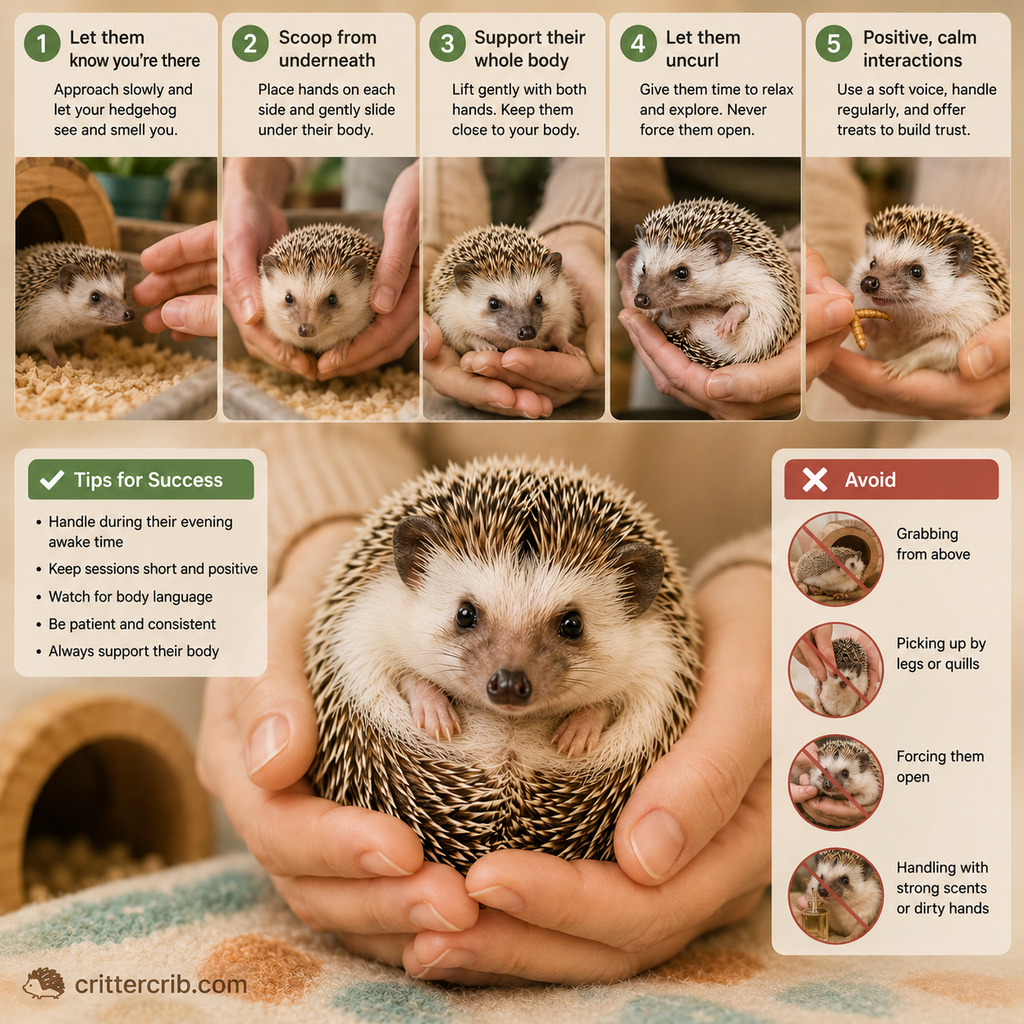
The safest basic technique is to scoop rather than grab.
1. Let Your Hedgehog Know You’re There
Approach calmly.
Speak softly or allow your hedgehog to smell your hand before attempting to lift it.
Avoid suddenly grabbing from directly overhead.
2. Place Your Hands on Either Side
Bring both hands toward the hedgehog from the sides.
Keep your movements slow and deliberate.
3. Slide Your Hands Underneath
Gently slide your fingers beneath the hedgehog from both sides.
You’re trying to scoop underneath the body rather than wrapping your fingers around it.
4. Lift With Both Hands
Cup your hands together and lift the hedgehog while supporting its entire body.
Keep it relatively close to a safe surface, especially while you’re learning.
5. Allow It to Uncurl
Once supported, give your hedgehog time.
A nervous animal may remain curled for a while before lowering its quills and beginning to explore.
Don’t force the ball open.
Let the hedgehog decide when it feels safe enough to emerge.
Never Force a Curled Hedgehog Open
If your hedgehog curls tightly, resist the temptation to pull at its legs or try to pry it open.
Curling is a defensive response.
Forcing the animal open can cause fear, stress, or injury.
Instead:
- Hold it securely.
- Keep the environment quiet.
- Avoid sudden movements.
- Speak softly.
- Give it time.
Many hedgehogs eventually begin sniffing and gradually uncurl when nothing threatening happens.
That moment is part of the trust-building process.
Hold Your Hedgehog Close to a Safe Surface
Hedgehogs aren’t animals you want dropping from your hands.
When you’re first learning to handle one, sit on the floor, a bed, or another safe area.
If the hedgehog suddenly moves, the potential fall is much shorter.
This is particularly helpful with confident hedgehogs that immediately start walking across your hands.
They can move faster than their round appearance suggests.
Don’t Pick Up a Hedgehog by Its Legs or Quills
Always support the body.
Never lift a hedgehog by:
- A leg
- The skin
- Individual quills
- The head
- Any other body part
Use two hands whenever practical and support the animal from underneath.
Think “scoop,” not “grab.”
Should You Wear Gloves to Handle a Hedgehog?
For routine bonding, bare hands are generally preferable when you can safely use them.
Your hedgehog learns your scent, and gloves can make gentle handling more awkward.
However, there may be situations where temporary hand protection is useful, such as handling a particularly frightened new hedgehog or moving an animal safely when necessary.
A small fleece blanket can sometimes make handling a defensive hedgehog easier.
The long-term goal should usually be calm, safe interaction rather than depending on thick gloves for every handling session.
How Often Should You Handle Your Hedgehog?
Regular handling helps your hedgehog become familiar with you.
For a healthy hedgehog that is settling in normally, aim for consistent daily interaction.
A session of around 20–30 minutes can be a useful starting point, although the ideal duration depends on the individual animal.
Some hedgehogs may happily explore for much longer.
Others become stressed and benefit from shorter sessions.
Consistency matters more than forcing a specific number of minutes.
Ten calm minutes every day can be more productive than one long, stressful session each weekend.
Handle Your Hedgehog During Its Natural Waking Hours
Hedgehogs are primarily nocturnal.
That means the middle of the day is usually not the best time for an enthusiastic bonding session.
Imagine someone waking you at 3 a.m. because they decided it was time to socialize.
You probably wouldn’t make your best first impression either.
Evening is often a better time to interact.
Your hedgehog may still be waking up and initially grumpy, but you’re working more closely with its natural schedule.
Give a New Hedgehog Time to Adjust
Moving to a new home is a major change.
New smells.
New sounds.
New enclosure.
New people.
Don’t expect your hedgehog to behave confidently on the first night.
Give it time to investigate its habitat and establish a routine.
At the same time, don’t avoid all interaction for weeks.
Gentle, predictable handling helps the hedgehog learn that you’re part of its normal environment.
How to Build Trust With a Hedgehog
Trust develops through repeated experiences.
Your hedgehog learns that your scent, voice, and hands are associated with safety rather than danger.
Keep a Consistent Routine
Try interacting around a similar time each evening.
Predictability can make handling less surprising.
Move Slowly
Sudden movement can trigger defensive behavior.
Slow movements give the hedgehog time to process what’s happening.
Talk Quietly
Your voice can become another familiar cue.
You don’t need to narrate your entire evening.
A calm greeting before reaching into the enclosure is enough.
Let Your Hedgehog Smell You
Hedgehogs rely heavily on scent.
Allow your hedgehog to investigate your hands without immediately trying to restrain it.
Use Positive Associations
An occasional appropriate treat can help your hedgehog associate your presence with something pleasant.
Keep treats small so they don’t disrupt a balanced diet.
Let Your Hedgehog Explore You
Handling doesn’t need to mean sitting perfectly still in your palms.
Many hedgehogs would rather explore.
Sit somewhere secure and allow your hedgehog to:
- Walk across your lap
- Sniff your hands
- Climb over a blanket
- Explore beside you
- Move through safe tunnels
- Investigate your clothing
You’re still bonding.
The hedgehog is learning your scent and becoming comfortable moving around you without being restrained.
For an active animal, this may be much more enjoyable than being expected to cuddle.
Use a Bonding Pouch or Fleece Blanket
A soft bonding pouch or fleece blanket can provide a sheltered place for your hedgehog while it spends time near you.
This can work particularly well with shy animals.
The hedgehog gets:
- Your scent
- Your voice
- Your movement
- Your presence
while still having somewhere to hide.
Always make sure the pouch or blanket is safe, breathable, and free of loose threads that could catch around feet or toes.
Supervise your hedgehog while using it.
Can You Put Your Scent in the Hedgehog’s Cage?
Some owners place a small piece of safely prepared fleece carrying their scent in the enclosure to help a new hedgehog become familiar with them.
If you try this, use clean, safe fabric without loose threads, holes, elastic, buttons, or anything the hedgehog could become tangled in.
Don’t use clothing covered in perfume, lotion, smoke, or other strong scents.
Your natural scent is the point.
Learn Your Hedgehog’s Body Language
Body language helps you decide when to continue, slow down, or end an interaction.
Signs of a Relaxed Hedgehog
A comfortable hedgehog may:
- Lower its quills
- Uncurl
- Sniff calmly
- Walk across your hands
- Explore
- Eat an appropriate treat
- Rest against you
- Show normal curiosity
Signs of a Nervous Hedgehog
A worried hedgehog may:
- Raise its quills
- Huff
- Curl
- Hide its face
- Freeze
- Twitch
- Repeatedly attempt to escape
Some nervousness during handling is normal, especially early in the relationship.
Look for gradual improvement over time.
What Does Hedgehog Anointing Mean?
New owners are sometimes alarmed the first time they see a hedgehog anoint.
The hedgehog encounters an interesting scent or taste, begins producing foamy saliva, twists into an impressive position, and spreads the saliva onto its quills.
It looks bizarre.
It’s also a well-known hedgehog behavior.
The exact purpose of self-anointing isn’t fully understood, but it can occur after encountering new smells or substances.
Anointing doesn’t automatically mean your hedgehog is sick or distressed.
Do Hedgehogs Bite?
Hedgehogs can bite, although biting isn’t usually their first defensive strategy.
A hedgehog may bite because:
- Your fingers smell like food.
- It’s frightened.
- It’s stressed.
- It’s investigating.
- It has learned that biting ends handling.
- It may be experiencing pain.
This is another reason to wash your hands before handling.
A finger that smells like dinner is unnecessarily confusing.
What Should You Do if a Hedgehog Bites?
Don’t scream, hit, shake, or punish your hedgehog.
Also avoid violently pulling your hand away, which could potentially cause injury.
Stay calm.
Once the hedgehog releases, clean the wound thoroughly.
If the bite is significant, seek appropriate medical care.
Then consider why the bite occurred.
Was there food on your fingers? Did you wake the hedgehog suddenly? Was it already displaying defensive behavior? Is biting a new behavior in an animal that previously handled well?
Understanding the cause is more useful than punishment.
Never Punish Defensive Behavior
Huffing, curling, and raising quills aren’t bad behavior.
They’re communication.
Your hedgehog is telling you it feels threatened.
Punishing that response adds another negative experience to handling and can make trust harder to establish.
Instead, make future interactions calmer and more predictable.
Trust is built by proving repeatedly that nothing bad happens when you’re around.
How to Handle a Very Shy Hedgehog
Some hedgehogs require considerably more patience than others.
If yours spends most handling sessions curled into a ball:
- Keep sessions consistent.
- Handle in a quiet room.
- Sit somewhere secure.
- Support the hedgehog without squeezing.
- Use a fleece blanket or bonding pouch.
- Speak calmly.
- Avoid repeatedly poking at its face.
- Allow it to uncurl on its own.
- Reward calm exploration when appropriate.
- Measure progress over weeks rather than days.
Don’t compare your hedgehog with videos of unusually social animals online.
You’re building a relationship with the animal in front of you.
How Long Does It Take for a Hedgehog to Trust You?
There isn’t a universal timeline.
One hedgehog may begin exploring your hands within a few days.
Another may need several weeks or longer before becoming noticeably more relaxed.
Progress may also be uneven.
Your hedgehog might have an excellent handling session one night and spend the next evening huffing at everything.
That doesn’t mean you’ve lost all your progress.
Look at the overall trend.
Is it uncurling faster? Exploring more? Huffing less? Becoming more willing to approach you?
Small changes count.
Don’t Chase Your Hedgehog Around the Enclosure
If every interaction begins with a hand pursuing the hedgehog from one side of its enclosure to the other, handling becomes associated with stress.
Approach calmly and confidently.
Hesitating repeatedly can sometimes make the interaction last longer and increase anxiety.
Use the two-handed scoop technique and lift gently.
Being calm doesn’t mean being forceful.
It means being predictable.
Avoid Handling Immediately After Eating Messy Food
Food smells on your hands can encourage investigative nibbling.
Likewise, food residue around your hedgehog’s mouth can make handling unnecessarily messy.
Wash your hands before interaction and give your hedgehog time to finish eating.
Keeping food and handling cues somewhat distinct can reduce confusion.
Keep Handling Areas Safe
Before letting your hedgehog explore outside its enclosure, check the area carefully.
Remove access to:
- Electrical cords
- Gaps under furniture
- Recliners
- Stairs
- Other pets
- Houseplants
- Cleaning products
- Small objects
- Open doors
- Unsafe heights
Hedgehogs may not look particularly fast until one decides to disappear beneath a piece of furniture.
A playpen or securely enclosed area can make bonding sessions much easier.
Be Careful Around Other Pets
Don’t assume your dog or cat will understand that the hedgehog is a family member.
Even a curious paw or playful bite can seriously injure a small animal.
Introduce no direct contact simply for entertainment.
Keep other pets securely separated during handling and exercise sessions.
A hedgehog shouldn’t have to remain defensive because a predator-sized animal is staring at it.
Children Should Be Supervised
Children can participate in hedgehog care, but adults should supervise handling.
Teach children to:
- Sit while holding the hedgehog
- Use both hands
- Support the body
- Avoid squeezing
- Never pull quills
- Avoid sudden movements
- Wash hands afterward
- Respect defensive behavior
If the child becomes frightened when the hedgehog raises its quills, have them place the animal safely down rather than dropping it.
Adults should remain responsible for the animal’s overall care.
Handling Can Help With Health Checks
Trust isn’t only about companionship.
A hedgehog that tolerates handling is easier to examine.
During normal interaction, become familiar with your hedgehog’s:
- Weight
- Skin
- Quills
- Eyes
- Ears
- Feet
- Nails
- Movement
- Appetite
- General behavior
You don’t need to perform a veterinary examination every evening.
Simply knowing what normal looks and feels like can help you recognize changes sooner.
Check Hedgehog Feet Regularly
Hedgehog feet deserve particular attention.
Hair or thread can sometimes become wrapped around toes or feet and restrict circulation.
Check for:
- Hair
- Thread
- Swelling
- Redness
- Injuries
- Overgrown nails
This is another reason to avoid fraying fabrics and loose fibers in the enclosure.
If something is tightly wrapped around a foot or toe and you can’t safely remove it, contact your veterinarian.
Weigh Your Hedgehog Regularly
Regular weight monitoring can help identify changes that aren’t immediately obvious.
Use a digital scale and keep a simple record.
Try to weigh under similar conditions each time.
A single small fluctuation isn’t necessarily concerning, but a consistent upward or downward trend deserves attention.
Unexpected weight loss, particularly when combined with reduced appetite or behavioral changes, warrants veterinary advice.
When Handling Problems May Be Medical
If a normally social hedgehog suddenly becomes unusually defensive, don’t automatically assume it’s having a bad mood.
Pain or illness can change behavior.
Contact a veterinarian if increased defensiveness occurs alongside signs such as:
- Reduced appetite
- Weight loss
- Difficulty walking
- Limping
- Unusual breathing
- Discharge
- Diarrhea
- Lethargy
- Swelling
- Skin problems
- Persistent scratching
- Unusual lumps
Hedgehogs may hide illness, so significant changes deserve attention.
Common Hedgehog Handling Mistakes
Trust can take time to build and seconds to disrupt.
Avoid these common mistakes:
- Grabbing from directly above
- Picking up by a leg or quills
- Squeezing the body
- Trying to pry open a curled hedgehog
- Punishing huffing or biting
- Dropping the hedgehog when its quills rise
- Chasing it around the enclosure
- Handling with food-smelling hands
- Using strong perfumes before handling
- Constantly waking it during the day
- Forcing long sessions when it’s overwhelmed
- Allowing unsupervised children to handle it
- Introducing it directly to dogs or cats
- Expecting immediate affection
The most effective approach is usually the least dramatic one: calm, consistent interaction.
A Simple Hedgehog Bonding Routine
Beginners sometimes overcomplicate bonding.
Try this straightforward routine:
Step 1: Choose a Consistent Time
Interact in the evening when your hedgehog is naturally becoming active.
Step 2: Wash Your Hands
Use mild, unscented soap and avoid strong fragrances.
Step 3: Approach Calmly
Speak softly and let the hedgehog know you’re there.
Step 4: Scoop With Both Hands
Support the body from underneath.
Step 5: Sit Somewhere Safe
Use the floor, couch, bed, or secure play area where a fall is unlikely.
Step 6: Let the Hedgehog Explore
Don’t constantly restrain it.
Allow sniffing and movement.
Step 7: Provide a Safe Hide
A fleece blanket or bonding pouch gives a shy hedgehog somewhere to relax.
Step 8: Repeat Regularly
End on a calm note and do it again the next day.
You don’t need every session to produce obvious progress.
Consistency is the progress.
Frequently Asked Questions About Handling Hedgehogs
Can You Hold a Hedgehog With Bare Hands?
Yes. Many owners routinely handle their hedgehogs with bare hands.
A defensive hedgehog with raised quills can feel sharp, but calm handling and trust-building generally make the process more comfortable over time.
Do Hedgehog Quills Hurt?
Raised quills can be uncomfortable or sharp against your hands.
When the hedgehog relaxes, the quills usually lie flatter and become easier to handle.
Can Hedgehogs Shoot Their Quills?
No.
Hedgehogs don’t shoot their quills like projectiles.
They raise them defensively when frightened or threatened.
Why Does My Hedgehog Huff at Me?
Huffing generally means your hedgehog feels defensive, startled, or uncomfortable.
It’s particularly common in new or recently awakened hedgehogs.
Approach calmly and give trust time to develop.
Why Does My Hedgehog Curl Up When I Touch It?
Curling is a natural defensive response.
Your hedgehog may not yet feel comfortable with your touch, or you may have startled it.
Consistent, gentle handling can help it become more familiar with you.
How Often Should I Hold My Hedgehog?
Regular daily interaction can help build familiarity and trust.
Keep sessions appropriate for the individual hedgehog and avoid forcing prolonged handling when it’s clearly overwhelmed.
How Long Should I Handle My Hedgehog?
Around 20–30 minutes can be a reasonable starting point for many healthy hedgehogs, but there’s no required duration.
Some animals tolerate longer sessions well, while very shy hedgehogs may initially benefit from shorter, calm interactions.
Why Does My Hedgehog Bite Me?
Your fingers may smell like food, or the hedgehog may be frightened, stressed, investigating, or experiencing discomfort.
Wash your hands before handling and look at what happened immediately before the bite.
How Do I Get My Hedgehog to Stop Being Scared of Me?
Build trust gradually through predictable daily interaction.
Move slowly, use a calm voice, let the hedgehog learn your scent, handle it gently, and avoid punishing defensive behavior.
Will My Hedgehog Ever Become Cuddly?
Possibly, but there’s no guarantee.
Some hedgehogs become very relaxed with their owners. Others remain active explorers that tolerate handling without wanting to cuddle.
A successful bond should be measured by trust rather than how long the animal sits still.
Building Trust Takes Patience
The first few handling sessions with a hedgehog can feel discouraging.
You reach toward your new pet and suddenly you’re holding an angry-looking ball of quills that huffs every time you move.
That’s not a failed relationship.
It’s a hedgehog using the defenses that have kept its species safe for a very long time.
Your job is to show it that those defenses aren’t necessary around you.
Approach calmly. Scoop from underneath. Support the body. Keep handling sessions safe and predictable. Let your hedgehog investigate your scent and explore around you without constantly being restrained.
Then repeat.
Over time, you may notice the ball uncurls a little faster. The huffing lasts a little less. A nose appears. Then a face. Eventually your hedgehog may begin exploring your hands as though they were never particularly frightening in the first place.
That’s what building trust looks like.
It doesn’t happen on a schedule, and every hedgehog is different. But with patience, consistency, and respect for the animal’s body language, handling can become a comfortable part of everyday care for both of you.