
Pacman frogs have a reputation for being one of the least energetic pets around.
They burrow. They sit. They wait for food. Then they may sit some more.
That doesn’t mean their enclosure should be an empty box with a water dish.
Good Pacman frog enrichment isn’t about making your frog run around or perform tricks. It’s about creating an environment that allows natural behaviors such as burrowing, hiding, hunting, choosing different resting spots, and responding to changes in its surroundings.
A well-designed habitat gives your frog options without constantly disturbing it.
If you want to make your Pacman frog’s enclosure more interesting while keeping stress low, here are some of the best enrichment ideas to try.
Do Pacman Frogs Need Enrichment?
Pacman frogs benefit from an environment that allows them to behave naturally.
But enrichment for a Pacman frog looks very different from enrichment for a dog, parrot, or even some reptiles.
Pacman frogs are ambush predators.
Instead of roaming large distances to chase prey, they commonly settle into a location, partially bury themselves, and wait for something edible to come within range.
That means a frog sitting still isn’t necessarily bored.
It’s often doing exactly what its instincts tell it to do.
The goal of enrichment should be to provide opportunities for natural behavior, not to force activity simply because inactivity looks boring to us.
Useful enrichment can encourage:
- Burrowing
- Hunting
- Exploring
- Choosing hiding places
- Moving between microhabitats
- Using different areas of the enclosure
- Responding naturally to feeding opportunities
Think of enrichment as adding choices rather than adding entertainment.
Start With a Proper Habitat
Before adding enrichment, make sure the basic enclosure is correct.
A frog with inappropriate temperature, humidity, substrate, or water conditions doesn’t need more stimulation. It needs better husbandry.
For many Pacman frogs, general environmental goals include:
- Warm but not excessively hot temperatures
- Consistently humid conditions
- Deep, moisture-retaining substrate
- A shallow water dish
- Hiding opportunities
- Appropriate ventilation
- A regular day-and-night cycle
Exact requirements can vary somewhat depending on species, age, and individual conditions.
Once those fundamentals are stable, enrichment can make an already suitable enclosure more interesting.
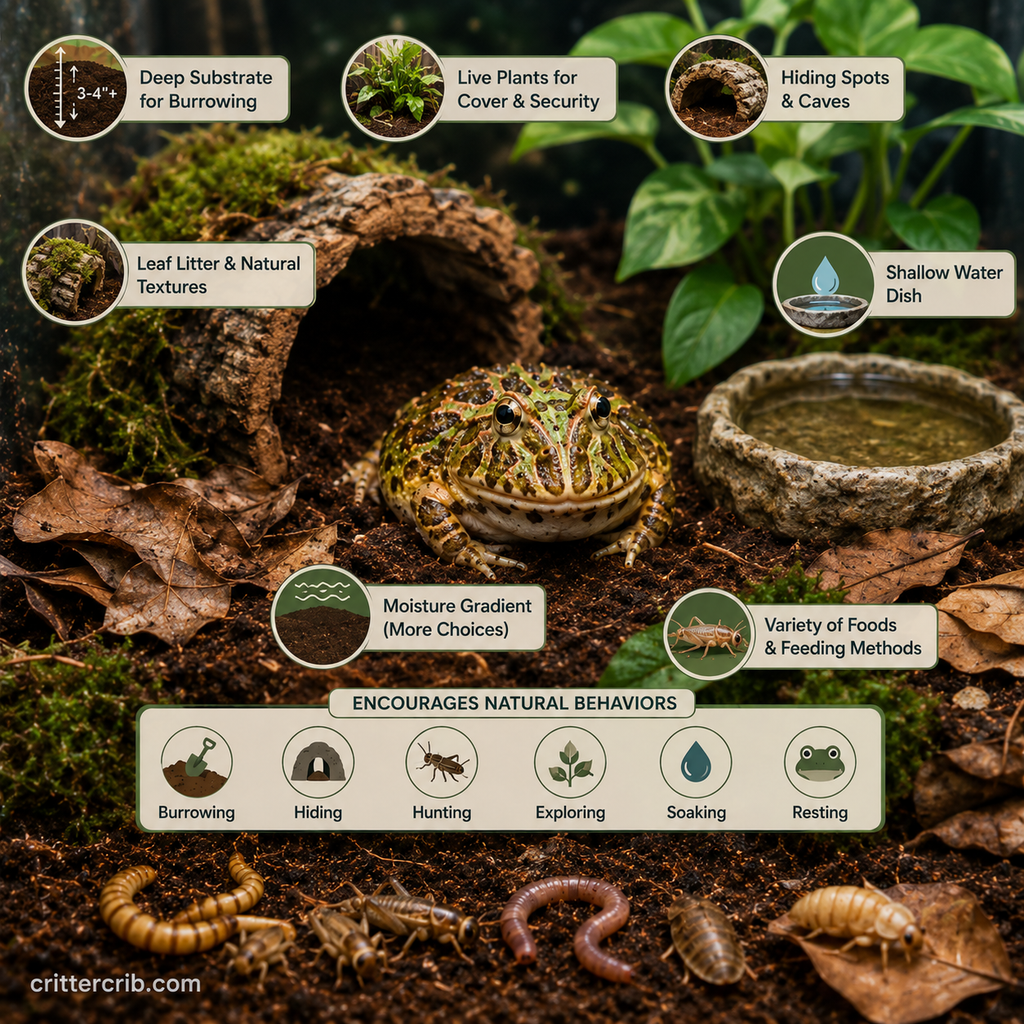
1. Provide Deep Substrate for Burrowing
If you only make one enrichment improvement, make it this one.
Pacman frogs are natural burrowers.
They often settle into the substrate with only their head and eyes exposed while waiting for prey.
A thin layer of substrate doesn’t give them much opportunity to perform this behavior.
Provide enough safe substrate for the frog to comfortably dig down and partially bury itself.
Depending on the frog’s size, several inches may be appropriate.
Suitable substrate options can include:
- Coconut fiber
- Appropriate organic topsoil
- Amphibian-safe soil mixtures
- Bioactive substrates designed for humid amphibian habitats
Whatever you use should retain moisture without becoming waterlogged.
Avoid soil containing fertilizers, pesticides, perlite, or other unsafe additives.
Let Your Frog Choose Its Burrow
You may be tempted to dig a perfect little hole and place your frog inside.
It’s better to let the frog choose.
Some Pacman frogs repeatedly return to a favorite location. Others move around the enclosure and create new depressions.
Both behaviors are useful to observe.
Where your frog chooses to burrow can even tell you something about its preferred temperature, moisture, or level of cover.
2. Create Different Moisture Zones
The entire enclosure doesn’t have to feel exactly the same.
Creating subtle differences in substrate moisture gives your frog choices.
For example, one portion can remain slightly more moist while another stays somewhat less damp.
This doesn’t mean allowing part of the habitat to become dry enough to risk dehydration.
The differences should remain within safe husbandry conditions.
A moisture gradient lets the frog move to the area that feels most comfortable at a particular time.
That’s a simple form of environmental enrichment because the animal can make its own decision.
3. Add Safe Hiding Places
Pacman frogs spend plenty of time buried, but additional cover can still make the enclosure feel secure.
Try adding:
- Cork bark
- Amphibian-safe caves
- Leaf litter
- Low artificial plants
- Live plants
- Curved pieces of bark
- Other smooth, stable hides
Choose hides large enough that your frog won’t become wedged inside.
Avoid rough edges or unstable decorations.
You don’t need to fill every inch of the enclosure.
A combination of open areas and sheltered areas gives the frog more options.
4. Use Leaf Litter
Leaf litter is one of the easiest ways to make a Pacman frog habitat feel more natural.
A layer of appropriate dried leaves adds texture and cover to the substrate.
Your frog may push underneath them, sit beside them, or incorporate them into its burrowing area.
Leaf litter can also be useful in bioactive enclosures.
Choose leaves from safe sources that haven’t been treated with pesticides or other chemicals.
Commonly used terrarium leaves include:
- Oak
- Magnolia
- Indian almond leaves
Prepare natural materials appropriately before introducing them to an amphibian enclosure.
Don’t collect random leaves from areas that may have been sprayed with lawn chemicals or pesticides.
5. Add Live Plants
Live plants can provide both visual and environmental enrichment.
They create shaded areas, break up open sightlines, and make the enclosure feel less exposed.
Plants may also help create subtle differences in moisture and cover.
Suitable options depend on the enclosure conditions, but commonly used terrarium plants may include:
- Pothos
- Philodendron varieties
- Some ferns
- Other humidity-tolerant terrarium plants
Make sure any plant is nontoxic and hasn’t been treated with pesticides or systemic chemicals.
Protect Plant Roots
Pacman frogs aren’t known for respecting landscaping.
A frog may decide that the perfect place to burrow is directly underneath your carefully planted greenery.
That’s normal.
Choose hardy plants and arrange them so the frog still has plenty of digging room.
You can also keep some plants in protected pots or position them toward the edges of the enclosure.
6. Rearrange the Habitat Occasionally
Small environmental changes can encourage exploration.
You might occasionally move:
- A piece of cork bark
- Leaf litter
- A hide
- A plant
- A lightweight decoration
Don’t completely redesign the enclosure every few days.
Constant change can become stressful rather than enriching.
A better approach is to make small adjustments occasionally while leaving familiar hiding and burrowing areas available.
If your frog has a favorite location, there’s no need to destroy it simply to force exploration.
Enrichment should create opportunities, not frustration.
7. Offer a Variety of Appropriate Foods
Dietary variety can provide nutritional and behavioral benefits.
Pacman frogs are carnivorous ambush predators and can consume a range of appropriately sized prey.
Depending on the frog’s age and size, suitable foods may include:
- Earthworms
- Nightcrawlers
- Crickets
- Dubia roaches
- Other appropriate feeder invertebrates
Choose prey that’s appropriately sized and nutritionally suitable.
Some feeders are better as staples than others, so variety doesn’t mean feeding every available insect equally.
Gut-Load Feeder Insects
Feeder insects should be properly gut-loaded when appropriate.
Gut-loading means feeding the insects nutritious food before they’re offered to your frog.
Supplementation with calcium and other nutrients may also be necessary depending on the diet.
Follow species-appropriate husbandry guidance or recommendations from an amphibian veterinarian.
8. Vary How Food Is Presented
You don’t need to turn every meal into a game.
But occasionally changing how food is presented can encourage natural feeding responses.
For example, you can alternate between:
- Tong feeding
- Offering prey in a controlled feeding area
- Allowing suitable prey to move naturally within reach
Always supervise live feeding.
Don’t release large numbers of insects into the enclosure and leave them there indefinitely.
Uneaten insects may hide in the substrate, stress the frog, or potentially bite it.
Don’t Make Food Unnecessarily Difficult to Catch
Enrichment shouldn’t turn feeding into a frustrating obstacle course.
Pacman frogs are ambush predators, not endurance hunters.
The goal is to stimulate normal feeding behavior while making sure the frog can successfully eat.
9. Provide Visual Barriers
An enclosure that feels completely exposed can be stressful.
Plants, cork bark, leaf litter, and background coverings can create visual barriers.
Covering the back or sides of a glass enclosure may also help reduce reflections and activity outside the tank.
This can be especially useful if the enclosure is in a busy room.
A frog that feels secure may be more likely to display normal behavior than one that constantly feels exposed.
10. Create Texture Without Creating Hazards
Environmental texture can make a habitat more varied.
You can use safe materials such as:
- Soft leaf litter
- Moss used appropriately
- Smooth cork bark
- Soil
- Stable pieces of wood
Avoid adding small stones, sharp objects, or loose materials that could be swallowed during feeding.
Pacman frogs have enormous mouths relative to their body size and aren’t always selective when striking at prey.
Anything near the food can potentially end up in that mouth.
Safety should always come before appearance.
11. Use a Shallow Water Dish
A water dish is a basic care requirement, but it also gives the frog another environmental option.
Choose a dish that is:
- Shallow
- Easy to enter
- Easy to exit
- Stable
- Large enough for the frog to sit in comfortably
Pacman frogs aren’t aquatic frogs and don’t need deep swimming water.
Change the water regularly and whenever it becomes contaminated with substrate or waste.
Use appropriately treated water that’s safe for amphibians.
12. Maintain a Consistent Day-and-Night Cycle
Light is part of an animal’s environment.
Pacman frogs don’t need bright lights shining on them all day and night.
A consistent light-dark schedule helps provide a predictable daily rhythm.
If you’re using enclosure lighting for plants or viewing, a timer makes the schedule easy to maintain.
Make sure the frog has shaded areas where it can retreat from light.
Avoid leaving bright lights on overnight.
13. Observe Your Frog at Different Times
Sometimes the best enrichment isn’t something you add.
It’s changing how you observe the animal.
If you only look at your Pacman frog during the brightest part of the day, you may assume it never does anything.
Check the enclosure during different periods, especially later in the day when the frog may become more responsive.
You might notice:
- Moving to a different burrow
- Soaking
- Exploring
- Repositioning itself
- Hunting
- Emerging from the substrate
Understanding when your frog naturally becomes active helps you appreciate its normal behavior without trying to force activity at the wrong time.
14. Consider a Bioactive Enclosure
A bioactive habitat can create a more complex and naturalistic environment.
These setups typically combine:
- Natural substrate
- Live plants
- Leaf litter
- Beneficial microorganisms
- Cleanup crew invertebrates such as springtails
A properly designed bioactive enclosure can provide varied textures, natural cover, and a dynamic environment.
However, “bioactive” doesn’t mean maintenance-free.
You still need to monitor:
- Waste
- Moisture
- Temperature
- Humidity
- Plant health
- Water quality
- Overall enclosure cleanliness
Research bioactive amphibian setups carefully before converting an established enclosure.
Enrichment Doesn’t Mean Handling
One of the biggest misconceptions about pet enrichment is that it has to involve direct interaction with the owner.
For Pacman frogs, handling isn’t a good enrichment activity.
Amphibian skin is delicate and permeable, and handling can expose the frog to oils, soap residue, lotion, sanitizer, and other contaminants.
It can also cause unnecessary stress.
Handle your Pacman frog only when necessary, such as during:
- Veterinary care
- Emergency enclosure maintenance
- Health checks
- Necessary transfers
You don’t need to pick up your frog to keep it stimulated.
Improving its habitat is far more appropriate.
Don’t Force Your Pacman Frog to Exercise
A Pacman frog that sits still for long periods isn’t automatically unhealthy or bored.
Ambush predators conserve energy.
Don’t poke the frog, repeatedly move it, spray it specifically to make it jump, or remove it from the enclosure to force exercise.
These activities can create stress without providing meaningful enrichment.
Instead, give the frog enough space and environmental choices to move when it wants to.
How Can You Tell if Enrichment Is Working?
You shouldn’t expect a dramatic personality transformation.
A Pacman frog with excellent enrichment may still spend a huge amount of time sitting partially buried.
Look for subtle signs that the frog is using its environment normally.
You may notice:
- Choosing different burrowing spots
- Using hides
- Moving between moisture zones
- Soaking occasionally
- Responding eagerly to food
- Exploring after enclosure changes
- Moving around during naturally active periods
The important word is choice.
If your frog has several safe options and uses them according to its own preferences, the enclosure is doing its job.
Signs Enrichment May Be Causing Stress
More isn’t always better.
Pay attention after introducing something new.
Possible warning signs include:
- Frantic escape attempts
- Persistent refusal to eat
- Repeatedly avoiding a newly changed area
- Difficulty burrowing
- Being unable to find secure cover
- Sudden abnormal behavior
If a new object or habitat change appears to create problems, remove it and return the enclosure to a familiar arrangement.
Also check basic husbandry.
A behavior that looks like a reaction to enrichment may actually be caused by incorrect temperature, humidity, substrate moisture, or another environmental issue.
Common Pacman Frog Enrichment Mistakes
Some enrichment ideas sound fun from a human perspective but aren’t appropriate for frogs.
Avoid:
- Handling for entertainment
- Taking the frog out to explore your home
- Exercise balls or similar devices
- Mirrors
- Toys designed for mammals or birds
- Deep swimming areas
- Constantly rearranging the enclosure
- Bright flashing or colored lights
- Chasing the frog to make it move
- Releasing excessive numbers of feeder insects
- Adding small swallowable decorations
- Using scented or chemically treated natural materials
You don’t need to invent complicated activities.
Naturalistic choices are usually more useful.
A Simple Pacman Frog Enrichment Setup
You can create an enriching enclosure without filling it with expensive accessories.
A simple setup might include:
- Several inches of moist, safe substrate
- Leaf litter across part of the enclosure
- One or two secure hides
- A shallow water dish
- Live or soft artificial plants
- Cork bark
- Slight variation in substrate moisture
- Open feeding space
- A predictable day-and-night cycle
Then occasionally introduce small, safe changes rather than constantly rebuilding the habitat.
That’s enough to give the frog opportunities to choose where it wants to burrow, hide, rest, and hunt.
Best Pacman Frog Enrichment Ideas at a Glance
If you’re looking for the most useful options, start with these:
- Provide deep substrate for burrowing.
- Create safe moisture gradients.
- Add hiding places.
- Use natural leaf litter.
- Add live or soft artificial plants.
- Make occasional small habitat changes.
- Feed a varied, nutritious diet.
- Vary food presentation occasionally.
- Provide visual barriers and shaded areas.
- Use different safe natural textures.
- Maintain a shallow water dish.
- Keep a consistent light-dark cycle.
- Observe activity at different times.
- Consider a properly designed bioactive enclosure.
You don’t need to implement all of them at once.
Start with the habitat itself and build from there.
Final Thoughts
The best Pacman frog enrichment is surprisingly simple.
Give your frog a safe environment where it can make choices.
Provide deep substrate so it can burrow. Add hiding places and leaf litter. Create subtle differences in moisture and cover. Offer a nutritious, varied diet and occasionally change how suitable prey is presented.
Then let the frog decide what to do.
Don’t measure enrichment by how many minutes your Pacman frog spends moving around. These frogs are naturally sedentary ambush predators, and sitting quietly in a carefully chosen burrow can be completely normal behavior.
A Pacman frog doesn’t need constant entertainment.
It needs a habitat that allows it to burrow, hide, hunt, soak, rest, and explore when it chooses.
If your enclosure provides those opportunities while maintaining proper temperature, humidity, cleanliness, and safety, you’re already giving your frog meaningful enrichment without making its life unnecessarily complicated.