Axolotls aren’t short-term pets.
While their small size and permanently youthful appearance can make them seem like simple aquarium animals, bringing one home can mean committing to more than a decade of care.
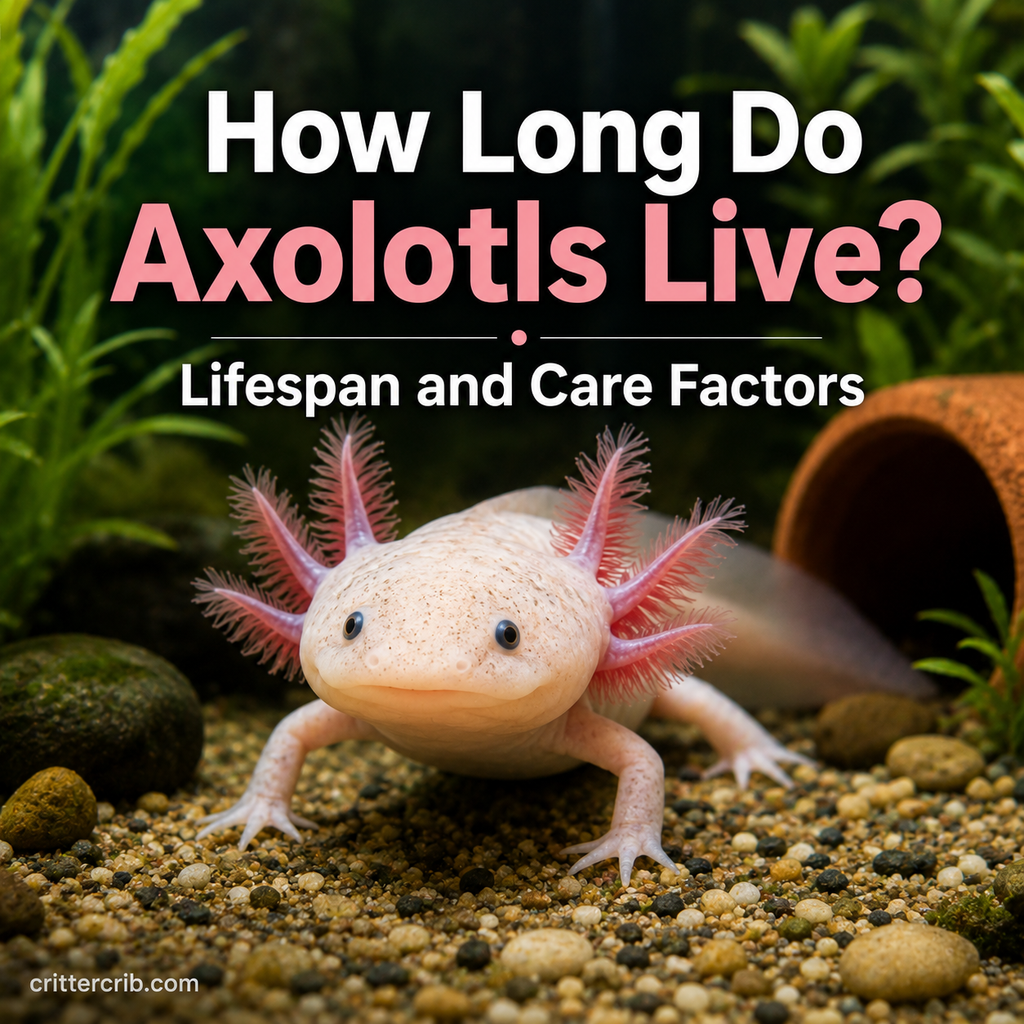
So, how long do axolotls live?
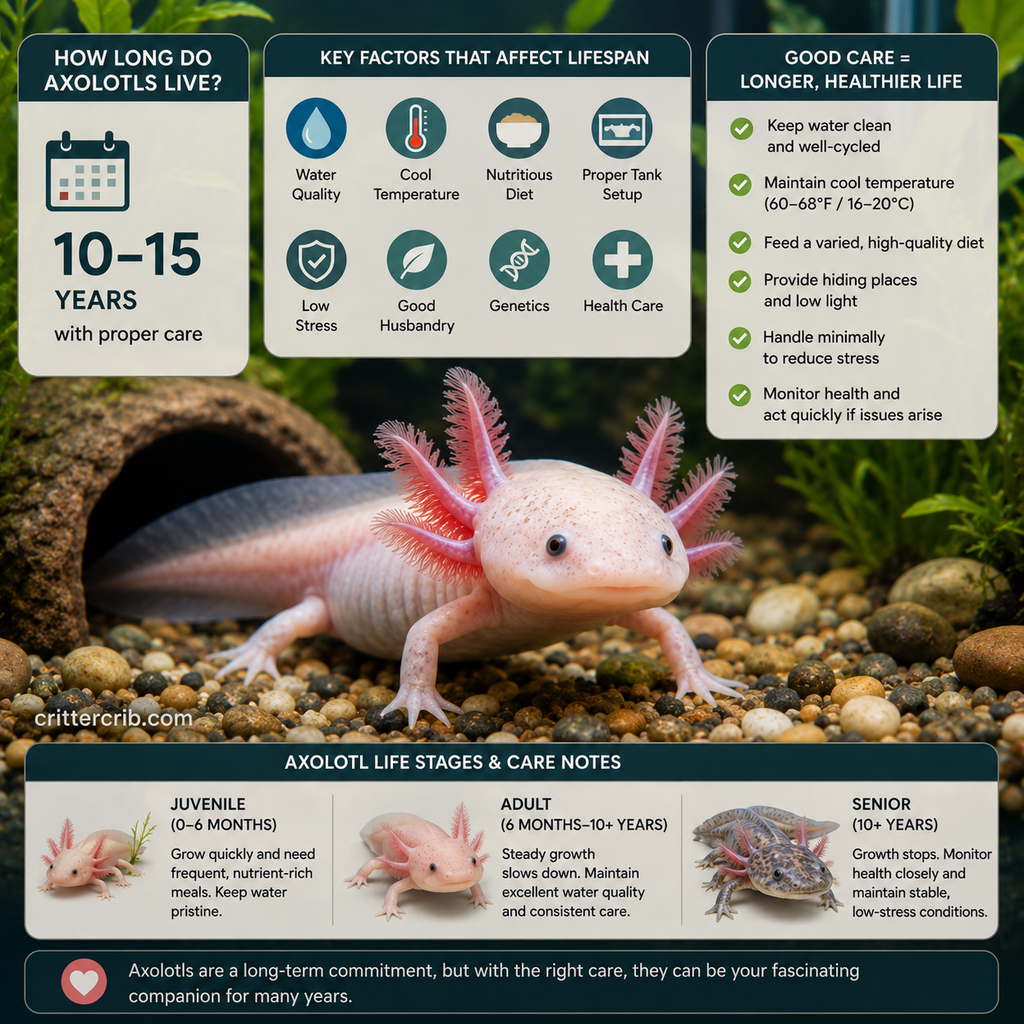
In captivity, a well-cared-for axolotl will commonly live around 10–15 years, although individual lifespans vary. Some may live for less time because of illness, genetics, or poor husbandry, while exceptionally well-cared-for individuals can potentially live longer.
The biggest difference you can make as an owner isn’t finding some secret longevity trick. It’s getting the basics right consistently.
Clean, cool water, good nutrition, low stress, and an appropriately maintained aquarium all contribute to giving an axolotl the best chance at a long life.
Here’s what affects axolotl lifespan and what you can do to support your pet through the years.
What Is the Average Lifespan of an Axolotl?
A reasonable expectation for a pet axolotl is approximately 10–15 years with good care.
That’s a substantial commitment compared with many small aquarium pets.
Axolotl lifespan isn’t guaranteed, of course. Two animals receiving similar care may not live for exactly the same amount of time.
Longevity can be influenced by:
- Genetics
- Water quality
- Water temperature
- Diet
- Aquarium conditions
- Stress
- Injuries
- Disease
- Veterinary care
- Overall husbandry
Some of these factors are outside your control.
Many aren’t.
Maintaining a stable, healthy environment throughout the axolotl’s life is one of the most important things you can do.
How Long Do Axolotls Live in the Wild?
Wild axolotls face very different conditions from animals living in carefully maintained aquariums.
Axolotls are native to the lake and canal system around Mexico City, particularly the remaining habitat associated with Xochimilco.
Wild animals face threats that captive pets generally don’t encounter, including habitat degradation, pollution, invasive species, predation, competition, and fluctuations in environmental conditions.
Because wild populations are critically endangered and difficult to study, comparing a neat “wild lifespan” number with captive lifespan isn’t particularly useful.
For pet owners, the more practical question is how to create captive conditions that support long-term health.
Why Can Captive Axolotls Live So Long?
A well-maintained aquarium removes many of the hazards an animal would encounter in nature.
A captive axolotl doesn’t need to escape predators or search a large habitat for food. Ideally, it also isn’t exposed to environmental pollution or dramatic changes in water conditions.
Instead, a responsible keeper provides:
- Consistent food
- Stable water conditions
- Appropriate temperature
- Protection from predators
- Veterinary care when necessary
- A controlled environment
But captivity only provides an advantage when the aquarium is managed properly.
Poor water quality or excessive heat can quickly turn a supposedly safe captive environment into a source of chronic stress.
Water Quality Is One of the Biggest Lifespan Factors
If there’s one part of axolotl care worth mastering, it’s aquarium water quality.
Axolotls spend their entire lives in water.
They eat in it, breathe in it, rest in it, and produce waste in it. That means poor water conditions affect them continuously.
A properly cycled aquarium uses beneficial bacteria to process toxic waste through the nitrogen cycle.
In a healthy established aquarium, you generally want:
- Ammonia: 0 ppm
- Nitrite: 0 ppm
- Nitrate: kept controlled through regular maintenance
- Stable, appropriate pH
Ammonia and nitrite can be dangerous even when the water looks perfectly clear.
That’s why visual inspection isn’t enough.
Test the Water Regularly
A reliable aquarium water-testing kit should be part of your basic axolotl supplies.
Testing lets you identify a problem before you’re relying on your axolotl’s behavior to tell you something is wrong.
How often you need to test depends on the aquarium’s age and stability.
A newly established tank generally needs closer monitoring than a mature aquarium with predictable water parameters.
If your axolotl suddenly behaves differently, testing the water should be one of your first steps.
Aquarium Cycling Matters From the Beginning
An axolotl shouldn’t be placed into a brand-new, uncycled aquarium.
Before the animal arrives, establish the nitrogen cycle.
Beneficial bacteria need time to colonize the filter and other aquarium surfaces. These bacteria process ammonia into nitrite and then into nitrate.
Without an established biological filter, toxic compounds can accumulate.
Trying to manage an aquarium cycle while an axolotl is already living in the tank is far more stressful than preparing everything beforehand.
A good start can prevent avoidable health problems during the animal’s earliest time in your care.
Temperature Can Affect Long-Term Health
Axolotls are cool-water amphibians.
A commonly recommended temperature range is roughly 60–68°F (16–20°C).
Brief fluctuations aren’t necessarily catastrophic, but prolonged excessive heat can cause stress and increase the risk of health problems.
This is particularly important during summer.
A room that seems comfortable to you may be too warm for an axolotl.
Watch for Seasonal Temperature Changes
Don’t check the aquarium temperature only when you first set up the tank.
Monitor it throughout the year.
Summer may require additional cooling through methods such as:
- Air conditioning
- Aquarium fans
- Moving the aquarium to a cooler room
- A dedicated aquarium chiller
The best solution depends on your climate and home.
If your aquarium regularly becomes too warm every summer, it’s worth investing in a reliable long-term cooling strategy rather than repeatedly improvising during heat waves.
Diet Plays a Role in Axolotl Longevity
Good nutrition supports growth, body condition, immune function, and overall health.
Axolotls are carnivorous.
Earthworms are widely used as a staple food for appropriately sized axolotls because they offer useful nutrition and are readily accepted by many individuals.
Other suitable foods may include high-quality sinking pellets formulated for carnivorous aquatic animals and other nutritionally appropriate foods.
The exact feeding routine depends on the axolotl’s:
- Age
- Size
- Body condition
- Food type
- Health
- Appetite
Juveniles generally need to eat more frequently than adults.
Don’t Overfeed
A strong appetite doesn’t mean unlimited food is healthy.
Overfeeding can contribute to excess weight and also creates more waste in the aquarium.
Uneaten food is another problem.
Food left decomposing in the tank can negatively affect water quality.
Remove leftovers promptly and adjust portions if food is regularly going uneaten.
Tank Size Can Indirectly Affect Lifespan
Tank size doesn’t determine an axolotl’s age directly, but it influences several important parts of husbandry.
A larger aquarium provides:
- More swimming and floor space
- Greater water volume
- More room for hides
- More dilution of waste
- Potentially greater stability in water conditions
For a single adult, many keepers use an aquarium of at least around 20 gallons, with larger setups such as 29 gallons or more often providing additional space and water volume.
Prioritize horizontal floor space rather than choosing a tall aquarium simply because it holds more water vertically.
Axolotls spend most of their time near the bottom.
Good Filtration Supports a Healthy Aquarium
Axolotls produce a significant amount of waste.
An appropriate filter helps maintain water quality and provides surface area for beneficial bacteria.
But there’s a balance.
Axolotls generally don’t appreciate strong currents.
Excessive flow may cause unnecessary stress, so choose filtration that provides adequate biological capacity without turning the aquarium into a fast-moving environment.
Options may include:
- Sponge filters
- Adjustable filters
- Filters with baffled outputs
- Other appropriately sized low-flow systems
The best filter is one that can handle the aquarium’s biological load while keeping water movement manageable.
Regular Water Changes Are Part of Long-Term Care
A filter doesn’t eliminate the need for water changes.
Nitrate and other dissolved waste products accumulate over time.
Regular partial water changes help keep conditions stable.
The exact frequency and percentage should be based on your aquarium size, stocking level, filtration, feeding, and water-test results.
Avoid unnecessarily replacing all the water at once.
Stable conditions are generally preferable to dramatic swings.
Always treat new tap water appropriately if your municipal supply contains chlorine or chloramine.
Stress Matters More Than It May Seem
Axolotls don’t express stress the way mammals do.
You won’t hear whining or see obvious facial expressions.
Instead, stress can result from environmental conditions.
Possible sources include:
- Excessive water temperature
- Poor water quality
- Strong currents
- Bright lighting
- Incompatible tank mates
- Frequent handling
- Lack of hiding places
- Sudden environmental changes
- Overcrowding
Reducing chronic stress is part of good long-term husbandry.
Give Your Axolotl Somewhere to Hide
Axolotls don’t have eyelids and generally don’t need intense aquarium lighting.
Provide caves, shaded areas, and other safe hiding places.
Any decoration should be smooth and free from sharp edges.
Your axolotl should be able to enter and exit hides without becoming trapped.
Substrate Safety Can Prevent Serious Problems
Axolotls sometimes swallow material while feeding.
That’s why small aquarium gravel can be risky.
Swallowed stones may potentially cause intestinal blockage or other digestive problems.
Depending on the axolotl’s size and age, safer approaches may include:
- Bare-bottom tanks
- Very fine appropriate sand for sufficiently large animals
- Large objects that cannot possibly be swallowed
Young axolotls require particular care when selecting substrate.
Don’t choose gravel simply because it makes the aquarium look more attractive.
Handling Should Be Kept to a Minimum
Axolotls are observation pets.
Their delicate skin and protective mucus layer aren’t designed for frequent human handling.
Unnecessary handling can cause stress and potentially damage the skin.
There may be situations where you need to move your axolotl, such as:
- Veterinary care
- Emergencies
- Temporary relocation
- Major aquarium problems
When that happens, minimize direct contact and use appropriate amphibian-safe methods.
For normal day-to-day ownership, enjoy your axolotl through the glass.
Tank Mates Can Create Additional Risks
Keeping an axolotl alone is often the simplest arrangement.
Fish can nip at an axolotl’s external gills, compete for food, introduce disease, or become food themselves.
Other axolotls can sometimes be housed together under suitable circumstances, but multiple animals require considerably more space and filtration.
Size differences can also create problems.
If you’re primarily interested in maximizing simplicity and reducing potential sources of injury or stress, a species-only tank with a single axolotl is hard to beat.
Genetics Also Influence Lifespan
Not every factor affecting longevity is something you can control.
Genetics play a role in overall health and lifespan.
This is one reason choosing a responsible breeder matters.
A reputable breeder should be able to provide useful information about the animal, including its age, diet, health history, and lineage when known.
Avoid purchasing an axolotl solely because a particular color morph looks appealing.
Health and responsible breeding practices matter more than appearance.
Veterinary Care Can Make a Difference
Finding veterinary care for an axolotl isn’t always as simple as taking a dog to the nearest clinic.
Not every veterinarian treats aquatic amphibians.
Ideally, locate an exotic veterinarian with amphibian experience before an emergency happens.
Possible warning signs that deserve attention include:
- Persistent loss of appetite
- Unexplained weight loss
- Abnormal swelling
- Significant skin changes
- Unusual gill deterioration
- Persistent floating problems
- Injuries
- Fungal-looking growth
- Major behavioral changes
Environmental problems can cause or contribute to many health concerns, so test the water and check temperature whenever your axolotl appears unwell.
Can Axolotls Regenerate Injuries?
Axolotls are famous for their regenerative abilities.
They can regenerate certain damaged tissues and body structures, including portions of limbs.
That’s remarkable, but it doesn’t make them indestructible.
Regeneration requires energy, and serious injuries can still lead to infection, complications, or death.
Don’t use their regenerative ability as an excuse to keep them with aggressive tank mates or unsafe decorations.
Preventing injuries is always better than relying on the animal’s ability to recover from them.
Do Different Axolotl Morphs Have Different Lifespans?
Axolotls come in a variety of captive color morphs, including leucistic, wild-type, albino, melanoid, and others.
Color alone isn’t usually a reliable way to predict lifespan.
Genetics, breeding history, overall health, and husbandry are far more important.
A well-cared-for axolotl of a common morph can potentially live a long life regardless of whether it’s pink, golden, dark, or spotted.
Choose an animal based on health and responsible breeding rather than assuming a rare appearance means better quality.
Signs of a Healthy Axolotl
There’s no way to predict exactly how long an individual axolotl will live, but regular observation can help you notice problems early.
A healthy axolotl generally shows:
- Consistent appetite
- Appropriate body condition
- Normal movement
- Healthy-looking skin
- Intact gills without obvious deterioration
- Normal response to food
- Ability to remain submerged normally
- No unexplained swelling or injuries
Learn what normal looks like for your individual animal.
A sudden change from its usual behavior can be more informative than comparing it with another axolotl online.
How to Help Your Axolotl Live a Long Life
There’s no guaranteed formula for reaching a particular age.
Instead, focus on consistent husbandry.
For the best chance at a long, healthy life:
- Fully cycle the aquarium before bringing the axolotl home.
- Keep ammonia and nitrite at 0 ppm.
- Monitor nitrate and perform regular partial water changes.
- Keep the water cool, generally around 60–68°F.
- Feed a nutritious, appropriately portioned diet.
- Remove uneaten food and waste.
- Provide adequate tank space.
- Use gentle but effective filtration.
- Avoid dangerous gravel and sharp decorations.
- Provide hides and low-stress surroundings.
- Minimize handling.
- Monitor your axolotl for physical or behavioral changes.
- Seek qualified veterinary care when something appears wrong.
None of these steps is particularly glamorous.
That’s exactly the point.
Long-term animal care is mostly about doing simple things correctly and consistently.
How Axolotl Care Changes With Age
An axolotl’s needs can change as it grows.
Juveniles generally require more frequent feeding and may need different substrate considerations than full-grown adults.
As your axolotl matures, feeding frequency usually decreases while maintaining good body condition becomes more important.
Older animals may also deserve closer monitoring for changes in:
- Appetite
- Weight
- Activity
- Buoyancy
- Skin
- Gills
- Waste production
Don’t assume the routine you used when your axolotl was six months old should remain identical for the next 12 years.
Adjust care according to the animal in front of you.
Axolotls Are a Long-Term Commitment
The possibility of a 10–15-year lifespan should be part of your decision before getting an axolotl.
Think about where you’ll be several years from now.
Consider:
- Moving
- College
- Job changes
- Long vacations
- Aquarium maintenance costs
- Summer cooling
- Veterinary expenses
- Power outages
- Finding someone knowledgeable enough to care for the animal when you’re away
Axolotls aren’t disposable starter pets.
A healthy young animal may remain part of your household for a significant portion of your life.
Axolotl Lifespan at a Glance
For quick reference:
- Typical captive lifespan: Around 10–15 years with good care
- Temperature: Generally around 60–68°F (16–20°C)
- Ammonia: 0 ppm
- Nitrite: 0 ppm
- Diet: Nutritious carnivorous foods such as appropriate earthworms and quality pellets
- Handling: Minimal
- Tank: Spacious, fully cycled, and appropriately filtered
- Biggest ongoing concerns: Water quality, temperature, nutrition, stress, and disease prevention
Individual axolotls may live shorter or longer lives, so these figures shouldn’t be treated as guarantees.
Final Thoughts
How long do axolotls live?
For a pet axolotl receiving good care, around 10–15 years is a reasonable lifespan to plan for. Some individuals may live less, while others can potentially exceed that range.
The important part isn’t chasing a record-breaking age.
It’s creating conditions that support good health year after year.
Keep the aquarium cycled. Test the water. Maintain cool temperatures. Feed a nutritious diet. Provide enough space and gentle filtration. Avoid unnecessary handling and unsafe tank mates. And pay attention when your axolotl’s normal appearance or behavior changes.
Most of the factors that support longevity are the same basic responsibilities that make up good everyday axolotl care.
Get those fundamentals right from the beginning, and you’ll give your axolotl the best opportunity to remain a fascinating part of your home for many years.