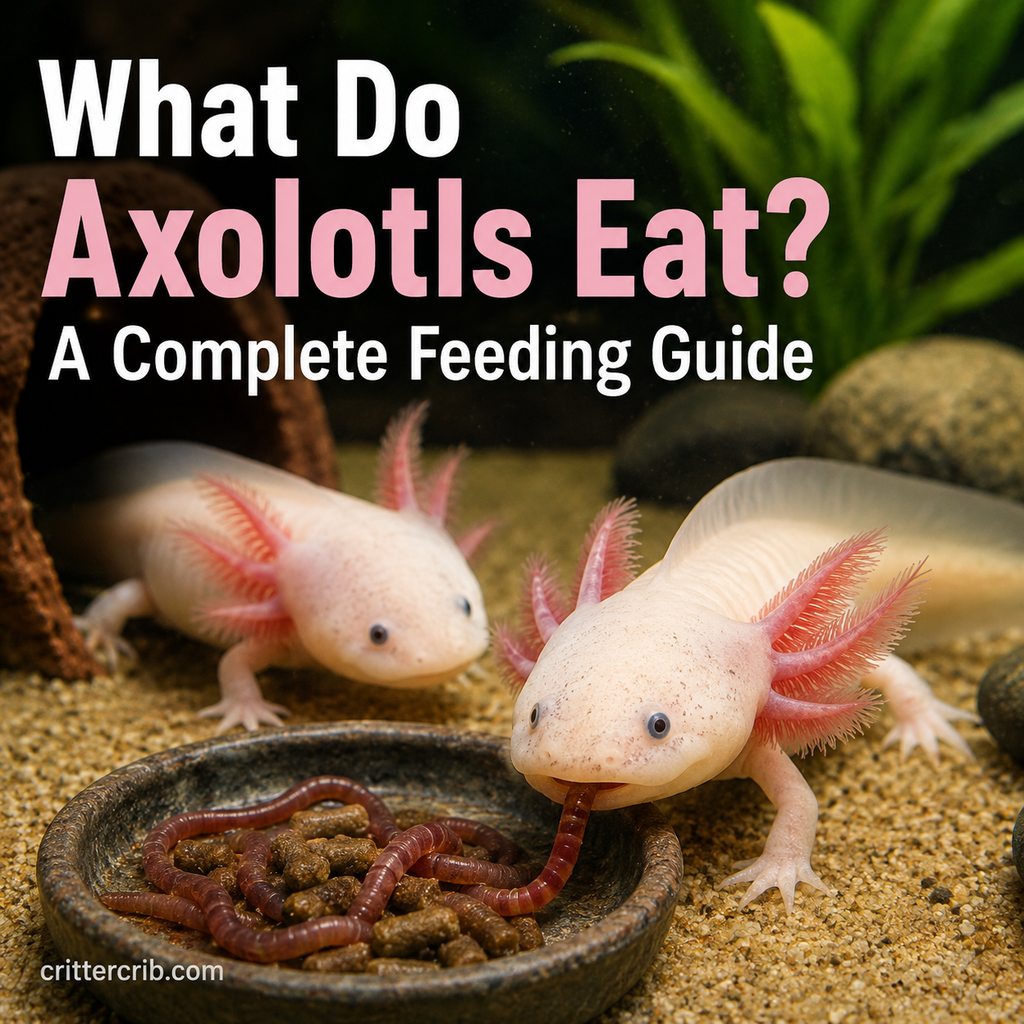
Axolotls may look like they’re smiling at everything that passes their tank, but when food is involved, they’re surprisingly serious hunters.
These aquatic salamanders are carnivores, which means their diet should consist primarily of animal-based foods. In the wild, axolotls eat worms, small crustaceans, insect larvae, and other tiny aquatic animals they can catch and swallow. Pet axolotls need a similar nutrient-rich diet, although fortunately you don’t have to recreate a Mexican lake ecosystem in your aquarium.
For most pet axolotls, earthworms, quality sinking pellets, and a few carefully chosen supplemental foods can provide a healthy, practical diet.
This guide covers what axolotls eat, the best foods to offer, how often to feed them, foods to avoid, and what to do when an axolotl suddenly stops eating.
What Do Axolotls Eat?
Axolotls are carnivorous amphibians. Rather than eating plants or grazing on algae, they hunt small animals that fit inside their mouths.
A pet axolotl’s diet can include:
- Earthworms and nightcrawlers
- High-quality sinking carnivore or axolotl pellets
- Blackworms
- Bloodworms
- Brine shrimp
- Daphnia
- Other appropriately sized aquatic invertebrates
Not every food on this list is equally suitable as a staple. Some are excellent everyday foods, while others work better as occasional treats or foods for young axolotls.
The goal isn’t to offer the largest possible variety. It’s to build a nutritionally balanced diet around reliable staple foods.
What Do Axolotls Eat in the Wild?
Wild axolotls are native to the freshwater canal and lake system around Xochimilco in Mexico City.
They’re opportunistic predators. Instead of chasing prey over long distances, an axolotl often waits until something edible gets close enough and then quickly sucks it into its mouth.
Wild prey can include:
- Worms
- Insect larvae
- Small crustaceans
- Mollusks
- Small aquatic invertebrates
- Very small fish or other aquatic animals when available
Axolotls don’t chew their meals the way mammals do. They use suction to pull prey into their mouths and generally swallow it whole.
This feeding behavior is important when choosing food for a pet axolotl. Food needs to be soft enough and appropriately sized to swallow safely.
Best Foods for Pet Axolotls
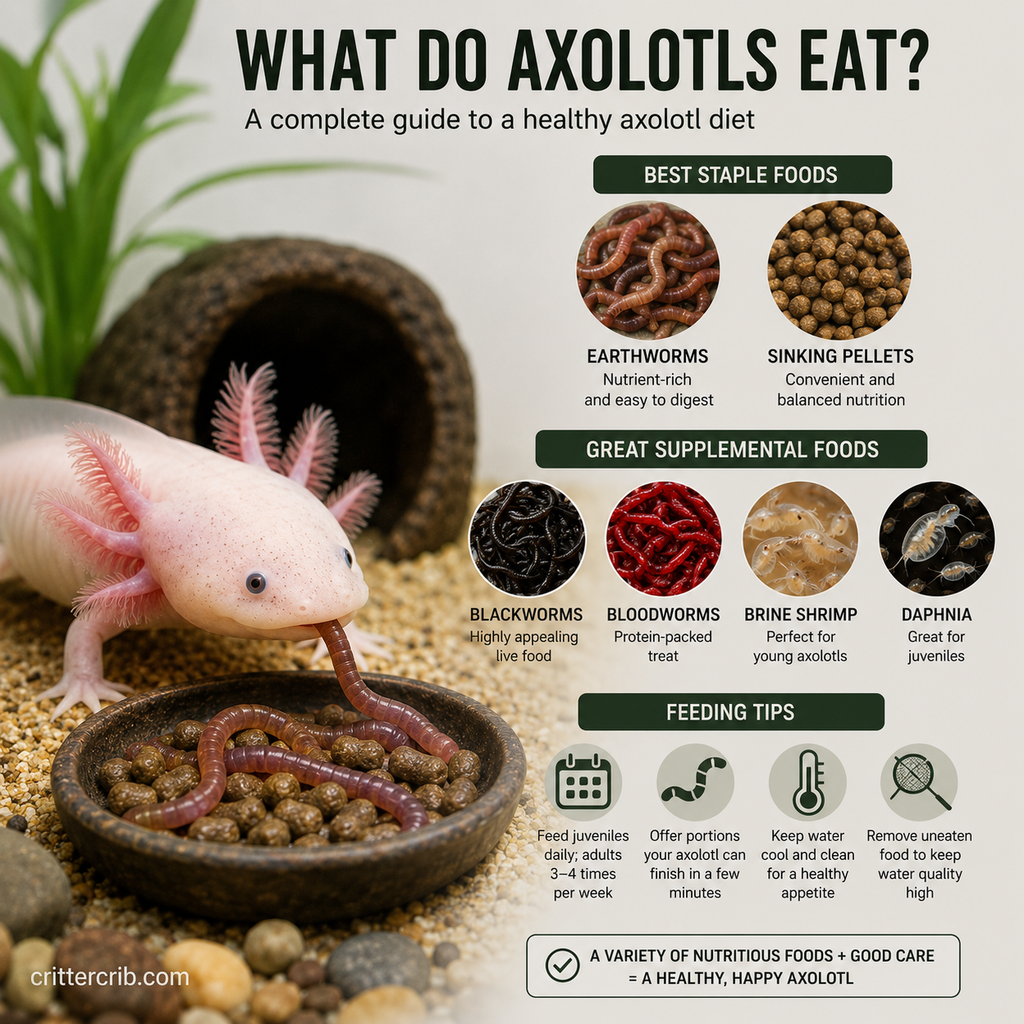
A healthy captive diet should provide plenty of animal protein while being easy for the axolotl to digest.
A few foods stand out as particularly useful.
Earthworms and Nightcrawlers
Earthworms are one of the best staple foods for adult axolotls.
They’re nutrient-dense, soft-bodied, and closely resemble the type of prey an axolotl is naturally adapted to eat.
Nightcrawlers are especially popular because they’re inexpensive and widely available.
Large worms may need to be cut into smaller pieces before feeding. The appropriate size depends on the size of your axolotl.
Always obtain worms from a safe source. Avoid collecting earthworms from yards, gardens, parks, or other areas where pesticides, herbicides, fertilizers, or other chemicals may have been used.
If your axolotl initially rejects earthworms, don’t immediately assume it dislikes them. Some worms release substances that can make them temporarily unappealing. Rinsing the worm thoroughly and offering a smaller piece may help.
Axolotl Pellets
High-quality sinking pellets can also be a convenient staple or part of a varied diet.
Look for pellets formulated for axolotls, salamanders, or carnivorous aquatic animals. Ideally, they should contain animal-based proteins as primary ingredients.
Sinking pellets are preferable because axolotls spend most of their time near the bottom of the aquarium.
Pellets also make portion control easy. They’re convenient when you don’t want to handle live or refrigerated worms at every feeding.
However, don’t assume every pellet sold for fish or aquatic animals is appropriate. Check the ingredients and nutritional information rather than choosing based solely on the packaging.
Blackworms
Live blackworms can be highly appealing to axolotls.
Their movement encourages natural feeding behavior, making them particularly useful for juveniles or picky eaters.
The downside is that live foods can introduce unwanted organisms into an aquarium if they come from an unreliable source.
If you use blackworms, purchase them from a reputable supplier and handle them carefully.
Bloodworms
Bloodworms are probably one of the best-known foods associated with axolotls, but they’re often misunderstood.
Axolotls certainly can eat bloodworms. Frozen bloodworms are especially convenient and are commonly offered to juveniles.
However, bloodworms generally shouldn’t be the sole long-term diet for an adult axolotl.
Think of them as a supplemental food rather than the foundation of the diet.
Frozen bloodworm cubes can also get messy. Uneaten worms spread across the bottom of the aquarium and can quickly contribute to poor water quality.
Brine Shrimp
Brine shrimp can be useful for young axolotls, particularly when the animals are still too small to handle larger foods.
Newly hatched brine shrimp move through the water, which can stimulate a young axolotl’s feeding response.
As the axolotl grows, however, larger and more substantial foods become more practical.
Daphnia
Daphnia are tiny freshwater crustaceans that can work well for very young axolotls.
Because they’re small and move naturally through the water, they can trigger hunting behavior in juveniles.
Like brine shrimp, daphnia become less useful as an axolotl grows large enough to eat worms and pellets.
What Should Baby Axolotls Eat?
Baby and juvenile axolotls require different feeding strategies than adults.
Very young axolotls respond strongly to movement and may initially be much more interested in live prey than stationary food.
Depending on their size and developmental stage, foods may include:
- Newly hatched brine shrimp
- Daphnia
- Live blackworms
- Chopped earthworms
- Small sinking pellets once they’re large enough
Young axolotls also generally need to eat more frequently than adults because they’re actively growing.
As they get larger, gradually transition them toward more substantial staple foods such as earthworms and appropriate pellets.
How Often Should You Feed an Axolotl?
Feeding frequency depends largely on age, size, body condition, water temperature, and the food being offered.
Baby and Juvenile Axolotls
Growing axolotls usually need food more frequently.
Very young axolotls may require daily feeding, and tiny larvae may need even more frequent access to appropriately sized live foods depending on their developmental stage.
As juveniles grow, their meals become larger and feeding frequency can gradually decrease.
Adult Axolotls
Healthy adults generally don’t need to eat as frequently as rapidly growing juveniles.
Many adult axolotls do well with appropriately sized meals several times per week rather than large daily meals.
There’s no universal schedule that works perfectly for every animal. Watch your axolotl’s body condition and feeding response rather than relying entirely on the calendar.
How Much Should You Feed an Axolotl?
Portion size is one of the harder parts of axolotl care because foods vary so much.
One earthworm isn’t nutritionally equivalent to one pellet, and a small juvenile obviously requires much less food than a fully grown adult.
Instead of relying on a rigid number, consider:
- The axolotl’s age
- Its overall size
- Body condition
- Food size
- How often it’s being fed
- Whether food is consistently left uneaten
A healthy axolotl should have a well-proportioned body without appearing excessively thin or unusually swollen.
If food is routinely being ignored or left behind, you may be offering too much.
How to Feed an Axolotl
Axolotls aren’t especially complicated to feed once you establish a routine.
You can offer worms using aquarium-safe feeding tongs, drop sinking pellets near the axolotl, or use a feeding dish to keep food concentrated in one area.
A simple feeding routine is:
- Prepare an appropriately sized portion.
- Place or gently move the food near the axolotl.
- Give the axolotl time to locate and swallow it.
- Watch to make sure the food is eaten normally.
- Remove leftovers promptly.
Feeding tongs can be particularly useful for worms because you can position the food directly in front of the axolotl without repeatedly putting your hands into the aquarium.
Avoid sharp or pointed tools that could injure the animal.
Should Axolotls Eat Live Food?
They can, but live food isn’t required for every meal.
Movement naturally attracts axolotls, so live worms and other suitable invertebrates can encourage feeding.
However, live food comes with potential drawbacks.
Poorly sourced live foods may introduce parasites, pathogens, or unwanted organisms into the aquarium.
Feeder fish are particularly problematic as a routine food source because they may carry disease and can potentially injure an axolotl.
A diet based on safe earthworms and appropriate prepared foods is generally easier to control.
Can Axolotls Eat Fish?
Axolotls are capable of eating small fish, but that doesn’t mean feeder fish should become part of their regular diet.
Live feeder fish can introduce disease or parasites into the aquarium. Fish may also nip at an axolotl’s delicate external gills.
There’s another practical problem: fish can be difficult to monitor. If they’re left swimming around the aquarium, you don’t necessarily know how much your axolotl has eaten.
There are safer and more nutritionally predictable foods available, so feeder fish generally aren’t necessary.
Can Axolotls Eat Shrimp?
Small shrimp may be eaten by axolotls if they’re able to catch them.
Some aquarium keepers introduce certain freshwater shrimp species, but anything small enough to fit into an axolotl’s mouth should be considered potential food rather than a permanent tank mate.
Shrimp should not replace a balanced staple diet.
Also consider where any live shrimp originated before introducing them to the aquarium. Live animals can potentially bring unwanted organisms with them.
Can Axolotls Eat Insects?
Axolotls naturally consume aquatic insect larvae, but that doesn’t mean random insects from around your home or yard are safe.
Wild insects may have been exposed to:
- Pesticides
- Herbicides
- Fertilizers
- Parasites
- Environmental contaminants
Some insects also have hard exoskeletons that aren’t ideal for axolotls.
It’s safer to stick with foods from reliable sources rather than experimenting with insects collected outdoors.
Can Axolotls Eat Human Food?
Human food isn’t appropriate for axolotls.
Avoid offering cooked meats, processed foods, deli meat, chicken, cheese, or leftovers from your own meals.
Even if an axolotl manages to swallow something, that doesn’t make it nutritionally appropriate.
Their digestive system is adapted for whole aquatic prey and similar animal foods, not seasoned or processed human food.
Foods Axolotls Should Avoid
Axolotls will sometimes attempt to swallow things that aren’t good for them, so appetite shouldn’t be used as the only measure of whether a food is safe.
Avoid feeding:
- Processed human foods
- Cooked or seasoned meat
- Dairy products
- Wild-caught insects from potentially contaminated areas
- Large or hard-shelled prey
- Feeder fish of unknown health status
- Foods too large to swallow safely
- Food collected from areas treated with pesticides or other chemicals
Also avoid making fatty mammal meat a routine part of the diet. Axolotls are better suited to eating worms and aquatic invertebrates.
Why Food Size Matters
Axolotls swallow food whole, so appropriately sizing each meal is important.
An oversized piece of food can be difficult to swallow and may be rejected or regurgitated.
Cut large earthworms into manageable pieces for smaller axolotls.
Pellets should also be appropriate for the animal’s size. Tiny juveniles need much smaller food than mature adults.
When you’re uncertain, offering several smaller pieces is usually more manageable than one oversized piece.
Why Is My Axolotl Not Eating?
An axolotl refusing a single meal isn’t necessarily an emergency, particularly if it’s an adult that otherwise appears healthy.
Persistent appetite loss deserves more attention.
Possible reasons include:
- Water temperature problems
- Poor water quality
- Elevated ammonia or nitrite
- Stress
- Recent environmental changes
- Inappropriate food
- Overfeeding
- Constipation or digestive problems
- Illness or injury
Start by checking the aquarium rather than immediately experimenting with dozens of different foods.
Water conditions have an enormous influence on amphibian health.
Test the water parameters and confirm that the aquarium is properly cycled and being maintained within appropriate conditions.
If appetite loss continues, the axolotl loses weight, behaves abnormally, develops unusual swelling, has skin or gill changes, or shows other signs of illness, contact a veterinarian experienced with amphibians or exotic animals.
Does Water Temperature Affect Feeding?
Yes.
Axolotls are cold-water amphibians, and temperature influences their metabolism, activity, appetite, and overall health.
Water that’s consistently too warm can stress an axolotl and contribute to health problems.
Rather than trying to compensate for appetite changes by offering more food, make sure the aquarium itself is providing appropriate environmental conditions.
A thermometer is an essential part of an axolotl setup because aquarium temperature can change with room temperature, lighting, seasonal weather, and nearby equipment.
Remove Uneaten Food From the Tank
Feeding and water quality are closely connected.
Leftover worms, pellets, bloodworms, and other foods eventually decompose. That waste can contribute to deteriorating water quality.
Remove uneaten food soon after feeding rather than leaving it in the aquarium until the next cleaning.
A turkey baster can be surprisingly useful for spot-cleaning small pieces of food and waste from the bottom of an axolotl tank.
A feeding dish can also make cleanup easier, particularly when using pellets or messy frozen foods.
Should You Feed Axolotls in a Separate Container?
Usually, you don’t need to move an axolotl into another container just for routine feeding.
Handling and moving an axolotl can create unnecessary stress.
Instead, use feeding tongs or a designated feeding area inside the aquarium.
A feeding dish can help keep pellets, worms, and other foods from disappearing around decorations or becoming mixed into the substrate.
Can Axolotls Overeat?
Yes, axolotls can be overfed.
Overfeeding also creates problems beyond weight gain because uneaten food produces additional waste.
Signs that your feeding routine may need adjusting include:
- Food regularly being left behind
- Frequent regurgitation
- Excessive weight gain
- Large amounts of food waste accumulating in the aquarium
Adjust portions gradually rather than making dramatic changes after a single meal.
Young axolotls require more frequent nutrition for growth, so their feeding needs shouldn’t be directly compared with those of adults.
Do Axolotls Need Supplements?
A healthy axolotl eating a balanced diet of appropriate whole foods and/or quality formulated pellets generally shouldn’t require random vitamin or mineral supplementation.
Adding supplements without understanding the animal’s nutritional needs can create new problems rather than solving them.
If you’re concerned about a nutritional deficiency, review the entire diet and discuss supplementation with an amphibian or exotic-animal veterinarian.
Creating a Simple Axolotl Feeding Routine
Axolotl feeding doesn’t have to become complicated.
For many adult pets, a straightforward approach works well:
Staple food
Use earthworms/nightcrawlers or a quality sinking pellet as the nutritional foundation.
Supplemental foods
Occasionally offer suitable alternatives such as blackworms or bloodworms.
Adjust for age
Feed growing juveniles more frequently and use appropriately sized foods.
Watch body condition
Use your axolotl’s appearance and feeding response to help determine whether portions need adjusting.
Clean after meals
Remove uneaten food before it begins breaking down.
Monitor the aquarium
Regularly check temperature and water quality. Good nutrition can’t compensate for unsuitable aquarium conditions.
Common Axolotl Feeding Mistakes
Even well-meaning owners can make feeding more complicated than necessary.
Some of the most common mistakes include:
- Feeding bloodworms as the only long-term food
- Offering portions that are too large
- Feeding adults as frequently as rapidly growing juveniles
- Leaving uneaten food in the aquarium
- Using wild-caught prey from potentially contaminated areas
- Relying heavily on feeder fish
- Giving human foods as treats
- Ignoring water quality when an axolotl stops eating
- Constantly changing foods because one meal was refused
Consistency is useful. Once you’ve found a nutritious staple food your axolotl accepts, you don’t need to reinvent its diet every week.
Frequently Asked Questions About Feeding Axolotls
What is the best food for axolotls?
Earthworms and nightcrawlers are excellent staple foods for many adult axolotls. High-quality sinking pellets formulated for carnivorous aquatic animals can also be useful as a staple or part of a varied diet.
Can axolotls eat bloodworms every day?
Bloodworms can be offered to axolotls, particularly juveniles, but they aren’t generally the best choice as the sole long-term diet for an adult. More substantial staple foods such as earthworms are preferable.
How long can an axolotl go without eating?
The answer varies significantly with age, size, temperature, body condition, and health. Healthy adults can tolerate longer periods between meals than growing juveniles, but deliberately fasting an axolotl for extended periods isn’t a normal feeding strategy.
Persistent refusal to eat—especially when accompanied by weight loss or other symptoms—should prompt an evaluation of water conditions and health.
Do axolotls eat plants?
Axolotls are carnivores and don’t require plants as a nutritional part of their diet.
Live aquarium plants can still be useful for enrichment, cover, and aquarium aesthetics, but they’re not axolotl food.
Do axolotls need to eat every day?
Not necessarily. Young, growing axolotls generally require more frequent feeding, while healthy adults can usually be fed less frequently.
Can axolotls eat worms from the garden?
It’s safer not to use worms collected from areas where you can’t verify chemical exposure. Pesticides, herbicides, fertilizers, and other contaminants are potential concerns. Worms raised or purchased specifically for safe feeding are a better option.
Why does my axolotl spit out its food?
Food may be rejected because it’s too large, unfamiliar, unappealing, or difficult to swallow. Stress and environmental or health problems can also affect feeding.
Occasionally spitting out a piece of food isn’t necessarily concerning. Repeated difficulty eating or persistent appetite loss deserves closer attention.
Final Thoughts
Feeding an axolotl is relatively simple once you understand what these unusual amphibians are designed to eat.
They’re carnivores, and their diet should revolve around nutritious animal-based foods. Earthworms and nightcrawlers are excellent staples for many adults, while quality sinking pellets offer a convenient alternative. Younger axolotls may benefit from smaller foods such as brine shrimp, daphnia, blackworms, and chopped worms as they grow.
Just as importantly, avoid turning feeding into a guessing game. Choose safe foods from reliable sources, offer appropriately sized portions, remove leftovers, and adjust feeding frequency as your axolotl matures.
And remember that appetite is connected to the rest of your axolotl’s environment. If an animal suddenly stops eating, checking water temperature and water quality can be just as important as checking what’s on the menu.
With a nutritious diet, clean water, and a consistent routine, feeding becomes one of the easiest parts of caring for an axolotl.