Goldfish have a reputation for being messy fish, and there’s some truth to it. They eat enthusiastically, produce a fair amount of waste, and can grow much larger than many new owners expect.
That makes regular aquarium maintenance especially important.
But cleaning a goldfish habitat doesn’t mean emptying the tank, scrubbing everything spotless, replacing all the water, and starting over. In fact, overly aggressive cleaning can disrupt the beneficial bacteria that help keep an aquarium stable.
A safer approach is regular partial water changes, targeted substrate cleaning, proper filter maintenance, algae removal when needed, and routine water testing.
Once you have a system, maintaining a goldfish tank becomes much easier.
Here’s a simple cleaning routine you can adapt to your aquarium.
How Often Should You Clean a Goldfish Tank?
There’s no single cleaning schedule that works for every goldfish aquarium.
How frequently your tank needs attention depends on:
- Aquarium size
- Number and size of goldfish
- Filtration
- Feeding habits
- Plant growth
- Amount of waste
- Water-test results
For many established goldfish aquariums, a weekly partial water change and general maintenance session is a practical starting point.
Some tanks may need more frequent attention. Large, lightly stocked aquariums with excellent filtration may sometimes require less.
Instead of relying entirely on the calendar, use water testing and the condition of the aquarium to guide your routine.
Why Goldfish Tanks Need Regular Cleaning
Goldfish constantly add waste to their environment.
Fish waste, uneaten food, decaying plant material, and other organic matter can eventually affect water quality.
A properly cycled aquarium contains beneficial bacteria that process toxic waste through the nitrogen cycle.
In simplified terms:
- Fish waste and decomposing material produce ammonia.
- Beneficial bacteria convert ammonia into nitrite.
- Other bacteria convert nitrite into nitrate.
- Water changes and plant growth help control nitrate and other accumulated substances.
In an established aquarium, ammonia and nitrite should generally remain at 0 ppm.
Regular maintenance helps keep conditions stable rather than waiting until the water looks dirty.
What You’ll Need to Clean a Goldfish Habitat
You don’t need an enormous collection of aquarium-cleaning equipment.
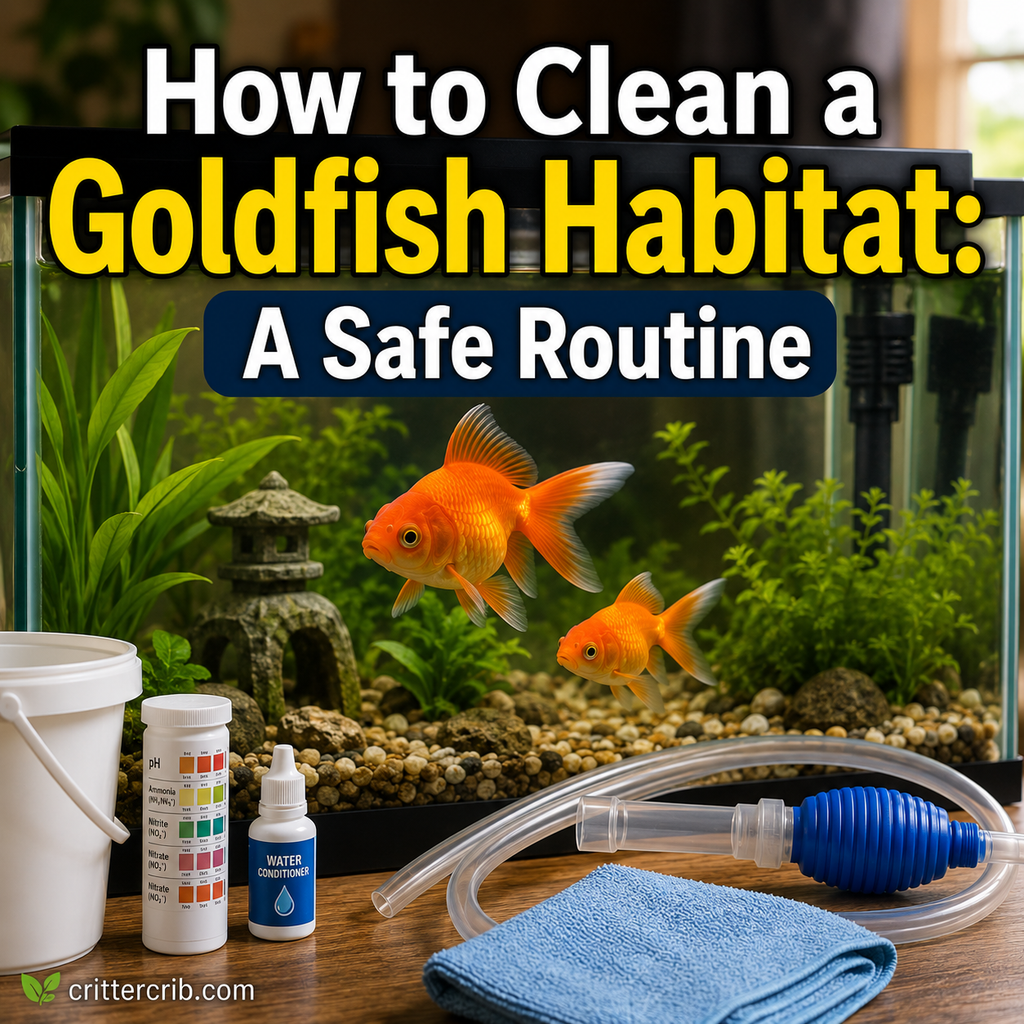
A basic maintenance kit can include:
- Aquarium siphon or gravel vacuum
- Bucket used only for aquarium maintenance
- Water conditioner
- Algae scraper or aquarium-safe sponge
- Freshwater test kit
- Thermometer
- Clean towels
- Small aquarium brush if needed
Keep your aquarium bucket separate from household cleaning supplies.
You don’t want traces of soap, bleach, detergent, or other chemicals accidentally entering the tank.
Should You Remove Goldfish While Cleaning the Tank?
Usually, no.
For routine maintenance, it’s generally better to leave your goldfish in the aquarium.
Catching and transferring fish can cause unnecessary stress and creates another opportunity for injury or temperature shock.
A normal partial water change can be performed around them.
Move slowly with the siphon and keep an eye on curious fish. Goldfish are often very interested in whatever you’re doing and may investigate the gravel vacuum.
Temporary removal may occasionally be necessary for unusual circumstances, but it shouldn’t be part of your standard weekly cleaning routine.
How to Clean a Goldfish Tank Step by Step
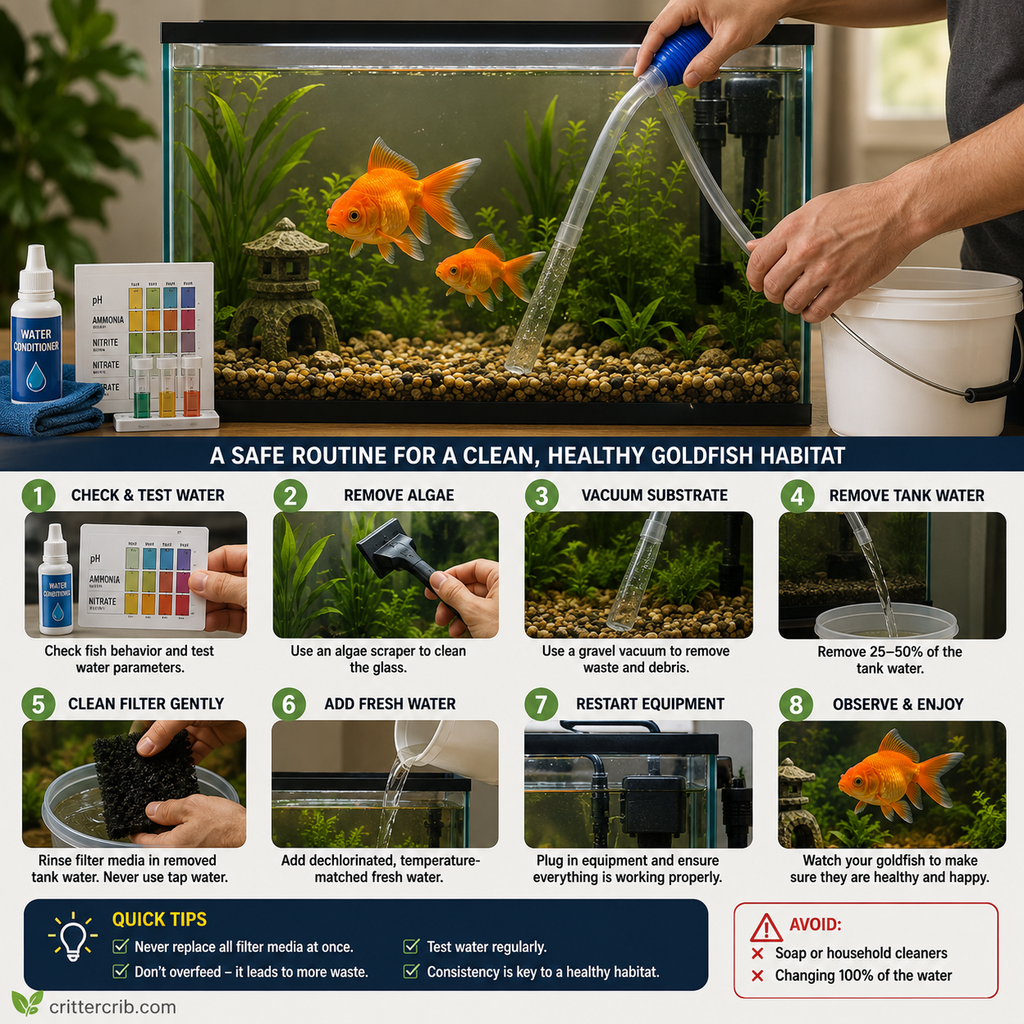
The goal is to clean the aquarium without completely disrupting the biological system.
Here’s a practical routine.
1. Check the Fish Before You Start
Take a minute to observe your goldfish before putting your hands in the aquarium.
Look at:
- Swimming behavior
- Appetite
- Breathing
- Fins
- Eyes
- Skin and scales
- General activity
Regular maintenance is a great opportunity to notice subtle changes.
If your goldfish suddenly behaves differently, test the water before assuming the tank simply needs a cosmetic cleaning.
2. Test the Aquarium Water
Test important parameters before the water change.
At minimum, you’ll generally want to know:
- Ammonia
- Nitrite
- Nitrate
- pH
Temperature is also important.
Recording results can help you spot trends over time.
For example, if nitrate climbs much faster than expected every week, you may need larger or more frequent water changes, improved filtration, reduced feeding, or a stocking adjustment.
3. Unplug Equipment When Appropriate
Before lowering the water level, check your equipment.
Some aquarium heaters and filters shouldn’t operate when partially exposed to air.
Follow the manufacturer’s instructions for your particular equipment.
If necessary, unplug:
- Heater
- Filter
- Other equipment affected by falling water levels
Never allow a running heater designed for full submersion to become exposed during a water change.
Let equipment cool when required before removing it from water.
4. Remove Algae From the Glass
If algae is obscuring your view, clean the aquarium glass before siphoning.
Use an aquarium-safe:
- Algae scraper
- Magnetic cleaner
- Sponge
- Appropriate blade designed for the aquarium material
Be careful with acrylic tanks because they scratch more easily than glass.
You don’t necessarily need to remove every patch of algae.
A small amount of harmless algae isn’t automatically a problem, and trying to keep the aquarium completely sterile creates unnecessary work.
5. Vacuum the Substrate
Goldfish waste and uneaten food can settle into gravel and other substrate.
A gravel vacuum allows you to remove debris while simultaneously draining old aquarium water.
Move through sections of the substrate and let the siphon pull out loose waste.
You don’t necessarily need to deep-clean every inch during every maintenance session.
For large aquariums, rotating between different sections can prevent maintenance from becoming overly disruptive.
If you’re using sand, keep the siphon slightly above the surface so debris is removed without sucking out large amounts of substrate.
6. Remove Part of the Aquarium Water
Routine goldfish maintenance generally involves a partial rather than complete water change.
The appropriate percentage depends on your aquarium and water-test results.
Many keepers use water changes in the range of roughly 25% to 50% as part of regular maintenance, with larger or more frequent changes used when conditions require them.
The important thing is consistency.
Your water-change routine should keep nitrate and other waste under control without exposing fish to dramatic swings in temperature or water chemistry.
7. Clean Decorations Only When Necessary
Aquarium decorations don’t need to look brand new every week.
If a decoration has excessive algae or debris, remove and clean it gently.
Use:
- Old aquarium water
- Dechlorinated water
- An aquarium-only brush
Avoid household soaps and detergents.
Some beneficial microorganisms live on aquarium surfaces, so aggressively sterilizing every decoration during each cleaning isn’t necessary.
8. Maintain the Filter Carefully
This is one of the most important parts of aquarium cleaning.
Your filter isn’t simply a machine that catches dirt.
Filter media can contain large populations of beneficial bacteria involved in the nitrogen cycle.
If reusable sponge or mechanical media becomes clogged, gently rinse or squeeze it in removed aquarium water rather than untreated chlorinated tap water.
Don’t try to make old filter media look brand new.
You generally want to remove enough debris to restore good water flow while preserving biological filtration.
9. Don’t Replace All Filter Media at Once
Some filters use cartridges that manufacturers recommend replacing on a schedule.
The problem is that throwing away all established media can also remove a substantial amount of beneficial bacteria.
Whenever possible, use filter media that can be maintained and reused.
If something truly needs replacing, avoid replacing every piece of biological media simultaneously.
Transitioning media gradually helps preserve stability.
The exact procedure depends on your filter design, so follow appropriate manufacturer guidance while keeping biological filtration in mind.
10. Refill With Conditioned Water
Tap water commonly contains chlorine or chloramine.
Treat replacement water with an aquarium water conditioner appropriate for your water supply.
Follow the manufacturer’s dosing instructions.
Try to match the replacement water temperature reasonably closely to the aquarium.
Pour or pump the new water in gradually so you don’t:
- Stress the fish
- Disturb the substrate
- Uproot plants
- Create a sudden temperature change
11. Restart the Equipment
Once the aquarium is refilled to the correct level, restart equipment according to manufacturer instructions.
Check that:
- Filter is running normally
- Heater is properly submerged
- Air pump is operating
- Water is circulating
- Temperature is appropriate
Some filters need to be primed after a water change.
Don’t assume everything restarted correctly just because you plugged it back in.
12. Observe Your Goldfish
Spend a few minutes watching the fish afterward.
Normal behavior should resume relatively quickly.
If you notice:
- Gasping
- Loss of balance
- Sudden lethargy
- Frantic swimming
- Clamped fins
check the temperature and water conditions immediately.
A dramatic change after maintenance can indicate a problem with replacement water, temperature, equipment, or water treatment.
How Much Water Should You Change?
There’s no magic percentage that works for every aquarium.
A lightly stocked, heavily filtered tank may behave very differently from a smaller aquarium containing several large goldfish.
A 25% to 50% weekly water change is a reasonable general starting range for many goldfish setups, but testing should determine whether that schedule is actually sufficient.
If nitrate climbs rapidly between water changes, consider:
- Larger water changes
- More frequent water changes
- Improved mechanical or biological filtration
- Reducing excess feeding
- Increasing aquarium volume
- Reviewing stocking levels
Don’t simply keep adding chemicals to compensate for a maintenance problem.
Should You Ever Change 100% of the Water?
Complete water changes aren’t normally necessary for routine maintenance.
They may be appropriate in certain emergencies, depending on the situation, but shouldn’t be the standard cleaning method.
A full drain can expose fish to unnecessary stress and sudden changes.
More importantly, the idea that you need to “reset” the aquarium every week misunderstands how a healthy tank works.
A mature aquarium is a living biological system.
Your job is to maintain stability, not repeatedly start from zero.
Should You Wash Aquarium Gravel?
You don’t need to remove all the gravel and wash it during normal maintenance.
Use a gravel vacuum instead.
This removes much of the trapped waste without dismantling the aquarium.
Taking every piece of gravel out, scrubbing it clean, and replacing it can be unnecessarily disruptive.
If you’re setting up a brand-new aquarium, rinsing new substrate according to the manufacturer’s instructions is different from routinely washing established substrate.
Can You Clean a Goldfish Tank With Tap Water?
Tap water is useful for refilling the aquarium after it’s properly treated.
But untreated tap water may contain chlorine or chloramine that can harm aquatic life and beneficial bacteria.
Use a suitable water conditioner before untreated tap water comes into contact with fish.
Be especially careful when cleaning filter media.
Rinsing biological media under untreated chlorinated tap water may damage the bacterial population you’re trying to preserve.
Never Use Soap to Clean a Goldfish Tank
Soap and household detergents don’t belong in an aquarium.
Even small residues can be harmful to fish.
Avoid using:
- Dish soap
- Household cleaners
- Glass cleaner
- Disinfectant sprays
- Scented cleaning products
This includes equipment such as buckets, sponges, brushes, and containers.
Keep dedicated aquarium tools that have never been exposed to cleaning chemicals.
How to Clean a Goldfish Bowl
If your goldfish currently lives in a small bowl, the best long-term solution isn’t finding a better bowl-cleaning technique.
It’s upgrading the habitat.
Goldfish can grow large and produce significant amounts of waste. Traditional bowls provide very little water volume and usually lack adequate filtration.
A properly sized, filtered aquarium gives you much more control over water quality.
The exact aquarium size depends on the type and number of goldfish you’re keeping, but both common and fancy goldfish require substantially more space than a small bowl provides.
Until an upgrade is possible, water quality needs particularly close attention because waste can accumulate rapidly in a small volume of water.
Why Your Goldfish Tank Gets Dirty So Quickly
If your aquarium seems filthy only a few days after cleaning, something may need adjusting.
Possible causes include:
- Overfeeding
- Too many fish
- Aquarium too small
- Inadequate filtration
- Filter media clogged with debris
- Excessive light causing algae
- Large amounts of decaying plant material
- Insufficient maintenance
Don’t assume the answer is simply cleaning more aggressively.
For example, an undersized tank containing several goldfish may remain difficult to maintain regardless of how often you scrub it.
Fixing the underlying cause usually works better than constantly treating the symptom.
How to Reduce Goldfish Tank Maintenance
You can’t eliminate aquarium maintenance, but you can make it easier.
Use Adequate Filtration
Goldfish benefit from effective mechanical and biological filtration.
Choose filtration appropriate for your aquarium volume and stocking level.
Don’t Overfeed
Offer an appropriate amount of food and remove significant leftovers.
More food going into the aquarium eventually means more waste coming out.
Provide Enough Aquarium Space
Larger water volumes generally provide greater stability and more room for filtration.
Test the Water
Testing lets you adjust maintenance before conditions become dangerous.
Keep a Consistent Schedule
A modest amount of regular maintenance is much easier than waiting until the aquarium becomes severely dirty.
Common Goldfish Tank Cleaning Mistakes
A few habits can make aquarium maintenance harder rather than easier.
Avoid:
- Replacing all the water every week
- Removing goldfish during every cleaning
- Washing everything with tap water
- Using soap or household cleaners
- Replacing all filter media at once
- Cleaning the filter until it looks brand new
- Ignoring water-test results
- Allowing the heater to run while exposed
- Adding untreated tap water
- Deep-cleaning every surface simultaneously
The goal isn’t maximum cleanliness.
It’s a stable, healthy aquatic environment.
A Simple Weekly Goldfish Cleaning Routine
For many established aquariums, your basic routine might look like this:
- Observe the goldfish.
- Test the water.
- Unplug equipment that can’t safely operate during a water change.
- Scrape excessive algae if necessary.
- Vacuum debris from the substrate.
- Remove approximately 25% to 50% of the water as appropriate.
- Gently clean clogged reusable filter media in removed tank water when needed.
- Add properly conditioned, temperature-matched replacement water.
- Restart and check equipment.
- Observe the fish afterward.
Once you’re comfortable with the process, it becomes routine.
You may spend more time getting the bucket and siphon out than figuring out what to do next.
Frequently Asked Questions About Cleaning a Goldfish Habitat
How often should I clean my goldfish tank?
Many goldfish aquariums benefit from weekly partial water changes and general maintenance. The exact schedule should be adjusted according to aquarium size, stocking, filtration, feeding, and water-test results.
How much water should I change in a goldfish tank?
Approximately 25% to 50% is a common starting range for routine water changes, although individual aquariums may require different amounts.
Should I remove my goldfish when cleaning the tank?
Usually not. Routine partial water changes can normally be performed with the fish remaining in the aquarium.
Can I use tap water in a goldfish tank?
Yes, provided it’s properly treated with a suitable water conditioner when necessary to neutralize chlorine or chloramine and is added at an appropriate temperature.
Can I use soap to clean aquarium decorations?
No. Soap and household cleaning products can leave residues that may harm fish. Use aquarium-safe cleaning methods instead.
How often should I clean my goldfish filter?
Clean reusable filter media when debris significantly reduces water flow or when maintenance is otherwise needed. Avoid unnecessary aggressive cleaning that removes beneficial bacteria.
Why does my goldfish tank smell?
A strong or unpleasant odor can indicate excess organic waste, overfeeding, inadequate maintenance, dead plant or animal material, or filtration problems. Check the aquarium and test the water rather than trying to mask the smell.
Why is my goldfish tank cloudy after cleaning?
Temporary cloudiness can occur if substrate debris was disturbed. Persistent cloudiness may be associated with bacterial blooms, overfeeding, disrupted biological filtration, or other water-quality issues.
Final Thoughts
Cleaning a goldfish habitat safely is less about scrubbing and more about maintaining balance.
Regular partial water changes, substrate vacuuming, careful filter maintenance, water testing, and properly treated replacement water handle most of the work.
Resist the urge to make the aquarium look completely sterile.
Those invisible communities of beneficial bacteria are doing important work every day, and preserving them helps keep the environment stable for your fish.
Once you establish a consistent routine, goldfish tank maintenance becomes much less intimidating. A little work every week is usually far easier—and much safer—than waiting until the aquarium looks like it needs a complete overhaul.