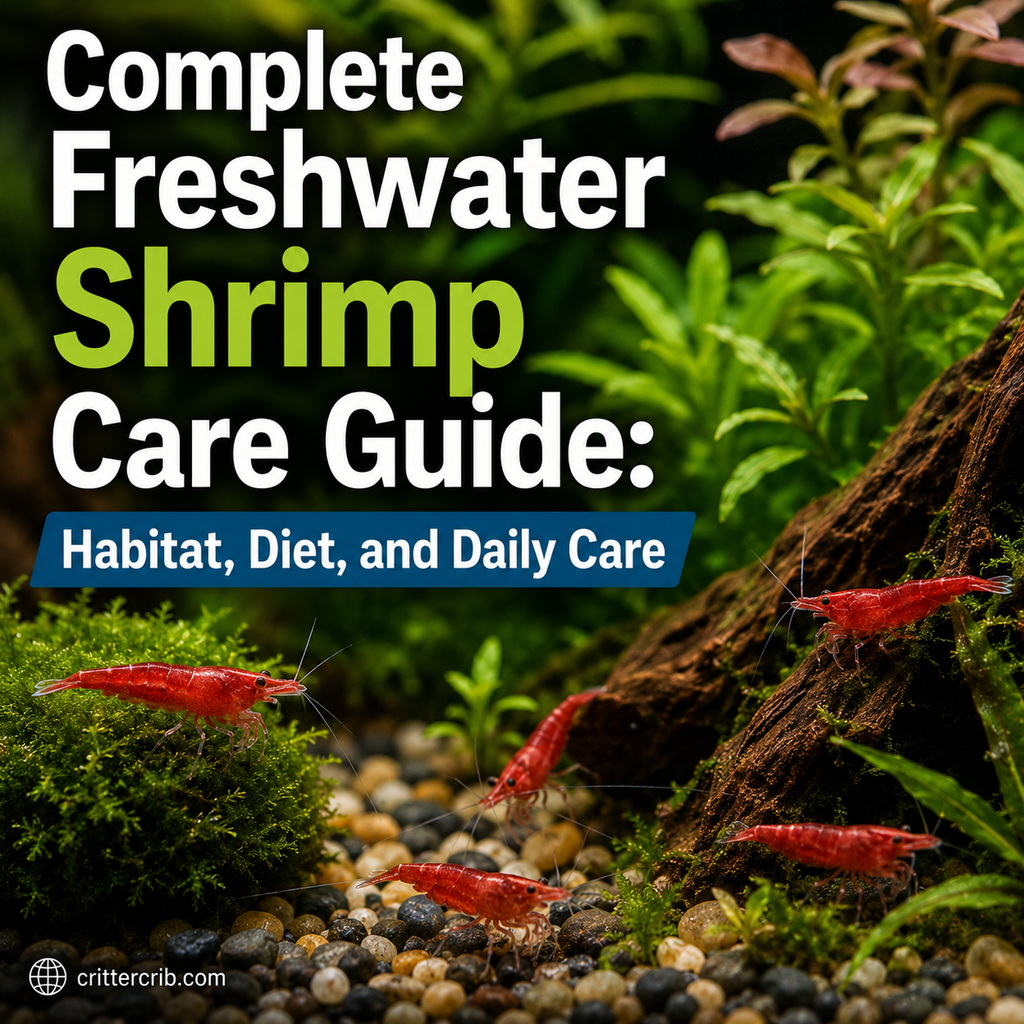
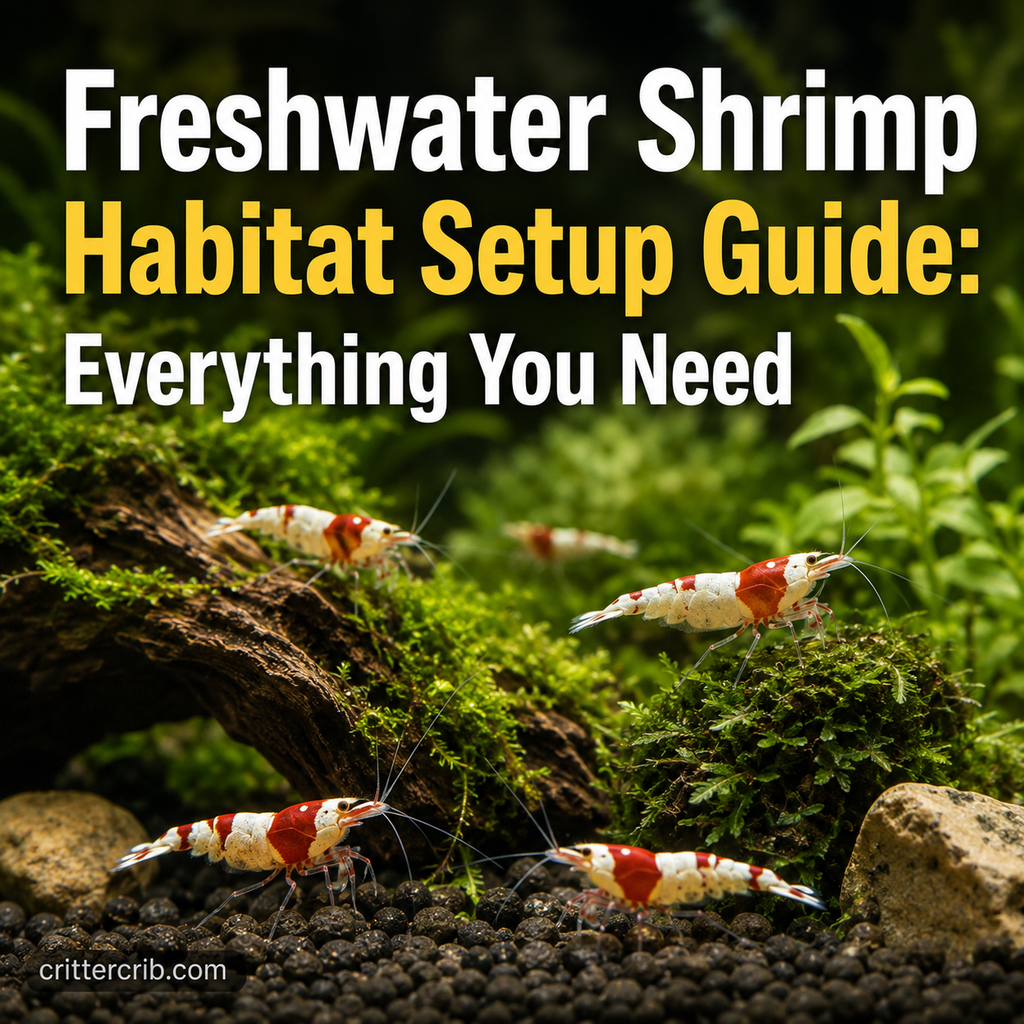
Freshwater shrimp are tiny compared with most aquarium fish, but setting up a good home for them takes more thought than simply filling a small tank with water.
Shrimp spend much of their day grazing. They’ll pick through moss, plants, wood, rocks, and other surfaces looking for biofilm and tiny bits of food. A well-established shrimp habitat gives them plenty of places to explore while keeping water conditions stable.
The good news is that a shrimp tank doesn’t need to be complicated.
A properly cycled aquarium, gentle filtration, suitable water parameters, plenty of surfaces to graze on, and a few carefully chosen plants can create an excellent environment.
This freshwater shrimp habitat setup guide walks through the process from an empty aquarium to introducing your first shrimp.
Start by Choosing the Freshwater Shrimp You Want to Keep
Before buying the aquarium, decide which shrimp you plan to keep.
Different freshwater shrimp don’t necessarily require identical conditions.
Two of the most common groups in the hobby are Neocaridina and Caridina shrimp.
Neocaridina Shrimp
Neocaridina davidi includes many of the colorful shrimp commonly sold for beginner aquariums, including:
- Cherry shrimp
- Blue dream shrimp
- Yellow shrimp
- Orange shrimp
- Green jade shrimp
- Chocolate shrimp
Neocaridina are popular partly because they can tolerate a reasonably broad range of conditions when those conditions remain stable.
They’re often a good starting point for someone setting up a first dedicated shrimp aquarium.
Caridina Shrimp
Caridina includes popular varieties such as crystal red shrimp and other selectively bred shrimp.
Some Caridina varieties require more specific water chemistry than Neocaridina and may be less forgiving of unsuitable conditions.
Experienced keepers sometimes use remineralized reverse-osmosis water and active substrate to create the desired mineral content and pH.
Before buying any shrimp, research the requirements of the exact species or variety you intend to keep.
This guide focuses primarily on the general principles of creating a freshwater shrimp habitat rather than prescribing one set of water parameters for every shrimp.
What Size Tank Do Freshwater Shrimp Need?
Shrimp have a very small physical footprint, which can make tiny aquariums tempting.
However, a larger volume of water generally provides more stability.
A 5-gallon aquarium can work for a small shrimp colony, but a tank around 10 gallons is an excellent starting point for many beginners.
The extra water volume provides more room for:
- Plants
- Grazing surfaces
- Filtration
- Colony growth
- Maintaining stable water conditions
Small tanks aren’t automatically bad, but they can change quickly.
Evaporation, overfeeding, temperature fluctuations, or a small amount of decaying organic material can have a much greater effect on a tiny aquarium.
For a first shrimp setup, a little extra water volume can make maintenance easier.
Choose the Right Location for Your Shrimp Tank
Where you put the aquarium matters.
Place it on a strong, level surface capable of supporting the full weight of the filled aquarium.
Avoid locations where the tank will experience dramatic temperature changes.
It’s also usually better to avoid prolonged direct sunlight. Some light can encourage algae growth, which shrimp may graze on, but uncontrolled direct sunlight can contribute to excessive algae and temperature fluctuations.
Choose a location:
- Away from heating and cooling vents
- Away from areas with frequent temperature swings
- With access to electrical outlets
- Where routine maintenance is practical
- Away from accidental bumps or disturbances
- Where you can actually enjoy watching the shrimp
Remember that water is heavy. Don’t assume an ordinary piece of furniture can safely support an aquarium without checking.
Freshwater Shrimp Tank Equipment Checklist
A basic shrimp aquarium doesn’t require an enormous amount of equipment.
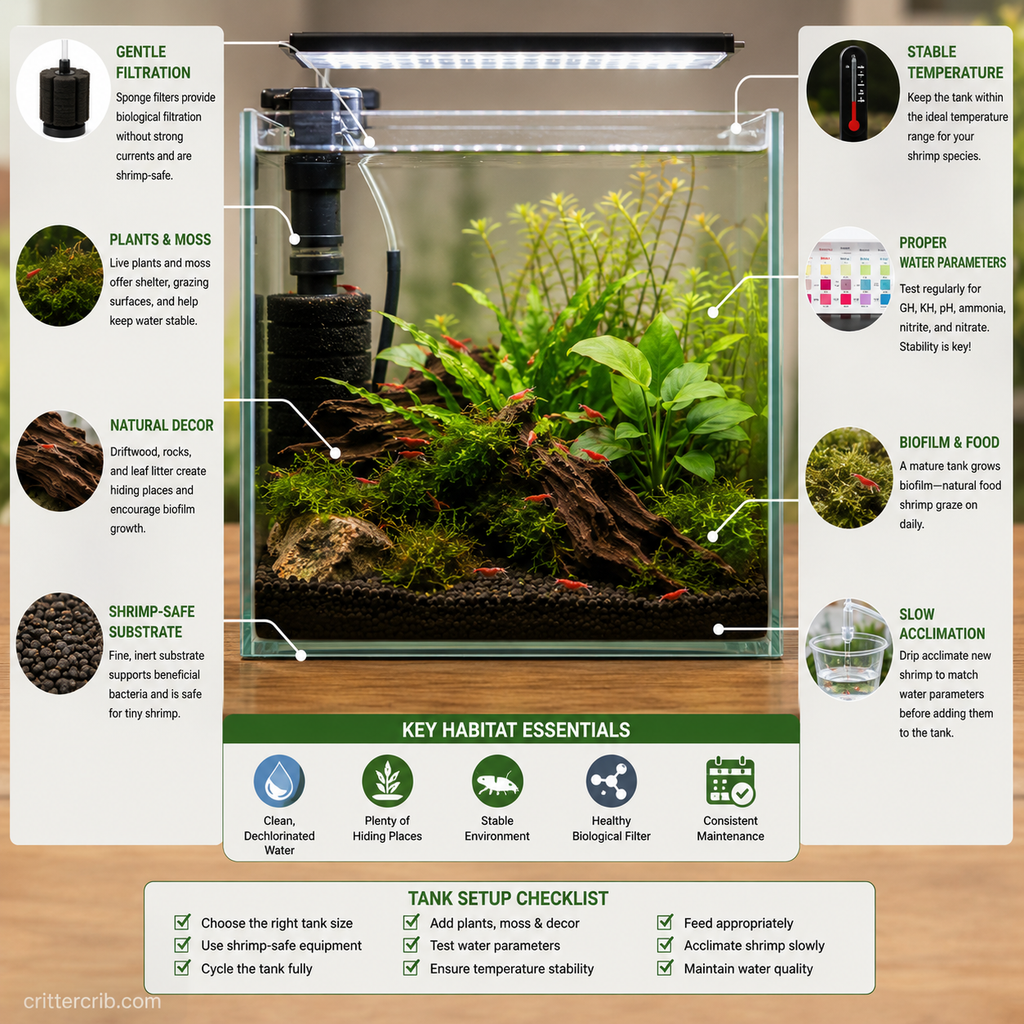
Depending on your setup, you’ll generally need:
- Aquarium
- Filter
- Aquarium light
- Substrate
- Water conditioner
- Water testing supplies
- Plants
- Aquarium-safe decorations or wood
- Thermometer
- Shrimp food
- Bucket or other aquarium maintenance supplies
A heater may also be appropriate depending on the shrimp species and the temperature of the room.
The goal isn’t to buy as much equipment as possible. It’s to create a stable environment and make routine care manageable.
Choose Shrimp-Safe Filtration
Filtration is important for maintaining water quality, but shrimp introduce one extra consideration: they’re tiny.
Baby shrimp are even tinier.
A filter intake that’s perfectly safe for an adult fish can potentially pull in shrimplets.
Sponge Filters
Air-driven sponge filters are extremely popular in dedicated shrimp tanks.
They provide gentle filtration while creating a large surface where microorganisms and biofilm can develop.
Shrimp often spend time grazing directly on the sponge.
Another advantage is that the filter doesn’t have a powerful exposed intake that can easily pull in baby shrimp.
Hang-on-Back and Canister Filters
Other filtration systems can also work.
If your filter has an exposed intake, consider adding an appropriately sized pre-filter sponge to help prevent shrimp and shrimplets from being drawn inside.
Keep the flow suitable for the species you’re keeping.
You want enough water movement for good filtration and oxygen exchange without turning the aquarium into a constant high-current environment.
Pick an Appropriate Substrate
Substrate affects both the appearance and function of a shrimp aquarium.
The right choice depends partly on the shrimp you’re keeping.
Inert Substrate
Sand and aquarium gravel that don’t significantly alter water chemistry are common choices for Neocaridina tanks.
A darker substrate can also make brightly colored shrimp easier to see.
Choose aquarium-safe material without dangerously sharp edges.
Active Substrate
Some shrimp keepers use active aquarium soils that influence water chemistry, often lowering pH and buffering the aquarium toward particular conditions.
These substrates are commonly associated with certain Caridina setups.
Don’t choose an active substrate simply because you’ve heard that shrimp like it.
Choose it because it matches the water chemistry requirements of the shrimp you’re planning to keep.
Add Plenty of Live Plants
Live plants are one of the best additions to a freshwater shrimp habitat.
They provide surfaces for biofilm and microorganisms to grow while giving shrimp places to explore and hide.
Plants can also help use nutrients within the aquarium.
Good options for shrimp tanks can include:
- Java moss
- Java fern
- Anubias
- Bucephalandra
- Cryptocoryne
- Floating plants
- Other suitable aquarium mosses
Moss is particularly useful in shrimp tanks.
Its fine structure creates an enormous amount of surface area, and tiny shrimplets can spend plenty of time picking through it for food.
Don’t Make the Tank Too Sterile
A shrimp aquarium doesn’t need to look dirty, but it also doesn’t need to be scrubbed until every surface is spotless.
Biofilm is valuable food for shrimp.
A mature aquarium with plants, wood, leaves, and other surfaces can develop a microscopic ecosystem that shrimp continually graze.
That’s one reason an established tank is often better for shrimp than a sparkling new aquarium that was filled yesterday.
Add Wood, Rocks, and Grazing Surfaces
Shrimp don’t just use decorations for appearance.
Every suitable surface becomes somewhere to explore.
Aquarium-safe driftwood is especially useful because its textured surface provides plenty of grazing area.
You can also use aquarium-safe:
- Rocks
- Wood
- Ceramic shrimp hides
- Natural-looking shelters
- Leaf litter appropriate for aquarium use
Avoid decorations with sharp edges or tiny openings where animals could become trapped.
Keep enough open space that you can still observe the shrimp and maintain the aquarium.
Cycle the Aquarium Before Adding Shrimp
This is one of the most important steps in the entire setup process.
Don’t add shrimp immediately after filling a new aquarium.
An aquarium needs an established biological filtration system capable of processing waste.
During the nitrogen cycle, beneficial microorganisms establish themselves in the aquarium and filter media.
In simplified terms:
- Waste produces ammonia.
- Beneficial bacteria convert ammonia into nitrite.
- Other bacteria convert nitrite into nitrate.
- Nitrate is managed through plants, water changes, and general aquarium maintenance.
Both ammonia and nitrite are toxic to aquatic animals.
A cycled aquarium should be able to process them effectively rather than allowing them to accumulate.
Test the Water Instead of Guessing
You can’t determine whether an aquarium is cycled simply by looking at it.
Clear water isn’t proof of safe water.
Use reliable aquarium tests to monitor:
- Ammonia
- Nitrite
- Nitrate
- pH
Depending on the shrimp you’re keeping, you’ll likely also want to understand:
- GH
- KH
- TDS
Water chemistry becomes especially important with shrimp because mineral content affects biological processes including molting.
Understand GH, KH, and TDS
These terms can sound intimidating when you’re new to shrimp keeping.
They’re easier to understand when you separate what each measurement tells you.
GH
GH stands for general hardness.
It broadly reflects concentrations of dissolved minerals such as calcium and magnesium in the water.
Mineral balance is important for shrimp, particularly because they regularly molt their exoskeleton.
KH
KH refers to carbonate hardness.
It relates to the water’s buffering capacity and its resistance to rapid changes in pH.
Different shrimp have different preferences, which is another reason you shouldn’t use one universal parameter chart for every species.
TDS
TDS stands for total dissolved solids.
A TDS meter provides a measurement of dissolved substances in the water, but it doesn’t tell you exactly what those substances are.
That makes TDS useful for monitoring consistency, but it shouldn’t replace proper water testing or an understanding of GH, KH, and other parameters.
Stability Is More Important Than Chasing Perfect Numbers
One of the easiest mistakes in shrimp keeping is constantly adjusting water chemistry.
You test the water, compare the result with something you saw online, add a product, test again, add something else, and suddenly the aquarium’s chemistry is changing constantly.
That can create more problems than it solves.
Research the appropriate range for your particular shrimp and aim for stable conditions within that range.
If your tap water isn’t suitable for the shrimp you want to keep, you may need a different approach.
Some advanced shrimp keepers use reverse-osmosis water and remineralize it to create predictable water chemistry.
For many beginner Neocaridina setups, suitable conditioned tap water may be considerably simpler.
Does a Shrimp Tank Need a Heater?
Not necessarily.
Whether you need a heater depends on:
- Shrimp species
- Room temperature
- Seasonal temperature changes
- Location of the aquarium
If your home naturally stays within an appropriate and stable temperature range for the shrimp, additional heating may not be necessary.
If the room becomes too cold or experiences large fluctuations, a heater may help maintain appropriate conditions.
Research the temperature requirements for your specific shrimp rather than choosing a universal setting.
Let the Aquarium Mature
Cycling establishes biological filtration, but shrimp also benefit from an aquarium that has had time to develop.
As the tank matures, microorganisms and biofilm colonize surfaces throughout the aquarium.
You’ll find this biological growth on:
- Plants
- Wood
- Rocks
- Filter sponges
- Substrate
- Aquarium glass
To us, some of these surfaces may look slightly “dirty.”
To a shrimp, they can look like a buffet.
You don’t necessarily need to wait months before introducing shrimp, but giving a properly cycled aquarium some additional time to mature can create a richer grazing environment.
Acclimate New Shrimp Carefully
Once your aquarium is cycled, stable, and ready, resist the urge to simply dump the shrimp into the tank.
The water they arrive in may differ from your aquarium in temperature, hardness, pH, and dissolved solids.
A gradual acclimation process helps reduce the severity of that transition.
Drip Acclimation
Many shrimp keepers use drip acclimation.
The basic idea is to slowly introduce aquarium water into the shrimp’s transport water over time.
This gradually changes the water conditions rather than exposing the shrimp to an immediate shift.
Once acclimation is complete, transfer the shrimp without unnecessarily adding transport water to the aquarium.
Avoid allowing the shrimp to remain in shipping or transport water longer than necessary, particularly after a long journey.
Feed Freshwater Shrimp Appropriately
A mature aquarium provides natural grazing opportunities, but that doesn’t mean you should never feed your shrimp.
Shrimp can eat a combination of naturally occurring biofilm, algae, microorganisms, and appropriate supplemental foods.
Depending on the species and setup, you might offer:
- Quality shrimp pellets
- Shrimp wafers
- Appropriate algae-based foods
- Suitable blanched vegetables occasionally
- Other foods formulated for freshwater shrimp
Feed conservatively.
A small shrimp colony doesn’t require much food, particularly in a mature planted aquarium.
Overfeeding Is a Common Shrimp Tank Problem
Shrimp are tiny.
The amount of food that looks reasonable to you may be far more than they can consume.
Uneaten food decomposes and can contribute to declining water quality.
Watch how quickly the shrimp consume what you provide and adjust accordingly.
Removing uneaten food can also help keep the aquarium clean.
Don’t Panic When Your Shrimp Molts
As shrimp grow, they periodically shed their old exoskeleton.
Finding what looks like an empty shrimp shell in the aquarium can be alarming the first time.
It doesn’t necessarily mean a shrimp died.
A shed exoskeleton is often translucent and looks like a hollow copy of the animal.
In many cases, you can leave the molt in the aquarium temporarily. Shrimp may consume it and recover some of its mineral content.
If you’re unsure whether you’re looking at a molt or a dead shrimp, examine it carefully before removing anything.
Choose Tank Mates Carefully
A dedicated shrimp-only aquarium gives you the greatest control over the environment and can make it easier for a colony to reproduce.
Community tanks are possible, but there’s an important reality to understand:
Small shrimp look like food to many fish.
Even relatively peaceful fish may eat baby shrimp if they can fit them in their mouths.
Heavy plant cover and moss can give shrimplets more places to hide, but no amount of vegetation can guarantee their safety around predatory tank mates.
If your goal is to establish a thriving breeding colony, a shrimp-only setup is often the simplest option.
Maintain the Shrimp Aquarium Consistently
Once the tank is established, maintenance should focus on stability rather than constantly changing things.
Routine care may include:
- Testing water periodically
- Performing appropriate partial water changes
- Removing excess debris
- Trimming plants
- Cleaning filter media when needed
- Removing uneaten food
- Checking equipment
- Topping off evaporated water appropriately
Avoid completely dismantling and scrubbing the aquarium during routine maintenance.
That can remove valuable biofilm and disturb the biological stability you’ve worked to establish.
Be Careful When Cleaning Filter Media
Filter media contains beneficial bacteria.
Don’t treat it like a dirty kitchen sponge that needs to be sterilized.
When cleaning is necessary, follow an aquarium-safe method that preserves as much beneficial biological filtration as possible.
Watch Out for Copper and Other Contaminants
Shrimp can be sensitive to substances that might be present in aquarium medications, fertilizers, or other products.
Copper is particularly important to consider because excessive exposure can be toxic to invertebrates.
Before using medication in an aquarium containing shrimp, confirm that it’s appropriate for the species and follow the product instructions carefully.
Also keep household contaminants away from the aquarium.
Avoid introducing:
- Soap
- Hand sanitizer
- Lotion
- Cleaning sprays
- Perfume
- Pesticides
- Unverified chemicals
Wash and thoroughly rinse aquarium equipment without leaving soap residue.
Common Freshwater Shrimp Habitat Mistakes
A good shrimp tank is often more about avoiding instability than buying specialized equipment.
Common mistakes include:
Adding Shrimp to an Uncycled Tank
A newly filled aquarium may look perfect while lacking the biological filtration needed to process waste.
Cycle first.
Changing Water Parameters Too Quickly
Shrimp can be sensitive to sudden environmental changes.
Avoid constantly adjusting pH, hardness, or temperature in pursuit of a precise number.
Overfeeding
More food doesn’t automatically produce healthier shrimp.
It can simply produce more waste.
Using an Unprotected Filter Intake
Baby shrimp can be extremely small.
Use shrimp-safe filtration or appropriately protect exposed intakes.
Keeping Shrimp With Predatory Fish
If a fish can fit a shrimplet in its mouth, assume there’s a possibility it will try.
Overcleaning the Aquarium
A spotless aquarium isn’t necessarily an ideal shrimp habitat.
Biofilm and microorganisms growing on surfaces are part of the ecosystem.
Ignoring Species-Specific Water Requirements
A setup that works beautifully for one type of shrimp may be inappropriate for another.
Always research the shrimp you’re actually buying.
Freshwater Shrimp Tank Setup: Step-by-Step
If you’re starting from scratch, the overall process can be simplified into these steps:
- Choose the shrimp species you want to keep.
- Research its temperature and water requirements.
- Select an appropriately sized aquarium.
- Choose substrate that matches your intended water chemistry.
- Install shrimp-safe filtration.
- Add aquarium-safe wood, rocks, and other structures.
- Add plenty of live plants and moss.
- Fill the aquarium with appropriately treated water.
- Begin cycling the aquarium.
- Test ammonia, nitrite, nitrate, and relevant water parameters.
- Allow the aquarium to establish and develop grazing surfaces.
- Confirm that conditions are stable.
- Purchase healthy shrimp from a reputable source.
- Acclimate them gradually.
- Introduce the shrimp and observe them closely.
- Feed conservatively and maintain stable conditions.
The process takes longer than filling a bowl and adding shrimp the same afternoon, but patience at the beginning can prevent many problems later.
Frequently Asked Questions About Freshwater Shrimp Habitats
Are Freshwater Shrimp Easy to Keep?
Some freshwater shrimp can be relatively beginner-friendly once they’re placed in an established aquarium with appropriate and stable conditions.
Neocaridina are commonly recommended to beginners.
More sensitive shrimp varieties may require greater control over water chemistry.
Do Shrimp Need a Filter?
A filter is strongly recommended for most shrimp aquariums.
Sponge filters are particularly popular because they provide biological filtration, gentle water movement, grazing surfaces, and protection for baby shrimp.
Do Freshwater Shrimp Need Live Plants?
Shrimp can technically be kept without a heavily planted aquarium, but live plants offer significant benefits.
They provide cover, grazing surfaces, and habitat complexity while helping create a more natural environment.
Do Shrimp Need an Air Pump?
If you’re using an air-driven sponge filter, you’ll need an air pump to operate it.
Other filter systems may provide sufficient water movement and gas exchange without a separate air stone, depending on the aquarium setup.
Can Shrimp Live in a 5-Gallon Tank?
Many freshwater shrimp can live successfully in a properly maintained 5-gallon aquarium.
However, small tanks can experience environmental changes more quickly than larger tanks. A 10-gallon aquarium can offer beginners more room and greater water-volume stability.
How Long Should a Shrimp Tank Cycle?
Don’t determine whether an aquarium is cycled by counting a specific number of days.
Instead, test the water and verify that the biological filtration is functioning correctly.
Cycling time can vary considerably depending on how the aquarium is established.
Can I Put Shrimp in a Brand-New Tank?
It’s better to introduce shrimp after the aquarium is properly cycled and has begun developing the biofilm and microorganisms they naturally graze on.
A newly filled tank usually lacks both biological stability and mature grazing surfaces.
Why Are My Shrimp Hiding?
New shrimp may hide while adjusting to unfamiliar surroundings.
Hiding can also occur during and around molting, or because fish and other tank mates make the shrimp feel vulnerable.
Persistent hiding accompanied by unusual behavior should prompt you to check water conditions and look for possible stressors.
How Many Shrimp Should I Start With?
The appropriate number depends on the species and aquarium size.
For a dedicated Neocaridina tank, starting with a modest group rather than one or two individuals can improve your chances of having both sexes if you hope to establish a breeding colony.
Avoid heavily stocking a brand-new aquarium simply because shrimp are small.
Build the Habitat Before You Buy the Shrimp
The easiest way to start keeping freshwater shrimp isn’t to buy the shrimp first.
Build their ecosystem first.
Choose the species you want, research its water requirements, establish a properly cycled aquarium, add plants and grazing surfaces, and give the tank time to become biologically stable.
Once the shrimp arrive, your job becomes much simpler.
Rather than constantly correcting problems, you can focus on maintaining the stable environment you’ve already created.
And that’s really the secret to a successful freshwater shrimp habitat: stability, patience, and an aquarium designed around the animals living in it.