
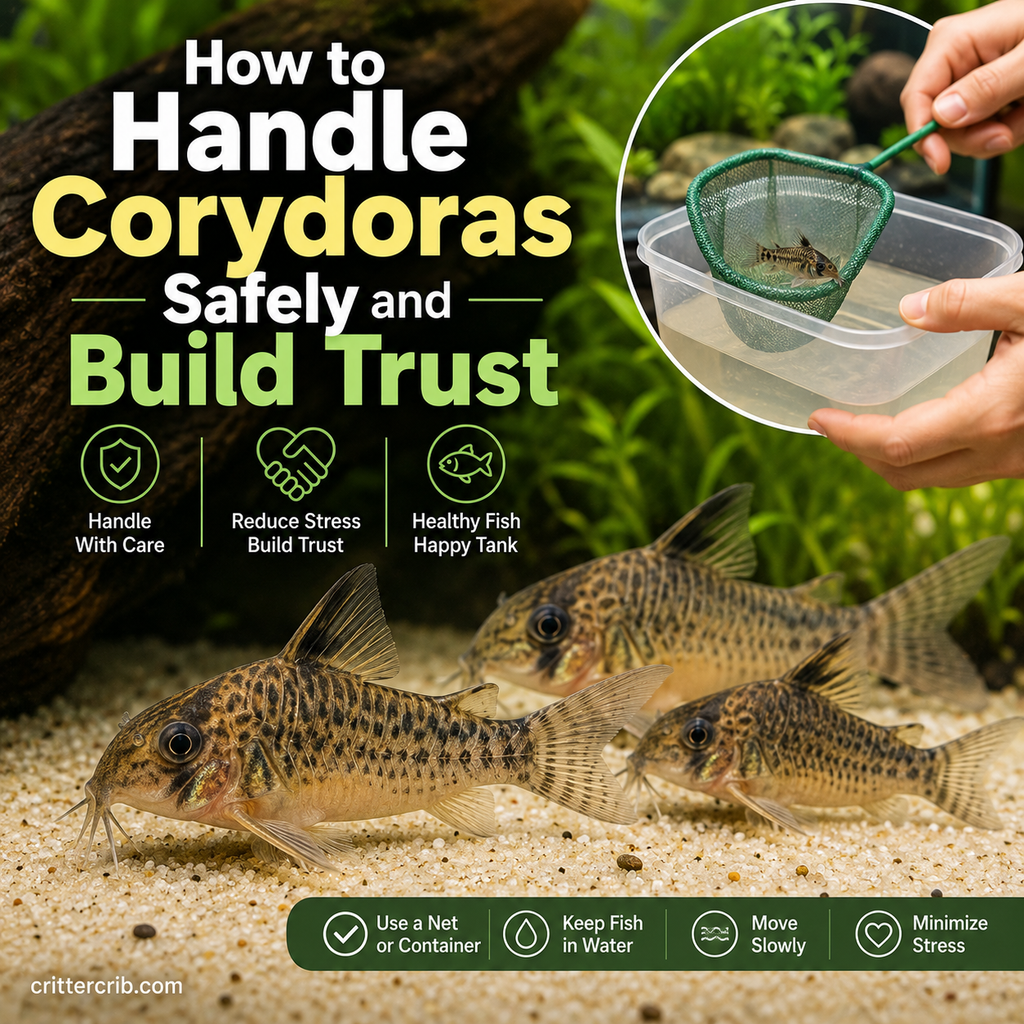
Corydoras catfish have a reputation for being peaceful, social, and endlessly entertaining. Spend enough time watching a group and you’ll see them sift through the substrate, dart toward the surface for air, rest together, and investigate just about everything on the bottom of the aquarium.
That friendly personality can make new owners wonder whether Corydoras can be handled or even taught to trust people.
They can certainly become comfortable with your presence. However, building trust with Corydoras isn’t about picking them up or touching them.
In fact, physical handling should generally be avoided unless it’s necessary.
Corydoras are small, delicate fish equipped with sharp fin spines that can injure both the fish and the person handling them. The safest way to build a relationship is through consistent feeding, calm movements, a comfortable environment, and predictable care.
When you do need to catch or transfer a Cory, knowing how to do it safely can prevent unnecessary stress and injury.
Here’s what every Corydoras keeper should know.
Should You Handle Corydoras With Your Hands?
Under normal circumstances, no.
Fish aren’t pets that benefit from being stroked, held, or picked up. Their bodies are adapted for life underwater, and unnecessary physical contact can damage the protective mucus layer covering their skin.
That mucus layer helps protect fish against:
- Pathogens
- Parasites
- Physical irritation
- Environmental stress
Handling can also frighten the fish.
For Corydoras, there’s another important concern: their fin spines.
Corydoras have stiff spines associated with their dorsal and pectoral fins. These structures help defend the fish against predators, but they can also become caught in nets or prick your skin.
The best approach is simple:
Enjoy your Corydoras inside the aquarium and only handle or transfer them when there’s a genuine reason.
Why Corydoras Have Sharp Spines
Corydoras may look harmless, but they have an effective defensive system.
Their pectoral and dorsal fin spines can lock into position when the fish feels threatened. This makes the Cory much harder for a predator to swallow.
It’s useful in nature.
It’s less convenient when you’re trying to move one between aquariums.
A frightened Cory may extend its spines while being caught. The spine can become tangled in fine aquarium netting, potentially injuring the fish while you try to free it.
The spines can also puncture human skin.
Some Corydoras species have defensive secretions associated with their spines, making it even more important to avoid getting pricked.
Treat their spines with respect even if your fish normally behaves calmly.
Can a Corydoras Sting You?
Corydoras aren’t aggressive fish that actively hunt down your hand and sting you.
However, their sharp fin spines can puncture skin if the fish is grabbed or handled carelessly.
Some species can also produce defensive toxins or irritating secretions associated with these spines.
For that reason:
- Don’t grab Corydoras with your bare hands.
- Don’t intentionally press against their fins.
- Be careful when removing them from nets or containers.
- Keep children from trying to catch them by hand.
- Use a container whenever possible when transferring them.
If you are punctured by a Corydoras spine, clean the wound promptly and monitor it. Seek medical advice if you develop significant pain, swelling, redness, signs of infection, an allergic reaction, or other concerning symptoms.
The easiest injury to deal with is the one that never happens, so minimizing direct contact is the best strategy.
When Would You Need to Handle a Corydoras?
Most Corydoras owners rarely need to physically handle their fish.
Situations where you may need to catch or move one include:
- Transferring it to another aquarium
- Moving to a new home
- Placing a fish in quarantine
- Moving a sick fish to a hospital tank
- Separating incompatible tank mates
- Performing major aquarium work
- Transporting fish to a veterinarian
- Rehoming a fish
Even in these situations, you don’t necessarily need to touch the fish.
A small aquarium-safe container can often be used instead.
The Safest Way to Catch a Corydoras
Catching Corydoras can be surprisingly challenging.
They’re quick when they want to be, and they’ll often dart around the bottom of the aquarium when a net appears.
Chasing them repeatedly increases stress.
Instead, prepare everything before you begin.
Gather Your Supplies First
Depending on the situation, you may need:
- Aquarium net
- Smooth aquarium-safe container
- Transport container or fish bag
- Aquarium water
- Towels for spills
- A lid for the transport container
If you’re moving the fish to another aquarium, make sure the destination is already prepared.
You don’t want to catch the fish and then realize you still need to adjust the heater, fill the tank, or rearrange decorations.
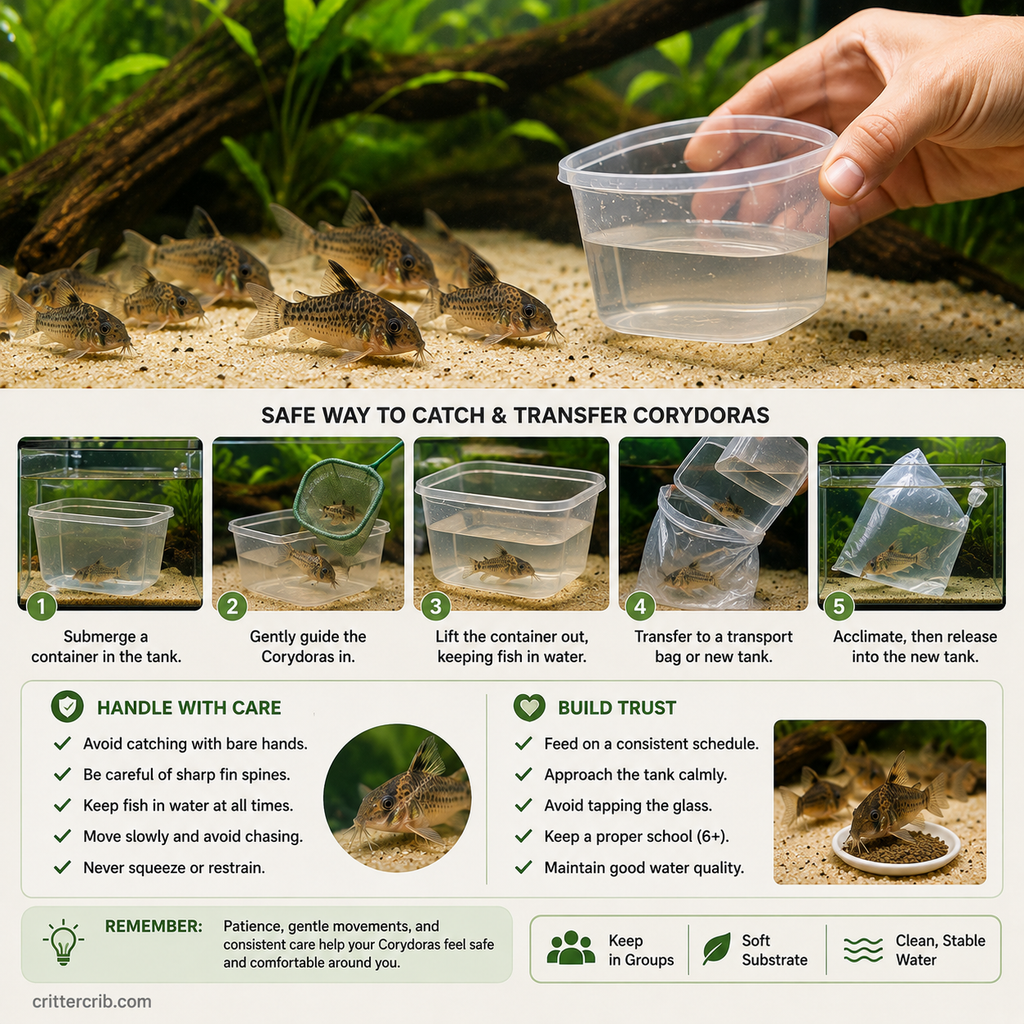
Using a Container Instead of a Net
For Corydoras, a smooth container can sometimes be safer than relying entirely on a net.
The goal is to guide the fish into the container while it remains underwater.
This reduces the chance of its spines becoming tangled.
Try the following approach:
- Lower an aquarium-safe container into the tank.
- Allow it to fill completely with aquarium water.
- Slowly guide the Cory toward the container.
- Use a net as a barrier or guide if necessary.
- Encourage the fish to swim into the container.
- Lift the container carefully while keeping the fish submerged.
Move slowly.
You aren’t trying to scoop the fish as quickly as possible.
You’re trying to guide it with minimal chasing and panic.
How to Use a Net Safely
Sometimes a net is still the most practical option.
Choose an appropriately sized aquarium net and move deliberately rather than rapidly chasing the fish around the tank.
It can help to use two nets.
One remains relatively stationary while the other gently guides the Cory toward it.
Once the fish enters the net, watch its fins carefully.
If a spine becomes caught, don’t pull the fish free.
Trying to force it out can damage the fin or spine.
Instead, keep the fish wet and carefully work the netting loose. If the fish is badly entangled or you can’t free it safely, getting experienced help is preferable to continuing to pull.
Never Chase a Corydoras Around the Tank
The more you chase a fish, the more frightened it becomes.
A stressed Cory may:
- Swim erratically
- Hide
- Breathe rapidly
- Extend its defensive spines
- Crash into decorations
- Become harder to catch
If your first attempt isn’t working, stop for a moment.
Consider temporarily removing movable decorations or lowering the water level when appropriate so the fish has fewer places to escape.
Always make sure any changes you make are safe for the other aquarium inhabitants.
Patience is usually more effective than speed.
Keep Corydoras in Water During Transfers
Whenever practical, keep the fish submerged.
A container transfer is useful because the Cory can remain underwater from the moment it’s caught until you’re ready to place it into another suitable container.
Brief air exposure during normal aquarium transfers isn’t necessarily catastrophic, but there’s no benefit to keeping a Cory out of water longer than necessary.
Remember that Corydoras occasionally swim to the surface and gulp atmospheric air.
That’s normal behavior.
It doesn’t mean they’re adapted to being held out of water.
Don’t Squeeze or Restrain a Corydoras
Never tightly grip a Cory to stop it from moving.
A struggling fish can easily injure itself against your fingers, and you could be punctured by a spine.
If direct handling becomes unavoidable for a veterinary or other legitimate reason, follow instructions from an aquatic veterinarian or experienced fish professional.
For ordinary aquarium transfers, a submerged container is usually the safer approach.
How to Transport Corydoras Safely
Moving Corydoras requires a little more care than simply catching them.
Use a secure fish-transport bag or suitable lidded container with enough water for the journey and appropriate air space.
Keep the transport container:
- Secure
- Upright
- Protected from extreme temperatures
- Away from direct sunlight
- Protected from excessive movement
- In a dark or dim environment when practical
Darkness can help reduce stress during transportation.
Be Careful When Bagging Corydoras
Corydoras spines can potentially puncture thin plastic bags.
If you’re transporting them in fish bags, double-bagging provides additional protection.
Place the second bag over the first so that the seams and corners aren’t aligned exactly the same way.
For longer or more complicated transportation, ask an experienced aquarium shop or aquatic veterinarian about appropriate fish-shipping methods.
Can Corydoras Release Toxins During Transport?
Some Corydoras species are known to release defensive substances when severely stressed.
This behavior is sometimes called “self-poisoning” among aquarium keepers because toxins released into a small volume of transport water may potentially affect the fish themselves.
Not every Corydoras will do this, and the risk varies among species and circumstances.
Still, it’s another reason to keep transport calm and minimize unnecessary stress.
For significant moves or shipping, experienced fish keepers may use specialized procedures to reduce transport risks.
For a simple move between aquariums in the same home, keeping the process short, calm, and well prepared is generally the best approach.
How to Acclimate Corydoras to a New Tank
After transportation, Corydoras may need time to adjust to differences in temperature and water chemistry.
Don’t simply dump a newly purchased fish and all of its store water into your aquarium.
A straightforward acclimation process can help reduce sudden changes.
Temperature Acclimation
A sealed fish bag can typically be floated in the aquarium for a short period to help equalize temperature.
Keep the aquarium lights dim during this process.
Water Chemistry
If the new aquarium differs significantly from the transport water, a gradual acclimation process may be appropriate.
However, don’t leave fish sitting in shipping water unnecessarily long, particularly after lengthy transportation.
The best acclimation method can vary depending on how long the fish has been transported and the condition of the water.
For locally purchased Corydoras that have only spent a short time in a bag, gradual acclimation is generally straightforward.
Once acclimated, transfer the fish without adding unnecessary store water to your established aquarium.
Give New Corydoras Time to Settle In
Don’t expect newly introduced Corydoras to immediately behave as though they’ve lived in your aquarium for years.
They may hide at first.
They may also remain unusually still or become more active after the lights go out.
Give them time.
For the first day or two:
- Keep lighting relatively subdued.
- Avoid tapping on the glass.
- Don’t constantly rearrange the aquarium.
- Keep sudden movements around the tank to a minimum.
- Make sure aggressive tank mates aren’t harassing them.
- Monitor their breathing and general behavior.
Once they realize the environment is safe, their normal activity usually becomes more apparent.
How to Build Trust With Corydoras
Trust with fish looks different from trust with mammals.
Your Cory isn’t going to climb onto your lap.
Instead, trust means the fish no longer treats your presence as an immediate threat.
A comfortable Corydoras may continue foraging when you’re nearby, swim toward familiar feeding areas, or become less likely to hide when you approach.
That relationship develops through consistency.
Feed on a Predictable Schedule
Food is one of the easiest ways to create positive associations.
Feed your Corydoras at roughly consistent times.
Over time, they may begin associating your presence with feeding.
Suitable foods can include:
- Quality sinking pellets or wafers
- Appropriate frozen foods
- Appropriate live foods
- Gel foods formulated for omnivorous fish
- Other nutritionally balanced sinking foods
Corydoras aren’t simply “cleanup fish.”
They need their own appropriate diet and shouldn’t be expected to survive on scraps left by other fish.
Approach the Aquarium Calmly
Imagine seeing an enormous figure suddenly rush toward your home.
That’s essentially what a fast-moving person can look like to a small fish.
You don’t need to creep around your aquarium, but calm movements help.
When approaching the tank:
- Walk normally rather than rushing.
- Avoid suddenly waving your hands against the glass.
- Don’t tap the aquarium.
- Keep loud impacts around the tank to a minimum.
Over time, your Corydoras will become accustomed to normal household activity.
Spend Time Near the Aquarium
One of the simplest ways to help fish become comfortable with you is simply being present.
Sit near the aquarium while reading, working, or watching the fish.
At first, shy Corydoras may retreat when you approach.
Eventually, they may realize that your presence doesn’t result in anything threatening.
This is especially useful with newly introduced fish.
You don’t need to interact constantly.
Consistency does most of the work.
Keep Corydoras in a Proper Group
Corydoras are social fish.
Most species are much more comfortable when kept with several others of their own kind.
A group of at least six of the same Corydoras species is a commonly recommended starting point.
Larger groups can be even better when aquarium size and filtration allow.
A lone Cory may be much more cautious and withdrawn.
When Corydoras feel secure in a group, you’re more likely to see natural behaviors such as:
- Group foraging
- Resting together
- Exploring the aquarium
- Following one another
- Short bursts of energetic swimming
Providing appropriate social conditions is one of the most effective ways to help them feel secure.
Create a Cory-Friendly Aquarium
You can’t build trust while the fish is constantly stressed by its environment.
Corydoras spend much of their time exploring the bottom of the aquarium, so the substrate deserves particular attention.
Choose a Smooth Substrate
Fine sand is a popular choice for Corydoras because it allows them to sift naturally through the substrate.
Smooth, fine gravel may also work depending on its texture.
Avoid sharp or jagged substrate that could potentially injure their barbels or underside.
Provide Hiding Places
Give your Corydoras somewhere to retreat when they want privacy.
Good options include:
- Live plants
- Driftwood
- Smooth caves
- Rock structures
- Shaded areas
Hiding places can actually make shy fish more confident.
When fish know there’s somewhere safe to retreat, they’re often more willing to explore.
Leave Open Foraging Areas
Don’t cover every inch of the aquarium with decorations.
Corydoras appreciate open areas where they can search the substrate for food.
A combination of shelter and open bottom space usually works well.
Maintain Good Water Quality
Nothing builds confidence in a fish faster than an environment where it consistently feels comfortable.
Corydoras need a properly cycled aquarium with stable water conditions.
Aim for:
- Ammonia: 0 ppm
- Nitrite: 0 ppm
- Nitrate: kept under control
- Stable temperature
- Appropriate pH for your Corydoras species
- Adequate oxygenation
Different Corydoras species come from somewhat different environments, so research the specific species you’re keeping rather than assuming every Cory has identical requirements.
Regular partial water changes and appropriate filtration are essential.
Don’t Try to Hand-Feed Too Quickly
You may see videos of aquarium fish taking food directly from someone’s fingers.
That doesn’t mean you need to train your Corydoras to do it.
Dropping sinking food into a consistent location is usually enough to build a positive association.
If your fish eventually becomes comfortable approaching your hand while you’re performing aquarium maintenance, that’s fine.
But don’t chase it with food or repeatedly reach toward it in an attempt to force interaction.
Trust develops when the fish is allowed to choose how close it wants to come.
Can You Hand-Feed Corydoras?
Some Corydoras may become comfortable enough to eat very close to your hand.
However, traditional hand-feeding isn’t particularly necessary for bottom-feeding Corydoras.
A safer and more natural approach is to place food on the substrate in front of them.
You can use feeding tongs or a feeding tube if you want more precise food placement.
This gives you some interaction without encouraging unnecessary physical contact.
Don’t Touch Corydoras to “Tame” Them
Touching isn’t how you tame a fish.
Repeatedly attempting to stroke or catch Corydoras is more likely to teach them that your hand is dangerous.
Instead, let them become accustomed to your presence during normal activities such as:
- Feeding
- Water changes
- Plant trimming
- Glass cleaning
- Routine observation
Eventually, you may notice them continuing to forage while your hand is elsewhere in the aquarium.
That’s a much better sign of trust than allowing themselves to be touched.
Signs Your Corydoras Is Becoming Comfortable With You
Every fish behaves differently, but a comfortable group of Corydoras may:
- Remain visible when you approach
- Continue foraging while you’re nearby
- Gather around familiar feeding areas
- Swim toward food when you enter the room
- Explore openly during the day
- Rest in visible areas
- Show normal group behavior
Don’t expect every Cory to become outgoing.
Some individuals and species are naturally more cautious than others.
The goal isn’t to make your fish perform.
It’s to create an environment where they feel secure enough to behave naturally.
Signs a Corydoras May Be Stressed
Pay attention when normal behavior suddenly changes.
Possible signs of stress include:
- Constant hiding
- Rapid breathing
- Clamped fins
- Loss of appetite
- Erratic swimming
- Unusual inactivity
- Repeated frantic movements
- Changes in coloration
- Separating from the group
Remember that occasional trips to the surface are normal for Corydoras.
They can gulp atmospheric air and absorb oxygen through their intestines.
Repeated frantic surface activity combined with other signs of distress, however, deserves investigation.
Whenever behavior changes suddenly, check water temperature and test ammonia, nitrite, nitrate, and other relevant parameters.
Common Corydoras Handling Mistakes
A few simple mistakes can make catching and transferring Corydoras unnecessarily stressful.
Picking Them Up for Fun
Corydoras don’t benefit from being removed from the water and held.
Keep physical handling limited to situations where it’s genuinely necessary.
Grabbing Them With Bare Hands
Their fin spines can injure you, and squeezing can injure the fish.
Use an aquarium-safe container whenever possible.
Chasing Them With a Net
Repeatedly pursuing a Cory around the aquarium creates unnecessary stress.
Guide rather than chase.
Pulling a Cory From a Tangled Net
If a spine becomes caught in netting, don’t yank the fish free.
Keep it wet and carefully loosen the material.
Tapping on the Glass
Tapping can startle aquarium fish and doesn’t help them become comfortable around people.
Forcing Interaction
Let your Corydoras decide how close they want to get.
Predictable, non-threatening care is much more effective than trying to force a fish to interact.
A Simple Routine for Building Trust
You don’t need complicated training exercises.
Try this straightforward approach:
- Keep your Corydoras in an appropriate group.
- Maintain excellent water quality.
- Provide hiding places and open foraging areas.
- Approach the aquarium calmly.
- Feed at reasonably consistent times.
- Place sinking food in a predictable area.
- Spend time near the aquarium without disturbing it.
- Avoid tapping the glass or chasing the fish.
- Perform maintenance calmly and consistently.
- Allow the Corydoras to approach on their own terms.
Give it time.
Some groups settle in within days, while shy fish may need considerably longer.
Frequently Asked Questions About Handling Corydoras
Can You Pick Up a Corydoras?
It’s best to avoid picking up Corydoras with your hands.
Their defensive fin spines can puncture skin, and physical handling can damage or stress the fish. Use an aquarium-safe container when transferring them whenever possible.
Are Corydoras Spines Dangerous?
Their dorsal and pectoral fin spines are sharp enough to puncture skin.
Some species also produce defensive secretions associated with their spines, so Corydoras should be handled carefully.
Do Corydoras Recognize Their Owners?
Corydoras can become accustomed to routines and may learn to associate your presence with feeding.
Whether that’s “recognition” in the way humans think about it is difficult to say, but experienced aquarium keepers commonly observe fish responding predictably to familiar feeding cues and people approaching the tank.
Can You Pet a Corydoras?
You shouldn’t intentionally pet Corydoras.
Touching can disturb their protective mucus layer and doesn’t provide the kind of social interaction these fish need.
Watching and feeding them is a safer way to interact.
Why Does My Corydoras Hide When It Sees Me?
New or naturally shy Corydoras may view movement outside the aquarium as a potential threat.
Give the fish time, approach calmly, provide hiding places, and maintain a proper social group.
Many become more confident once they adjust to their environment.
Why Does My Cory Swim to the Surface?
Occasional surface trips are normal.
Corydoras can gulp atmospheric air at the surface and absorb oxygen through their intestinal tract.
However, frequent frantic trips to the surface combined with rapid breathing or other unusual behavior may indicate poor water quality, inadequate oxygenation, excessive temperature, or another problem.
How Many Corydoras Should Be Kept Together?
Corydoras are social fish, and a group of at least six of the same species is a good general starting point.
Make sure your aquarium has enough space and filtration for the entire group.
Final Thoughts
The safest way to handle Corydoras is usually not to handle them at all.
These peaceful little catfish don’t need physical affection to develop a comfortable relationship with their keeper. In fact, picking them up can create unnecessary stress and expose both you and the fish to injury from their sharp defensive spines.
When you do need to move a Corydoras, preparation and patience matter.
Whenever possible, guide the fish into a smooth container while keeping it underwater. Avoid prolonged chasing, squeezing, or pulling a fish from tangled netting.
Building trust is much simpler.
Give your Corydoras a proper group, smooth substrate, hiding places, clean water, good food, and a predictable routine. Approach the aquarium calmly and allow the fish to become accustomed to you at its own pace.
Eventually, the real sign of trust isn’t that your Cory lets you touch it.
It’s that you can walk up to the aquarium and your fish simply carries on being a Cory—sifting through the sand, exploring with its group, and perhaps heading toward its favorite feeding spot because it knows dinner might be coming.