Budgies may be small birds, but bringing one home can be a surprisingly long commitment. With good care, a healthy budgie can be part of your household for many years.
So, how long do budgies live?
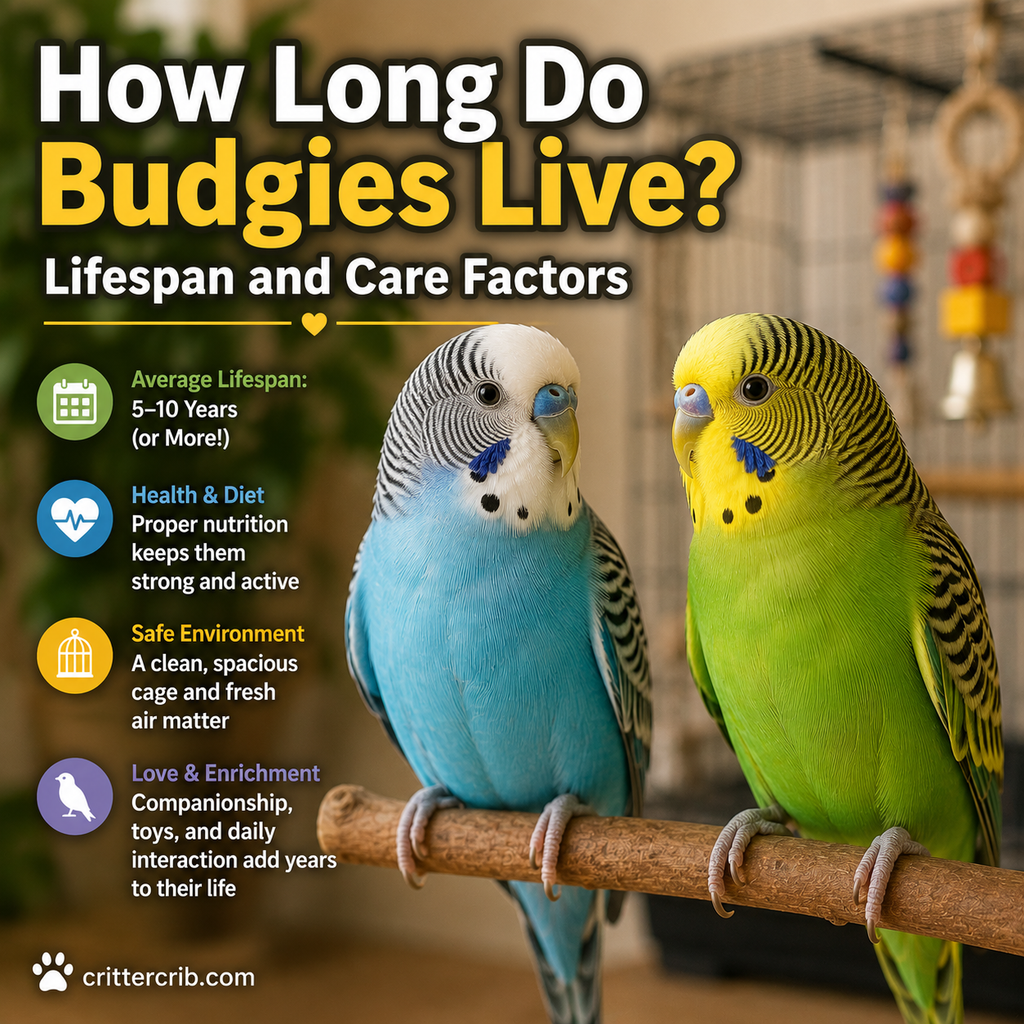
A pet budgie commonly lives around 5 to 10 years, but some can live considerably longer. With excellent nutrition, a safe environment, regular exercise, and appropriate veterinary care, some budgies reach 10 to 15 years or more.
There’s no way to predict exactly how long an individual bird will live. Genetics play a role, but so do everyday factors such as diet, weight, exercise, housing, exposure to household hazards, and how quickly health problems are recognized.
Understanding those factors gives you the best chance of helping your budgie live a long, healthy life.
What Is the Average Lifespan of a Budgie?
For pet budgies, a lifespan of approximately 5 to 10 years is common.
However, that’s a broad average rather than an expiration date.
Some budgies live fewer than five years because of illness, accidents, genetics, poor nutrition, or other health problems. Others remain active well beyond 10 years.
Under excellent conditions, a budgie may live into its early teens and occasionally beyond.
It’s helpful to think of budgie lifespan as a range rather than one specific number.
How Long Can Budgies Live in Captivity?
Pet budgies can potentially live longer than wild budgies because they don’t face many of the dangers present in nature.
A well-cared-for pet usually has:
- Reliable access to food
- Clean drinking water
- Protection from predators
- Shelter from extreme weather
- Access to veterinary care
- A controlled environment
- Protection from many diseases and injuries
But captivity doesn’t automatically guarantee a long life.
A pet bird can still develop nutritional deficiencies, obesity, tumors, infections, liver problems, injuries, and other medical conditions.
The quality of care matters enormously.
How Long Do Budgies Live in the Wild?
Wild budgerigars live in Australia, where survival can be unpredictable.
They face challenges that pet birds generally don’t, including:
- Predators
- Food shortages
- Drought
- Extreme temperatures
- Disease
- Competition
- Injuries
- Long-distance travel
Because of these pressures, many wild birds don’t reach the maximum lifespan the species is biologically capable of achieving.
Pet budgies avoid many of these threats, which gives them the potential to live longer when they’re properly cared for.
Can Budgies Live 15 Years?
Yes, some budgies can reach 15 years.
That doesn’t mean every healthy budgie will.
Longevity depends on a combination of genetics, breeding history, nutrition, environment, activity, preventive care, and plain luck.
Rather than aiming for a particular birthday, focus on maintaining your bird’s health and quality of life throughout every stage.
A healthy nine-year-old budgie with good mobility, appetite, and interest in its surroundings is more important than simply reaching a particular number.
What Determines How Long a Budgie Lives?
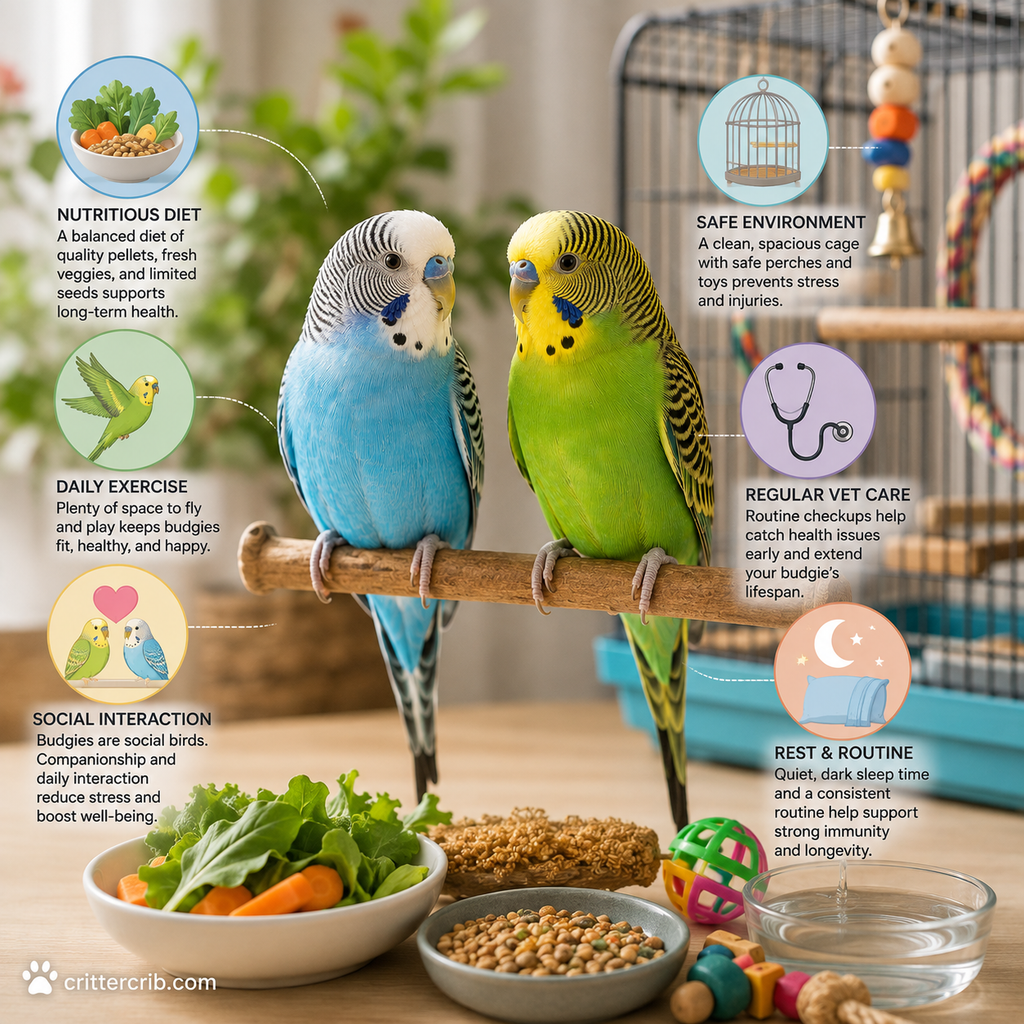
There isn’t one secret to extending a budgie’s lifespan.
Longevity is influenced by many factors working together.
Some you can control. Others you can’t.
The most important factors include:
- Genetics
- Diet
- Body weight
- Exercise
- Cage setup
- Mental stimulation
- Social interaction
- Veterinary care
- Air quality
- Household safety
- Sleep
- Stress
- Disease prevention
Let’s look at each one more closely.
Genetics and Breeding Matter
You can provide excellent care and still encounter health problems that are influenced by genetics.
Budgies bred without careful attention to health may have a greater risk of inherited weaknesses or certain medical conditions.
You usually can’t determine a bird’s future health simply by looking at it.
If you’re getting a budgie from a breeder, ask about:
- The age of the bird
- Parent health
- Breeding practices
- Known health problems
- Veterinary history
- How the young birds are raised and weaned
Regardless of where your budgie comes from, arranging an initial examination with an avian veterinarian is a good idea.
Diet Can Have a Major Impact on Lifespan
Nutrition is one of the most important aspects of long-term budgie care.
Historically, many pet budgies have been fed primarily seed mixtures.
Budgies certainly enjoy seeds, but an all-seed diet can be high in fat and deficient in important nutrients.
Over time, poor nutrition may contribute to health problems.
A more balanced diet generally includes an appropriately formulated budgie food along with suitable fresh vegetables and other bird-safe foods.
Healthy fresh options may include:
- Leafy greens
- Broccoli
- Bell peppers
- Carrots
- Peas
- Herbs
- Other bird-safe vegetables
Fruit can also be offered appropriately, usually in smaller quantities because of its sugar content.
Don’t Change a Budgie’s Diet Suddenly
If your budgie currently eats only seeds, don’t remove them overnight and replace the bowl with unfamiliar pellets.
Birds don’t necessarily recognize a new item as food simply because it’s edible.
A small bird that stops eating can become ill quickly.
Diet conversions should be gradual, and an avian veterinarian can help you determine an appropriate nutritional plan for your individual bird.
Keep Your Budgie at a Healthy Weight
Budgies are tiny, so even a small amount of excess body fat can be significant.
Obesity can contribute to health problems and make exercise more difficult.
The opposite is also concerning.
Unexpected weight loss can be an early sign of illness.
Because visual changes can be difficult to notice under feathers, many experienced bird owners monitor weight using a small gram scale.
Ask your avian veterinarian what weight range and body condition are appropriate for your bird.
A trend is often more useful than one isolated measurement.
If a budgie that normally weighs roughly the same suddenly begins losing weight, contact your veterinarian.
Exercise Supports Long-Term Health
Budgies are active birds designed to fly.
A small cage that allows little movement doesn’t provide much opportunity for exercise.
Choose a spacious cage with room to move between perches, climb, play, and stretch the wings.
Supervised out-of-cage time in a bird-safe room can provide additional exercise.
Before allowing your budgie to fly freely:
- Close windows
- Secure exterior doors
- Turn off ceiling fans
- Remove other pets
- Cover obvious hazards
- Close toilet lids
- Remove access to hot surfaces
- Keep toxic plants out of reach
Flight and movement support both physical and mental well-being.
Cage Size and Setup Matter
Your budgie will spend a significant amount of time inside its cage, so the environment should encourage healthy behavior.
A good setup includes:
- Enough horizontal space for movement
- Safe bar spacing
- Natural perches
- Perches of different diameters
- Food and water dishes
- Chewing toys
- Foraging opportunities
- Climbing activities
- Open space for movement
Avoid overcrowding the cage with toys.
More accessories don’t automatically create a better environment if the bird can barely move between them.
Mental Stimulation Is Important
Budgies are intelligent parrots.
A bird living in an unchanging cage with nothing to investigate can become bored.
Provide opportunities for:
- Chewing
- Shredding
- Foraging
- Climbing
- Exploring
- Training
- Playing
- Social interaction
Rotate toys periodically to introduce variety.
You don’t need to replace everything at once. In fact, some budgies are cautious about unfamiliar objects.
Introduce changes gradually and observe your bird’s reaction.
Social Interaction Can Affect Quality of Life
Budgies are highly social.
In the wild, they live in groups and spend much of their time communicating and interacting with other birds.
A pet budgie needs meaningful social opportunities too.
That might come from:
- A compatible budgie companion
- Regular interaction with people
- Training sessions
- Talking and whistling
- Supervised play
A single budgie can live successfully with people when it receives plenty of appropriate interaction.
If you keep multiple budgies, make sure they have enough space and resources to avoid constant competition.
Sleep Is Easy to Overlook
Sleep is part of good bird care.
Budgies generally benefit from around 10 to 12 hours of quiet, darkness, and uninterrupted rest each night.
A cage in a living room where televisions and lights remain on until 1 a.m. may make consistent sleep difficult.
Try to establish a predictable day-and-night schedule.
Some owners cover the cage at night, while others provide a quiet sleeping area.
A cover isn’t mandatory, but the bird should have a dark, calm environment with adequate ventilation.
Regular Veterinary Care Can Help Budgies Live Longer
One of the most valuable things you can do is establish a relationship with an avian veterinarian before there’s an emergency.
Birds are very good at hiding signs of illness.
By the time a budgie looks obviously sick, the condition may already be advanced.
Routine examinations can help establish what’s normal for your bird and may identify problems before they become more serious.
Don’t wait for dramatic symptoms before seeking help.
Learn the Early Signs of Illness
Knowing your budgie’s normal behavior makes changes easier to spot.
Potential warning signs include:
- Persistent feather fluffing
- Reduced appetite
- Weight loss
- Unusual droppings
- Reduced activity
- Sitting on the cage floor
- Difficulty perching
- Open-mouth breathing
- Noticeable tail bobbing while breathing
- Discharge around the eyes or nostrils
- Sudden behavioral changes
- Unusual weakness
A budgie that’s quieter than normal isn’t necessarily sick.
But a normally active bird that suddenly becomes quiet, fluffed up, and uninterested in food should be taken seriously.
Contact an avian veterinarian if you’re concerned.
Household Accidents Can Shorten a Budgie’s Life
Some of the biggest threats to pet budgies aren’t diseases.
They’re accidents.
A free-flying budgie can encounter numerous household hazards.
Common dangers include:
- Open doors
- Open windows
- Ceiling fans
- Hot stovetops
- Boiling water
- Open toilets
- Deep water containers
- Electrical cords
- Toxic plants
- Dogs and cats
- Heavy objects
- Small spaces where the bird can become trapped
Bird-proofing should happen before the cage door opens.
Never rely on the assumption that your budgie “knows better.”
Air Quality Is Extremely Important
Birds have highly efficient respiratory systems, which also makes them vulnerable to airborne contaminants.
Keep budgies away from:
- Cigarette smoke
- Vaping aerosols
- Aerosol sprays
- Scented candles
- Essential oil diffusers
- Strong cleaning fumes
- Paint fumes
- Cooking smoke
- Overheated nonstick cookware
Certain fumes that seem minor to humans can be dangerous or even fatal to birds.
A clean cage in a room with poor air quality is not a healthy environment.
Temperature and Humidity Affect Comfort
Healthy budgies generally do well at comfortable household temperatures.
Approximately 65°F to 80°F (18°C to 27°C) is a reasonable range for many healthy birds, with temperatures around 70°F to 75°F (21°C to 24°C) being comfortable in many homes.
Avoid sudden temperature swings and direct drafts.
Moderate indoor humidity—roughly 40% to 60%—is also a reasonable target.
Extreme heat, cold, dryness, or humidity can create additional stress.
Sick, elderly, very young, or recovering birds may have different environmental requirements.
Keep the Cage Clean
Good hygiene reduces exposure to spoiled food, mold, and excessive waste.
Basic cage maintenance includes:
- Providing fresh water daily
- Washing dirty dishes
- Removing spoiled fresh foods
- Replacing cage liners regularly
- Cleaning dirty perches
- Removing accumulated droppings
- Washing the cage as needed
Avoid strong fumes while cleaning.
Bird-safe cleaning methods are always preferable around the cage.
Do Male or Female Budgies Live Longer?
There isn’t a simple rule that one sex will always live longer.
Both male and female budgies can reach advanced ages with good care.
Female birds do face certain reproductive health risks that males don’t, including problems associated with egg laying.
A female can sometimes produce eggs even without a male present.
If your female budgie begins laying eggs or shows signs of reproductive problems, consult an avian veterinarian.
Does Color Affect a Budgie’s Lifespan?
Color alone isn’t a reliable way to predict lifespan.
Budgies come in many colors and mutations because of selective breeding.
Genetics and breeding practices can influence health, but you shouldn’t assume that a particular color automatically means a bird will live longer or shorter.
Focus on the individual bird’s health, history, care, and environment.
How Can You Tell How Old a Budgie Is?
Estimating the age of a young budgie can sometimes be possible based on physical characteristics such as forehead markings, eye appearance, and other developmental features.
Once a budgie reaches adulthood, determining its exact age by appearance becomes much more difficult.
If the bird has a breeder leg band or documented history, you may be able to establish its age more accurately.
Otherwise, an adult budgie described as “two years old” based purely on appearance may only be an estimate.
What Happens as Budgies Get Older?
Aging doesn’t happen exactly the same way in every bird.
An older budgie may gradually:
- Become less active
- Sleep more
- Move more carefully
- Spend less time flying
- Develop changes in feather condition
- Have more difficulty gripping certain perches
- Require closer health monitoring
Don’t automatically assume every change is simply old age.
Reduced activity, weight loss, weakness, or difficulty perching can also indicate illness.
Veterinary evaluation becomes particularly important as a bird ages.
Adjust the Cage for an Older Budgie
Senior budgies may benefit from habitat adjustments.
Depending on the bird’s mobility, you might:
- Lower some perches
- Provide easier routes between important areas
- Use comfortable natural perches
- Keep food and water easily accessible
- Reduce the risk of long falls
- Add platforms if recommended
- Monitor weight more frequently
The goal isn’t to remove all activity.
It’s to make normal movement safer and easier.
How to Help Your Budgie Live a Long Life
You can’t control genetics or guarantee a particular lifespan.
You can control many aspects of everyday care.
Focus on these fundamentals:
- Feed a balanced diet.
- Maintain a healthy body weight.
- Provide a spacious, stimulating cage.
- Encourage regular exercise.
- Offer social interaction.
- Provide toys and foraging opportunities.
- Maintain consistent sleep.
- Keep the cage and dishes clean.
- Protect your bird from household hazards.
- Maintain excellent air quality.
- Schedule appropriate veterinary care.
- Respond quickly to changes in behavior or health.
None of these individually guarantees longevity.
Together, they give your budgie a much better foundation for a healthy life.
Frequently Asked Questions About Budgie Lifespan
How Long Do Budgies Usually Live as Pets?
Many pet budgies live approximately 5 to 10 years.
With excellent care, some reach 10 to 15 years or potentially longer.
Can a Budgie Live 20 Years?
A budgie reaching 20 would be exceptionally old.
Reports of very long-lived budgies exist, but owners shouldn’t consider 20 years a typical lifespan.
Planning for a potential commitment of 10 years or more is still sensible.
Why Do Some Budgies Die Young?
Early death can result from many causes, including genetic problems, disease, nutritional deficiencies, accidents, toxins, reproductive complications, and undiagnosed medical conditions.
Sometimes a bird can become seriously ill despite receiving good care.
Do Budgies Live Longer Alone or in Pairs?
There’s no simple rule that being alone or paired directly determines lifespan.
Social well-being is important, though.
A single budgie needs plenty of appropriate human interaction, while multiple budgies need sufficient space, compatible relationships, and access to resources.
Do Indoor Budgies Live Longer?
Indoor pet budgies are protected from many environmental hazards, predators, and weather extremes.
However, indoor environments contain their own risks, including toxic fumes, other pets, ceiling fans, open windows, and poor diets.
Good management matters more than simply being indoors.
At What Age Is a Budgie Considered Old?
There’s no exact birthday when every budgie becomes “senior.”
A budgie approaching the later portion of its expected lifespan—often somewhere around seven years and beyond—may benefit from closer monitoring for age-related changes.
Individual birds age differently.
Can Better Food Make a Budgie Live Longer?
Nutrition can significantly influence overall health, but no food can guarantee a longer life.
A balanced diet helps reduce the risk of nutritional problems and supports healthy body condition, organ function, and immune health.
What’s the Most Important Thing for a Long-Lived Budgie?
There isn’t one single factor.
A combination of good nutrition, exercise, social interaction, safe housing, clean air, proper sleep, preventive veterinary care, and quick attention to health changes provides the strongest foundation.
Final Thoughts
So, how long do budgies live?
A typical pet budgie may live around 5 to 10 years, while well-cared-for individuals can reach 10 to 15 years or more.
That’s considerably longer than some first-time owners expect from such a small bird.
Lifespan isn’t determined by one thing. Genetics certainly matter, but everyday care matters too.
A balanced diet, healthy weight, exercise, social interaction, mental stimulation, good sleep, clean housing, safe air, and regular veterinary care can all contribute to a healthier life.
Just as important is knowing your individual bird.
Learn how much your budgie normally eats. Notice its usual activity level. Pay attention to its droppings, weight, vocalizations, and behavior.
When something changes, don’t ignore it.
You can’t guarantee that your budgie will reach 10, 12, or 15 years old. What you can do is create the conditions that give it the best opportunity to remain healthy, active, and comfortable for as many years as possible.
And when you’re considering getting a budgie in the first place, remember that this little bird isn’t necessarily a short-term pet.
It may be your companion for a decade or longer.