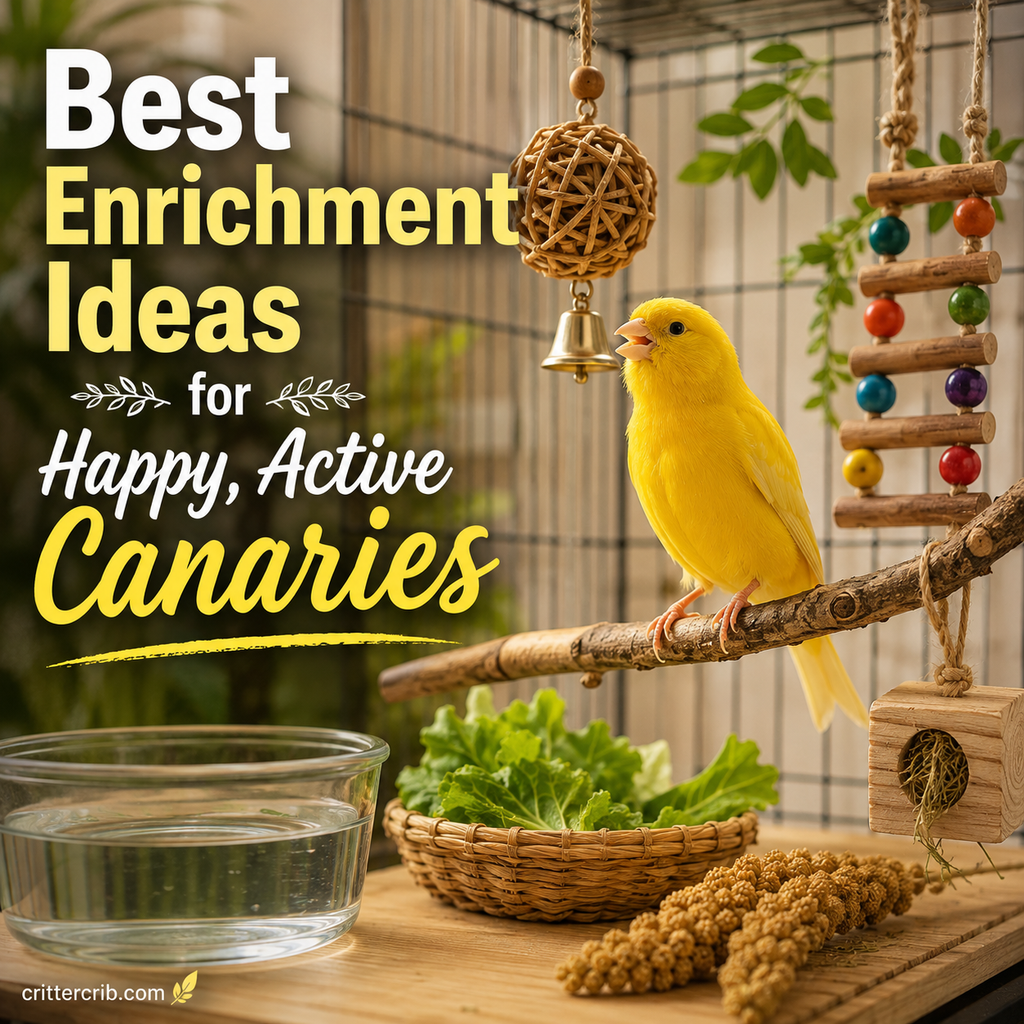
Canaries are famous for their beautiful songs, but there’s much more to these little birds than sitting on a perch and singing.
They’re active, curious animals that naturally spend their days flying, searching for food, bathing, exploring, and responding to what’s happening around them. A cage that provides only food, water, and one or two perches may meet basic physical needs, but it doesn’t give a canary much to do.
That’s where enrichment comes in.
Canary enrichment doesn’t have to mean filling the cage with complicated toys. In fact, many canaries aren’t interested in parrot-style toys designed for chewing and manipulating with a powerful beak.
For canaries, some of the best enrichment comes from movement, foraging, bathing, varied perches, fresh foods, and a thoughtfully arranged environment.
Here are practical ways to keep your canary active, curious, and engaged.
What Is Enrichment for Canaries?
Enrichment means providing opportunities for your canary to perform natural behaviors and interact with its environment.
That can include:
- Flying
- Hopping
- Foraging
- Bathing
- Exploring
- Singing
- Investigating food
- Moving between different perches
- Responding to sounds and activity
- Interacting with appropriate natural materials
Good enrichment gives your bird choices.
Instead of spending the entire day sitting beside a food bowl, your canary has reasons to move around and investigate different parts of its environment.
Why Do Canaries Need Enrichment?
Wild canaries don’t spend their day inside a small area with food conveniently placed beside their favorite perch.
They move.
They search for food, respond to other birds, explore vegetation, bathe, avoid threats, and continually process information about their surroundings.
Pet canaries live much safer lives, but that convenience also removes many of the activities that would normally occupy their time.
Enrichment helps replace some of those opportunities.
It can encourage:
- Physical exercise
- Mental stimulation
- Natural behaviors
- Exploration
- Environmental confidence
- Variety in the daily routine
You don’t need to entertain your canary every minute.
The goal is to create an environment that gives the bird interesting things to do independently.
Start With a Spacious Cage
One of the best forms of enrichment is simply having room to move.
Canaries are flying birds.
When choosing a cage, prioritize horizontal space rather than height alone. A long rectangular cage gives your bird more opportunity to move between opposite sides.
A tall, narrow cage may look spacious based on total dimensions but provide relatively little usable flight distance.
Arrange the cage so there’s an open path through the middle.
Don’t fill that valuable space with toys and perches.
Encourage Flight Between Perches
Perch placement can turn an ordinary cage into a more active environment.
Instead of putting several perches close together, position some farther apart.
This encourages your canary to fly or hop between them.
For example, you might place:
- One perch toward the upper left
- Another toward the upper right
- A lower perch near a feeding station
- A separate perch near a bath
Your bird now has a reason to move throughout the cage.
Avoid creating a dense ladder of perches that allows the canary to reach everything with one or two tiny hops.
Provide Different Types of Perches
Perch variety is both environmental enrichment and an important part of foot care.
Natural bird-safe branches are particularly useful because they have irregular surfaces and changing diameters.
Your canary’s feet don’t remain in exactly the same position all day.
Consider providing a mixture of:
- Natural wood branches
- Commercial natural perches
- Appropriately sized smooth perches
- Bird-safe swings
Avoid relying entirely on identical dowel perches.
Also avoid abrasive sandpaper perch covers as everyday standing surfaces.
Rearrange Perches Occasionally
You don’t need to redesign the cage every week.
Constant major changes could actually make a cautious bird uncomfortable.
However, occasionally moving a perch or changing one part of the setup can provide something new to investigate.
Make small adjustments rather than transforming the entire habitat overnight.
Your canary should still have familiar places to eat, drink, and sleep.
Offer a Canary Bath
Bathing is one of the simplest and most effective enrichment activities for many canaries.
Some birds become visibly excited when fresh bath water appears.
Use a shallow bird bath that’s appropriate for your canary’s size.
You can offer it regularly and allow your bird to decide whether it wants to bathe.
A canary may:
- Hop into the water
- Splash vigorously
- Dip its head
- Shake water through its feathers
- Preen afterward
Remove dirty bath water when your bird finishes rather than leaving contaminated water available all day.
Make Bathing Part of the Routine
Canaries often learn routines quickly.
If you offer a bath around the same part of the day, your bird may begin anticipating it.
That anticipation itself adds variety to the daily schedule.
Try offering bath water during the morning or earlier part of the day so your bird has plenty of time to dry before nighttime.
Never force a canary into water.
If your bird isn’t interested, simply try again another day.
Use Food as Enrichment
Food doesn’t always have to appear in exactly the same bowl in exactly the same location.
You can use appropriate foods to encourage exploration.
This doesn’t mean hiding your canary’s entire diet or making the bird struggle to eat.
Start with small, easy challenges.
For example, you can offer a favorite bird-safe food in a different location or present leafy greens in a way that encourages your bird to investigate.
Introduce Simple Foraging
Foraging doesn’t need to involve an elaborate puzzle.
For a canary that’s never had to search for food, simple is better.
You might:
- Place a small amount of a favorite appropriate food in an easy-to-find location.
- Allow the bird to become comfortable visiting it.
- Gradually make the location slightly more interesting.
- Introduce simple bird-safe foraging opportunities as your canary gains confidence.
Always make sure your bird continues eating its normal diet.
Enrichment should add interest, not make basic nutrition difficult to obtain.
Offer Fresh Greens and Vegetables
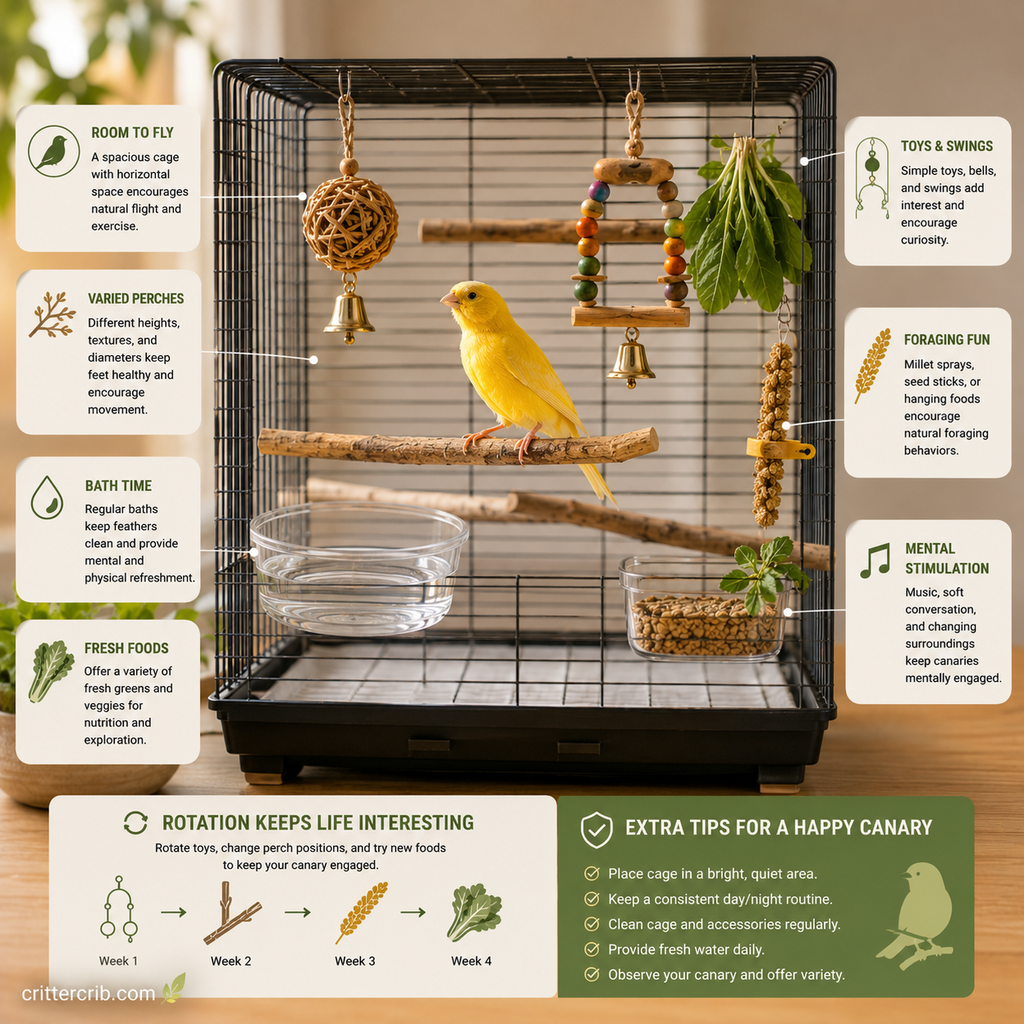
Fresh foods can provide nutritional variety while also giving your canary new textures, shapes, and colors to explore.
Depending on your bird’s diet and veterinary recommendations, appropriate options may include small amounts of bird-safe foods such as:
- Broccoli
- Carrot
- Bell pepper
- Kale
- Romaine lettuce
- Other suitable leafy greens
Wash fresh produce thoroughly.
Introduce unfamiliar foods gradually and remove uneaten fresh food before it spoils.
Never assume a human food is safe for birds. Check first if you’re uncertain.
Hang Bird-Safe Greens for Exploration
Instead of always putting fresh greens in a dish, you can securely attach them to an appropriate area of the cage.
This encourages your canary to approach, investigate, and nibble.
Make sure anything used to attach food is bird-safe and can’t create an entanglement hazard.
Position the food somewhere clean rather than underneath a favorite perch.
A simple change in presentation can turn an ordinary food into an activity.
Provide Canary-Appropriate Toys
Canaries don’t necessarily play with toys the same way parrots do.
A parrot may spend an hour dismantling a wooden puzzle with its beak. A canary is more likely to enjoy items associated with movement, investigation, or light interaction.
Potential options include:
- Small swings
- Bird-safe bells
- Lightweight hanging toys
- Simple moving toys
- Appropriate natural materials
Observe your individual bird.
If your canary ignores a toy for weeks, replacing it with something different may be more useful than continuing to add similar toys.
Don’t Overcrowd the Cage With Toys
More enrichment isn’t always better.
A cage filled with hanging toys can reduce the space available for flying.
For canaries, open movement space is particularly important.
Start with one or two strategically placed toys.
Ask yourself whether each accessory adds something useful.
If the cage begins looking like an obstacle course, remove a few items.
Your canary needs room to be a bird.
Try a Swing
A simple swing can be an excellent addition.
Some canaries use swings frequently, while others barely touch them.
Place the swing somewhere accessible without blocking the main flight path.
Give your bird time to become comfortable with it.
New objects can initially seem suspicious, especially to a cautious canary.
Don’t immediately remove the swing because it wasn’t used on the first day.
Rotate Toys Instead of Adding More
If you have several toys, keep only a few in the cage at once.
Every so often, swap one for something different.
Toy rotation provides novelty without creating clutter.
You might keep:
- One swing
- One small interactive toy
- One additional enrichment item
Then rotate the extras.
You don’t need a strict weekly schedule. Change things when the environment has become very familiar.
Introduce New Objects Gradually
Canaries can be cautious about unfamiliar objects.
Something that looks harmless to you may appear enormous and suspicious to a tiny bird.
If your canary becomes frightened by a new toy, don’t force the issue.
Try placing the object outside the cage where the bird can see it.
After a while, move it closer.
Once your canary stops reacting nervously, you can try introducing it into the cage.
Confidence is more important than speed.
Use Natural Materials Safely
Natural materials can make the environment more interesting, but “natural” doesn’t automatically mean safe.
If you provide branches or other plant materials, make sure:
- The species is known to be bird-safe
- No pesticides were used
- The material isn’t moldy
- It hasn’t been chemically treated
- It hasn’t been contaminated by wild animals
- There are no sharp or dangerous pieces
When you’re unsure what a branch or plant is, don’t put it in the cage.
Commercial bird-safe natural perches are easier if you don’t want to identify and prepare your own materials.
Create Visual Variety Around the Cage
Enrichment doesn’t have to happen entirely inside the cage.
Canaries observe their surroundings.
A cage in a bright, comfortable part of the home can provide everyday visual stimulation from people moving around and normal household activity.
Your bird might watch:
- People entering the room
- Safe activity outside a window
- Changes in natural daylight
- Household routines
However, stimulation should remain balanced.
A cage placed in a constantly chaotic area may become stressful rather than enriching.
Can You Put a Canary Near a Window?
A window can provide visual stimulation, but cage placement requires care.
Don’t place the cage directly against glass where your bird could experience cold drafts, temperature fluctuations, or intense sunlight.
A bright location set back from the window can provide some of the benefits without the same risks.
If direct sunlight reaches the cage, make sure your canary can move into shade.
Never allow the entire cage to become a sun trap.
Talk to Your Canary
Canaries aren’t typically handled like companion parrots, but they can become familiar with their owners.
Talk softly when you approach the cage.
Your bird may learn your voice and routine.
Some canaries become noticeably more comfortable around familiar people over time.
You don’t have to constantly talk to the bird.
Ordinary, calm interaction helps make you part of its environment.
Let Your Canary Hear Normal Household Sounds
A completely silent room isn’t necessary.
Normal household sounds can provide stimulation.
Your canary may respond to:
- Conversation
- Gentle music
- Everyday household activity
- Other appropriate environmental sounds
Keep volume reasonable.
Constant loud television, shouting, or powerful speakers next to the cage can be stressful.
Your canary should also have quiet periods during the day and uninterrupted sleep at night.
What About Playing Canary Sounds?
Recordings of other canaries may get your bird’s attention and sometimes trigger singing or calling.
Use them cautiously.
Your bird may interpret recorded calls as real birds that it can hear but never locate or interact with.
Occasional playback may provide stimulation, but continuously playing bird recordings isn’t necessary for enrichment.
Pay attention to your canary’s response.
If the recording seems to cause frantic searching or persistent distressed calling, stop using it.
Singing Is a Form of Natural Behavior
Male canaries are especially famous for singing.
Providing a comfortable, low-stress environment supports normal vocal behavior.
Not every quiet period means your bird is bored.
Canaries may sing less during certain times of year, particularly around molting, and individual birds vary.
A sudden change in singing combined with changes in appetite, posture, droppings, or activity deserves closer attention.
Give Your Canary Opportunities to Exercise
Exercise is enrichment.
A cage large enough for meaningful movement gives your bird opportunities to use its wings throughout the day.
Some owners also provide supervised out-of-cage flight in a properly bird-proofed room.
If you choose to do this, preparation is essential.
Before opening the cage:
- Close windows and exterior doors.
- Turn off ceiling fans.
- Remove cats and dogs.
- Remove open containers of water.
- Keep the bird away from kitchens.
- Cover or address dangerous glass surfaces when necessary.
- Block unsafe gaps behind furniture.
- Remove toxic plants.
- Make sure everyone knows the bird is loose.
Unlike many trained parrots, a canary may not simply step onto your hand when it’s time to return.
Allow plenty of time and avoid chasing the bird around the room.
Encourage Your Canary to Return Voluntarily
If you provide out-of-cage flight, make the cage an appealing home base.
Keep familiar food, water, and resting areas inside.
Whenever possible, allow your canary to return voluntarily rather than catching it.
Chasing a small bird can be stressful and may damage trust.
Out-of-cage exercise isn’t mandatory if you provide a suitably spacious flight cage and can’t create a reliably safe room.
Safety comes first.
Change the Food Presentation Occasionally
Small changes can make ordinary routines more interesting.
For example, you might occasionally:
- Offer greens in a different safe location
- Use a separate dish for a small treat
- Attach vegetables securely to the cage
- Introduce a simple foraging opportunity
Don’t move all essential food and water unpredictably.
Your bird should always know where to find its basic resources.
Think of enrichment as adding optional challenges rather than making everyday life confusing.
Provide Opportunities for Choice
One of the most overlooked forms of enrichment is choice.
Give your canary options.
It might choose between:
- Several perch heights
- Sunlight and shade
- Bathing or staying dry
- Different resting areas
- Exploring a toy or ignoring it
- Eating fresh greens or returning to its regular food
- Being near household activity or retreating to a quieter part of the cage
A good habitat doesn’t force the bird to interact constantly.
It provides possibilities.
Keep the Cage Layout Interesting but Familiar
There’s a balance between novelty and security.
If you completely rearrange the cage every few days, your canary may never have time to become comfortable with its environment.
Instead, maintain familiar essentials while making occasional smaller changes.
For example:
- Replace one perch
- Rotate one toy
- Add fresh greens
- Introduce a new swing
- Move one enrichment item
Leave favorite sleeping and feeding locations relatively predictable unless there’s a reason to change them.
Keep Enrichment Clean
Anything inside a bird cage eventually gets dirty.
Food, droppings, feathers, and bath water can contaminate toys and accessories.
During routine cleaning, inspect enrichment items.
Remove anything that’s:
- Heavily soiled
- Moldy
- Broken
- Rusty
- Frayed
- Sharp
- Difficult to sanitize
- Developing dangerous gaps or loops
Enrichment should make your bird’s life better, not introduce unnecessary hazards.
Avoid Mirrors as a Substitute for Companionship
Mirrors are commonly sold as bird toys.
A canary may respond to its reflection as though another bird is present.
While occasional interest isn’t necessarily a problem, a mirror shouldn’t be treated as a replacement for appropriate social and environmental stimulation.
If your bird becomes excessively focused on the reflection or behaves differently around it, consider removing the mirror and offering other forms of enrichment.
Does a Canary Need Another Canary?
This depends partly on the individual birds, their sex, the enclosure, and how they’re housed.
Canaries aren’t always social in the same way as species such as finches that commonly live closely together.
Adult males can be territorial, and placing unfamiliar canaries together without appropriate planning can lead to conflict.
Don’t purchase a second canary simply because you assume your bird is lonely.
If you’re considering multiple birds, research appropriate housing for their sex and individual behavior and make sure you have enough space to separate them if necessary.
Avoid Forcing Human Interaction
Canaries are generally birds to observe rather than cuddle.
You don’t need to handle your bird every day for it to have an enriched life.
In fact, unnecessary grabbing can create stress.
Build trust by:
- Moving calmly
- Maintaining routines
- Talking softly
- Providing food and enrichment
- Allowing the bird to approach at its own pace
A canary that comfortably sings, bathes, eats, and explores while you’re nearby is showing that it feels secure.
Watch Your Canary to Discover What It Likes
The best enrichment plan comes from observation.
Your canary will tell you what works through its behavior.
Maybe it ignores every toy but races toward the bath.
Perhaps it spends ten minutes investigating fresh greens.
Maybe a swing becomes its favorite afternoon perch.
Notice which activities encourage your bird to move, explore, and behave naturally.
Then provide more opportunities like those.
Signs Your Canary May Need More Enrichment
Boredom can be difficult to identify because behavior changes can also have medical or environmental causes.
Possible signs that the environment deserves closer attention include:
- Very little movement despite being otherwise healthy
- Lack of interest in the surroundings
- Repetitive behaviors
- Few opportunities for exercise
- Spending nearly all day on one perch
- Having little to investigate besides food and water
Before assuming boredom is responsible for a major behavioral change, rule out health problems.
A canary that suddenly becomes inactive, stops eating, remains fluffed up, sits on the cage floor, or shows breathing changes needs veterinary attention.
Canary Enrichment Ideas Checklist
You don’t need to implement everything at once.
Try a mixture of activities:
- Spacious horizontal cage
- Widely spaced perches that encourage movement
- Natural perch variety
- Shallow bird bath
- Fresh bird-safe greens
- Simple foraging opportunities
- Swing
- Lightweight canary-appropriate toys
- Occasional toy rotation
- Safe natural materials
- Visual stimulation
- Calm interaction with people
- Appropriate household sounds
- Opportunities for supervised flight when safe
- Occasional small cage-layout changes
- Different ways of presenting appropriate foods
Observe what your bird actually enjoys and build from there.
Easy DIY Canary Enrichment Ideas
Homemade enrichment can be useful, but simplicity and safety matter.
You don’t need elaborate craft projects.
Fresh Green Station
Secure a small amount of bird-safe leafy greens to an appropriate part of the cage.
Your canary gets both food and something new to investigate.
Simple Foraging Dish
Offer a small portion of a favorite appropriate food in a separate shallow bird-safe dish placed somewhere different from the regular feeding station.
This encourages your bird to explore another area.
Natural Perch Change
Replace one ordinary perch with a properly prepared bird-safe natural branch.
The different shape, diameter, and texture immediately changes how your bird moves through that part of the cage.
Avoid homemade items containing glue, paint, unknown metals, loose fibers, sharp components, or materials you can’t confirm are safe for birds.
Common Canary Enrichment Mistakes
Even good intentions can create problems.
Avoid:
- Filling the cage with too many toys
- Blocking flight paths
- Changing everything at once
- Forcing a frightened bird toward new objects
- Using unsafe natural branches
- Leaving fresh food until it spoils
- Using toys with dangerous strings or openings
- Assuming all parrot toys are appropriate for canaries
- Playing loud sounds continuously
- Using mirrors as a substitute for proper enrichment
- Catching the bird unnecessarily
- Making basic food difficult to access
- Ignoring damaged toys
Good enrichment should encourage natural behavior without compromising safety or comfort.
Frequently Asked Questions About Canary Enrichment
Do Canaries Need Toys?
Canaries can benefit from appropriate toys, although toys are only one part of enrichment.
Flight space, varied perches, bathing, fresh foods, foraging, and environmental stimulation can be equally or more important.
What Toys Do Canaries Like?
Some canaries enjoy swings, small bells, lightweight hanging toys, and simple objects that move.
Individual preferences vary, so experiment with a few safe options rather than filling the cage.
Do Canaries Get Bored?
Canaries can benefit from environmental variety and opportunities to perform natural behaviors.
A cage offering nothing besides food, water, and a single perch provides relatively little stimulation.
Do Canaries Like Swings?
Many canaries use swings, although not every bird will.
Introduce one without blocking the main flight path and give your bird time to investigate it.
Do Canaries Like Baths?
Many canaries enjoy bathing and may bathe enthusiastically when provided with fresh shallow water.
Offer bathing opportunities regularly without forcing the bird into the water.
Should I Leave the Radio on for My Canary?
Quiet music or normal household audio can provide environmental stimulation, but your canary doesn’t need constant background noise.
Make sure the bird also receives quiet periods and adequate nighttime sleep.
Can I Move My Canary’s Toys Around?
Yes, occasional small changes can add variety.
Avoid constantly rearranging the entire cage, particularly if your bird is cautious.
Keep important resources such as food, water, and favorite sleeping areas relatively predictable.
Can I Give My Canary Parrot Toys?
Some small, lightweight bird toys may be appropriate, but many parrot toys are designed for much larger, stronger birds.
Choose items suited to your canary’s size and behavior and inspect them carefully for entanglement or trapping hazards.
How Often Should I Change Canary Enrichment?
There’s no required schedule.
Rotate or change items periodically when they become overly familiar, worn, or ignored.
Your bird’s behavior is a better guide than a calendar.
Final Thoughts
Keeping a canary enriched doesn’t require a cage overflowing with expensive toys.
Some of the best enrichment is surprisingly simple.
Give your bird room to fly. Arrange perches so it has reasons to move. Offer regular baths, introduce appropriate fresh foods, create easy foraging opportunities, and occasionally provide something new to investigate.
Then watch what happens.
Every canary has preferences. One bird may love swings, another may be fascinated by leafy greens, while another seems happiest flying from perch to perch and singing from its favorite spot.
The goal isn’t to keep your canary busy every second.
It’s to create a safe environment where the bird has choices and opportunities to fly, forage, bathe, explore, rest, and behave naturally.
When you build enrichment around those behaviors rather than simply buying more toys, you create a much more interesting home for your canary—and a more enjoyable bird to observe.