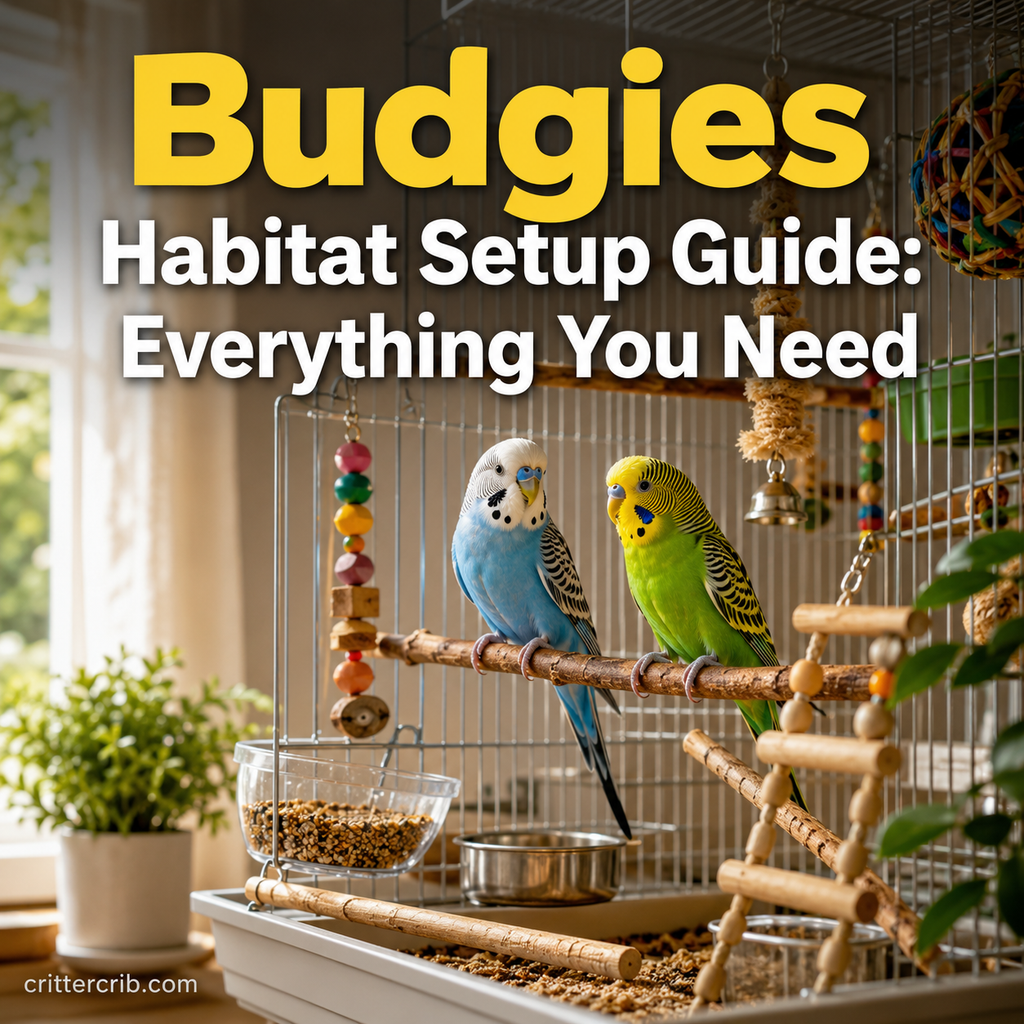
Setting up the right habitat for a budgie is about much more than buying a cage and adding a food bowl. Budgies are active, intelligent birds that spend much of their day climbing, flying, chewing, playing, eating, and interacting with their surroundings.
A well-designed habitat gives your budgie enough room to move while also providing safe places to eat, sleep, exercise, and explore. The setup should feel secure without being cramped, and interesting without becoming cluttered.
Fortunately, you don’t need an elaborate bird room or an enormous collection of accessories to get started. A spacious cage, thoughtfully arranged perches, a few good toys, proper food and water stations, and a safe location in your home can provide an excellent foundation.
This guide covers everything you need to know about setting up a comfortable, practical habitat for a pet budgie.
What Does a Budgie Need in Its Habitat?
A good budgie habitat should support several basic needs:
- Space to stretch and move between perches
- Opportunities for short flights
- Perches of different sizes and textures
- Separate food and fresh water
- Toys and activities for mental stimulation
- Safe items to chew and explore
- A comfortable place to rest
- Protection from household hazards
- Regular interaction and exercise outside the cage when appropriate
Think of the cage as your budgie’s home base rather than simply a place to keep your bird.
Your goal is to create an environment where your budgie can comfortably perform natural behaviors throughout the day.
Choosing the Right Budgie Cage
The cage is the most important part of your habitat setup.
Budgies may be small, but they’re surprisingly active. A cage that looks large in a pet store can quickly become crowded once you add perches, bowls, and toys.
In general, bigger is better as long as the bar spacing remains safe.
Cage Size
For a single budgie, look for a cage that provides plenty of horizontal space for movement. A practical starting point is around 18 inches wide by 18 inches deep by 18 inches tall, but a larger cage is strongly preferable whenever you have the space and budget.
For two budgies, choose something substantially larger.
Width is especially valuable because budgies generally move and fly horizontally rather than straight up and down.
A long rectangular cage is usually more useful than a tall, narrow one.
Remember that minimum dimensions should be viewed as a starting point, not an ideal target. If your bird will spend significant portions of the day inside the cage, additional space becomes even more important.
Bar Spacing
Bar spacing should generally be about 1/2 inch or less for budgies.
Bars that are too widely spaced can allow a small bird to squeeze its head or body through and potentially become trapped or injured.
Before buying a cage designed for a larger species, always check the spacing.
Cage Shape
Rectangular cages are usually the most practical option.
They provide usable horizontal space and make it easier to position perches, toys, and feeding stations without crowding the center.
Avoid choosing a cage based primarily on decorative appearance. Complicated shapes and narrow towers can look attractive while providing less usable space for the bird.
Cage Material
Choose a cage made from bird-safe materials with a durable finish.
Avoid cages that are rusty, peeling, damaged, or made from questionable metals. Budgies frequently use their beaks to climb cage bars, so the cage surface needs to be safe for regular contact.
If you’re buying a used cage, inspect it carefully before bringing your bird home.
Where Should You Put a Budgie Cage?
Cage placement can have a major effect on how comfortable your budgie feels.
Budgies are social animals. Keeping the cage isolated in a room that nobody uses may leave the bird without enough everyday stimulation.
A living room, home office, or another frequently occupied area can work well.
However, the busiest possible location isn’t always the best one either.
Your budgie needs periods of quiet and uninterrupted rest.
A Good Cage Location Should Be
- Away from direct drafts
- Away from heating and air-conditioning vents
- Protected from intense direct sunlight
- Away from kitchen fumes
- Away from smoke and aerosols
- Somewhere your budgie can regularly see household activity
- Quiet and dark enough at night for proper sleep
Positioning at least part of the cage near a wall can also help some birds feel more secure because they aren’t exposed on every side.
Keep Budgies Away From the Kitchen
The kitchen is generally not a good location for a bird cage.
Cooking creates fumes, smoke, steam, grease, and rapid temperature changes. Birds also have sensitive respiratory systems.
Of particular concern are fumes produced when certain nonstick or PTFE-containing cookware and appliances are overheated. These fumes can be extremely dangerous to birds.
Keeping the cage well away from cooking areas is the safer choice.
How to Arrange a Budgie Cage
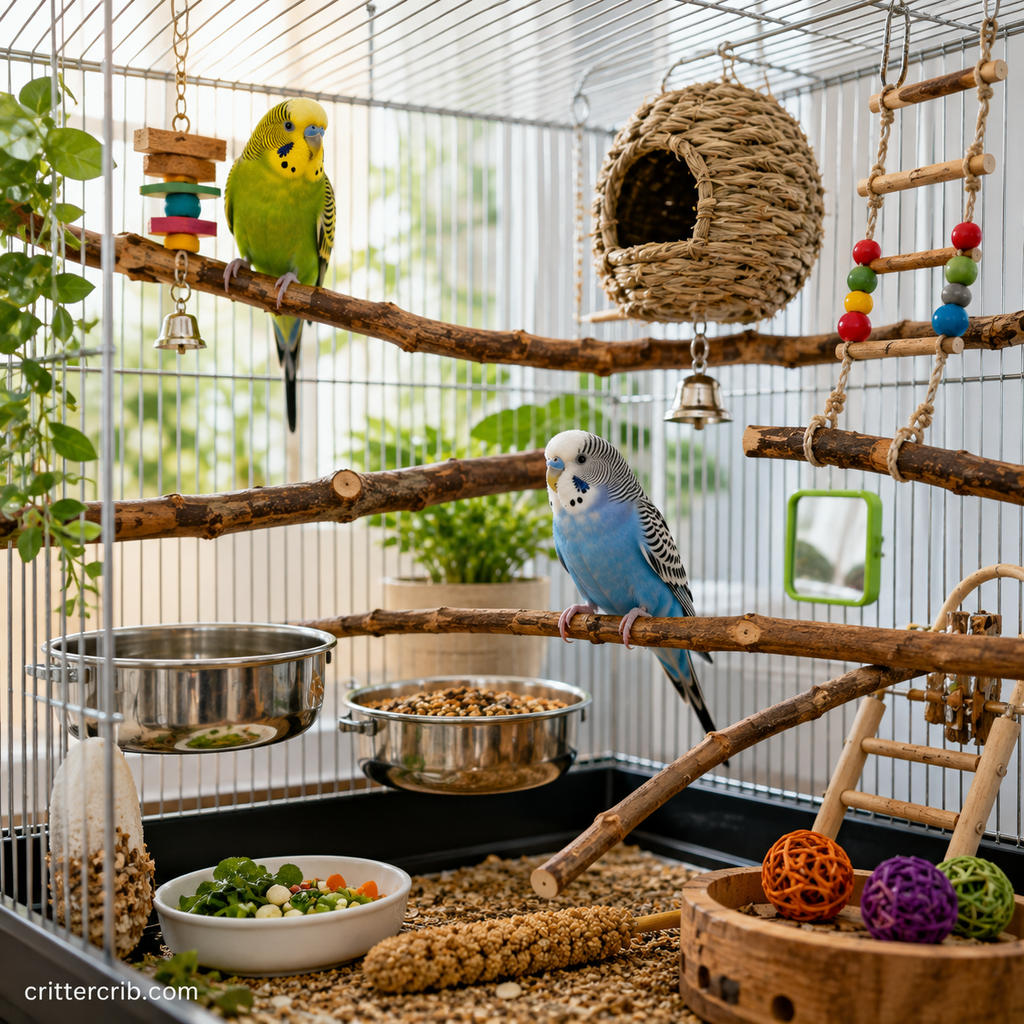
Once you have the right cage, resist the temptation to fill every available space.
Budgies need enrichment, but they also need room to move.
A good setup creates different activity areas while leaving open space through the center of the cage.
Start With the Perches
Place several perches at different heights.
You might have:
- A comfortable higher perch for resting
- A natural branch perch in another area
- A lower perch near food or water
- Another perch positioned to encourage climbing or movement
Avoid placing every perch directly above another one. Droppings from the upper perch can contaminate the perch below.
The same rule applies to food and water dishes.
The Best Perches for Budgies
Perches aren’t just places for a budgie to sit.
Budgies spend hours standing on their feet every day, so perch variety is an important part of their environment.
Natural wood branches are especially useful because their changing diameters encourage the feet to grip in slightly different ways.
Suitable bird-safe woods can include certain branches from trees such as:
- Apple
- Willow
- Birch
- Elm
- Maple
Only use branches from tree species you have positively identified as bird-safe. They should also be free from pesticides, chemical treatments, mold, and contamination.
Commercial natural-wood bird perches are a convenient alternative if you’re unsure about preparing branches yourself.
Use Different Perch Sizes
A budgie’s feet shouldn’t remain in exactly the same position all day.
Provide perches with varying diameters so the bird isn’t constantly gripping one identical surface.
The bird’s toes should wrap comfortably around a perch rather than meeting completely underneath it.
What About Dowel Perches?
Many cages come with straight wooden dowels.
You don’t necessarily have to throw them away, but they shouldn’t be the only type of perch available.
A cage filled entirely with smooth, identical dowels doesn’t provide much variation for your bird’s feet.
Mixing natural branches and other appropriate bird perches creates a more varied environment.
Avoid Sandpaper Perch Covers
Sandpaper-covered perches are often marketed as a way to maintain a bird’s nails.
However, abrasive surfaces can irritate a budgie’s feet. A bird spends far more time standing on a perch than filing its nails against it.
Choose comfortable, appropriately sized perches instead.
Food and Water Bowl Placement
Budgies should have reliable access to clean drinking water and an appropriate diet every day.
Place bowls where your bird can reach them easily without allowing perches to hang directly overhead.
Otherwise, droppings may repeatedly fall into the food or water.
Stainless steel bowls are popular because they’re durable and relatively easy to clean. Bird-safe bowls that securely attach to the cage can also prevent spills.
Keep Water Clean
Replace your budgie’s drinking water at least daily and sooner whenever it becomes dirty.
Budgies can drop food, feathers, toys, and other debris into their water.
Wash the container regularly rather than continually topping off old water.
What Should Go on the Bottom of a Budgie Cage?
Keep the cage floor simple.
Plain paper or another bird-safe disposable cage liner makes it easy to clean the bottom of the cage and monitor droppings.
Avoid materials that create unnecessary dust or make it difficult to see what’s happening underneath your bird.
Being able to observe changes in droppings can sometimes help you notice potential health problems sooner.
Replace dirty cage liners regularly.
Essential Budgie Toys
Budgies are intelligent, curious birds.
Without enough stimulation, a cage can become extremely boring.
Provide several toys that encourage different behaviors instead of buying five versions of essentially the same thing.
Useful categories include:
- Chewing toys
- Shredding toys
- Foraging toys
- Climbing toys
- Swings
- Bells designed specifically for birds
- Manipulation toys
- Simple puzzle-style toys
Budgies often enjoy destroying things. That’s normal.
Shredding bird-safe materials gives them an appropriate outlet for chewing and exploration.
Rotate Toys
You don’t need every toy your budgie owns inside the cage simultaneously.
Rotating toys can keep the environment interesting while reducing clutter.
For example, keep a selection of toys and occasionally swap one or two.
Some budgies investigate a new toy immediately. Others may be suspicious of it for several days.
Introduce unfamiliar objects gradually if your bird appears nervous.
Check Toys for Damage
Inspect toys regularly.
Remove anything with:
- Frayed fibers that could entangle feet
- Broken pieces
- Sharp edges
- Exposed wire
- Loose components that could trap toes or beaks
- Heavy contamination that can’t be cleaned
A toy that was safe when purchased may become unsafe after months of enthusiastic chewing.
Should Budgies Have a Mirror?
Mirrors are commonly sold as budgie toys, but they can be complicated.
A budgie may interpret its reflection as another bird. Some birds become unusually focused on the mirror, spending excessive amounts of time interacting with or attempting to feed the reflection.
For that reason, a mirror shouldn’t be treated as a substitute for companionship or interaction.
If your budgie becomes obsessed with a mirror, removing it may be appropriate.
There are plenty of other enrichment options that encourage healthier exploration, foraging, chewing, and play.
Creating Space for Exercise
A beautifully decorated cage isn’t useful if your budgie can’t move through it.
Try to preserve an open route through the middle of the cage.
Your bird should be able to:
- Hop between nearby perches
- Climb the cage bars
- Stretch both wings comfortably
- Move without constantly hitting toys
- Make short flights when cage size permits
This is one reason oversized toys can be problematic in smaller cages.
A toy might technically fit while still occupying too much usable space.
Do Budgies Need Time Outside the Cage?
Budgies benefit from regular opportunities for exercise and interaction outside their cage when this can be done safely.
Before opening the cage, bird-proof the room.
Bird-Proofing a Room
Before allowing your budgie to fly freely:
- Close exterior doors and windows.
- Turn off ceiling fans.
- Cover or otherwise make large windows and mirrors obvious to an inexperienced bird if necessary.
- Keep cats, dogs, and other potential predators out.
- Remove open containers of water.
- Secure dangerous electrical cords where practical.
- Remove toxic plants and hazardous objects.
- Prevent access to hot surfaces and cooking areas.
- Make sure everyone in the household knows the bird is out.
Don’t rely on the assumption that a budgie “knows” a window is solid glass.
New or frightened birds can collide with transparent surfaces.
Budgie Lighting and Natural Daylight
Budgies benefit from a predictable daily rhythm with daytime light followed by darkness and quiet at night.
Natural daylight can be helpful, but that doesn’t mean putting the cage directly in intense sunlight for hours.
A cage sitting in strong sun can become uncomfortably warm, particularly if the bird has nowhere shaded to retreat.
Instead, provide a bright environment while making sure your budgie can move away from direct sunlight.
How Much Sleep Do Budgies Need?
Budgies need a consistent period of darkness and quiet each night.
Many pet budgies do well with roughly 10 to 12 hours of uninterrupted sleep.
A bird kept in a living room with televisions, conversations, and bright lights until midnight may not receive adequate rest even if the cage is covered.
If your household stays active late into the night, consider whether the cage can be moved to a quiet sleeping area or whether another sleeping arrangement would work better.
Should You Cover a Budgie Cage at Night?
Covering the cage isn’t mandatory in every home.
A cover can help create a darker environment, particularly in rooms where some ambient light remains at night. However, the cage still needs adequate ventilation.
If the room is already quiet and dark, your budgie may sleep comfortably without a cover.
Watch your bird’s behavior and create a consistent nighttime routine.
Temperature and Drafts
Typical comfortable indoor household temperatures are generally suitable for healthy budgies.
Sudden temperature changes are often more concerning than small normal fluctuations.
Avoid placing the cage:
- Directly beside an air-conditioning vent
- Next to a heater
- In a strong draft
- Against a frequently opened exterior door
- In direct intense sunlight
If you’re comfortable in the room under ordinary indoor conditions, your budgie will often be comfortable too, but always pay attention to your individual bird.
Household Hazards Around Budgies
A safe cage doesn’t automatically mean your budgie has a safe environment.
Birds have extremely efficient respiratory systems and can be sensitive to airborne contaminants.
Keep budgies away from:
- Cigarette and vape smoke
- Aerosol sprays
- Strong cleaning fumes
- Paint and solvent fumes
- Scented smoke
- Cooking smoke
- Overheated nonstick cookware and appliances
- Other potentially harmful airborne chemicals
You should also be careful with candles, essential oil diffusers, plug-in fragrances, and heavily scented household products around birds.
When you’re unsure whether an airborne product is bird-safe, avoiding exposure is the safest approach.
Keeping the Budgie Cage Clean
Routine cleaning keeps the habitat comfortable and makes major cleanups easier.
Daily Tasks
A quick daily routine might include:
- Replace drinking water
- Wash dirty food and water dishes
- Remove spoiled fresh food
- Replace heavily soiled cage paper
- Wipe obvious messes
- Check toys and perches for hazards
Regular Deep Cleaning
Periodically give the cage a more thorough cleaning.
Remove accessories as necessary and clean:
- Cage bars
- Cage tray
- Grates
- Perches
- Food dishes
- Water dishes
- Washable toys
Rinse cleaned surfaces thoroughly and allow them to dry before returning your bird and accessories.
Avoid leaving strong chemical residues behind.
Setting Up a Habitat for Two Budgies
Two budgies require more resources and space than one.
Choose a larger cage and arrange it so one bird can’t easily control everything important.
Providing multiple feeding or resting locations can reduce competition.
Watch the birds carefully when they’re first introduced. Budgies are social, but that doesn’t guarantee that every pair will immediately get along.
Each bird should be able to move away from the other when desired.
Budgie Habitat Setup Checklist
Before bringing your budgie home, make sure you have the essentials.
Cage Essentials
- Appropriately sized rectangular cage
- Safe bar spacing
- Secure doors and latches
- Removable or easily cleaned cage bottom
- Several appropriately sized perches
- Food dishes
- Water dish
- Bird-safe cage liner
Enrichment
- Chewing toy
- Shredding toy
- Foraging activity
- Climbing or swinging toy
- Additional toys for rotation
Home Safety
- Safe cage location
- No direct drafts
- No access to kitchen fumes
- No smoke exposure
- Safe nighttime sleeping environment
- Bird-proofed area for supervised out-of-cage activity
You don’t have to buy everything marketed specifically for budgies. Focus on providing the things that support movement, safety, enrichment, cleanliness, and natural behaviors.
Common Budgie Habitat Setup Mistakes
Even well-meaning owners can accidentally create an uncomfortable environment.
Some common mistakes include:
- Choosing a cage that’s too small
- Buying a tall, narrow cage instead of prioritizing width
- Using unsafe bar spacing
- Filling the cage with too many toys
- Using only identical dowel perches
- Putting food or water underneath perches
- Keeping the cage in an isolated room
- Placing the cage in the kitchen
- Allowing exposure to smoke or strong fumes
- Providing too little nighttime darkness
- Never rotating enrichment
- Failing to inspect damaged toys
- Assuming a small bird doesn’t need much exercise
Most of these problems are easy to correct once you start looking at the cage from the bird’s perspective.
How to Introduce Your Budgie to a New Habitat
When your budgie first arrives, give it time to adjust.
A new bird suddenly encounters unfamiliar people, sounds, objects, smells, and surroundings. Even a friendly budgie may initially sit quietly and observe.
For the first few days:
- Keep the environment relatively calm.
- Maintain predictable food and water routines.
- Approach the cage slowly.
- Speak gently around your bird.
- Avoid constantly reaching into the cage.
- Give your budgie time to learn that its new environment is safe.
You can gradually introduce training and additional interaction as the bird becomes more comfortable.
Don’t interpret initial nervousness as your budgie disliking you. Adjustment takes time, and every bird has its own personality.
How to Tell If Your Budgie Likes Its Habitat
A comfortable budgie will usually interact with its environment rather than simply sitting motionless all day.
Positive everyday behaviors can include:
- Moving between perches
- Playing with toys
- Climbing
- Eating normally
- Preening
- Vocalizing
- Exploring new objects
- Resting comfortably
- Interacting with you or another budgie
Learn what is normal for your individual bird.
A sudden change in activity, appetite, droppings, posture, breathing, or behavior can sometimes indicate illness rather than dissatisfaction with the cage.
Birds can hide signs of illness surprisingly well. If you notice concerning changes, contact an avian veterinarian rather than assuming that changing the habitat will solve the problem.
Frequently Asked Questions About Budgie Habitats
How Big Should a Budgie Cage Be?
A single budgie should have a cage with enough room to move freely, stretch its wings, and travel between perches without hitting toys or cage walls. Around 18 × 18 × 18 inches can be considered a basic starting point, but larger horizontal cages are preferable.
If you have room for a larger properly spaced cage, your budgie can benefit from the additional space.
Is a Tall or Wide Cage Better for Budgies?
A wide cage is generally more useful.
Budgies naturally move horizontally, so a long cage provides more usable flight space than a narrow cage that’s exceptionally tall.
What Bar Spacing Is Safe for Budgies?
Approximately 1/2 inch or less is generally appropriate for budgies.
Always check the manufacturer’s specifications before purchasing a cage.
How Many Perches Should a Budgie Have?
There’s no perfect number because cage sizes vary.
Several strategically positioned perches with different diameters and textures are better than filling every level of the cage. Your budgie still needs open space to move.
How Many Toys Should Be in a Budgie Cage?
A few varied toys are generally better than a cage packed with toys.
Provide different forms of enrichment and rotate them periodically. The bird should always have enough open space to move comfortably.
Where Should a Budgie Sleep?
Your budgie can usually sleep in its regular cage as long as the environment becomes quiet and dark enough at night.
A high, comfortable perch is often favored for sleeping.
Can I Keep a Budgie Cage in My Bedroom?
Yes, provided the bedroom is safe for birds.
Avoid smoke, aerosols, strong fragrances, dangerous fumes, and excessive nighttime disturbance. Also consider whether your own sleep schedule provides the bird with enough darkness and quiet.
Should a Budgie Cage Be Near a Window?
Being able to see natural daylight and outdoor activity can provide stimulation, but avoid placing the cage where your bird is exposed to intense direct sunlight, drafts, or extreme temperature changes.
A bright location set back from the window can often work better than placing the cage directly against the glass.
Final Thoughts
A good budgie habitat doesn’t need to look complicated.
Start with a spacious, secure cage and build the environment around your bird’s actual needs: movement, comfortable perches, clean food and water, enrichment, social interaction, sleep, and safety.
The best setups also evolve over time.
You may discover that your budgie prefers one type of perch, ignores an expensive toy but loves shredding simple bird-safe materials, or chooses a particular corner of the cage for sleeping. Paying attention to these preferences can help you fine-tune the habitat.
Keep the cage clean, rotate enrichment, inspect equipment regularly, and make sure your bird has plenty of opportunities to exercise and interact.
A thoughtfully arranged habitat gives your budgie more than somewhere to live. It provides a safe home base where this energetic little bird can explore, play, rest, and express the behaviors that make budgies such engaging companions.