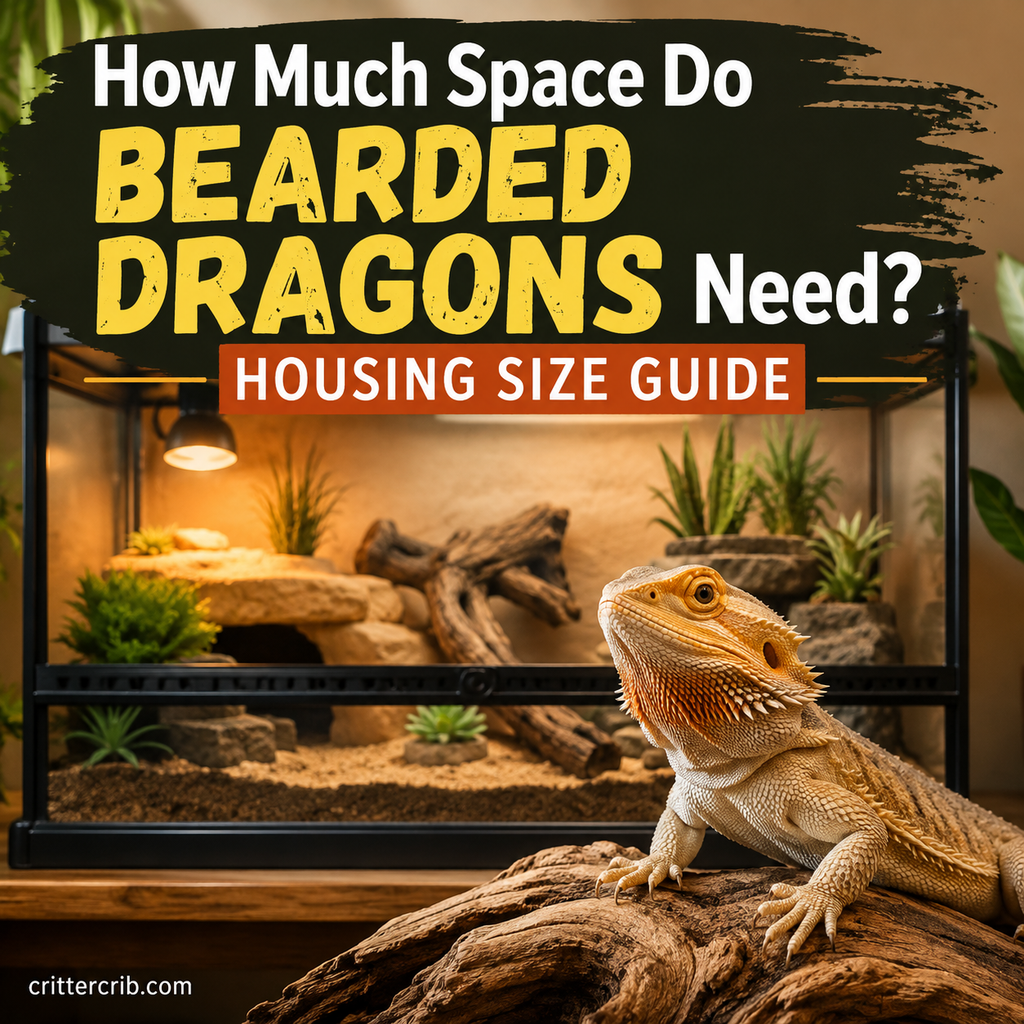
Bearded dragons may look small when they’re curled up under a basking lamp, but they need more room than many new owners expect. These active reptiles spend their days moving between warm and cool areas, climbing, basking, exploring, and finding comfortable places to rest.
For most adult bearded dragons, a 4 x 2 x 2-foot enclosure (120 gallons or equivalent) should be considered a practical minimum. Larger enclosures can be even better when they’re set up correctly.
Baby bearded dragons can live in smaller habitats temporarily, but they grow quickly. Starting with an adult-sized enclosure can save you from buying several tanks as your dragon gets bigger.
This guide explains how much space bearded dragons need at different ages, why enclosure dimensions matter, and how to make good use of the space you provide.
What Size Enclosure Does a Bearded Dragon Need?
A bearded dragon’s enclosure should provide enough room for normal movement while also allowing you to create distinct temperature zones.
A general housing guide is:
- Baby bearded dragons: Approximately 40 gallons or larger
- Juvenile bearded dragons: Approximately 75 gallons or larger
- Adult bearded dragons: At least 4 x 2 x 2 feet
- Large adults: Consider an enclosure larger than 4 x 2 x 2 feet when possible
Gallons can be useful when shopping, but they’re not always the best way to judge a reptile enclosure. Two habitats advertised with similar capacities can have very different dimensions.
For bearded dragons, usable floor space is especially important.
A long, wide enclosure generally works better than a tall, narrow one because bearded dragons spend much of their time on or relatively close to the ground.
Minimum Enclosure Size for an Adult Bearded Dragon
For a typical adult, aim for an enclosure measuring at least:
48 inches long x 24 inches wide x 24 inches high
This is commonly described as a 4 x 2 x 2 enclosure.
These dimensions provide considerably more usable space than the smaller aquariums that were once commonly recommended for adult beardies.
An adult dragon needs enough room to fully stretch out, turn around comfortably, explore, and choose between different areas of its environment.
The enclosure also needs to accommodate:
- A basking area
- A cooler retreat
- UVB lighting
- Hides
- Climbing structures
- Feeding areas
- Water or hydration provisions when appropriate
- Safe substrate or flooring
Simply fitting a bearded dragon inside a tank isn’t enough. The habitat needs room for the dragon and the environmental features required to keep it comfortable.
Is a 40-Gallon Tank Big Enough for a Bearded Dragon?
A 40-gallon enclosure can work as temporary housing for a young bearded dragon, but it is generally too small to be a permanent home for an adult.
This is where older bearded dragon care advice can become confusing.
For years, 40-gallon breeder tanks were commonly suggested for adults. Modern husbandry practices increasingly favor larger habitats because they provide more room for natural movement and make it easier to create a useful temperature gradient.
A 40-gallon enclosure can also become surprisingly cramped once you add a basking platform, hide, branches, feeding dishes, and other furnishings.
If you’re buying a habitat for a baby and have the budget and room for it, purchasing an adult-sized enclosure from the beginning is often the better long-term investment.
Bearded Dragon Enclosure Size by Age
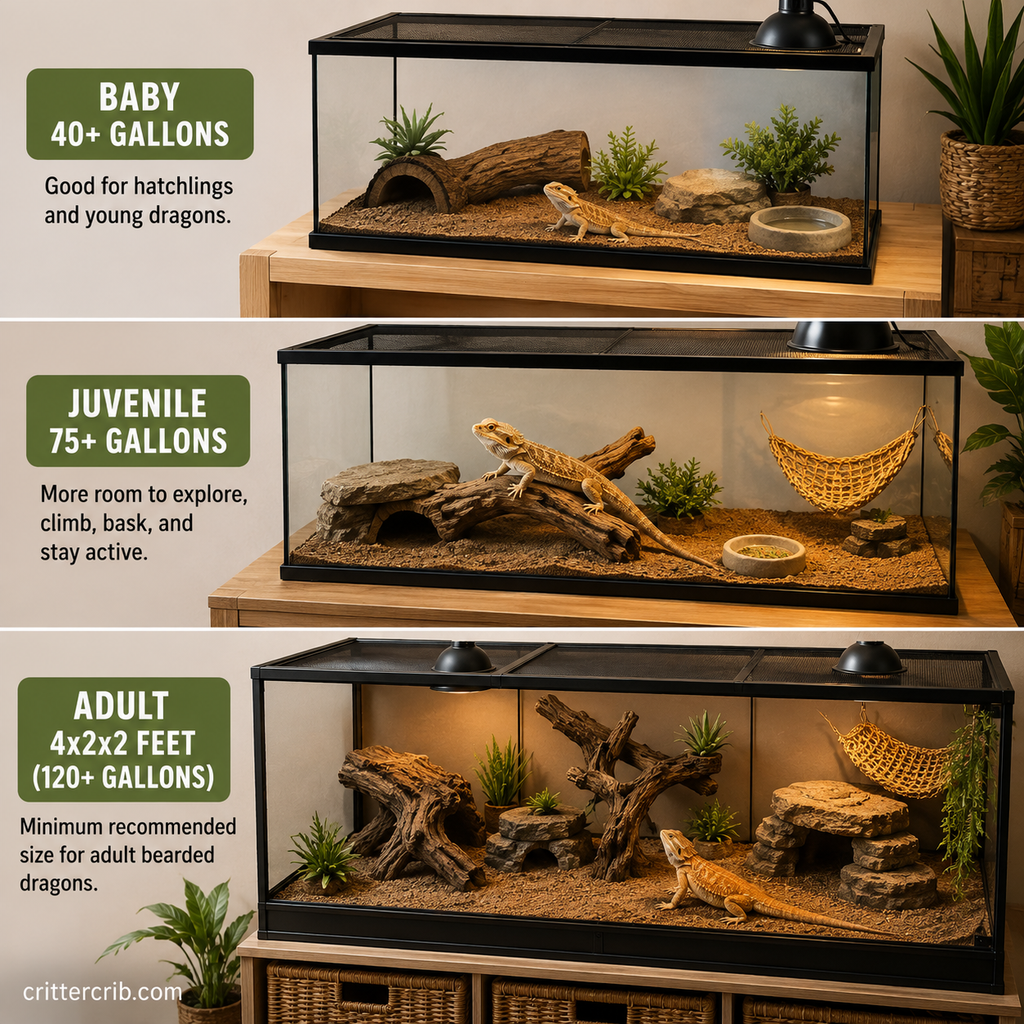
Bearded dragons grow rapidly during their first year, so housing requirements can change quickly.
Baby Bearded Dragons
Baby beardies are tiny, but that doesn’t mean they need to spend their early months in a tiny enclosure.
A habitat around 40 gallons can provide temporary housing for a baby, assuming temperatures and UVB exposure are properly managed.
However, there’s usually no need to deliberately keep a baby in a small enclosure.
A healthy baby can live in a larger habitat as long as the setup makes food, basking areas, hides, and other necessities easy to find.
If you start with a 4 x 2 x 2 enclosure, you may be able to avoid upgrading entirely.
Juvenile Bearded Dragons
Once a bearded dragon enters its juvenile growth stage, additional space becomes increasingly important.
A juvenile may be considerably more active than expected and can quickly outgrow its original starter tank.
An enclosure around 75 gallons can serve as an intermediate size, but if you’re upgrading anyway, moving directly to the dragon’s permanent adult enclosure often makes more sense.
Adult Bearded Dragons
Adult beardies should generally have at least a 4 x 2 x 2-foot habitat.
Some adults grow larger than others, and bigger dragons can particularly benefit from additional floor space.
If you have room for a 5-foot or 6-foot enclosure and can maintain the correct environmental conditions throughout it, the extra space can provide more opportunities for exploration and enrichment.
Why Bearded Dragons Need So Much Space
A reptile enclosure isn’t simply a container that prevents an animal from escaping.
It is the bearded dragon’s entire environment.
A well-designed habitat gives your dragon choices throughout the day.
Your beardie should be able to move closer to heat when it wants to bask and retreat to a cooler area when it needs to regulate its body temperature.
It should also have opportunities to climb, hide, explore, eat, and rest.
Without enough space, creating those separate areas becomes difficult.
Floor Space Matters More Than Gallons
When comparing enclosures, don’t focus exclusively on gallon capacity.
Instead, look at the actual dimensions.
Bearded dragons are primarily terrestrial reptiles, so horizontal floor space is extremely valuable.
Consider two enclosures that hold roughly similar volumes. One may be tall and narrow, while another is long and wide.
The wider enclosure will usually provide more useful living space for a bearded dragon.
A good enclosure should allow the dragon to travel horizontally between different environmental zones rather than forcing everything into one small area.
Is Height Important for Bearded Dragons?
Yes, but height shouldn’t come at the expense of length and width.
Bearded dragons aren’t strictly ground-dwelling animals. They frequently climb rocks, logs, branches, and other elevated surfaces when given the opportunity.
A 24-inch-high enclosure provides enough vertical room for many useful features, including:
- Raised basking platforms
- Sturdy branches
- Rocks
- Ledges
- Hides
- Hammocks or other safe climbing features
Vertical space can make an enclosure more interesting, but all climbing structures should be stable and positioned to reduce the risk of falls.
The height also needs to work with your heating and UVB setup. A basking platform placed too close to a heat source can create unsafe temperatures.
Can a Bearded Dragon Enclosure Be Too Big?
You may hear that a large enclosure will stress a baby bearded dragon or make it impossible for the animal to find food.
In most cases, a properly designed large enclosure is not inherently a problem.
The key phrase is “properly designed.”
A huge, nearly empty enclosure isn’t automatically better than a smaller, thoughtfully arranged one.
A larger habitat should still provide easy access to:
- Food
- Basking heat
- UVB exposure
- Hiding places
- Safe climbing opportunities
- Cooler areas
Young dragons may benefit from multiple feeding locations or carefully monitored feeding sessions so you can confirm they’re eating properly.
You can also add appropriate furnishings to make a large enclosure feel structured rather than exposed.
Why a 4 x 2 x 2 Enclosure Works Well
The popularity of the 4 x 2 x 2 enclosure isn’t arbitrary.
Those dimensions provide enough room to divide the habitat into functional zones without requiring an enormous amount of household space.
Basking Zone
One side of the habitat can contain the main basking area.
Your dragon should be able to position itself beneath the heat source while receiving appropriate UVB exposure.
Transition Zone
The middle portion of the enclosure provides room to move between warmer and cooler conditions.
This area can contain branches, rocks, plants, or other safe enrichment items without becoming overcrowded.
Cool Zone
The opposite end should provide a noticeably cooler environment.
A hide in this area gives the dragon somewhere to retreat when it doesn’t want to bask.
This warm-to-cool gradient is much harder to establish in a very short enclosure.
How Much Room Does a Bearded Dragon Need to Move Around?
At minimum, an adult beardie should be able to walk around normally, turn without difficulty, and fully stretch out without constantly bumping into walls or decorations.
Watch how your dragon actually uses its habitat.
A good enclosure encourages different behaviors throughout the day. You might see your beardie basking in the morning, climbing onto a branch later, moving to the cooler side, digging, exploring, or resting in a hide.
If nearly every activity has to happen in the same small section of the enclosure, the habitat may not be providing enough usable space.
Should You Get a 5-Foot or 6-Foot Enclosure?
If you have the room, going larger than 4 x 2 x 2 can be worthwhile.
A 5- or 6-foot-long enclosure provides additional opportunities to create a varied environment.
You might have room for:
- Multiple climbing areas
- Larger rocks and branches
- More substantial hides
- Digging areas
- Additional enrichment
- More separation between hot and cool zones
However, bigger isn’t automatically better if you can’t maintain the correct conditions.
Heating and lighting a 6-foot enclosure may require a different setup than heating a 4-foot habitat.
Always verify temperatures and UVB exposure throughout the enclosure rather than assuming that a larger habitat will function the same way.
How Much Space Do Two Bearded Dragons Need?
Bearded dragons are generally best housed individually.
Buying a larger enclosure doesn’t necessarily make cohabitation safe.
Two beardies sharing a habitat may compete for important resources such as:
- Basking locations
- UVB exposure
- Food
- Hides
- Preferred resting areas
One animal may dominate the best basking spot or food without obvious fighting occurring.
Because of these risks, providing each bearded dragon with its own properly equipped enclosure is generally the safer approach.
If you plan to keep two dragons, think in terms of two complete habitats, not one oversized tank.
How to Use Enclosure Space Effectively
Buying a large habitat is only the first step. The interior should be arranged so your bearded dragon can actually use the available space.
Create a Clear Temperature Gradient
Place the primary heat source toward one end rather than directly in the middle.
This helps create a warm side and cool side.
Use reliable digital thermometers and appropriate temperature-measuring equipment to check conditions instead of judging temperature by touch.
Provide an Elevated Basking Area
A stable rock, platform, or branch can allow your beardie to bask at an appropriate distance from its heat and UVB sources.
Make sure the structure can’t shift or collapse.
Add Hiding Places
A bearded dragon should have access to secure places where it can retreat.
Whenever space permits, providing options in different temperature zones gives the dragon more control over where it rests.
Include Climbing Opportunities
Branches, cork, rocks, ledges, and similar structures can turn unused vertical space into enrichment.
Keep them stable and avoid creating dangerous fall distances.
Don’t Overcrowd the Habitat
More enrichment doesn’t mean filling every available inch.
Your dragon still needs open areas for walking and turning around.
Try to create a balance between open floor space and interesting environmental features.
Where Should You Put a Bearded Dragon Enclosure?
The enclosure itself takes up substantial room, especially once you move to a 4 x 2 x 2 habitat.
Before buying one, measure the area where you intend to put it.
Remember that you’ll need additional clearance for lighting, electrical cords, ventilation, and routine maintenance.
Choose a location that is:
- Stable and level
- Away from strong drafts
- Protected from excessive direct sunlight
- Away from constant foot traffic when possible
- Accessible for feeding and cleaning
- Near safe electrical outlets
Avoid placing the enclosure where direct sunlight can unexpectedly increase temperatures inside it.
Do Bearded Dragons Need Time Outside Their Enclosure?
Supervised exploration outside the enclosure can provide additional stimulation, but it shouldn’t be used to compensate for an undersized habitat.
Your bearded dragon’s enclosure remains its primary living environment.
If you allow your dragon to explore outside its habitat, make sure the area is secure and free from hazards such as:
- Other pets
- Open doors
- Electrical cords
- Small objects that could be swallowed
- Dangerous gaps beneath furniture
- Toxic plants
- Cleaning chemicals
- Cold surfaces or drafts
Supervised time outside the habitat can be enriching, but your dragon should still have plenty of room inside its permanent home.
Signs Your Bearded Dragon May Need More Space
No single behavior automatically proves that an enclosure is too small. However, the habitat deserves another look if your bearded dragon has very little room to move once its furnishings are installed.
Potential signs of an inadequate setup include:
- Constantly bumping into enclosure walls or furnishings
- Very limited walking space
- Difficulty establishing separate hot and cool areas
- An adult dragon occupying a large percentage of the enclosure’s length
- Basking, feeding, hiding, and cooling areas overlapping because of limited room
- Almost no space for enrichment
Glass surfing can sometimes occur in an unsuitable environment, but it can have several causes. Don’t automatically assume enclosure size is responsible without evaluating temperatures, lighting, stressors, reflections, and the rest of the setup.
Common Bearded Dragon Housing Mistakes
Even a reasonably large enclosure can become unsuitable if it isn’t arranged correctly.
Keeping an Adult in a Starter Tank
A tank that worked when your beardie was a few months old may become cramped surprisingly quickly.
Plan upgrades before your dragon completely outgrows its current habitat.
Choosing Height Instead of Floor Space
A tall enclosure may look spacious but provide little usable ground area.
Prioritize length and width first, then add enough height for safe climbing.
Filling Every Inch With Decorations
Bearded dragons need enrichment, but they also need room to move.
Leave open pathways between major habitat features.
Ignoring the Cool Side
Heating the entire enclosure evenly prevents the dragon from choosing between different temperatures.
The habitat needs a usable thermal gradient.
Buying Multiple Small Enclosures
Starting with a small tank and upgrading repeatedly can become expensive.
If your budget allows, purchasing a suitable adult-sized enclosure early can be simpler and more economical over the life of your dragon.
Planning for the Space Before Getting a Bearded Dragon
Bearded dragons are sometimes marketed as relatively easy reptiles because they don’t require the enormous habitats associated with species such as large monitors or iguanas.
Still, a proper adult enclosure isn’t small.
A 4 x 2-foot footprint takes up about as much floor or furniture space as a substantial cabinet or table.
Before bringing a beardie home, consider where the enclosure will go and whether that location can remain dedicated to the animal long term.
You’ll also need space above or around the enclosure for heating, UVB equipment, electrical connections, and maintenance access.
Planning for the adult habitat from day one can prevent an unpleasant surprise several months later.
Frequently Asked Questions
What is the minimum enclosure size for an adult bearded dragon?
A 4 x 2 x 2-foot enclosure is a good minimum target for most adult bearded dragons. Larger habitats can provide additional enrichment and movement opportunities when properly heated and lit.
Is 120 gallons enough for a bearded dragon?
An enclosure commonly described as 120 gallons can be appropriate for an adult if its dimensions are approximately 48 x 24 x 24 inches.
Check the actual measurements rather than relying solely on gallon capacity.
Can a baby bearded dragon live in a 120-gallon enclosure?
Yes. A baby can live in a large enclosure when the habitat is properly arranged and the dragon can easily access food, basking areas, UVB, hides, and appropriate temperatures.
Is a 40-gallon tank enough for an adult bearded dragon?
A 40-gallon enclosure is generally too small for permanent adult housing. It can be useful as temporary housing for a young bearded dragon, but you’ll need to plan for an upgrade.
Do bearded dragons prefer long or tall enclosures?
Length and width should generally take priority because bearded dragons use substantial horizontal space. However, some height is valuable because beardies also climb and bask on elevated surfaces.
Is a 4 x 2 x 2 enclosure enough for a bearded dragon?
For most adults, a properly equipped 4 x 2 x 2 enclosure provides a reasonable minimum amount of space. If you can provide a larger habitat while maintaining appropriate temperatures and UVB exposure, additional space can be beneficial.
Can two bearded dragons live in a 4 x 2 x 2 enclosure?
Bearded dragons are generally best housed separately. A larger shared enclosure doesn’t eliminate competition or other risks associated with cohabitation. Each dragon should have its own appropriately sized habitat.
Final Thoughts
So, how much space does a bearded dragon need?
For most adults, plan on at least a 4 x 2 x 2-foot enclosure, with larger housing being a welcome upgrade when practical.
Babies and juveniles can temporarily live in smaller habitats, but because bearded dragons grow quickly, buying an adult-sized enclosure early can save money and avoid repeated upgrades.
More importantly, don’t judge a habitat only by its gallon rating.
Look at its actual dimensions and ask whether it provides enough room for your beardie to walk, climb, bask, hide, cool down, and explore.
The best enclosure isn’t simply the biggest box you can buy. It’s one that uses its space effectively and gives your bearded dragon meaningful choices throughout the day.