Blue-tongued skinks aren’t short-term pets. With proper care, one could be part of your household for a couple of decades.
So, how long do blue-tongued skinks live?
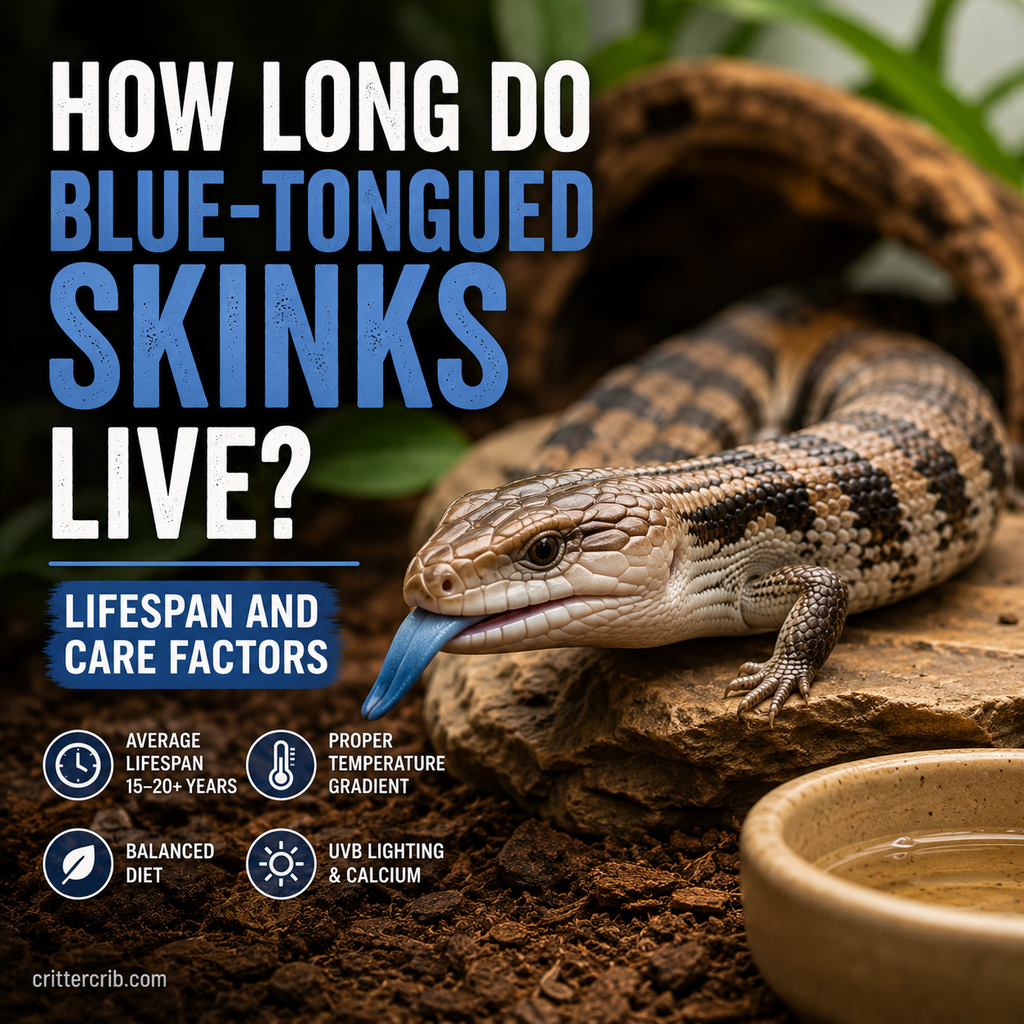
Many pet blue-tongued skinks can live around 15 to 20 years, and some individuals may live beyond 20 years with excellent care. Their actual lifespan depends on several factors, including species, genetics, diet, enclosure conditions, temperature, lighting, body condition, and access to veterinary care.
That makes getting a blue-tongued skink a much bigger commitment than some prospective owners expect.
Fortunately, many of the things that support a long life are within an owner’s control. Good nutrition, proper temperatures, appropriate UVB lighting, enough space, exercise, and early attention to health problems can all contribute to long-term well-being.
Here’s what to know about blue-tongued skink lifespan and the care factors that can influence it.
What Is the Average Blue-Tongued Skink Lifespan?
A lifespan of approximately 15 to 20 years is a reasonable expectation for many properly cared-for blue-tongued skinks in captivity.
Some may live longer.
Others may have shorter lives because of genetics, previous husbandry, illness, injury, reproductive complications, or other factors.
There isn’t a specific age that every blue-tongued skink should reach.
Instead, think of lifespan as a range.
If you’re considering getting one, it’s sensible to prepare for the possibility that your skink could still be with you 20 years from now.
How Long Do Blue-Tongued Skinks Live in Captivity?
Captive blue-tongued skinks can potentially live for 15 to 20 years or longer when their needs are consistently met.
Life in captivity removes many of the dangers wild reptiles encounter.
A pet skink doesn’t normally need to worry about:
- Predators
- Food shortages
- Drought
- Extreme weather
- Competition for resources
- Many traumatic injuries
- Finding appropriate shelter
- Lack of medical treatment
Captivity only becomes an advantage when husbandry is appropriate, though.
Poor temperatures, inadequate nutrition, obesity, unsuitable humidity, or other long-term care problems can negatively affect health.
How Long Do Blue-Tongued Skinks Live in the Wild?
Estimating the lifespan of wild blue-tongued skinks is more difficult.
Wild animals aren’t being monitored throughout their entire lives, and survival conditions vary between habitats and populations.
Blue-tongued skinks in nature may face:
- Predation
- Vehicle strikes
- Habitat loss
- Food scarcity
- Parasites
- Disease
- Extreme temperatures
- Injuries
- Competition
Young animals can be particularly vulnerable.
A captive skink living under good husbandry conditions doesn’t face many of these threats, which can give it an opportunity to live much longer.
Do All Blue-Tongued Skinks Have the Same Lifespan?
“Blue-tongued skink” doesn’t refer to just one identical population of lizards.
Several species and subspecies are kept in captivity, and they don’t all come from exactly the same environments.
Commonly kept blue-tongued skinks include Australian and Indonesian types.
Examples include:
- Northern blue-tongued skinks
- Eastern blue-tongued skinks
- Indonesian blue-tongued skinks
- Merauke blue-tongued skinks
- Irian Jaya blue-tongued skinks
Their care requirements can differ, particularly when it comes to humidity and environmental conditions.
This matters for longevity.
Following generic “blue tongue care” without knowing what type of skink you have can lead to inappropriate husbandry.
What Factors Affect a Blue-Tongued Skink’s Lifespan?
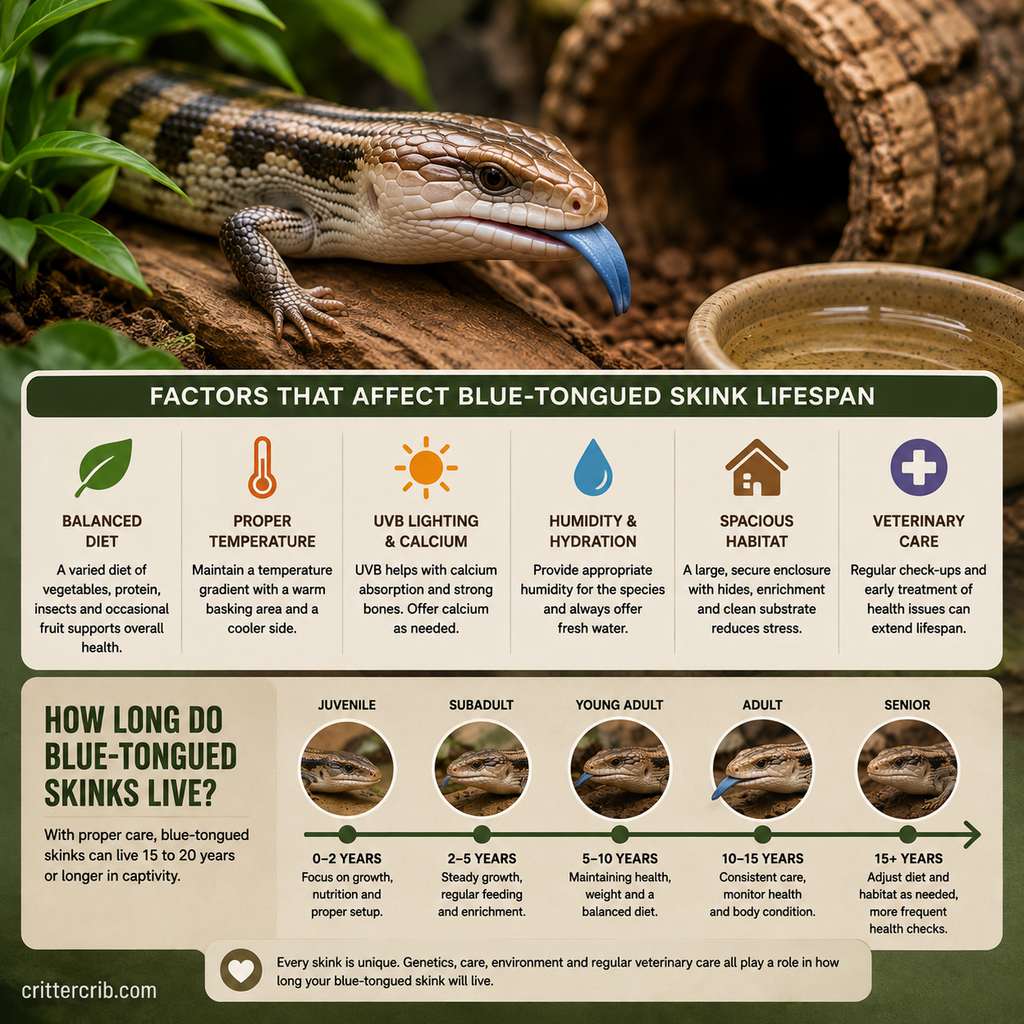
Genetics matter, but daily care has a major influence on long-term health.
Important factors include:
- Diet
- Weight management
- Temperature
- UVB lighting
- Enclosure size
- Humidity
- Hydration
- Substrate
- Exercise
- Enrichment
- Stress
- Cleanliness
- Veterinary care
These factors work together.
Excellent nutrition can’t completely compensate for incorrect temperatures, just as a beautiful enclosure can’t compensate for chronic overfeeding.
Good husbandry is about creating a complete environment that consistently supports the animal’s needs.
Diet Plays a Major Role in Long-Term Health
Blue-tongued skinks are omnivores.
They can consume both animal and plant foods, and variety is an important part of creating an appropriate diet.
Depending on the skink’s age, species, and individual needs, a balanced diet may include appropriate combinations of:
- Leafy greens
- Vegetables
- Animal-based protein
- Appropriate insects
- Occasional fruit
- Other nutritionally suitable foods
Young, rapidly growing skinks may have different nutritional needs from adults.
The goal isn’t simply to feed as much variety as possible. It’s to create a nutritionally balanced diet while avoiding foods that contribute little besides calories.
Avoid Making Fruit a Major Part of the Diet
Blue-tongued skinks often enjoy sweet foods.
That doesn’t mean fruit should dominate the menu.
Fruit is generally better treated as a smaller or occasional component of the diet rather than a staple.
Vegetables, greens, and appropriate protein sources should make up the more meaningful portion of a balanced feeding plan.
Obesity Can Become a Long-Term Problem
Blue-tongued skinks can be enthusiastic eaters.
They’re also relatively stocky animals to begin with, which can make excessive weight difficult for inexperienced owners to recognize.
A skink eagerly eating everything offered isn’t proof that it needs more food.
Captive reptiles don’t necessarily expend as much energy searching for food, escaping predators, or traveling through territory as wild animals do.
Overfeeding combined with limited activity can contribute to excessive weight gain.
How to Help Prevent Obesity
Pay attention to:
- Portion size
- Feeding frequency
- Treats
- High-calorie foods
- Body condition
- Activity level
- Weight trends
Periodic weighing can be useful.
A digital scale gives you objective information that can be tracked over months or years.
If you’re unsure whether your skink is at a healthy weight, ask a reptile veterinarian to evaluate its body condition.
Proper Temperatures Support Digestion and Activity
Blue-tongued skinks are ectothermic.
They rely on their environment to regulate body temperature, so enclosure temperatures influence digestion, activity, appetite, and other physiological processes.
A proper habitat should provide a temperature gradient.
That means the skink can choose between a warmer basking area and cooler portions of the enclosure.
Measure Temperatures Instead of Guessing
Don’t rely on touching a surface with your hand.
Use appropriate monitoring equipment such as:
- Digital thermometers
- Temperature probes
- Infrared temperature measuring devices when appropriate
- Thermostats for compatible heating equipment
Monitor both the basking area and cooler portions of the habitat.
The exact temperature requirements can vary depending on the type of blue-tongued skink you’re keeping, so species-specific husbandry matters.
UVB Lighting Can Be Part of Good Husbandry
Appropriate UVB lighting is commonly recommended for blue-tongued skinks.
UVB exposure supports vitamin D3 production and calcium metabolism, helping maintain healthy bones and other physiological functions.
A UVB setup isn’t simply a matter of putting any reptile bulb on top of the enclosure.
Effective exposure depends on factors such as:
- Bulb type
- Fixture
- Distance from the animal
- Placement
- Screens or barriers
- Manufacturer recommendations
- Replacement schedule
UVB bulbs can continue producing visible light even after useful UVB output has declined.
Follow the manufacturer’s replacement guidance for the specific product you’re using.
Calcium and Nutrition Work Together
Calcium plays an important role in reptile health.
However, calcium supplementation should be considered alongside the entire diet and the skink’s UVB exposure.
Supplementation needs can vary depending on:
- Age
- Diet
- UVB setup
- Health
- Reproductive status
More supplementation isn’t automatically better.
A reptile veterinarian can help determine whether your feeding and supplementation routine is appropriate.
Enclosure Size Can Affect Quality of Life
Blue-tongued skinks are relatively large, heavy-bodied lizards.
They need enough floor space to walk, explore, bask, hide, and move between different environmental zones.
An enclosure that’s too small can make it harder to provide:
- A useful temperature gradient
- Multiple hides
- Enrichment
- Exercise opportunities
- Separate feeding and resting areas
- Different microenvironments
Floor space is particularly important because blue-tongued skinks are primarily terrestrial.
Height can still be useful for environmental complexity, but usable ground area should be a priority.
Give Your Skink Places to Hide
A blue-tongued skink shouldn’t have to choose between feeling secure and maintaining the right body temperature.
Providing hiding opportunities in different parts of the enclosure allows the skink to thermoregulate while remaining concealed.
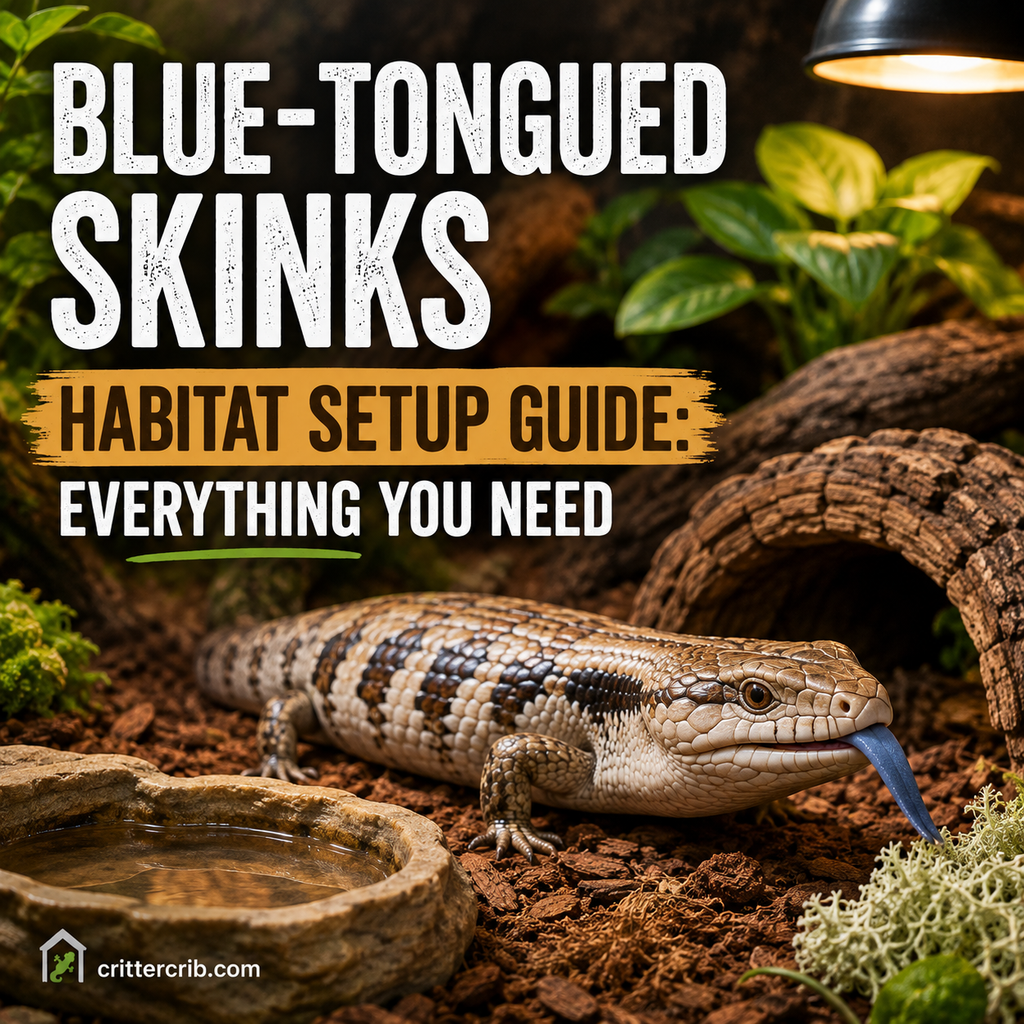
Useful habitat features can include:
- Warm-side hide
- Cool-side hide
- Cork bark
- Artificial plants
- Low tunnels
- Stable rocks
- Visual barriers
Hides should be appropriately sized and secure.
Any heavy decorations must be positioned so they can’t collapse onto a digging skink.
Humidity Requirements Depend on the Type of Skink
One of the biggest mistakes in blue-tongued skink care is assuming every type needs identical humidity.
They don’t.
Some Australian blue-tongued skinks are adapted to relatively drier conditions, while Indonesian types generally require higher humidity.
This is why identifying your skink correctly is so important.
Monitor Humidity
Use a digital hygrometer rather than trying to judge humidity by appearance.
Also pay attention to:
- Shedding
- Skin condition
- Substrate moisture
- Ventilation
- Drinking behavior
Humidity should be appropriate for the particular species or subspecies rather than based on one universal number.
Hydration Matters
Blue-tongued skinks should have access to fresh drinking water.
Provide a stable dish that’s easy to access and clean.
The bowl should be large enough for comfortable drinking without taking over the entire enclosure.
Change the water regularly and clean the dish whenever it becomes contaminated.
Diet and environmental humidity can also contribute to overall hydration.
Persistent signs of dehydration warrant a closer look at husbandry and potentially veterinary evaluation.
Substrate Can Influence Health and Behavior
A suitable substrate can support humidity control, digging, comfort, and enrichment.
The best choice depends partly on the type of blue-tongued skink and the enclosure environment.
Whatever you use should be:
- Appropriate for the species
- Free of harmful chemicals
- Maintained hygienically
- Suitable for the required humidity
- Deep enough for natural behavior when appropriate
Avoid choosing substrate solely because it looks attractive.
Function matters more.
Exercise and Enrichment Support Quality of Life
A healthy blue-tongued skink shouldn’t spend its entire life moving between a food bowl and one hide.
Environmental enrichment encourages activity and natural behavior.
You can provide enrichment through:
- Digging opportunities
- Cork bark
- Low climbing surfaces
- Tunnels
- Multiple hides
- Different textures
- Safe objects to investigate
- Occasional changes to enclosure furniture
- Appropriate supervised exploration
Blue-tongued skinks are powerful, curious animals.
Some will push, dig underneath, or rearrange objects you’ve carefully placed.
That’s part of the experience.
Make sure anything heavy remains secure even after your skink decides your interior design needs improvement.
Cleanliness Helps Reduce Health Risks
Regular enclosure maintenance is another basic part of supporting long-term health.
Remove waste and contaminated substrate promptly.
A practical routine includes:
- Removing feces and urates.
- Taking out uneaten fresh food.
- Cleaning food dishes.
- Changing contaminated water.
- Removing heavily soiled substrate.
- Performing deeper cleaning when needed.
You don’t need to completely sterilize the enclosure every day.
The goal is consistent hygiene without constantly disrupting the animal’s environment.
Stress Can Affect Overall Well-Being
Many blue-tongued skinks become relatively comfortable around people, but individuals vary.
Some tolerate handling readily.
Others are more defensive or easily stressed.
Potential sources of stress include:
- Excessive handling
- Lack of hiding areas
- Other pets around the enclosure
- Constant environmental disturbance
- Incorrect temperatures
- Inappropriate humidity
- Insufficient space
- Frequent complete enclosure rearrangements
Give your skink opportunities to retreat and allow it time to become accustomed to normal interaction.
Does Handling Affect a Blue-Tongued Skink’s Lifespan?
Appropriate handling isn’t expected to shorten a healthy skink’s life.
Gentle interaction can make routine health checks and veterinary visits easier because the animal becomes accustomed to being handled.
But there’s no need to force constant interaction.
Support the skink’s body securely and avoid grabbing it by the tail.
If the animal repeatedly struggles, hisses, tries to escape, or becomes highly defensive, reduce the intensity or duration of handling sessions.
Common Health Problems That Can Affect Lifespan
Even well-cared-for blue-tongued skinks can develop health problems.
Early recognition can improve the chances of successful treatment.
Metabolic Bone Disease
Problems involving calcium, vitamin D3, UVB exposure, and diet can contribute to metabolic bone disease.
Possible signs include:
- Weakness
- Tremors
- Difficulty walking
- Limb abnormalities
- Jaw changes
- Reduced mobility
Suspected metabolic bone disease requires veterinary attention.
Respiratory Illness
Inappropriate temperatures, humidity, or other factors may contribute to respiratory problems.
Possible signs include:
- Unusual breathing
- Wheezing
- Nasal discharge
- Open-mouth breathing
- Reduced activity
- Loss of appetite
Respiratory symptoms should be evaluated by a reptile veterinarian.
Parasites
Internal and external parasites can affect reptiles.
Possible signs may include:
- Weight loss
- Abnormal stool
- Reduced appetite
- Poor body condition
- Lethargy
Veterinary testing can help determine whether parasites are present and whether treatment is necessary.
Shedding Problems
Retained shed may indicate that humidity, hydration, or other husbandry conditions need attention.
The toes can be particularly important to monitor because constricting retained shed may interfere with circulation.
Don’t aggressively pull stuck shed from the animal.
Persistent shedding problems should be discussed with a reptile veterinarian.
Regular Veterinary Care Matters
Blue-tongued skinks can live for many years, so establishing a relationship with a reptile veterinarian early is worthwhile.
A veterinarian can help with:
- Wellness examinations
- Weight evaluation
- Nutrition
- Parasite testing
- Husbandry questions
- Skin problems
- Respiratory symptoms
- Injuries
- Reproductive concerns
Don’t wait until your skink is seriously ill to figure out which veterinary clinic treats reptiles.
Find one before you need one.
Watch for Changes in Behavior
You see your skink more often than a veterinarian does.
That makes you the person most likely to notice when something changes.
Pay attention to:
- Appetite
- Weight
- Stool
- Activity
- Walking
- Breathing
- Shedding
- Skin
- Eyes
- Mouth
- General behavior
A single unusual day isn’t necessarily an emergency.
Persistent changes deserve more attention.
Keep Basic Health Records
Blue-tongued skinks may live for two decades, which makes long-term records surprisingly useful.
You won’t remember every feeding change or weight measurement from eight years ago.
Keep a simple record containing:
- Weight
- Feeding changes
- Shedding problems
- Veterinary visits
- Medications
- Major enclosure changes
- Unusual symptoms
You can use a notebook, spreadsheet, or notes app.
The format doesn’t matter nearly as much as consistency.
How Can You Help a Blue-Tongued Skink Live Longer?
There’s no guaranteed formula for reaching a particular age.
However, good husbandry gives your skink the best opportunity for a long, healthy life.
Focus on these fundamentals:
- Identify your blue-tongued skink correctly.
- Provide species-appropriate humidity.
- Maintain an appropriate temperature gradient.
- Provide suitable UVB lighting.
- Feed a balanced omnivorous diet.
- Avoid chronic overfeeding.
- Monitor body condition and weight.
- Provide adequate enclosure space.
- Offer multiple secure hides.
- Encourage exercise and natural behaviors.
- Maintain fresh drinking water.
- Keep the enclosure clean.
- Minimize unnecessary stress.
- Watch for changes in health or behavior.
- Establish care with a reptile veterinarian.
Doing the basics correctly year after year matters more than constantly searching for complicated husbandry tricks.
How Can You Tell When a Blue-Tongued Skink Is Getting Older?
Aging can look different from one individual to another.
Older skinks may gradually become less active or develop changes in mobility and body condition.
However, don’t automatically blame every change on age.
Symptoms such as:
- Significant weight loss
- Persistent appetite loss
- Difficulty walking
- Weakness
- Abnormal breathing
- Swelling
- Sudden behavioral changes
can indicate health problems rather than normal aging.
Senior reptiles still deserve veterinary evaluation when something seems wrong.
Caring for a Senior Blue-Tongued Skink
Older skinks may benefit from small adjustments that make daily life easier.
Depending on the individual, you may need to:
- Make basking areas easier to reach
- Reduce difficult climbing obstacles
- Monitor weight more frequently
- Adjust feeding based on body condition
- Provide easily accessible water
- Maintain comfortable substrate
- Schedule more frequent health checks
The goal isn’t necessarily to completely redesign the habitat.
It’s to adapt the environment as the animal’s needs change.
Is a Blue-Tongued Skink a Long-Term Commitment?
Absolutely.
A blue-tongued skink purchased today could potentially still be living with you 15 or 20 years from now.
Before bringing one home, consider what that timeframe means.
Over the animal’s lifetime, you may:
- Move
- Change jobs
- Change relationships
- Travel
- Have children
- Adopt other pets
- Experience changes in income
Your skink will still need appropriate food, housing, equipment, and veterinary care through those changes.
That’s one reason lifespan should be considered before choosing any reptile.
Frequently Asked Questions About Blue-Tongued Skink Lifespan
How Long Do Pet Blue-Tongued Skinks Live?
Many properly cared-for blue-tongued skinks can live approximately 15 to 20 years in captivity, with some individuals potentially living longer.
Genetics, species, diet, husbandry, body condition, and veterinary care can all influence lifespan.
Can Blue-Tongued Skinks Live 20 Years?
Yes.
A lifespan approaching or exceeding 20 years is possible for some blue-tongued skinks under good captive care.
It shouldn’t be considered a guarantee for every individual.
What Shortens a Blue-Tongued Skink’s Lifespan?
Potential factors include poor nutrition, chronic obesity, inappropriate temperatures, incorrect humidity, inadequate UVB exposure, untreated disease, parasites, injuries, chronic stress, and other husbandry problems.
Genetic and medical factors outside an owner’s control can also affect lifespan.
Do Blue-Tongued Skinks Live Longer in Captivity?
They can.
Captive skinks receiving proper care are protected from predators, severe food shortages, many environmental hazards, and some injuries encountered in the wild.
They also have access to veterinary treatment.
Do Blue-Tongued Skinks Need UVB?
Providing appropriate UVB exposure is widely considered beneficial husbandry for blue-tongued skinks because it supports vitamin D3 production and calcium metabolism.
UVB should be provided using suitable equipment and placement rather than simply adding any reptile bulb.
Which Blue-Tongued Skink Lives the Longest?
There isn’t a dependable rule guaranteeing that one commonly kept type will always outlive another.
Individual genetics and lifelong husbandry play major roles.
More importantly, identify the type of skink you own so you can provide the correct environmental conditions for it.
Final Thoughts
So, how long do blue-tongued skinks live?
For many pet blue-tongued skinks, approximately 15 to 20 years is a reasonable lifespan to plan for, and some individuals may live beyond 20 years.
That makes them a significant commitment.
Fortunately, supporting a long life doesn’t require some secret technique. It comes down to consistently getting the important things right.
Feed a balanced diet. Avoid obesity. Provide appropriate temperatures, humidity, UVB lighting, enclosure space, fresh water, hiding places, and enrichment. Keep the habitat clean and pay attention when your skink’s normal behavior changes.
Just as importantly, know which type of blue-tongued skink you actually have.
Care requirements aren’t identical across every species and subspecies, particularly when it comes to humidity. Providing husbandry tailored to the individual animal is much more useful than following a generic care sheet.
With thoughtful care and regular attention to its health, a blue-tongued skink can be a fascinating companion for a surprisingly large portion of your life.