Tortoises may move slowly, but that doesn’t mean they need a small living space.
In fact, one of the most common mistakes new tortoise owners make is choosing an enclosure based on the animal’s current size. A young tortoise can look tiny in a large habitat, but many species grow considerably and spend a surprising amount of time walking, exploring, grazing, digging, and moving between warmer and cooler areas.
So, how much space does a tortoise actually need?
There isn’t one enclosure size that works for every tortoise. The right amount of space depends on the species, adult size, age, climate, and whether the tortoise lives primarily indoors or outside.
This guide explains how much room tortoises need, how enclosure requirements change as they grow, and why providing enough usable floor space is such an important part of responsible tortoise care.
How Much Space Does a Tortoise Need?
As a general principle, tortoises should be given the largest practical enclosure you can safely provide.
Unlike arboreal reptiles that make extensive use of vertical space, tortoises primarily need floor space. A tall enclosure doesn’t compensate for a small footprint.
A properly designed habitat should give a tortoise enough room to:
- Walk and explore
- Turn around comfortably
- Move between warm and cool areas
- Access food and water
- Dig or burrow when appropriate
- Use multiple hides
- Exercise naturally
- Get away from exposed areas
- Graze in species where grazing is appropriate
For many commonly kept small-to-medium terrestrial tortoises, an enclosure around 4 × 8 feet is a useful target for an adult, with larger being better when possible.
That isn’t a universal minimum for every species, however.
Large tortoises can require dramatically more room, while temporary juvenile accommodations may be smaller.
The species should always determine the long-term housing plan.
Why Tortoises Need More Room Than You Might Expect
A tortoise sitting quietly under a basking lamp can give the impression that it doesn’t do very much.
Watch one throughout an entire day, however, and you’ll often see a different animal.
Tortoises naturally move around their environment searching for food, suitable temperatures, shelter, and comfortable resting areas. Some species cover considerable distances when conditions allow.
Providing adequate space allows those natural behaviors to occur.
A larger habitat also makes proper husbandry easier.
You need enough room to create distinct areas within the enclosure rather than placing the basking spot, hide, water, and food practically on top of one another.
This is especially important for temperature regulation.
Tortoises are ectothermic, meaning they depend on environmental heat sources to regulate their body temperature. They need to be able to move toward warmth and away from it.
If the enclosure is extremely small, creating a useful temperature gradient can become difficult.
Tortoise Enclosure Size by Age
Age can influence enclosure size, but it’s important to plan for the adult animal from the beginning.
A hatchling doesn’t necessarily need to move directly into a huge outdoor enclosure. Young tortoises can be housed in smaller, carefully controlled environments when appropriate.
The problem comes when a temporary juvenile enclosure becomes permanent.
Hatchling Tortoises
Hatchlings are tiny, but they still need room to move between different parts of their habitat.
Depending on the species, a carefully designed enclosure around 2 × 3 feet or larger can provide a starting point for a very young tortoise.
However, husbandry needs vary significantly between species, particularly when it comes to humidity and temperature.
The habitat should be large enough to provide:
- A basking area
- A cooler retreat
- Secure hiding areas
- Food
- Water
- Appropriate substrate
- Space for natural movement
Young tortoises can grow faster than owners expect, so enclosure upgrades should be planned before the animal becomes crowded.
Juvenile Tortoises
As a tortoise grows, usable floor space should increase.
A juvenile that once looked tiny in its habitat may eventually spend much of its time walking along the enclosure boundaries.
Rather than waiting until the tortoise obviously appears cramped, increase the habitat size as the animal grows.
For many species, moving toward a 4 × 4-foot or larger enclosure during the juvenile stage provides considerably more usable space.
Again, species and individual size matter more than age alone.
Adult Tortoises
Adult housing is where substantial floor space becomes particularly important.
For many smaller commonly kept species, something around 4 × 8 feet provides a much more appropriate starting point than a typical reptile aquarium.
Whenever practical, additional space is beneficial.
Larger species need significantly larger enclosures, and giant tortoises may require dedicated outdoor areas rather than conventional reptile habitats.
Tortoise Housing Size by Species
“Tortoise” covers animals with very different adult sizes.
A Russian tortoise and a sulcata tortoise shouldn’t be expected to live in similarly sized habitats.
The following dimensions are general planning guidelines rather than rigid measurements. Individual husbandry requirements, climate, enclosure design, and the tortoise’s actual adult size should also be considered.
Russian Tortoise Space Requirements
Russian tortoises are relatively small, which sometimes leads people to house them in undersized tanks.
Despite their compact bodies, they can be very active.
An adult Russian tortoise benefits from approximately 4 × 8 feet of floor space when practical, particularly in a permanent enclosure.
Outdoor housing can work very well in suitable weather because it allows natural sunlight, digging, grazing, and exploration.
Russian tortoises are also skilled diggers and surprisingly capable escape artists.
Outdoor walls need to account for both behaviors.
Hermann’s Tortoise Space Requirements
Hermann’s tortoises are another relatively small species that benefits from much more room than its body size might suggest.
A spacious enclosure around 4 × 8 feet is a useful adult target, with larger outdoor habitats providing even more opportunities for natural movement.
Include environmental variety such as:
- Sunny areas
- Shade
- Hides
- Safe plants
- Different substrate depths
- Feeding or grazing areas
The goal isn’t simply to create an empty rectangle. You want to make the available space useful.
Greek Tortoise Space Requirements
Greek tortoises vary somewhat in adult size depending on locality and subspecies.
As with Hermann’s and Russian tortoises, an adult habitat in the neighborhood of 4 × 8 feet provides a useful planning target for many individuals.
Outdoor housing can provide significantly more space in an appropriate climate.
Pay close attention to the environmental requirements of the particular type of Greek tortoise you’re keeping rather than assuming every Mediterranean tortoise needs identical care.
Marginated Tortoise Space Requirements
Marginated tortoises grow larger than many other commonly kept Mediterranean species.
That means they should generally receive more space.
An enclosure larger than 4 × 8 feet is preferable for an adult, and suitable outdoor housing can be especially valuable.
Owners should plan around adult size rather than purchasing housing based on a small juvenile.
Red-Footed Tortoise Space Requirements
Red-footed tortoises are moderately large and active animals that benefit from substantial floor space.
Adults should have large enclosures, often at least around 6 × 8 feet where practical, with additional room being beneficial.
Their housing requirements also differ from those of arid or Mediterranean species.
Red-footed tortoises naturally encounter warmer, more humid environments, so simply giving them a large dry enclosure isn’t enough.
Space and environmental conditions have to work together.
Yellow-Footed Tortoise Space Requirements
Yellow-footed tortoises can become fairly large and should be planned for accordingly.
Large outdoor or dedicated indoor habitats are generally more suitable for adults than conventional reptile enclosures.
They also require environmental conditions appropriate for a tropical tortoise.
Before acquiring one, owners should consider whether they can realistically provide enough space and appropriate conditions when the animal reaches adult size.
Leopard Tortoise Space Requirements
Leopard tortoises can grow substantially larger than Russian, Greek, or Hermann’s tortoises.
Adults require significant space.
A small indoor tortoise table that works for a juvenile won’t be sufficient for a large adult.
Where climate allows, a secure outdoor habitat offers much more room for walking and grazing. Owners in colder climates may also need a large heated indoor area for periods when outdoor temperatures aren’t suitable.
Planning for winter housing is just as important as planning for summer.
Sulcata Tortoise Space Requirements
Sulcata tortoises are a completely different housing commitment.
A baby sulcata may fit in your hands. An adult can become enormous.
Adults generally need a large, secure outdoor area with substantial room for walking and grazing. Think in terms of a dedicated yard or large pen rather than a traditional reptile enclosure.
Sulcatas are also powerful diggers.
A poorly designed boundary may not contain a determined adult.
Owners need to plan for:
- Large amounts of outdoor space
- Strong fencing
- Digging behavior
- Shelter
- Appropriate heating during cold weather
- Grazing areas
- Long-term maintenance
A sulcata shouldn’t be purchased with the expectation that it will remain an indoor tabletop pet.
Can a Tortoise Enclosure Be Too Big?
Under appropriate conditions, providing additional space isn’t generally the problem people sometimes imagine it to be.
The real issue is whether the space is properly designed.
A very large enclosure that doesn’t maintain appropriate temperatures, humidity, security, or access to resources isn’t automatically better than a smaller well-designed habitat.
This is particularly relevant for hatchlings.
Young tortoises need to be able to easily locate food, water, warmth, and shelter. A huge but barren enclosure can leave a hatchling exposed rather than enriched.
If you provide a large habitat, make the space usable.
Include:
- Multiple hides
- Visual barriers
- Appropriate plants
- Varied terrain
- Accessible food and water
- Suitable substrate
- Proper temperature zones
A spacious, well-structured enclosure gives a tortoise choices.
That’s the real advantage.
Is a Glass Aquarium Big Enough for a Tortoise?
Most standard aquariums aren’t ideal permanent homes for adult tortoises.
One major limitation is floor space.
Aquariums are typically designed around fish and therefore provide significant volume and height. A terrestrial tortoise gets little benefit from that vertical volume.
A tortoise table or custom enclosure can provide considerably more floor space without becoming excessively tall.
Glass can also create another issue.
Some tortoises repeatedly attempt to walk through transparent barriers because they can see the space beyond them. This can result in persistent pacing or scratching.
Using opaque lower walls or visual barriers may help.
How Big Should a Tortoise Table Be?
For smaller adult tortoise species, a tortoise table around 4 × 8 feet can provide a useful amount of floor space when indoor housing is necessary.
Not everyone has room for an eight-foot enclosure, which is exactly why housing requirements should be considered before choosing a tortoise species.
You can build tortoise tables in different shapes to accommodate a room.
For example, an L-shaped habitat can sometimes provide more usable floor area than a simple rectangle.
Focus on total usable floor space rather than enclosure volume.
Indoor vs. Outdoor Tortoise Housing
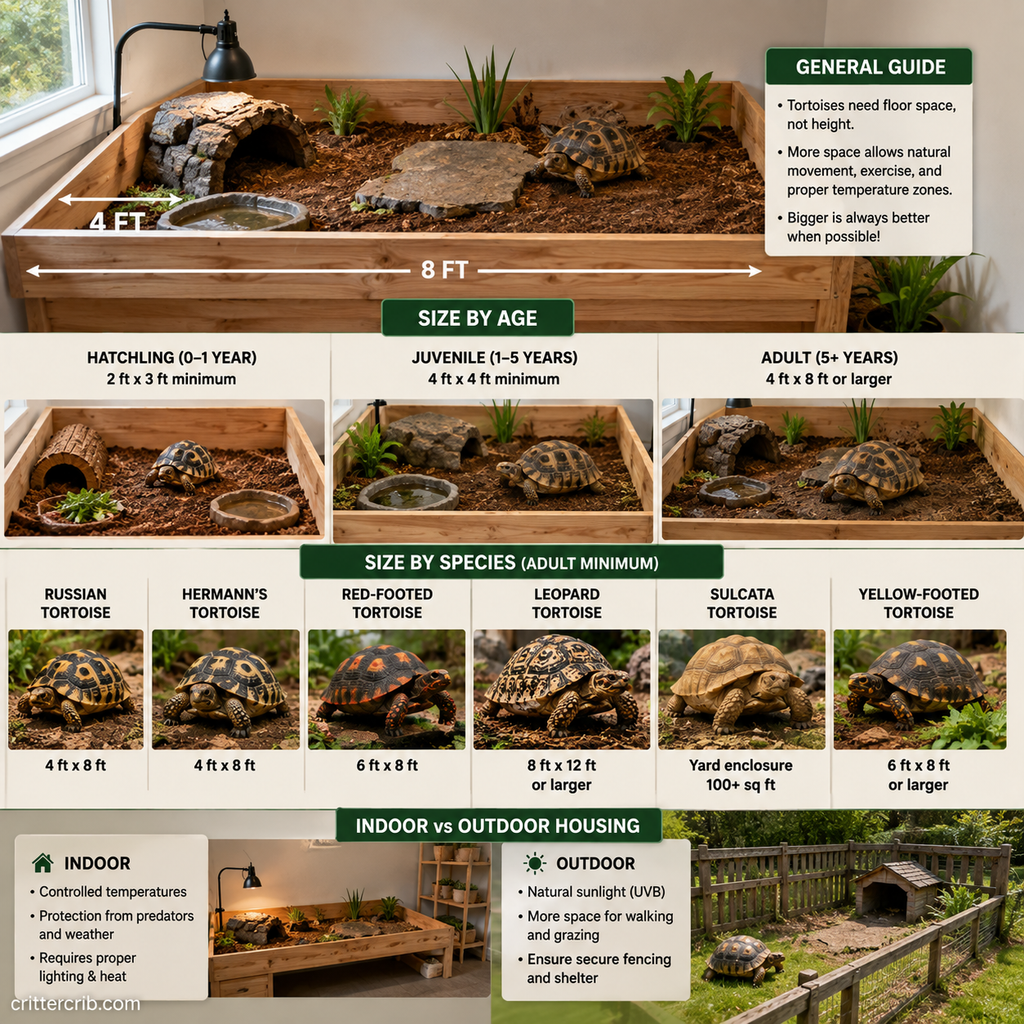
Whether indoor or outdoor housing is preferable depends on species, climate, season, and local conditions.
Both can work when designed correctly.
Indoor Tortoise Enclosures
Indoor housing gives you more control over environmental conditions.
This can be especially useful for:
- Hatchlings
- Cold climates
- Extreme weather
- Quarantine
- Seasonal housing
- Species requiring carefully managed conditions
However, indoor enclosures can become too small simply because household space is limited.
They also require artificial heat and appropriate lighting, including UVB when natural sunlight isn’t available.
An indoor enclosure should provide enough room for the tortoise to move through meaningful environmental zones.
Advantages of Indoor Housing
Indoor housing can offer:
- Controlled temperatures
- Protection from predators
- Protection from severe weather
- Easier observation
- Controlled humidity
- Consistent access to lighting and heat
Challenges of Indoor Housing
Potential drawbacks include:
- Limited floor space
- Dependence on artificial lighting
- Difficulty housing very large species
- Less access to natural grazing
- Greater need for environmental enrichment
For large tortoises, indoor housing may eventually mean dedicating a substantial section of a room, garage, shed, or other properly heated structure.
Outdoor Tortoise Enclosures
Outdoor habitats can provide excellent opportunities for natural tortoise behavior when the climate is appropriate.
Natural sunlight is particularly valuable, and outdoor enclosures can offer much more room for exploration.
A good outdoor habitat may include:
- Sunny basking areas
- Shaded areas
- Secure hides
- Edible plants
- Grazing areas
- Varied terrain
- Digging opportunities
- Safe water access
However, putting a tortoise outside isn’t as simple as placing it inside a fence.
Security is essential.
How Big Should an Outdoor Tortoise Enclosure Be?
For smaller species, an outdoor enclosure of at least several dozen square feet provides much more opportunity for movement than a small indoor setup.
An 8 × 8-foot enclosure, for example, provides 64 square feet.
An 8 × 12-foot enclosure provides 96 square feet.
If you have safe space available, going larger can create a much richer environment.
Large species such as sulcatas and leopard tortoises may require hundreds or even thousands of square feet depending on the animal, climate, and long-term housing arrangement.
Instead of asking how small the enclosure can be, it is often more useful to ask how much secure space you can realistically dedicate to the animal.
Outdoor Enclosure Walls and Security
Outdoor housing needs secure boundaries.
The exact construction depends on the species.
Some tortoises dig extensively, while others may push surprisingly hard against barriers.
Walls should generally prevent the tortoise from seeing an obvious path directly through the boundary.
Also inspect the perimeter regularly.
Weather, digging, plant growth, and soil movement can create escape routes over time.
Don’t Forget Predators
Outdoor tortoises can be vulnerable to predators.
Potential threats vary by location but can include:
- Dogs
- Coyotes
- Raccoons
- Birds of prey
- Rats
- Other wildlife
Young tortoises are especially vulnerable.
Depending on local predators and the size of the tortoise, a secure top or other protective measures may be necessary.
Why Floor Space Matters More Than Height
Tortoises aren’t climbing lizards.
Although some individuals can scramble over surprisingly difficult obstacles, enclosure height isn’t where most of their usable habitat exists.
Imagine two enclosures.
One measures 2 × 2 feet but is 4 feet tall.
Another measures 4 × 8 feet but has relatively low, secure walls.
For a terrestrial tortoise, the second enclosure provides vastly more useful living space.
Prioritize footprint first.
Wall height should primarily be determined by containment, security, substrate depth, and the species’ ability to climb or push against barriers.
Creating Different Zones Within the Enclosure
Providing enough space allows you to create a habitat rather than simply a container.
A good tortoise enclosure should have several functional areas.
Basking Zone
Provide an appropriately heated area where the tortoise can raise its body temperature.
The required basking temperature depends on species.
Cooler Zone
Your tortoise needs somewhere to retreat when it no longer wants additional heat.
This is one reason very small enclosures can be problematic.
Hiding Areas
Provide secure retreats.
Multiple hides give the tortoise options depending on temperature, humidity, and activity.
Feeding or Grazing Areas
Depending on the species, you may provide food in designated areas or establish safe edible vegetation for grazing.
Water Area
Fresh water should be accessible without dominating the enclosure.
Use a container that allows safe entry and exit.
Digging Areas
Many tortoises naturally dig or burrow.
Appropriate substrate depth allows them to express this behavior.
How to Make a Tortoise Enclosure Feel Larger
If you’re already providing an appropriately sized habitat, thoughtful design can make the space more interesting and functional.
Avoid creating one large, empty rectangle.
Instead, consider adding:
- Safe plants
- Logs
- Low mounds
- Rocks that cannot shift or collapse
- Different substrate depths
- Multiple hides
- Visual barriers
- Grazing patches
- Shaded areas
These features break up sightlines and encourage exploration.
Be careful with obstacles near enclosure walls. A tortoise can use objects as steps and climb much higher than you might expect.
Signs a Tortoise Enclosure May Be Too Small
You can’t determine enclosure quality from behavior alone, but certain patterns can suggest that the setup deserves another look.
Possible signs include:
- Persistent pacing along boundaries
- Repeated escape attempts
- Constant interaction with enclosure walls
- Difficulty establishing temperature zones
- Resources crowded together
- Little room for natural walking
- Lack of space for hides and enrichment
Some pacing can have other causes, including seasonal or reproductive behavior.
Still, if your tortoise spends much of its active time repeatedly walking the same short path, increasing usable space and reviewing husbandry is worthwhile.
Can Tortoises Free-Roam Inside a House?
Allowing a tortoise to permanently roam freely around the house isn’t a good replacement for a properly designed enclosure.
A normal household floor doesn’t provide the controlled environmental conditions a tortoise needs.
Potential problems include:
- Inadequate temperatures
- Lack of UVB exposure
- Drafts
- Accidental injuries
- Being stepped on
- Access to unsafe objects
- Ingestion of foreign material
- Encounters with other pets
- Difficulty monitoring food and waste
Supervised exploration in a safe area can provide enrichment, but the tortoise should still have an appropriately designed primary habitat.
Can Two Tortoises Share an Enclosure?
Providing twice the floor space doesn’t automatically make cohabitation safe.
Tortoises aren’t social animals in the way many people expect pets to be.
Housing multiple tortoises together can create:
- Competition for food
- Competition for basking areas
- Chasing
- Ramming
- Biting
- Mounting
- Chronic stress
- Unequal access to resources
One animal may continually dominate another without dramatic fighting.
Keeping tortoises separately is often the safest option.
If multiple animals are housed in the same large outdoor area under circumstances appropriate for the species, significantly more space, visual barriers, multiple hides, and duplicate resources become important.
Never assume a tortoise needs a “friend.”
Plan for Adult Size Before Buying a Tortoise
One of the best things a future tortoise owner can do is design the adult enclosure before bringing home the animal.
Ask yourself:
- How large will this species become?
- How much indoor floor space can I dedicate permanently?
- Can the tortoise live outdoors in my climate?
- Where will it live during winter?
- Can I provide appropriate heat and lighting indoors?
- Can I build a secure outdoor enclosure?
- Will I still have enough space when the tortoise is fully grown?
This is especially important for large species.
A tiny sulcata is easy to accommodate.
A mature sulcata is not.
Choosing a species that fits the space you realistically have is much easier than trying to find space for a giant tortoise years later.
Frequently Asked Questions About Tortoise Enclosure Size
Is a 4 × 2-foot enclosure big enough for a tortoise?
It may provide temporary housing for some young tortoises, but 4 × 2 feet is generally limited for an adult. Many smaller adult species benefit from considerably more floor space, such as approximately 4 × 8 feet when practical.
Is 4 × 8 feet big enough for a tortoise?
For many smaller adult tortoise species, 4 × 8 feet can provide a useful target for a permanent enclosure. Larger species require considerably more room, and providing additional space is beneficial when conditions can be maintained properly.
Do tortoises need a lot of space?
Yes. Although tortoises are slow-moving, many are active walkers and explorers. They need enough room for exercise, thermoregulation, hiding, feeding, digging, and other natural behaviors.
Do tortoises prefer indoor or outdoor enclosures?
Outdoor housing can provide natural sunlight and significantly more space when the climate and species make it appropriate. Indoor housing provides greater environmental control. Many keepers use a combination depending on season and weather.
How much space does a baby tortoise need?
A baby can initially use a smaller enclosure than an adult, provided it has adequate space for temperature zones, hides, food, water, and movement. Something around 2 × 3 feet or larger may work as a starting point for some species, but the enclosure will need to grow with the animal.
How much room does a sulcata tortoise need?
Adult sulcatas require very large spaces and are best thought of as yard-sized animals rather than conventional indoor reptiles. Secure outdoor areas, strong boundaries, shelter, and appropriate cold-weather accommodations are major long-term requirements.
Can I keep a tortoise in a 40-gallon tank?
A 40-gallon aquarium may be useful temporarily for some very small juveniles under appropriate conditions, but it generally doesn’t provide enough floor space for an adult tortoise. Floor dimensions matter more than gallon capacity.
Does a tortoise need space to exercise?
Yes. Walking, exploring, grazing, and digging are normal tortoise behaviors. Providing substantial usable floor space allows these activities to occur naturally.
Final Thoughts
When it comes to tortoise housing, bigger isn’t about spoiling your pet. Space is a fundamental part of creating a functional environment.
A tortoise needs room to walk, explore, warm up, cool down, hide, eat, and interact naturally with its surroundings.
For many smaller adult species, approximately 4 × 8 feet is a useful enclosure target, with larger spaces offering even more opportunities for natural behavior. Medium and large species require substantially more room, and giant tortoises such as sulcatas may eventually need dedicated outdoor areas.
Most importantly, plan around the tortoise’s adult size.
The tiny animal you bring home may be easy to house today, but tortoises are long-lived animals. The enclosure you can provide five, ten, or twenty years from now matters just as much as the one you have today.
Choose a species whose adult housing requirements fit the space you can realistically provide, and you’ll have a much stronger foundation for responsible long-term care.