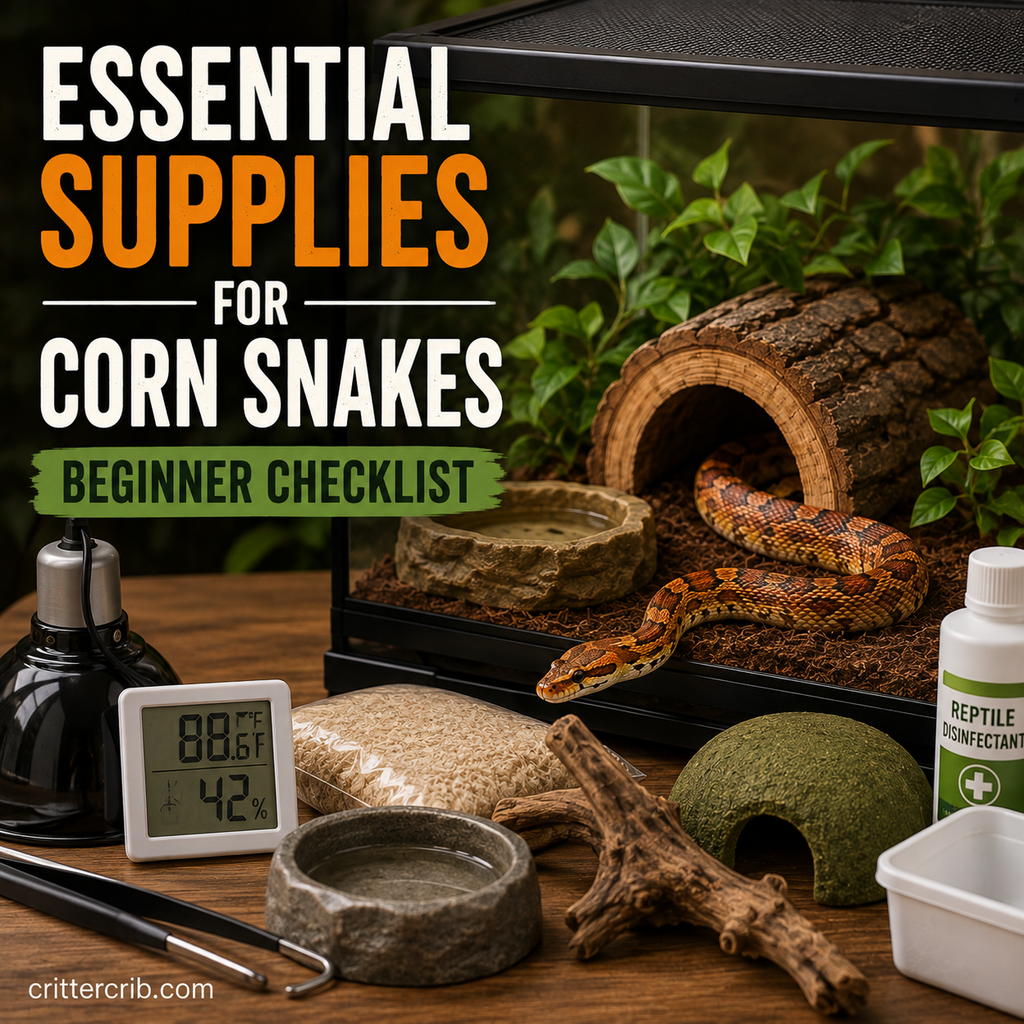
Bringing home a corn snake is exciting, but the easiest way to make the transition go smoothly is to have the enclosure completely set up before the snake arrives.
Corn snakes are often recommended to beginner reptile keepers because they’re generally manageable, hardy, and relatively straightforward to care for. Still, they need more than a tank, some bedding, and a water bowl.
The right enclosure size, secure lid, controlled heat, hides, substrate, temperature monitoring, and feeding equipment all matter.
If you’re preparing for your first corn snake, this checklist covers the essential supplies you’ll need, what each item is for, and a few things you can probably leave off your shopping list.
Corn Snake Supplies at a Glance
Here’s a quick overview of the basic supplies you’ll need:
- Secure enclosure
- Escape-proof lid or locking doors
- Thermostat
- Appropriate heat source
- Digital thermometers
- Hygrometer
- Substrate
- At least two secure hides
- Water bowl
- Climbing branches
- Foliage or other cover
- Feeding tongs
- Appropriately sized frozen-thawed rodents
- Reptile-safe cleaning supplies
- Temporary holding container
- Optional lighting and enrichment
Some of these items are inexpensive. Others, particularly the enclosure and environmental controls, can represent a significant portion of the initial cost.
It’s better to budget for the complete setup rather than buying the snake first and trying to add essential equipment afterward.
1. A Secure Corn Snake Enclosure
The enclosure will probably be your largest purchase.
Corn snakes are active animals that climb, explore, burrow, and investigate small openings. Adults can grow several feet long, so they need enough room to move around naturally.
A good adult enclosure should provide enough space for the snake to fully stretch out and use different areas of its environment.
An enclosure around 4 x 2 x 2 feet is a good target for many adult corn snakes, particularly if you want room for climbing structures and enrichment.
Young corn snakes can begin in smaller enclosures, provided they’re appropriately furnished and completely secure.
Escape Prevention Is Essential
Corn snakes have a reputation for being talented escape artists.
A small gap that looks insignificant to you may be an exit route to a young snake.
Make sure:
- Sliding doors lock securely
- Screen tops use proper clips
- Cable openings are sealed appropriately
- Ventilation holes aren’t large enough for the snake to pass through
- Doors cannot be pushed open
Don’t rely on placing books or other heavy objects on top of an unsecured screen lid.
Use hardware designed to secure the enclosure.
2. A Thermostat
A thermostat is one of the most important pieces of equipment in a corn snake setup.
It regulates the heat source so temperatures don’t continue rising unchecked.
This isn’t the same thing as a thermometer.
A thermometer tells you the temperature.
A thermostat controls the heating equipment.
If you’re using a heat source that can raise enclosure temperatures beyond the safe range, it should be controlled appropriately.
Choose a thermostat compatible with the type of heating equipment you’re using.
3. An Appropriate Heat Source
Corn snakes need access to a warm area as well as a cooler retreat.
They shouldn’t be kept at one uniform temperature throughout the enclosure.
Depending on your enclosure, heating options may include:
- Overhead heat lamps
- Deep heat projectors
- Ceramic heat emitters
- Other appropriately controlled reptile heating equipment
The best choice depends on the enclosure material, room temperature, and setup.
An overhead heat source can create a more natural warm area from above.
Whatever you choose, pair it with appropriate temperature monitoring and thermostatic control.
Do Corn Snakes Need a Heat Mat?
Under-tank heaters have traditionally been common in snake keeping, but they aren’t your only option.
A properly configured overhead heating system can provide effective warmth while allowing you to create a useful temperature gradient.
If a heat mat is used, it needs appropriate thermostat control and must be installed according to the manufacturer’s directions.
Never place an unregulated heating device where your snake can overheat or suffer burns.
4. Digital Thermometers
You need to know what temperatures your snake is actually experiencing.
Guessing isn’t enough.
Place digital temperature probes where they provide useful readings of the warm and cool portions of the habitat.
This allows you to confirm that your temperature gradient is functioning correctly.
A basic setup should let you monitor:
- Warm side
- Cool side
- Significant changes throughout the day
Avoid relying entirely on inexpensive stick-on analog gauges.
Digital thermometers with probes are generally much easier to position where the readings actually matter.
5. Infrared Temperature Gun
An infrared temperature gun isn’t absolutely required, but it’s one of the most useful tools a reptile keeper can own.
It allows you to quickly check surface temperatures throughout the enclosure.
You can measure:
- Basking surfaces
- Substrate
- Hides
- Branches
- Different areas of the enclosure
Remember that an infrared temperature gun measures surface temperature rather than air temperature.
Use it alongside your digital thermometers, not as a replacement for them.
6. A Digital Hygrometer
Corn snakes aren’t tropical rainforest snakes, but humidity still matters.
A digital hygrometer lets you monitor the enclosure instead of guessing based on how dry or damp the substrate looks.
Humidity can be affected by:
- Room conditions
- Substrate
- Ventilation
- Water bowl placement
- Heating
- Seasonal weather
Monitoring becomes particularly useful around shedding.
If your corn snake repeatedly has incomplete sheds, humidity is one of the husbandry factors worth reviewing.
7. Safe Substrate
Substrate covers the enclosure floor and can provide opportunities for burrowing.
Several options can work for corn snakes.
Common choices include:
- Aspen
- Cypress mulch
- Coconut-based substrate
- Appropriate reptile soil mixtures
- Paper towels for quarantine or temporary setups
Each has advantages and disadvantages.
Aspen
Aspen is popular because it’s relatively inexpensive, easy to spot-clean, and holds burrows well.
It should be kept dry.
If it becomes wet, remove the damp portion promptly.
Moisture-Retaining Substrates
Cypress and coconut-based substrates can retain more moisture than aspen.
That can be useful depending on your enclosure and household conditions, but you don’t want the habitat permanently saturated.
Paper Towels
Paper towels aren’t particularly natural-looking, but they’re extremely useful when monitoring a new or sick snake.
They make it easy to observe:
- Feces
- Urates
- Regurgitation
- Mites
- Other potential problems
Once a healthy new snake has completed an appropriate observation or quarantine period, you can transition to a more enriching substrate.
8. At Least Two Hides
A corn snake should be able to feel secure without sacrificing its ability to regulate body temperature.
Provide at least:
- One hide on the warm side
- One hide on the cool side
A third humid hide can also be useful, particularly around shedding.
What Makes a Good Snake Hide?
A good hide should feel snug.
Corn snakes often prefer an enclosed space where their body can make contact with the sides.
A huge decorative cave may look impressive to us but may not provide the same sense of security as a properly sized hide.
You can use:
- Commercial reptile hides
- Cork bark
- Appropriately modified containers
- Other reptile-safe structures
Make sure hides are stable and don’t have sharp edges.
9. A Water Bowl
Your corn snake should have access to clean, fresh water.
Choose a bowl that’s:
- Stable
- Easy to clean
- Difficult to tip
- Large enough for comfortable access
Some corn snakes may occasionally soak.
The bowl doesn’t necessarily need to dominate the enclosure, but it should be appropriately sized for your individual snake.
Check the water every day.
Snakes have an unfortunate habit of getting substrate, waste, and other debris into water dishes.
10. Climbing Branches
Corn snakes aren’t purely ground-dwelling.
They’re capable climbers and often make good use of elevated structures when given the opportunity.
Branches add usable space to the enclosure and encourage exercise and exploration.
Choose branches that are:
- Sturdy
- Appropriately sized
- Free from sharp edges
- Securely positioned
Don’t simply balance a heavy branch against the side of the enclosure.
Make sure it cannot fall onto your snake.
11. Foliage and Visual Cover
An enclosure shouldn’t feel like an empty display case.
Artificial or reptile-safe live plants can create visual barriers and help your snake move around while remaining partially concealed.
Additional cover can include:
- Artificial vines
- Cork bark
- Leaf litter
- Branches
- Logs
- Rocks
- Other reptile-safe décor
You don’t need to pack every inch of the habitat.
The goal is to create choices.
Your corn snake should be able to explore without always feeling exposed.
12. A Humid Hide
A humid hide provides a localized area of higher humidity.
This can be especially useful when your snake is preparing to shed.
A humid hide typically contains a moisture-retaining material such as:
- Damp sphagnum moss
- Damp paper towel
- Another appropriate reptile-safe medium
The material should be moist rather than dripping wet.
Check it regularly so it doesn’t become dirty or moldy.
13. Feeding Tongs
Long feeding tongs help keep your fingers away from the feeding response.
They also make it easier to present prey without handling it directly.
Choose a pair long enough to maintain some distance between your hand and the snake.
Feeding tongs are inexpensive and worth having from the beginning.
14. Appropriately Sized Frozen-Thawed Rodents
Corn snakes are typically fed appropriately sized mice or rats depending on their age and size.
Frozen-thawed prey is convenient, widely available, and avoids many of the risks associated with feeding live rodents.
Keep snake food stored separately and hygienically.
Avoid Live Feeding When Possible
Live rodents can injure snakes.
A frightened rodent may bite or scratch, particularly if it’s left unattended in the enclosure.
Frozen-thawed prey is generally the safer and more practical option for routine feeding.
If you’re having difficulty transitioning a snake to frozen-thawed prey, consult an experienced reptile veterinarian or knowledgeable keeper rather than repeatedly leaving live prey unattended.
15. A Small Digital Scale
A digital kitchen scale is an inexpensive addition that makes it much easier to monitor your snake’s growth and body condition.
Weighing your corn snake periodically can help you:
- Track growth
- Choose appropriate prey
- Identify unexpected weight loss
- Monitor feeding
- Keep basic health records
Use a container on top of the scale to keep the snake safely contained during weighing.
Record the weight so you can compare measurements over time.
16. Reptile-Safe Cleaning Supplies
You’ll need to clean the enclosure regularly.
Keep reptile cleaning equipment separate from your normal household cleaning supplies.
A basic kit might include:
- Disposable gloves
- Paper towels
- Dedicated scrub brush
- Waste scoop
- Reptile-appropriate disinfectant
- Trash bags
- Spare substrate
Always follow the cleaning product’s instructions for dilution, contact time, rinsing, and safe use.
Never spray cleaning chemicals around your snake.
Move the animal to a secure temporary container during more extensive cleaning.
17. A Secure Temporary Container
This item is easy to forget until the first time you need it.
A secure temporary container is useful when:
- Deep cleaning the enclosure
- Transporting your snake
- Inspecting the habitat
- Visiting the veterinarian
- Performing maintenance
The container should have adequate ventilation and a secure lid.
It doesn’t need to be a permanent habitat.
It simply needs to safely contain the snake for a short period.
18. Lighting
Corn snakes benefit from a predictable day-and-night cycle.
If the room doesn’t provide an appropriate light cycle, enclosure lighting on a timer can create consistency.
What About UVB?
Corn snakes can survive without the same high-intensity UVB requirements associated with many basking lizards, but appropriately provided low-level UVB can be a beneficial addition to a well-designed enclosure.
If you provide UVB, select equipment suitable for the species and enclosure dimensions.
Correct placement matters because screen tops, distance, and fixture design can affect how much UVB reaches the animal.
Lighting should turn off at night so your snake has a proper period of darkness.
19. Outlet Timers
Timers are inexpensive and make enclosure management much easier.
Use them for equipment that should follow a regular day-and-night schedule.
Instead of remembering to turn lights on every morning and off every evening, the schedule happens automatically.
This creates a more consistent routine for both you and your snake.
Heating equipment that requires temperature regulation should still be controlled by an appropriate thermostat rather than relying only on a timer.
20. Optional Enrichment
Once you’ve covered the essentials, you can make the enclosure more interesting.
Enrichment doesn’t need to be complicated.
Consider adding:
- Additional branches
- Cork tubes
- Leaf litter
- Different climbing textures
- Additional hides
- Plants
- Elevated platforms
- Safe tunnels
You can occasionally rearrange parts of the habitat, but don’t constantly redesign the entire enclosure.
Corn snakes also benefit from environmental stability.
Supplies You Probably Don’t Need
Pet stores sell plenty of reptile products that aren’t essential.
You can usually skip items such as:
- Heat rocks
- Decorative analog temperature gauges when you’re already using accurate digital equipment
- Tiny permanent starter tanks
- Excessive vitamin supplements for a healthy snake eating whole prey
- Expensive decorative items that provide no usable cover or enrichment
- Bright nighttime bulbs
Heat rocks are particularly unnecessary.
A thermostatically controlled overhead heating system can provide a safer, more useful warm area without encouraging the snake to wrap around a concentrated heated surface.
Set Everything Up Before Buying the Snake
Don’t assemble the enclosure the same afternoon you bring your corn snake home.
Set it up ahead of time.
Run the habitat for several days if possible and confirm:
- Heating works correctly
- Thermostat is functioning
- Warm-side temperatures are appropriate
- Cool-side temperatures are appropriate
- Humidity is reasonable
- Doors and lids are secure
- Hides are positioned properly
- Decorations are stable
- Water is easily accessible
This gives you time to solve problems before there’s an animal depending on the setup.
Corn Snake Beginner Shopping Checklist
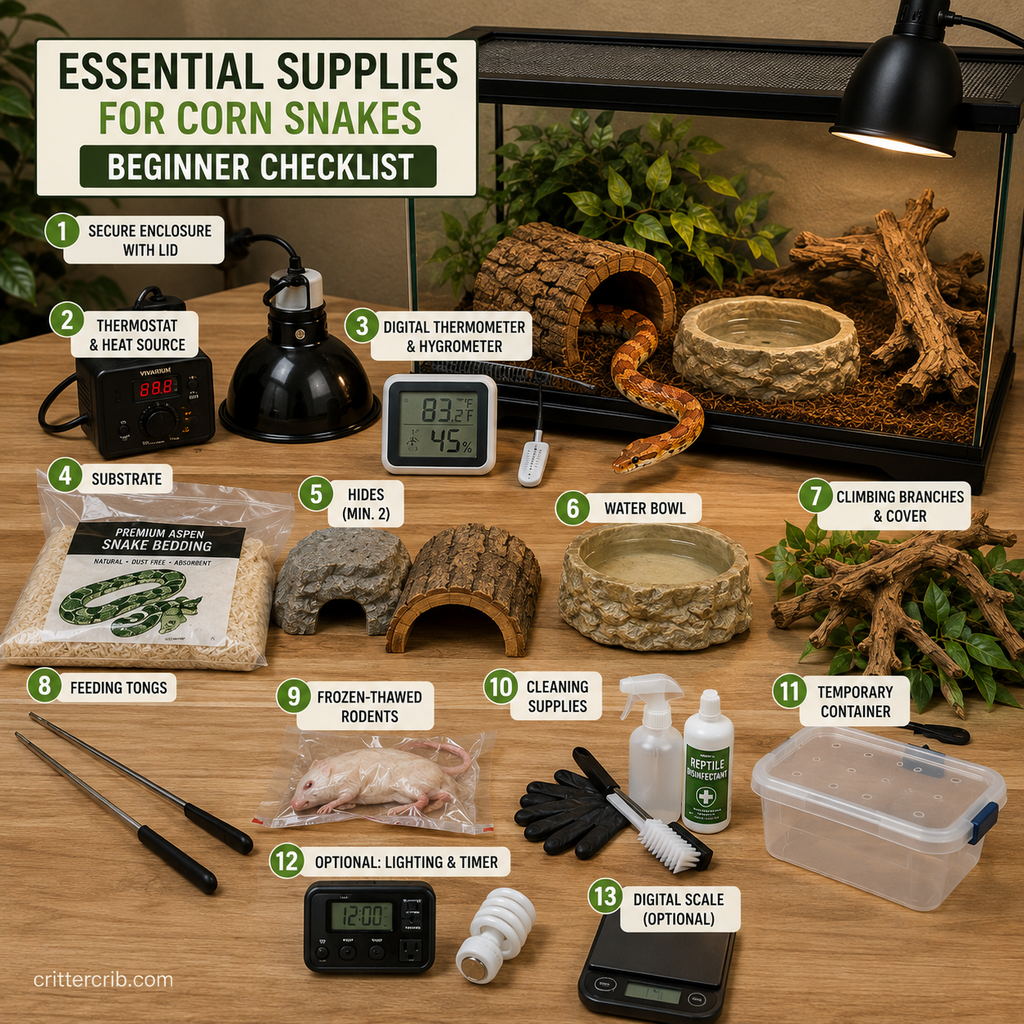
Before bringing your snake home, run through this final list.
Essential
- Secure enclosure
- Locking or escape-proof lid/doors
- Appropriate heat source
- Thermostat
- Digital warm-side thermometer
- Digital cool-side thermometer
- Digital hygrometer
- Safe substrate
- Warm hide
- Cool hide
- Water bowl
- Climbing structures
- Visual cover
- Feeding tongs
- Frozen-thawed prey
- Cleaning supplies
- Secure temporary container
Highly Recommended
- Infrared temperature gun
- Humid hide
- Digital scale
- Lighting
- Outlet timer
- Additional branches
- Plants and foliage
- Additional hides
You don’t have to buy the most expensive version of everything.
Spend your budget where it matters most: a secure appropriately sized enclosure, reliable environmental controls, accurate monitoring equipment, and furnishings that allow your snake to feel secure.
How Much Does a Corn Snake Setup Cost?
The snake itself may be one of the less expensive parts of getting started.
Your total cost will depend heavily on enclosure size and equipment quality.
The major expenses usually include:
- Enclosure
- Heating
- Thermostat
- Lighting
- Temperature and humidity monitoring
- Décor and hides
After the initial setup, routine expenses are generally more manageable.
You’ll continue purchasing items such as:
- Frozen rodents
- Substrate
- Cleaning supplies
- Replacement lighting when applicable
- Veterinary care
Budget for an exotic-animal veterinarian as part of responsible reptile ownership, even if your snake is currently healthy.
Common Beginner Setup Mistakes
A good shopping list also helps you avoid buying the wrong things.
Common mistakes include:
- Choosing an enclosure the snake will quickly outgrow
- Underestimating how easily corn snakes escape
- Using heating equipment without a thermostat
- Relying on one thermometer
- Providing only one hide
- Leaving the enclosure too exposed
- Buying décor instead of functional climbing structures
- Using an unstable water bowl
- Assuming corn snakes never climb
- Buying the snake before testing the enclosure
- Spending heavily on optional accessories while skipping environmental monitoring equipment
Get the fundamentals right first.
You can always improve the appearance of the habitat later.
Final Thoughts on Corn Snake Supplies
Corn snakes are often described as beginner-friendly reptiles, and that’s fair — but beginner-friendly doesn’t mean they can thrive with minimal equipment.
A proper setup starts with a secure, appropriately sized enclosure. Add controlled heating, accurate temperature and humidity monitoring, suitable substrate, multiple hides, fresh water, climbing opportunities, and plenty of cover.
Then add the practical equipment you’ll use behind the scenes: feeding tongs, a digital scale, cleaning supplies, timers, and a secure temporary container.
Most importantly, assemble and test everything before your corn snake comes home.
Once the habitat is stable, secure, and properly furnished, daily care becomes much simpler. Instead of constantly fixing problems, you can spend your time observing your snake explore, climb, burrow, and settle into its new home.