
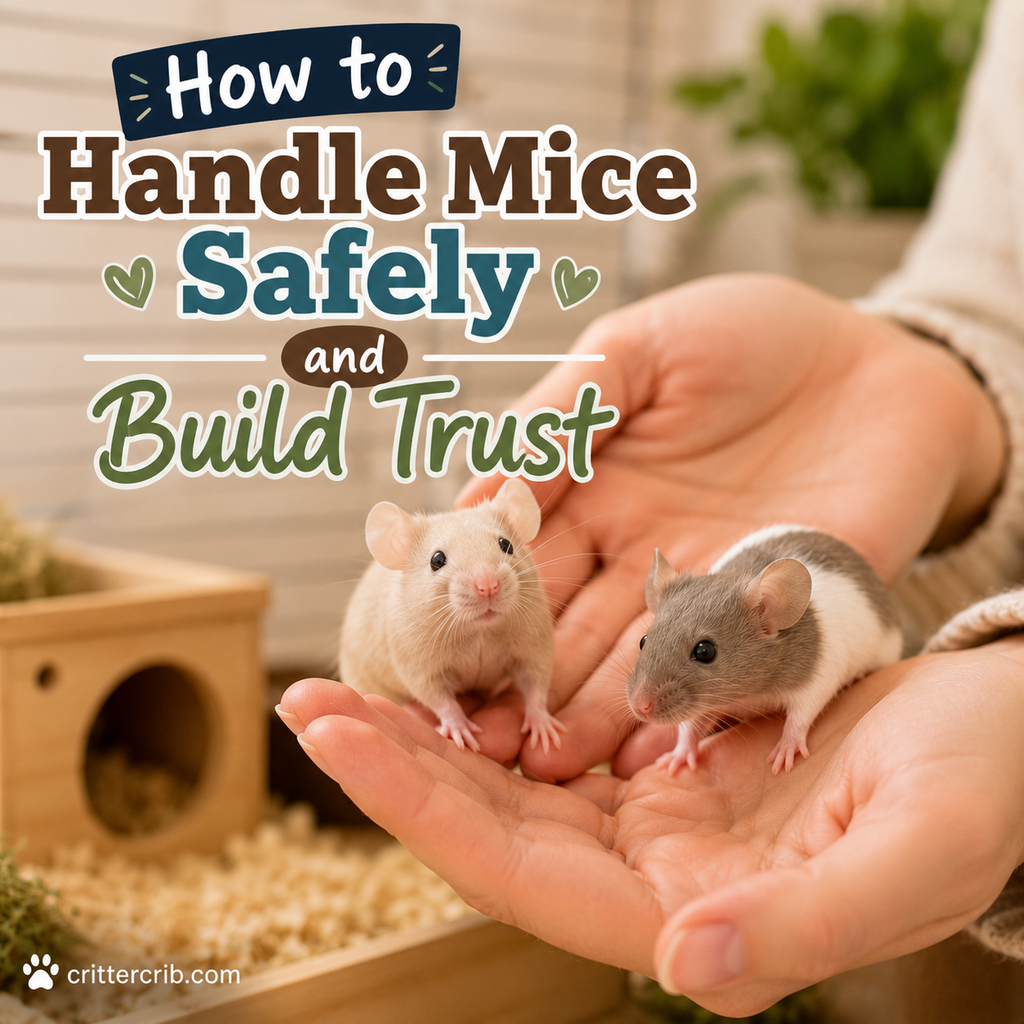
Pet mice may be tiny, but earning their trust can take a little patience.
A new mouse doesn’t automatically understand that the large hand entering its enclosure belongs to someone who wants to take care of it. From the mouse’s perspective, being chased, grabbed, or suddenly lifted into the air can be frightening.
That’s why good mouse handling starts before you actually pick your pet up.
By moving slowly, allowing your mouse to investigate you, and making interactions predictable, you can gradually teach it that your hands aren’t something to fear. Once that trust develops, routine handling, health checks, and cage maintenance usually become much easier.
Some mice become confident enough to climb onto their owners voluntarily. Others remain more cautious throughout their lives.
Either way, the goal isn’t to force your mouse to become cuddly. It’s to help it feel safe around you and make necessary handling as calm as possible.
Here’s how to handle mice safely while building trust along the way.
Why Are Pet Mice Nervous About Being Handled?
Mice are prey animals.
In the wild, being grabbed from above would rarely mean anything good.
That instinct helps explain why a new mouse may run into a hideout when your hand enters the enclosure.
It doesn’t necessarily mean your mouse dislikes you.
Your pet simply hasn’t learned what your presence means yet.
A nervous mouse might:
- Run away
- Hide
- Freeze
- Jump suddenly
- Squeak
- Nip
- Avoid your hand
- Urinate or defecate during handling
These behaviors can become less frequent as the mouse becomes accustomed to you.
Give your new pet time to settle in rather than expecting immediate interaction.
Let a New Mouse Settle In First
Bringing a mouse home introduces a lot of unfamiliar things at once.
There’s a new enclosure, different smells, new sounds, unfamiliar people, and possibly new cage mates.
Allow your mouse some quiet time to explore its surroundings.
During the first few days, focus on basic care and calm interaction.
You can:
- Provide food and fresh water
- Keep the enclosure in a comfortable location
- Speak softly nearby
- Perform necessary spot cleaning
- Avoid unnecessary chasing or grabbing
- Let your mouse establish hiding and sleeping areas
You don’t have to completely ignore your mouse.
The idea is simply to avoid overwhelming it.
Once your mouse is eating, drinking, exploring, and behaving normally, you can begin gradually introducing your hands.
Start by Getting Your Mouse Used to Your Presence
Trust begins with familiarity.
Spend some time near the enclosure without trying to touch your mouse.
Speak quietly when you approach.
Move normally but avoid sudden movements directly over the cage.
Over time, your mouse will learn your voice, scent, and routine.
You may notice it becoming less likely to hide when you enter the room.
That’s progress.
Use Your Voice Consistently
Mice can become familiar with the sounds associated with everyday routines.
Speaking gently before opening the enclosure gives your mouse a little warning that you’re approaching.
This is especially useful if your mouse is resting.
Instead of suddenly reaching into the enclosure, say something first and give your pet a moment to respond.
Predictability helps build confidence.
Let Your Mouse Investigate Your Hand
Once your mouse seems comfortable with your presence, place a clean hand inside the enclosure.
Don’t chase the mouse.
Don’t immediately try to pick it up.
Simply rest your hand on the bedding.
Your mouse may initially stay far away.
That’s fine.
Curiosity often takes over eventually.
The mouse may approach, sniff your fingers, or walk around your hand.
Keep still and let the interaction happen on its terms.
Repeat this regularly.
Eventually, your hand becomes another familiar part of the environment rather than something that always grabs the mouse.
Use Food to Build Positive Associations
A small amount of appropriate food can make your hand considerably more interesting.
Start by offering something your mouse enjoys from your fingertips.
Once it’s comfortable taking food from you, place the reward on your open palm.
The mouse may stretch forward to reach it without climbing onto you.
Eventually, it may put one paw on your hand.
Then two.
One day, you may find the entire mouse sitting on your palm.
Let that happen gradually.
Avoid using excessive treats. You can sometimes use a small portion of the mouse’s regular diet for training rather than continually adding high-calorie extras.
How to Pick Up a Mouse Safely
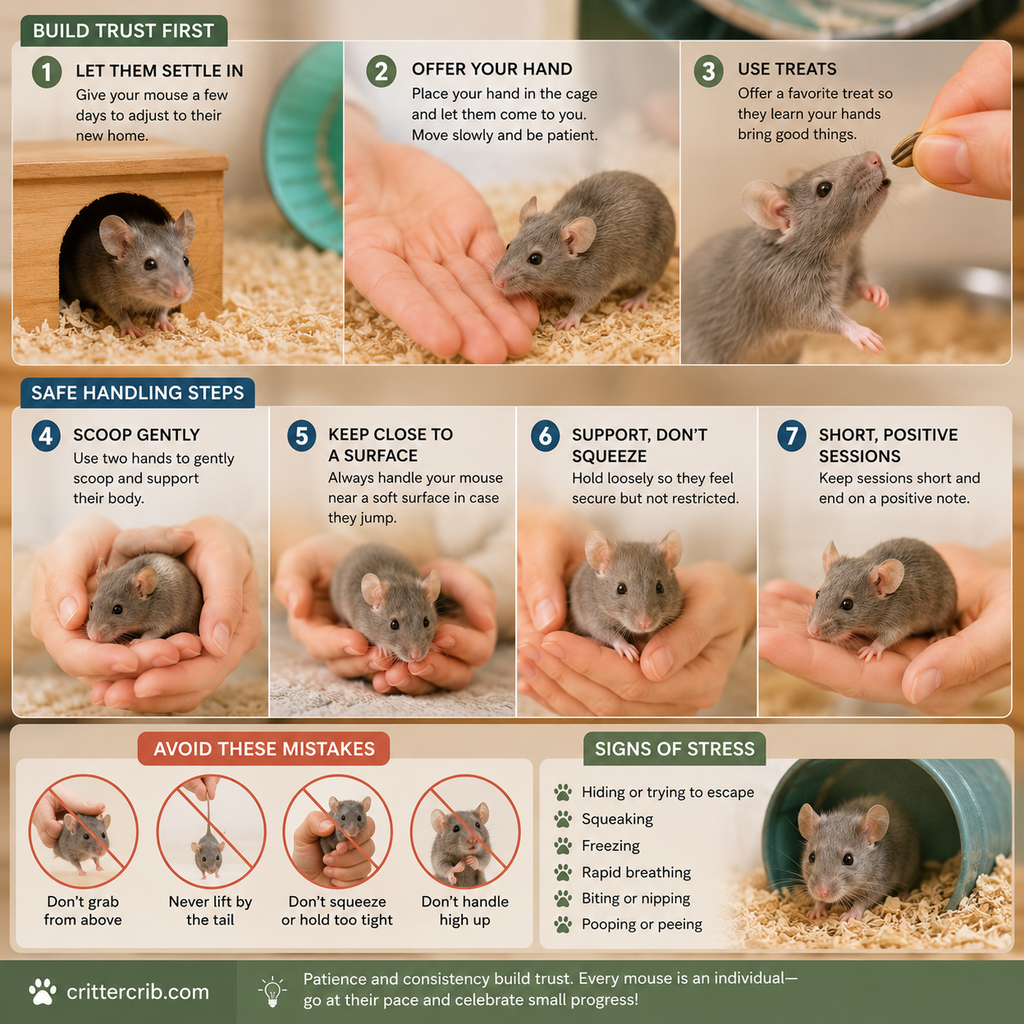
Once your mouse is comfortable approaching your hands, you can begin practicing gentle handling.
Whenever possible, encourage the mouse to walk onto your hands voluntarily.
Step 1: Approach Slowly
Bring your hands into the enclosure where your mouse can see them.
Avoid swooping down quickly from above.
Allow the mouse a moment to recognize you.
Step 2: Use Two Hands to Scoop
Place your hands on either side of the mouse and gently scoop underneath it.
Form a loose cup with your hands.
This supports the mouse’s body without squeezing.
Step 3: Keep Your Hands Close to a Surface
For your first handling sessions, remain close to the floor, a bed, or another safe surface.
Mice can move very quickly.
Keeping your hands low reduces the distance your mouse could fall if it suddenly jumps.
Step 4: Allow the Mouse to Move
You don’t necessarily need to hold your mouse completely still.
A confident mouse may enjoy walking from one hand to the other.
You can slowly alternate your hands so your mouse continues moving without getting away.
Step 5: Keep Early Sessions Short
The first few handling sessions don’t need to last long.
A minute or two of calm interaction can be more useful than a long session that ends with your mouse desperately trying to escape.
Gradually increase handling time as your mouse becomes comfortable.
Can You Pick a Mouse Up by Its Tail?
As a general rule, avoid picking up a pet mouse by its tail during normal handling.
The tail is sensitive, and lifting a mouse by it can cause pain, fear, or injury if done incorrectly.
For everyday interaction, scooping with your hands or allowing the mouse to climb onto you is a much better approach.
There are circumstances where trained veterinary or animal-care professionals may briefly restrain a mouse using specialized techniques involving the base of the tail.
That’s different from casually carrying a pet mouse by its tail.
For normal handling at home, support the mouse’s body.
Never Grab a Mouse by the Tip of Its Tail
Never lift or pull a mouse by the end of its tail.
If emergency restraint is required, get guidance from a veterinarian on safe handling techniques.
A frightened mouse can twist, jump, and move surprisingly quickly, so improvising restraint can result in injury.
Whenever possible, use a small container, tunnel, or hide to move a mouse that isn’t comfortable with hands.
Using a Tunnel or Cup to Move a Nervous Mouse
This is one of the easiest techniques for handling a mouse that hasn’t learned to trust you yet.
Place a small tunnel, cardboard tube, or suitable container in the enclosure.
Allow the mouse to walk inside.
Once it’s inside, carefully cover the exits with your hands and move the entire object.
This can be useful when:
- Cleaning the enclosure
- Moving a new mouse
- Transferring a mouse to a carrier
- Handling an especially nervous mouse
- Avoiding unnecessary chasing
The mouse gets to remain inside a familiar-feeling enclosed space instead of being grabbed.
Over time, you can continue working on hand taming separately.
How to Hold a Mouse Once You’ve Picked It Up
Keep your hands relaxed but positioned so the mouse can’t unexpectedly leap away.
Don’t squeeze.
Allow your mouse to sit in your cupped hands or walk between them.
Some mice enjoy climbing onto arms and sleeves once they’re comfortable.
If you allow this, make sure you’re in a secure environment.
A mouse that suddenly runs across your shoulder can disappear behind furniture remarkably quickly.
Early handling sessions are safest inside a secure play area or while sitting close to the floor.
How to Put a Mouse Down Safely
Returning a mouse to its enclosure should be calm too.
Lower your hands into the cage before allowing the mouse to step off.
Don’t drop it from above.
If your mouse is eager to return, it may try to jump before you’re ready.
Keep your hands cupped until you’re close to the bedding or another stable surface.
Then allow your mouse to walk off on its own.
How Long Does It Take for a Mouse to Trust You?
There’s no exact timeline.
Some mice become comfortable with their owners within days.
Others need several weeks or longer.
Factors that can affect trust include:
- Age
- Personality
- Previous handling
- Genetics
- Environment
- Health
- How consistently you interact
- Whether previous experiences with people were positive
A mouse from a responsible breeder that has received gentle handling from an early age may adjust quickly.
A poorly socialized or frightened mouse may require considerably more patience.
Don’t measure success by whether your mouse becomes cuddly.
Instead, look for gradual improvements.
Signs Your Mouse Is Starting to Trust You
A mouse that’s becoming comfortable may:
- Stay visible when you approach
- Come to the front of the enclosure
- Sniff your fingers
- Take food from your hand
- Walk onto your palm
- Groom itself near you
- Explore while your hand is nearby
- Climb onto your hands voluntarily
- Remain relatively relaxed during handling
These behaviors show that your mouse is beginning to view you as part of its normal environment rather than an immediate threat.
How to Tell if a Mouse Is Scared
Watch your mouse’s body language during interactions.
Possible signs of fear or stress include:
- Frantic attempts to escape
- Repeatedly hiding from you
- Freezing
- Sudden jumping
- Defensive biting
- Persistent squeaking during handling
- Rapid breathing
- Urinating or defecating excessively when picked up
A single behavior doesn’t always mean your mouse is terrified.
For example, mice naturally hide and can be extremely active.
Look at the context and whether the behavior occurs consistently during your interactions.
What Should You Do if Your Mouse Bites You?
A frightened mouse may bite when it feels trapped.
If that happens, avoid reacting by hitting, flicking, or punishing the mouse.
Punishment is likely to make your pet even more cautious around hands.
Instead, think about what happened immediately before the bite.
Did you:
- Corner the mouse?
- Wake it suddenly?
- Grab it?
- Put your fingers near a nest?
- Move too quickly?
- Smell like food?
Wash your hands before handling so they don’t carry strong food smells.
If your mouse repeatedly bites during interactions, return to slower trust-building exercises.
Let it approach your hand instead of reaching toward it.
Any bite that breaks the skin should be washed thoroughly with soap and water. Seek medical advice if the wound is deep, won’t stop bleeding, or develops signs of infection.
Don’t Chase Your Mouse Around the Cage
Chasing is one of the quickest ways to make handling stressful.
Imagine a giant hand following you through every hiding place until it finally catches you.
That’s not a great foundation for trust.
If you need to move your mouse before it’s comfortable being handled, use a tunnel or container.
For everyday bonding, let your mouse approach voluntarily.
The less frequently your hands predict a stressful chase, the more willing your mouse may become to investigate them.
Don’t Disturb a Sleeping Mouse Unnecessarily
Mice often rest during the day and become more active in the evening and at night.
Try to schedule bonding sessions when your mouse is naturally awake.
Repeatedly waking a sleeping mouse because you want to play can make interactions unnecessarily stressful.
If you need to wake your mouse for an important reason, make some gentle noise first.
Give it a moment to emerge rather than reaching directly into the nest.
Build a Routine
Mice can become comfortable with predictable patterns.
Try interacting at similar times each day.
A simple routine might look like this:
- Approach the enclosure and speak softly.
- Open the door or lid slowly.
- Place your hand inside.
- Allow your mouse to investigate.
- Offer a small food reward.
- Practice voluntary climbing onto your hand.
- End the session before your mouse becomes stressed.
Consistency matters more than making each session long.
Five calm minutes every day can be more useful than occasional lengthy handling sessions.
Let Your Mouse Have Some Control
One of the easiest ways to build trust is giving your mouse choices.
Instead of grabbing it every time you interact, sometimes open the enclosure and simply offer your hand.
If the mouse approaches, great.
If it doesn’t, try again later.
This teaches your mouse that your hand doesn’t automatically mean restraint.
Choice is especially useful when you’re working with a shy animal.
As confidence increases, voluntary interactions often become much more frequent.
Can Children Handle Pet Mice?
Children can interact with pet mice, but supervision is important.
Mice are small, fast, and physically delicate.
A child may accidentally squeeze a mouse or drop it if the animal suddenly moves.
Young children should usually interact while sitting on the floor or another safe surface.
Teach children to:
- Move slowly
- Use two hands
- Never squeeze
- Never pull the tail
- Avoid chasing
- Keep the mouse close to a safe surface
- Allow the mouse to walk away
- Wash their hands after handling
An adult should remain responsible for the animal’s overall care and safety.
Use a Secure Area for Out-of-Cage Interaction
Once your mouse is comfortable with you, a secure play area can provide additional opportunities for exploration and bonding.
Before allowing your mouse out, check carefully for:
- Small gaps
- Electrical cords
- Open doors
- Other pets
- Toxic plants
- Small objects
- Furniture the mouse can disappear behind
- Unsafe climbing areas
Mice can squeeze through extremely small openings.
A playpen or other secure mouse-safe space is often easier than trying to mouse-proof an entire room.
Provide tunnels, hides, cardboard, and other enrichment so your mouse has something to explore.
Male and Female Mice May Behave Differently
Individual personality matters more than stereotypes, but there can be some general behavioral differences.
Male mice are often kept individually because unfamiliar adult males may fight.
A well-socialized male may therefore rely more heavily on human interaction and enrichment.
Female mice are generally social and are commonly kept with compatible females.
This doesn’t mean every male will love handling or every female will prefer other mice.
Get to know the individual animal in front of you.
Handling Mice for Health Checks
Even a mouse that isn’t especially affectionate should become comfortable enough with basic handling that you can monitor its health.
Regularly observe:
- Eyes
- Ears
- Nose
- Coat
- Skin
- Feet
- Teeth
- Movement
- Body condition
- Breathing
You can also weigh your mouse periodically using an appropriate digital scale.
Weight changes can sometimes reveal a developing problem before it becomes visually obvious.
When a Behavior Change Could Mean Illness
A mouse suddenly becoming reluctant to be handled isn’t always experiencing a trust problem.
Pain or illness can change behavior.
Pay attention if your normally active mouse suddenly:
- Stops eating
- Loses weight
- Becomes unusually lethargic
- Hides constantly
- Develops noisy or difficult breathing
- Has discharge around the eyes or nose
- Develops a hunched posture
- Stops grooming normally
- Becomes unexpectedly aggressive
Mice can become ill quickly.
If you notice significant changes, contact a veterinarian experienced with small mammals.
Common Mouse Handling Mistakes
Avoiding a few common mistakes can make trust-building much easier.
These include:
- Grabbing a mouse from above
- Chasing it around the enclosure
- Lifting it by the tail during normal handling
- Squeezing or restraining too tightly
- Handling high above the floor
- Forcing long interactions
- Waking the mouse unnecessarily
- Punishing biting
- Ignoring signs of fear
- Allowing young children to handle unsupervised
- Letting a mouse loose in an unsecured room
If you’ve already made one of these mistakes, don’t panic.
Return to slower, positive interactions and give your mouse time to become comfortable again.
A Simple Mouse Trust-Building Plan
If you’re starting with a particularly shy mouse, break the process into stages.
Stage 1: Become Familiar
Spend time near the enclosure and speak softly.
Don’t attempt unnecessary handling.
Stage 2: Introduce Your Hand
Rest your hand inside the enclosure without chasing or grabbing.
Allow your mouse to investigate.
Stage 3: Offer Food
Use a small amount of appropriate food to reward approaching and touching your hand.
Stage 4: Encourage Climbing
Place food on your palm and allow the mouse to climb onto you voluntarily.
Stage 5: Practice Gentle Lifting
Once your mouse is comfortable sitting on your hand, lift it only slightly above the bedding.
Then put it back down.
Stage 6: Extend Handling Gradually
Slowly increase the duration of calm handling sessions.
If your mouse becomes frightened at any stage, return to the previous step for a while.
There’s no reason to rush.
Safe Handling Is Really About Trust
Learning how to handle a mouse safely isn’t just about knowing where to put your hands.
It’s about changing what those hands mean to your pet.
At first, your mouse may see your hand as something enormous and unpredictable entering its territory.
With patience, that can change.
Your hand becomes the thing that brings food. Then something interesting to sniff. Then something safe to climb onto. Eventually, it may become a familiar place where your mouse is completely comfortable sitting.
Whenever possible, let your mouse approach voluntarily and scoop it gently with two hands when lifting is necessary. Keep handling close to a safe surface, avoid grabbing or squeezing, and never carry a pet mouse around by the end of its tail.
Most importantly, pay attention to the individual animal.
Some mice become extremely confident with people. Others always prefer a little more personal space.
Both can learn to trust you.
When you move at your mouse’s pace rather than forcing interaction, you’re much more likely to end up with a pet that approaches because it wants to—not simply because it has nowhere else to go.