Setting up a gerbil habitat can look pretty simple at first. Add some bedding, a food bowl, a water bottle, maybe a wheel, and you’re done—right?
Not quite.
Gerbils are active little animals with a serious instinct to dig. Given enough substrate, they’ll create tunnels, sleeping chambers, food storage areas, and entire underground networks. A good gerbil habitat should give them the space and materials to do those things naturally.
That means the typical small pet-store cage with a thin layer of bedding usually isn’t the best setup.
Fortunately, creating a comfortable gerbil habitat doesn’t have to be complicated. Once you understand what gerbils actually need, you can build an enclosure that’s easier to maintain and much more interesting for your pets.
Here’s everything you need to set up a gerbil habitat properly.
What Do Gerbils Need in Their Habitat?
A good gerbil enclosure should provide opportunities to:
- Dig
- Burrow
- Run
- Chew
- Hide
- Forage
- Nest
- Explore
- Rest
The basic supplies you’ll need include:
- A spacious enclosure
- Deep bedding
- Nesting material
- A solid exercise wheel
- Hideouts
- Safe chew toys
- A sand bath
- Fresh water
- Appropriate food
- Enrichment
You’ll also need to think about ventilation, temperature, enclosure location, and how everything is arranged.
The goal isn’t to fill every inch with accessories.
Gerbils need usable space, especially below the surface.
What Type of Enclosure Is Best for Gerbils?
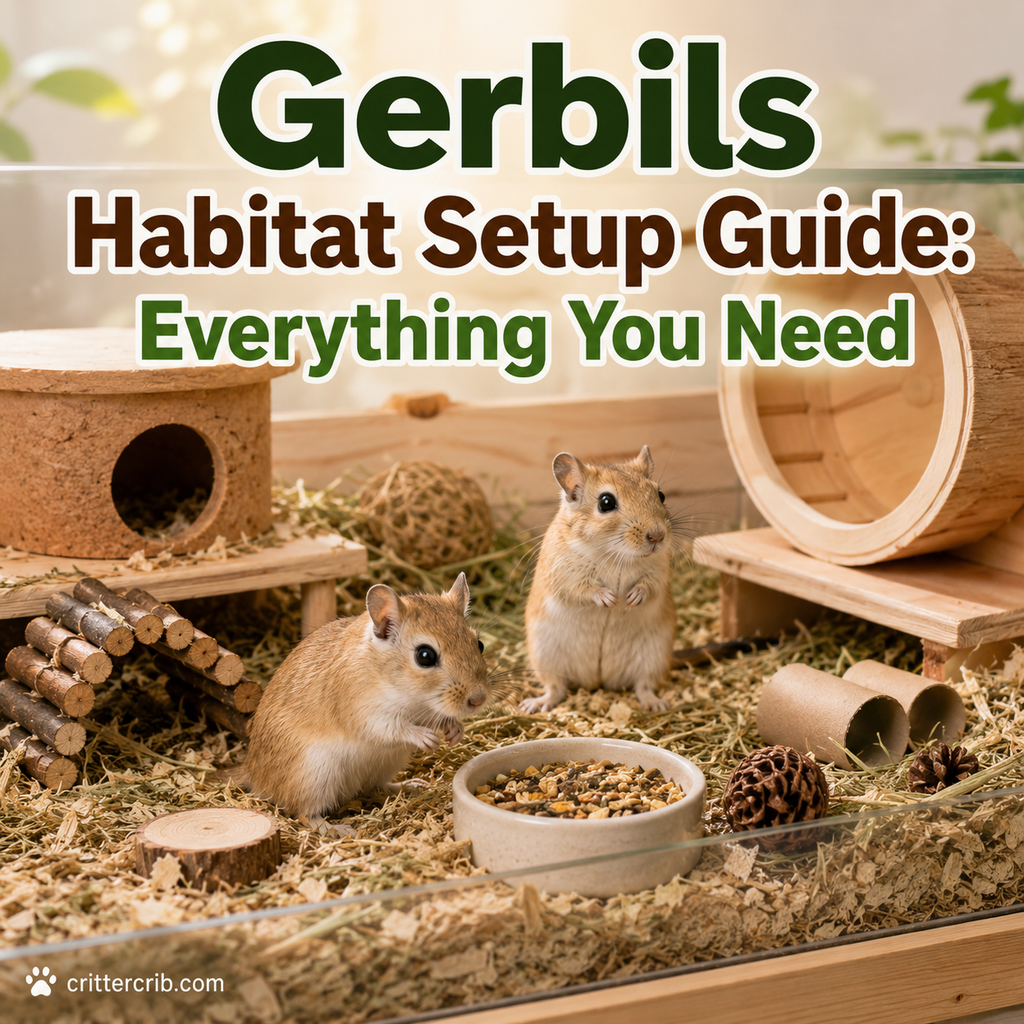
Glass tanks and similar deep-sided enclosures are popular choices for gerbils because they allow you to provide a substantial layer of bedding without having it kicked all over the room.
Gerbils are enthusiastic diggers.
Very enthusiastic.
If you’ve ever watched one launch bedding behind itself while excavating a tunnel, you’ll understand why shallow plastic cage bases can become messy quickly.
A tank-style enclosure also gives you a great view of the tunnels your gerbils create.
Make Sure the Enclosure Has Good Ventilation
A glass enclosure still needs adequate airflow.
The top should be securely covered with a well-ventilated mesh lid that allows air circulation while preventing escapes.
Avoid sealing the habitat with a solid lid.
Good ventilation helps prevent excessive moisture and odors from building up inside the enclosure.
What About Wire Cages?
Wire cages can provide excellent ventilation, but they often aren’t ideal on their own because they don’t hold enough bedding for deep burrowing.
Some owners use a deep tank-style lower enclosure combined with a secure upper level.
This can create separate areas for burrowing and activities such as eating, drinking, sand bathing, and running.
Whatever design you choose, make sure it is secure and doesn’t create dangerous fall risks or escape routes.
How Big Should a Gerbil Habitat Be?
Gerbils benefit from as much usable space as you can reasonably provide.
Rather than buying the smallest enclosure marketed for gerbils, choose a habitat that allows plenty of room for deep bedding, an appropriately sized wheel, hides, food, water, and enrichment.
For a pair of gerbils, many experienced keepers start with an enclosure around the equivalent of a 20-gallon long tank or larger, with larger setups often providing more flexibility for enrichment and deep substrate.
Local welfare organizations and veterinary recommendations may vary, so consider minimum dimensions a starting point rather than a target.
Bigger isn’t automatically better if the enclosure is poorly arranged, but additional usable space usually gives you more options for creating a stimulating environment.
Gerbils Usually Need Companionship
Unlike Syrian hamsters, gerbils are social animals.
They generally do best with a compatible same-sex companion, often a bonded pair.
Keeping a single gerbil alone may sometimes be necessary because of age, health, aggression, or the loss of a companion, but social housing is normally preferable when it can be done safely.
Don’t simply place unfamiliar gerbils together.
Gerbils can be territorial, and introductions need to be handled carefully. A method commonly known as the split-cage introduction allows unfamiliar gerbils to gradually become accustomed to each other’s scent and presence before direct interaction.
If you already have a bonded pair, avoid unnecessary separation because it can sometimes disrupt their relationship.
How Much Bedding Do Gerbils Need?
Deep bedding is one of the most important parts of a gerbil habitat.
Gerbils naturally construct extensive burrow systems.
A shallow layer of substrate doesn’t give them much opportunity to express that behavior.
Aim to provide a deep section of bedding—ideally at least several inches and preferably around 8–12 inches or more where the enclosure allows it.
More depth gives gerbils greater freedom to create stable tunnels and chambers.
You don’t necessarily need the entire enclosure filled to the same level.
One popular setup uses a large deep-bedding section for burrowing and a smaller area with less substrate for the wheel, water, and sand bath.
What Bedding Is Best for Gerbils?
Good gerbil bedding should be:
- Absorbent
- Low in dust
- Comfortable
- Safe for digging
- Capable of holding tunnels
Paper-based bedding is commonly used.
Aspen can also be incorporated into suitable setups, and hay can help add structure to tunnels.
Some owners combine materials to create a substrate that holds burrows particularly well.
For example, layers or mixtures of paper bedding and hay can give tunnels more structural support.
Bedding Materials to Avoid
Be cautious with strongly aromatic softwood shavings and heavily scented bedding products.
Cedar bedding should generally be avoided.
You should also avoid:
- Artificially perfumed bedding
- Extremely dusty substrate
- Cat litter
- Clumping litter
- Materials containing harmful chemicals
- Fluffy cotton-like nesting fibers
Products marketed as “nesting fluff” can look comfortable but may pose risks if fibers become wrapped around a gerbil’s limbs or are swallowed.
Plain shredded, unscented tissue or toilet paper can make a much safer nesting material.
Give Gerbils Plenty of Burrowing Material
You don’t need to construct elaborate tunnels yourself.
That’s your gerbils’ job.
Provide enough substrate and they’ll usually begin building almost immediately.
You can make the process more interesting by partially burying safe items such as:
- Cardboard tubes
- Small cardboard boxes
- Wooden tunnels
- Safe hideouts
Gerbils may incorporate these objects into their burrow system.
Don’t be surprised if your carefully arranged enclosure looks completely different the following morning.
Gerbils are enthusiastic interior designers, and they rarely care about your original layout.
Do Gerbils Need a Hideout?
Yes.
Even with deep bedding, gerbils should have secure places where they can retreat.
Wooden hides are particularly useful because gerbils often chew them as well.
You can provide more than one hiding option, especially in a larger enclosure.
Avoid overcrowding the habitat, though.
Your gerbils still need room to move and dig.
Some hides may eventually disappear beneath the bedding as your gerbils incorporate them into their tunnel system.
That’s completely normal.
What Size Wheel Do Gerbils Need?
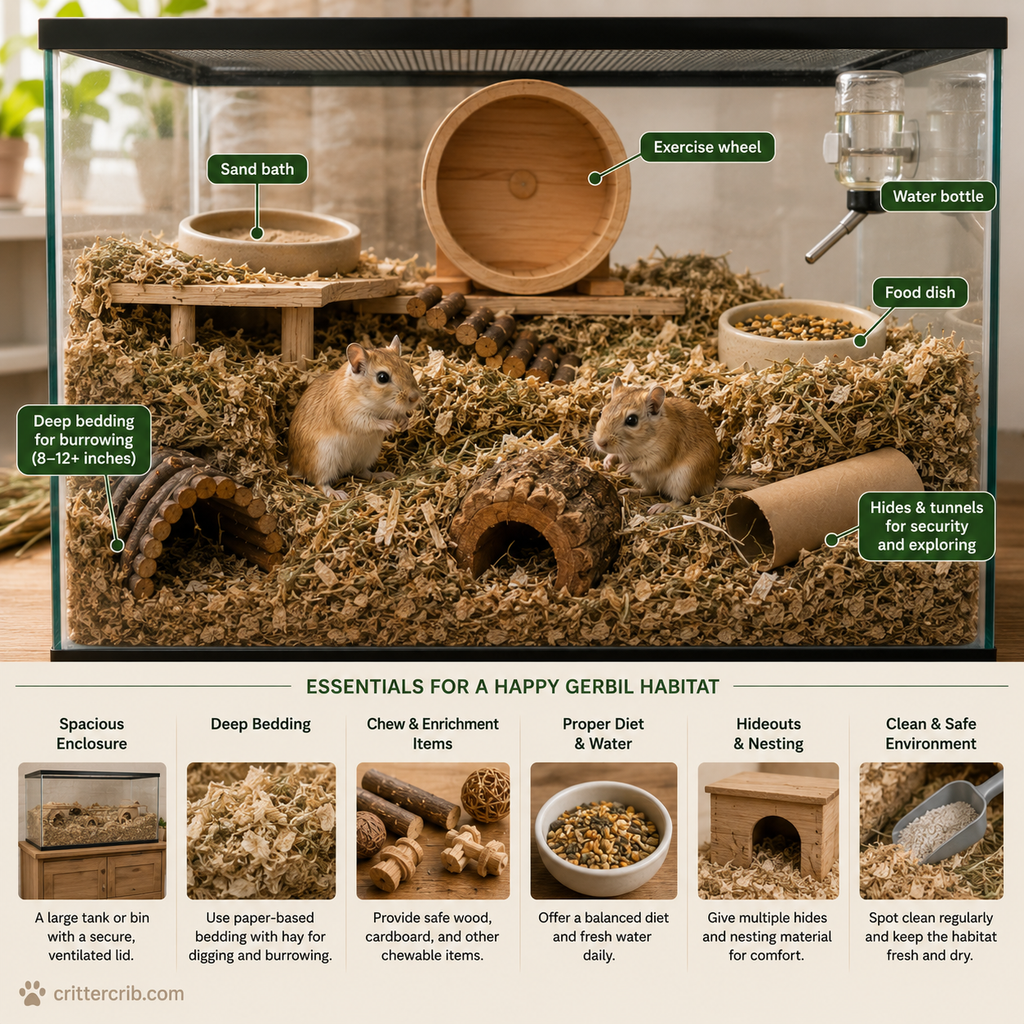
Gerbils benefit from access to an appropriately sized exercise wheel.
Choose a wheel large enough that your gerbil can run without dramatically arching its back.
For adult Mongolian gerbils, wheels around 8–10 inches in diameter or larger are commonly appropriate, depending on the size of the individual animal.
The running surface should be solid.
Avoid wire or mesh running surfaces that could catch small feet or tails.
Where Should You Put the Wheel?
If you place the wheel directly on deep bedding, your gerbils may bury it.
Sometimes impressively fast.
A platform or separate shallow-substrate section can help keep the wheel usable.
Make sure the wheel is stable and can’t fall onto a gerbil that’s digging underneath it.
Heavy accessories placed over deep substrate should be supported from the bottom or positioned on stable platforms.
Do Gerbils Need a Sand Bath?
Yes, a sand bath is a useful part of a gerbil habitat.
Gerbils use sand to help keep their coats clean and manage excess oils.
Use a suitable small-animal bathing sand rather than chinchilla dust.
Very fine dust can irritate the respiratory system.
Avoid ordinary beach sand, construction sand, and products containing additives unless you’re certain they’re safe and appropriately prepared for small animals.
A ceramic or glass dish works well because it’s difficult to chew and relatively easy to clean.
Some gerbils may also use the sand bath as a toilet.
While that isn’t particularly glamorous, it can make spot cleaning easier.
What Should Gerbils Chew?
Gerbils need plenty of safe chewing opportunities.
Their teeth grow continuously, so chewing is a normal and necessary behavior.
Good options can include:
- Gerbil-safe wooden chews
- Untreated cardboard
- Plain cardboard tubes
- Safe branches
- Wooden hides
- Appropriate chew toys
Cardboard tubes from toilet paper or paper towels are inexpensive enrichment.
Just make sure they’re plain and free from adhesives, coatings, fragrances, or other questionable materials.
Your gerbils may reduce a cardboard tube to confetti remarkably quickly.
That’s part of the fun.
How Should You Provide Water?
Gerbils need constant access to fresh, clean water.
A water bottle is commonly used because it helps prevent bedding from contaminating the water.
Check the bottle every day.
Make sure:
- It contains fresh water
- The nozzle isn’t blocked
- Water actually flows
- The bottle isn’t leaking
- Your gerbils can comfortably reach it
A leaking bottle can soak a large area of bedding, so address leaks quickly.
Some owners use a stable water bowl, but gerbils may bury bowls or kick bedding into them.
Whatever method you choose, clean water should always be available.
Where Should the Food Go?
Gerbils should receive an appropriate, nutritionally balanced diet formulated for them.
You can provide food in a bowl, but scatter feeding can also be an excellent form of enrichment.
Instead of placing every piece of food in one location, sprinkle some of the daily food around the enclosure.
Your gerbils then have to search and forage for it.
This encourages natural behavior and gives them something productive to do.
You can use a combination of bowl feeding and scatter feeding if that works better for your setup.
Always monitor how much your gerbils are actually eating.
What Enrichment Do Gerbils Need?
Enrichment doesn’t have to mean buying dozens of expensive pet-store toys.
Gerbils often enjoy simple objects that allow them to chew, dig, shred, and explore.
Try providing:
- Cardboard tubes
- Cardboard boxes
- Wooden tunnels
- Safe chew toys
- Hay
- Foraging opportunities
- Platforms
- Buried hides
- Different safe substrate textures
Rotate some enrichment periodically.
You don’t need to replace everything at once.
Leaving familiar objects and scents in the habitat can help maintain a sense of security.
How to Arrange a Gerbil Habitat
There’s no single perfect layout.
A practical setup often divides the enclosure into different functional areas.
Deep Burrowing Area
Make this the largest section.
Fill it generously with suitable bedding so your gerbils can create tunnels.
Mixing in hay can help support burrow structures.
Activity Area
Use a stable platform or shallower area for things that need to remain above the bedding, such as:
- Exercise wheel
- Sand bath
- Water
- Food dish
This helps prevent everything from disappearing underground.
Hiding and Enrichment Areas
Place hides, cardboard, tunnels, and chew items throughout the habitat.
Some can be partially buried.
Your gerbils will probably rearrange everything anyway, so don’t worry about making the enclosure look perfect.
Where Should You Put a Gerbil Cage?
Place the enclosure in a stable indoor environment.
Avoid locations exposed to:
- Direct sunlight
- Radiators
- Space heaters
- Air-conditioning vents
- Cold drafts
- Excessive humidity
- Constant loud noise
- Rapid temperature changes
Direct sunlight is particularly important to avoid.
A glass enclosure can become significantly warmer when sunlight shines directly through it.
Choose a comfortable room with good ventilation and a relatively stable temperature.
Gerbils can adapt to normal household activity, but they should still have quiet periods for resting.
How Often Should You Clean a Gerbil Habitat?
One advantage of a large enclosure with deep bedding is that it usually doesn’t require constant complete cleaning.
Spot cleaning is often more appropriate.
Remove:
- Damp bedding
- Heavily soiled areas
- Spoiled fresh food
- Dirty sand
- Contaminated nesting material when necessary
Complete substrate changes can be stressful because they remove familiar scents and destroy the entire burrow system.
When a deeper cleaning is necessary, consider retaining a portion of clean old bedding and mixing it with the fresh substrate.
That helps preserve familiar scent cues.
How frequently you’ll need a deeper clean depends on factors such as enclosure size, number of gerbils, bedding depth, ventilation, and how heavily particular areas become soiled.
Let the condition of the habitat guide you rather than following an unnecessarily aggressive cleaning schedule.
How to Keep the Habitat From Smelling
Gerbils generally don’t produce as much urine as some other small pets, and a properly maintained habitat shouldn’t have an overwhelming odor.
To control smells:
- Use absorbent bedding
- Provide plenty of substrate
- Spot-clean wet areas
- Clean the sand bath regularly
- Remove spoiled fresh food
- Fix leaking water bottles immediately
- Maintain good ventilation
If the enclosure develops a strong ammonia-like smell, it needs attention.
Don’t try to cover odors with scented bedding or air fresheners.
Address the source instead.
Make Sure Heavy Items Can’t Fall
This is one of the most important safety considerations in a deep-bedding habitat.
Gerbils dig underneath things.
If you place a heavy ceramic sand bath or wooden platform directly on top of deep loose bedding, your gerbils may tunnel beneath it and destabilize it.
Heavy accessories should sit securely on the enclosure floor, a stable divider, or a properly supported platform.
Then add bedding around them.
Check the enclosure regularly for anything that has shifted as your gerbils excavate.
Gerbil-Proof Plastic Accessories
Gerbils are serious chewers.
Plastic accessories may quickly become damaged, and swallowing pieces of plastic could create a health risk.
Whenever practical, choose durable materials such as:
- Glass
- Ceramic
- Metal
- Safe untreated wood
Inspect accessories regularly.
Remove anything that has become dangerously damaged, sharp, or unstable.
Common Gerbil Habitat Setup Mistakes
A few mistakes appear frequently in beginner setups.
These include:
- Using an enclosure that’s too small
- Providing only a thin layer of bedding
- Using unsafe or highly scented substrate
- Choosing a wheel that’s too small
- Using a wire or mesh running surface
- Providing too few chew items
- Using excessively dusty bathing material
- Putting heavy accessories on top of loose bedding
- Keeping the enclosure in direct sunlight
- Using too many plastic accessories
- Completely replacing all bedding too frequently
- Housing incompatible gerbils together
- Providing too little enrichment
Many of these problems are easy to correct.
The biggest improvement you can often make is simply providing more usable space and deeper bedding.
Gerbil Habitat Setup Checklist
Before bringing your gerbils home, make sure you have:
- A spacious, secure enclosure
- A ventilated mesh lid
- Plenty of safe, deep bedding
- Safe nesting material
- An appropriately sized solid exercise wheel
- At least one secure hideout
- A suitable sand bath
- Fresh water
- Nutritionally appropriate gerbil food
- Wooden chews and cardboard
- Foraging and enrichment opportunities
- Stable supports for heavy accessories
- A safe indoor location away from direct sunlight and drafts
Set everything up before your gerbils arrive.
That way, they can move directly into their new environment and begin settling in.
Building a Habitat Your Gerbils Can Actually Use
The best gerbil habitat isn’t necessarily the one with the most accessories or the most elaborate decorations.
It’s the one that allows gerbils to behave like gerbils.
Give them deep bedding and they’ll dig.
Provide cardboard and they’ll shred it.
Offer safe wood and they’ll chew it.
Give them enough space and they’ll create pathways, nests, tunnels, and food storage areas that you probably never would have designed yourself.
That’s exactly what you want.
Start with a spacious enclosure, plenty of burrowing material, a suitable wheel, sand bath, hides, fresh food and water, safe chewing materials, and enrichment.
Then let your gerbils take over the decorating.
Their habitat may not stay picture-perfect for long, but a busy network of tunnels and shredded cardboard is often a much better sign than an enclosure that looks untouched.
A good gerbil habitat should be safe and comfortable, but it should also give these energetic little animals something to do.
And with the right setup, watching them transform their enclosure can become one of the most enjoyable parts of keeping gerbils.