Pet rats pack a lot of personality into a surprisingly short life.
They’re intelligent, social, curious animals that can learn routines, recognize their caregivers, enjoy exploring, and form strong bonds with both people and other rats. Unfortunately, compared with many other companion animals, rats don’t live very long.
So, how long do rats live?
Domestic pet rats typically live around 2 to 3 years, although some may live longer and others have shorter lives due to genetics, illness, or other factors. Good nutrition, appropriate housing, companionship, enrichment, and prompt veterinary care can’t guarantee a particular lifespan, but they can help give a rat the best opportunity for a healthy life.
Here’s what influences a pet rat’s lifespan, what to expect as your rat gets older, and how you can support good health at every stage.
What Is the Average Lifespan of a Pet Rat?
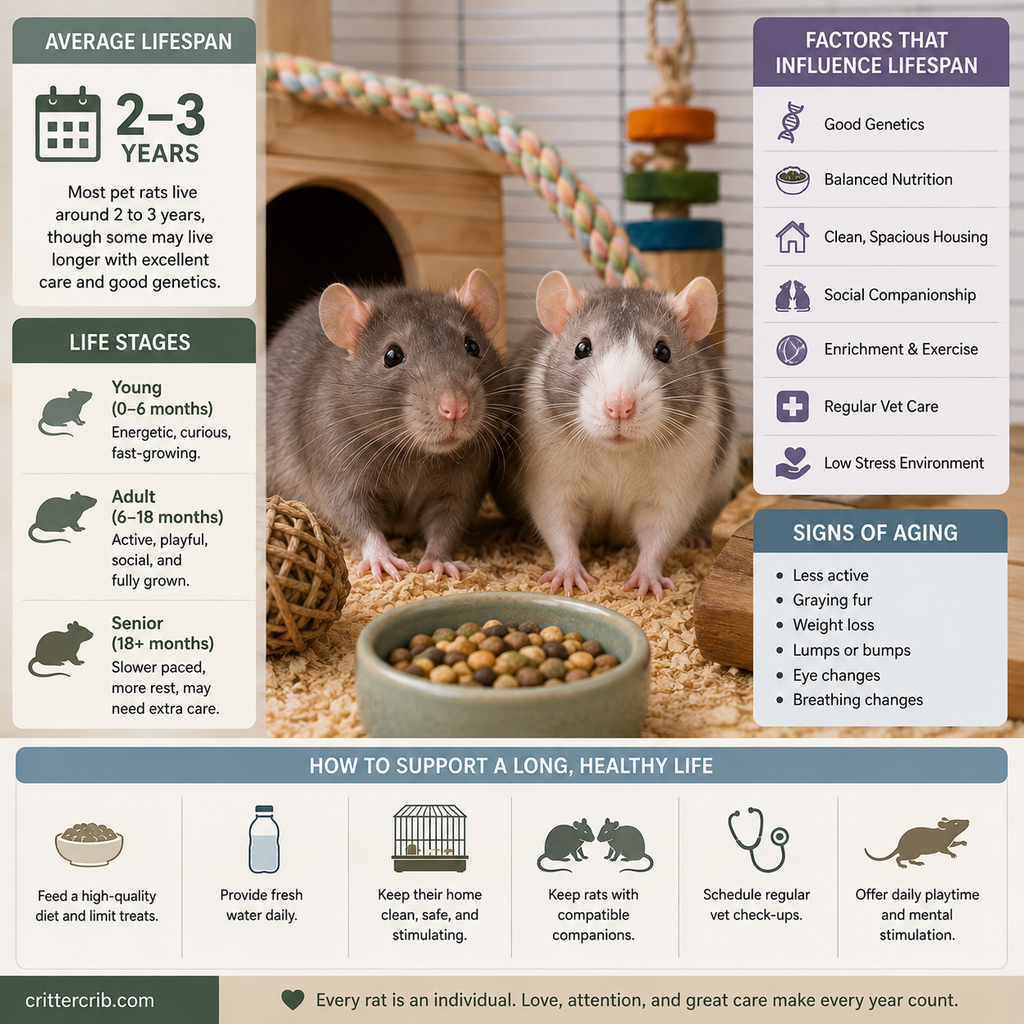
Most pet rats live approximately 2 to 3 years.
Some rats may reach three years or beyond, while others develop health problems much earlier.
Compared with dogs, cats, rabbits, and some other companion animals, that’s a relatively short lifespan.
It also means rats mature and age quickly.
A rat that still feels like a relatively new addition to your household can move from adolescence to adulthood and eventually into its senior years within a short period of time.
That’s one reason regular observation is so important.
How Long Do Rats Live in Captivity?
Domestic rats living in appropriate indoor environments generally have advantages that wild rats don’t.
Pet rats usually have:
- Reliable food
- Clean drinking water
- Protection from predators
- Stable shelter
- Veterinary care
- Controlled temperatures
- Social interaction
- Enrichment
These factors remove many of the dangers faced by wild animals.
However, domestic rats can still be vulnerable to age-related illnesses and inherited health problems. Excellent care can improve quality of life, but it can’t completely overcome genetics or prevent every disease.
How Long Do Wild Rats Live?
Wild rats generally have much shorter lives than well-cared-for pet rats.
Life outdoors comes with significant risks, including:
- Predators
- Food shortages
- Extreme weather
- Injuries
- Parasites
- Disease
- Poisoning
- Competition
- Human activity
Many wild rats don’t survive long enough to reach old age.
This is an important distinction when researching rat lifespan. A statistic about wild rat survival doesn’t necessarily tell you what to expect from a domesticated pet rat living safely indoors.
Why Do Pet Rats Have Such Short Lifespans?
There isn’t one simple reason.
Rats have naturally fast life cycles. They grow quickly, reach reproductive maturity relatively early, and age much faster than humans and many larger companion animals.
Genetics also play a major role.
Domestic rats can be predisposed to certain health conditions that become more common with age.
While responsible breeding may reduce some inherited risks, no breeder can guarantee that an individual rat will remain healthy for a specific number of years.
What Affects a Pet Rat’s Lifespan?
You can’t control everything about how long your rat lives.
You can, however, control much of its everyday environment.
Several factors can influence long-term health and quality of life.
1. Genetics
Genetics are one of the biggest factors you can’t change after bringing a rat home.
Some family lines may have higher rates of certain diseases, while others may have greater longevity.
If you’re purchasing rats from a breeder, look for someone who pays attention to:
- Health history
- Temperament
- Longevity
- Genetic diversity
- Responsible breeding practices
Ask about the health and lifespan of parents and previous generations when that information is available.
Adopted rats may have unknown genetic histories, but that doesn’t make them less deserving of a good home.
It simply means you’ll need to focus on the factors you can control.
2. Diet and Nutrition
Good nutrition supports overall health throughout a rat’s life.
A pet rat’s main diet should generally be based on a nutritionally complete food formulated for rats rather than a random mixture of seeds and treats.
A balanced diet helps provide appropriate amounts of:
- Protein
- Fat
- Carbohydrates
- Vitamins
- Minerals
- Other essential nutrients
Fresh foods can sometimes be offered as part of an appropriate diet, but they shouldn’t turn into an unbalanced replacement for complete nutrition.
Avoid Overfeeding
Rats are very convincing when food is involved.
A rat standing at the cage door looking hungry doesn’t necessarily need another handful of treats.
Consistently feeding excessive amounts of calorie-dense foods can contribute to obesity, which may make mobility and other health issues more difficult.
Monitor body condition and adjust feeding based on your rat’s individual needs.
If you’re unsure about weight or nutrition, ask a veterinarian experienced with rats.
3. Maintaining a Healthy Weight
Weight changes can tell you a surprising amount about a rat’s health.
Both excessive weight gain and unexplained weight loss deserve attention.
Consider weighing your rats regularly using a digital kitchen scale that measures in grams.
Record the results.
A simple weight log can help you notice gradual changes that aren’t obvious just by looking at your rat every day.
This becomes particularly useful as rats get older.
4. Proper Housing
A rat spends a large percentage of its life inside or around its enclosure.
Housing matters.
A good rat cage should provide enough room for:
- Climbing
- Exploring
- Sleeping
- Eating
- Social interaction
- Enrichment
- Exercise
The enclosure should also be secure, well ventilated, and easy to maintain.
Avoid cramped cages simply because rats are physically small.
They’re active, intelligent animals that benefit from usable space.
5. Cage Cleanliness
Keeping the enclosure clean is important, particularly because rats can be susceptible to respiratory problems.
Urine and waste shouldn’t be allowed to accumulate.
At the same time, constantly stripping the entire cage can be unnecessary and disruptive.
A practical routine includes:
- Regular spot cleaning
- Removing wet or heavily soiled bedding
- Washing dirty food and water containers
- Cleaning surfaces as needed
- Performing more thorough cage cleaning on an appropriate schedule
The exact frequency depends on cage size, number of rats, bedding type, litter habits, and ventilation.
The goal is a clean environment without turning cage maintenance into a constant source of disruption.
6. Bedding and Air Quality
Good air quality is easy to overlook.
Rats live close to their bedding, so dusty or irritating materials can affect the environment they’re breathing in every day.
Choose bedding that is:
- Appropriate for rats
- Absorbent
- Low in dust
- Unscented
- Comfortable
Avoid heavily fragranced products intended to cover odors.
If the cage smells strongly, adding perfume isn’t the solution. The enclosure needs cleaning or a better maintenance routine.
Good room ventilation matters too, but avoid placing rats directly in strong drafts.
7. Social Companionship
Rats are highly social animals.
In most circumstances, pet rats should live with compatible rats rather than spending their lives alone.
A human can provide affection and interaction, but we can’t fully replace another rat.
Compatible rats may:
- Sleep together
- Groom each other
- Play
- Explore together
- Communicate
- Provide social comfort
Pairs can work, but small compatible groups may offer additional social opportunities.
Introductions should always be handled appropriately. Don’t simply place unfamiliar adult rats together without learning how to introduce them safely.
8. Mental Stimulation
A rat can have nutritious food and a spotless cage and still have a boring life.
Rats are intelligent.
They investigate, solve problems, climb, forage, chew, dig, and learn.
Provide enrichment such as:
- Tunnels
- Hammocks
- Cardboard boxes
- Climbing structures
- Foraging activities
- Safe chew items
- Digging opportunities
- Puzzle feeders
- Training sessions
Rotate some items periodically instead of filling the cage with every toy you own.
A familiar object can become interesting again after being absent for a while.
9. Exercise
Regular movement helps support physical condition and gives rats an outlet for their natural curiosity.
A spacious cage provides opportunities for everyday activity, but supervised time outside the cage can add much more.
Create a secure rat-proofed area where your rats can:
- Run
- Climb
- Investigate
- Forage
- Interact with you
- Explore different objects
Remove electrical cords, toxic plants, unsafe foods, small gaps, and anything else that could become dangerous.
Rats are extremely good at discovering the one place you forgot to block.
10. Stress
Chronic stress isn’t good for any animal.
Potential stressors for pet rats can include:
- Social isolation
- Aggressive cage mates
- Rough handling
- Constant loud noise
- Unsafe interactions with other pets
- Extreme temperatures
- Lack of hiding places
- An inappropriate enclosure
A good environment should give rats opportunities to explore while also allowing them to retreat and rest.
Pay attention to the individual rat.
One rat may confidently investigate every new object immediately. Another may need more time.
11. Veterinary Care
One of the most important things you can do happens before your rat becomes sick.
Find a veterinarian who treats rats.
Not every dog-and-cat veterinary clinic routinely treats small exotic mammals.
Before you need help:
- Find rat-experienced veterinarians nearby.
- Confirm that they’re accepting patients.
- Ask about regular appointment availability.
- Find out where to go for after-hours emergencies.
- Keep the clinic’s contact information accessible.
Waiting until a rat is seriously ill to begin searching can cost valuable time.
Common Health Problems That Can Affect Rat Lifespan
Rats can experience many different medical conditions.
Some problems become increasingly common as they age.
Owners should be particularly aware of changes involving:
- Breathing
- Appetite
- Weight
- Mobility
- Skin and coat
- Lumps or masses
- Eyes
- Teeth
- Behavior
Respiratory disease and tumors are among the health concerns frequently encountered in pet rats, although many other conditions are possible.
Never assume that a symptom is simply “old age.”
A veterinarian should evaluate significant changes.
Respiratory Problems in Rats
Respiratory issues are especially important to watch for.
Possible warning signs include:
- Frequent sneezing
- Noisy breathing
- Labored breathing
- Reduced activity
- Discharge around the nose or eyes
- Changes in appetite
Occasional noises don’t automatically tell you what is wrong, but persistent or worsening respiratory symptoms warrant veterinary attention.
Don’t wait for severe breathing difficulty before seeking help.
Tumors and Lumps
Rats can develop lumps and masses as they age.
Not every lump is the same, and you can’t reliably determine what one is simply by touching it.
Regular gentle handling makes it easier to notice new changes.
If you discover a lump, schedule a veterinary examination.
Depending on the type, location, size, age of the rat, and overall health, your veterinarian can discuss appropriate options.
Dental Problems
Rat teeth grow continuously.
Normal gnawing and proper tooth alignment usually help maintain them, but dental problems can occur.
Watch for:
- Difficulty eating
- Drooling
- Weight loss
- Visible abnormal tooth growth
- Food falling from the mouth
- Changes in eating habits
Never attempt complicated dental treatment yourself.
A veterinarian can determine whether trimming or other treatment is needed.
How Can You Help a Pet Rat Live Longer?
There is no trick that guarantees a rat will live to a particular age.
The goal is to stack as many factors as possible in your rat’s favor.
Focus on:
- Feeding a balanced diet.
- Maintaining an appropriate body condition.
- Providing a spacious, well-ventilated enclosure.
- Using safe, low-dust bedding.
- Keeping rats with compatible companions.
- Providing exercise and enrichment.
- Maintaining good cage hygiene.
- Monitoring weight and behavior.
- Seeking veterinary care promptly.
- Giving your rats a safe, low-stress environment.
These habits support both lifespan and quality of life.
What Are the Life Stages of a Pet Rat?
Rat development happens quickly, and there isn’t one universally agreed age at which every rat enters a particular life stage.
Still, thinking in broad stages can help you adjust care.
Young Rats
Young rats are usually extremely energetic and curious.
This is a good time to focus on:
- Socialization
- Gentle handling
- Appropriate nutrition
- Climbing opportunities
- Exploration
- Training
- Building positive routines
Young rats can seemingly turn an organized cage into chaos within minutes.
That’s often a sign they’re using it.
Adult Rats
Adult rats may become a little more predictable while remaining playful and active.
Continue monitoring:
- Weight
- Diet
- Activity
- Social relationships
- Respiratory health
- Overall condition
Don’t stop providing enrichment just because your rats aren’t babies anymore.
Senior Rats
As rats age, you may notice changes in activity, strength, balance, coat condition, or body composition.
Some senior rats remain remarkably active. Others need their environment adjusted.
Your veterinarian can help determine whether a change is normal aging or evidence of a medical problem.
How to Make a Cage Easier for an Older Rat
A cage designed for an athletic young rat may become difficult to navigate later.
Senior rats may benefit from adjustments such as:
- Lower hammocks
- Easier access to food
- Easier access to water
- Additional ramps
- More stable platforms
- Soft sleeping areas
- Reduced fall distances
- Food and water available on multiple levels
Don’t automatically remove every climbing opportunity.
Instead, observe what your rat can comfortably manage and modify the cage accordingly.
The goal is independence without unnecessary risk.
Pay More Attention to Senior Rat Weight
Weight monitoring becomes particularly valuable as rats age.
Gradual weight loss can be difficult to notice under fur.
Weigh your senior rat regularly and keep a simple record.
If you notice an unexplained downward trend, contact your veterinarian rather than waiting until the weight loss becomes visually obvious.
Quality of Life Matters as Much as Lifespan
When discussing how long rats live, it’s easy to focus entirely on the number.
Two years.
Two and a half.
Three.
But lifespan isn’t the only measure of good care.
Quality of life matters just as much.
A rat should have opportunities to:
- Interact with companions
- Explore
- Eat comfortably
- Rest securely
- Move without unnecessary pain
- Engage with its environment
- Receive veterinary care when needed
As a rat becomes elderly or develops a serious illness, talk openly with your veterinarian about comfort and quality of life.
Sometimes the most important care decisions aren’t about extending life at any cost. They’re about keeping the time your rat has comfortable and enjoyable.
Should a Rat’s Short Lifespan Stop You From Getting One?
For some people, the short lifespan is the hardest part of keeping rats.
It’s worth considering before bringing them home.
If you become attached to your animals, losing them after only a few years can be emotionally difficult.
On the other hand, rats can fit an enormous amount of personality into those years.
They’re often interactive, trainable, affectionate, and endlessly curious.
Understanding the lifespan beforehand helps you make an informed decision rather than being surprised later.
Final Thoughts: How Long Do Pet Rats Live?
Most pet rats live around 2 to 3 years, although individual lifespan varies.
Genetics play an important role, and there is no way to guarantee that a particular rat will reach a certain age. What you can do is provide the conditions that support a healthy, comfortable life.
Feed an appropriate diet. Maintain a clean, spacious environment. Give rats compatible companions, exercise, enrichment, and plenty of opportunities to explore. Monitor their weight and behavior, and don’t delay veterinary care when something seems wrong.
As your rats get older, adjust their environment to match their changing abilities.
Their lives may be shorter than we’d like, but good rat care isn’t simply about adding as many days as possible.
It’s about making those days good ones.