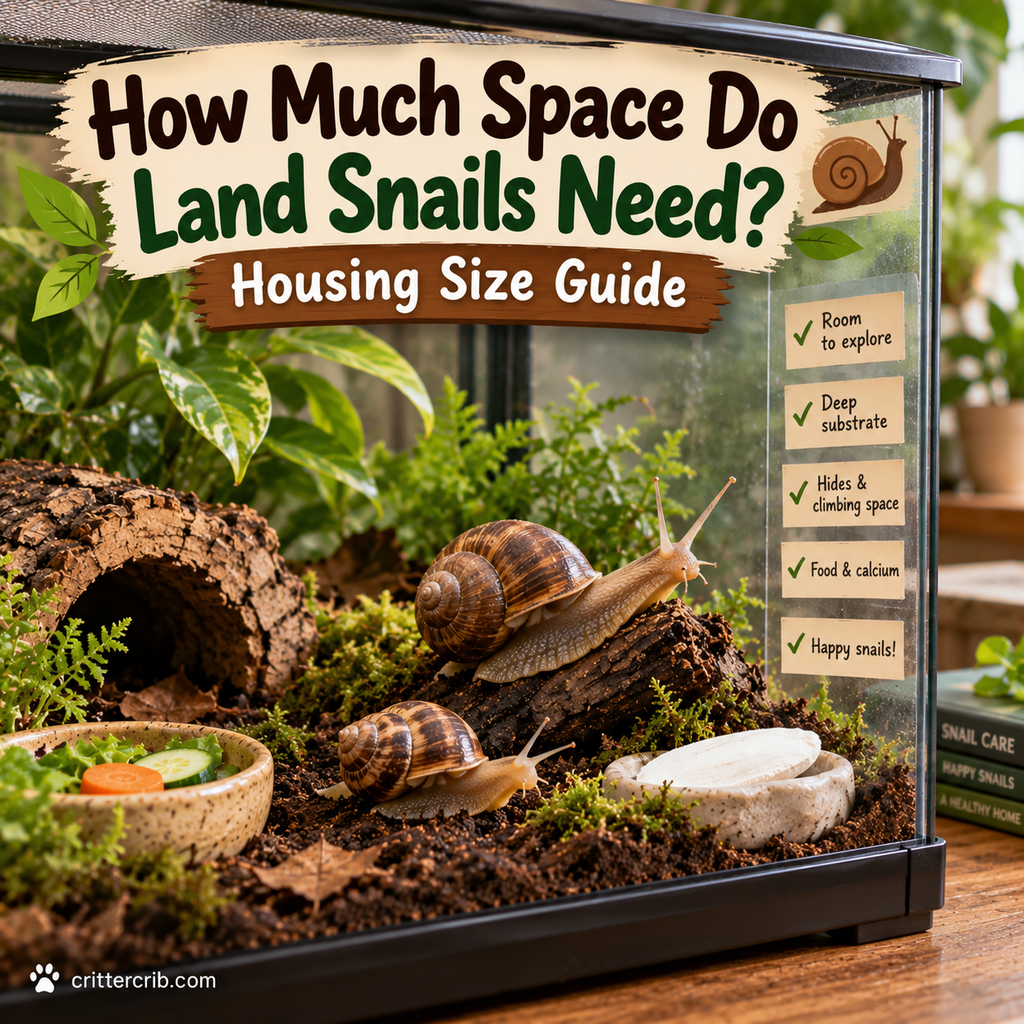
Land snails are small, quiet pets, so it’s easy to assume they can live comfortably in just about any container that fits them.
They do need more room than that.
A good snail enclosure needs enough space for crawling, feeding, burrowing, hiding, and exploring while still making it possible to maintain the humidity and moisture the species requires.
The size of the snail matters too. A tiny garden snail and a much larger land snail obviously shouldn’t be housed using the same dimensions.
So, how much space do land snails actually need?
There’s no single enclosure size that works for every species, but there are practical guidelines you can use to choose a comfortable home.
How Big Should a Land Snail Enclosure Be?
As a practical starting point, the enclosure should provide several times the snail’s shell length in usable floor space in both directions, along with enough height for deep substrate, hides, and low climbing opportunities.
For many commonly kept small land snails, an enclosure in roughly the 5-gallon range can provide generous room for one or a small number of adults, depending on species and setup. Larger species may require substantially more space.
Treat gallon measurements as a rough reference, not a rule.
A snail enclosure should be large enough for the animal to:
- Crawl around freely
- Completely extend its body
- Access food and calcium
- Burrow into the substrate
- Hide beneath cover
- Explore different areas
- Move without constantly encountering enclosure walls
The enclosure should also provide enough room to maintain suitable moisture without becoming stagnant.
Snail Size Matters More Than a Universal Tank Size
“Land snail” describes an enormous variety of animals.
Some species remain quite small. Others develop shells several inches long.
That’s why advice such as “all snails need a 5-gallon tank” isn’t particularly useful.
Instead, consider:
- Adult shell size
- Number of snails
- Species
- Activity level
- Substrate requirements
- Humidity needs
- Amount of décor
- Feeding area
Always research the adult size of your particular species.
A juvenile that looks tiny today may eventually require considerably more room.
Do Land Snails Need More Floor Space or Height?
For most terrestrial land snails, floor space is generally more useful than excessive height.
Snails spend plenty of time climbing, but they don’t need a towering vertical enclosure.
In fact, too much height can introduce another concern.
Snails sometimes lose their grip and fall.
A fall onto a hard rock, ceramic decoration, or other solid object can damage the shell.
A wider enclosure with useful ground-level habitat and moderate climbing opportunities is generally more practical than an extremely tall enclosure.
How Much Substrate Do Land Snails Need?
Substrate is an important part of the snail’s usable habitat.
Many land snails burrow to:
- Rest
- Regulate moisture
- Hide
- Lay eggs
- Find more comfortable conditions
Provide enough substrate for the snail to bury itself completely.
For many commonly kept species, several inches may be appropriate, but larger snails need deeper substrate.
A useful way to judge depth is simple:
Can your snail disappear completely beneath the substrate without reaching the bottom?
If not, consider adding more.
Best Substrate for Land Snails
A snail-safe substrate should retain moisture without remaining waterlogged.
Depending on the species and setup, suitable materials may include:
- Organic topsoil without fertilizers or pesticides
- Appropriate soil-based mixes
- Coconut fiber mixed with other suitable materials
- Leaf litter
- Other species-appropriate natural substrate components
Coconut fiber is commonly used, but relying on it alone isn’t always ideal for every species.
A naturalistic soil mixture can provide better structure and opportunities for burrowing.
Avoid substrates containing:
- Fertilizers
- Pesticides
- Herbicides
- Perlite
- Added chemicals
- Fragrances
Know what’s in the substrate before introducing your snail.
How Much Space Do Baby Snails Need?
Baby snails don’t need an adult-sized enclosure immediately.
In fact, keeping very small juveniles in a huge enclosure can make them harder to monitor.
A smaller grow-out container makes it easier to:
- Find the snails
- Monitor feeding
- Locate eggs or hatchlings
- Maintain humidity
- Clean the enclosure
- Observe shell development
The container still needs proper ventilation, substrate, food, calcium, and hiding opportunities.
As the snails grow, move them into progressively larger housing.
How Much Space Do Adult Land Snails Need?
Adult enclosure size should be based on the species’ mature size rather than how large the snail was when you purchased it.
The snail should have enough room to move around the enclosure without being surrounded by clutter.
A good adult setup includes space for:
- Deep substrate
- Food
- Calcium
- Hides
- Leaf litter
- Moss if used
- Low branches or bark
- Open crawling areas
Don’t fill every inch with decorations.
A natural-looking enclosure can still leave plenty of usable movement space.
How Much Space Do Two Land Snails Need?
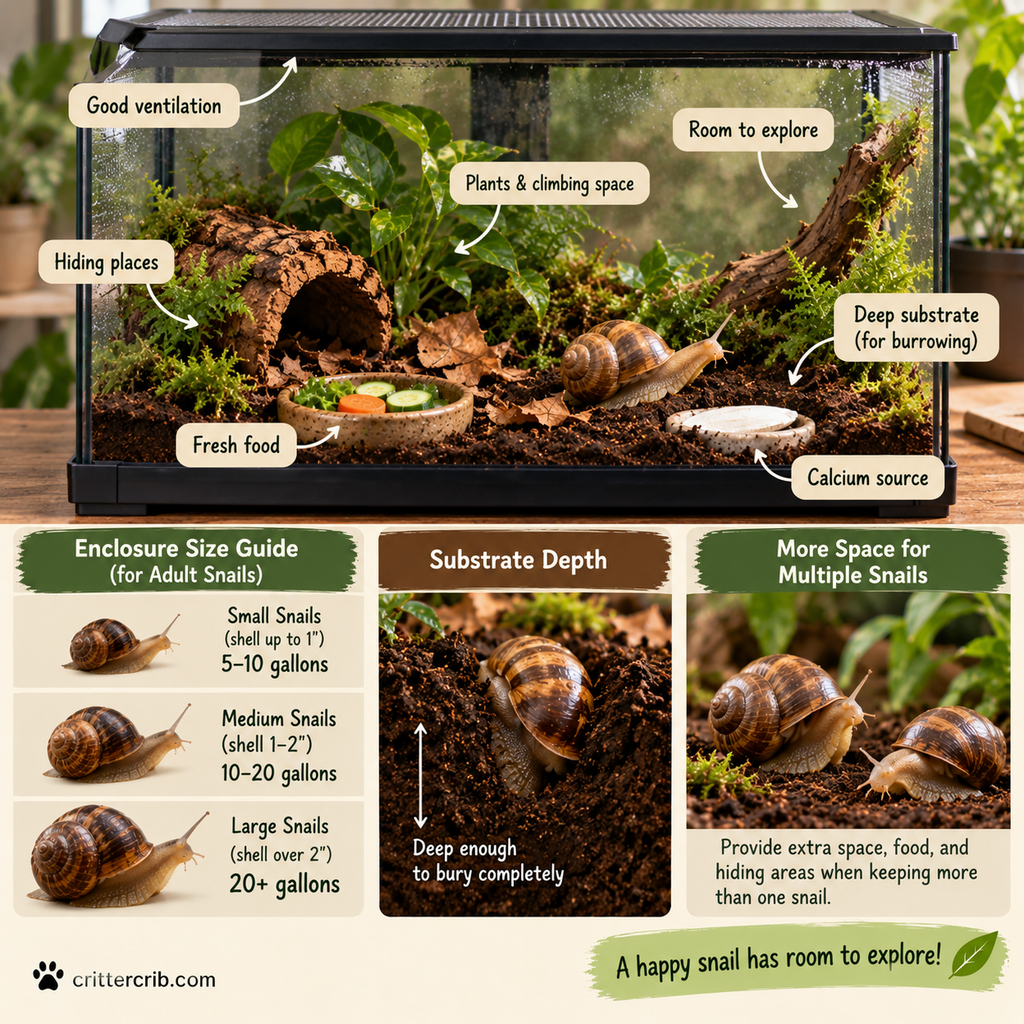
Adding another snail means increasing usable space.
Two snails need room to move, feed, hide, and burrow without constantly competing for the same areas.
There’s no perfect formula because species and size vary so much.
Instead of simply doubling the tank size, consider whether the enclosure provides enough resources for all inhabitants.
With multiple snails, provide:
- More floor space
- Multiple hiding areas
- Plenty of food
- Constant access to calcium
- Adequate substrate
- Good ventilation
- Enough room around feeding areas
Overcrowding can also make the enclosure dirty much faster.
Can Land Snails Live Alone?
Many commonly kept land snails can be housed individually.
You don’t necessarily need to buy a second snail because you’re worried the first will become lonely.
Their social needs aren’t comparable to those of social mammals.
Keeping one snail also makes population control easier.
This matters because some land snails can reproduce readily under suitable conditions.
Depending on the species, reproduction may even be possible without the situation being as straightforward as keeping a male and female together.
Know the reproductive biology of your species before deciding to keep multiple snails.
Can a Land Snail Enclosure Be Too Small?
Yes.
A container can physically hold a snail while still being inadequate housing.
Signs that the setup may be too cramped include:
- Very little open crawling space
- Food occupying much of the enclosure
- No room for adequate substrate
- Decorations crowding the snail
- Difficulty maintaining clean conditions
- Multiple snails constantly occupying the same small areas
The enclosure also needs to be large enough for routine maintenance.
You should be able to replace food, clean surfaces, inspect the substrate, and handle other care without completely dismantling the habitat every time.
Can a Snail Enclosure Be Too Big?
A large enclosure isn’t inherently bad.
However, oversized housing can create practical challenges, especially for tiny juveniles.
You may have more difficulty:
- Finding the snail
- Monitoring food intake
- Locating eggs
- Maintaining consistent humidity
- Spotting health problems
- Finding uneaten food
For an adult snail, extra space is usually less concerning as long as the environment can be maintained correctly.
The bigger issue isn’t having “too much room.”
It’s having more enclosure than you can manage properly.
Do Land Snails Need Ventilation?
Yes.
Land snails need humidity, but they also need fresh air.
A completely sealed enclosure may retain moisture extremely well, but it can create stagnant conditions.
Ventilation helps with air exchange and reduces excessive condensation and persistent mold.
At the same time, an enclosure with huge amounts of ventilation may dry out too quickly.
The goal is balance.
Your enclosure should retain the moisture required by the species while still allowing regular airflow.
How Humid Should a Land Snail Enclosure Be?
Humidity requirements vary between species.
A tropical land snail may need different conditions from a species adapted to a more temperate environment.
Don’t rely on a single humidity number for every snail.
Instead, research the species you’re keeping.
A hygrometer can be useful for monitoring general conditions, but also pay attention to the substrate.
It should usually remain appropriately moist without becoming waterlogged.
If the enclosure dries almost immediately after misting, you may have too much ventilation.
If it’s constantly dripping with condensation and never seems to dry at all, you may need better airflow or less misting.
Do Land Snails Need a Water Dish?
A shallow water dish can be provided for many larger land snails, but it isn’t always necessary for very small species when appropriate moisture and hydration are maintained.
If you provide one, keep it shallow.
The snail should be able to enter and exit easily.
Avoid deep containers.
Clean the dish regularly because snails have an impressive ability to crawl through substrate and then immediately drag it into their water.
Land Snails Need Constant Access to Calcium
Calcium is essential for shell growth and maintenance.
A calcium source should generally remain available rather than being treated as an occasional supplement.
Cuttlebone is commonly used because the snail can rasp at it as needed.
Whatever source you use, make sure it’s appropriate for snails and doesn’t contain unnecessary additives.
Don’t rely on calcium powder sprinkled over every meal as the only option if you can provide a separate source the snail can access voluntarily.
What Should Go Inside a Land Snail Enclosure?
You don’t need to turn the enclosure into a complicated display terrarium.
A functional snail habitat might contain:
- Deep substrate
- Leaf litter
- Cork bark
- Soft hides
- Moss
- Safe plants
- Small branches
- Food area
- Calcium source
- Shallow water dish if appropriate
The key word is soft.
Avoid filling the enclosure with hard rocks, ceramic decorations, or other objects that could damage a shell if the snail falls onto them.
Do Land Snails Need Hiding Places?
Yes, hiding opportunities are useful.
Snails may seek sheltered areas during the day or when environmental conditions change.
Simple hides can include:
- Cork bark
- Leaf litter
- Soft plant cover
- Suitable pieces of wood
- Safe lightweight hides
A snail may also simply burrow into the substrate.
You don’t need an elaborate cave.
You just need to give the animal options.
Do Land Snails Need Things to Climb?
Land snails are excellent climbers.
You’ll probably find yours on the enclosure wall or lid eventually, regardless of how beautifully you’ve decorated the ground.
Low climbing structures can encourage exploration.
Try:
- Cork bark
- Small branches
- Plants
- Pieces of wood
Keep climbing structures secure and avoid creating long drops onto hard surfaces.
Why Is My Snail Always on the Lid?
This is extremely common.
A snail climbing the enclosure walls and hanging from the lid doesn’t automatically mean the habitat is too small.
Snails naturally explore vertical surfaces.
However, constant lid-climbing can be a reason to check environmental conditions.
Make sure:
- Substrate moisture is appropriate
- Temperature is suitable
- Humidity is correct
- Food is fresh
- Substrate is safe
- The enclosure isn’t overcrowded
If everything checks out, your snail may simply enjoy climbing.
Should a Snail Enclosure Have a Secure Lid?
Absolutely.
Snails are slow escape artists.
That sounds contradictory until you discover one halfway across the room.
They can climb enclosure walls and squeeze through openings you might not expect.
Use a secure lid that still provides appropriate ventilation.
Check ventilation holes carefully if you’re keeping juveniles. Tiny snails may be able to fit through openings that are completely secure for adults.
How Often Should You Clean a Land Snail Enclosure?
Snail enclosures benefit from regular spot cleaning rather than constant complete resets.
Routine maintenance includes:
- Removing spoiled food
- Cleaning obvious waste
- Wiping excessively dirty enclosure walls
- Cleaning water and food dishes
- Checking for mold
- Maintaining substrate moisture
- Inspecting for eggs
- Replacing deteriorated organic material when necessary
Avoid unnecessarily replacing all substrate on a frequent schedule.
A naturalistic enclosure can develop beneficial microorganisms, and constant disruption isn’t always useful.
Do You Need to Check the Substrate for Eggs?
If you’re keeping species capable of reproducing, yes.
Land snails may bury eggs in the substrate, making them easy to miss.
This is especially important when keeping multiple mature snails.
Research the species so you know:
- Whether it can reproduce in your setup
- What the eggs look like
- How frequently to check
- How eggs should be handled
- Whether possession or breeding is regulated where you live
Don’t release unwanted snails or eggs outdoors.
Non-native land snails can become serious invasive pests.
Are Giant Land Snails Legal to Keep?
This depends heavily on the species and where you live.
Certain large land snails are regulated or prohibited because of their potential agricultural and ecological impact.
In the United States, for example, giant African land snails are subject to strict federal restrictions.
Before buying any exotic land snail, verify that the species is legal to possess where you live.
Don’t assume that because someone is selling a snail online, you’re legally allowed to own it.
Common Land Snail Housing Mistakes
A few setup mistakes are especially common among new keepers.
Choosing a Tiny Container Because the Snail Is Small
Small animals still need usable habitat.
Provide room for movement, burrowing, feeding, and hiding.
Using Substrate That’s Too Shallow
Your snail should be able to burrow completely.
This is also important for species that lay eggs underground.
Using Hard Decorations
Snails climb.
Snails also fall.
Keep hard rocks and other shell-damaging surfaces out of likely fall zones.
Sealing the Enclosure to Increase Humidity
Humidity shouldn’t come at the expense of ventilation.
Balance moisture retention with airflow.
Providing Too Much Empty Height
A snail doesn’t need a skyscraper.
Prioritize floor area and substrate depth over excessive vertical space.
Forgetting Adult Size
Buy housing based on where the snail is going, not just where it is today.
Overcrowding
More snails mean more food consumption, waste, eggs, and maintenance.
Increase space and resources as the population increases.
How to Choose the Right Land Snail Enclosure
Before buying a tank or container, ask yourself a few questions.
- What species am I keeping?
- How large will it be as an adult?
- How many snails will live together?
- Can each snail burrow completely?
- Is there enough open crawling space?
- Can I maintain appropriate humidity?
- Does the enclosure provide ventilation?
- Are climbing areas safe?
- Can the lid prevent escapes?
- Can I easily clean and inspect the enclosure?
If the enclosure handles all of those requirements comfortably, you’re on the right track.
Frequently Asked Questions About Land Snail Enclosure Size
Is a 1-gallon container big enough for a land snail?
It may work temporarily for very small species or juveniles, but it can be restrictive for many adult snails once substrate, food, hides, and other habitat features are added.
Choose the enclosure based on the adult size of your particular species.
Is a 5-gallon tank big enough for land snails?
A 5-gallon enclosure can provide plenty of space for some small to medium land snails, depending on species, number of animals, and enclosure dimensions.
Larger species may need considerably more room.
Is a 10-gallon tank too big for one snail?
Not necessarily.
An adult snail can use a larger enclosure as long as you can maintain suitable humidity, temperature, food availability, and cleanliness.
For tiny juveniles, a smaller grow-out enclosure may make monitoring easier.
Do snails need more horizontal or vertical space?
Most terrestrial land snails benefit more from usable floor space and substrate depth than excessive enclosure height.
They still enjoy climbing, so provide safe vertical surfaces and low structures.
How deep should land snail substrate be?
Provide enough substrate for the snail to completely bury itself.
The exact depth depends on the size and species.
Can I keep several snails in one enclosure?
Many species can be kept in groups when adequate space and resources are available.
Remember that keeping multiple mature snails can also result in reproduction.
Give Your Snail Space It Can Actually Use
So, how much space do land snails need?
There isn’t one tank size that fits every species.
A better approach is to look at the snail itself.
Consider its adult shell size, how many snails you’re keeping, how deeply they need to burrow, and how much space remains after you add food, calcium, hides, leaf litter, and other habitat features.
For most terrestrial snails, prioritize floor space and substrate depth rather than excessive height.
Give them room to crawl, somewhere soft to hide, plenty of substrate for burrowing, appropriate humidity, good ventilation, and a secure lid.
Your snail will probably still spend an unreasonable amount of time hanging upside down from that lid.
That’s okay.
Having enough space doesn’t mean a snail will use its enclosure the way you expected. It means it has the choice.