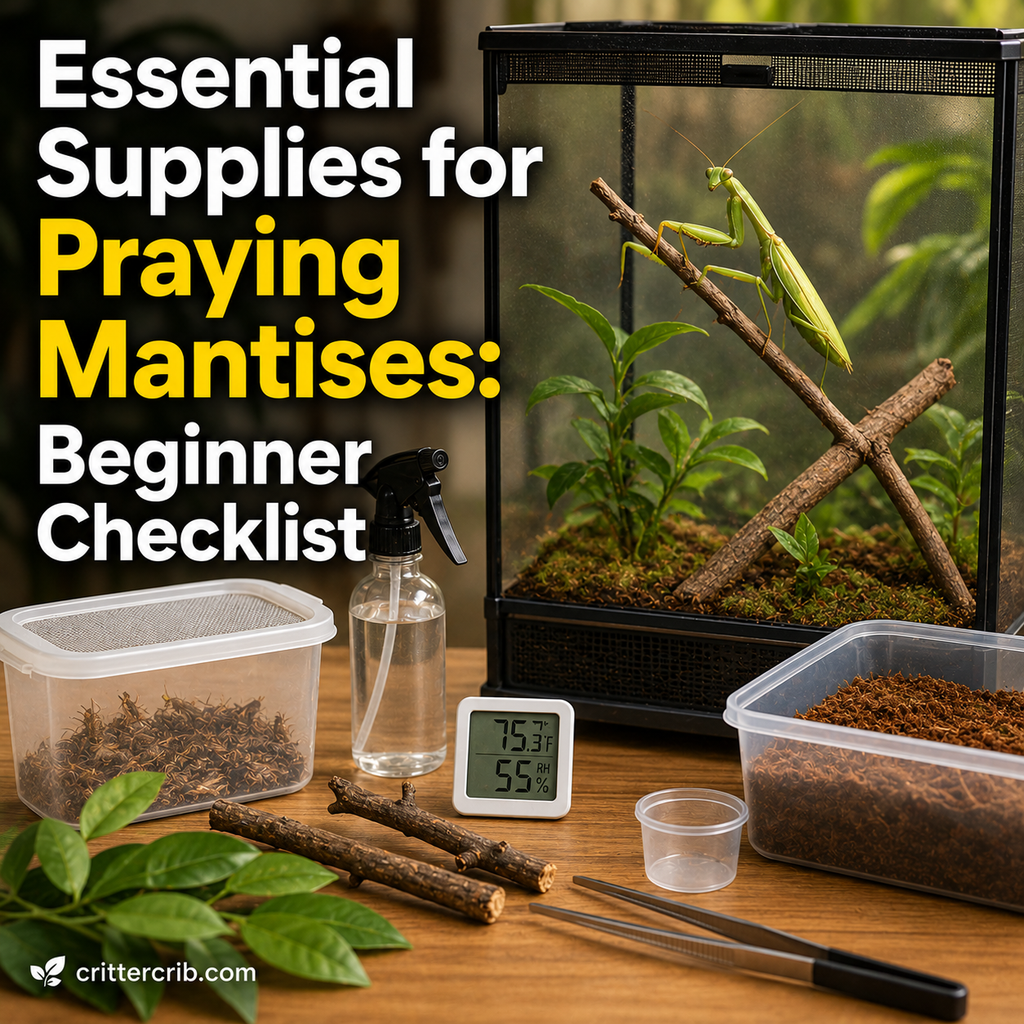
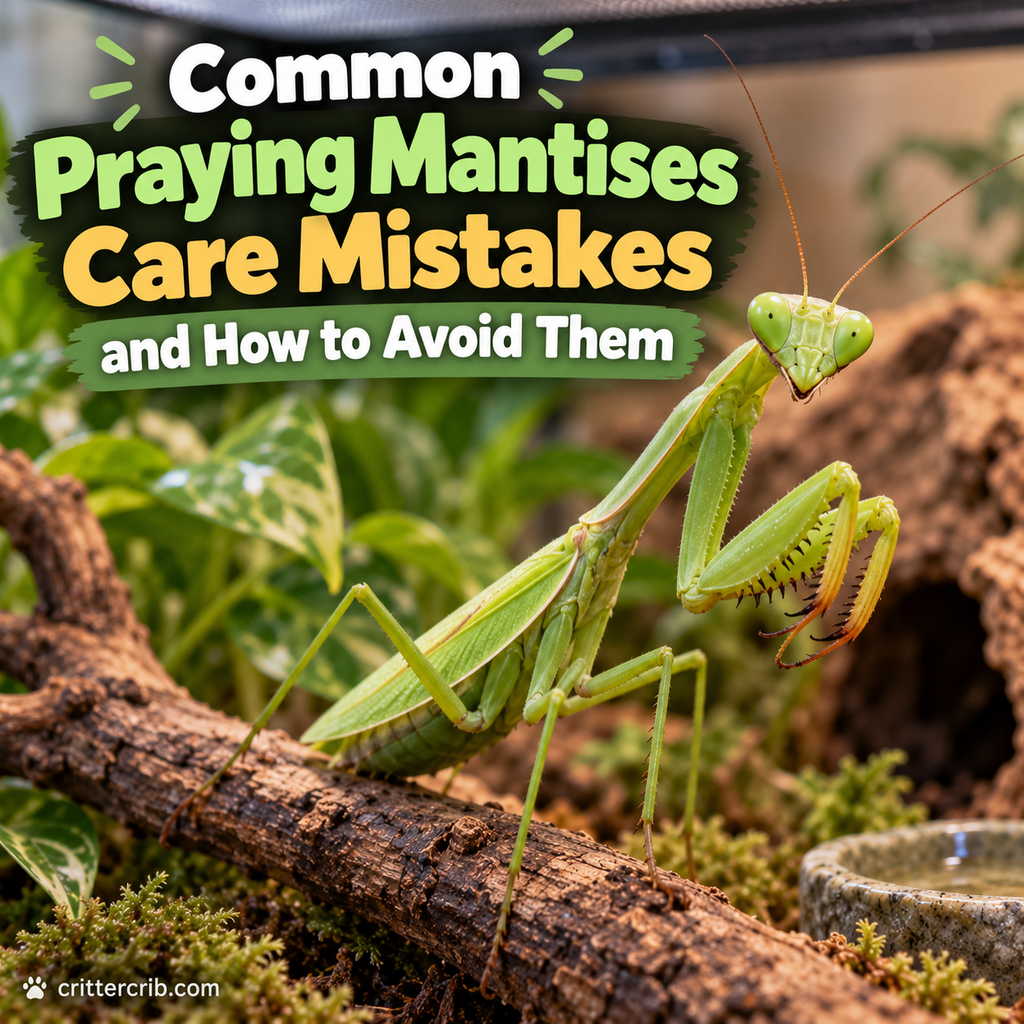
Praying mantises can seem like easy pets. Give them a container, add a branch, toss in a cricket, and you’re done—right?
Not quite.
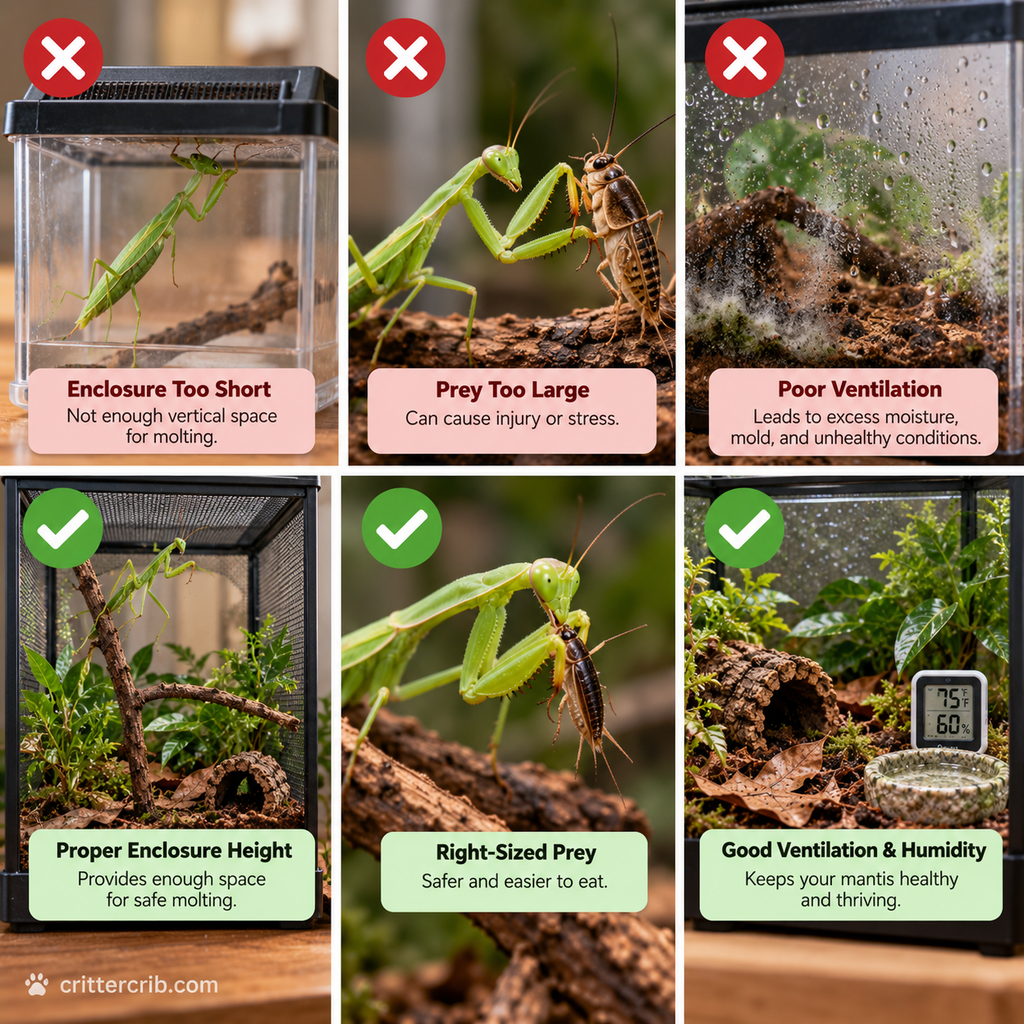
Mantises don’t require complicated care, but some of their needs are surprisingly specific. An enclosure that’s too short can interfere with molting. Poor ventilation can create stagnant conditions. Prey that’s too large can injure a mantis, while the wrong temperature or humidity can cause additional problems.
Many praying mantis care mistakes are easy to prevent once you understand how these insects actually live.
Whether you’re raising a tiny nymph or caring for an adult mantis, here are some of the most common mistakes to watch for and what to do instead.
Mistake #1: Using an Enclosure That’s Too Small
One of the biggest mistakes new keepers make is choosing an enclosure based only on how much room the mantis needs to walk around.
Molting space matters even more.
Mantises molt while hanging upside down. They emerge from the old exoskeleton and need enough clear vertical space beneath themselves to extend their body and legs completely.
If the enclosure is too short, a mantis can hit the floor, decorations, or other objects during a molt.
That can lead to deformities or a failed molt.
How Much Space Does a Praying Mantis Need?
Requirements vary with species and life stage, but a commonly used guideline is an enclosure approximately:
- Three times the mantis’s body length in height
- Two times its body length in width
More space isn’t automatically better, especially for tiny nymphs that need to locate food easily.
The important thing is providing enough unobstructed vertical room for safe molting.
Mistake #2: Forgetting About the Molting Surface
Height alone isn’t enough.
Your mantis also needs somewhere secure to hang.
In nature, mantises molt from vegetation, branches, and other surfaces. In captivity, the top and upper portions of the enclosure should provide good grip.
Useful options can include:
- Fine mesh
- Appropriately textured enclosure lids
- Secure twigs
- Artificial or live foliage
- Other species-appropriate climbing surfaces
Make sure these surfaces are firmly attached.
A branch that collapses during a molt isn’t much better than having no branch at all.
Mistake #3: Putting Decorations Directly Below the Mantis
A beautifully decorated enclosure can actually become dangerous if every inch is packed with branches and plants.
Mantises need open space beneath their preferred hanging areas.
Before adding decorations, imagine your mantis hanging upside down from the ceiling and slowly emerging downward from its old exoskeleton.
Is there enough room?
Keep major obstacles away from the primary molting zone, including:
- Large rocks
- Tall decorations
- Food dishes
- Dense branches
- Hard artificial ornaments
A natural-looking enclosure is nice.
A safe molting enclosure is more important.
Mistake #4: Getting the Humidity Wrong
Humidity is one of the most commonly misunderstood parts of praying mantis care.
There isn’t one perfect humidity level for every mantis.
Different species come from different climates. A tropical mantis may require conditions quite different from a species adapted to a drier habitat.
Keeping an enclosure too dry may contribute to dehydration and molting problems.
Keeping it constantly soaked isn’t the solution either.
Excess moisture combined with poor airflow can encourage:
- Mold
- Bacterial growth
- Stagnant conditions
- Unhealthy substrate
Research the requirements of the exact species you’re keeping rather than following a universal humidity number.
Mistake #5: Misting Without Providing Ventilation
Humidity and ventilation work together.
It’s easy to assume that sealing an enclosure helps maintain moisture. Unfortunately, an enclosure that holds humidity exceptionally well may also hold stagnant air.
Good airflow is particularly important in humid setups.
Depending on the enclosure, ventilation may be provided through:
- Mesh panels
- Ventilation holes
- Cross-ventilation
- Ventilated lids
Cross-ventilation can be particularly useful because it allows air to move through the enclosure rather than only escaping from the top.
The goal is appropriate humidity without creating a constantly wet, stuffy container.
Mistake #6: Using Unsafe Mesh
Mesh is useful because it provides ventilation and climbing surfaces, but not every type is ideal.
Very hard or abrasive metal mesh can potentially damage the feet of some mantises over time.
Softer mesh materials may be preferable in many setups, provided they’re secure and the openings don’t allow the mantis or feeder insects to escape.
Whatever material you choose, inspect it for:
- Sharp edges
- Loose strands
- Gaps
- Damaged areas
- Escape points
Tiny mantis nymphs can fit through surprisingly small openings.
Mistake #7: Feeding Prey That’s Too Large
Watching a mantis catch prey is one of the most fascinating parts of keeping one.
That doesn’t mean bigger prey creates a better feeding experience.
Oversized prey can intimidate or potentially injure a mantis, particularly when the mantis is young, recently molted, or otherwise vulnerable.
Choose prey appropriate to the mantis’s size.
Common feeder insects include:
- Fruit flies
- Houseflies
- Blue bottle flies
- Small roaches
- Appropriately sized crickets
- Other suitable feeder insects
Tiny nymphs may begin with flightless fruit flies, while larger mantises can handle larger prey.
The feeder should match the predator.
Mistake #8: Leaving Live Prey With a Molting Mantis
This mistake can have serious consequences.
A molting mantis is extremely vulnerable. Its new exoskeleton is soft, and it can’t defend itself normally.
Uneaten feeder insects may disturb or injure it.
If your mantis appears to be preparing to molt, remove uneaten prey.
Signs of an approaching molt can include:
- Refusing food
- Reduced activity
- Spending more time hanging
- A fuller-looking abdomen
- Changes in behavior
Don’t panic if a mantis suddenly stops eating.
It may simply be preparing for its next molt.
Mistake #9: Handling a Mantis During or Immediately After Molting
A freshly molted mantis needs time.
Its new exoskeleton must harden before it returns to normal activity.
Handling during this period can cause injury.
Don’t:
- Touch the mantis
- Try to reposition it
- Offer large prey immediately
- Shake or move the enclosure unnecessarily
- Pull away the old exoskeleton while the mantis is still molting
Let the animal complete the process without interference.
It’s tempting to “help” when a molt looks difficult, but physically intervening can easily make things worse.
Mistake #10: Overfeeding
Mantises are enthusiastic predators, and many will accept food readily.
That doesn’t mean they need to eat constantly.
Feeding requirements depend on:
- Species
- Age
- Size
- Growth rate
- Abdomen condition
- Temperature
- Reproductive status
Rather than feeding simply because the mantis will strike, learn to observe its abdomen and normal feeding behavior.
A very thin abdomen may suggest it’s ready for food. A noticeably plump abdomen can indicate that feeding can wait.
Overfeeding may also mean more uneaten insects wandering around the enclosure.
Mistake #11: Relying on Only One Feeder Insect
It’s easy to find one feeder that works and use it exclusively.
Variety can be beneficial.
Depending on the mantis species and size, you can rotate appropriate feeders such as flies, roaches, and other insects.
Crickets are commonly available, but they shouldn’t automatically be the only option simply because the local pet store stocks them.
Feeder quality matters too.
Use healthy insects from reliable sources and avoid feeding wild-caught insects from areas that may have been exposed to pesticides.
Mistake #12: Feeding Wild-Caught Insects From Questionable Areas
That moth fluttering around your porch might look like a free meal.
The problem is that you don’t know where it has been.
Wild insects may have encountered:
- Pesticides
- Herbicides
- Parasites
- Environmental contaminants
For a captive mantis, commercially raised or otherwise trusted feeder insects are generally the safer choice.
This is particularly important in residential areas where pest-control products may be used regularly.
Mistake #13: Using the Wrong Temperature
Temperature influences metabolism, digestion, growth, and activity.
Again, there is no single perfect temperature for all mantises.
Some species thrive around typical household temperatures. Others need warmer conditions.
Research the natural habitat and established captive-care recommendations for your species.
Avoid putting the enclosure:
- In direct sunlight
- Against a heating vent
- Directly beside a radiator
- Near an air-conditioning vent
- In areas with extreme temperature swings
Direct sunlight is especially dangerous because small enclosures can overheat quickly.
Mistake #14: Using Uncontrolled Heat Sources
If your mantis requires supplemental heat, don’t simply place the enclosure on the hottest heat mat you can find.
Uncontrolled heating can create dangerous temperatures.
If additional heat is genuinely necessary, use an appropriate setup with reliable temperature monitoring and control.
A digital thermometer can help you see what the enclosure is actually experiencing rather than guessing based on room temperature.
Heating requirements vary significantly between species, so don’t add heat just because the animal is “exotic.”
Mistake #15: Keeping Multiple Mantises Together
Praying mantises are predators.
And unfortunately for their roommates, they aren’t particularly concerned about whether their prey happens to be another mantis.
Cannibalism is a real risk.
Although tolerance varies among species and life stages, housing mantises individually is generally the safer approach for pet keepers.
Keeping several together can result in:
- Missing limbs
- Stress
- Competition for food
- Cannibalism
Don’t assume that two mantises sitting peacefully together today will still be peaceful tomorrow.
Mistake #16: Handling Too Frequently
Some mantises tolerate careful handling surprisingly well.
That doesn’t mean they need it.
Mantises aren’t social pets that require physical affection, and unnecessary handling introduces risks.
A mantis can:
- Fall
- Jump unexpectedly
- Fly
- Become stressed
- Be accidentally squeezed
- Escape
If you do handle your mantis, allow it to walk onto your hand rather than grabbing it around the body.
Keep handling sessions low to the ground or over a safe surface.
Observation should make up most of your interaction.
Mistake #17: Grabbing the Mantis
Never pick up a mantis by:
- Its legs
- Its abdomen
- Its wings
- Its raptorial forelegs
Those delicate limbs can be injured.
Instead, place your hand in front of the mantis and gently encourage it to step forward if handling is necessary.
You can sometimes use your other hand to gently guide it from behind without squeezing or restraining it.
Patience works much better than force.
Mistake #18: Keeping the Enclosure Too Wet
Misting is often part of mantis husbandry, but spraying more water isn’t always better.
An enclosure that remains permanently soaked may develop mold or other problems, particularly if ventilation is poor.
The correct misting frequency depends on:
- Species
- Ventilation
- Temperature
- Enclosure size
- Substrate
- Local climate
Allow conditions to follow the moisture requirements appropriate for your particular mantis.
Don’t blindly mist several times a day because someone else’s enclosure requires it.
Mistake #19: Assuming a Water Bowl Is Always Necessary
Mantises commonly drink droplets from leaves, enclosure walls, and other surfaces after misting.
A deep open water dish can create an unnecessary drowning hazard, especially for small nymphs and feeder insects.
For many species, appropriate misting provides accessible drinking droplets while also helping maintain suitable humidity.
If you use any water container, it should be designed with the animal’s safety in mind.
Again, species-specific husbandry takes priority over a universal rule.
Mistake #20: Panicking When Your Mantis Stops Eating
A mantis refusing food isn’t automatically sick.
One of the most common reasons for temporary appetite loss is an approaching molt.
Adult females may also change their feeding behavior depending on reproductive condition, while temperature and other environmental factors can influence appetite.
If your mantis stops eating:
- Remove uneaten prey.
- Observe its behavior.
- Check temperature and humidity.
- Look for signs of an approaching molt.
- Avoid unnecessary handling.
Persistent refusal to eat alongside weakness, injury, or other unusual symptoms deserves closer attention.
But skipping a meal by itself isn’t necessarily an emergency.
Mistake #21: Mistaking a Molt for a Dead Mantis
Molting can look strange.
A mantis may hang motionless for an extended period before beginning the process. During the molt, its position can look uncomfortable or even alarming.
Don’t immediately assume something has gone wrong.
Avoid touching or moving the mantis unless there is a genuine reason to believe intervention is necessary.
The safest thing you can usually provide during a normal molt is space.
Mistake #22: Removing an Ootheca Without Understanding What It Is
Adult female mantises may produce an egg case called an ootheca.
Depending on whether the female has mated, the species, and other circumstances, an ootheca may or may not be fertile.
Don’t immediately throw one away without identifying what’s happening.
Some oothecae can eventually produce a surprisingly large number of nymphs.
If you have a potentially fertile ootheca, research the species before attempting to incubate it.
You’ll need to understand:
- Incubation requirements
- Whether diapause is necessary
- Expected hatch timing
- Number of possible nymphs
- Suitable first foods
- Housing requirements
Do this research before dozens of tiny mantises unexpectedly appear.
Mistake #23: Releasing a Pet Mantis Outdoors
Releasing a captive mantis isn’t always harmless.
The species may not be native to your area, and captive animals can potentially introduce ecological or disease concerns.
Never release an exotic or non-native pet simply because you no longer want to keep it.
Instead, consider:
- Rehoming it with another keeper
- Contacting a local invertebrate group
- Asking the breeder or seller for guidance
Responsible pet ownership includes planning for the animal’s entire life.
Mistake #24: Not Identifying the Species
This mistake contributes to many of the others.
“Mantis care” is a broad category.
Different species can have different requirements for:
- Temperature
- Humidity
- Adult size
- Enclosure dimensions
- Ventilation
- Prey size
- Molting space
- Lifespan
Whenever possible, know the scientific name of the species you’re keeping.
A vague pet-store label such as “praying mantis” doesn’t tell you enough to provide precise care.
A Simple Praying Mantis Care Checklist
You don’t need to obsess over every detail once the basics are correct.
Use this checklist as a starting point:
- Identify your mantis species.
- Provide enough vertical molting space.
- Include secure hanging surfaces.
- Keep the area below molting spots clear.
- Maintain species-appropriate humidity.
- Provide good ventilation.
- Use appropriately sized feeder insects.
- Remove prey before a molt.
- Avoid handling during and after molting.
- Maintain an appropriate temperature.
- House mantises separately.
- Avoid unnecessary handling.
- Never use pesticide-exposed feeder insects.
- Monitor appetite and body condition.
- Research ootheca care before attempting incubation.
Once the enclosure is properly established, mantis care can be refreshingly straightforward.
Frequently Asked Questions About Praying Mantis Care
Are praying mantises easy to care for?
Many commonly kept species are relatively manageable once their basic needs are understood. The biggest considerations include correct enclosure dimensions, safe molting space, temperature, humidity, ventilation, and appropriately sized live prey.
How often should I mist a praying mantis?
There isn’t one schedule for every species. Misting frequency depends on the mantis’s natural habitat, enclosure ventilation, temperature, substrate, and local conditions. Research the specific species you’re keeping.
How often should I feed my praying mantis?
Feeding frequency depends on age, species, size, temperature, and body condition. Young nymphs generally eat more frequently than adults. Observing abdomen size and feeding response is more useful than following a rigid universal schedule.
Why is my praying mantis hanging upside down?
Hanging upside down is normal behavior and is especially important during molting. If your mantis refuses food and spends extended periods hanging, it may be preparing to molt.
Can I keep two praying mantises together?
Individual housing is generally the safer choice. Mantises are predatory and cannibalism can occur, even if they initially appear to tolerate one another.
Can I hold my praying mantis?
Careful occasional handling may be possible with some individuals, but it isn’t necessary for the mantis’s well-being. Avoid handling around molts, never grab the animal, and prevent falls or escapes.
What happens if a praying mantis falls while molting?
A fall during molting can be serious because the mantis’s new exoskeleton is extremely soft. It may result in deformities, injury, or an unsuccessful molt. Providing adequate enclosure height and secure hanging surfaces helps reduce this risk.
Why won’t my praying mantis eat?
A mantis may refuse food before molting. Temperature, stress, maturity, reproductive condition, or health problems can also affect appetite. Check the enclosure conditions and observe the animal before assuming something is wrong.
Do praying mantises need a heat lamp?
Not necessarily. Heating requirements depend on species and ambient room temperature. Some species do well at normal household temperatures, while others require additional warmth. If heating is necessary, temperatures should be monitored carefully.
Final Thoughts
Most praying mantis care mistakes come down to a few basic problems: incorrect enclosure design, misunderstanding molting, inappropriate humidity or ventilation, feeding mistakes, and too much unnecessary interference.
The good news is that these problems are usually preventable.
Start by identifying your species. Give your mantis plenty of vertical space and a secure place to hang, keep the molting area clear, provide appropriate temperature and moisture, and offer correctly sized live prey.
Then give it some space.
Mantises are fascinating precisely because you can watch so much natural behavior in a relatively small enclosure—hunting, climbing, grooming, molting, and patiently waiting for prey.
You don’t need to constantly interact with them to be a good keeper.
Sometimes the best mantis care is simply creating the right environment and letting the mantis do what it does best.