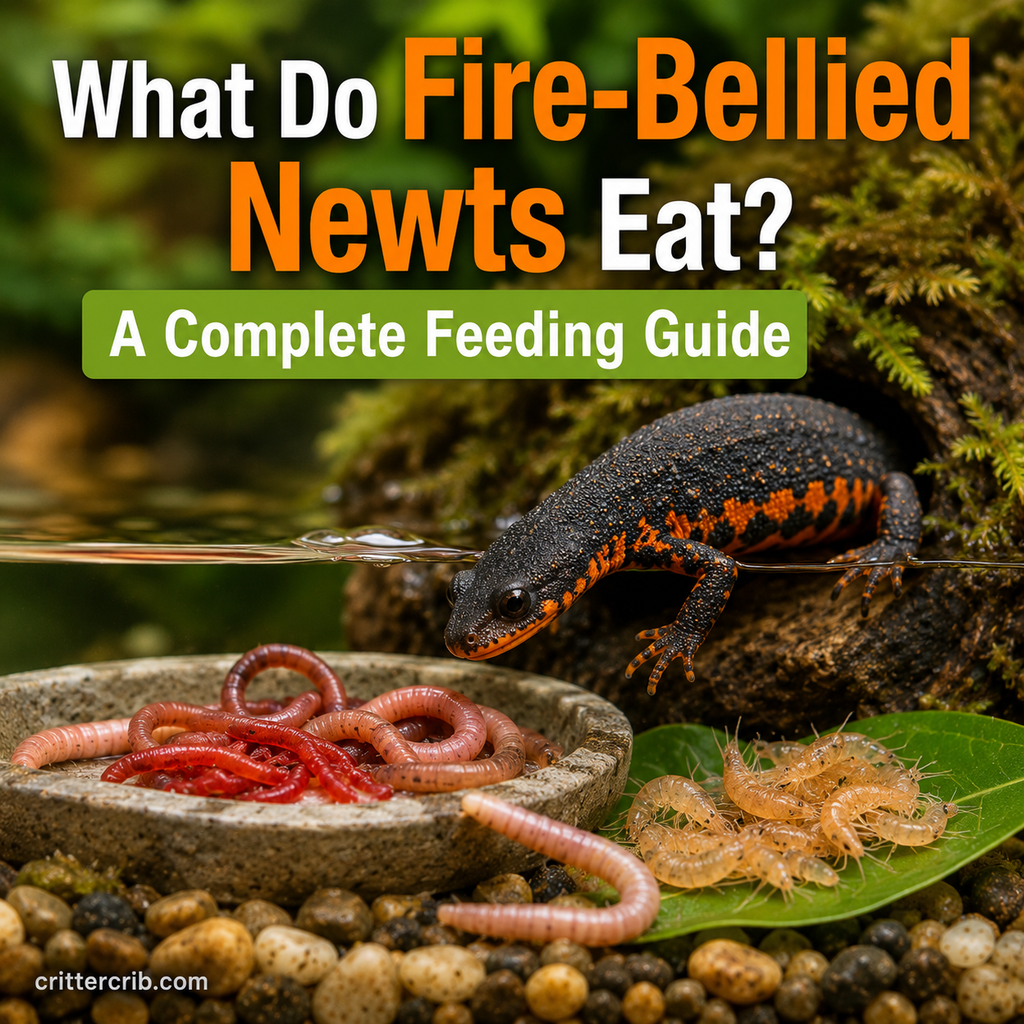
Fire-bellied newts may be small, but they’re enthusiastic little predators.
In the wild, they eat a variety of tiny aquatic animals and invertebrates. In captivity, the same basic principle applies: fire-bellied newts need an animal-based diet with enough variety to provide balanced nutrition.
So, what do fire-bellied newts eat?
Good options include appropriately sized earthworms, chopped nightcrawlers, bloodworms, blackworms, small crustaceans, and other suitable live or frozen invertebrates. The best diet doesn’t rely too heavily on one food. Instead, it combines nutritious staples with occasional variety.
Feeding also changes with age. Juvenile newts usually need smaller food and more frequent meals, while healthy adults can generally eat less often.
Here’s how to build a practical feeding routine for your fire-bellied newt.
What Do Fire-Bellied Newts Eat in the Wild?
Fire-bellied newts are carnivorous.
In their natural habitat, they feed on small prey they can capture in or around the water.
Their diet can include:
- Aquatic insect larvae
- Worms
- Small crustaceans
- Tiny aquatic invertebrates
- Other appropriately sized animal prey
They’re opportunistic hunters rather than specialized eaters.
Movement is particularly important when they’re hunting live prey. A wriggling worm or swimming invertebrate naturally attracts a newt’s attention.
Captive feeding should reflect this variety while using foods that are safe, nutritious, and practical to obtain.
Best Foods for Fire-Bellied Newts
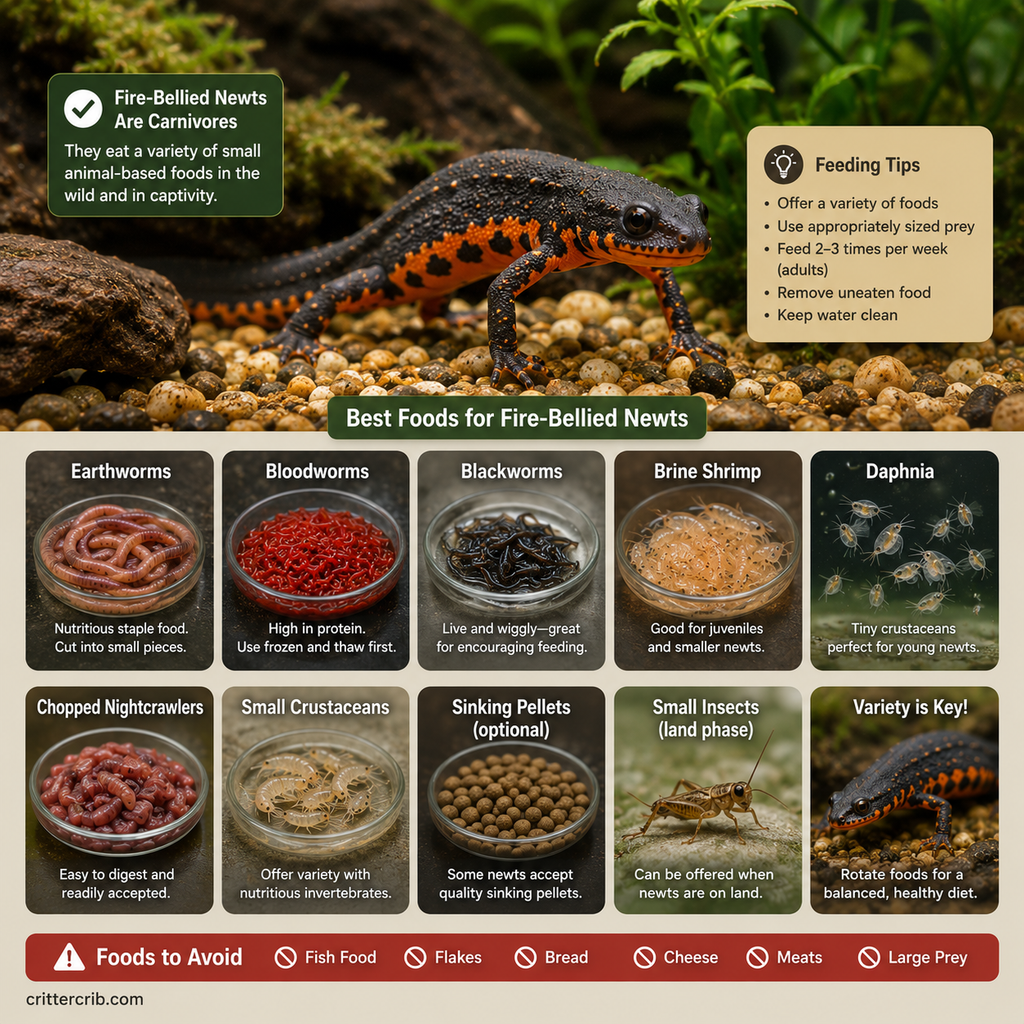
No single food needs to make up every meal.
A varied diet is generally the better approach.
Some foods, however, are more useful as regular staples than others.
Earthworms and Nightcrawlers
Earthworms are among the most useful foods for many captive salamanders and newts.
They’re nutritious, readily available in many areas, and easy to portion.
A full nightcrawler will usually be far too large for a small fire-bellied newt, so cut it into appropriately sized pieces.
The pieces should be small enough for the newt to swallow comfortably.
Where Should You Get Earthworms?
Use worms from a safe source.
Bait shops can be convenient, but you’ll want to know how the worms were raised and whether they’ve been exposed to chemicals.
Worms sold specifically as reptile or amphibian feeders are another option.
Avoid collecting worms from lawns or gardens that may have been treated with:
- Pesticides
- Herbicides
- Fertilizers
- Other lawn chemicals
A free worm isn’t worth exposing your newt to an unknown chemical.
Bloodworms
Bloodworms are another food commonly offered to aquatic newts.
Frozen bloodworms are widely available in aquarium stores and are convenient to portion.
Thaw frozen food before feeding rather than dropping a large frozen cube directly into the enclosure.
Bloodworms can be useful as part of a varied diet, but they shouldn’t necessarily be the only food your newt receives for its entire life.
Variety helps prevent nutritional gaps.
Blackworms
Live blackworms can trigger an excellent feeding response.
Their movement makes them particularly appealing to aquatic newts.
They can also encourage natural hunting behavior because the newt has to locate and capture moving prey.
The downside is availability.
Not every aquarium shop carries live blackworms, and proper storage is important.
If you use them, purchase from a reputable source and keep them according to appropriate feeder-care practices.
Brine Shrimp
Brine shrimp can be useful for smaller or younger animals, depending on their size.
Newly hatched brine shrimp are especially tiny and may be suitable for very small larvae, while larger brine shrimp can provide variety for juveniles.
For adult fire-bellied newts, brine shrimp are generally better treated as dietary variety rather than the primary staple.
Daphnia
Daphnia are tiny aquatic crustaceans that can be useful for young newts and smaller animals.
Live daphnia have the added benefit of moving through the water, encouraging natural hunting.
They’re especially useful when the newt needs prey smaller than chopped earthworm pieces.
As with other feeder animals, use daphnia from a clean, reliable source.
Other Small Aquatic Invertebrates
Depending on availability and your newt’s size, other appropriate aquatic invertebrates may provide additional dietary variety.
The key questions are always:
- Is it safe?
- Is it nutritious?
- Is it appropriately sized?
- Is it from a reliable source?
- Can the newt digest it easily?
Don’t feed unfamiliar wild-caught invertebrates simply because they’re small enough to fit in your newt’s mouth.
Can Fire-Bellied Newts Eat Pellets?
Some fire-bellied newts will accept high-quality sinking pellets designed for carnivorous aquatic amphibians or similar animals.
Others completely ignore them.
Live and frozen foods often trigger a stronger feeding response because they look and smell more like natural prey.
If your newt accepts a nutritionally appropriate pellet, it can be a convenient addition to the diet.
However, pellets don’t need to replace all fresh, live, or frozen foods.
A varied feeding plan is still useful.
Can Fire-Bellied Newts Eat Crickets?
Small crickets can sometimes be offered when a newt is spending time on land, but they’re not always the most convenient choice for predominantly aquatic animals.
Crickets can drown, hide, or escape into areas where the newt can’t easily catch them.
For aquatic fire-bellied newts, foods that can be offered directly in the water are usually easier to manage.
If you do use insects, make sure they’re appropriately sized and gut-loaded.
Remove anything that isn’t eaten.
Foods to Avoid Feeding Fire-Bellied Newts
Just because a newt will attempt to eat something doesn’t mean it’s a good food.
Avoid inappropriate foods such as:
- Human meat or processed foods
- Bread
- Cheese
- Dog food
- Cat food
- Seasoned foods
- Wild insects from pesticide-treated areas
- Large, hard-bodied prey
- Food that’s beginning to spoil
Also avoid making fatty or nutritionally incomplete foods the foundation of the diet.
Feeding variety should mean rotating suitable prey—not experimenting with random foods from your kitchen.
How Often Should You Feed Fire-Bellied Newts?
Feeding frequency depends on the newt’s:
- Age
- Size
- Body condition
- Temperature
- Activity
- Food type
- Health
Healthy adults generally don’t need to eat every day.
Many adult fire-bellied newts do well when fed approximately two to three times per week, although individual needs vary.
Juveniles usually need food more frequently because they’re actively growing.
Watch the Animal, Not Just the Calendar
A feeding schedule is a starting point.
Body condition tells you whether the schedule is actually working.
A healthy newt shouldn’t become progressively thinner between meals, but it also shouldn’t become excessively heavy.
Adjust portions and frequency based on the animal in front of you.
How Much Should You Feed?
There’s no universal number of worms or bloodworms that works for every fire-bellied newt.
Food sizes vary too much.
A useful approach is to offer a modest amount and watch how much the animal comfortably consumes.
You want the newt to eat well without leaving piles of uneaten food behind.
If leftovers are consistently accumulating, you’re probably offering too much.
If your newt is losing weight despite eagerly eating everything offered, reassess portion size, feeding frequency, temperature, and overall health.
How to Feed Fire-Bellied Newts
There are several practical ways to offer food.
Feeding With Tongs
Feeding tongs can be especially useful for chopped earthworms.
Hold the food close enough for the newt to see and smell it.
A slight movement can help attract attention.
Don’t repeatedly poke the newt in the face.
Give it time to respond.
Tong feeding has several advantages:
- You can see exactly how much the newt eats.
- Food is less likely to disappear into the enclosure.
- Multiple newts can be fed individually.
- Leftover food is easier to control.
Use smooth, appropriately sized feeding tools to reduce the chance of accidental injury.
Using a Feeding Dish
A shallow feeding dish can help keep certain foods contained.
This is particularly useful in an aquarium with substrate where small pieces of food might otherwise disappear.
Over time, some newts learn where food normally appears.
Remove the dish for cleaning as needed so decomposing food doesn’t accumulate.
Scatter Feeding
Live aquatic foods such as blackworms or daphnia can sometimes be released into the enclosure so the newt can hunt naturally.
This can provide useful feeding enrichment.
However, don’t add excessive quantities.
You still need to monitor how much your newt actually eats and whether leftover prey affects aquarium cleanliness.
Feeding Multiple Fire-Bellied Newts
If you keep more than one newt, don’t assume everyone gets an equal share simply because you added enough food.
Some individuals are faster or more assertive than others.
Watch each animal.
You may need to:
- Tong-feed individuals
- Place food in multiple locations
- Use more than one feeding dish
- Temporarily separate animals during feeding
Regular observation helps prevent a dominant newt from becoming overweight while a quieter animal slowly loses condition.
Feeding Juvenile Fire-Bellied Newts
Young newts require smaller foods and generally more frequent meals.
Depending on their stage and size, appropriate foods may include:
- Daphnia
- Small blackworms
- Brine shrimp
- Tiny chopped earthworms
- Other appropriately sized live aquatic foods
The food must be small enough to swallow easily.
Juveniles are growing rapidly, so consistent access to nutritious food is especially important.
As they grow, gradually introduce larger foods.
What About Newts That Spend Time on Land?
Fire-bellied newts can go through periods when they spend more time on land, particularly depending on age, species, season, and environmental conditions.
Terrestrial animals may need food presented differently.
Small earthworm pieces remain useful because they can be offered directly with tongs.
Appropriately sized terrestrial invertebrates may also be accepted.
Avoid letting large numbers of insects roam freely around the enclosure.
Uneaten insects can hide, die, or potentially bother the newt.
Do Fire-Bellied Newts Need Calcium Supplements?
Supplementation depends on the overall diet.
Whole prey such as appropriately selected earthworms can provide good nutrition, while some insect-heavy diets may require additional attention to calcium and vitamin balance.
If you’re feeding terrestrial insects such as crickets, proper gut-loading and supplementation may be appropriate.
Aquatic foods can make supplementation trickier because powders wash off quickly in water.
Rather than automatically dusting everything, build the diet around nutritious staple foods and seek species-appropriate guidance from an experienced exotic veterinarian when determining whether supplementation is necessary.
More supplementation isn’t automatically better.
Why Dietary Variety Matters
Feeding the same food at every meal is convenient, but it may not provide ideal nutrition over the long term.
Different foods provide different nutrient profiles.
For example, you might rotate between:
- Chopped earthworms
- Bloodworms
- Blackworms
- Appropriate aquatic invertebrates
- A suitable pellet if accepted
The exact rotation doesn’t have to be complicated.
The goal is simply to avoid relying exclusively on one limited food when other appropriate options are available.
What If Your Fire-Bellied Newt Won’t Eat?
Skipping one meal isn’t always an emergency.
Newts may temporarily refuse food because of:
- Environmental changes
- Stress
- Temperature changes
- A recent move
- Seasonal behavior
- Unfamiliar food
- Illness
Start by checking the habitat.
Check the Water
Poor water quality can affect appetite.
Test:
- Ammonia
- Nitrite
- Nitrate
- pH
- Temperature
Ammonia and nitrite should be at 0 ppm in an established aquarium.
Correct environmental problems safely rather than trying five new foods while ignoring poor water conditions.
Try a More Appealing Food
Movement can trigger feeding.
If your newt ignores pellets or frozen food, try a small piece of fresh earthworm or another suitable live food.
Use feeding tongs to move it gently within the newt’s field of view.
Reduce Stress
A newly acquired newt may need time to settle.
Make sure the enclosure has:
- Hiding places
- Appropriate water conditions
- Gentle filtration
- Suitable temperature
- Low-stress surroundings
Avoid repeatedly handling or disturbing an animal that’s already refusing food.
Know When to Contact a Veterinarian
Persistent loss of appetite combined with weight loss, abnormal skin, bloating, unusual swimming, lethargy, sores, or other physical changes deserves professional attention.
Locate a veterinarian experienced with amphibians or exotic animals.
How Can You Tell if Your Newt Is Eating Enough?
Regular observation is more useful than obsessing over one meal.
Look at your newt’s overall body condition.
A healthy animal should maintain a proportionate body shape without becoming extremely thin or excessively swollen.
Also pay attention to:
- Appetite
- Activity
- Skin condition
- Normal movement
- Weight or body condition over time
Photographs taken periodically from similar angles can help you notice gradual changes that are difficult to see day to day.
Should You Feed Fire-Bellied Newts by Hand?
Direct hand-feeding isn’t necessary.
Feeding tongs are safer and more hygienic.
Newts may associate movement near the enclosure with food and become quite responsive at feeding time.
That’s useful, but don’t intentionally teach them to strike at your fingers.
Amphibians also have delicate skin, so unnecessary touching should be avoided.
Remove Uneaten Food
This is particularly important in aquatic enclosures.
Leftover food eventually decomposes.
That can contribute to:
- Increased waste
- Poor water quality
- Bacterial growth
- Unpleasant odors
- Detritus buildup
Remove uneaten pieces after feeding rather than leaving them until the next day.
A feeding dish or targeted tong feeding can make cleanup much easier.
Feeding and Water Quality Go Together
Every meal eventually affects the aquarium.
The more food that enters the tank, the more waste the filtration system has to process.
Overfeeding can therefore create two problems at once:
- The newt receives more calories than it needs.
- The aquarium receives more organic waste than necessary.
Maintain a properly cycled aquarium and perform routine partial water changes based on water-test results and the needs of your setup.
A good feeding routine isn’t just about nutrition.
It’s also about keeping the environment clean.
Common Fire-Bellied Newt Feeding Mistakes
Several mistakes appear repeatedly with new keepers.
Avoid:
- Feeding only one type of food indefinitely
- Offering prey that’s too large
- Feeding adults excessively
- Underfeeding growing juveniles
- Leaving uneaten food in the aquarium
- Assuming every newt in a group has eaten
- Collecting prey from chemically treated areas
- Using inappropriate human foods
- Relying entirely on nutritionally poor treats
- Ignoring a persistent loss of appetite
- Overusing supplements
- Allowing feeder insects to remain in the enclosure indefinitely
Most feeding problems are easier to prevent than correct.
A Simple Fire-Bellied Newt Feeding Routine
You don’t need a complicated weekly menu.
For a healthy adult, a simple routine might involve offering food two or three times per week and rotating nutritious options.
For example:
- First feeding: Chopped earthworm
- Second feeding: Blackworms or another suitable aquatic invertebrate
- Third feeding: Chopped earthworm, bloodworms, or another appropriate food
That’s only an example.
Your actual routine should depend on what your newt accepts, what’s available, its body condition, and the nutritional quality of the foods you’re using.
Juveniles will generally need a different schedule with smaller, more frequent meals.
Fire-Bellied Newt Feeding Checklist
For quick reference:
- Base the diet on nutritious animal-based foods.
- Use earthworms or chopped nightcrawlers as a useful staple.
- Provide dietary variety.
- Offer appropriately sized food.
- Feed healthy adults roughly two to three times per week as a starting point.
- Feed growing juveniles more frequently.
- Watch each newt eat.
- Remove leftovers.
- Use feeding tongs when useful.
- Buy feeders from safe sources.
- Don’t rely exclusively on one food.
- Monitor body condition.
- Investigate persistent appetite loss.
- Maintain good water quality.
Final Thoughts
So, what do fire-bellied newts eat?
A healthy captive diet can include chopped earthworms, nightcrawlers, bloodworms, blackworms, small aquatic invertebrates, and other appropriately sized carnivorous foods. Some individuals may also accept suitable sinking pellets.
The key is variety and quality.
You don’t need to offer a huge buffet at every meal. Instead, find a few nutritious foods your newt eats reliably and rotate them.
Pay attention to portion size, remove leftovers, and watch each animal eat—especially when multiple newts share an enclosure.
And remember that feeding doesn’t happen in isolation.
Temperature, water quality, stress, and overall habitat conditions can all affect appetite.
Combine a varied diet with a clean, stable enclosure, and you’ll have the foundation for keeping your fire-bellied newt well-fed and healthy.