
African dwarf frogs live entirely in water, which means keeping their habitat clean isn’t just about making the aquarium look nice. Water quality directly affects the environment they breathe, eat, swim, and rest in every day.
The good news is that cleaning an African dwarf frog tank doesn’t require tearing everything apart.
In fact, you generally don’t want to completely empty and scrub an established aquarium. A healthy tank depends on beneficial bacteria that help process waste. Overcleaning can disrupt that biological balance and potentially cause more problems than it solves.
A better approach is simple: remove waste, perform regular partial water changes, clean the substrate as needed, and maintain the filter without sterilizing it.
Here’s how to do it safely.
African Dwarf Frog Tank Cleaning at a Glance
For a healthy, established aquarium, a typical cleaning routine includes:
- Removing uneaten food after feeding
- Spot-cleaning visible waste
- Testing the water regularly
- Performing partial water changes
- Vacuuming debris from the substrate
- Wiping algae from the glass as needed
- Cleaning decorations only when necessary
- Gently maintaining the filter without destroying beneficial bacteria
- Treating replacement tap water with an appropriate conditioner
Most importantly, avoid turning routine maintenance into a complete aquarium reset.
Consistency is much safer than repeatedly deep-cleaning the entire habitat.
Why African Dwarf Frog Tanks Need Regular Cleaning
African dwarf frogs may be small, but waste still accumulates in their aquarium.
Several things contribute to declining water quality:
- Frog waste
- Uneaten food
- Decaying plant material
- Organic debris
- Dead plant leaves
- Dirty substrate
As organic material breaks down, ammonia can enter the water.
In a properly cycled aquarium, beneficial bacteria convert ammonia into nitrite and then nitrate. Ammonia and nitrite are toxic, while nitrate is generally managed through partial water changes and aquarium maintenance.
That’s why a tank can look clear while still having poor water quality.
You can’t judge water safety by appearance alone.
How Often Should You Clean an African Dwarf Frog Tank?
There isn’t one cleaning schedule that works perfectly for every aquarium.
Tank size, filtration, feeding, number of frogs, live plants, and water parameters all influence how quickly maintenance is needed.
For many established setups, a partial water change approximately once a week is a practical starting point.
However, water testing should help determine the actual schedule.
You may need more frequent maintenance if:
- The aquarium is relatively small
- Several frogs live together
- Food frequently remains uneaten
- Nitrate rises quickly
- The substrate collects substantial debris
- Filtration is limited
A larger, properly cycled aquarium with good filtration may remain more stable than a very small setup.
Supplies for Cleaning an African Dwarf Frog Habitat
Keeping a few aquarium-specific supplies nearby makes maintenance much easier.
Useful items include:
- Aquarium siphon or gravel vacuum
- Bucket used only for aquarium maintenance
- Aquarium water conditioner
- Water test kit
- Algae scraper or aquarium-safe sponge
- Thermometer
- Turkey baster or similar spot-cleaning tool
- Clean towels for spills
Avoid using your aquarium bucket for household cleaning.
Even small amounts of detergent or other chemicals can be harmful to aquatic animals.
Should You Remove African Dwarf Frogs While Cleaning?
Usually, no.
For ordinary partial water changes and routine maintenance, it’s generally less stressful to leave the frogs in their aquarium.
You can carefully siphon around them.
Move slowly and keep track of where each frog is before placing the siphon into the tank.
African dwarf frogs are curious and may investigate equipment.
When Might You Need to Move the Frogs?
Temporary relocation may occasionally be necessary during:
- Major aquarium repairs
- Equipment replacement
- Emergencies
- Complete tank relocation
- Situations where the habitat becomes unsafe
If you need to move a frog, use an appropriate aquarium-safe container filled with suitable water.
Routine weekly cleaning shouldn’t require repeatedly catching and transferring the frogs.
Step-by-Step: How to Clean an African Dwarf Frog Tank
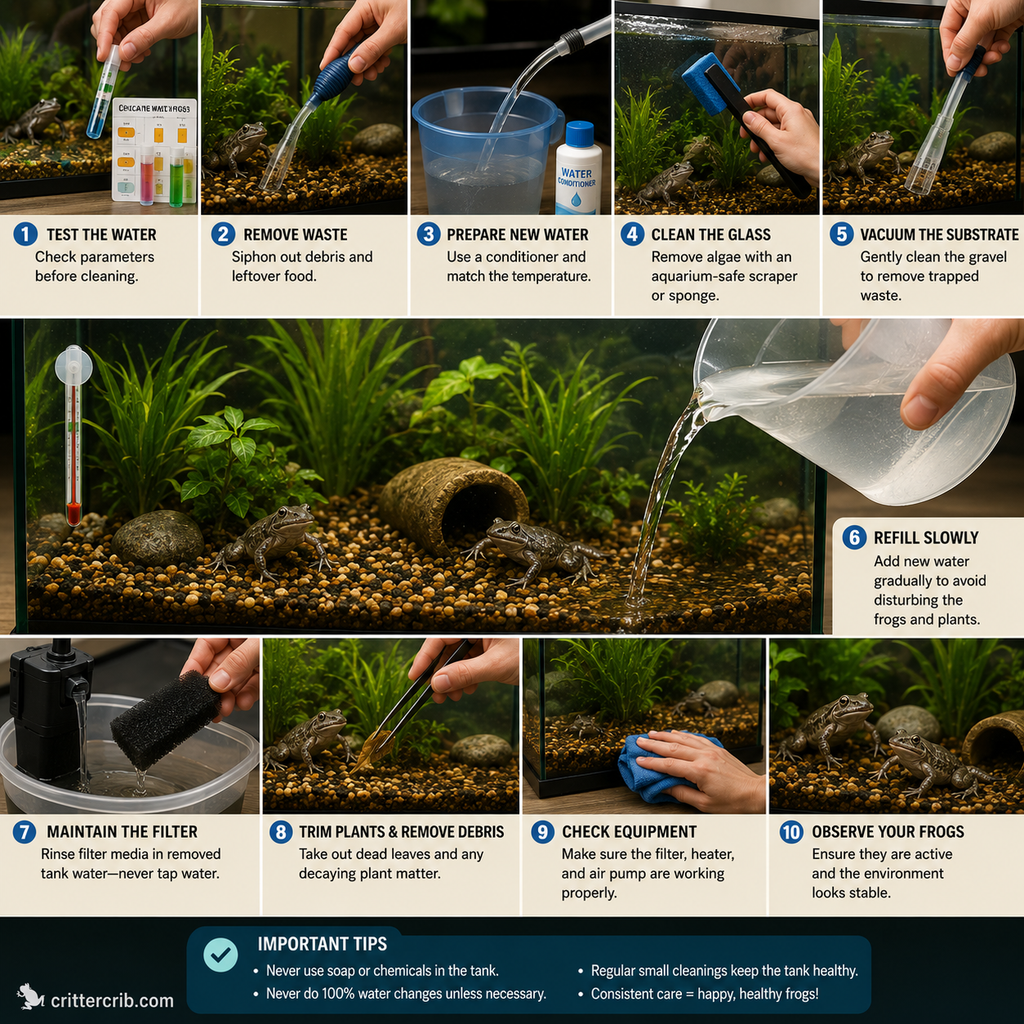
A regular cleaning session doesn’t need to be complicated.
For an established aquarium, follow this basic routine.
1. Check the Water Before Cleaning
Testing before the water change gives you useful information about what’s happening in the aquarium.
Check important parameters such as:
- Ammonia
- Nitrite
- Nitrate
- pH
In a cycled aquarium, ammonia and nitrite should remain at 0 ppm.
Tracking nitrate can help you determine whether your current water-change schedule is adequate.
If ammonia or nitrite is detectable, don’t simply assume the tank needs a bigger cleaning. Something may be wrong with the aquarium’s biological cycle, filtration, stocking, or maintenance routine.
2. Prepare the Replacement Water
If you’re using municipal tap water, treat it with an appropriate aquarium water conditioner.
Tap water may contain chlorine or chloramine, both of which can be harmful to aquatic animals and the beneficial bacteria in your aquarium.
Follow the conditioner manufacturer’s directions.
Try to get the replacement water reasonably close to the aquarium’s temperature before adding it.
Large, sudden temperature changes can stress aquatic animals.
3. Unplug Equipment When Appropriate
Before lowering the water level, check your aquarium equipment.
Some filters and heaters shouldn’t operate when the water drops below a certain level.
Follow the manufacturer’s instructions for your equipment.
If anything needs to be unplugged during maintenance, remember to reconnect it after the aquarium has been refilled.
4. Remove Visible Waste and Uneaten Food
Before siphoning, look around the aquarium for obvious debris.
Remove:
- Uneaten food
- Frog waste
- Dead plant leaves
- Other organic material
A turkey baster dedicated to aquarium use can be helpful for quick spot cleaning.
Removing waste before it breaks down is one of the easiest ways to maintain water quality.
5. Siphon Out a Portion of the Water
Use an aquarium siphon to remove part of the old water.
For routine maintenance, you generally don’t need to empty the entire aquarium.
A partial water change removes nitrate and dissolved waste while preserving a stable environment.
The exact percentage depends on water quality and the individual aquarium, but moderate weekly partial changes are commonly used.
Let your test results guide you.
6. Clean Debris From the Substrate
As you siphon water, use the opportunity to remove debris from the bottom.
If you’re using aquarium gravel or another appropriate substrate, gently vacuum areas where waste accumulates.
You don’t necessarily need to aggressively clean every inch during every water change.
Instead, concentrate on areas where you can see:
- Food particles
- Waste
- Plant debris
- Other organic material
In larger aquariums, rotating which sections you clean can make maintenance easier.
7. Clean the Glass if Needed
Algae on aquarium glass is usually more of an appearance issue than an emergency.
Use an aquarium-safe algae scraper or sponge to clean the inside surfaces.
Never spray household glass cleaner near the aquarium.
Even if you’re cleaning the outside glass, apply any appropriate cleaning product to a cloth away from the tank rather than spraying it toward the aquarium.
For the safest approach, plain water and a clean cloth are often sufficient for exterior smudges.
8. Check Decorations and Plants
You don’t need to remove and scrub every decoration each week.
If a decoration has accumulated excessive algae or debris, clean it gently.
Artificial plants, rocks, hides, and other aquarium furnishings can often be rinsed or wiped using removed aquarium water.
Live plants can be trimmed when necessary.
Remove dead or decaying leaves before they break down in the tank.
9. Refill the Aquarium Slowly
Add the prepared, conditioned replacement water gradually.
Pouring water too quickly can:
- Disturb the substrate
- Frighten the frogs
- Uproot plants
- Move decorations
A slow refill keeps things calmer.
Make sure the final water level is appropriate for your filter and other equipment.
10. Restart and Check the Equipment
Once the aquarium is refilled, reconnect any equipment you unplugged.
Confirm that:
- The filter is running normally
- Water flow looks appropriate
- The heater is operating correctly if one is used
- The thermometer is functioning
- Nothing shifted dangerously during cleaning
Watch the aquarium for a few minutes before walking away.
How Much Water Should You Change?
For many established aquariums, a partial water change of roughly 20–30% per week can be a reasonable starting point.
But don’t treat that percentage as an unbreakable rule.
The right amount depends on:
- Nitrate levels
- Tank volume
- Number of animals
- Feeding
- Filtration
- Plant growth
- Maintenance frequency
If nitrate accumulates quickly, the aquarium may require larger or more frequent partial changes.
Water testing provides much better guidance than following a schedule blindly.
Why You Shouldn’t Replace All the Water Every Week
A 100% water change usually isn’t necessary for routine maintenance.
African dwarf frogs benefit from stable aquarium conditions.
Completely draining and refilling the tank can create unnecessary changes in:
- Temperature
- pH
- Water chemistry
- Overall environmental stability
It can also encourage owners to aggressively clean every aquarium surface at the same time.
Beneficial bacteria live primarily on surfaces, especially filter media and substrate, rather than floating freely in the water. So simply changing water doesn’t automatically destroy the cycle.
The bigger danger comes from combining a complete water change with aggressive cleaning or replacement of filter media and substrate.
Routine partial maintenance is generally safer.
How to Clean the Filter Safely
Your aquarium filter is one place where being “too clean” can become a problem.
Filter media provides a large surface area for beneficial bacteria.
If reusable biological media becomes dirty, it can often be gently rinsed in water you’ve just removed from the aquarium.
This removes loose debris without aggressively sterilizing the media.
Avoid Washing Biological Filter Media Under Untreated Tap Water
Chlorinated water can harm beneficial bacteria.
Instead, place some removed aquarium water in a bucket and gently rinse reusable media there when needed.
Don’t scrub it until it looks brand new.
You’re trying to remove excessive debris, not sterilize it.
Don’t Replace All Filter Media at Once
Some filters use disposable cartridges that manufacturers recommend replacing frequently.
From a biological filtration standpoint, throwing away all established media at once can remove a large colony of beneficial bacteria.
Whenever possible, maintain stable biological media in the filter.
If something genuinely needs replacement, replacing portions gradually can help preserve the aquarium’s bacterial population.
How Often Should You Clean the Filter?
The filter doesn’t necessarily need to be cleaned every time you perform a water change.
Clean it when water flow decreases or excessive debris accumulates.
Depending on the setup, that might mean periodic maintenance rather than weekly cleaning.
Overcleaning the filter can be counterproductive.
Check it regularly, but don’t dismantle and scrub it simply because you’re already cleaning the aquarium.
Cleaning a Sponge Filter
Sponge filters are relatively easy to maintain.
When the sponge becomes clogged:
- Remove some aquarium water during a water change.
- Place the sponge in that water.
- Gently squeeze it several times.
- Remove enough debris to restore water flow.
- Return it to the aquarium.
- Restart the air system.
The water may become surprisingly dirty while squeezing the sponge.
That’s normal.
The goal isn’t to make the sponge look new.
Cleaning Gravel and Substrate
Food and waste can settle between pieces of substrate.
A gravel vacuum helps remove that material during a water change.
Move slowly around the tank so you don’t accidentally injure a frog.
African dwarf frogs may investigate the siphon, so always know where they are.
Do You Need to Remove the Substrate?
Normally, no.
Removing all the substrate every week would be unnecessarily disruptive.
Substrate surfaces can also support beneficial bacteria.
Use a siphon to remove accumulated debris while leaving the majority of the habitat in place.
Cleaning a Sand Substrate
Sand requires a slightly different approach.
Debris often sits on top rather than sinking deeply between particles.
Hold the siphon slightly above the sand so waste is lifted without removing large quantities of substrate.
If sand gets sucked into the siphon, adjust the distance.
With practice, you can remove debris while leaving most of the sand behind.
Cleaning Decorations and Hides
Decorations generally only need attention when they’re visibly dirty or accumulating unwanted algae.
Don’t use:
- Dish soap
- Household disinfectants
- Bleach during ordinary routine maintenance
- Scented cleaning products
- Bathroom cleaners
- Multipurpose sprays
For routine cleaning, an aquarium-safe brush, sponge, or rinse is usually sufficient.
Keep any cleaning tools used for the frog aquarium separate from household cleaning supplies.
How to Clean Live Plants
Live plants don’t need to be sterilized.
During routine maintenance:
- Remove dead leaves
- Trim damaged growth
- Remove trapped debris
- Gently clean excessive algae if necessary
Healthy plants can actually contribute to aquarium stability by using nutrients from the water.
Avoid unnecessarily uprooting plants every week.
African Dwarf Frog Water Safety
Clean water isn’t just water that looks clear.
You also need to consider what’s dissolved in it.
Chlorine and Chloramine
Municipal water is commonly disinfected.
Always use an appropriate aquarium water conditioner when necessary.
Temperature
Try to match replacement water reasonably closely to the aquarium.
Avoid sudden temperature swings.
Ammonia and Nitrite
Both should remain at 0 ppm in a properly cycled aquarium.
Any detectable amount deserves attention.
Nitrate
Nitrate is the end product of the aquarium nitrogen cycle and gradually accumulates.
Partial water changes help control it.
Regular testing will show how quickly nitrate builds up in your particular setup.
Why Uneaten Food Is Such a Problem
African dwarf frogs can be messy eaters.
Food that isn’t consumed eventually breaks down and contributes to the aquarium’s waste load.
This is especially important with foods that quickly spoil.
After feeding, check whether anything remains.
Remove leftovers rather than assuming the filter will take care of them.
A turkey baster can make this job much easier.
Good feeding habits reduce how much cleaning you’ll need to do later.
Should You Deep-Clean an African Dwarf Frog Tank?
Routine deep cleaning generally isn’t necessary for a healthy established aquarium.
There are situations where major intervention may be required, such as:
- Contamination
- Aquarium leaks
- Certain disease-management situations under veterinary guidance
- Major equipment failure
- Complete tank relocation
Those situations are different from normal weekly maintenance.
If the aquarium is healthy, your goal should be maintaining its stability rather than repeatedly starting over.
Common African Dwarf Frog Tank Cleaning Mistakes
Cleaning mistakes can sometimes create worse water conditions than the original mess.
Emptying the Entire Tank Every Week
This creates unnecessary instability and often leads to excessive cleaning of other aquarium surfaces.
Partial water changes are generally more appropriate.
Replacing All the Filter Media
Established filter media contains beneficial bacteria.
Throwing everything away at once can reduce biological filtration.
Using Soap
Never use dish soap to clean aquarium equipment, decorations, or the inside of the tank.
Residue can be harmful to aquatic animals.
Forgetting Water Conditioner
Fresh-looking tap water isn’t automatically frog-safe.
Treat replacement water appropriately before it enters the aquarium.
Adding Water at the Wrong Temperature
Large temperature differences can stress your frogs.
Overfeeding
Some “dirty tank” problems are actually feeding problems.
If large quantities of food remain after every meal, reduce waste at the source.
Cleaning Everything at Once
Avoid aggressively cleaning the substrate, filter, decorations, and every aquarium surface simultaneously unless there’s a specific reason.
Maintaining biological stability is part of maintaining cleanliness.
A Simple Weekly African Dwarf Frog Cleaning Routine
Once the aquarium is established, maintenance can become a predictable routine.
A typical weekly session might look like this:
- Test the water.
- Prepare conditioned replacement water.
- Remove uneaten food and visible debris.
- Siphon approximately 20–30% of the aquarium water, adjusting based on test results.
- Vacuum dirty sections of substrate.
- Wipe algae from the glass if necessary.
- Remove dead plant material.
- Refill slowly with conditioned water.
- Restart equipment.
- Confirm that the filter, temperature, and water level are normal.
Filter maintenance can be performed separately when needed rather than automatically every week.
Quick Daily Maintenance
You don’t have to wait for cleaning day to remove obvious waste.
A quick daily check can prevent debris from accumulating.
Look for:
- Leftover food
- Frog waste
- Dead leaves
- Equipment problems
- Unusual water cloudiness
Removing a small piece of waste takes seconds.
Leaving it in the aquarium gives it time to decompose.
How Do You Know the Tank Is Clean Enough?
Don’t aim for an aquarium that looks sterile.
A healthy aquarium is a functioning ecosystem.
Some algae, plant debris, and natural biological growth can exist without meaning the habitat is dirty.
Instead, focus on measurable and practical signs:
- Ammonia remains at 0 ppm
- Nitrite remains at 0 ppm
- Nitrate is controlled
- Water temperature is appropriate
- Waste doesn’t accumulate excessively
- Food isn’t rotting on the bottom
- The filter maintains good flow
- The frogs behave normally
Water quality matters more than whether every decoration looks brand new.
Frequently Asked Questions About Cleaning an African Dwarf Frog Tank
How Often Should I Change the Water for African Dwarf Frogs?
Many established aquariums benefit from weekly partial water changes.
However, tank size, stocking, filtration, feeding, and water-test results should determine the exact frequency.
Can I Do a 100% Water Change?
A complete water change generally isn’t necessary for routine cleaning.
Partial water changes provide a more stable approach to regular maintenance.
Can I Use Tap Water?
Tap water can often be used when it’s properly treated with an appropriate aquarium water conditioner and the source water is otherwise suitable.
Don’t add untreated chlorinated or chloraminated tap water directly to the aquarium.
Can I Use Soap to Clean the Tank?
No.
Avoid soaps, detergents, household cleaners, and scented products inside the aquarium or on equipment that will contact aquarium water.
Should I Take My African Dwarf Frogs Out When Cleaning?
Not for ordinary partial water changes.
Leaving them in the aquarium usually avoids the stress of catching and transferring them.
Move carefully while siphoning and always keep track of where the frogs are.
How Often Should I Vacuum the Gravel?
Inspect the substrate during regular water changes and remove accumulated waste as necessary.
You don’t need to aggressively vacuum every inch every time.
Why Does My African Dwarf Frog Tank Get Dirty So Quickly?
Common causes include:
- Overfeeding
- Too many animals for the aquarium
- Insufficient filtration
- A small water volume
- Decaying plant material
- Infrequent water changes
- Uneaten food accumulating in the substrate
Look for the source of the waste rather than simply cleaning more aggressively.
Should I Replace the Filter Cartridge Every Month?
Avoid automatically throwing away all established biological filter media solely because a calendar says it’s time.
Filter media can support important beneficial bacteria.
Maintain reusable media appropriately and replace material when genuinely necessary, ideally without removing all established biological filtration at once.
Final Thoughts on Cleaning an African Dwarf Frog Habitat
Cleaning an African dwarf frog habitat isn’t about making the aquarium sterile.
It’s about keeping the water safe and the environment stable.
For most established tanks, regular partial water changes, substrate cleaning, removal of uneaten food, occasional algae removal, and careful filter maintenance provide a solid routine.
Avoid the temptation to tear down the aquarium and scrub everything each week.
Beneficial bacteria are doing important work behind the scenes, and preserving that biological filtration is just as important as removing visible dirt.
Test the water, clean consistently, avoid overfeeding, and deal with waste before it has time to break down.
Once you establish a routine, maintaining an African dwarf frog aquarium becomes much simpler—and your frogs get the clean, stable aquatic environment they depend on.