

Pacman frogs aren’t exactly known for being energetic pets. You might set up a beautiful enclosure, provide the perfect hiding spots, and then watch your frog sit in essentially the same place for days.
For a Pacman frog, that’s often completely normal.
These round, heavily built frogs are ambush predators. Instead of actively hunting across large areas, they spend much of their time partially buried and waiting for prey to come within striking distance. Their naturally sedentary lifestyle can make it difficult for new owners to tell the difference between normal Pacman frog behavior and a potential problem.
Why is your Pacman frog buried? Why does it suddenly lunge at feeding tongs? Is sitting in the water dish normal? What about refusing food or staying hidden for days?
Understanding what these behaviors mean can make caring for a Pacman frog much easier.
Understanding Normal Pacman Frog Behavior
Pacman frogs belong to the genus Ceratophrys and are native to parts of South America. They’re sometimes called horned frogs because several species have raised areas above their eyes that resemble small horns.
In the wild, Pacman frogs rely heavily on camouflage and patience.
They bury themselves in loose substrate or leaf litter with only part of their bodies exposed. From there, they wait for insects and other small animals to move close enough to capture.
That hunting strategy explains many of the behaviors you’ll see in captivity.
A healthy Pacman frog may spend a surprising amount of time:
- Sitting completely still
- Buried beneath the substrate
- Remaining in one favorite location
- Waiting near the surface of the substrate
- Becoming suddenly active when food appears
- Moving more during the evening or nighttime
Compared with tree frogs and some other amphibians, Pacman frogs can seem unusually inactive.
Inactivity alone isn’t necessarily a sign that something is wrong.
Why Does My Pacman Frog Sit Still All Day?
This is probably one of the first behaviors new Pacman frog owners notice.
The frog barely moves.
You may even wonder whether it’s bored.
Pacman frogs are naturally sedentary ambush predators. Conserving energy while waiting for prey is part of their normal behavior.
A frog may remain in essentially the same location for hours or even days before repositioning itself.
If your frog has a healthy appetite, maintains appropriate body condition, and lives in an enclosure with suitable temperature and humidity, spending long periods sitting still is generally expected.
When Inactivity May Be a Concern
There’s an important difference between a frog that’s peacefully resting and one that’s unusually weak or unresponsive.
Pay closer attention if inactivity occurs alongside:
- Persistent refusal to eat
- Significant weight loss
- Difficulty moving
- Abnormal posture
- Changes in skin appearance
- Unusual breathing
- Swelling
- Redness
- Trouble using the legs normally
When several symptoms appear together, the behavior deserves closer investigation.
Start by checking the enclosure conditions, particularly temperature, humidity, substrate moisture, and water quality.
If the frog continues to appear unwell, contact a veterinarian experienced with amphibians or exotic pets.
Why Do Pacman Frogs Bury Themselves?
Burrowing is one of the most characteristic Pacman frog behaviors.
In many cases, a buried Pacman frog is simply doing exactly what its instincts tell it to do.
Burrowing helps the frog:
- Hide from potential predators
- Remain concealed while waiting for prey
- Maintain contact with moist substrate
- Feel secure
- Regulate exposure to environmental conditions
Some frogs bury themselves almost completely, leaving only their eyes and the top of their head visible.
Others disappear entirely.
Both behaviors can be normal.
Should You Dig Up a Buried Pacman Frog?
Usually, no.
Constantly uncovering your frog can cause unnecessary stress and prevents it from displaying natural behavior.
There are times when checking on a buried frog may be appropriate, particularly if it has remained hidden for an unusually long period and you’re concerned about its health.
But don’t dig it up every day simply to make sure it’s still there.
Instead, monitor enclosure conditions and learn your individual frog’s normal routine.
Why Does My Pacman Frog Keep Changing Burrowing Spots?
Although Pacman frogs aren’t particularly active, they do occasionally relocate.
A frog may leave one burrow and establish another somewhere else in the enclosure.
Sometimes this is simply normal exploration.
Other times, the frog may be searching for more comfortable conditions.
For example, one section of the enclosure may be:
- More humid
- Cooler
- Warmer
- Darker
- More securely covered
- Better suited for burrowing
If your frog repeatedly moves away from one particular area, check whether there’s an environmental reason.
A temperature gradient can help give the frog some ability to choose where it feels comfortable.
Why Is My Pacman Frog Completely Hidden?
A Pacman frog disappearing beneath the substrate can be alarming the first time it happens.
Fortunately, it’s often normal.
Some individuals prefer to remain almost completely buried for extended periods, especially during daylight hours.
The substrate should be deep enough for the frog to burrow naturally while remaining appropriately moist.
Avoid keeping the substrate waterlogged. Pacman frogs need humid conditions, but constantly saturated substrate can create other problems.
If the frog is repeatedly hiding while refusing food or showing other concerning symptoms, evaluate the enclosure conditions rather than assuming the behavior is purely behavioral.
Are Pacman Frogs Nocturnal?
Pacman frogs tend to be more active during the evening and nighttime.
That means you may rarely see some of their more interesting behavior during the middle of the day.
Your frog may reposition itself, explore briefly, soak, or become more responsive to food after the room becomes darker.
Don’t expect constant nighttime activity, though.
Even during their active periods, Pacman frogs are still ambush predators.
Their version of an exciting evening may involve moving several inches and sitting somewhere else.
Why Does My Pacman Frog Suddenly Lunge at Things?
Pacman frogs have an impressive feeding response.
A frog that has been sitting motionless can suddenly launch forward when prey moves nearby.
This behavior is normal and reflects how Pacman frogs hunt.
They have large mouths relative to their bodies and are opportunistic predators.
Movement can trigger the feeding response, which means a hungry frog may occasionally strike at something that isn’t food.
That can include:
- Feeding tongs
- Fingers
- Decorations being moved
- Water droplets
- Shadows or movement near the enclosure
This is one reason handling should be kept to a minimum.
Do Pacman Frogs Bite?
Yes, Pacman frogs can bite.
They aren’t generally trying to attack their owners out of aggression. In many cases, biting occurs because the frog mistakes movement for food or reacts defensively when disturbed.
Pacman frogs have surprisingly strong jaws for their size.
Larger individuals can deliver a noticeable bite.
Using feeding tongs can help keep your fingers away from the frog’s mouth during feeding.
However, avoid repeatedly waving food directly in the frog’s face. Allow it to respond naturally rather than constantly provoking a strike.
Why Does My Pacman Frog Refuse Food?
A Pacman frog occasionally skipping a meal isn’t automatically a problem.
Appetite can vary based on several factors, including:
- Age
- Temperature
- Stress
- Feeding frequency
- Recent meal size
- Seasonal changes
- Prey preference
- Overall health
Young frogs typically eat more frequently because they’re growing rapidly.
Adults may naturally eat less often.
A frog that recently consumed a large meal may simply not be hungry again yet.
Check the Environment First
If your Pacman frog suddenly stops eating, check the enclosure.
Incorrect temperatures can reduce appetite.
Humidity that’s too low or excessively wet substrate may also contribute to stress.
Make sure the enclosure is within an appropriate range for the species you’re keeping.
Also consider whether you’ve recently changed:
- The enclosure
- Substrate
- Lighting
- Feeding method
- Food type
- Enclosure location
Even relatively minor changes can temporarily affect behavior.
When Food Refusal Becomes Concerning
A single skipped meal usually isn’t an emergency.
Persistent food refusal combined with weight loss, weakness, abnormal skin, bloating, unusual stool, or other symptoms is more concerning.
Keeping track of your frog’s weight can be useful if you’re unsure whether its body condition is changing.
Consult an experienced exotic veterinarian if appetite loss continues or other symptoms develop.
Why Does My Pacman Frog Sit in Its Water Dish?
Occasional soaking is normal Pacman frog behavior.
Amphibians interact with water very differently from mammals. Their skin plays an important role in water balance, and Pacman frogs may spend time soaking in a shallow water dish.
Your frog might enter the dish to:
- Rehydrate
- Cool down
- Shed
- Defecate
- Simply rest
The water dish should be shallow enough that the frog can sit comfortably without struggling to keep its head above water.
Pacman frogs aren’t aquatic frogs and shouldn’t be expected to swim in deep water.
Constant Soaking Can Tell You Something
Occasional soaking is normal.
Spending nearly all of its time in the water dish may indicate that conditions elsewhere in the enclosure aren’t comfortable.
Check whether:
- The substrate is too dry
- Temperatures are too high
- Humidity is too low
- The substrate is irritating
- The enclosure has appropriate hiding opportunities
The behavior itself provides useful information when considered alongside the rest of the habitat.
Why Does My Pacman Frog Pee When Handled?
Some Pacman frogs may urinate when picked up or frightened.
This can be a defensive response.
From the frog’s perspective, a large animal suddenly lifting it from the ground isn’t necessarily a friendly interaction.
That’s one of several reasons Pacman frogs are better considered observation pets rather than animals that should be handled regularly.
If handling is necessary, keep it brief.
Because amphibians have highly permeable skin, clean, damp, powder-free gloves are commonly used when handling is unavoidable.
Never handle a frog immediately after applying lotions, sanitizer, insect repellent, cleaning products, or other chemicals.
Why Does My Pacman Frog Puff Up?
A Pacman frog may inflate its body when it feels threatened.
Puffing up makes the frog appear larger and potentially more difficult for a predator to swallow.
You may see this behavior if:
- You attempt to pick up the frog
- You disturb its burrow
- Something suddenly enters the enclosure
- The frog feels cornered
Occasional defensive puffing isn’t necessarily concerning.
Frequent defensive behavior, however, could mean the frog is being disturbed too often.
Give it space and allow it to settle.
Why Does My Pacman Frog Make Noise?
Pacman frogs aren’t always silent.
Males can produce vocalizations, particularly as they mature.
Calling is generally associated with reproductive behavior and may become more noticeable at certain times.
Some frogs may also make defensive sounds when disturbed.
If your frog suddenly begins vocalizing, it doesn’t necessarily mean something is wrong.
Sex, age, environmental conditions, and individual behavior can all influence how vocal a Pacman frog becomes.
Why Does My Pacman Frog Close Its Eyes While Eating?
Owners sometimes become concerned when their frog appears to close or partially close its eyes while swallowing.
Frogs use movements involving their eyes as part of the swallowing process.
Their eyes can retract slightly and help push food toward the throat.
So a Pacman frog appearing to blink or close its eyes while swallowing prey can be completely normal.
It’s one of those behaviors that looks strange until you understand what the frog is doing.
Why Does My Pacman Frog Shed Its Skin?
Like other amphibians, Pacman frogs regularly shed the outer layer of their skin.
You may notice the frog:
- Moving its body strangely
- Stretching
- Opening and closing its mouth
- Rubbing itself
- Pulling skin toward its mouth
The frog may then eat the shed skin.
That can look alarming if you’ve never seen it before, but shedding and consuming the old skin are normal amphibian behaviors.
When Shedding May Indicate a Problem
Normal shedding usually occurs without significant difficulty.
Repeated abnormal shedding, skin lesions, excessive redness, or pieces of skin that remain attached for long periods may deserve closer attention.
Environmental conditions, particularly humidity and substrate moisture, should be checked if shedding seems abnormal.
Why Does My Pacman Frog Eat Its Shed Skin?
Eating shed skin is normal.
Rather than leaving the old skin behind, frogs often consume it during the shedding process.
This behavior can help recycle nutrients and removes evidence that could potentially attract attention in the wild.
You may never find a complete piece of shed skin in the enclosure because your frog has already eaten it.
Why Does My Pacman Frog Have Its Mouth Open?
A Pacman frog may briefly open its mouth while eating, swallowing, shedding, or repositioning itself.
Persistent open-mouth behavior is different.
If your frog continually sits with its mouth open, particularly if it appears to be breathing abnormally, investigate further.
Check the enclosure conditions and look for additional symptoms.
Persistent breathing difficulty warrants veterinary attention.
Why Does My Pacman Frog Try to Climb the Glass?
Pacman frogs aren’t climbers.
Occasionally moving against the glass doesn’t necessarily mean anything is wrong, especially when the frog is exploring a new enclosure.
Repeated attempts to escape may deserve more attention.
Possible causes include:
- Uncomfortable temperature
- Improper substrate moisture
- Environmental stress
- Recent enclosure changes
- Lack of suitable hiding areas
Check the habitat before assuming the frog simply wants to explore.
A well-designed Pacman frog enclosure should encourage the animal’s natural burrowing behavior.
Why Does My Pacman Frog Jump Suddenly?
Despite their chunky appearance, Pacman frogs can move surprisingly quickly when motivated.
Sudden jumping may occur when:
- Capturing prey
- Escaping a perceived threat
- Being startled
- Relocating within the enclosure
Their movement tends to occur in short bursts rather than prolonged activity.
A frog sitting still for hours and suddenly jumping toward a cricket is displaying perfectly normal ambush-predator behavior.
Does a Pacman Frog Recognize Its Owner?
Pacman frogs may become accustomed to routines around feeding.
For example, your frog may become more alert when the enclosure opens or when feeding tongs appear.
That doesn’t necessarily mean it recognizes you in the same way a social mammal might.
It’s more useful to think of the frog as learning environmental cues.
Movement near the enclosure can become associated with food.
That’s still interesting behavior, but you shouldn’t expect a Pacman frog to seek affection or social interaction.
Do Pacman Frogs Get Bored?
It’s difficult to apply human ideas about boredom directly to amphibians.
Pacman frogs naturally spend enormous amounts of time remaining still and waiting for prey.
A frog sitting quietly isn’t necessarily unhappy.
Instead of trying to make the enclosure constantly entertaining, focus on allowing natural behaviors.
A good environment should provide:
- Deep, suitable substrate
- Appropriate humidity
- A comfortable temperature gradient
- Cover and security
- A shallow water dish
- Enough room to reposition and burrow
- Appropriate feeding opportunities
Occasionally varying appropriate feeder insects can also provide nutritional and behavioral variety.
Do Pacman Frogs Like Being Held?
Pacman frogs don’t need regular handling.
Handling provides little obvious benefit to the frog and may create unnecessary stress.
There’s also the issue of their sensitive skin.
Amphibians can absorb substances through their skin, which makes oils, soaps, lotions, chemicals, and other contaminants on human hands potentially problematic.
Handle your Pacman frog only when necessary, such as during enclosure maintenance, health checks, or transportation.
They’re much better suited to watching than holding.
Pacman Frog Behavior Before Pooping
Pacman frogs have a reputation for producing surprisingly large bowel movements.
Before defecating, some frogs may:
- Become more active
- Enter their water dish
- Shift position
- Appear temporarily bloated
- Move away from their usual burrow
Individual behavior varies considerably.
Many Pacman frogs seem to prefer using their water dish as a bathroom, which is convenient for cleanup but means the water may need changing frequently.
Remove waste promptly and provide fresh, treated water.
Why Is My Pacman Frog Bloated?
Pacman frogs naturally have round bodies, so determining whether a frog is actually bloated can sometimes be difficult.
Temporary changes in appearance may occur after:
- Eating a large meal
- Drinking or absorbing water
- Defecating
- Inflating defensively
Persistent or severe swelling is different.
If your frog remains unusually swollen or shows other symptoms such as weakness, appetite loss, abnormal movement, or difficulty maintaining a normal posture, seek veterinary advice.
Don’t attempt to diagnose or treat serious swelling solely based on appearance.
Why Does My Pacman Frog Stay Buried for Weeks?
Extended periods underground can sometimes occur when environmental conditions change.
Pacman frogs can respond to unfavorable conditions by reducing their activity significantly.
In nature, some Ceratophrys species may enter a dormant state during periods when conditions become unsuitable, forming a protective layer around themselves.
This is sometimes referred to as estivation.
Should You Intentionally Make a Pet Pacman Frog Estivate?
For ordinary pet care, deliberately forcing estivation isn’t necessary.
Instead, maintain stable, species-appropriate environmental conditions.
If your frog remains buried for an unusually long period, verify:
- Temperature
- Humidity
- Substrate moisture
- Body condition
- Recent feeding history
Avoid repeatedly digging the frog up without reason, but don’t ignore prolonged behavioral changes when they’re accompanied by weight loss or other symptoms.
Signs of Stress in Pacman Frogs
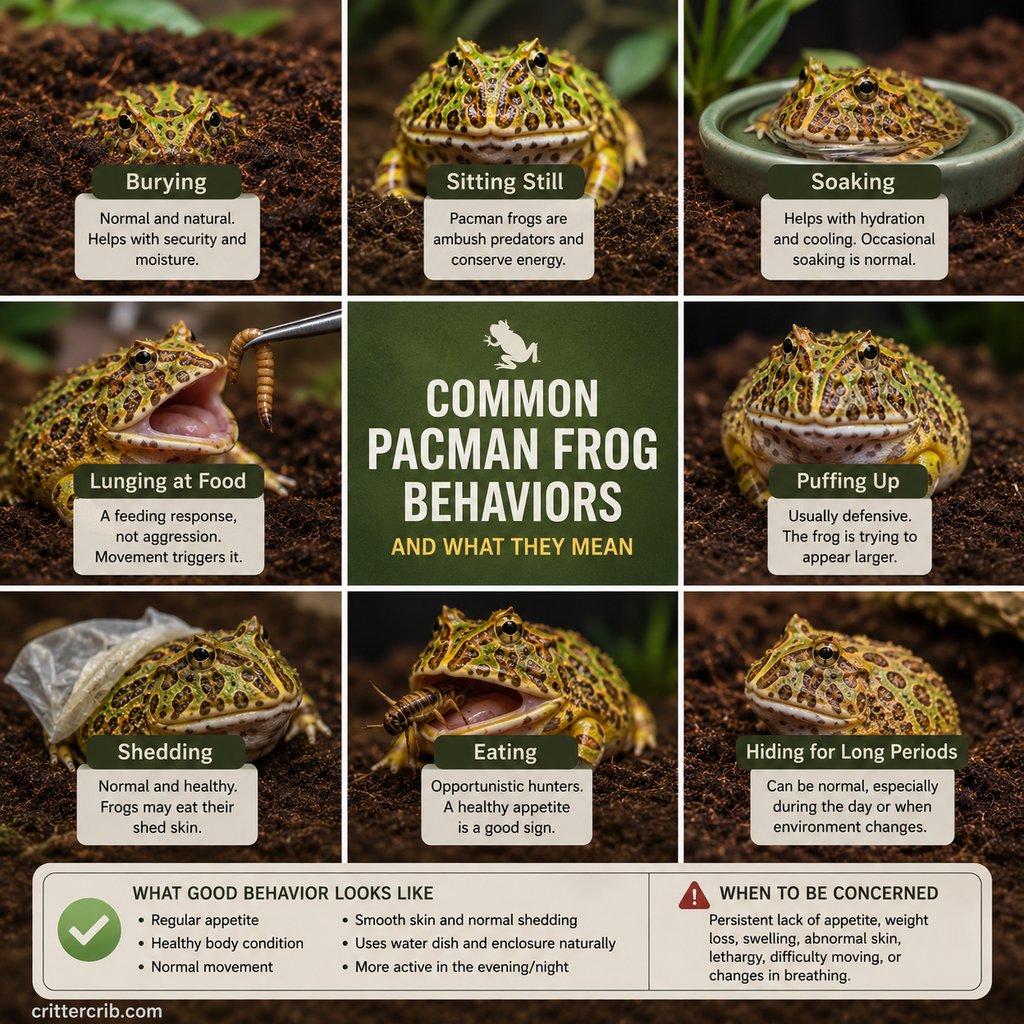
One behavior by itself rarely tells the whole story.
A frog occasionally soaking, burrowing, refusing one meal, or moving around the enclosure may be perfectly healthy.
Patterns are more informative.
Possible signs that something deserves attention include:
- Constant attempts to escape
- Persistent food refusal
- Significant weight loss
- Unusual weakness
- Constant soaking combined with dry enclosure conditions
- Repeated defensive behavior
- Abnormal breathing
- Significant changes in skin appearance
- Difficulty moving normally
Whenever behavior suddenly changes, check husbandry first.
Temperature, humidity, substrate, water, cleanliness, and feeding practices can influence how a Pacman frog behaves.
How to Tell If Your Pacman Frog Is Comfortable
You don’t need your frog to be constantly active to know that it’s doing well.
Normal behavior may actually look rather uneventful.
A comfortable Pacman frog will often:
- Burrow naturally
- Remain still for extended periods
- Respond readily to appropriate food
- Occasionally reposition itself
- Soak periodically
- Shed normally
- Maintain healthy body condition
- Become somewhat more active during lower-light periods
The key is learning what’s normal for your particular frog.
Once you’ve observed the same animal for several months, sudden changes become much easier to recognize.
Common Pacman Frog Behaviors at a Glance
Here’s a quick way to interpret some of the behaviors owners commonly encounter.
Sitting Still
Usually normal. Pacman frogs are ambush predators and naturally spend long periods motionless.
Burrowing
Normal and expected. Burrowing provides security and helps the frog maintain comfortable conditions.
Hiding Completely
Often normal, particularly during the day.
Lunging at Feeding Tongs
Usually a feeding response rather than aggression.
Soaking
Normal occasionally. Constant soaking may justify checking enclosure humidity and temperature.
Puffing Up
Usually defensive behavior caused by feeling threatened.
Urinating When Handled
Can be a defensive response to stress.
Eating Shed Skin
Completely normal.
Closing the Eyes While Swallowing
Normal frog anatomy at work.
Calling or Croaking
Often normal, particularly in mature males.
Refusing One Meal
Usually not an immediate concern.
Persistent Food Refusal
Worth investigating, especially if accompanied by weight loss or other symptoms.
Staying Buried for Long Periods
Can be normal, but extended changes in activity should be considered alongside temperature, humidity, appetite, and body condition.
Frequently Asked Questions About Pacman Frog Behavior
Why Is My Pacman Frog Not Moving?
Pacman frogs naturally spend long periods sitting still. If your frog is eating normally, maintains healthy body condition, and has appropriate enclosure conditions, limited movement is generally expected.
Sudden lethargy combined with other symptoms is more concerning.
Why Does My Pacman Frog Stare at Me?
Your frog may simply be watching movement outside the enclosure.
It may also associate your presence with feeding, particularly if you normally approach the enclosure before offering food.
Why Does My Pacman Frog Keep Burying Itself?
Burrowing is a natural Pacman frog behavior. These frogs are ambush predators that spend much of their time partially concealed while waiting for prey.
Why Does My Pacman Frog Jump at Me?
The frog may be reacting defensively or responding to movement as though it’s potential food.
Avoid placing your fingers directly in front of a hungry Pacman frog.
Why Is My Pacman Frog More Active at Night?
Pacman frogs tend to become more active during lower-light periods. You may notice your frog repositioning, soaking, or responding more readily to prey during the evening.
Is My Pacman Frog Sleeping or Sick?
A resting Pacman frog can look remarkably inactive.
Consider the entire picture rather than activity alone. Appetite, body condition, skin appearance, posture, breathing, and enclosure conditions can help determine whether the frog is simply resting or potentially unwell.
How Do I Know If My Pacman Frog Is Happy?
It’s difficult to measure “happiness” in a frog the way we might with a dog or cat.
Instead, look for indicators of good welfare: normal feeding, appropriate body condition, natural burrowing, normal shedding, typical movement, and the absence of persistent stress behaviors or physical problems.
Final Thoughts on Pacman Frog Behavior
Pacman frogs make much more sense once you stop expecting them to behave like active, interactive pets.
They’re ambush predators.
Sitting still, burying themselves, hiding for long periods, suddenly lunging at prey, soaking occasionally, shedding their skin, and becoming more active after dark are all behaviors that can be completely normal.
The most useful thing you can do is learn your individual frog’s routine.
Instead of worrying about every strange movement, watch for changes in patterns. A frog that normally eats enthusiastically and suddenly refuses food for an extended period deserves more attention than a frog that simply spends another afternoon buried in its favorite corner.
Good husbandry also makes behavior easier to interpret. Maintain appropriate temperature and humidity, provide suitable substrate and clean water, feed a balanced diet, minimize unnecessary handling, and give your frog plenty of opportunities to behave naturally.
Once you understand those basics, you’ll probably discover that your Pacman frog isn’t doing “nothing” after all.
It’s simply behaving like a Pacman frog.