

Aquatic snails aren’t always the first animals people think about when choosing aquarium pets, but they’re surprisingly interesting once you start watching them. They explore plants, climb the glass, search constantly for food, and occasionally appear in places that make you wonder how a snail got there so quickly.
If you’re thinking about keeping one, you may be wondering how long aquatic snails actually live.
Most commonly kept freshwater aquarium snails live around 1 to 3 years, although lifespan varies considerably by species. Some may live for only about a year, while certain larger species can survive several years with good care.
Water quality, temperature, diet, calcium availability, genetics, tank mates, and even how old the snail was when you purchased it can all influence how long it lives.
Here’s what to expect from popular aquarium snails and how you can give yours the best chance at a long, healthy life.
What Is the Average Lifespan of an Aquatic Snail?
There isn’t one universal aquatic snail lifespan because aquariums contain many different species.
For common freshwater snails, approximately 1 to 3 years is a useful general range.
Some species naturally have shorter lives. Others may live considerably longer under favorable conditions.
The snail’s lifespan also shouldn’t be confused with how long you’ll personally own it.
A snail purchased from an aquarium store may already be mature. Unless you know when it hatched, you usually won’t know its exact age.
Aquatic Snail Lifespan by Species
Knowing which snail you own is important when estimating lifespan.
Here’s a general comparison of several popular freshwater aquarium snails.
| Aquatic Snail | Approximate Lifespan |
|---|---|
| Nerite snail | 1–3 years |
| Mystery snail | 1–2 years |
| Ramshorn snail | 1–2 years |
| Malaysian trumpet snail | 1–2+ years |
| Bladder snail | Around 1 year |
| Rabbit snail | 2–4+ years |
These are general estimates rather than guarantees.
Individual snails may live shorter or longer lives depending on genetics and aquarium conditions.
How Long Do Nerite Snails Live?
Nerite snails commonly live around 1 to 3 years in captivity.
They’re popular aquarium inhabitants because they’re active grazers and can consume several types of algae.
Nerites also have an interesting reproductive advantage for freshwater aquariums: although females may lay eggs, the young of many commonly kept nerite species require brackish or marine conditions to develop successfully.
That means they’re unlikely to create a rapidly expanding snail population in a typical freshwater tank.
Good water quality, adequate food, stable parameters, and sufficient minerals for shell health can all contribute to their long-term well-being.
How Long Do Mystery Snails Live?
Mystery snails generally live around 1 to 2 years.
Their lifespan may seem relatively short, but they’re active and entertaining aquarium inhabitants.
Mystery snails can become fairly large compared with many other freshwater snails. You’ll often see them climbing the aquarium glass, exploring plants, or extending their siphon toward the surface.
Because they grow relatively quickly, proper nutrition and shell development are particularly important.
Make sure they have access to appropriate foods and enough calcium and other minerals to maintain healthy shell growth.
How Long Do Ramshorn Snails Live?
Ramshorn snails typically live around 1 to 2 years.
They’re smaller than mystery snails and reproduce much more readily in freshwater aquariums.
In fact, many aquarists don’t intentionally purchase them at all.
Ramshorn snails can arrive as hitchhikers on live plants, and a few individuals can eventually become a noticeable population if plenty of food is available.
Despite sometimes being labeled “pest snails,” they’re still living aquarium animals that contribute to the ecosystem by consuming algae, decaying plant matter, and leftover food.
How Long Do Malaysian Trumpet Snails Live?
Malaysian trumpet snails may live approximately 1 to 2 years or longer depending on conditions.
They’re famous for spending much of their time burrowing through substrate.
At night, you may suddenly discover far more snails than you realized were living in the aquarium.
Their burrowing behavior can help disturb the upper layers of substrate, and they readily consume organic material.
They can also reproduce quickly when excess food is available.
A population explosion often says more about how much food is entering the aquarium than it does about the snails themselves.
How Long Do Bladder Snails Live?
Bladder snails generally have relatively short lifespans, often around a year.
Like ramshorn snails, they’re common hitchhikers on aquarium plants.
They reproduce readily and can establish populations quickly.
Because multiple generations may be present simultaneously, it can be difficult to notice the lifespan of any individual snail.
You may simply see the colony continue even as individual animals come and go.
How Long Do Rabbit Snails Live?
Rabbit snails are among the longer-lived freshwater aquarium snails.
Depending on species and conditions, they may live approximately 2 to 4 years or potentially longer.
They’re larger, slower-reproducing snails with distinctive elongated shells.
Because they’re relatively long-lived compared with many smaller aquarium snails, keeping one is more of a long-term commitment than adding a few small hitchhiker species.
What Factors Affect an Aquatic Snail’s Lifespan?
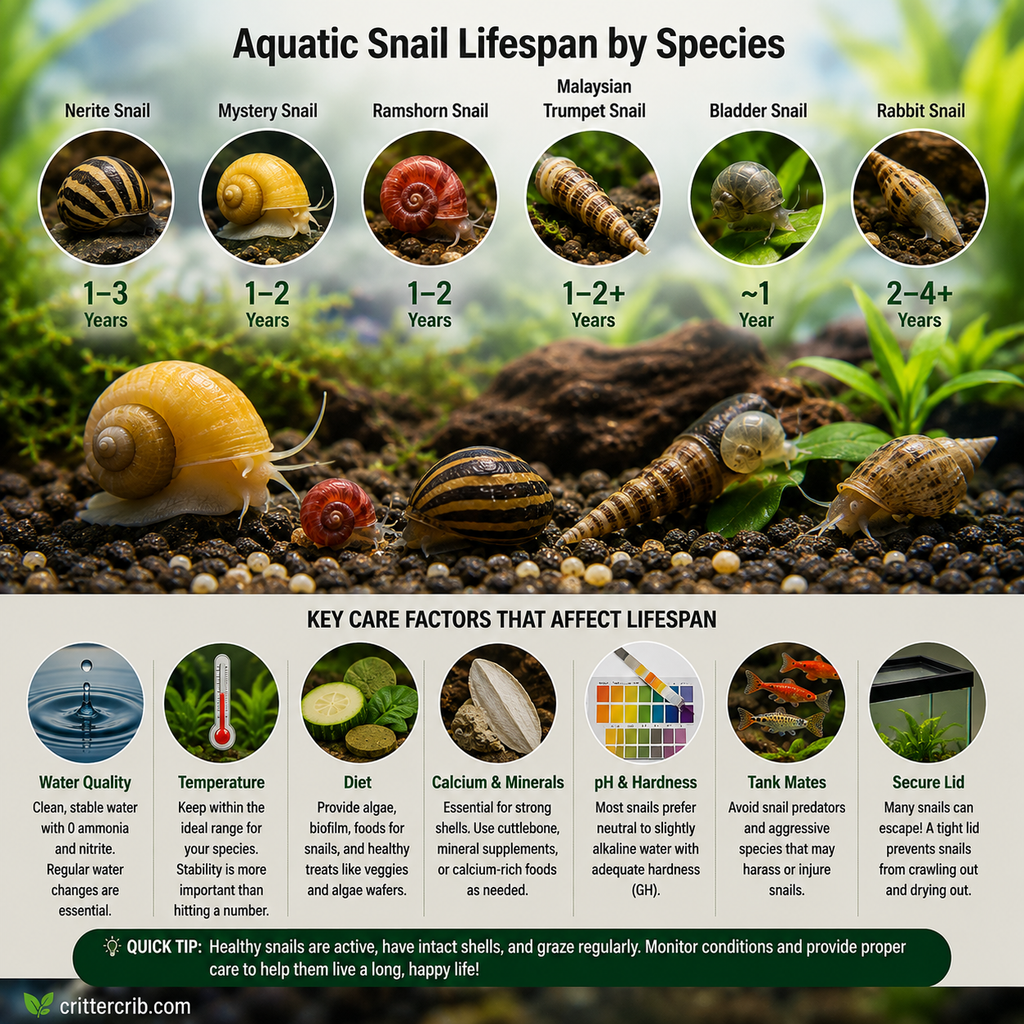
Species sets the general biological range, but aquarium conditions can have a major influence on health.
Several factors deserve particular attention.
Water Quality
Good water quality is one of the foundations of snail care.
Aquatic snails may be hardy, but they still live in constant contact with the surrounding water.
Poor conditions can expose them to harmful levels of ammonia, nitrite, or other pollutants.
In an established freshwater aquarium:
- Ammonia should generally remain at 0 ppm
- Nitrite should generally remain at 0 ppm
- Nitrate should be controlled through appropriate maintenance
- Temperature should remain within the species’ preferred range
- Sudden parameter swings should be minimized
Test your aquarium water rather than relying on appearance.
Crystal-clear water can still contain harmful compounds.
Temperature
Temperature can affect a snail’s metabolism.
Warmer conditions generally increase metabolic activity, while cooler conditions can slow it down.
That doesn’t mean deliberately keeping a snail cold will automatically make it live longer.
The goal should be maintaining an appropriate, stable temperature for the species.
When snails live in a community aquarium, make sure the chosen temperature falls within the healthy range for every animal in the tank.
Diet
Snails may graze throughout the aquarium, but that doesn’t mean they’ll always find enough nutrition.
Depending on the species, aquatic snails may eat:
- Algae
- Biofilm
- Decaying plant material
- Leftover fish food
- Commercial snail or invertebrate foods
- Algae wafers
- Appropriate vegetables
- Other organic material
If your aquarium is extremely clean and contains very little natural food, supplemental feeding may be necessary.
Don’t assume visible algae automatically provides a complete diet.
Calcium and Minerals
Shell health is one of the most important parts of aquatic snail care.
A snail’s shell requires minerals, particularly calcium, for proper growth and maintenance.
Insufficient mineral availability or unsuitable water chemistry may contribute to:
- Thin shells
- Pitting
- Cracks
- Erosion
- Weak new growth
The appropriate solution depends on your water chemistry and snail species.
Some aquarists use calcium-rich foods, mineral supplements, cuttlebone prepared for aquarium use, or other sources to support shell development.
Test your water before making major adjustments.
Adding minerals blindly can change hardness or other parameters unnecessarily.
pH and Water Hardness
Acidic water can be difficult for many shelled aquatic animals.
Very low pH may contribute to shell erosion over time.
Many commonly kept freshwater snails do better in neutral to moderately alkaline conditions with enough dissolved minerals to support their shells.
However, exact requirements vary by species.
Before purchasing a snail, compare its needs with the water parameters already maintained in your aquarium.
Stable, appropriate conditions are better than constantly adjusting the water in pursuit of a supposedly perfect number.
Genetics
Not every factor affecting lifespan can be controlled.
Two snails raised in nearly identical conditions may still live different lengths of time.
Genetics can influence:
- Longevity
- Growth
- Shell development
- Disease resistance
- Overall vigor
The snail’s health before you purchased it also matters.
Choosing an active snail with an intact shell from a reputable source gives you a better starting point.
Can Tank Mates Affect a Snail’s Lifespan?
Absolutely.
Some fish view snails as food.
Others may repeatedly nip at antennae or harass a snail whenever it comes out of its shell.
Potentially problematic tank mates can include certain:
- Loaches
- Pufferfish
- Cichlids
- Large predatory fish
- Other snail-eating species
Compatibility depends on the exact species involved.
Don’t purchase a snail simply because it’s labeled a “cleanup crew” animal and assume every community fish will ignore it.
Research both animals before combining them.
Do Aquatic Snails Need Their Own Food?
Sometimes.
A mature aquarium may provide algae, biofilm, leftover food, and decaying plant matter for grazing.
That can be enough to supply part of a snail’s diet.
But a heavily cleaned tank with very little algae may not provide sufficient nutrition, especially for larger snails.
Appropriate supplemental foods can include:
- Algae wafers
- Sinking invertebrate foods
- Blanched zucchini
- Green beans
- Spinach
- Other species-appropriate vegetables
Remove substantial leftovers before they decompose and affect water quality.
Feeding your snail shouldn’t create a water-quality problem that ultimately harms it.
Does a Clean Aquarium Help Snails Live Longer?
Yes—but “clean” needs some context.
Good water quality is essential.
A completely sterile aquarium isn’t.
Snails naturally graze on algae, biofilm, microorganisms, and decaying organic material. Scrubbing every surface spotless can remove potential food sources.
Instead, focus on maintaining healthy water while allowing some natural biological activity.
That means:
- Regular partial water changes
- Appropriate filtration
- Controlled feeding
- Water testing
- Removing excessive waste
- Leaving some safe grazing surfaces available
An aquarium can be healthy without looking freshly scrubbed every day.
How Does Overfeeding Affect Aquatic Snails?
Overfeeding can create two different problems.
First, uneaten food decomposes and may harm water quality.
Second, species that reproduce readily may experience dramatic population growth when food is abundant.
If your aquarium suddenly contains dozens or hundreds of ramshorn, bladder, or Malaysian trumpet snails, look at how much food is entering the tank.
Reducing excess feeding often helps control the population naturally.
Don’t starve animals intentionally, but avoid providing more food than the aquarium inhabitants can reasonably consume.
How Can You Help Aquatic Snails Live Longer?
There’s no guaranteed way to make a snail reach a particular age.
You can, however, reduce many preventable problems.
1. Identify Your Snail
Know what species you’re keeping.
A nerite snail, mystery snail, and rabbit snail don’t necessarily have identical care requirements.
2. Maintain Stable Water Quality
Use an established, cycled aquarium whenever possible.
Test the water regularly and perform appropriate partial water changes.
Avoid sudden changes in temperature or chemistry.
3. Provide Appropriate Nutrition
Make sure your snail has enough food.
Natural algae and biofilm can contribute to the diet, but supplemental feeding may be necessary.
4. Support Healthy Shell Growth
Provide appropriate calcium and minerals based on your snail’s needs and water chemistry.
Watch for changes in shell condition.
5. Choose Compatible Tank Mates
Avoid fish and other animals likely to eat, injure, or repeatedly harass your snail.
6. Cover the Aquarium
Some aquatic snails are surprisingly talented escape artists.
Mystery and nerite snails, in particular, may travel above the waterline.
A secure aquarium lid can prevent an adventurous snail from leaving the tank and drying out.
Check openings around filters, heaters, and cables.
7. Avoid Copper-Based Treatments Unless They’re Known to Be Safe
Aquatic invertebrates can be sensitive to copper and certain other medications.
Always check whether a treatment is safe for snails before adding it to the aquarium.
If medication is required for fish, follow reliable veterinary or manufacturer guidance.
Signs of a Healthy Aquatic Snail
Snails aren’t constantly active, so sitting still doesn’t automatically indicate a problem.
Healthy behavior may include:
- Moving around the aquarium
- Grazing on surfaces
- Climbing glass and decorations
- Responding when disturbed
- Extending antennae normally
- Regular feeding
Shell condition is also important.
Look for a shell that appears structurally sound, particularly around newer growth.
Small imperfections aren’t always an emergency, especially on older portions of the shell, but rapid deterioration deserves attention.
Signs Your Aquatic Snail May Be in Trouble
Watch for significant changes such as:
- Remaining completely inactive for unusually long periods
- Repeatedly falling and being unable to right itself
- Severe shell erosion
- Cracked or badly damaged shell
- Unusual swelling
- Strong foul odor
- Body hanging unusually far outside the shell without responding
- Sudden changes affecting multiple snails
Start by checking water quality and temperature.
If several aquarium inhabitants begin behaving abnormally at the same time, an environmental problem becomes particularly important to investigate.
Is My Aquatic Snail Dead or Sleeping?
This is one of the most common questions new snail owners ask.
Snails can remain still for surprisingly long periods.
A snail that hasn’t moved for several hours isn’t necessarily dead.
Before assuming the worst:
- Observe it for movement.
- Check whether the trapdoor, or operculum in species that have one, remains closed.
- Gently move the snail to a visible location if necessary.
- Check the aquarium conditions.
- Give it some time.
A dead snail typically develops a very strong, unpleasant odor as decomposition begins.
If you’re uncertain, remove the snail temporarily into a container of appropriate aquarium water for closer observation rather than leaving a potentially dead animal to decompose in the tank.
Do Aquatic Snails Slow Down With Age?
Older snails may become less active, although activity also varies with temperature, feeding, time of day, and species.
Aging may be accompanied by:
- Reduced activity
- More frequent resting
- Slower movement
- Increased shell wear
Don’t automatically assume inactivity means old age.
Poor water quality, inappropriate temperature, insufficient food, injury, or illness can produce similar behavior.
Check environmental conditions whenever you notice a major change.
Frequently Asked Questions About Aquatic Snail Lifespan
How long do aquarium snails live?
Many commonly kept freshwater aquarium snails live approximately 1 to 3 years, although lifespan varies substantially by species. Some larger species may live several years.
How long do mystery snails live?
Mystery snails commonly live around 1 to 2 years under suitable aquarium conditions.
How long do nerite snails live?
Nerite snails often live approximately 1 to 3 years, although individual lifespan varies.
What aquarium snail lives the longest?
Some larger snails, including rabbit snails, can live several years and may outlive many smaller aquarium snail species.
Can aquarium snails die from poor water quality?
Yes. Ammonia, nitrite, unsuitable pH, extreme temperatures, sudden parameter changes, and other environmental problems can negatively affect aquatic snails.
Do snails need calcium?
Calcium and other minerals are important for shell development and maintenance. The amount and method of supplementation depend on the snail species, diet, and existing water chemistry.
Can aquarium snails crawl out of the tank?
Yes. Some aquatic snails may climb above the waterline and potentially escape through openings in the aquarium. A secure lid can help prevent accidental escapes.
Can aquatic snails live with fish?
Many can, provided the fish have compatible environmental requirements and aren’t likely to eat or harass the snails.
Final Thoughts
So, how long do aquatic snails live?
For many common freshwater aquarium snails, somewhere around 1 to 3 years is a reasonable general expectation. Smaller species may have shorter lifespans, while larger snails such as rabbit snails can potentially live several years.
Species is only part of the equation.
Stable water quality, appropriate temperature, enough food, proper mineral availability, healthy shell development, and compatible tank mates all contribute to your snail’s long-term health.
And don’t underestimate them because they’re slow.
Give an aquatic snail a healthy aquarium with plenty of surfaces to explore, and you’ll quickly discover that there’s almost always something going on—even if it takes the snail a little longer to get there.