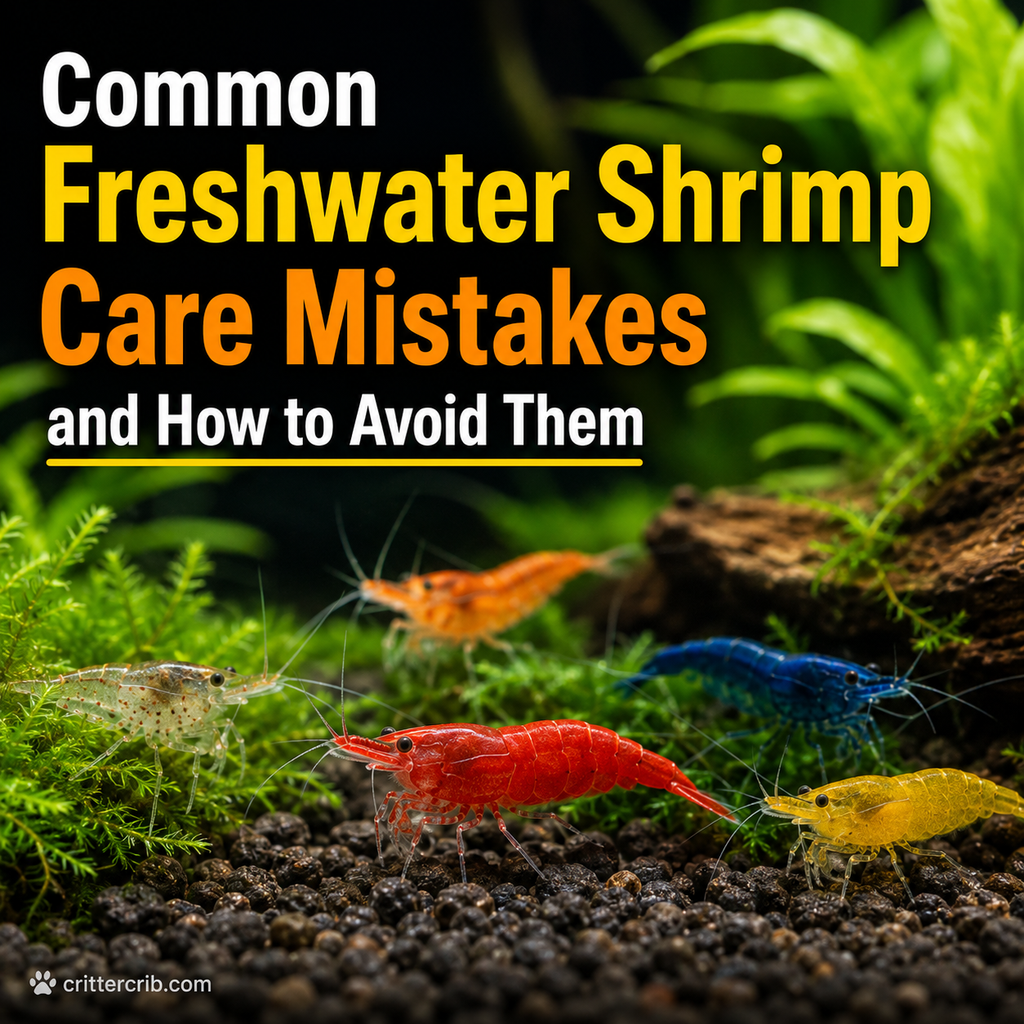
Freshwater shrimp can look like incredibly easy aquarium pets. They’re tiny, don’t need huge amounts of food, and spend much of the day quietly grazing around the tank.
Then a new shrimp keeper wakes up one morning and finds a shrimp dead for seemingly no reason.
Unfortunately, shrimp can be less forgiving of sudden environmental changes than many common aquarium fish. A tank that seems perfectly fine at first glance may still have problems with ammonia, unstable water parameters, inappropriate minerals, overfeeding, or contaminants.
The good news is that many freshwater shrimp care mistakes are preventable.
Whether you’re keeping cherry shrimp, Amano shrimp, blue dream shrimp, crystal shrimp, or another freshwater species, learning what commonly goes wrong can save you a lot of frustration—and give your shrimp a much better environment.
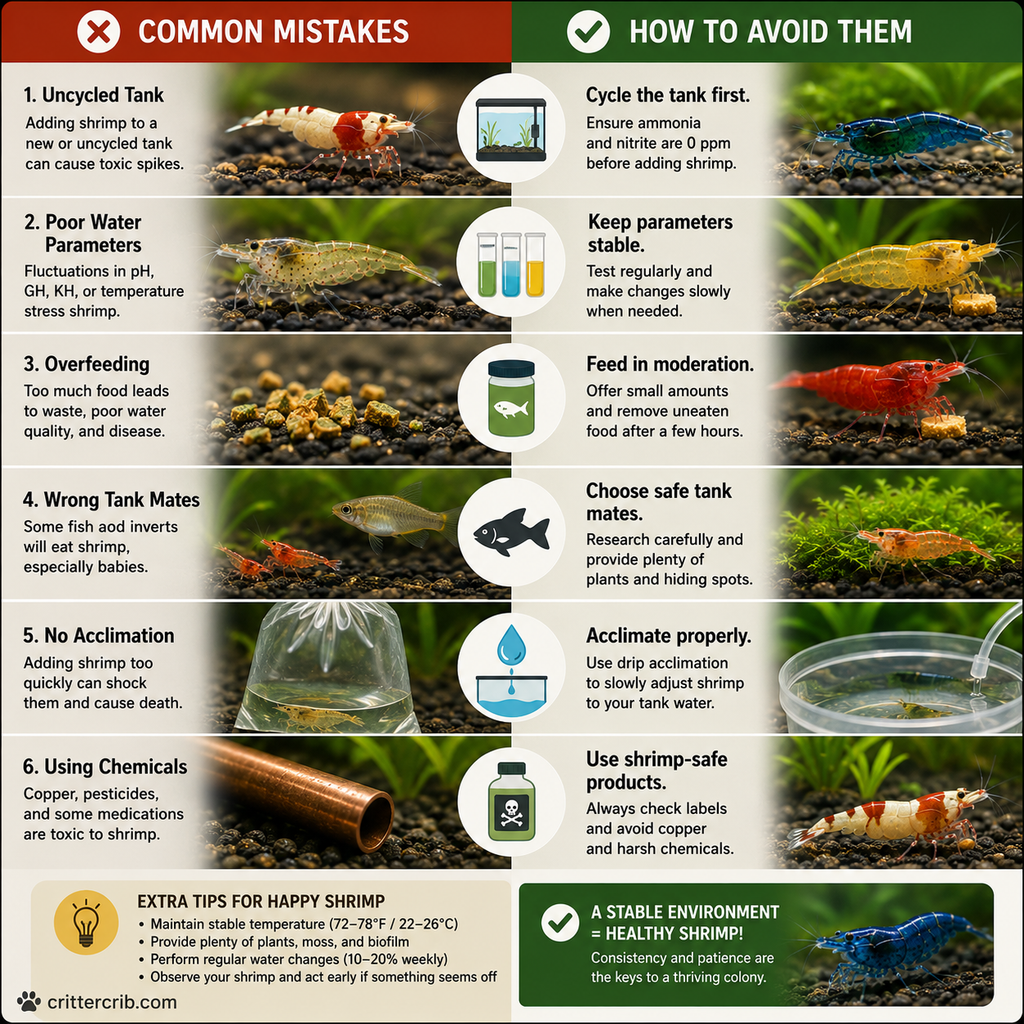
1. Adding Shrimp to an Uncycled Aquarium
One of the biggest mistakes beginners make is adding shrimp to a brand-new aquarium.
Clean-looking water doesn’t mean an aquarium is biologically ready for animals.
A functioning aquarium needs beneficial bacteria that process waste through the nitrogen cycle. Ammonia from waste is converted into nitrite and eventually nitrate.
Both ammonia and nitrite are toxic.
In a properly cycled aquarium, you generally want:
- Ammonia: 0 ppm
- Nitrite: 0 ppm
- Nitrate: kept at an appropriate low level through maintenance and plant growth
Shrimp can be particularly vulnerable to poor water quality.
How to Avoid It
Cycle the aquarium before adding shrimp and use a reliable water test kit to verify that the biological filtration is functioning.
Don’t rely solely on how long the tank has been running.
A tank that’s been filled with water for several weeks isn’t necessarily cycled if the biological process hasn’t actually been established.
2. Adding Shrimp to a Tank That’s Too New
Cycling and maturity aren’t quite the same thing.
A newly cycled aquarium may be capable of processing ammonia, but it can still be relatively sterile compared with an established shrimp tank.
Freshwater shrimp spend much of their day grazing on surfaces. They pick through biofilm, algae, microorganisms, and other edible material growing throughout the aquarium.
An older tank usually provides more natural grazing opportunities.
How to Avoid It
If possible, give a newly cycled aquarium some additional time to mature before stocking it heavily with shrimp.
Live plants, wood, rocks, and other surfaces can provide areas where biofilm develops.
This doesn’t mean the tank needs to look dirty. A mature aquarium can be clean while still supporting plenty of microscopic life.
3. Choosing the Wrong Shrimp for Your Water
Not all freshwater shrimp require the same conditions.
This is especially important when comparing common Neocaridina shrimp with many Caridina species.
Neocaridina varieties, including popular cherry shrimp, tend to tolerate a broader range of conditions when those conditions are stable.
Some Caridina shrimp have more specific requirements and are often kept in softer, more acidic water.
Buying shrimp first and researching their needs later can create unnecessary problems.
How to Avoid It
Before purchasing shrimp, research the exact species or variety and compare its requirements with your water.
Consider:
- Temperature
- pH
- GH
- KH
- TDS, when relevant
- Aquarium size
- Tank mates
Sometimes the easiest shrimp to keep is the species that already matches your available water rather than one that requires you to constantly alter it.
4. Chasing the “Perfect” pH
Aquarium keepers love numbers.
It’s easy to see an online care sheet recommending a particular pH and immediately start adding products to force your aquarium toward that number.
That can cause more harm than good.
Shrimp generally benefit from stable conditions. Constantly raising and lowering pH can expose them to repeated environmental stress.
How to Avoid It
Determine whether your water falls within an appropriate range for the shrimp you’re keeping.
If it does, stability may be more valuable than chasing an exact number.
If your water is genuinely unsuitable for a particular species, use an appropriate long-term strategy rather than repeatedly adding quick-fix chemicals.
For specialized Caridina setups, this may involve remineralized reverse-osmosis water and an active substrate.
5. Ignoring GH and KH
Many beginners test pH but overlook water hardness.
For shrimp, that can be a mistake.
General hardness, or GH, reflects dissolved minerals such as calcium and magnesium that are important for shrimp physiology and molting.
Carbonate hardness, or KH, relates to the water’s buffering capacity and can influence pH stability.
The appropriate ranges vary by shrimp species.
How to Avoid It
Know both your source water and your shrimp’s requirements.
Testing GH and KH can be particularly helpful when:
- Shrimp experience repeated molting problems
- You’re using reverse-osmosis water
- Your tap water is extremely soft or hard
- You’re keeping sensitive Caridina shrimp
- You’re trying to diagnose unexplained losses
Don’t add minerals blindly. Test first and make adjustments based on the species you’re keeping.
6. Making Sudden Changes to Water Parameters
A shrimp may tolerate a particular temperature or pH but struggle when that parameter changes rapidly.
Sudden changes can occur during:
- Large water changes
- Moving shrimp between tanks
- Acclimation
- Switching water sources
- Adding untreated water
- Rapid temperature shifts
- Altering mineral content
The difference between old and new water can sometimes matter as much as the individual numbers.
How to Avoid It
Keep maintenance consistent.
When performing water changes, try to make the replacement water reasonably compatible with the aquarium in temperature and relevant chemistry.
If you’re intentionally changing water parameters, do so gradually when possible.
Shrimp keeping tends to reward consistency.
7. Acclimating New Shrimp Too Quickly
Shrimp purchased from a store or breeder may have been living in water that’s quite different from yours.
Simply opening the bag and immediately releasing them into the aquarium can expose them to a rapid change in temperature and water chemistry.
How to Avoid It
Gradual acclimation is commonly used for freshwater shrimp.
Drip acclimation allows aquarium water to slowly mix with the water the shrimp arrived in.
A basic approach is to:
- Place the shrimp and their transport water in a clean container.
- Use airline tubing to slowly siphon aquarium water into the container.
- Control the flow so the water is added gradually.
- Allow the shrimp time to adjust.
- Transfer the shrimp into the aquarium without unnecessarily adding store water.
Acclimation time depends on how different the water conditions are.
Avoid leaving shrimp in shipping water unnecessarily long once the bag has been opened, particularly after lengthy shipping.
8. Performing Huge Water Changes Without a Reason
Water changes are good.
Unnecessarily dramatic water changes can be a problem when the replacement water differs substantially from the aquarium.
Shrimp may respond poorly to abrupt changes in:
- Temperature
- pH
- GH
- KH
- TDS
This doesn’t mean you should avoid water changes.
Neglecting water changes can create its own problems.
How to Avoid It
Perform regular, appropriately sized water changes based on your aquarium’s conditions.
Test nitrate and monitor the tank rather than following extreme rules such as “never change shrimp water.”
Consistency is the goal.
Emergency situations are different. If toxic ammonia, nitrite, or another contaminant is present, a larger water change may be necessary despite the potential stress.
9. Overfeeding
Overfeeding is one of the easiest ways to destabilize a shrimp aquarium.
Shrimp are tiny.
A portion of food that looks insignificant to you may actually be far more than a colony needs.
Uneaten food decomposes and can contribute to:
- Ammonia
- Excess nitrate
- Bacterial growth
- Cloudy water
- Pest populations
- Poor overall water quality
Shrimp also graze naturally on biofilm and algae throughout the aquarium.
How to Avoid It
Feed conservatively.
Start with a small amount and watch how quickly the shrimp consume it.
Remove significant leftovers rather than letting them sit in the aquarium indefinitely.
As your colony grows, you can adjust the amount accordingly.
10. Assuming Shrimp Can Live on Algae Alone
The opposite feeding mistake is assuming shrimp never need supplemental food.
It’s true that shrimp graze on algae, biofilm, decaying plant material, and microorganisms.
But the amount available varies dramatically between aquariums.
A mature planted tank may provide substantial natural food. A new, spotless aquarium may provide very little.
How to Avoid It
Provide a varied, species-appropriate diet when necessary.
Depending on the shrimp you’re keeping, this might include:
- Quality shrimp food
- Algae-based foods
- Biofilm-based foods
- Appropriate vegetables
- Protein-containing foods in moderation
- Natural grazing throughout the aquarium
Observe the colony rather than following a rigid feeding schedule.
11. Keeping the Aquarium Too Clean
A sparkling aquarium isn’t necessarily the ideal shrimp aquarium.
If you scrub every surface, remove every trace of algae, vacuum every inch of substrate, and constantly replace or sterilize materials, you may remove many of the surfaces shrimp naturally graze on.
Biofilm is valuable food.
How to Avoid It
Keep the aquarium clean without making it sterile.
You can clean the viewing glass while allowing some algae and biofilm to remain on:
- Rocks
- Driftwood
- Plant surfaces
- Hardscape
- Less-visible areas of the aquarium
The goal isn’t neglect.
It’s balance.
12. Using Copper-Containing Products Carelessly
Shrimp are invertebrates, and copper can be toxic to them at sufficient concentrations.
This becomes particularly important when using fish medications or other aquarium treatments.
A product that’s safe for fish may not necessarily be safe for shrimp.
How to Avoid It
Before adding any medication, algae treatment, fertilizer, or other chemical to a shrimp aquarium, read the label carefully.
Look specifically for warnings about:
- Shrimp
- Snails
- Invertebrates
- Crustaceans
Don’t assume that the presence of trace copper in every product automatically makes it dangerous. Concentration and formulation matter.
The important rule is to use aquarium products exactly as directed and verify that they’re considered appropriate for shrimp.
13. Using Household Chemicals Near the Aquarium
Shrimp can be sensitive to contaminants that accidentally enter the water.
Potential sources include:
- Cleaning sprays
- Soap
- Hand lotion
- Pesticides
- Air fresheners
- Paint
- Aerosols
- Residue on aquarium tools
Something as simple as reaching into the tank with soap residue on your hands can introduce unwanted substances.
How to Avoid It
Wash your hands thoroughly with plain water before working in the aquarium and rinse away residues.
Avoid spraying household chemicals near an open tank.
Keep aquarium buckets, siphons, nets, and other equipment dedicated exclusively to aquarium use.
Never clean aquarium equipment with household soap.
14. Introducing Plants Without Considering Pesticides
Live plants are excellent for shrimp tanks, but newly purchased plants can sometimes carry pesticide residues or other treatments.
Shrimp may be more sensitive to these substances than fish.
How to Avoid It
Buy plants from shrimp-safe sources whenever possible.
Ask whether plants have been treated with pesticides or chemicals that could affect invertebrates.
Depending on the source, appropriate quarantine and rinsing procedures may be worthwhile before adding new plants to an established shrimp colony.
Tissue-culture plants can also reduce the risk of introducing pests and some contaminants because they’re grown under sterile laboratory conditions.
15. Choosing Tank Mates That Eat Shrimp
A fish can be peaceful and still eat a shrimp.
Many fish naturally investigate and consume small animals that fit into their mouths.
Adult shrimp may survive around certain small fish while newborn shrimplets disappear almost immediately.
How to Avoid It
If your main goal is to establish a thriving breeding colony, a shrimp-only aquarium is often the safest option.
If you want a community tank, research every potential tank mate.
Dense plants and moss can provide additional cover for young shrimp, but hiding places don’t guarantee survival.
Remember the simple rule: if a fish can fit a baby shrimp in its mouth, there’s a chance it will try.
16. Not Protecting the Filter Intake
Baby shrimp are incredibly small.
A powerful filter intake can potentially pull shrimplets into the filtration system.
How to Avoid It
Sponge filters are popular in shrimp aquariums because they provide gentle filtration while offering additional grazing surfaces.
If you’re using a hang-on-back or canister filter, consider an appropriate pre-filter sponge over the intake.
This can:
- Protect baby shrimp
- Catch larger debris
- Provide additional biological filtration
- Create another biofilm-covered grazing surface
Clean the pre-filter periodically so it doesn’t become clogged.
17. Panicking When You Find a Shed Exoskeleton
The first time you see a ghostly shrimp-shaped shell sitting on the substrate, you might think one of your shrimp died.
It may simply be a molt.
Shrimp periodically shed their exoskeleton as they grow.
A healthy shed exoskeleton can look remarkably like a transparent shrimp.
How to Avoid It
Learn to distinguish between a molt and a dead shrimp.
Molts are generally:
- Clear or whitish
- Hollow
- Split where the shrimp exited
- Lightweight-looking
You usually don’t need to remove a molt immediately.
Shrimp may consume it, recycling some of the minerals it contains.
18. Removing Every Molt
Once you realize what a molt is, your instinct may still be to remove it because it looks like waste.
That’s usually unnecessary.
Shrimp often pick at and consume their old exoskeletons.
How to Avoid It
Unless there’s a specific reason to remove it, leave normal molts in the aquarium and allow the shrimp to graze on them.
A molt is a normal part of shrimp life.
A sudden increase in failed molts, deaths during molting, or other abnormalities is a different issue and may justify checking water parameters and mineral balance.
19. Assuming Every Death Is a Molting Problem
Molting gets blamed for almost everything in shrimp keeping.
A shrimp dies, so the conclusion becomes, “It must need more calcium.”
That’s risky.
Shrimp can die from:
- Ammonia
- Nitrite
- Rapid parameter changes
- Inappropriate temperature
- Contaminants
- Disease
- Poor acclimation
- Predation
- Age
- Improper mineral balance
- Other environmental problems
Adding calcium or mineral products without testing can make the situation worse.
How to Avoid It
When unexplained deaths occur, investigate systematically.
Check:
- Ammonia
- Nitrite
- Nitrate
- Temperature
- pH
- GH and KH
- Recent water changes
- New plants or decorations
- Medications or chemicals
- Tank-mate behavior
Look for patterns before changing the water chemistry.
20. Overstocking Too Quickly
Shrimp have a relatively small biological load compared with many fish, but an aquarium still has limits.
A breeding colony can grow substantially when conditions are good.
Adding a large number of shrimp to a newly established tank can also create more demand than the developing ecosystem is ready to support.
How to Avoid It
Start with a reasonable colony size and allow the aquarium to mature.
Monitor water quality as the population grows.
If you’re keeping Neocaridina and conditions are favorable, you may eventually have far more shrimp than you started with.
That’s usually a sign you’re doing something right—but it’s still worth keeping an eye on stocking levels.
21. Ignoring Temperature
Shrimp are sometimes kept without heaters, which can work well when room temperature remains within an appropriate range for the species.
The problem is assuming temperature doesn’t matter.
Aquariums near windows, exterior walls, heating vents, or air conditioners may experience larger fluctuations than expected.
How to Avoid It
Use an aquarium thermometer.
Even if you don’t use a heater, knowing the actual water temperature helps you understand what’s happening in the tank.
Research the appropriate temperature range for your shrimp species rather than applying one number to every freshwater shrimp.
22. Mixing Shrimp Without Understanding Genetics
This is less of a health mistake and more of a breeding mistake.
Different color varieties of Neocaridina can interbreed.
If you combine red, blue, yellow, orange, and other color lines, their offspring won’t necessarily remain a rainbow of vibrant colors.
Over generations, mixed breeding can produce more wild-type coloration.
How to Avoid It
If maintaining a particular color line matters to you, keep that variety separate from other compatible Neocaridina colors.
If you simply want a fun mixed colony and don’t care about maintaining color genetics, mixing them may not bother you.
Just know what to expect before you start.
What Does a Good Freshwater Shrimp Setup Look Like?
A shrimp aquarium doesn’t need to be complicated.
A simple setup can include:
- Fully cycled aquarium
- Stable water parameters
- Shrimp-safe filtration
- Sponge-covered intake
- Live plants
- Moss
- Driftwood or other hardscape
- Plenty of biofilm-covered surfaces
- Appropriate lighting
- Species-appropriate food
- Regular water testing
- Consistent maintenance
Shrimp tend to thrive when the aquarium is stable rather than constantly being adjusted.
What to Check When Shrimp Keep Dying
If shrimp deaths start occurring, resist the urge to add random treatments.
Start with the basics.
Step 1: Test the Water
Check ammonia, nitrite, nitrate, temperature, pH, GH, and KH as appropriate.
Step 2: Review Recent Changes
Ask yourself what changed during the previous several days.
Did you:
- Perform a large water change?
- Add new plants?
- Use fertilizer?
- Medicate fish?
- Add new animals?
- Change food?
- Clean the filter?
- Switch water sources?
- Spray anything near the tank?
The timing can provide valuable clues.
Step 3: Check for Contamination
Consider whether soap, cleaning products, pesticides, metals, or other chemicals could have entered the aquarium.
Step 4: Observe the Shrimp
Look for:
- Unusual swimming
- Lethargy
- Failed molts
- Discoloration
- Loss of appetite
- Repeated attempts to escape the water
- Unusual deaths following water changes
Step 5: Avoid Making Five Changes at Once
When you change multiple variables simultaneously, it becomes difficult to determine what actually caused the problem.
Correct obvious emergencies immediately, but otherwise make thoughtful changes based on evidence.
Frequently Asked Questions About Freshwater Shrimp Care
Are freshwater shrimp hard to keep?
Many freshwater shrimp, particularly Neocaridina varieties such as cherry shrimp, can be relatively easy to keep once the aquarium is mature and stable. Problems often occur when water conditions fluctuate or shrimp are added to an immature tank.
Why do my shrimp keep dying?
Possible causes include ammonia or nitrite, unstable water parameters, poor acclimation, contaminants, inappropriate GH or KH, unsuitable temperature, predation, or other health problems. Test the water and review recent changes before assuming one specific cause.
Do freshwater shrimp need a filter?
A filter is highly beneficial because it provides biological filtration and helps maintain water quality. Sponge filters are particularly popular for shrimp tanks because they’re gentle and safe for baby shrimp.
Do shrimp need a heater?
Not always. Whether a heater is necessary depends on the shrimp species and your room temperature. A thermometer is still useful for monitoring temperature and detecting fluctuations.
Do shrimp need calcium?
Shrimp require appropriate minerals for normal biological processes and molting, but that doesn’t mean every shrimp tank needs calcium supplements. Test your water hardness and consider the requirements of your particular species before adding minerals.
Can shrimp live in tap water?
Many freshwater shrimp can thrive in properly treated tap water when its parameters are appropriate for the species. Other shrimp, particularly some Caridina varieties, may require more specialized water preparation.
How often should you feed freshwater shrimp?
There’s no universal schedule because colony size, aquarium maturity, available biofilm, and food type all matter. Feed conservatively and adjust according to how quickly food is consumed and how much natural grazing material is available.
Should I remove shrimp molts?
Usually not. Shrimp often consume their shed exoskeletons, allowing some of the minerals to be recycled.
Final Thoughts
Most freshwater shrimp care mistakes come down to one thing: changing too much, too quickly.
Shrimp tend to do well in mature aquariums with clean water, stable parameters, appropriate minerals, plenty of grazing surfaces, and consistent maintenance.
They don’t need you to constantly adjust the pH, deep-clean every surface, add supplements, or chase every number mentioned on an aquarium forum.
Start with the right shrimp for your water. Cycle and mature the aquarium. Acclimate new shrimp carefully. Feed conservatively. Protect them from unsafe tank mates and filter intakes. Test before adjusting water chemistry.
And when something goes wrong, investigate before reaching for another bottle of aquarium chemicals.
A stable shrimp tank can eventually become surprisingly low-maintenance. Once the aquarium finds its balance, much of your job is simply keeping that balance intact—and enjoying a colony of shrimp busily grazing, exploring, and multiplying.