Freshwater shrimp don’t need an aquarium packed with expensive equipment, but they do need the right basics.
For beginners, the biggest challenge is often figuring out which supplies are genuinely important. Aquarium stores offer everything from specialized shrimp foods and mineral additives to elaborate filters, feeding dishes, breeding accessories, and water treatments. Some are useful. Others aren’t necessary for your first shrimp tank.
The essentials are much simpler: a properly sized aquarium, gentle filtration, stable temperature, conditioned water, a mature biological environment, appropriate food, plants or other cover, and reliable water-testing supplies.
Get those things right and you’ve already handled most of the important work.
This beginner checklist covers the essential supplies for freshwater shrimp, what each item does, and which extras you can consider once your aquarium is established.
Freshwater Shrimp Supplies at a Glance
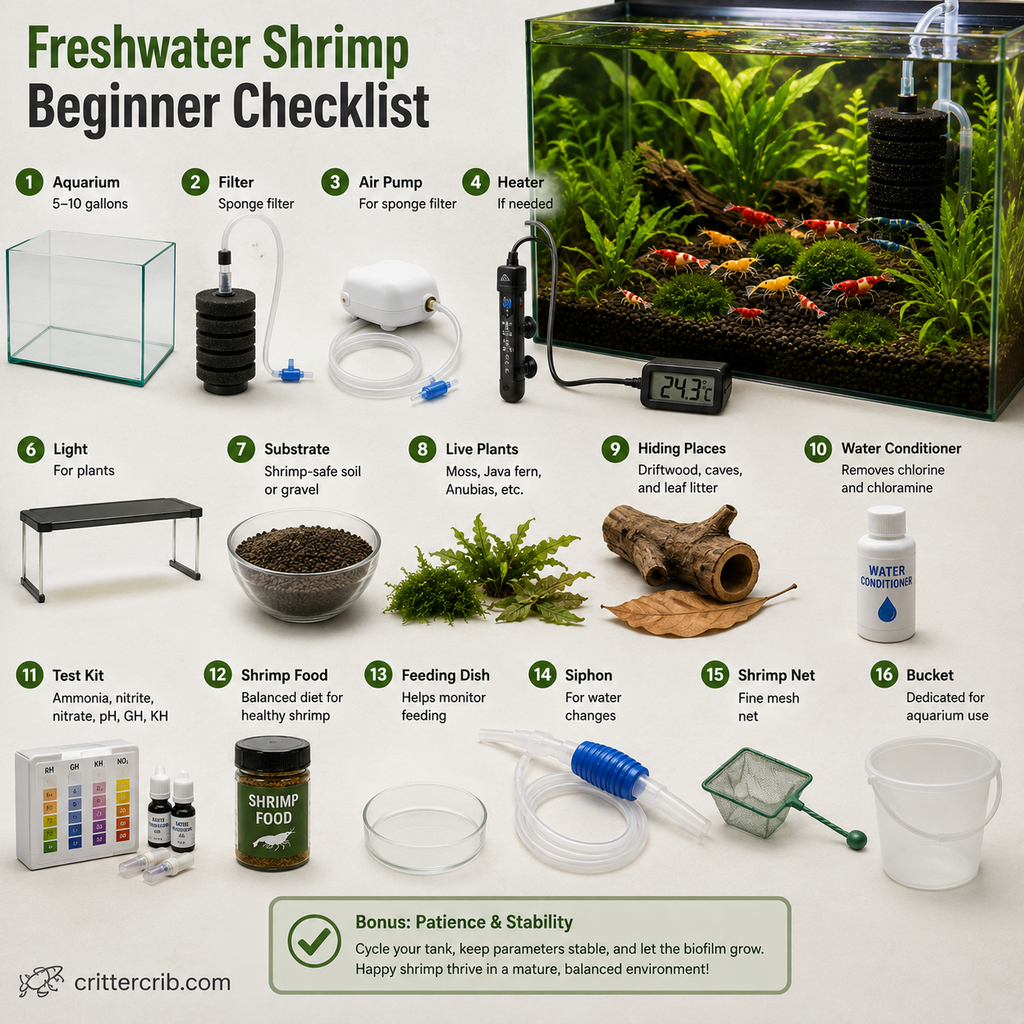
If you’re preparing your first freshwater shrimp aquarium, your basic shopping list will usually include:
- Aquarium
- Secure lid, when appropriate
- Gentle filter
- Heater if required
- Thermometer
- Aquarium light
- Substrate
- Live plants
- Hiding places
- Water conditioner
- Water-testing kit
- Shrimp food
- Aquarium siphon
- Dedicated aquarium bucket
- Algae scraper
- Shrimp-safe net
Depending on your water and the shrimp species you’re keeping, you may also need specialized tests or mineral-management supplies.
Don’t buy additives simply because they’re labeled for shrimp. Test your water and understand what your particular shrimp need first.
Start by Choosing the Shrimp Species
Before buying equipment, decide which freshwater shrimp you actually want to keep.
Different shrimp can have different water requirements.
Popular freshwater aquarium shrimp include:
- Neocaridina shrimp
- Caridina shrimp
- Amano shrimp
Colorful Neocaridina varieties, including cherry shrimp, are particularly popular with beginners because they’re adaptable when kept in appropriate, stable conditions.
Caridina varieties can require more specific water chemistry and may involve additional equipment or water preparation.
Amano shrimp grow larger and are commonly kept for their active grazing behavior, but their breeding requirements differ significantly from typical freshwater dwarf shrimp.
Knowing the species first prevents you from buying equipment based on generic “shrimp tank” advice that may not fit the animals you eventually choose.
1. A Proper Freshwater Shrimp Aquarium
Your aquarium is obviously the foundation of the setup.
Freshwater dwarf shrimp are tiny, which sometimes leads people to keep them in extremely small containers.
They can certainly live in smaller aquariums than many fish, but very small water volumes can be challenging for beginners.
Shrimp tend to appreciate stability.
In a tiny aquarium, temperature and water chemistry can change more quickly.
What Size Tank Is Best for Beginner Shrimp?
A 5-gallon aquarium can work for a small shrimp colony, but a 10-gallon tank is often an excellent beginner size.
Ten gallons provides:
- More stable water conditions
- More room for plants
- Greater surface area for grazing
- More flexibility as the colony grows
- Easier equipment placement
- More margin for beginner mistakes
A 10-gallon aquarium is still small enough to fit comfortably in many homes while offering considerably more water volume than a desktop nano tank.
Do Shrimp Tanks Need a Lid?
A lid can be useful for reducing evaporation and preventing animals from escaping.
Amano shrimp in particular can be surprisingly capable explorers.
A lid also reduces how quickly evaporation changes the water level.
However, make sure any lid still allows appropriate gas exchange and works safely with your aquarium equipment.
2. A Shrimp-Safe Filter
Filtration is one of the most important pieces of equipment in a shrimp aquarium.
The filter helps move water, captures debris, and provides valuable surface area for beneficial bacteria.
Those bacteria form part of the aquarium’s biological filtration.
The key with shrimp is choosing a filter that won’t turn into a shrimp trap.
Sponge Filters
Sponge filters are extremely popular in shrimp tanks.
They provide:
- Gentle water movement
- Biological filtration
- Mechanical filtration
- A large surface for biofilm
- Minimal risk of sucking in baby shrimp
Shrimp may spend considerable time grazing directly on the sponge.
Sponge filters usually require an air pump, airline tubing, and often a check valve.
Hang-on-Back Filters
A hang-on-back filter can also work.
However, the intake should be protected with a pre-filter sponge or another shrimp-safe intake guard.
Newborn shrimp are tiny enough to be pulled into an unprotected filter intake.
Internal Filters
Some internal filters can work as well, provided the flow isn’t excessive and all intake openings are safe for shrimp.
Whatever filter you choose, prioritize gentle circulation and shrimp safety over raw power.
3. An Air Pump for a Sponge Filter
If you choose a sponge filter, you’ll need an air pump to operate it.
The basic setup usually consists of:
- Air pump
- Airline tubing
- Sponge filter
- Check valve
- Optional airflow-control valve
A check valve is a small but useful piece of equipment.
It helps prevent aquarium water from siphoning backward through the airline toward the pump if power is lost or the pump stops.
Install it in the correct direction according to the manufacturer’s instructions.
4. A Heater When Necessary
Whether your shrimp aquarium needs a heater depends on the shrimp species and your home’s temperature.
Many commonly kept freshwater shrimp tolerate typical indoor temperatures reasonably well, but that doesn’t mean every unheated aquarium is appropriate.
Temperature stability matters.
If the room experiences large temperature swings or becomes colder than your shrimp’s suitable range, a heater may be necessary.
Research the temperature requirements of the exact species you’re keeping.
Don’t Heat a Shrimp Tank Automatically
Warmer isn’t always better.
Higher temperatures can affect metabolism and dissolved oxygen levels, and different shrimp species have different preferences.
Don’t install an oversized heater and automatically set the aquarium to tropical-fish temperatures without checking what your shrimp actually need.
If you use a heater, choose one appropriately sized for the aquarium.
5. An Aquarium Thermometer
Whether you use a heater or not, a thermometer is inexpensive and useful.
It tells you what’s actually happening in the aquarium.
Room temperature and water temperature aren’t necessarily identical.
A thermometer also helps you notice:
- Heater malfunctions
- Seasonal temperature changes
- Unexpected overheating
- Large day-to-night fluctuations
Check it regularly as part of your normal aquarium routine.
6. Appropriate Substrate
Substrate affects the appearance of the aquarium, provides surfaces for microorganisms, supports plants, and can influence water chemistry depending on the type you choose.
For beginner shrimp tanks, substrate generally falls into two categories.
Inert Substrate
Inert gravel or sand doesn’t intentionally alter water chemistry.
This can be a straightforward choice for many Neocaridina setups.
Choose aquarium-safe substrate without sharp or potentially harmful material.
Active Substrate
Active aquarium soils are designed to influence water chemistry, often by lowering and buffering pH.
These substrates are frequently used in setups for certain Caridina shrimp.
However, active substrate isn’t automatically better.
If you’re keeping shrimp that don’t require those conditions, altering your water chemistry unnecessarily can make the aquarium more complicated.
Choose substrate based on the shrimp’s needs, not packaging that simply says “shrimp.”
7. Live Aquarium Plants
Live plants are one of the best additions you can make to a shrimp aquarium.
They provide surfaces where biofilm and microorganisms can develop, create cover, and help make the aquarium feel more natural.
Shrimp spend much of their time grazing.
A densely planted aquarium gives them plenty of surfaces to explore.
Beginner-friendly plants can include:
- Java moss
- Java fern
- Anubias
- Cryptocoryne
- Water sprite
- Floating plants
Mosses are especially popular in shrimp tanks because their complex structure provides lots of grazing area and cover for tiny shrimplets.
Do You Need Expensive Aquarium Plants?
No.
Start with hardy species appropriate for your lighting and water conditions.
You can always add more later.
The goal isn’t to create an award-winning aquascape on day one. It’s to create a stable environment with useful cover and grazing surfaces.
8. Driftwood and Other Hiding Areas
Shrimp appreciate structure.
Driftwood, rocks, plants, and other aquarium-safe materials increase usable surface area and create hiding places.
This is particularly useful when shrimp molt.
A newly molted shrimp has a soft exoskeleton and may hide until it hardens.
Natural-looking materials can also develop biofilm that shrimp graze on.
Possible additions include:
- Aquarium-safe driftwood
- Smooth rocks
- Shrimp caves
- Cholla wood
- Leaf litter appropriate for aquarium use
Research any natural material before placing it into the aquarium.
Don’t collect random wood or rocks outside and assume they’re automatically aquarium-safe.
9. Aquarium Lighting
Shrimp themselves don’t require intense aquarium lighting.
Plants do.
Your lighting should therefore be chosen primarily around the needs of your live plants.
A basic LED aquarium light can be sufficient for many easy plant species.
Use a consistent lighting schedule.
Leaving aquarium lights on excessively can encourage unwanted algae growth.
Interestingly, some algae isn’t necessarily bad in a shrimp tank because shrimp graze on naturally occurring growth.
The goal isn’t a completely sterile aquarium.
It’s balance.
10. A Light Timer
A timer isn’t strictly essential, but it’s inexpensive enough to be worth considering.
Instead of manually switching the aquarium light on and off every day, a timer maintains a consistent schedule.
This is useful for:
- Plant growth
- Controlling excessive lighting
- Maintaining a regular day-night cycle
- Making aquarium care easier
Smart plugs can serve the same purpose if they’re appropriate for the equipment you’re using.
11. Water Conditioner
If you’re filling the aquarium with municipal tap water, you’ll generally need an aquarium water conditioner that treats chlorine or chloramine as appropriate for your water supply.
These disinfectants make tap water safe for people but can be harmful to aquatic animals and beneficial bacteria.
Follow the conditioner manufacturer’s instructions.
Don’t assume that simply letting tap water sit overnight will always make it safe. Chloramine, when present, doesn’t dissipate in the same way chlorine can.
12. A Reliable Water-Testing Kit
If there’s one area where beginners shouldn’t rely on guessing, it’s water quality.
Shrimp can be sensitive to unstable or inappropriate water conditions.
At minimum, you should be able to monitor:
- Ammonia
- Nitrite
- Nitrate
- pH
Depending on the shrimp species and your water source, you may also want to test:
- GH
- KH
- TDS
Why GH and KH Matter for Shrimp
GH refers to general hardness and relates largely to dissolved calcium and magnesium.
These minerals matter to shrimp because they’re involved in healthy exoskeleton development and molting.
KH measures carbonate hardness and influences the water’s buffering capacity.
Different shrimp species prefer different ranges.
Don’t chase generic numbers without identifying what your shrimp actually need.
What Is a TDS Meter?
TDS stands for total dissolved solids.
A small digital TDS meter can be useful for monitoring changes in dissolved material in aquarium water, particularly in more specialized shrimp setups.
However, TDS doesn’t tell you exactly which substances are dissolved in the water.
It’s a monitoring tool, not a complete water analysis.
13. Shrimp Food
Shrimp spend much of their day grazing on biofilm, algae, microorganisms, and organic material in the aquarium.
That doesn’t mean you should never feed them.
A quality food formulated for freshwater shrimp can supplement what they find naturally.
Depending on the species, suitable foods may include:
- Shrimp pellets
- Shrimp wafers
- Algae-based foods
- Appropriate blanched vegetables
- Specialized protein foods in moderation
Variety can be useful.
Avoid Overfeeding Shrimp
Overfeeding is one of the easiest ways to create water-quality problems.
A small shrimp colony needs surprisingly little supplemental food, especially in a mature planted aquarium.
If large amounts of food remain after feeding, you’re probably offering too much.
Uneaten food decomposes and contributes to organic waste.
Start conservatively and adjust based on how quickly the colony consumes what you provide.
14. A Feeding Dish
A shrimp feeding dish is optional, but it can be useful.
Rather than dropping food directly onto the substrate, you can place it into a small glass or ceramic dish.
This makes it easier to:
- See how much shrimp are eating
- Remove leftovers
- Keep food from disappearing into substrate
- Observe the colony during feeding
You don’t need one to successfully keep shrimp, but it’s a convenient inexpensive accessory.
15. A Small Shrimp-Safe Net
Keep a small aquarium net available.
You may need it for:
- Moving shrimp
- Removing debris
- Transferring animals
- Aquarium maintenance
Choose a fine-mesh net appropriate for small shrimp.
Move slowly when catching them.
Shrimp can dart surprisingly quickly, and chasing them aggressively around the aquarium creates unnecessary stress.
16. An Aquarium Siphon
Regular water changes are part of maintaining a freshwater shrimp aquarium.
A small aquarium siphon makes removing water easier.
For shrimp tanks, especially those containing tiny babies, be careful around the siphon intake.
You can reduce the risk of accidentally siphoning shrimplets by:
- Watching the intake closely
- Using a smaller siphon
- Moving slowly
- Placing fine mesh over the intake when appropriate
Shrimp tanks often don’t require aggressive gravel vacuuming.
Much of the aquarium’s biofilm and natural material is useful to the colony.
Remove excessive waste without trying to sterilize the environment.
17. A Dedicated Aquarium Bucket
A simple bucket deserves a place on your checklist.
Use it only for aquarium maintenance.
Don’t borrow the household cleaning bucket.
Residues from soap, detergent, disinfectants, or other chemicals can be dangerous to aquatic animals.
A dedicated aquarium bucket can be used for:
- Water changes
- Preparing replacement water
- Rinsing reusable filter media
- Holding aquarium equipment during maintenance
Label it if necessary so nobody accidentally uses it for household cleaning.
18. An Algae Scraper
You may want an algae scraper or aquarium-safe cleaning pad for the front glass.
Notice the word “may.”
Shrimp graze on algae and biofilm.
You don’t necessarily want every surface of a shrimp aquarium to look freshly sterilized.
Many shrimp keepers clean the front viewing glass while allowing some natural growth to remain on side or back surfaces.
Avoid household glass cleaners anywhere they could enter the aquarium.
19. Mineral Supplements: Only When Needed
Walk into the shrimp section of an aquarium store and you’ll probably find mineral powders, blocks, liquids, stones, and supplements.
Do you need them?
Maybe.
But don’t add minerals blindly.
Shrimp need appropriate mineral content for healthy molting and exoskeleton development, but whether supplementation is necessary depends on your existing water.
Test GH, KH, and other relevant parameters first.
If your tap water already provides appropriate mineral levels for your shrimp species, adding additional products may push conditions in the wrong direction.
More isn’t automatically better.
20. RO Water: Useful for Some Shrimp, Not Essential for Everyone
Reverse osmosis, or RO, water contains very low levels of dissolved minerals.
Advanced shrimp keepers sometimes use RO water and then remineralize it to create precise water parameters.
This approach is particularly common with certain Caridina shrimp.
For a beginner keeping Neocaridina in suitable tap water, RO water may be unnecessary.
Before buying an RO system or hauling water home from a store every week, test your tap water.
If it’s already appropriate for your shrimp, keeping things simple may be better.
The Most Important “Supply”: A Cycled Aquarium
You can’t buy this one in a box.
Before adding shrimp, your aquarium needs an established biological filter.
Fish and shrimp waste eventually produces ammonia, which is toxic.
In a cycled aquarium, beneficial bacteria convert:
- Ammonia into nitrite
- Nitrite into nitrate
Ammonia and nitrite should generally remain at 0 ppm in an established aquarium.
Cycling takes time.
For shrimp, there’s another reason patience helps.
A brand-new aquarium is often relatively sterile. An established tank develops biofilm, algae, microorganisms, and other natural grazing material.
Shrimp spend a large portion of their time feeding on these surfaces.
Allowing the aquarium to mature before adding a large shrimp colony can therefore provide a much more suitable environment.
Biofilm Is a Good Thing
New aquarium owners often assume that every slightly slimy or discolored surface needs to be scrubbed.
In a shrimp tank, biofilm is valuable.
Biofilm is a community of microorganisms that develops on surfaces such as:
- Plants
- Driftwood
- Rocks
- Filter sponges
- Aquarium glass
- Decorations
Shrimp graze on it constantly.
This doesn’t mean you should allow the aquarium to become filthy.
It means a healthy shrimp tank doesn’t need to look sterile.
Optional Supplies Worth Considering
Once you’ve covered the essentials, several accessories can make shrimp keeping easier.
Useful optional supplies include:
- Feeding dish
- Feeding tube
- TDS meter
- Light timer
- Shrimp caves
- Cholla wood
- Botanicals
- Magnifying glass
- Breeding net for specific situations
- Extra sponge filter
- Battery-powered air pump for outages
None of these replaces the fundamentals.
Good water quality and stability matter more than an aquarium full of specialized accessories.
Supplies You Probably Don’t Need Right Away
Beginners sometimes spend a surprising amount of money before the aquarium even contains shrimp.
You probably don’t need to immediately purchase:
- Multiple water additives
- pH-adjusting chemicals
- Numerous mineral supplements
- Several different specialty foods
- Expensive aquascaping tools
- Elaborate breeding equipment
- Automatic feeders
- Large collections of botanicals
Start simple.
Once you’ve maintained the aquarium for a while, you’ll have a much better idea of what would actually improve your setup.
Freshwater Shrimp Supplies by Priority
If you’re working with a limited budget, prioritize purchases in this order.
Essential Before Adding Shrimp
- Aquarium
- Filter
- Water conditioner
- Water-testing supplies
- Appropriate substrate
- Thermometer
- Heater if needed
- Light for plants
- Live plants or suitable cover
Essential for Ongoing Care
- Shrimp food
- Siphon
- Aquarium bucket
- Small net
Useful Extras
- Feeding dish
- Light timer
- TDS meter
- Additional plants
- Driftwood
- Shrimp caves
Only When Your Water Requires Them
- Remineralizer
- Mineral supplements
- RO water or RO filtration
- Specialized buffering substrate
This approach helps prevent spending money on products your aquarium doesn’t actually need.
How Much Does a Basic Shrimp Setup Cost?
Costs vary considerably depending on aquarium size, equipment, plants, and whether you buy new or used supplies.
The aquarium itself isn’t always the most expensive part.
Your total setup may include:
- Tank
- Filter
- Air pump
- Heater
- Light
- Substrate
- Plants
- Water conditioner
- Testing supplies
- Food
- Maintenance equipment
Buying a complete aquarium kit can sometimes reduce the initial cost, but check whether the included filter is shrimp-safe.
You may need to add a pre-filter sponge or replace the filtration system.
Don’t spend your entire budget on the shrimp themselves.
Setting up the environment correctly should come first.
Setting Up Your Shrimp Tank in the Right Order
Once you’ve gathered your supplies, resist the urge to add shrimp immediately.
A better order is:
- Position the aquarium on a stable surface.
- Add the substrate.
- Arrange rocks, driftwood, and decorations.
- Add live plants.
- Install the filter.
- Install the heater if necessary.
- Install the thermometer.
- Fill the aquarium with conditioned water.
- Start the filter and other equipment.
- Begin cycling the aquarium.
- Monitor water parameters.
- Allow the aquarium to establish and mature.
- Add shrimp only when conditions are appropriate.
The waiting period may be the least exciting part of setting up your first shrimp tank.
It’s also one of the most important.
Common Beginner Shrimp Supply Mistakes
Buying the right equipment is only useful if you use it appropriately.
Choosing the Smallest Possible Aquarium
Tiny tanks look convenient, but they can be harder to keep stable.
A 10-gallon aquarium is often much more forgiving for beginners.
Using an Unprotected Filter Intake
Baby shrimp can disappear into surprisingly small filter openings.
Use a sponge filter or protect powered filter intakes.
Buying Additives Before Testing the Water
Don’t try to “fix” water chemistry you haven’t measured.
Test first.
Using Household Cleaning Equipment
Keep aquarium buckets, sponges, and other maintenance equipment separate from anything exposed to cleaning chemicals.
Overfeeding
More food creates more waste.
Shrimp in established aquariums already spend considerable time grazing.
Adding Shrimp to a Brand-New Tank
A tank can look beautiful while still lacking an established nitrogen cycle and mature biofilm.
Give the aquarium time.
Constantly Changing Water Parameters
Shrimp generally appreciate stability.
Repeatedly adding products to chase exact numbers can create more fluctuation than simply maintaining appropriate stable conditions.
Beginner Freshwater Shrimp Checklist
Before bringing shrimp home, run through this final checklist.
Aquarium and Equipment
- Aquarium is appropriately sized
- Tank is fully supported and level
- Filter is operating
- Filter intake is shrimp-safe
- Heater is installed if required
- Thermometer is working
- Lighting is on a consistent schedule
Water
- Tap water is properly conditioned
- Aquarium has completed its nitrogen cycle
- Ammonia is 0 ppm
- Nitrite is 0 ppm
- Nitrate is being controlled
- pH is appropriate and stable
- GH and KH are suitable for the species
- Temperature is appropriate and stable
Habitat
- Live plants are established
- Shrimp have hiding places
- There are plenty of grazing surfaces
- Aquarium isn’t excessively sterile
- No unsafe decorations are present
Maintenance Supplies
- Water conditioner is available
- Testing supplies are available
- Dedicated aquarium bucket is ready
- Siphon is available
- Shrimp-safe net is available
- Appropriate food is available
If you can check those boxes, you’re in much better shape than someone who simply fills a tank and adds shrimp the same afternoon.
Freshwater Shrimp Supply FAQ
What Do I Need for a Basic Shrimp Tank?
At minimum, you’ll need an appropriate aquarium, gentle filtration, conditioned water, testing supplies, substrate, cover or plants, food, and a stable temperature.
A heater may or may not be necessary depending on the shrimp species and your room temperature.
What Size Tank Is Best for Beginner Shrimp?
A 10-gallon aquarium is an excellent beginner size.
It provides more stable water conditions than very small nano tanks while remaining easy to fit into many homes.
Do Freshwater Shrimp Need a Filter?
Yes, filtration is strongly recommended.
Sponge filters are particularly popular because they provide gentle biological filtration while remaining safe for tiny shrimp.
Do Shrimp Need an Air Pump?
If you’re using an air-driven sponge filter, yes.
Other filtration systems may provide sufficient circulation and gas exchange without a separate air pump.
Do Shrimp Need a Heater?
Not always.
Whether a heater is necessary depends on the shrimp species and the temperature and stability of the room.
Do Shrimp Need Live Plants?
Shrimp can technically be kept without live plants, but plants provide cover, grazing surfaces, and habitat for biofilm.
They’re highly recommended for most shrimp aquariums.
Do I Need Special Shrimp Substrate?
Not necessarily.
Many Neocaridina shrimp can do well with an inert substrate when the water parameters are appropriate.
Specialized active substrates are more useful when you intentionally need their effects on water chemistry.
Do I Need a TDS Meter for Shrimp?
A TDS meter can be useful, particularly for specialized setups, but it doesn’t replace testing GH, KH, pH, ammonia, nitrite, and nitrate.
Do Shrimp Need Special Food?
Shrimp benefit from appropriate supplemental food even though they graze naturally on biofilm and algae.
Choose a quality shrimp food and avoid overfeeding.
Do I Need Mineral Supplements?
Only if your water and shrimp species require them.
Test your water before adding mineral products.
Can I Put Shrimp in a New Tank Immediately?
It’s much better to introduce shrimp to a properly cycled and established aquarium.
A mature tank provides both biological filtration and natural grazing surfaces.
Final Thoughts on Freshwater Shrimp Supplies
Setting up your first freshwater shrimp aquarium doesn’t require buying every product with a picture of a shrimp on the package.
Focus on the fundamentals.
Give your shrimp an appropriately sized aquarium, gentle filtration, stable water conditions, plenty of plants and grazing surfaces, appropriate food, and a mature biological environment.
For many beginners, a 10-gallon planted aquarium with a sponge filter is an excellent place to start.
From there, let the shrimp species and your actual water parameters determine what else you need.
You may eventually find that a feeding dish makes maintenance easier, a TDS meter helps you monitor your water, or specialized remineralization gives you better control over a particular Caridina setup.
Or you may discover that your simple aquarium works perfectly well without any of those things.
That’s the important distinction between useful equipment and unnecessary equipment.
Buy supplies to solve actual husbandry needs, not because aquarium marketing makes them seem mandatory.
A stable, mature, well-maintained tank will do far more for your freshwater shrimp than a cabinet full of additives ever will.