Goldfish may not bark, meow, or follow you around the house, but they communicate quite a bit through their behavior. Once you know what to look for, the way a goldfish swims, eats, rests, and interacts with its surroundings can tell you a lot about how it’s doing.
Some behaviors that look strange to a new goldfish owner are completely normal. A fish resting near the bottom isn’t necessarily sick, and a goldfish swimming excitedly toward the glass may simply have learned that you’re the person who brings food.
Other changes deserve more attention. Gasping at the surface, repeatedly rubbing against objects, losing balance, or suddenly becoming unusually inactive can sometimes point to water-quality problems, stress, or illness.
Understanding the difference starts with learning what’s normal for your particular fish.
This guide explains common goldfish behaviors, what they can mean, and when a change in behavior may be a sign that something needs attention.
Understanding Normal Goldfish Behavior
Healthy goldfish are generally active and curious.
They spend much of their time swimming around the aquarium, investigating plants and decorations, searching the substrate for food, and responding to activity outside the tank.
Goldfish also develop individual habits. One fish may spend most of the day exploring while another prefers a slower pace. Some immediately rush toward people approaching the aquarium, while others are more cautious.
That’s why behavior is most useful when you compare it with what’s normal for your own fish.
A sudden change is often more meaningful than a single behavior by itself.
For example, resting occasionally may be normal. A normally energetic goldfish suddenly sitting on the bottom all day is more concerning.
Why Does My Goldfish Swim Toward Me?
One of the most recognizable goldfish behaviors is swimming toward the front of the aquarium when someone approaches.
It can certainly look like your goldfish is happy to see you.
In many cases, your fish has learned to associate your presence with something particularly exciting: food.
Goldfish can learn routines and recognize cues associated with feeding. If you usually feed your fish when you approach the aquarium, it may quickly learn what happens next.
You might notice your goldfish:
- Swimming rapidly toward the front glass
- Following you as you move past the aquarium
- Gathering near its usual feeding area
- Swimming toward the surface
- Appearing especially active around feeding time
This is usually normal behavior.
It can also make goldfish feel surprisingly interactive compared with what many first-time fish owners expect.
Just don’t let enthusiastic begging convince you to overfeed. Goldfish may continue looking for food even when they’ve already eaten enough.
Why Is My Goldfish Always Looking for Food?
Goldfish spend a lot of time investigating their surroundings for potential food.
You’ll often see them picking through gravel or sand, examining plants, or nibbling at surfaces inside the aquarium.
This doesn’t necessarily mean they’re starving.
Foraging is a natural behavior.
Goldfish are opportunistic feeders, and searching for edible material is simply part of what they do.
A fish that has just eaten may return to searching the substrate shortly afterward.
Rather than feeding every time your goldfish appears hungry, maintain an appropriate feeding routine.
Overfeeding can contribute to digestive issues and deteriorating water quality.
Why Does My Goldfish Spit Out Its Food?
Seeing a goldfish take food into its mouth and immediately spit it back out can look concerning, but it isn’t always a problem.
Goldfish sometimes manipulate food before swallowing it. They may take something into their mouth, spit it out, and try again.
Possible explanations include:
- The food is too large
- The food is too hard
- The fish is investigating whether something is edible
- The fish is breaking food into manageable pieces
- It doesn’t like that particular food
If your goldfish eventually eats normally and otherwise behaves well, occasional spitting usually isn’t cause for alarm.
Persistent inability to eat, repeated rejection of foods it normally accepts, weight loss, or visible problems around the mouth deserve closer attention.
Why Is My Goldfish Digging in the Gravel?
Goldfish frequently sift through aquarium substrate looking for food.
They may pick up pieces of gravel, move them around in their mouths, and spit them back out.
It’s another form of natural foraging.
The behavior can become surprisingly energetic. Some goldfish will rearrange portions of their aquarium while searching.
Make sure the substrate you use is appropriate for goldfish.
Avoid anything sharp enough to cause injury, and consider the potential for appropriately sized gravel to become lodged in a fish’s mouth. Many goldfish keepers prefer sand or carefully selected substrate for this reason.
Why Does My Goldfish Nibble on Plants?
Goldfish aren’t always gentle gardeners.
They may nibble, pull at, or uproot aquarium plants.
This behavior can be frustrating if you’ve carefully arranged a planted aquarium, but it isn’t particularly unusual.
Goldfish are omnivorous and may investigate plant material as food.
Some aquarium plants tolerate goldfish better than others. Tougher plants or varieties with less appealing leaves may have a better chance of surviving.
Nibbling on plants doesn’t automatically mean your fish isn’t getting enough food.
It’s often simply part of normal exploration and feeding behavior.
Why Is My Goldfish Chasing Another Goldfish?
Chasing can have several explanations, so context matters.
Occasional brief chasing may simply be part of normal interaction between fish.
Persistent chasing, however, deserves attention.
Breeding Behavior
During spawning behavior, male goldfish may chase females around the aquarium.
This can become surprisingly vigorous and may continue for extended periods.
Mature males may also develop small white breeding tubercles, particularly around the gill covers and leading edges of the pectoral fins.
Don’t automatically assume every white spot is a breeding tubercle, though. White spots can also be associated with disease, and their location and appearance matter.
Competition and Stress
Chasing may also occur around food or when fish are crowded.
If one fish is constantly harassing another, check whether the aquarium provides adequate swimming space and whether all fish can access food comfortably.
Persistent harassment can cause stress or injury.
Why Does My Goldfish Follow Another Goldfish?
Goldfish are social fish and may spend time swimming alongside or following one another.
If both fish appear relaxed and neither is being constantly chased or prevented from eating, this behavior isn’t usually concerning.
You may see goldfish:
- Swimming together
- Exploring the same area
- Resting near one another
- Following each other around the tank
- Gathering when food appears
The important distinction is between relaxed social interaction and relentless chasing that leaves one fish unable to rest.
Why Is My Goldfish Swimming Up and Down the Glass?
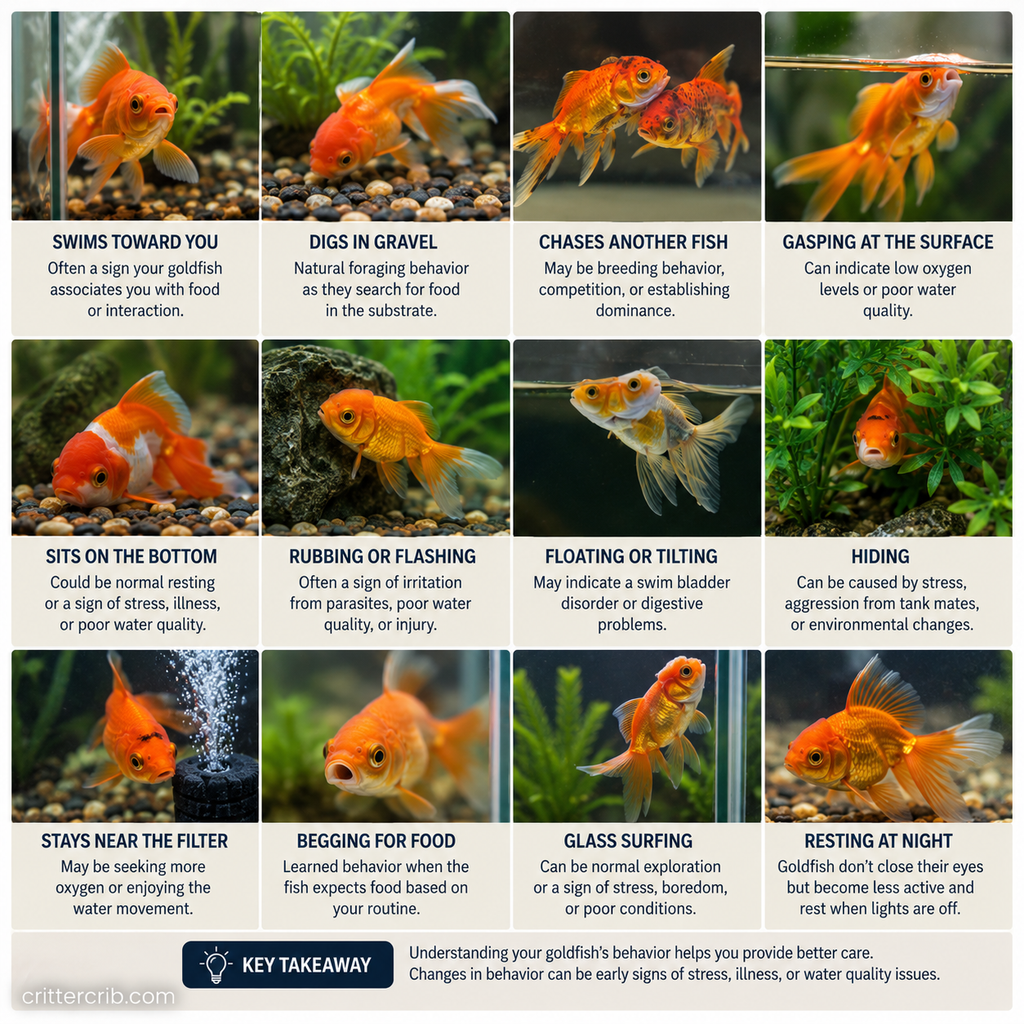
Repeatedly swimming up and down along the aquarium wall is sometimes called glass surfing.
An occasional trip along the glass isn’t necessarily significant.
Persistent repetitive swimming can have several possible causes.
A goldfish may be:
- Exploring its environment
- Responding to its reflection
- Excited about feeding
- Reacting to activity outside the aquarium
- Adjusting to a new environment
- Experiencing stress
If the behavior begins suddenly or continues for long periods, check the aquarium conditions.
Water quality, temperature, available swimming space, tank mates, and recent changes to the environment are all worth considering.
Why Is My Goldfish Swimming Frantically?
Sudden bursts of fast swimming occasionally happen and aren’t always abnormal.
A goldfish may become excited when food appears or react quickly after being startled.
Constant frantic swimming is different.
If your goldfish suddenly begins racing around the aquarium, investigate potential sources of stress.
Start with the basics:
- Test ammonia.
- Test nitrite.
- Check nitrate.
- Check water temperature.
- Confirm the filter is operating properly.
- Consider whether anything recently changed in the aquarium.
Water-quality problems should always be high on the checklist when fish behavior changes unexpectedly.
Why Is My Goldfish Hiding?
Goldfish are generally visible, active fish, so persistent hiding can indicate that something has changed.
A newly introduced goldfish may initially hide while becoming accustomed to its surroundings.
Temporary hiding can also occur after:
- Aquarium maintenance
- Being startled
- Changes to decorations
- Transportation
- Introduction of new fish
- Sudden activity around the aquarium
If hiding persists, look for additional symptoms.
A fish that hides while also refusing food, clamping its fins, breathing rapidly, or showing physical abnormalities may be stressed or ill.
Why Is My Goldfish Sitting on the Bottom?
Bottom sitting is one of those behaviors that can be either relatively harmless or a warning sign depending on the circumstances.
Goldfish do rest.
A fish may occasionally spend time near the bottom, particularly during quieter periods.
However, persistent bottom sitting can be associated with:
- Poor water quality
- Stress
- Illness
- Temperature problems
- Exhaustion
- Buoyancy difficulties
Pay particular attention when bottom sitting represents a significant change from your fish’s normal behavior.
What Should You Check First?
Test the water.
Ammonia and nitrite should generally be at 0 ppm in an established aquarium.
Also check the temperature and nitrate level and look for other symptoms such as rapid breathing, clamped fins, loss of appetite, sores, spots, swelling, or difficulty swimming.
Behavior alone doesn’t provide a diagnosis, but it can tell you that further investigation is needed.
Do Goldfish Sleep?
Goldfish rest, although their sleep doesn’t look exactly like ours.
They don’t close their eyes because goldfish don’t have eyelids.
During rest, a goldfish may:
- Hover relatively still
- Stay lower in the aquarium
- Move its fins gently
- React less quickly to activity
- Become noticeably less active
This often occurs when the aquarium lights are off and the surrounding environment is quiet.
Providing a consistent day-and-night cycle is important.
Goldfish don’t need aquarium lights running around the clock. Keeping the tank constantly illuminated can disrupt their natural rhythm.
Why Is My Goldfish Floating at the Top?
A goldfish spending time near the surface isn’t automatically in trouble.
Fish may explore all levels of an aquarium, especially when expecting food.
Persistent floating, however, can indicate a problem.
Pay attention to whether your fish can control its position normally.
If it repeatedly floats upward despite attempting to swim downward, rolls onto its side, or struggles to maintain normal orientation, it may be experiencing a buoyancy problem.
These problems can have several possible causes, including digestive issues, physical abnormalities, infection, or other health conditions.
Because the causes vary, avoid assuming every floating goldfish simply needs a particular home remedy.
Check water quality first and evaluate the fish’s overall condition.
Why Is My Goldfish Gasping at the Surface?
Repeated gasping at the surface deserves prompt attention.
Unlike bettas, goldfish don’t have a labyrinth organ designed for routinely breathing atmospheric air.
A goldfish repeatedly gulping at the surface may be experiencing inadequate oxygenation, poor water quality, gill irritation, or another health problem.
Potential contributors include:
- High ammonia
- Elevated nitrite
- Insufficient water movement
- Low dissolved oxygen
- Overcrowding
- Excessive waste
- High water temperature
- Gill disease or damage
Test the aquarium water promptly.
Also make sure the filter is functioning and creating adequate surface movement for gas exchange.
If multiple fish suddenly begin gasping at once, an environmental problem becomes especially important to investigate.
Why Is My Goldfish Staying Near the Filter?
Goldfish sometimes congregate near filters because of the water movement or increased oxygenation in that area.
Occasionally spending time there may be normal.
If your fish suddenly refuses to leave the filter outlet or consistently gathers where the water is most oxygenated, check the rest of the aquarium.
Poor oxygenation or water quality could be contributing to the behavior.
Watch for rapid gill movement or surface gasping as well.
Why Is My Goldfish Rubbing Against Rocks or Decorations?
Fish occasionally brush against aquarium objects.
Repeated rubbing or scratching is different.
This behavior is often called flashing.
A goldfish may quickly turn its body and rub against:
- Rocks
- Gravel
- Decorations
- Plants
- Aquarium surfaces
Persistent flashing can indicate irritation.
Possible causes include water-quality problems, parasites, or other conditions affecting the skin or gills.
Don’t immediately medicate the entire aquarium based on flashing alone.
Test the water first and inspect the fish carefully for additional symptoms.
Why Is My Goldfish Shaking or Twitching?
Occasional unusual movement may simply be a reaction to something in the environment.
Repeated twitching, shaking, darting, or sudden jerking movements deserve closer attention.
Water-quality problems and irritation should be considered.
Look for accompanying signs such as:
- Flashing
- Clamped fins
- Rapid breathing
- White spots
- Excess mucus
- Redness
- Loss of appetite
Again, behavior provides a clue rather than a specific diagnosis.
Why Does My Goldfish Have Clamped Fins?
Healthy goldfish generally hold and move their fins naturally while swimming.
Clamped fins are held unusually close to the body.
Persistent fin clamping can be a general sign that a fish isn’t feeling well.
Potential causes include:
- Poor water quality
- Stress
- Temperature problems
- Illness
- Parasites
If you notice clamped fins, check the water parameters and observe the fish for additional symptoms.
The combination of several symptoms is usually more informative than fin position alone.
Why Is My Goldfish Breathing Fast?
Rapid gill movement can indicate stress or difficulty obtaining enough oxygen.
Possible causes include poor water quality, low dissolved oxygen, gill irritation, parasites, disease, or environmental stress.
If rapid breathing appears suddenly:
- Check ammonia and nitrite immediately.
- Check temperature.
- Make sure filtration and surface agitation are adequate.
- Observe whether other fish show the same behavior.
- Look for visible signs of illness or injury.
If multiple fish develop rapid breathing at approximately the same time, investigate the aquarium environment urgently.
Why Is My Goldfish Swimming Sideways?
A goldfish swimming sideways, upside down, or struggling to remain upright may be experiencing a buoyancy disorder.
Fancy goldfish can be particularly susceptible to buoyancy problems because selective breeding has produced compact body shapes that can affect their internal anatomy.
However, abnormal swimming isn’t a diagnosis by itself.
Potential causes range from digestive problems to infection, physical abnormalities, injury, or poor water conditions.
Check water parameters and consider what the fish has recently eaten.
Persistent or severe swimming problems should be evaluated carefully, ideally with guidance from a veterinarian experienced with aquatic animals.
Why Is My Goldfish Swimming Upside Down?
An upside-down goldfish isn’t displaying normal resting behavior.
If the fish is alive but cannot maintain its normal orientation, it may have a significant buoyancy problem or another health issue.
Don’t automatically assume that feeding peas will solve the problem.
While dietary changes may be appropriate in certain situations, abnormal buoyancy can have multiple causes.
Start by checking water quality and observing for other symptoms.
If the condition persists or the fish appears distressed, seek professional veterinary advice when available.
Why Is My Goldfish Not Eating?
A goldfish occasionally skipping a meal isn’t necessarily an emergency.
Persistent loss of appetite is more significant, particularly in a fish that normally becomes enthusiastic at feeding time.
Possible reasons include:
- Stress
- Poor water quality
- Sudden temperature changes
- Illness
- Recent transportation
- Inappropriate food
- Digestive problems
A newly introduced goldfish may need some time to settle before eating normally.
If an established fish suddenly stops eating, check aquarium conditions and look for other changes in behavior or appearance.
Why Is My Goldfish Suddenly Lethargic?
Lethargy means more than simply resting.
A lethargic goldfish may remain in one area for long periods, respond weakly to food, or swim considerably less than usual.
If an active fish suddenly becomes lethargic, consider it a reason to investigate.
Check:
- Ammonia
- Nitrite
- Nitrate
- Water temperature
- Filter operation
- Breathing
- Appetite
- Physical appearance
Water quality is often one of the easiest potential problems to identify and correct, so it’s a sensible place to begin.
Why Is My Goldfish Jumping?
Goldfish can jump.
An occasional jump may happen after the fish is startled, but repeated jumping or attempts to escape the aquarium can signal stress.
Possible reasons include:
- Poor water quality
- Sudden environmental changes
- Irritation
- Being startled
- Inadequate aquarium conditions
A secure aquarium lid can help prevent a fish from jumping out.
Repeated jumping should also prompt water testing and closer observation.
Why Is My Goldfish Blowing Bubbles?
Occasional bubbles around a goldfish’s mouth aren’t necessarily unusual.
Goldfish interact with the water surface, substrate, food, and decorations in ways that can produce bubbles.
However, don’t confuse occasional bubble production with persistent surface gasping.
If the fish repeatedly gulps at the surface or appears to have difficulty breathing, investigate oxygenation and water quality.
Why Does My Goldfish Stare at Me?
Goldfish are highly responsive to visual activity outside their aquarium.
Your fish may approach and appear to watch you because it has learned that people—particularly certain people or movements—predict food or other activity.
They may also follow movement outside the glass.
This ability to learn routines is one reason goldfish can become engaging pets.
Over time, you’ll probably notice that your fish responds differently to familiar daily activities than it does to random movement around the room.
Can Goldfish Recognize Their Owners?
Goldfish can learn associations and respond to visual cues, routines, and feeding signals.
That doesn’t necessarily mean they’re recognizing you in exactly the same way a dog recognizes its owner.
Still, goldfish are capable of learning.
A fish that consistently approaches when you appear may have learned that your presence predicts feeding or interaction.
They can also become accustomed to regular aquarium routines.
The old idea that goldfish have only a few seconds of memory is a myth. Their behavior demonstrates much greater learning and memory ability than that claim suggests.
Do Goldfish Get Bored?
It’s difficult to know exactly how a goldfish experiences boredom, but providing an appropriate and stimulating environment allows it to express natural behaviors.
A good goldfish habitat should provide plenty of swimming space and opportunities to explore and forage.
Enrichment can include:
- Aquarium-safe plants
- Appropriate substrate
- Smooth decorations
- Varied food presented appropriately
- Areas to explore
- Compatible goldfish when the aquarium is large enough
Avoid constantly rearranging the aquarium simply for entertainment. Stability matters too.
The goal is to create an interesting environment without introducing unnecessary stress.
How Water Quality Affects Goldfish Behavior
When goldfish behavior suddenly changes, water quality should be one of the first things you investigate.
Goldfish produce a considerable amount of waste.
In a properly cycled aquarium, beneficial bacteria convert toxic ammonia into nitrite and then nitrate.
Ammonia and nitrite should generally remain at 0 ppm in an established aquarium.
Poor water conditions can contribute to behaviors such as:
- Surface gasping
- Lethargy
- Bottom sitting
- Flashing
- Clamped fins
- Rapid breathing
- Loss of appetite
- Erratic swimming
This is why observing your fish and testing your water go hand in hand.
You can’t determine ammonia concentration by looking at how clear the water appears.
How to Tell Whether Goldfish Behavior Is Normal or Concerning
One unusual behavior doesn’t always mean your goldfish is sick.
Instead, look at the complete picture.
Ask yourself:
Is This Normal for My Fish?
Knowing your goldfish’s normal routine gives you a baseline.
A behavior that one fish performs regularly may be unusual for another.
Did the Behavior Start Suddenly?
Sudden changes deserve more attention than long-standing habits.
Think about whether anything recently changed, including a water change, new food, new fish, aquarium maintenance, equipment changes, or temperature fluctuations.
Are There Other Symptoms?
Look for physical or behavioral changes such as:
- White spots
- Redness
- Swelling
- Damaged fins
- Raised scales
- Cloudy eyes
- Excess mucus
- Rapid breathing
- Appetite loss
- Difficulty swimming
Several symptoms occurring together provide much more useful information.
Are Other Fish Affected?
If every fish suddenly begins behaving strangely, consider an environmental cause.
Water-quality problems, oxygen issues, temperature changes, or contamination can potentially affect multiple fish simultaneously.
If only one fish is affected while the others behave normally, an individual health problem may be more likely.
What to Do When Your Goldfish Starts Acting Strangely
When you notice a significant behavioral change, avoid randomly treating the aquarium with medication.
Instead, work through the situation systematically.
- Observe exactly what the fish is doing.
- Test ammonia, nitrite, nitrate, and other relevant water parameters.
- Check the water temperature.
- Make sure the filter is functioning.
- Confirm there is adequate surface agitation and oxygenation.
- Look closely for visible physical symptoms.
- Think about recent changes to the aquarium.
- Monitor whether other fish develop similar behavior.
If water conditions are unsafe, appropriate water changes and correcting the underlying aquarium problem may be necessary.
If water quality is good but the fish continues deteriorating, seek advice from a veterinarian experienced with fish when possible.
Avoid treating based solely on a guess. A symptom such as flashing, floating, or lethargy can have multiple possible causes.
Common Goldfish Behavior FAQ
Why Does My Goldfish Follow My Finger?
Goldfish can learn to follow visual movement, especially when that movement has become associated with feeding.
It’s generally normal behavior and can be a simple form of interaction with your fish.
Why Does My Goldfish Beg for Food?
Your goldfish has probably learned that seeing you means food may be coming.
Don’t use begging alone to determine how much to feed. Maintain an appropriate feeding schedule instead.
Why Does My Goldfish Pick Up Rocks?
Goldfish naturally forage along the bottom of their environment.
They may pick up substrate while searching for food and then spit it back out.
Make sure the substrate is safe and doesn’t present an unnecessary choking or impaction risk.
Why Is My Goldfish Staying in One Corner?
Occasionally resting in a favorite area can be normal.
Persistent corner sitting, particularly when accompanied by lethargy, clamped fins, rapid breathing, or appetite loss, warrants checking water quality and the fish’s health.
Why Is My Goldfish Gulping at the Surface?
Occasional surface activity may happen around feeding.
Repeated gasping can indicate low oxygen, poor water quality, gill irritation, or illness and should be investigated promptly.
Why Is My Goldfish Rubbing Against Things?
Repeated rubbing or flashing may indicate skin or gill irritation.
Check water parameters first and look for additional signs of parasites or disease before deciding on treatment.
Why Does My Goldfish Rest on the Bottom at Night?
Goldfish have periods of rest and may become relatively still when the aquarium is dark.
If the fish returns to normal activity during the day and shows no other symptoms, this can be normal.
Persistent bottom sitting throughout the day is more concerning.
Why Is My Goldfish Suddenly Scared of Me?
Fish can react to changes in their surroundings.
New decorations, sudden movements, changes in lighting, aquarium maintenance, or a recent stressful experience can temporarily make a goldfish more cautious.
If the change persists, check for other signs of stress or illness.
Do Goldfish Play With Each Other?
Goldfish interact socially and may swim together, follow one another, and explore the same areas.
It’s difficult to determine whether every interaction qualifies as “play” in the human sense, so it’s better to describe what you can observe rather than assign human emotions to every behavior.
How Do I Know If My Goldfish Is Happy?
There’s no single goldfish behavior that definitively proves happiness.
Instead, look for signs consistent with good overall health and appropriate conditions.
A healthy goldfish will typically have a good appetite, swim normally, interact with its environment, maintain normal breathing, and show no obvious signs of disease or chronic stress.
Learning Your Goldfish’s Normal Routine
One of the best things you can do for your goldfish doesn’t require any special equipment.
Watch it.
Spend a few minutes observing your fish each day, particularly around feeding time.
Notice:
- Where it normally swims
- How active it usually is
- How quickly it responds to food
- Where it rests
- How it interacts with other fish
- How quickly it breathes
- How it holds its fins
You’ll gradually learn what’s typical.
That makes behavioral changes much easier to spot.
A random list of symptoms can only tell you so much. Knowing that your normally enthusiastic goldfish suddenly ignores breakfast and sits behind a decoration all morning gives you much more useful information.
Final Thoughts on Goldfish Behavior
Goldfish behavior becomes much easier to understand once you stop looking at individual actions in isolation.
Swimming toward you, digging through substrate, nibbling plants, resting at night, and constantly searching for food can all be perfectly normal.
Other behaviors deserve closer attention, especially when they appear suddenly.
Persistent surface gasping, rapid breathing, clamped fins, repeated flashing, severe lethargy, loss of appetite, or difficulty staying upright can indicate that something is wrong.
When that happens, start with the aquarium environment.
Test the water, check the temperature, inspect the equipment, and observe whether other fish are affected. Then look for additional symptoms that can help narrow down what’s happening.
Most importantly, get to know your own goldfish.
Once you’re familiar with its everyday routine, you’ll be much better equipped to tell the difference between a quirky goldfish being a goldfish and a genuine change that deserves your attention.