Bringing home a canary is exciting, but walking through the bird aisle at a pet store can make a simple setup feel surprisingly complicated. There are dozens of cages, perches, foods, toys, supplements, feeders, and accessories, and not everything marketed for small birds is actually necessary.
Fortunately, a canary doesn’t need an enormous collection of supplies to get started.
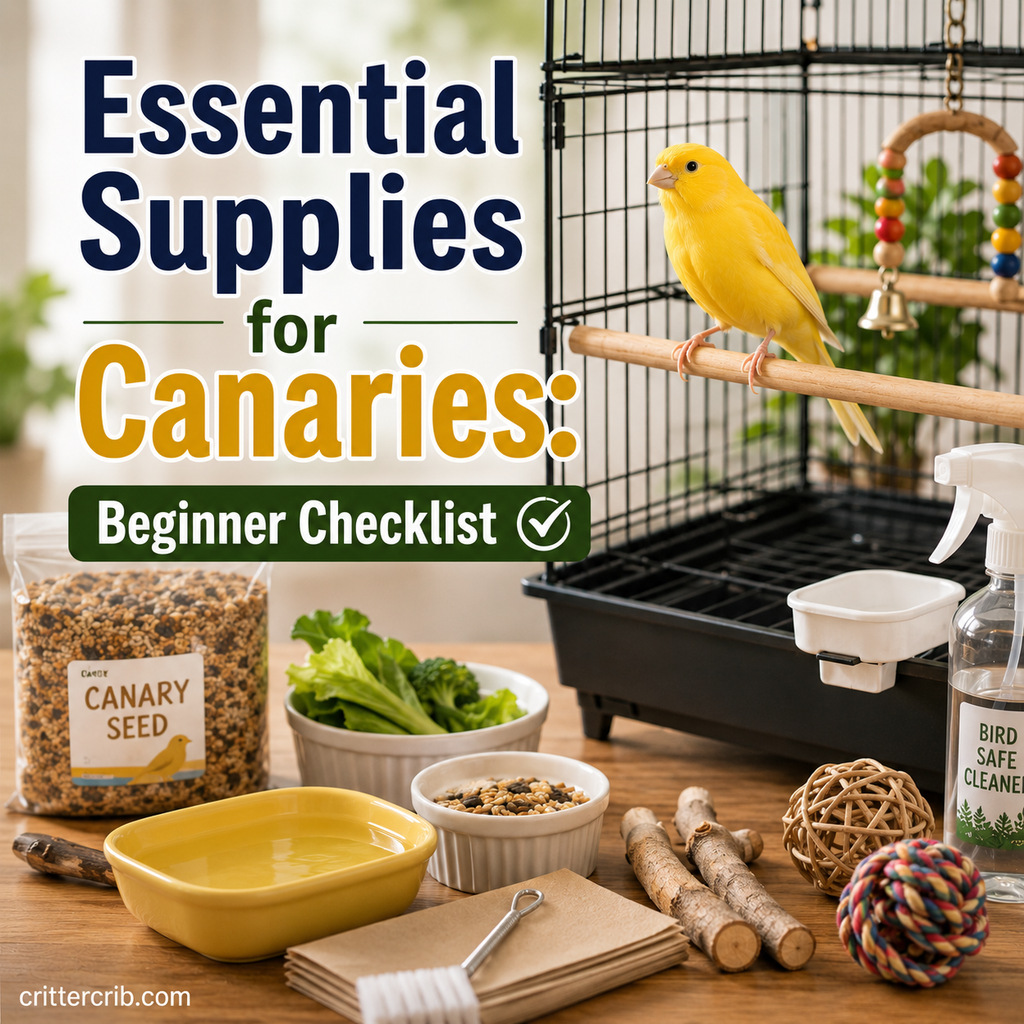
The essentials are straightforward: a safe and appropriately sized cage, several suitable perches, quality food, fresh water, feeding dishes, bathing opportunities, enrichment, cleaning supplies, and a secure carrier for travel.
Getting these basics right matters much more than filling the cage with accessories.
This beginner canary checklist covers what you’ll need before bringing your bird home, along with a few items that are useful but optional and others that are better avoided.
Canary Supplies Checklist at a Glance
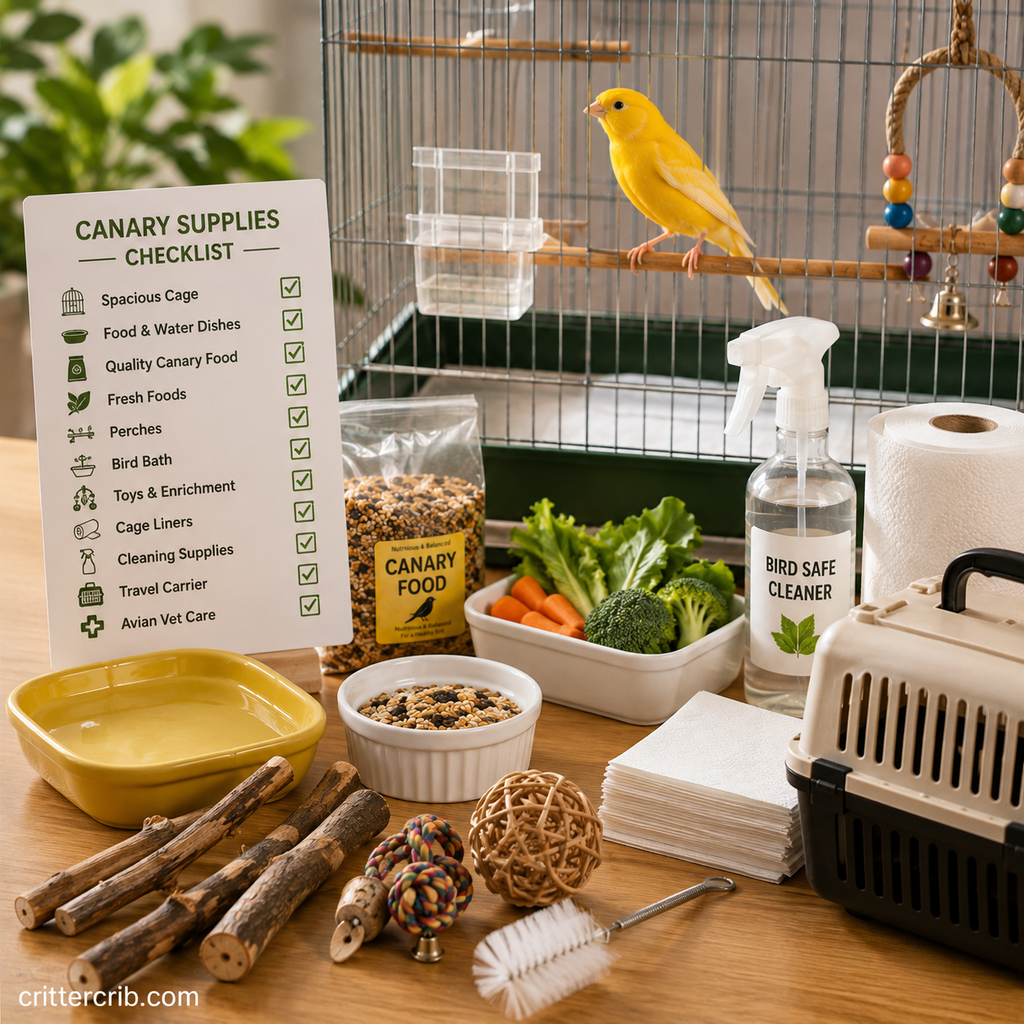
If you’re preparing for your first canary, start with these essentials:
- Appropriately sized bird cage
- Food and water dishes
- Quality canary food
- Fresh vegetables and other appropriate foods
- Several suitable perches
- Bird bath
- Toys and enrichment
- Cage liners
- Bird-safe cleaning supplies
- Small cleaning brush
- Secure travel carrier
- Access to an avian veterinarian
You don’t have to buy every accessory on day one. Focus on creating a safe, comfortable habitat first and add enrichment as you learn what your individual canary enjoys.
1. A Spacious Canary Cage
The cage is the foundation of your canary’s setup, so it’s worth choosing carefully.
Canaries are active little birds that benefit from horizontal space. They need room to hop between perches, stretch their wings, and ideally make short flights within their enclosure.
For a single canary, look for a rectangular cage that’s at least around 18 inches wide, 18 inches deep, and 18 inches high, with a larger cage strongly preferred whenever practical.
A cage around 24 inches or more in horizontal width gives you considerably more flexibility when arranging perches and accessories.
Why Cage Width Matters
Canaries primarily move horizontally rather than flying straight up and down.
That makes a wide rectangular cage generally more useful than a narrow cage that’s unusually tall.
When comparing cages, consider how much actual movement space remains after you add:
- Perches
- Food dishes
- Water
- A bath
- Toys
A large-looking cage can become surprisingly crowded once it’s fully furnished.
Check the Bar Spacing
For canaries, bar spacing should generally be around 1/2 inch or less.
A cage designed for larger parrots may provide plenty of space but have gaps that are too wide for a small bird.
Also look for secure doors, sturdy construction, bird-safe materials, and a removable bottom tray that makes cleaning easier.
2. Several Good Perches
Canaries spend a great deal of time on their feet, making perch selection particularly important.
Instead of filling the cage with identical smooth dowels, provide several perches with varying diameters and textures.
Natural wood branches can be a good option because their irregular surfaces give a bird’s feet different positions to grip.
Suitable perch materials may include bird-safe natural woods and commercially manufactured perches designed for small birds.
How to Position Canary Perches
Arrange perches so your canary has room to move between them.
Avoid creating a crowded maze.
You might place:
- A comfortable perch toward one end of the cage.
- Another perch toward the opposite end.
- A higher resting perch.
- A perch that provides easy access to food and water.
Leave an open horizontal pathway where possible.
Don’t position perches directly above food or water containers, since droppings can contaminate them.
Inspect perches regularly and replace anything that’s splintered, damaged, excessively worn, or difficult to keep clean.
3. Canary Food
Nutrition deserves more thought than simply buying a bag labeled “canary seed.”
Seed mixtures are commonly associated with canaries, but an all-seed diet may not provide balanced nutrition.
A more complete feeding plan can include an appropriately formulated canary diet along with suitable fresh foods.
Depending on your bird and your avian veterinarian’s recommendations, this might involve:
- Formulated food intended for canaries
- Some seeds
- Fresh leafy greens
- Appropriate vegetables
- Limited amounts of suitable fruit
Dietary changes should generally be made gradually rather than abruptly, particularly if your canary is accustomed to eating mostly seed.
If you’re bringing home a bird from a breeder, rescue, or pet store, ask what it’s currently eating. Starting with familiar food can make the transition to a new home easier.
4. Food Dishes
You’ll need at least one suitable food container, although having extras makes cleaning and feeding more convenient.
Stainless-steel dishes are popular because they’re durable and easy to wash. Some cages come with appropriately sized feeding cups that attach to the sides.
Whatever style you choose, dishes should be:
- Easy to remove
- Easy to wash
- Securely attached
- Appropriately sized
- Positioned away from overhead perches
If you offer fresh foods separately from your canary’s regular diet, an additional small dish can be useful.
Remove uneaten fresh food before it spoils.
5. A Fresh Water Dish or Bottle
Your canary should always have access to clean, fresh water.
A simple bird-safe water dish works well and makes it easy to see how much water is available.
Water containers should be cleaned and refilled every day, and more often if they become contaminated.
Canaries can introduce:
- Seed hulls
- Food
- Feathers
- Droppings
- Bathing debris
into open water dishes.
Check the water throughout the day rather than assuming it’s still clean because you filled it that morning.
If you choose a bottle-style watering system, make sure your canary understands how to use it and verify every day that water is flowing properly.
6. A Canary Bird Bath
Many canaries enjoy bathing, so a bird bath is a useful addition to your supply list.
You can find baths designed to attach to cage doors or sit securely within an enclosure.
The bath should be:
- Stable
- Appropriately sized
- Easy to clean
- Filled with shallow, clean water
- Removed or refreshed when dirty
You don’t necessarily need to leave a bath in the cage continuously.
Offering regular bathing opportunities allows your canary to decide when it wants to splash around.
Expect some mess. An enthusiastic canary can send water considerably farther than you might expect.
7. Toys and Enrichment
Canaries aren’t typically handled and played with in exactly the same way as many companion parrots, but they still benefit from an interesting environment.
The key is providing enrichment without overcrowding the cage.
Possible options include:
- Small swings
- Bird-safe hanging toys
- Foraging opportunities
- Lightweight toys appropriate for small birds
- Natural perching options
You don’t need ten toys hanging in the enclosure at once.
Start with a few carefully selected items and watch how your canary responds.
Some birds are curious immediately, while others may take time to approach something unfamiliar.
Rotate enrichment periodically rather than continually adding more objects.
8. Cage Liners
Cage liners make everyday cleanup much easier.
Plain paper or paper towels are simple choices because they’re inexpensive, easy to replace, and allow you to see your canary’s droppings.
Being able to observe droppings is useful because changes can sometimes provide an early indication that something is different with your bird.
Replace the liner daily or whenever it becomes heavily soiled.
Avoid materials that create excessive dust or make it difficult to monitor droppings.
If your cage has a grate above the liner, make sure the paper is positioned securely underneath it.
9. Basic Cage-Cleaning Supplies
Canaries generate seed hulls, feathers, food debris, and droppings every day.
Having dedicated cleaning supplies nearby makes maintenance much easier.
A basic cleaning kit might contain:
- Paper towels or washable cloths
- Small scrub brush
- Dedicated dish brush
- Warm water
- Bird-appropriate cleaning product when needed
- Handheld vacuum, broom, or dustpan
- Spare cage liners
Keep brushes and cloths used for the bird habitat separate from your regular kitchen and bathroom cleaning supplies.
Birds have sensitive respiratory systems, so avoid casually using strongly scented cleaners, aerosol sprays, air fresheners, or harsh fumes around your canary.
Never spray household cleaner directly into an occupied cage.
10. A Small Vacuum or Broom
This isn’t technically a bird supply, but you may quickly consider it one.
Canaries can scatter lightweight debris outside the cage, particularly seed hulls and feathers.
A small handheld vacuum, regular vacuum, or broom and dustpan can make daily cleanup much easier.
A washable mat beneath the cage can also protect flooring and catch some of the debris.
If your canary is frightened by the vacuum, don’t suddenly turn it on beside the cage. Allow the bird to become accustomed to the sound from a comfortable distance.
11. A Secure Travel Carrier
A travel carrier is one of those supplies people sometimes forget until they suddenly need one.
Don’t wait for an emergency.
Every canary owner should have a secure carrier that can be used for:
- Veterinary appointments
- Emergencies
- Moving
- Temporary relocation
- Evacuations
The carrier should be appropriately sized for a small bird and designed to prevent escape.
Keep it somewhere accessible rather than buried at the back of a garage or storage closet.
You’ll be glad to have it ready if you ever need to leave the house quickly with your bird.
12. An Avian Veterinarian
You can’t put this item in your shopping cart, but it’s one of the most important things to arrange before bringing home a canary.
Find a veterinarian experienced in avian medicine.
Not every veterinary clinic treats birds, and some clinics that see exotic pets may have varying levels of bird experience.
Having a clinic identified ahead of time prevents you from scrambling to find one if your canary becomes ill or injured.
Keep the clinic’s:
- Name
- Phone number
- Address
- Regular hours
- Emergency instructions
somewhere easy to find.
It’s also worth identifying where you would take your bird if an emergency occurred when your regular veterinarian was closed.
Optional Canary Supplies Worth Considering
Once you’ve covered the essentials, several additional items can make canary care more convenient.
Cage Cover
Some owners use a breathable cage cover at night to help create a darker sleeping environment.
A cover isn’t always necessary if the room already becomes quiet and appropriately dark at night.
If you use one, make sure the cage maintains adequate ventilation and your canary doesn’t become frightened by it.
Full-Spectrum Bird Lighting
Lighting can be useful in certain indoor setups, especially where natural light conditions are limited.
However, don’t simply place any bright household lamp beside the cage.
Bird lighting involves factors such as bulb type, distance, exposure time, and safety. Ask an avian veterinarian for guidance if you think supplemental lighting would benefit your canary.
Extra Food and Water Dishes
Having a spare set is convenient.
You can replace a dirty bowl immediately while the other one is being washed and dried.
Digital Kitchen Scale
A small gram scale can be useful for monitoring your canary’s weight.
Birds often hide signs of illness, and an unexplained change in weight can be important.
Because canaries are so small, you’ll need an accurate scale that measures in grams.
Ask your avian veterinarian about an appropriate weight-monitoring routine for your individual bird.
Supplies You Probably Don’t Need
Pet stores sell plenty of bird products that aren’t essential.
Some are unnecessary, while others may be inappropriate depending on how they’re used.
Grit
Canaries hull their seeds before swallowing them and generally don’t require insoluble grit to grind food in the way some other birds do.
Don’t automatically add grit simply because you see it marketed for birds.
If you’re considering a mineral or dietary supplement, discuss it with your avian veterinarian first.
Sandpaper Perch Covers
A rough surface may sound useful for keeping nails short, but abrasive perch covers can be uncomfortable for feet.
Providing appropriate natural perches with varied diameters is generally a better way to create diverse footing.
Mirrors
Mirrors are sometimes sold as standard bird toys, but they’re not necessary for a canary.
If you do offer one, observe your bird’s behavior rather than assuming it’s beneficial.
Heavily Scented Cage Products
Your canary’s habitat doesn’t need to smell like perfume.
Regular removal of droppings, discarded food, and dirty liners should keep odors under control.
Avoid air fresheners and strongly fragranced products around birds.
Where Should You Put the Canary Cage?
Buying the right supplies is only part of setting up a good habitat.
Location matters too.
Choose an area that allows your canary to experience normal household activity without being constantly disturbed.
Avoid placing the cage:
- Directly beside heating or cooling vents
- In strong drafts
- In the kitchen
- Where it receives excessive direct sunlight
- Beside constantly loud equipment
- In an area where other pets can harass the bird
Kitchen placement is particularly risky because birds are sensitive to smoke and cooking fumes. Overheated nonstick cookware and certain appliances can release fumes that are especially dangerous to birds.
A stable cage stand can help position the enclosure at a comfortable height.
Setting Up the Cage Before Your Canary Comes Home
Don’t wait until your new canary arrives to assemble everything.
Set up the habitat beforehand.
A simple process is:
- Assemble the cage and check all doors and latches.
- Install several suitable perches.
- Position food and water dishes.
- Add a small amount of enrichment.
- Place fresh liner in the bottom tray.
- Make sure there is plenty of open movement space.
- Check that no perch is positioned directly over food or water.
- Place the cage in its permanent location.
- Prepare the travel carrier.
- Have your canary’s familiar food ready.
Look at the completed cage from your bird’s perspective.
Can it move easily between perches? Can it reach food and water without navigating around toys? Is there enough open space to stretch and flutter?
If everything looks crowded, remove something.
How Much Should You Budget for Canary Supplies?
The initial cage will usually be one of your biggest expenses, but it’s worth prioritizing quality and usable space over decorative extras.
Your startup budget needs to account for:
- Cage
- Perches
- Bowls
- Initial food
- Bath
- Toys
- Carrier
- Cleaning supplies
- Cage liners
There will also be ongoing expenses, including food, replacement toys and perches, cleaning materials, and veterinary care.
Rather than spending heavily on accessories, put more of your initial budget toward a good cage, appropriate nutrition, and veterinary care.
Those are much more important than decorative extras.
Common Beginner Canary Setup Mistakes
Even a well-intentioned setup can have problems.
Buying Too Small a Cage
Canaries need movement space.
Choose a cage based on how your bird will use it, not simply whether the bird physically fits inside.
Filling the Cage With Accessories
Perches and enrichment are important, but empty space is important too.
Your canary should be able to move without constantly navigating around objects.
Feeding Only Seed
Canaries may eagerly eat seeds, but preference doesn’t necessarily equal complete nutrition.
Discuss an appropriate balanced diet with an avian veterinarian.
Using Identical Perches
A variety of appropriately sized natural perch surfaces provides more diverse footing than several identical smooth dowels.
Forgetting About Veterinary Care
A veterinarian isn’t something to start looking for only after your bird becomes sick.
Find an avian veterinarian before you need one.
Buying Everything Marketed for Canaries
“Made for birds” doesn’t automatically mean your particular bird needs it.
Keep your initial setup simple, safe, and functional.
Frequently Asked Questions
What Do I Need Before Getting a Canary?
At minimum, prepare an appropriately sized cage, several suitable perches, food and water containers, quality canary food, cage liners, bathing access, some enrichment, cleaning supplies, and a secure travel carrier.
You should also locate an avian veterinarian before bringing your canary home.
Do Canaries Need Toys?
Yes, canaries can benefit from appropriate enrichment.
However, they don’t need a cage packed with toys. A few carefully selected items, combined with suitable perches and plenty of movement space, can create a stimulating environment.
Do Canaries Need a Bird Bath?
Canaries commonly enjoy bathing, so providing regular access to a shallow bird bath is a good idea.
Keep the bath clean and replace the water whenever it becomes dirty.
Do Canaries Need a Nest?
A pet canary doesn’t automatically need a nest for sleeping.
Nesting materials and nests are generally associated with breeding behavior rather than being standard sleeping equipment.
If you’re not intentionally and responsibly breeding canaries, there’s usually no reason to add a nest simply because it looks cozy.
Do Canaries Need Cuttlebone?
Cuttlebone is commonly provided as a calcium source and can also offer an additional surface for beak activity.
However, your canary’s nutritional needs depend on its overall diet. Rather than relying on supplements to correct an unbalanced diet, discuss calcium and other nutritional requirements with an avian veterinarian.
Should I Buy Two Canaries?
Don’t assume that every canary needs another canary in the same cage.
Canary social behavior varies, and males in particular can be territorial toward one another. Housing decisions depend on sex, cage size, individual temperament, and breeding considerations.
If you’re considering multiple canaries, research compatible housing arrangements before putting them together.
What Is the Most Important Canary Supply?
It’s difficult to choose only one, but a spacious, safe cage and appropriate nutrition are two of the most important investments.
A fancy collection of toys can’t compensate for cramped housing or an inadequate diet.
Final Canary Supplies Checklist
Before bringing your new bird home, run through this list one last time.
Essential
- Spacious rectangular cage
- Appropriate bar spacing
- Several varied perches
- Quality canary food
- Food dishes
- Fresh water container
- Bird bath
- A few appropriate toys
- Cage liners
- Cleaning supplies
- Secure travel carrier
- Avian veterinarian contact information
Helpful Extras
- Spare food and water dishes
- Washable floor mat
- Small vacuum
- Cage cover when appropriate
- Gram scale
- Additional enrichment for rotation
You can always add supplies later as you learn more about your bird’s preferences.
Final Thoughts
Preparing for a canary doesn’t have to involve buying everything in the bird aisle.
Start with the things that directly affect your bird’s everyday life: a spacious cage, appropriate perches, nutritious food, fresh water, bathing opportunities, enrichment, and a clean environment.
Then think about practical items that are easy to overlook. A secure travel carrier should be ready before an emergency happens, and you should know where to find an avian veterinarian before your bird needs medical attention.
Most importantly, resist the temptation to overcrowd the cage.
Canaries are active birds. Open space that allows them to hop, flutter, and move between perches is often more valuable than another decorative accessory.
Build a simple, safe setup first. Once your canary settles in, you’ll quickly learn which toys, perches, foods, and activities it prefers—and you can build from there.