
Budgies may be small, but they have surprisingly expressive personalities. Spend enough time around one and you’ll notice head bobbing, beak grinding, chirping, fluffing up, stretching, preening, and plenty of other little behaviors that can leave you wondering what your bird is trying to tell you.
The good news is that many budgie behaviors become fairly easy to understand once you know what to look for.
A budgie’s behavior can provide clues about its mood, comfort level, social relationships, and sometimes even its health. However, one behavior rarely tells the whole story. Body posture, sounds, surroundings, and changes from your bird’s normal routine all matter.
This guide explains common budgie behaviors and what they usually mean, from happy chirping and affectionate preening to biting, screaming, and signs that something may be wrong.
Understanding Budgie Body Language
Budgies communicate constantly, even when they aren’t making a sound.
Their feathers, eyes, wings, posture, beak, and movements can all provide information about how they’re feeling. Learning your individual bird’s normal behavior is especially useful because not every budgie expresses itself in exactly the same way.
A relaxed bird might sit comfortably on a perch with slightly fluffed feathers, while an excited budgie may become much more animated and vocal.
Context is important, too. A budgie fluffing its feathers briefly after preening is very different from a bird remaining puffed up and inactive for hours.
Why Do Budgies Chirp?
Chirping is one of the most common—and usually most positive—budgie behaviors.
Budgies are naturally social birds, so vocal communication is an important part of everyday life. A comfortable budgie may chirp throughout the day while playing, interacting with another bird, or simply observing what’s happening around the room.
Frequent cheerful chirping can indicate that your budgie is:
- Comfortable in its surroundings
- Socially engaged
- Interested in what’s happening nearby
- Communicating with another bird or person
- Excited or playful
Some budgies are naturally much more vocal than others.
A sudden change matters more than the absolute amount of noise. If a normally talkative budgie becomes unusually quiet and withdrawn, pay attention to its other behaviors.
Why Do Budgies Chatter or Babble?
Budgies often produce long strings of soft chirps, whistles, clicks, and other sounds that can seem like they’re having a conversation with themselves.
In a way, they are.
This relaxed chatter is often associated with a comfortable, content bird. Male budgies in particular can be enthusiastic vocalizers, although females can chatter and mimic sounds as well.
A budgie may chatter toward:
- Another budgie
- A favorite toy
- A mirror
- Its owner
- Objects around its cage
Budgies can also incorporate sounds they hear frequently into their vocal routines.
Why Does My Budgie Grind Its Beak?
Soft beak grinding is usually a good sign.
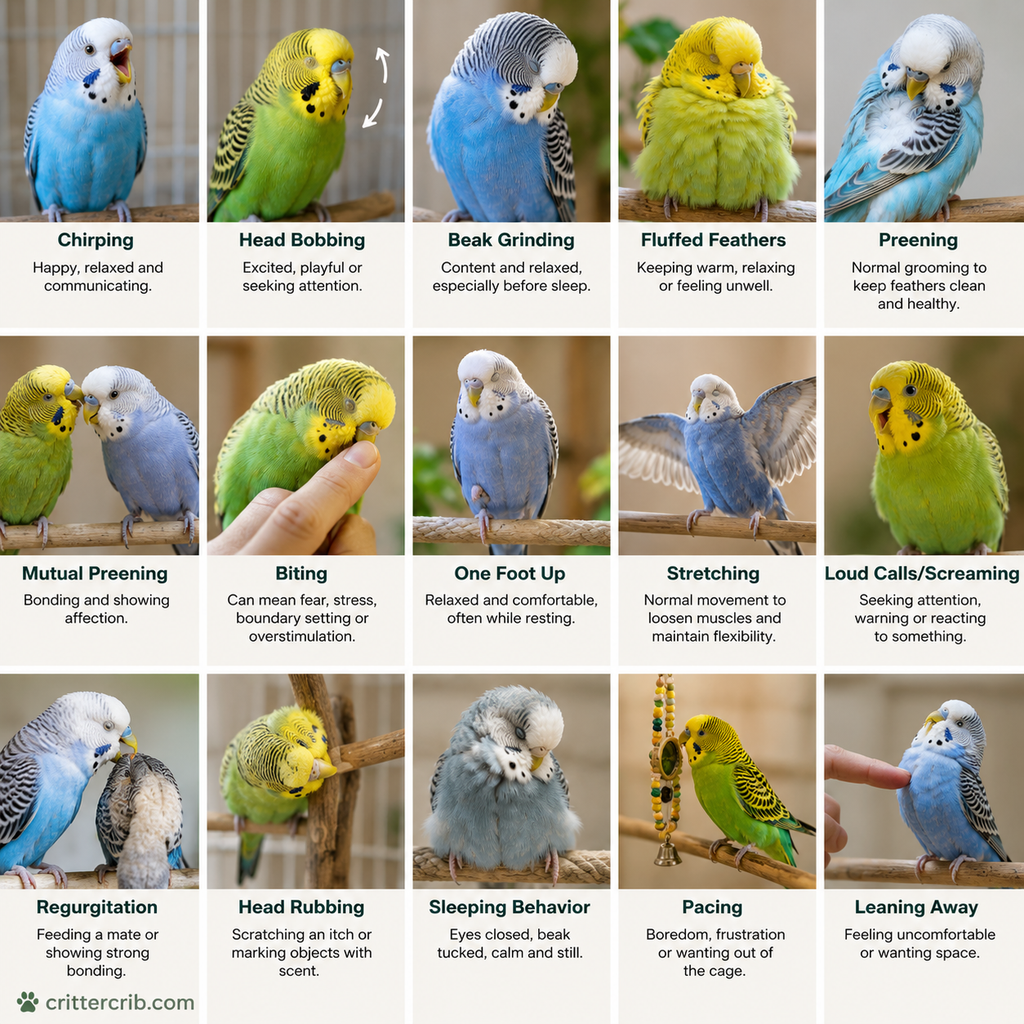
Budgies commonly grind their upper and lower beaks together when they’re relaxed, particularly before falling asleep. The sound can resemble a quiet scratching or crunching noise.
You might notice beak grinding when your budgie is:
- Settling down for the evening
- Resting comfortably
- Sitting quietly after preening
- Relaxing near a trusted companion
If your budgie is perched comfortably with relaxed feathers and quietly grinding its beak, it’s generally behaving normally.
Why Do Budgies Bob Their Heads?
Head bobbing can mean several things depending on the situation.
Young budgies may bob their heads when interacting with parents or other birds. Adults can also head-bob when excited, playful, social, or trying to get attention.
You may see a budgie rapidly bobbing its head while chirping at another budgie, a toy, or even you.
Head bobbing is especially common during energetic social interactions.
Occasional enthusiastic head bobbing is generally nothing to worry about. As with any behavior, however, unusual repetitive movements accompanied by poor balance, weakness, or other concerning symptoms deserve closer attention.
Why Do Budgies Fluff Up Their Feathers?
A budgie fluffing its feathers doesn’t automatically mean something is wrong.
Healthy budgies regularly fluff their feathers for several reasons.
They may fluff up to:
- Rearrange their feathers
- Relax
- Stay warm
- Preen
- Settle down to sleep
You might see your bird suddenly puff up, shake its body, and then return its feathers to their normal position. That’s typical feather maintenance.
The situation becomes more concerning when a budgie stays noticeably puffed up for an extended period and also appears sleepy, weak, unusually quiet, or uninterested in food.
Persistent fluffing combined with other changes can be a sign that the bird isn’t feeling well.
Why Does My Budgie Stand on One Foot?
Standing or sleeping on one foot is common in comfortable budgies.
Birds can tuck one foot into their feathers while resting, which may help conserve warmth and allow the tucked leg to relax.
A budgie resting on one foot while appearing calm and balanced is generally displaying normal behavior.
Budgies often switch which foot they tuck.
If your bird suddenly refuses to put weight on one particular foot, repeatedly holds it up while awake, or shows swelling or difficulty moving, that’s different from ordinary resting behavior and should be investigated.
Why Does My Budgie Stretch?
Budgies stretch for many of the same reasons people do.
A typical stretch may involve extending one wing and one leg on the same side of the body. The budgie may then repeat the movement on the opposite side.
You might also see both wings raised or extended briefly.
Stretching is especially common:
- After waking up
- Following a nap
- After sitting in one position
- Before becoming active
- During or after preening
Regular stretching is a normal part of keeping the body and feathers comfortable.
Why Does My Budgie Preen?
Preening is essential feather maintenance.
A budgie uses its beak to clean, straighten, and organize its feathers. You’ll probably see your bird carefully working its way through different parts of its plumage every day.
Healthy preening can look surprisingly intense. Budgies twist their bodies into strange positions to reach feathers on their chest, wings, back, and tail.
They may also briefly fluff themselves or shake after finishing.
Regular preening usually indicates normal self-care.
Excessive feather chewing, bald areas, damaged feathers, irritated skin, or constant frantic grooming are different and may warrant further investigation.
Why Do Budgies Preen Each Other?
Mutual preening, sometimes called allopreening, is a social behavior.
Budgies that have formed a bond may gently groom feathers that are difficult for the other bird to reach, particularly around the head and neck.
Mutual preening can indicate:
- Trust
- Social bonding
- Affection
- Comfort with one another
A budgie that trusts its human companion may sometimes enjoy gentle head scratches as well, although individual preferences vary considerably.
Never force physical contact. Let your budgie’s body language tell you whether it wants to be touched.
Why Does My Budgie Rub Its Head on the Cage?
Head rubbing can be part of normal grooming.
Budgies cannot easily preen every feather on their own heads with their beaks. They may rub their head or face against a perch, toy, cage accessory, or another suitable surface.
This can become particularly noticeable during a molt when new pin feathers are developing.
However, frequent frantic scratching or rubbing accompanied by irritated skin, feather loss, crusting, or other abnormalities should not simply be assumed to be grooming.
Why Does My Budgie Shake Its Feathers?
A quick full-body shake is usually normal.
Budgies frequently fluff themselves and then shake their feathers back into position. You may notice this after preening, stretching, bathing, or resting.
It can happen in a fraction of a second.
Continuous trembling is different from an occasional feather shake. If the entire bird appears to be shaking repeatedly or seems weak or distressed, consider the broader situation rather than assuming it’s ordinary grooming.
Why Does My Budgie Yawn?
Budgies yawn occasionally just like many other animals.
A normal yawn usually involves opening the beak widely for a moment before returning to normal behavior.
You may notice yawning when your bird is:
- Tired
- Relaxing
- Getting ready to sleep
- Stretching after resting
Repeated mouth opening, breathing difficulties, pronounced tail movement while breathing, or other respiratory changes shouldn’t automatically be interpreted as yawning.
Why Does My Budgie Wag or Flick Its Tail?
A brief tail flick or shake can occur during ordinary movement, stretching, or feather adjustment.
What deserves more attention is repeated pronounced movement of the tail synchronized with every breath, particularly when the bird is sitting still.
Birds naturally move slightly while breathing, so the distinction can sometimes be subtle. Look at the entire bird and consider whether there are other changes in breathing, posture, activity, or appetite.
Why Does My Budgie Bob Its Tail?
Small tail movements can be normal.
Pronounced, persistent up-and-down tail bobbing while the budgie breathes can sometimes indicate that breathing requires more effort than usual.
Watch for additional signs such as:
- Open-mouth breathing
- Wheezing or unusual respiratory sounds
- Lethargy
- Remaining puffed up
- Reduced appetite
- Sitting unusually low or still
Significant breathing difficulty in a bird should be taken seriously.
Why Does My Budgie Regurgitate Food?
Regurgitation can be a social or courtship-related behavior in budgies.
A bonded budgie may bring partially digested food back up and offer it to another budgie. Some birds may also attempt to feed a favorite toy, mirror, or even their owner.
This shouldn’t be confused with vomiting.
Regurgitation is typically a more controlled behavior directed toward something the bird is socially interested in. Vomiting can involve more forceful expulsion of food, repeated head movements, and food being scattered around the bird.
If you suspect your budgie is vomiting rather than displaying normal social regurgitation, veterinary advice is appropriate.
Why Does My Budgie Tap or Rub Its Beak?
Budgies use their beaks for much more than eating.
A budgie may rub its beak against a perch after eating, helping remove food residue. This can look like the bird is wiping one side of its beak and then the other.
Budgies may also gently tap or interact with objects using their beaks while exploring.
Their beaks function almost like an additional hand, helping them investigate objects, climb, manipulate toys, and interact with their environment.
Why Does My Budgie Chew Everything?
Chewing is completely natural for budgies.
A curious budgie explores much of its environment with its beak. Toys, natural perches, paper, and other bird-safe materials can provide appropriate opportunities for chewing and shredding.
This behavior becomes inconvenient when a free-flying budgie discovers things you’d rather it didn’t chew.
Keep unsafe materials out of reach, including:
- Electrical cords
- Toxic plants
- Painted or treated materials of unknown safety
- Small objects that could be swallowed
- Household chemicals
- Unsafe metals
Providing appropriate chewable toys can redirect some of this natural behavior.
Why Does My Budgie Bite?
Biting doesn’t necessarily mean your budgie is aggressive or dislikes you.
A budgie may bite because it is:
- Frightened
- Defending its space
- Overstimulated
- Protecting a mate or favorite area
- Uncomfortable with being handled
- Giving a warning that earlier body-language signals were ignored
Young or curious budgies may also explore fingers with their beaks without actually trying to hurt you.
Pay attention to what happens immediately before a bite. You may discover a consistent trigger.
For example, if your bird leans away whenever your hand approaches and eventually bites when you continue moving closer, the bite may be its final attempt to create distance.
Respecting those earlier signals can build trust and reduce defensive biting.
Why Does My Budgie Suddenly Fly Around the Cage?
Short bursts of energetic activity are common.
A budgie may suddenly fly between perches, climb rapidly around the cage, chirp excitedly, and generally behave as though it has received a burst of energy.
Healthy budgies need movement and mental stimulation, so periods of energetic activity are expected.
However, frantic flight caused by fear looks different.
A frightened budgie may crash into cage bars or desperately attempt to escape after being startled. Sudden noises, unfamiliar objects, pets, shadows, or unexpected movements can trigger panic.
Why Does My Budgie Scream?
Budgies can occasionally become surprisingly loud.
Loud calls may be used to communicate with flock members, get attention, express excitement, or respond to noises in the environment.
A budgie might call loudly when:
- You leave the room
- Another bird disappears from view
- It hears birds outside
- The household becomes noisy
- It wants interaction
- Something has startled it
Try to determine what triggers the calling rather than simply attempting to stop the noise.
Because budgies are social animals, some degree of vocal communication is completely natural.
Why Does My Budgie Call When I Leave the Room?
This may be a contact call.
Wild budgies live socially, and vocalizations help flock members maintain contact. Pet budgies can use similar calls when a familiar person or companion moves out of sight.
You may hear your budgie repeatedly calling from another room shortly after you leave.
Some owners naturally respond verbally, allowing the bird to hear that they are still nearby.
Why Does My Budgie Suddenly Become Quiet?
Quiet behavior isn’t automatically concerning. Budgies naturally have quieter periods during naps, rest, or bedtime.
What matters is whether the change is unusual for your bird.
A normally energetic and talkative budgie that suddenly becomes very quiet deserves observation, particularly if the change occurs alongside:
- Persistent puffed-up feathers
- Sleeping much more than usual
- Reduced appetite
- Changes in droppings
- Difficulty perching
- Weakness
- Breathing changes
- Sitting on the cage floor
Birds can sometimes hide signs of illness, making noticeable behavioral changes particularly important.
Why Does My Budgie Close Its Eyes Around Me?
Context makes a big difference here.
A relaxed budgie that slowly closes its eyes while sitting comfortably near you may feel safe enough to rest.
You may see the bird become slightly fluffy, tuck one foot up, grind its beak, and gradually become sleepy.
Those behaviors together generally suggest relaxation.
On the other hand, a budgie remaining unusually sleepy throughout the day should not automatically be interpreted as a sign of trust. Consider the bird’s overall activity and normal routine.
Why Does My Budgie Turn Its Back to Me?
This isn’t necessarily an insult.
Sometimes your budgie simply wants to look in another direction, rest, or pay attention to something else.
A comfortable bird may even turn away from you because it doesn’t feel the need to watch you constantly.
A nervous budgie, by contrast, may position itself farther away, move away when approached, freeze, or repeatedly attempt to create distance.
Look at the entire interaction rather than interpreting one posture by itself.
Why Does My Budgie Pace Back and Forth?
Pacing can have several explanations.
An excited budgie may move rapidly along a perch because it wants attention or expects to be let out of its cage.
Repetitive pacing can also occur when a bird is frustrated, bored, or attempting to reach something outside the cage.
Consider whether your budgie has enough opportunities for:
- Exercise
- Foraging
- Chewing
- Climbing
- Social interaction
- Safe out-of-cage activity
- Exploring different toys and perches
A stimulating environment gives budgies appropriate outlets for their natural behaviors.
Why Does My Budgie Hang Upside Down?
Some budgies simply enjoy climbing.
You might discover your bird hanging from a toy, cage bar, swing, or perch in a seemingly ridiculous position.
For an active, coordinated budgie, occasional upside-down climbing can be part of play and exploration.
Make sure toys and cage accessories are securely installed so enthusiastic climbing doesn’t result in an accident.
Why Does My Budgie Spread Its Wings?
Wing spreading can have several meanings.
A budgie may briefly stretch its wings after resting. It may also hold them slightly away from its body when it’s warm.
Excited or active birds may use different wing positions during play and movement as well.
Again, context matters.
A quick stretch followed by normal activity is very different from a bird persistently holding its wings away from its body while showing signs of overheating or distress.
Why Do Budgies Puff Up When Sleeping?
A slightly fluffy sleeping budgie is usually normal.
Fluffing the feathers traps a layer of air close to the body and can help the bird remain comfortable while resting.
A sleeping budgie may also:
- Stand on one foot
- Turn its head backward
- Tuck its beak into its back or shoulder feathers
- Grind its beak
- Close both eyes
These are common resting behaviors.
Persistent puffing throughout the daytime combined with inactivity is more concerning than ordinary nighttime fluffing.
What Does a Happy Budgie Look Like?
There isn’t one universal “happy budgie pose.”
Instead, look for a collection of normal behaviors indicating that your bird feels comfortable enough to eat, explore, rest, vocalize, and interact with its surroundings.
A comfortable budgie may:
- Chirp and chatter regularly
- Play with toys
- Explore its cage
- Preen normally
- Stretch its wings and legs
- Eat and drink normally
- Rest comfortably
- Grind its beak before sleeping
- Interact voluntarily with people or other birds
- Show curiosity about its environment
The key word is voluntarily.
A confident budgie chooses to explore and interact rather than being forced into situations.
Signs a Budgie Is Scared or Uncomfortable
Fear can look different depending on the bird and situation.
Some budgies flee immediately, while others become extremely still.
Possible signs of discomfort or fear include:
- Moving away from your hand
- Freezing in place
- Rapidly climbing away
- Frantic flight
- Defensive biting
- Leaning away
- Becoming unusually quiet
- Keeping the body tense and alert
If your budgie repeatedly shows these behaviors during handling, slow down.
Trust is generally built more effectively by allowing the bird to approach at its own pace rather than repeatedly forcing interaction.
How to Tell Normal Behavior From a Possible Health Problem
One of the most useful things you can learn is what is normal for your individual budgie.
Every bird has its own routine.
One may spend half the morning enthusiastically chattering while another is naturally quieter. One may love toys while another prefers climbing and shredding.
A sudden change from that baseline can sometimes provide an early indication that something isn’t right.
Pay particular attention to combinations of symptoms rather than isolated behaviors.
Potential warning signs include:
- Remaining puffed up for long periods
- Sleeping significantly more than usual
- Sudden loss of interest in food
- Major changes in droppings
- Difficulty breathing
- Persistent pronounced tail bobbing while breathing
- Weakness or poor balance
- Repeatedly falling from perches
- Sitting on the cage floor unexpectedly
- Sudden dramatic personality changes
- Suspected vomiting
- Unusual discharge around the eyes or nostrils
If you’re concerned that your budgie may be sick, contacting an avian veterinarian is safer than trying to diagnose the problem from behavior alone.
How to Understand Your Budgie Better
Learning budgie behavior isn’t about memorizing a dictionary where every movement has exactly one meaning.
Instead, learn to recognize patterns.
1. Observe your budgie’s normal routine
Notice when your bird normally eats, naps, vocalizes, plays, preens, and becomes active.
Knowing what’s typical makes unusual changes much easier to recognize.
2. Look at multiple signals together
Imagine your budgie is slightly fluffed up.
By itself, that tells you very little.
Now add context.
If your budgie is standing on one foot, quietly grinding its beak, and getting ready to sleep, the fluffing likely reflects relaxation.
If the same bird is puffed up in the middle of the day, barely moving, and refusing food, the situation is very different.
3. Pay attention to triggers
When your budgie reacts strongly, think about what happened immediately beforehand.
Did someone approach the cage?
Did you introduce a new toy?
Was there a loud noise?
Did another pet enter the room?
Understanding triggers can help you distinguish excitement, fear, territorial behavior, and ordinary social communication.
4. Respect your budgie’s boundaries
A budgie doesn’t need to enjoy being touched or handled constantly to have a good relationship with you.
Allowing your bird to make choices can help build confidence.
Use positive interactions and patience rather than grabbing or chasing the bird whenever possible.
5. Watch for changes
Individual behaviors can be ambiguous. Changes in normal behavior are often much more informative.
If your normally energetic bird suddenly stops playing, vocalizing, or eating, don’t dismiss the change simply because you can’t identify one specific symptom.
Frequently Asked Questions About Budgie Behavior
Why does my budgie chirp when I talk?
Your budgie may be responding socially to your voice. Budgies naturally communicate vocally, and some learn that conversations with their owners are opportunities to chirp, chatter, whistle, or practice mimicked sounds.
Why does my budgie stare at me?
Your bird may simply be watching what you’re doing. Budgies are visually attentive animals, and a curious bird may spend considerable time observing people, objects, and activity around its cage.
Why does my budgie puff up when I talk to it?
If your budgie remains relaxed and behaves normally otherwise, brief feather fluffing may simply occur as it settles or adjusts its plumage. Look at the bird’s overall posture and accompanying behaviors rather than interpreting fluffing alone.
Why does my budgie nibble my finger?
Gentle nibbling may be exploration, grooming-like social interaction, or play. A hard defensive bite accompanied by avoidance or tense body language has a very different meaning.
Why does my budgie make noises before sleeping?
Quiet chatter and beak grinding are common when budgies settle down. A comfortable bird may produce soft sounds for a while before finally falling asleep.
Do budgies recognize their owners?
Budgies can learn to recognize familiar people and associate them with voices, routines, interactions, and experiences. A well-socialized budgie may respond differently to a familiar caregiver than to an unfamiliar person.
How can I tell if my budgie trusts me?
Trust usually develops gradually. A budgie that voluntarily remains near you, eats comfortably in your presence, interacts with you, steps onto your hand willingly, or relaxes enough to preen and rest nearby may be showing increasing comfort and trust.
Not every trusting budgie enjoys being touched, though. Personality matters.
Final Thoughts
Budgies communicate far more than many new owners initially realize.
A head bob can signal excitement. Soft beak grinding often accompanies relaxation. Chirping keeps the social conversation going, while preening maintains feathers and can strengthen bonds between companions.
The most important skill isn’t memorizing every possible behavior. It’s learning your own budgie.
Observe what your bird does when it’s relaxed, excited, sleepy, playful, nervous, and hungry. Over time, those patterns become familiar, making it much easier to recognize both normal behavior and meaningful changes.
And whenever behavior changes suddenly alongside physical symptoms, reduced appetite, breathing difficulties, or unusual inactivity, don’t rely on body-language interpretation alone. An avian veterinarian can help determine whether there’s an underlying health problem.
The better you understand your budgie’s everyday behavior, the easier it becomes to provide an environment where this curious, social little bird can feel secure and thrive.