
Tarantulas aren’t exactly expressive pets. They don’t wag their tails, chirp for attention, or come running when you enter the room. Much of the time, a perfectly healthy tarantula may appear to be doing almost nothing.
Then one day it’s climbing the enclosure walls. Another day it has buried the entrance to its hide. Maybe it suddenly refuses food, spends hours rearranging substrate, or flips completely onto its back.
If you’re new to keeping tarantulas, some of these behaviors can look strange or even alarming.
The good news is that many seemingly unusual tarantula behaviors are completely normal. Understanding what your spider is doing—and why—makes it much easier to tell the difference between everyday tarantula behavior and something that deserves closer attention.
Here’s what some of the most common tarantula behaviors mean.
Understanding Normal Tarantula Behavior
Tarantulas are largely solitary animals whose behavior revolves around a few basic priorities: staying protected, finding food, maintaining a suitable retreat, reproducing, and conserving energy.
That last one explains a lot.
A tarantula doesn’t need to constantly roam its enclosure to be healthy. Remaining motionless for long periods is normal, particularly when the spider feels secure.
Behavior also varies considerably between species.
Some tarantulas are enthusiastic burrowers. Others spend more time in the open. Arboreal species naturally climb and build webbed retreats above the ground, while terrestrial species generally remain closer to the substrate.
Age, sex, enclosure conditions, feeding, and an approaching molt can all influence behavior too.
Instead of judging your tarantula by one isolated action, pay attention to its usual habits and look for changes over time.
Why Is My Tarantula Not Moving?
Seeing a tarantula sit in exactly the same position for hours—or even much longer—can make a new keeper wonder if something is wrong.
Usually, there isn’t.
Tarantulas are ambush predators. They don’t need to constantly search for food and can spend long periods waiting in or near a retreat.
Remaining still also conserves energy.
A tarantula may become more active:
- At night
- When searching for prey
- After enclosure changes
- When exploring
- During mating-related activity
- When environmental conditions change
If your tarantula looks normal and occasionally changes position, inactivity by itself generally isn’t a reason to panic.
Why Is My Tarantula Hiding?
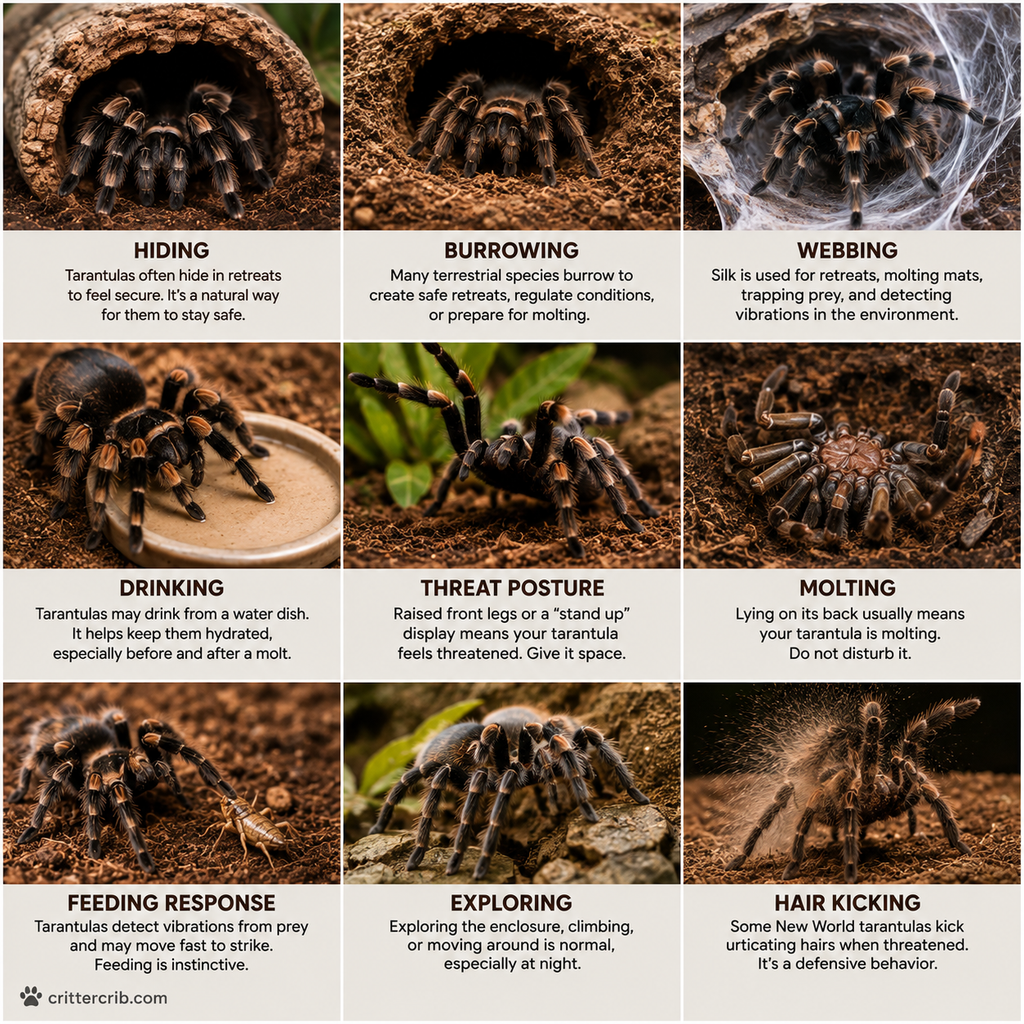
Hiding is one of the most natural things a tarantula can do.
In the wild, retreats provide protection from predators, environmental extremes, and unwanted disturbances.
Depending on the species, a tarantula may hide beneath cork bark, inside a burrow, behind enclosure decorations, or within a webbed retreat.
Some individuals may remain hidden for extended periods.
This doesn’t necessarily mean the tarantula is afraid of you or unhappy with its enclosure. A spider that regularly uses its hide may simply feel secure there.
Should You Check on a Hiding Tarantula?
Usually, no.
Repeatedly lifting hides or disturbing a burrow can create unnecessary stress.
If you can confirm that enclosure conditions are appropriate and there isn’t an obvious emergency, it’s generally better to allow the spider to emerge on its own.
This becomes especially important when a tarantula may be preparing to molt.
Why Is My Tarantula Burrowing?
Burrowing is normal for many terrestrial tarantulas.
Some species construct extensive underground retreats, while others simply excavate beneath a hide or move substrate around until the enclosure suits them.
A tarantula may burrow to:
- Create a secure retreat
- Prepare for molting
- Regulate its exposure to environmental conditions
- Avoid light or disturbance
- Behave according to its species’ natural instincts
Don’t assume that a tarantula spending most of its time underground isn’t enjoying its enclosure.
For a fossorial species in particular, disappearing underground is exactly what you should expect.
What If My Tarantula Buries Its Hide Entrance?
This behavior can look worrying.
You provide a nice hide, and your tarantula responds by constructing a wall across the entrance.
Leave it alone.
Tarantulas may seal themselves inside their retreats when they want privacy, particularly before a molt. The spider can usually reopen the entrance when it’s ready.
Avoid digging through the substrate to “rescue” it unless you have a genuine reason to believe an emergency has occurred.
Why Is My Tarantula Moving Substrate Around?
Tarantulas can be surprisingly opinionated interior decorators.
A carefully arranged enclosure may not remain carefully arranged for long.
Your spider might:
- Move substrate
- Dig beneath decorations
- Fill its water dish with dirt
- Cover areas with webbing
- Rearrange material around its hide
- Build small walls or barriers
This is usually normal.
Rather than trying to restore the enclosure every time the tarantula changes something, allow it to modify its surroundings as long as the resulting setup remains safe.
Why Does My Tarantula Keep Putting Dirt in Its Water Dish?
Few behaviors confuse tarantula keepers quite like this one.
You clean the water dish, refill it, and return the next morning to discover that your spider has filled it with substrate again.
Sometimes it seems almost deliberate.
The exact motivation isn’t always obvious. The tarantula may simply be moving substrate around its enclosure, and the water dish happens to be in the way.
Whatever the reason, don’t remove the water dish permanently.
Clean it out and refill it as necessary. Providing access to clean water is more important than winning an ongoing decorating disagreement with your spider.
Why Is My Tarantula Webbing?
All tarantulas can produce silk, although the amount and way they use it varies greatly between species.
Webbing can serve several purposes.
A tarantula may use silk to:
- Line its retreat
- Reinforce a burrow
- Detect vibrations
- Create a feeding area
- Construct a molting mat
- Build an arboreal retreat
- Prepare for reproduction
Heavy webbing isn’t automatically a sign that anything is wrong.
Some species create impressive networks of silk throughout their enclosures, while others produce relatively little visible webbing.
Why Is My Tarantula Making a Web Mat?
A mat of silk can have several explanations.
A tarantula approaching a molt may prepare a silk mat before shedding its old exoskeleton. Tarantulas may also lay down silk while feeding or maintaining their retreat.
Mature males can produce specialized sperm webs as part of reproductive behavior.
Context matters, so look at what else your spider has been doing.
Why Is My Tarantula Refusing Food?
Food refusal is one of the most common reasons new tarantula owners become concerned.
Fortunately, tarantulas can go surprisingly long periods without eating.
A tarantula may refuse food because:
- A molt is approaching
- It recently molted
- It isn’t hungry
- The prey is too large or intimidating
- Environmental conditions aren’t appropriate
- A mature male is more focused on finding a mate
- The species naturally has a slower feeding response
Don’t try to force a tarantula to eat.
If live prey isn’t eaten within a reasonable period, remove it. This is particularly important when you suspect the tarantula is preparing to molt.
An uneaten cricket or other feeder insect can potentially injure a vulnerable molting spider.
What Is Premolt Behavior?
Premolt describes the period leading up to a molt.
Behavior can change considerably during this time.
Common premolt signs may include:
- Refusing food
- Becoming less active
- Spending more time hidden
- Sealing a burrow or retreat
- Increased webbing
- A darkening abdomen in some species
- Preparing a molting mat
Not every tarantula displays every sign.
Some stop eating well before molting, while others may accept food relatively close to the event.
Learning your individual tarantula’s patterns becomes easier with experience.
Why Is My Tarantula Lying on Its Back?
This is one of the most important tarantula behaviors for a keeper to recognize.
A tarantula lying on its back is very often molting.
Do not immediately assume it is dying.
During a molt, the spider sheds its old exoskeleton and emerges with a new, initially soft one. Tarantulas commonly flip onto their backs as part of this process.
Never Disturb a Molting Tarantula
Molting leaves a tarantula extremely vulnerable.
Do not:
- Flip the spider over
- Touch it
- Pick it up
- Offer live prey
- Try to pull away the old exoskeleton
Give it space.
Keep the environment appropriate for the species and allow the process to happen naturally.
Once the molt is complete, the tarantula still needs time for its new exoskeleton and fangs to harden before normal feeding resumes.
Molting vs. a Death Curl
A tarantula on its back and a tarantula in a “death curl” generally look very different.
A molting tarantula commonly lies on its back or side with its legs positioned outward.
A severely weakened tarantula may pull its legs tightly underneath its body. This inward curling posture is often called a death curl.
If your tarantula is upright with its legs tightly curled underneath it and is unusually unresponsive, investigate the enclosure conditions and the spider’s condition promptly.
Don’t confuse an ordinary resting posture with a true death curl, though. Look at the entire situation rather than relying on one leg position.
Why Is My Tarantula Stretching Out?
Sometimes a tarantula seems to flatten itself against the substrate or stretch its legs dramatically.
This can be perfectly normal.
After molting, a tarantula may stretch as its new exoskeleton develops. Tarantulas also adopt different resting positions depending on the surface, temperature, and their surroundings.
An occasional unusual pose isn’t necessarily a problem.
The more useful question is whether the spider is behaving differently alongside other concerning changes.
Why Is My Tarantula Climbing the Walls?
The answer depends heavily on the type of tarantula.
For an arboreal species, climbing is expected. These tarantulas naturally spend much of their lives above ground.
Persistent wall climbing by a terrestrial tarantula deserves more attention.
It may simply be exploring, especially after being moved into a new enclosure. However, repeated attempts to avoid the substrate can sometimes indicate that the spider doesn’t like something about its environment.
Check:
- Substrate moisture
- Temperature
- Ventilation
- Enclosure layout
- Possible pests or mold
- Recent disturbances
For terrestrial species, enclosure height also matters. A heavy-bodied tarantula falling from excessive height can suffer a serious abdominal injury.
Why Is My Tarantula Walking Around Constantly?
Occasional exploration is normal, particularly at night.
A sudden increase in roaming can have several explanations.
One of the most common occurs in mature males.
After reaching maturity, male tarantulas may spend considerable time wandering in search of a receptive female. They may pace the enclosure, climb, or appear much more restless than before.
Persistent pacing in other tarantulas can also justify checking husbandry conditions.
Again, behavior should be interpreted in context.
Why Is My Tarantula Standing Over Its Water Dish?
A tarantula may occasionally position itself over or near its water dish.
It could simply be drinking.
Tarantulas don’t drink in the same obvious way as a dog or cat, so keepers don’t always notice it happening.
Repeatedly spending unusual amounts of time around water may be worth observing more closely, especially if accompanied by other changes. Make sure clean water remains available and check that the enclosure conditions are appropriate for the species.
Why Does My Tarantula Raise Its Front Legs?
A tarantula raising its front legs may be displaying a defensive posture.
Depending on the species and situation, it may lift the front portion of its body and expose its fangs.
The message is fairly straightforward:
Back off.
Don’t poke the spider or attempt to handle it to see what happens next.
Defensive displays are warnings. Respecting them reduces stress on the animal and lowers your chances of being bitten.
Why Does My Tarantula Kick Hairs?
Many New World tarantulas possess urticating hairs on their abdomens that can be used defensively.
When threatened, the spider may rapidly rub or kick these hairs into the surrounding area.
Urticating hairs can irritate human skin and may be particularly problematic if they reach the eyes or respiratory system.
Hair kicking is another clear sign that the tarantula wants distance.
If it happens during enclosure maintenance, reconsider how you’re approaching the animal. Slower movements and less disturbance may help.
Never put your face close to the enclosure when interacting with a defensive tarantula.
Why Does My Tarantula Have a Bald Spot?
A bald area on the abdomen is common in some New World tarantulas.
It often occurs because the spider has kicked urticating hairs.
A bald patch can therefore develop after repeated defensive behavior.
The exposed skin may also darken as a molt approaches. After the tarantula molts, the urticating hairs are replaced along with the rest of the exoskeleton.
A bald abdomen alone doesn’t necessarily indicate poor health.
Why Does My Tarantula Attack the Water Stream?
Sometimes adding water to an enclosure produces a surprisingly dramatic reaction.
A tarantula may rush toward moving water or tongs because vibrations trigger a feeding response.
To the spider, movement may resemble potential prey.
This is one reason enclosure maintenance should be done carefully. Don’t assume a tarantula that usually appears calm will remain calm when vibrations or movement suddenly trigger its instincts.
Why Does My Tarantula Pounce on Food?
A fast feeding response is normal for many tarantulas.
Tarantulas detect vibrations extremely well. When prey moves nearby, the spider can react with impressive speed.
It may:
- Turn toward the vibration.
- Approach or wait for the prey.
- Suddenly strike.
- Grab the prey with its front legs and fangs.
- Carry it to a preferred feeding area.
A tarantula that sits motionless all day can move remarkably quickly when food appears.
This sudden speed is also an important reminder to be careful whenever the enclosure is open.
Why Is My Tarantula Doing a “Happy Dance”?
After capturing prey, some tarantulas appear to slowly rotate, move their legs, or lay silk around the feeding area.
Keepers sometimes affectionately call this a “happy dance.”
It doesn’t necessarily mean the tarantula is experiencing happiness in the way humans understand it.
The behavior is more likely related to feeding and silk placement. The spider may lay down webbing while manipulating its prey and preparing the area where it will eat.
It’s normal—and interesting to watch.
Does Tarantula Behavior Show Emotion?
It’s easy to interpret animal behavior through a human lens.
A tarantula sitting calmly on a hand may look friendly. One hiding in a burrow may appear shy. Another rushing toward food might seem excited.
Those descriptions are convenient, but they don’t necessarily reflect what the spider is experiencing.
Tarantula behavior is better understood in terms of responses to:
- Threats
- Food
- Vibrations
- Environmental conditions
- Reproduction
- Molting
- Shelter
- Disturbance
A tarantula doesn’t need affection or social interaction from its keeper.
Providing a secure enclosure and minimizing unnecessary disturbance is much more valuable than trying to form a traditional pet-owner bond.
Do Tarantulas Recognize Their Owners?
There isn’t good evidence that tarantulas recognize individual owners in the social way that many mammals can.
A tarantula may appear calmer during certain interactions, but that shouldn’t automatically be interpreted as recognition or affection.
Tarantulas primarily navigate their world through sensory information such as vibration, touch, and chemical cues.
It’s better to appreciate them for what they are rather than expecting dog-like or reptile-like interactions.
Do Tarantulas Like Being Handled?
Handling is generally unnecessary.
Even if a tarantula tolerates being on your hand, that doesn’t mean it enjoys the experience.
Handling introduces several risks:
- The tarantula may fall.
- The spider may suddenly run.
- Defensive species may bite.
- Urticating hairs may be released.
- The animal may become unnecessarily stressed.
A fall can be particularly dangerous for heavy-bodied terrestrial tarantulas because the abdomen can rupture.
Tarantulas make excellent observation animals. You can enjoy their behavior without regularly touching them.
How Behavior Differs Between Terrestrial, Arboreal, and Fossorial Tarantulas
Understanding your tarantula’s natural lifestyle makes its behavior much easier to interpret.
Terrestrial Tarantulas
Terrestrial species spend most of their time on or near the ground.
You may see them:
- Sitting outside a hide
- Excavating substrate
- Waiting near a retreat entrance
- Webbing the surrounding area
- Ambushing prey
Safe enclosure height is particularly important because falls can be dangerous.
Arboreal Tarantulas
Arboreal species are adapted to living above the ground.
Typical behaviors include:
- Climbing enclosure walls
- Building elevated web retreats
- Hiding behind cork bark
- Spending little time on the substrate
- Moving quickly between elevated surfaces
An arboreal tarantula climbing isn’t displaying the same potentially concerning behavior as a terrestrial tarantula constantly trying to escape the ground.
Fossorial Tarantulas
Fossorial species spend much of their lives underground.
Expect:
- Extensive digging
- Deep burrows
- Long periods out of sight
- Webbing around burrow entrances
- Sudden feeding responses near the entrance
Owning a fossorial tarantula sometimes means owning what appears to be an enclosure full of dirt.
That’s normal.
The burrow itself is an important part of observing the animal’s natural behavior.
When Should Tarantula Behavior Concern You?
One unusual behavior isn’t automatically an emergency.
Changes become more meaningful when they’re persistent, extreme, or accompanied by physical problems.
Pay closer attention if you notice:
- Legs tightly curling beneath the body
- Difficulty walking or coordinating movements
- An injury or leaking fluid
- Persistent attempts to escape unsuitable substrate
- Unusual weakness
- Problems during or after a molt
- An abdomen that appears severely shrunken
- Evidence of pests or contamination
- A sudden major behavioral change with no obvious explanation
If something seems wrong, start by checking the basics.
Verify the enclosure setup, water availability, ventilation, temperature, substrate conditions, and species-specific husbandry requirements.
For a seriously injured or unwell tarantula, seek guidance from an experienced exotic veterinarian or qualified invertebrate specialist when available.
How to Observe Tarantula Behavior Without Disturbing Them
One of the best ways to understand your tarantula is simply to watch it.
Try observing after the room becomes darker, when many tarantulas become more active.
You may notice behaviors you rarely see during the day, including:
- Exploring
- Drinking
- Digging
- Webbing
- Hunting
- Rearranging substrate
- Maintaining a burrow
Avoid constantly opening the enclosure to investigate every movement.
Observation through the enclosure gives you a much more natural picture of how the spider behaves when it doesn’t feel disturbed.
Keeping simple notes can also be useful. Record feeding dates, molts, food refusals, and major behavioral changes. Over time, patterns become easier to recognize.
Frequently Asked Questions About Tarantula Behavior
Why Is My Tarantula Suddenly Hiding All the Time?
Hiding is normal and may happen for many reasons. Your tarantula may simply prefer its retreat, or it could be approaching a molt.
If it seals the entrance to its hide, avoid disturbing it.
Why Has My Tarantula Stopped Eating?
Food refusal is common, especially before a molt.
Remove uneaten live prey and continue providing clean water. Some healthy tarantulas can go extended periods without food.
Why Is My Tarantula on Its Back?
It is very likely molting.
Don’t flip it over or disturb it. Keep live feeder insects away while the spider is vulnerable.
Why Is My Tarantula Always in Its Burrow?
For many species, that’s completely normal.
Fossorial tarantulas in particular may spend most of their lives underground. Even terrestrial species may remain inside retreats for long periods.
Why Is My Tarantula Suddenly More Active?
Nighttime exploration, environmental changes, hunger, or reproductive behavior can increase activity.
Mature males are especially likely to wander while searching for a mate.
Why Is My Tarantula Raising Its Front Legs at Me?
It may be displaying a defensive threat posture.
Stop what you’re doing and give the tarantula space rather than provoking it further.
Why Does My Tarantula Keep Filling Its Water Dish With Dirt?
It’s a common and usually harmless behavior associated with digging and rearranging substrate.
Clean and refill the dish rather than removing it.
Is Webbing a Good Sign?
Webbing is normal tarantula behavior.
How much webbing you see depends heavily on species. Tarantulas use silk for retreats, burrows, feeding, molting, and reproduction.
Final Thoughts on Tarantula Behavior
The more time you spend around tarantulas, the less mysterious their behavior becomes.
A spider disappearing underground isn’t necessarily sick. A tarantula refusing dinner isn’t automatically starving. One lying on its back probably doesn’t need rescuing at all—it may be doing exactly what it needs to do to grow.
Understanding these behaviors is also one of the most rewarding parts of keeping tarantulas.
Watch how your spider constructs its retreat, responds to prey, places webbing, excavates substrate, and changes its routine before a molt. You’ll gradually learn what’s typical for the species and, eventually, what’s typical for that particular individual.
Most importantly, resist the urge to interfere with every unusual-looking behavior.
Tarantulas have been digging, molting, hiding, hunting, and building retreats without human assistance for millions of years. A good keeper provides the right environment, watches carefully, and knows when the best thing to do is simply leave the spider alone.