Tarantulas don’t need enormous enclosures to live comfortably. In fact, giving one a huge tank isn’t necessarily better and can sometimes make feeding, monitoring, and maintaining the right conditions more difficult.
What matters most is providing the right kind of space.
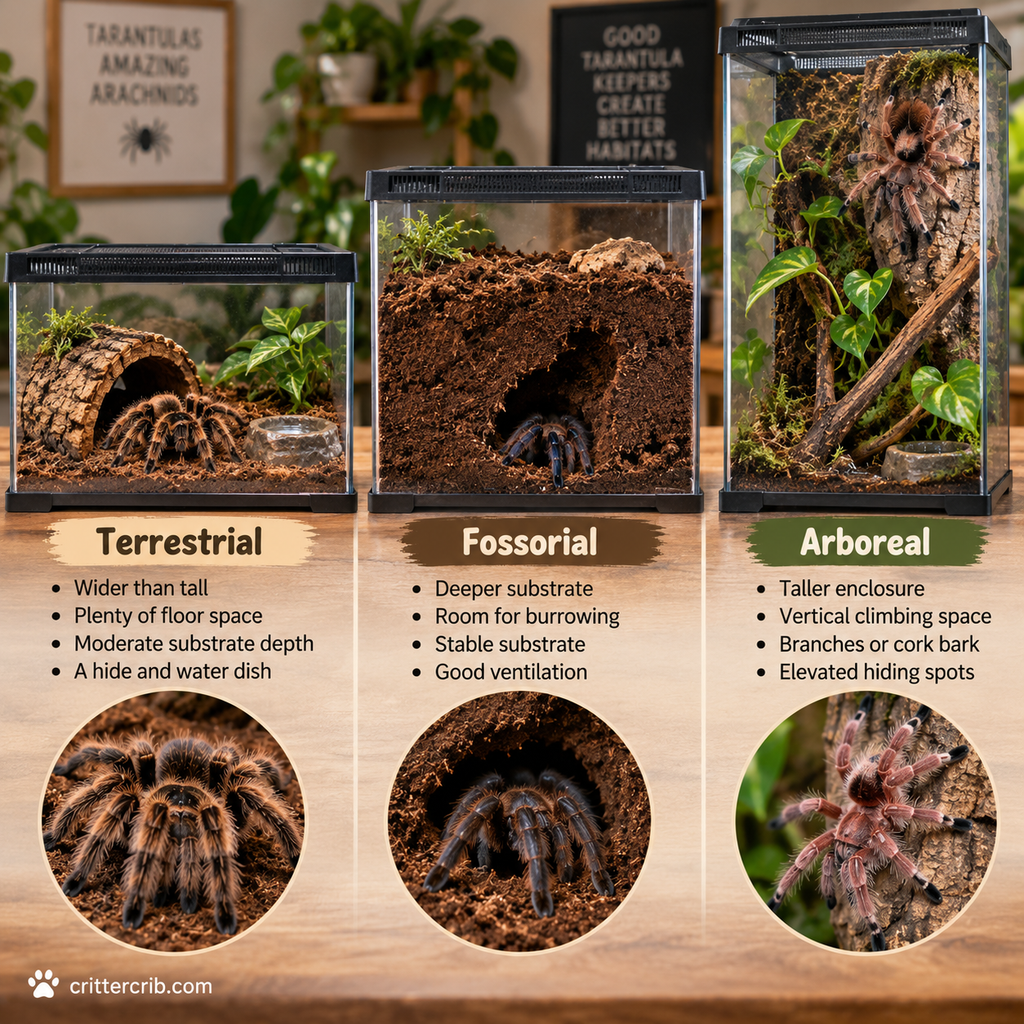
A terrestrial tarantula needs enough floor area and substrate to move around safely. A burrowing species needs considerably deeper substrate. An arboreal tarantula needs vertical room and climbing surfaces instead.
So, how much space does a tarantula actually need?
There isn’t one enclosure size that works for every species, but there are practical guidelines you can use to choose an appropriate home.
How Big Should a Tarantula Enclosure Be?
For many adult tarantulas, an enclosure with a floor length roughly 2 to 3 times the tarantula’s diagonal leg span provides a useful starting point.
The width can generally be around 1.5 to 2 times the leg span.
These aren’t strict measurements. Tarantula housing should also account for:
- Species
- Adult size
- Terrestrial, fossorial, or arboreal lifestyle
- Amount of substrate required
- Ventilation
- Hiding places
- Water dish placement
- Safe distance between the substrate and enclosure lid
A 2-inch tarantula obviously shouldn’t be placed in the same setup as a 6-inch adult.
More importantly, two tarantulas with similar leg spans may need very different enclosure layouts depending on how they naturally live.
Tarantula Enclosure Size at a Glance
A useful way to think about tarantula housing is to start with the spider’s lifestyle rather than simply buying a tank based on gallon capacity.
Terrestrial Tarantulas
Prioritize:
- Floor space
- Deep enough substrate for secure footing
- Low climbing height
- A hide
- Easy access to water
Terrestrial species spend most of their time at or near ground level.
Fossorial Tarantulas
Prioritize:
- Deep substrate
- Enough room for burrow construction
- Stable substrate
- Appropriate ventilation
- A secure enclosure
These tarantulas may spend the majority of their lives underground.
Arboreal Tarantulas
Prioritize:
- Vertical space
- Climbing surfaces
- Cork bark or similar structures
- Elevated hiding opportunities
- Good ventilation
For arboreal species, enclosure height is much more useful than excessive floor area.
Why Bigger Isn’t Always Better for Tarantulas
It’s easy to assume that a larger enclosure automatically provides a better quality of life.
With tarantulas, that’s not necessarily the case.
A properly designed enclosure that’s moderately sized can provide everything the spider needs: room to move, somewhere to hide, access to water, appropriate substrate, and suitable environmental conditions.
An excessively large enclosure can make routine care more difficult.
For example, prey insects may wander far from the tarantula. It can become harder to determine whether food has been eaten, and maintaining appropriate moisture conditions may become less predictable.
There’s also a practical issue.
Tarantulas don’t use space the way dogs, cats, or even many reptiles do. Some individuals establish a preferred hide or burrow and spend an enormous amount of time there.
That doesn’t mean the enclosure should be tiny. It means usable space is more important than maximum space.
How Much Space Do Terrestrial Tarantulas Need?
Terrestrial tarantulas live primarily on the ground.
Many popular pet species fall into this general category, including tarantulas from genera such as Grammostola, Brachypelma, Tliltocatl, and Aphonopelma.
An enclosure for an adult terrestrial tarantula should provide enough horizontal space for comfortable movement without creating excessive climbing height.
This last point is particularly important.
Why Terrestrial Tarantulas Shouldn’t Have Too Much Height
Tarantulas may look tough, but their abdomens can be vulnerable to injury.
A heavy-bodied terrestrial tarantula that climbs the enclosure wall and falls onto a hard object can potentially suffer a serious abdominal injury.
That’s why a tall, mostly empty aquarium isn’t ideal for a terrestrial species.
Instead, much of the enclosure’s vertical space can be filled with appropriate substrate.
The distance between the substrate surface and the enclosure lid should remain relatively modest for large, heavy-bodied terrestrial species.
The goal is simple: give the spider room to move without giving it far to fall.
How Much Space Do Fossorial Tarantulas Need?
Fossorial tarantulas are adapted for burrowing.
For these species, substrate depth is one of the most important enclosure measurements.
A fossorial tarantula may create an extensive burrow and spend much of its time inside it. Some owners rarely see more than a pair of legs waiting near the burrow entrance.
That’s completely normal.
Instead of focusing primarily on horizontal floor area, provide enough depth for natural burrowing behavior.
Depending on the species and size of the spider, this can mean filling a substantial portion of the enclosure with substrate.
The substrate should also be capable of holding a burrow without constantly collapsing.
A tall container can work well for fossorial species when much of that height is filled with substrate. What you don’t want is a deep empty drop above the substrate.
How Much Space Do Arboreal Tarantulas Need?
Arboreal tarantulas live above ground and require a different enclosure design.
Species from genera such as Avicularia, Caribena, Psalmopoeus, and Poecilotheria are associated with climbing and elevated retreats.
For these tarantulas, vertical space is useful.
A tall enclosure allows the spider to:
- Climb
- Build web retreats
- Hide behind bark
- Establish an elevated resting area
- Behave more naturally
Cork bark is commonly positioned vertically to create climbing and hiding opportunities.
Branches and other suitable structures can also be used, provided they’re secure and don’t create unnecessary hazards.
Think Vertical Instead of Simply Bigger
An arboreal enclosure doesn’t need to be huge.
It needs to be tall enough to provide meaningful climbing space while still allowing you to safely perform routine maintenance.
A wide, shallow enclosure may technically have more internal volume but provide less useful habitat for an arboreal spider.
This is why enclosure dimensions matter more than the number of gallons printed on a tank label.
Tarantula Enclosure Size by Life Stage
Tarantulas can grow dramatically over their lifetimes.
A tiny spiderling shouldn’t start life in an adult-sized enclosure.
As the tarantula grows, it can be moved into progressively larger housing.
Spiderling Enclosures
Very small spiderlings are often kept in small containers rather than conventional terrariums.
The enclosure should provide:
- Adequate ventilation
- Appropriate substrate
- A small hiding opportunity
- Easy access to food
- Suitable moisture for the species
Keeping the enclosure relatively compact makes it much easier to monitor a tiny spider.
It also makes finding and removing uneaten prey easier.
The container still needs to be secure. Spiderlings can squeeze through surprisingly small openings.
Juvenile Tarantula Enclosures
As the tarantula grows, it will eventually need more room.
A juvenile enclosure bridges the gap between a tiny spiderling setup and permanent adult housing.
Watch how easily the spider can move around.
If the tarantula is beginning to look cramped, has difficulty positioning itself normally, or has clearly outgrown the enclosure’s usable space, it’s probably time to consider rehousing.
There’s no need to jump directly from a tiny container to a huge adult terrarium.
Gradual upgrades make management easier.
Adult Tarantula Enclosures
Once a tarantula approaches adult size, you can choose an enclosure based on its expected adult dimensions and natural lifestyle.
An adult setup should have room for:
- The tarantula
- A suitable hide
- A water dish
- Appropriate substrate
- Necessary climbing or burrowing structures
- Safe maintenance access
An enclosure doesn’t need large areas of unused empty space.
How Deep Should Tarantula Substrate Be?
Substrate depth depends heavily on the tarantula.
For terrestrial species, substrate serves several purposes. It provides footing, helps manage moisture, gives the spider an opportunity to excavate, and reduces dangerous fall distance.
Many terrestrial tarantulas will dig even if they’re not considered truly fossorial.
For burrowing species, considerably deeper substrate is needed.
Instead of looking for one universal substrate measurement, ask:
Can this particular tarantula perform its normal behavior safely with the substrate provided?
A fossorial species should be able to construct a meaningful burrow.
A terrestrial species should have enough substrate to dig while also being protected from long falls.
An arboreal species generally needs less substrate depth because much of its usable space is above ground.
Does a Tarantula Need a Hide?
Most tarantulas should have access to an appropriate retreat.
For terrestrial species, this might be:
- Cork bark
- Half of a suitable hide
- A piece of wood partially buried in substrate
- Another secure, appropriately sized shelter
You can partially bury a hide to create the beginning of a burrow.
Fossorial tarantulas often construct their own retreats when given sufficient substrate.
Arboreal species may use vertical cork bark, tubes, plants, and webbing to create elevated retreats.
A hide doesn’t need to be elaborate.
It needs to make the spider feel secure.
How Much Ventilation Does a Tarantula Enclosure Need?
Enclosure size isn’t the only consideration.
Ventilation matters too.
Stagnant, constantly damp conditions can create problems in a tarantula enclosure. At the same time, some species require more moisture than others.
Cross-ventilation can be particularly useful because it allows air to move through the enclosure rather than relying only on holes in the lid.
The exact setup depends on the species.
This is one reason it’s important to research your tarantula before bringing it home. A desert-associated terrestrial species and a tropical arboreal species shouldn’t automatically be kept under identical conditions.
Do Tarantulas Need Large Water Dishes?
Adult and larger juvenile tarantulas should generally have access to a clean water dish.
The dish doesn’t need to occupy a huge portion of the enclosure.
Choose something:
- Stable
- Shallow enough to manage easily
- Appropriately sized for the spider
- Easy to remove and clean
Tarantulas sometimes fill their water dishes with substrate.
This is one of those strange tarantula behaviors you’ll probably encounter sooner or later. Simply clean and refill the dish as necessary.
Can a Tarantula Enclosure Be Too Small?
Yes.
While tarantulas don’t require huge territories in captivity, that doesn’t mean extremely cramped housing is appropriate.
An enclosure may be too small if the tarantula can’t comfortably:
- Turn around
- Stretch its legs
- Move between the hide and water dish
- Assume normal resting positions
- Dig or climb as appropriate for its species
The enclosure also needs enough room for you to safely feed the spider and maintain its habitat.
A tiny container that technically fits the spider isn’t the same thing as an appropriately designed enclosure.
Can a Tarantula Enclosure Be Too Big?
A large enclosure isn’t automatically dangerous, but unnecessarily oversized housing can create practical problems.
You may have more difficulty:
- Finding a small tarantula
- Monitoring feeding
- Locating uneaten prey
- Maintaining moisture gradients
- Performing maintenance
- Observing changes in behavior
For terrestrial tarantulas, an oversized enclosure can become especially problematic if “bigger” also means excessively tall.
Again, usable space matters more than sheer volume.
Do Tarantulas Need Enrichment?
Tarantulas don’t need an enclosure packed with toys.
However, a well-designed habitat should allow natural behavior.
Depending on the species, useful environmental features can include:
- Deep substrate
- Cork bark
- Hiding places
- Anchoring points for webbing
- Artificial or safe live plants
- Leaf litter
- Climbing structures for arboreal species
Avoid overcrowding the enclosure.
Your tarantula should still have clear pathways and enough room to move naturally.
Should Tarantulas Be Housed Together?
For most pet tarantulas, the safest general approach is to house them individually.
Putting two tarantulas in a larger enclosure doesn’t automatically make cohabitation safe.
Cannibalism and aggression are possible.
Although certain species have sometimes been kept communally by experienced keepers, communal tarantula housing requires species-specific knowledge and carries additional risk.
For the typical pet owner, one tarantula per enclosure is the simplest and safest approach.
Common Tarantula Housing Mistakes
Choosing the correct enclosure isn’t difficult once you understand how the spider lives.
Several mistakes, however, appear frequently.
Choosing an Enclosure Based Only on Gallons
A 10-gallon enclosure isn’t automatically better than a smaller enclosure.
Look at its actual dimensions.
A terrestrial tarantula benefits from horizontal room and limited fall height. An arboreal tarantula benefits from vertical space.
Leaving Too Much Empty Height
This is particularly risky for heavy terrestrial tarantulas.
Add enough substrate to reduce the distance the spider could fall.
Not Providing Enough Substrate
A thin layer of substrate may prevent a tarantula from digging or constructing a retreat.
This is especially inappropriate for fossorial species.
Using an Enclosure That’s Too Large for a Spiderling
Tiny spiders can be difficult to monitor in large terrariums.
Start small and rehouse as the tarantula grows.
Forgetting About Ventilation
A beautiful enclosure isn’t useful if it doesn’t provide suitable airflow.
Plan ventilation before introducing the spider.
Adding Too Many Decorations
An elaborate enclosure can look impressive, but tarantulas don’t need every inch filled.
Prioritize functional features over decoration.
How to Choose the Right Tarantula Enclosure
Before buying an enclosure, work through a few basic questions.
- What species is the tarantula?
Identify its adult size and environmental requirements. - Is it terrestrial, fossorial, or arboreal?
This determines whether horizontal space, substrate depth, or vertical space should be prioritized. - How large is the tarantula right now?
Choose housing for its current life stage rather than automatically buying its final adult enclosure. - How much substrate does it need?
Burrowing species require substantially more substrate than primarily arboreal species. - Is the enclosure well ventilated?
Make sure airflow is appropriate for the species. - Can the spider fall far enough to hurt itself?
This is especially important for terrestrial tarantulas. - Can you maintain the enclosure safely?
You should be able to refill water, remove prey remains, and perform routine maintenance without unnecessary difficulty.
Frequently Asked Questions About Tarantula Enclosure Size
Is a 5-gallon tank big enough for a tarantula?
It can be, depending on the dimensions, species, and size of the tarantula.
Don’t rely on gallon capacity alone. A tank that’s appropriate for one terrestrial species may be poorly shaped for an arboreal tarantula.
Is a 10-gallon tank too big for a tarantula?
For many tarantulas, a 10-gallon aquarium provides more space than necessary, although whether it’s inappropriate depends on how it’s configured.
For a terrestrial species, the biggest concern may be excessive empty height rather than floor area.
Do tarantulas like small spaces?
Tarantulas frequently spend time in tight retreats and burrows because these areas provide security.
That doesn’t mean they should be kept in containers barely larger than their bodies.
Their enclosure should provide a secure retreat along with enough usable space for normal movement.
How often do tarantulas need a bigger enclosure?
There’s no fixed schedule.
Rehousing depends on the spider’s growth rate, species, feeding, temperature, and current enclosure size.
Evaluate the spider after molts and as it approaches the limits of its current setup.
Do tarantulas need room to exercise?
Tarantulas need enough space to move and perform natural behaviors, but they don’t require large exercise areas in the way many vertebrate pets do.
A properly sized, well-designed enclosure is more useful than an enormous empty tank.
What size enclosure does a baby tarantula need?
Spiderlings are usually kept in much smaller enclosures than adults.
The exact size depends on the spiderling’s leg span and species. The enclosure should be large enough for normal movement while remaining compact enough for easy feeding and monitoring.
The Best Tarantula Enclosure Is About Proportions, Not Gallons
So, how much space does a tarantula need?
For many species, an enclosure measuring roughly two to three times the spider’s diagonal leg span in length is a reasonable starting point, but that number only tells part of the story.
How the space is arranged matters more.
Terrestrial tarantulas need safe horizontal space with limited fall height. Fossorial tarantulas need deep substrate. Arboreal tarantulas need vertical climbing room and elevated retreats.
Spiderlings should generally start in smaller enclosures and move into larger housing as they grow.
Instead of asking whether a tarantula needs a 5-gallon, 10-gallon, or 20-gallon tank, look at the spider in front of you.
Consider its size, species, natural behavior, and life stage. Then build the enclosure around those needs.
For tarantulas, the right space isn’t necessarily the biggest one. It’s the space they can actually use.