
Pet rats are much more expressive than many people expect.
Spend enough time around them and you’ll start noticing an entire vocabulary of behaviors. They groom each other, wrestle, grind their teeth, flatten themselves into strange sleeping positions, stash food, climb the cage bars, and occasionally race around as though someone pressed a hidden turbo button.
Some of these behaviors are easy to understand. Others can be confusing, especially for a first-time rat owner.
Is teeth grinding good or bad? Why does your rat lick your fingers? Is wrestling normal? Why is one rat pinning another? And what does it mean when a rat’s eyes appear to vibrate or bulge slightly?
Understanding common rat behavior helps you communicate with your pets and recognize what’s normal for them. It can also make unusual changes easier to spot.
This guide covers common pet rat behaviors, body language, sounds, social interactions, sleeping habits, grooming, play, and warning signs worth paying attention to.
Understanding Pet Rat Behavior
Rats are intelligent, social animals.
They’re constantly gathering information about their surroundings through smell, hearing, touch, vision, and especially their whiskers.
They’re also prey animals.
That combination produces an interesting personality: curious enough to investigate something new, but cautious enough to retreat immediately if it suddenly seems dangerous.
A healthy, comfortable pet rat may spend its time:
- Exploring
- Climbing
- Digging
- Foraging
- Grooming
- Wrestling with companions
- Building nests
- Chewing
- Sleeping in piles
- Investigating people
- Stashing food
Individual personalities vary considerably.
One rat may rush to the cage door every time you enter the room. Another might watch from a hammock until it decides you’re worth investigating.
Neither personality is automatically better or healthier.
What’s important is learning what’s normal for each rat.
Why Do Rats Grind Their Teeth?
Rat owners often notice a quiet grinding or clicking sound coming from their pets.
This behavior is called bruxing.
Rats grind their incisors by moving the jaw in a way that rubs the teeth against one another.
What Does Bruxing Mean?
Bruxing can occur when a rat is relaxed or content.
You may notice it while your rat is:
- Being gently petted
- Resting
- Sitting comfortably with you
- Preparing to sleep
- Relaxing with cage mates
However, context matters.
Rats may also brux when they’re stressed, uncomfortable, or experiencing pain.
Don’t interpret teeth grinding by itself as proof that your rat is happy.
Look at the rest of the animal.
A relaxed rat comfortably resting while gently bruxing presents a very different picture from a hunched, inactive rat that’s refusing food.
What Is Rat Boggling?
Boggling is one of the strangest rat behaviors to witness for the first time.
A rat’s eyes may appear to rapidly move in and out of the sockets.
It can look alarming.
Boggling is related to bruxing. The muscles involved in moving the jaw are located near structures behind the eyes, and vigorous tooth grinding can cause visible eye movement.
Does Boggling Mean a Rat Is Happy?
Boggling is frequently seen when a rat appears deeply relaxed or excited in a positive context.
For example, a rat may brux and boggle while being comfortably petted.
But again, don’t interpret the behavior in isolation.
Because bruxing can also occur during stress or discomfort, consider:
- Posture
- Appetite
- Activity
- Environment
- Recent events
- Other signs of illness
A relaxed rat melting into your lap while boggling is generally much less concerning than a rat hiding, hunched, and behaving abnormally.
Why Does My Rat Lick Me?
If your rat repeatedly licks your hands, fingers, or arms, you’re experiencing a common social behavior.
Rats groom themselves and each other frequently.
Licking you may be an extension of that grooming behavior.
Your rat may also be interested in:
- Salt on your skin
- Food smells
- Lotion or other scents
- Something you recently touched
Wash your hands before handling your rats, particularly after handling food, chemicals, medications, or other animals.
Is Licking a Sign of Affection?
It can occur during friendly social interaction, but it’s better not to assign a precise human emotion to every lick.
If your rat voluntarily approaches you, climbs onto you, grooms your hand, and remains relaxed, those behaviors together suggest that it feels comfortable interacting with you.
That’s more meaningful than trying to translate a single lick.
Why Does My Rat Nibble My Fingers?
Gentle nibbling can be exploratory or grooming behavior.
Rats use their mouths to investigate objects, and some carefully nibble fingernails, skin, or clothing.
This is different from a defensive bite.
A relaxed rat gently grooming your finger isn’t displaying the same behavior as a frightened rat that suddenly bites hard when cornered.
Pay attention to:
- Body posture
- Pressure of the bite
- Situation
- Whether the rat had an escape route
- Whether the behavior is new
Sudden biting in a normally gentle rat can sometimes indicate fear, stress, pain, or illness.
Why Do Rats Groom Themselves So Much?
Rats are remarkably clean animals.
They spend a significant amount of time grooming their:
- Face
- Ears
- Body
- Legs
- Tail
- Genital area
You may see a rat lick its paws and then rub them rapidly across its face.
That’s normal.
Rats don’t generally require routine bathing by their owners.
When Grooming Becomes Excessive
Normal grooming shouldn’t cause persistent bald patches, irritated skin, or injuries.
Excessive scratching or grooming can sometimes be associated with:
- Parasites
- Skin irritation
- Stress
- Allergic or environmental irritation
- Social overgrooming
- Other medical problems
If your rat develops sores, scabs, significant hair loss, or persistent itching, have it evaluated by a veterinarian.
Why Do Rats Groom Each Other?
Social grooming is common between rats.
One rat may groom another’s:
- Face
- Head
- Neck
- Back
- Ears
This can reinforce social relationships and help rats clean areas that are difficult to reach themselves.
Sometimes grooming becomes more assertive.
One rat may pin another down and groom it rather enthusiastically.
This can overlap with dominance behavior.
As long as the interaction isn’t causing injuries or significant distress, it may simply be part of normal rat social life.
Why Do Rats Wrestle?
Rats wrestle.
Young rats in particular may spend a lot of time chasing, pinning, tumbling, and jumping on each other.
To someone unfamiliar with rats, perfectly normal play can look like a serious fight.
Playful wrestling may include:
- Chasing
- Pouncing
- Pinning
- Rolling
- Light nipping
- Bouncing away
- Returning for more
A useful clue is what happens afterward.
If both rats continue interacting normally, eat together, sleep together, and voluntarily return to play, the wrestling probably isn’t a major problem.
Rat Play Fighting vs. Real Fighting
Knowing the difference between play and aggression is important.
Normal Play May Include
- Chasing
- Wrestling
- Pinning
- Mutual interaction
- Brief squeaking
- Rats repeatedly returning to each other
More Concerning Conflict May Include
- Persistent aggressive chasing
- Puffed fur
- Sideways posturing
- Intense confrontation
- Biting that causes injury
- Blood
- One rat constantly attempting to escape
- Preventing another rat from eating or resting
Rat owners sometimes use the phrase “no blood, no foul,” but you shouldn’t wait for a serious injury if an interaction is clearly escalating.
Observe the entire social pattern.
A rat that is repeatedly terrorized by another may be experiencing a welfare problem even before visible wounds appear.
Why Does One Rat Pin Another?
Pinning can occur during play and social interactions.
One rat may flip another onto its back and stand over it.
The rat underneath may squeak dramatically.
That doesn’t automatically mean something is wrong.
Rats establish relationships through a variety of interactions, and pinning can be part of normal social behavior.
Intervene when interactions become genuinely aggressive, result in injury, or prevent one rat from comfortably using the enclosure.
Why Do Rats Squeak?
Rats can produce several vocalizations.
Some are within the range humans can hear, while many rat vocalizations occur at ultrasonic frequencies that we can’t hear without specialized equipment.
Audible squeaks can occur during:
- Wrestling
- Grooming
- Handling
- Surprise
- Protest
- Fear
- Discomfort
- Social interaction
A single squeak doesn’t tell you exactly what happened.
Watch the context.
Some rats are simply more vocal than others.
One rat may squeak whenever its companion touches it, while another barely makes an audible sound.
Why Does My Rat Make a Hissing Sound?
Hissing isn’t usually a relaxed social sound.
A rat that hisses may feel threatened, defensive, frightened, or highly agitated.
Give the animal space and evaluate what’s happening.
Don’t force interaction with a rat displaying defensive body language.
If the behavior appears suddenly in a normally calm rat, consider whether pain or illness could be contributing.
Why Do Rats Wag or Vibrate Their Tails?
Tail movements in rats can have several meanings depending on the situation.
Some rats rapidly vibrate, twitch, or wag their tails when they’re highly stimulated.
This may occur during:
- Excitement
- Tension
- Social encounters
- Frustration
- Alertness
It’s not equivalent to a dog’s friendly tail wag.
Look at the rat’s entire posture before interpreting it.
A relaxed rat showing subtle tail movement is different from a tense rat with puffed fur confronting another animal.
Why Does My Rat Freeze?
Freezing is a natural prey-animal response.
A rat may suddenly stop moving after:
- Hearing an unfamiliar sound
- Detecting a strange smell
- Seeing sudden movement
- Entering a new environment
- Becoming startled
The rat may remain perfectly still while evaluating whether something is dangerous.
Give it a moment.
If nothing threatening happens, curiosity often takes over and exploration resumes.
Frequent Freezing
A rat that constantly appears frightened may need a more secure environment.
Check whether the enclosure has:
- Hiding areas
- Covered sleeping spaces
- Quiet resting locations
- Predictable routines
Also consider whether other household pets, loud noises, or frequent disruptions are creating stress.
Why Does My Rat Stare at Me?
Your rat may simply be watching you.
Rats learn routines remarkably quickly.
They can associate your presence with:
- Food
- Treats
- Playtime
- Opening the enclosure
- Attention
If your rat appears at the cage door every evening around the same time, it may have learned exactly when something interesting usually happens.
Sometimes you’re not being lovingly admired.
You’re being reminded that dinner is late.
Why Does My Rat Sniff Me?
Scent provides rats with a huge amount of information.
When your rat intensely sniffs your hands, clothing, or hair, it may be investigating:
- Where you’ve been
- What you’ve eaten
- Other animals you’ve touched
- New scents
- Familiar scents
Sniffing is normal exploratory behavior.
You’ll often see rapid nose movements combined with whisker movement as the rat investigates.
Why Do Rats Move Their Whiskers So Much?
Rat whiskers are highly sensitive.
Rats move them back and forth in a behavior known as whisking.
Whiskers help them gather information about nearby surfaces and spaces, particularly when visibility is limited.
You’ll notice especially active whisking when a rat enters somewhere unfamiliar.
The nose starts moving.
The whiskers start working.
Then the investigation begins.
Why Does My Rat Stand on Its Hind Legs?
Standing upright allows a rat to gather more information about its surroundings.
It may be:
- Sniffing the air
- Looking around
- Investigating a sound
- Trying to reach something
- Asking for attention
- Anticipating food
This is normal exploratory behavior.
If your rat stands at the enclosure door whenever you approach, there’s a good chance it has learned that you’re the person who makes interesting things happen.
Why Does My Rat Climb the Cage Bars?
Occasional climbing can simply be exercise and exploration.
Rats are capable climbers.
However, constant frantic climbing may suggest that the rat wants something or that the environment could be improved.
Consider whether your rats have enough:
- Space
- Exercise
- Enrichment
- Social interaction
- Out-of-cage activity
- Climbing opportunities
Some rats also climb the bars because they’ve learned that doing so gets your attention.
Rats are excellent at training humans.
Why Do Rats Chew Everything?
Rats are rodents, and their incisors grow continuously.
Chewing is normal.
Provide plenty of appropriate materials so they can gnaw safely.
Options may include:
- Safe wooden chews
- Cardboard
- Paper tubes
- Boxes
- Appropriate branches
- Foraging toys
Inspect the enclosure regularly for chewing damage.
Pay particular attention to plastic accessories, fabric, enclosure components, and anything that could expose sharp edges.
Why Does My Rat Destroy Its Hammock?
You carefully select a beautiful hammock.
Your rats spend three days sleeping in it.
Then someone decides it needs another entrance.
This is normal rat ownership.
Rats may chew, dig, pull, and rearrange fabric as part of nesting and exploratory behavior.
Inspect fabric frequently for:
- Large holes
- Loose threads
- Exposed stuffing
- Frayed edges
- Entrapment hazards
Replace damaged items when they become unsafe.
Why Do Rats Build Nests?
Nest building is natural.
Give rats safe materials they can collect and arrange.
They may use:
- Plain paper
- Unscented tissue
- Paper bedding
- Shredded safe material
You may put everything exactly where you think it belongs.
Your rats may disagree.
It’s common to find bedding transported across the enclosure and stuffed into a favorite sleeping area.
Let them organize safe materials themselves.
Why Do Rats Stash Food?
Food caching is another normal behavior.
A rat may take food from the bowl, carry it across the enclosure, and hide it.
If several rats live together, you may watch them repeatedly move the same piece of food from one hiding place to another.
Check caches when cleaning.
Dry staple food may simply be stored, but fresh food shouldn’t be allowed to sit hidden until it spoils.
Why Does My Rat Dig?
Digging can be part of normal exploration and foraging.
Some rats enthusiastically dig through bedding, paper, or designated digging boxes.
You can encourage this behavior with safe enrichment.
A dig box can provide an opportunity to:
- Search for food
- Move substrate
- Investigate scents
- Explore
Make sure whatever material you use is safe, low in problematic dust, and appropriate for rats.
Why Do Rats Sleep in Piles?
If you have multiple rats, you may provide several beautiful sleeping areas only to discover every rat compressed into the same hammock.
Sleeping together is common social behavior.
Rats may pile on top of one another, sleep side by side, or squeeze into a hide that looks much too small for the entire group.
Still, provide multiple sleeping options.
The fact that they often choose to sleep together doesn’t mean they should be forced to.
Why Does My Rat Sleep in Strange Positions?
Rats can look completely ridiculous while sleeping.
You may find one:
- Flat on its stomach
- Hanging partly out of a hammock
- Upside down
- Curled into a ball
- Stretched along a shelf
- Buried beneath cage mates
If the rat otherwise appears healthy and behaves normally when awake, unusual sleeping positions generally aren’t a concern.
You’ll eventually stop wondering how that could possibly be comfortable.
Mostly.
Why Does My Rat Pee on Me?
Rats sometimes leave tiny drops of urine while exploring people or objects.
This can be scent marking.
Males are often particularly noticeable markers, although individual behavior varies.
It’s not necessarily a sign that your rat couldn’t hold its bladder.
Your hand may simply have been officially added to the rat’s territory.
Why Do Rats Scent Mark?
Scent is important to rat communication.
Urine marking can provide information about identity, territory, reproductive status, and social relationships.
Rats may mark:
- Cage furniture
- New objects
- Play areas
- Other rats
- Their owners
Frequent tiny marking droplets are different from a rat suddenly producing unusually large amounts of urine.
Changes in urination deserve attention, particularly when accompanied by increased drinking or other symptoms.
Why Does My Rat Follow Me?
A comfortable rat may follow you during supervised playtime.
It may associate you with safety, interaction, food, or entertainment.
Some rats become extremely people-oriented and regularly climb onto their owners.
Others are more independent.
Both personalities are normal.
Trust doesn’t have to look exactly the same in every rat.
Why Does My Rat Climb Onto My Shoulder?
Your shoulder provides several things rats tend to appreciate:
- Height
- Warmth
- Familiar scent
- A good observation point
- Proximity to you
Some rats become dedicated shoulder passengers.
Be careful when standing or walking.
A rat can change direction quickly, and falls from height can cause injuries.
Why Does My Rat Hide?
Rats need hiding places.
Retreating into a hammock, box, tunnel, or enclosed sleeping area is normal.
A rat may hide because it’s:
- Sleeping
- Startled
- Resting
- Eating privately
- Avoiding activity
- Looking for security
Hiding becomes more concerning when there’s a sudden change.
A normally social rat that begins hiding constantly while also eating less or behaving lethargically may be unwell.
Why Is My Rat Suddenly Less Active?
Activity changes deserve attention, particularly if they’re sudden.
Rats naturally slow down as they age, and individuals have different energy levels.
But significant lethargy can indicate illness.
Watch for additional changes such as:
- Reduced appetite
- Weight loss
- Labored breathing
- Changes in stool
- Difficulty walking
- Poor grooming
- Hunched posture
- Discharge around the nose or eyes
- Weakness
If your rat’s behavior has changed noticeably, contact a veterinarian experienced with rats.
Why Does My Rat Have Red Around Its Eyes or Nose?
Rats naturally produce a reddish secretion called porphyrin from glands located behind the eyes.
You may occasionally notice small amounts around the eyes or nose, particularly after sleeping.
It can resemble blood, which understandably alarms new owners.
When Porphyrin May Be Concerning
Excessive porphyrin staining can occur when a rat is stressed or unwell.
If you notice substantial or persistent red staining along with:
- Sneezing
- Noisy breathing
- Reduced appetite
- Lethargy
- Poor coat condition
- Weight loss
have your rat evaluated by a veterinarian.
Don’t assume every reddish stain is harmless simply because porphyrin exists.
Context matters.
Understanding Rat Body Language
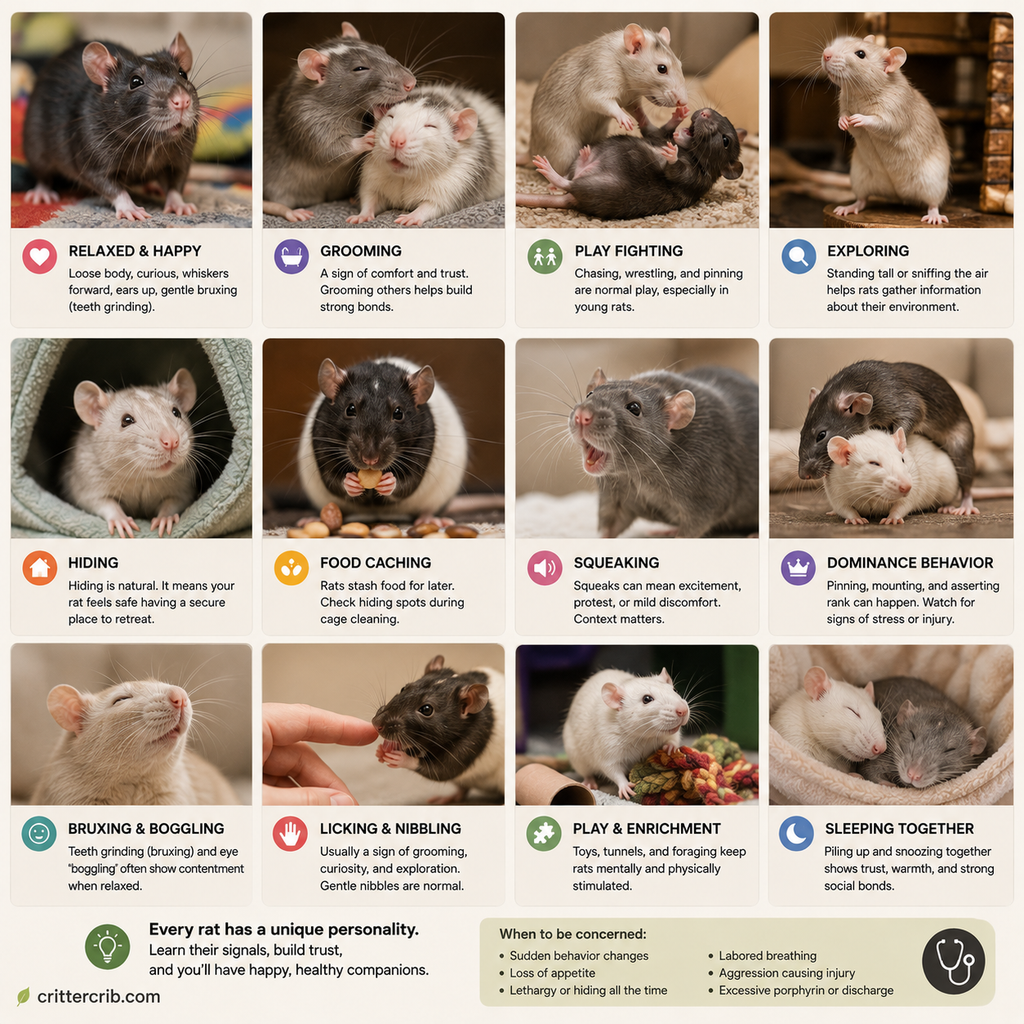
No single behavior tells you everything.
The most useful approach is looking at the whole rat.
Signs of a Relaxed Rat
A comfortable rat may:
- Groom normally
- Explore confidently
- Approach familiar people
- Eat openly
- Rest in exposed positions
- Play with companions
- Accept gentle interaction
- Brux while relaxed
Signs of Fear or Stress
A stressed rat may:
- Freeze frequently
- Hide excessively
- Avoid interaction
- Attempt to escape
- Become unusually defensive
- Remain tense
- Show increased aggression
- Groom excessively
Signs of Potential Aggression
Watch for combinations such as:
- Puffed fur
- Sideways posturing
- Intense staring
- Hissing
- Aggressive chasing
- Biting
- Escalating confrontations
Again, context matters.
Rats wrestle and chase during normal play, so don’t interpret movement alone.
Rats Need Other Rats
Rats are highly social animals and generally shouldn’t be kept alone without a compelling veterinary or behavioral reason.
Human companionship is valuable, but we can’t fully replace another rat.
Compatible rats can:
- Groom each other
- Wrestle
- Sleep together
- Communicate
- Explore together
- Provide social companionship
If you’re considering pet rats, plan around keeping at least a compatible pair rather than a single animal.
Introductions between unfamiliar rats should be handled carefully rather than simply placing them together.
How to Build Trust With a Pet Rat
Trust usually develops through repeated positive experiences.
Don’t force interaction.
Start Slowly
Spend time near the enclosure.
Talk quietly.
Let your rat become familiar with your presence.
Offer Appropriate Treats
Food can help create positive associations.
Offer small appropriate treats from your hand.
Eventually, your rat may begin approaching whenever you open the door.
Let the Rat Approach You
Place your hand inside the enclosure and allow investigation.
Avoid repeatedly chasing a nervous rat around its cage to pick it up.
Practice Gentle Handling
Once your rat becomes comfortable, support its body securely when lifting.
Keep early handling sessions short and positive.
Provide Out-of-Cage Interaction
A secure play area gives your rats opportunities to interact with you voluntarily.
Sit with them and let them explore.
You may quickly become part playground, part climbing structure.
How to Encourage Natural Rat Behaviors
A good habitat should provide opportunities for rats to behave naturally.
Include ways to:
- Climb
- Dig
- Chew
- Forage
- Hide
- Nest
- Explore
- Socialize
- Rest
Make Food More Interesting
Instead of putting every piece of food into a bowl, occasionally use scatter feeding or simple foraging activities.
Hide appropriate food in:
- Cardboard tubes
- Paper
- Boxes
- Foraging toys
Make your rats work a little for something they’d otherwise receive automatically.
Rotate Enrichment
You don’t need to constantly buy new toys.
Rotate safe items periodically.
Even moving familiar objects or introducing a cardboard box can create something new to investigate.
Learn What’s Normal for Your Rats
Perhaps the most important lesson in understanding rat behavior is that “normal” varies.
One rat may be fearless.
Another cautious.
One may spend half its waking life climbing on you.
Another may prefer sitting nearby.
One might squeak dramatically every time a cage mate attempts to groom it.
Another may barely make an audible sound.
Learn those patterns.
They become your baseline.
When a Behavior Change Needs Veterinary Attention
Behavior is often one of the earliest clues that a small animal isn’t feeling well.
Rats may hide signs of illness until they’re significantly affected.
Contact a veterinarian when you notice concerning changes such as:
- Sudden appetite loss
- Significant lethargy
- Difficulty breathing
- Persistent noisy breathing
- Rapid or unexplained weight loss
- Difficulty walking
- Head tilt
- Seizures
- Significant bleeding
- Persistent diarrhea
- Abnormal swelling
- Severe aggression appearing suddenly
- Inability to eat or drink
Don’t wait for a rat to “look extremely sick.”
Small animals can deteriorate quickly.
Having an established veterinarian before an emergency occurs makes getting help much easier.
Frequently Asked Questions About Rat Behavior
How Can I Tell If My Rat Is Happy?
Look for the overall pattern.
A comfortable rat generally eats normally, grooms itself, explores, interacts with companions, rests comfortably, and shows interest in its environment.
Relaxed bruxing and boggling may occur during particularly comfortable moments.
Why Does My Rat Brux When I Pet It?
If your rat is relaxed and voluntarily remaining with you, gentle bruxing may accompany contentment.
Because bruxing can also happen during stress or discomfort, always consider the rest of its body language.
What Does It Mean When a Rat Boggles?
Boggling occurs when the eyes appear to move rapidly in and out as a result of vigorous jaw movement associated with bruxing.
It’s often seen during relaxed or highly stimulating situations.
Why Does My Rat Lick My Hand?
Your rat may be grooming you, investigating your skin, or tasting salt or another scent.
If it voluntarily approaches and remains relaxed, licking can be part of a comfortable social interaction.
Why Does My Rat Pee on My Hand?
Small urine droplets can be scent marking.
Rats sometimes mark people and objects as they explore.
Why Do My Rats Fight?
Many interactions that look like fighting are actually play or normal social behavior.
Wrestling, chasing, and pinning can be normal.
Persistent aggression, injuries, blood, severe bullying, or one rat being prevented from accessing resources are more concerning.
Why Does My Rat Squeak When Another Rat Grooms It?
Some rats protest during grooming or social interactions.
Brief squeaking isn’t necessarily a sign of serious conflict.
Watch the entire interaction and what happens afterward.
Why Does My Rat Hide Food?
Food caching is normal.
Rats may transport food from a feeding area and store it somewhere they consider secure.
Check caches regularly for fresh foods that could spoil.
Why Is My Rat Always Climbing?
Rats are natural climbers and explorers.
Provide safe climbing structures and sufficient enrichment.
Persistent frantic climbing may indicate that your rat needs more space, exercise, enrichment, or interaction.
Why Does My Rat Suddenly Freeze?
A sudden noise, movement, or unfamiliar scent may trigger a prey-animal freezing response.
Give your rat time to assess the situation.
Do Rats Recognize Their Owners?
Pet rats can learn to recognize familiar people through scent, sound, routine, and repeated interactions.
Many begin approaching their caregivers, climbing onto them, or responding to familiar cues.
Understanding Your Rat Gets Easier With Time
At first, rat behavior can seem like a collection of strange habits.
Why are its eyes doing that?
Why did it steal the food you just put down and hide it three feet away?
Why is one rat sitting on another rat?
And why did your carefully arranged hammock suddenly acquire four additional entrances?
Spend enough time with rats and those behaviors begin making sense.
You’ll recognize playful wrestling. You’ll know when a rat is simply freezing because something startled it. You’ll recognize the difference between gentle grooming and a serious confrontation.
You’ll also learn the individual personalities living inside your enclosure.
That’s particularly important because changes in behavior can provide early clues that something isn’t right.
Instead of trying to interpret every movement individually, look at the whole picture: posture, sounds, activity, appetite, environment, social interactions, and your rat’s normal personality.
Provide compatible companionship, enough space, hiding areas, climbing opportunities, chewing materials, foraging activities, and regular interaction.
Then spend time watching.
Rats are constantly communicating.
Once you learn their habits, you’ll be surprised by how much they’re actually telling you.