Leopard geckos may spend plenty of time tucked inside a hide, but that doesn’t mean they benefit from living in a bare enclosure with nothing interesting to do.
In the wild, these small reptiles navigate rocky terrain, investigate their surroundings, search for food, find secure hiding places, and move between different temperatures throughout the day and night. A thoughtfully designed enclosure gives a pet leopard gecko opportunities to perform some of those same natural behaviors.
That’s where enrichment comes in.
Leopard gecko enrichment doesn’t need to involve elaborate toys or constant handling. In fact, some of the best enrichment ideas are surprisingly simple: additional hides, textured surfaces, climbing opportunities, occasional changes to the enclosure, and feeding methods that encourage natural hunting behavior.
The goal isn’t to keep a gecko entertained every minute. It’s to create an environment that gives it choices and encourages safe, species-appropriate activity.
Here are some of the best enrichment ideas for keeping a leopard gecko active and engaged.
What Is Enrichment for a Leopard Gecko?
Enrichment means providing safe opportunities for an animal to interact with its environment and express natural behaviors.
For leopard geckos, that might involve:
- Exploring
- Climbing
- Hunting
- Digging
- Choosing between hiding areas
- Moving between warmer and cooler locations
- Investigating new objects or scents
- Foraging for food
Good enrichment should always be voluntary.
Your gecko should be able to investigate something new or simply ignore it. Enrichment shouldn’t involve repeatedly disturbing the animal, forcing it to interact, or placing it in situations that cause obvious stress.
A well-designed habitat actually provides enrichment around the clock because the gecko has choices about where to go and what to do.
Start With an Enriching Leopard Gecko Habitat
Before adding toys or activities, look at the enclosure itself.
A leopard gecko living in a mostly empty tank won’t get as much benefit from an occasional enrichment activity as one living in a varied, thoughtfully arranged habitat.
The enclosure is the foundation.
A good setup should provide different temperatures, multiple hiding opportunities, safe surfaces, and enough usable space for the gecko to move around.
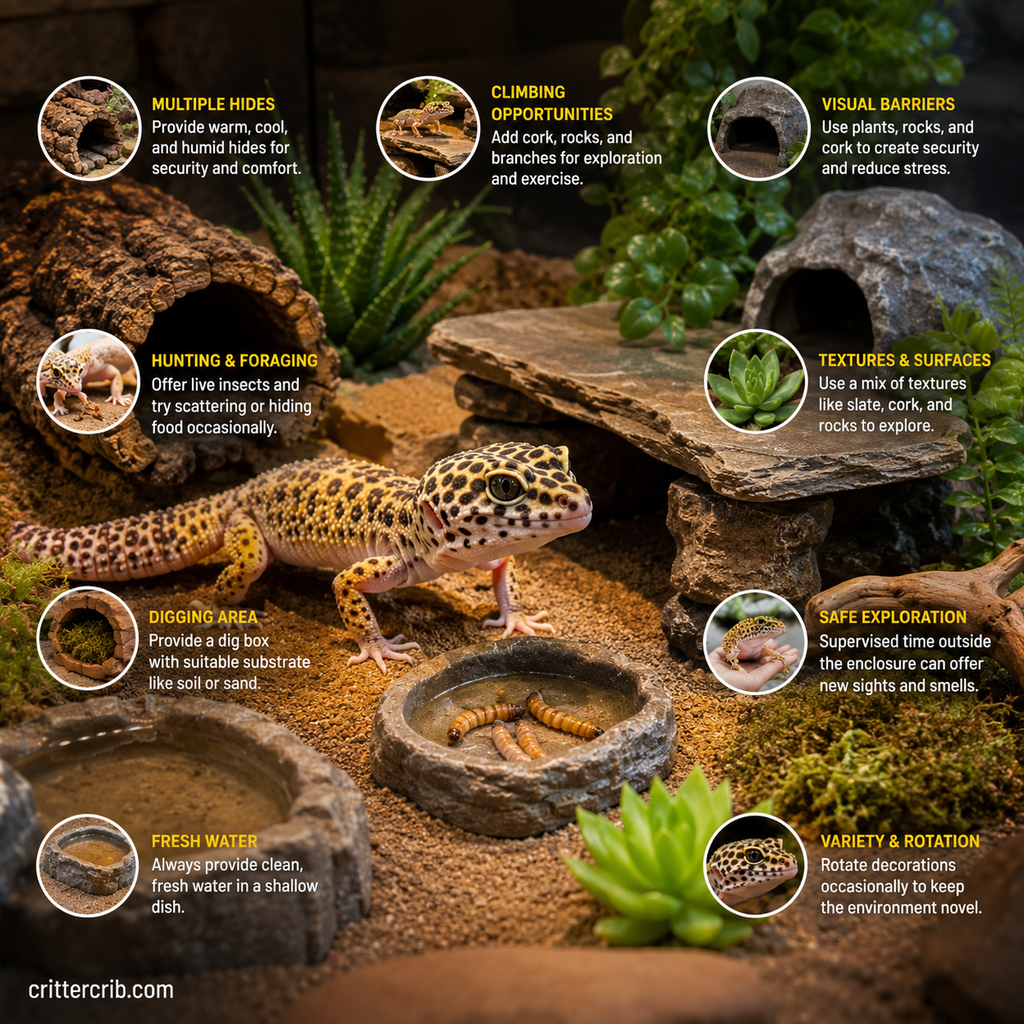
Provide Multiple Hides
Hides aren’t just places for leopard geckos to sleep. They allow the animal to choose where it feels most comfortable while regulating its temperature and moisture exposure.
At minimum, leopard gecko habitats typically include access to:
- A warm hide
- A cool hide
- A humid hide
You can provide additional hiding opportunities beyond these basics.
Cork bark, reptile-safe caves, partially covered areas, rock formations, and other secure structures can create multiple places for the gecko to investigate.
Make sure anything heavy is stable and can’t shift or collapse onto the animal.
1. Create Safe Climbing Opportunities
Leopard geckos aren’t built for climbing smooth vertical surfaces like many arboreal geckos, but that doesn’t mean they never climb.
Low-level climbing can provide excellent physical and environmental enrichment.
Try adding:
- Cork bark
- Low branches
- Stable rocks
- Slate platforms
- Reptile-safe ledges
- Textured ramps
Keep climbing structures relatively low and secure.
Leopard geckos don’t have the adhesive toe pads found on species such as crested geckos, so they’re not especially well equipped to recover from a bad foothold.
A complicated climbing structure isn’t necessary. Even a piece of cork bark positioned at a gentle angle can create another route through the habitat.
2. Build Different Levels Into the Enclosure
An enclosure doesn’t have to be completely flat.
Adding different elevations increases the amount of usable space available to your gecko.
A low platform might create a basking or resting area on top while providing another sheltered area underneath.
You can create different levels with:
- Slate
- Cork
- Rocks
- Low platforms
- Reptile-safe backgrounds
- Commercial reptile ledges
Think of the enclosure as a small landscape rather than an empty box.
The more usable surfaces you create, the more opportunities your leopard gecko has to choose where it wants to spend its time.
3. Encourage Natural Hunting Behavior
Feeding time is one of the easiest opportunities for leopard gecko enrichment.
Leopard geckos are insectivores, and hunting appropriately sized live prey allows them to use natural stalking and striking behaviors.
Instead of making every meal identical, occasionally vary how suitable feeder insects are presented.
Depending on your enclosure and feeding routine, you might allow your gecko to pursue appropriate insects within a controlled area.
Suitable feeder insects can include options such as:
- Crickets
- Dubia roaches
- Black soldier fly larvae
- Mealworms
- Other appropriately sized feeder insects
Variety can provide nutritional benefits as well as different feeding experiences.
Always make sure feeder insects are appropriate for your gecko and properly gut-loaded and supplemented according to its nutritional needs.
Don’t leave uneaten insects such as crickets loose in the enclosure indefinitely, since they may bother or potentially injure a resting gecko.
4. Try Simple Foraging Activities
Food doesn’t always have to appear in exactly the same place.
You can occasionally encourage your leopard gecko to search for food rather than immediately presenting it.
For example, you might place suitable feeder insects in different safe feeding areas or use an escape-resistant feeder dish that requires the gecko to approach and investigate.
Keep these activities easy at first.
Enrichment shouldn’t prevent the gecko from getting enough food. Young, underweight, elderly, sick, or visually impaired geckos may need more straightforward feeding methods.
The purpose is to add a little challenge, not turn dinner into an obstacle course.
5. Add Cork Bark
If you’re looking for one simple enclosure addition that can provide several forms of enrichment, cork bark is hard to beat.
Depending on how it’s positioned, cork can function as:
- A climbing surface
- A hiding area
- A tunnel
- A visual barrier
- A textured walking surface
- Part of a natural-looking habitat
Its irregular shape creates opportunities for exploration that smooth plastic decorations don’t always provide.
Just make sure pieces are positioned securely.
Large or heavy enclosure decorations should never be able to shift and trap the gecko underneath them.
6. Provide Tunnels and Covered Pathways
Leopard geckos often appreciate being able to move around without feeling completely exposed.
You can create covered pathways using appropriately sized reptile-safe materials such as cork tubes, hides, rock formations, or artificial foliage.
These structures allow a gecko to travel through different parts of its habitat while remaining partially concealed.
That’s especially useful in larger enclosures.
Instead of having a wide-open space between two hides, visual barriers and covered areas can make more of the enclosure feel usable.
7. Use Visual Barriers
More open space isn’t always better.
A completely exposed enclosure may leave a leopard gecko reluctant to travel far from its hides.
Breaking up sight lines can make the habitat feel more secure while also creating additional areas to explore.
Visual barriers might include:
- Cork bark
- Artificial plants
- Reptile-safe live plants in suitable setups
- Rocks
- Branches
- Background structures
- Additional hides
The gecko can then move around objects rather than simply crossing an empty enclosure.
This creates a more complex environment without necessarily making it cluttered.
8. Offer a Digging Area When Appropriate
Digging can be another enrichment opportunity for leopard geckos.
If your normal enclosure setup doesn’t provide a suitable digging substrate, a designated dig box can offer an alternative.
The container should be large enough for the gecko to enter and turn around comfortably, and it should contain a reptile-appropriate material that allows some digging behavior.
Avoid substrates or materials that are dusty, chemically treated, sharp, or otherwise unsafe.
Substrate choices are a common point of debate among reptile keepers, and the safest option can depend on the individual animal and overall husbandry setup.
If you’re unsure whether a particular loose substrate is appropriate, discuss your enclosure with an experienced reptile veterinarian.
9. Change Small Parts of the Enclosure Occasionally
You don’t need to completely redesign your leopard gecko’s habitat every week.
Actually, constantly changing everything could be stressful.
Instead, occasionally make small changes.
You might:
- Move a piece of cork
- Change the angle of a branch
- Add a new tunnel
- Swap one decoration for another
- Introduce a different textured surface
- Slightly rearrange a nonessential portion of the habitat
Your gecko may spend time investigating the change.
The key is moderation.
Keep important resources such as essential hides, water, appropriate temperature zones, and other necessities reliably available.
10. Introduce New Textures
Leopard geckos experience their environment partly through physical contact with different surfaces.
A habitat containing only one smooth surface provides relatively little variety.
Safe textures might include:
- Slate
- Cork
- Smooth stone
- Reptile-safe substrate
- Textured hides
- Naturalistic backgrounds
Different textures can also help create a habitat that feels more like a landscape and less like a container.
Avoid anything with sharp edges or small spaces where toes could become trapped.
11. Provide a Humid Hide With Suitable Material
A humid hide is an important husbandry feature, particularly when a leopard gecko is shedding.
It can also add another environmental zone to explore.
Suitable moisture-retaining material can create a noticeably different microenvironment from the rest of the enclosure.
The hide should remain appropriately moist rather than soaking wet, and it should be cleaned regularly to prevent unsanitary conditions.
A gecko may move in and out of the humid hide depending on its needs.
That ability to choose between different microclimates is itself a form of environmental complexity.
12. Create a Safe Exploration Area Outside the Enclosure
Some leopard geckos tolerate supervised exploration outside their habitat.
A secure play area can provide new textures, objects, and spaces to investigate.
This could be a contained area equipped with simple items such as:
- Cardboard tubes
- Small boxes
- Cork bark
- Low climbing objects
- Tunnels
- Soft or textured surfaces
Supervision is essential.
Leopard geckos can squeeze into surprisingly small spaces, and an ordinary room contains plenty of potential hazards.
Keep the gecko away from other pets, electrical cords, gaps under furniture, unsafe plants, chemicals, and places where it could fall or become trapped.
Temperature matters too. Don’t leave a leopard gecko exploring in an area that’s uncomfortably cold.
13. Use Cardboard for Temporary Enrichment
Enrichment doesn’t have to be expensive.
Clean cardboard can be used to create temporary tunnels, barriers, and exploration structures during supervised activities.
For example, you could arrange several small boxes with openings to create a simple maze.
Your gecko can choose whether to walk through, around, or hide inside them.
Because cardboard can’t be thoroughly disinfected and can absorb moisture and waste, it’s generally better treated as temporary enrichment rather than permanent enclosure furniture.
Replace it when it becomes dirty or damaged.
14. Let Your Gecko Investigate Your Hands
Handling can provide stimulation for leopard geckos that are already comfortable interacting with people.
Rather than immediately picking up your gecko, try placing your hand inside the enclosure and allowing it to approach voluntarily.
Some geckos may:
- Smell your hand
- Walk across it
- Climb onto your arm
- Investigate your fingers
- Ignore you completely
All of those responses are fine.
Allowing the gecko to make the first move can make interactions less stressful than repeatedly reaching down and grabbing it from above.
15. Practice Choice-Based Handling
Handling doesn’t need to be something that simply happens to your leopard gecko.
Whenever practical, give it some control over the interaction.
You can place your hand near the gecko and allow it to climb aboard. If it walks away instead, don’t chase it around the enclosure.
Over time, some geckos become comfortable voluntarily stepping onto their owner’s hand.
This can make routine handling easier while providing a change in environment and gentle physical activity.
Not every leopard gecko enjoys frequent handling, though.
Respect the individual animal’s behavior.
16. Use Safe Scents Sparingly
Leopard geckos investigate their environment using chemical cues as well as sight.
Introducing an unfamiliar but safe natural object can occasionally encourage investigation.
However, scent enrichment requires caution.
Never use:
- Essential oils
- Perfumes
- Air fresheners
- Cleaning fragrances
- Scented candles
- Chemicals
- Products intended for dogs or cats
Reptiles can be sensitive to substances that humans might consider harmless.
When in doubt, skip artificial scent enrichment entirely. There are plenty of safer ways to make a leopard gecko’s environment interesting.
17. Create Seasonal or Occasional Enclosure Variations
You can occasionally introduce a new piece of habitat furniture and later remove it.
This keeps some parts of the environment familiar while allowing new opportunities for investigation.
For example, rotate between a few safe enrichment objects such as:
- Different cork pieces
- Tunnels
- Additional hides
- Low platforms
- Rock arrangements
You don’t need dozens of accessories.
A few well-chosen items rotated occasionally can provide variety without overwhelming the enclosure.
18. Give Your Leopard Gecko Places to Choose
One of the most overlooked forms of enrichment is simply providing choices.
Instead of designing an enclosure where there’s only one acceptable place to hide or rest, provide alternatives.
A leopard gecko might choose between:
- Warm and cool areas
- Dry and humid hides
- Open and covered spaces
- High and low surfaces
- Different textures
- Several hiding locations
This lets the animal respond to its own needs rather than having every decision made for it.
Choice is one of the reasons a larger, well-designed enclosure can offer significant benefits.
How Often Should You Provide Enrichment?
There’s no requirement to introduce a brand-new activity every day.
Much of a leopard gecko’s enrichment should come from its permanent environment.
A habitat with hides, varied textures, climbing opportunities, temperature choices, and interesting structures is already providing enrichment whether you’re actively interacting with the gecko or not.
Additional activities can be introduced periodically.
For example:
- Hunting opportunities can happen during normal feeding.
- Minor enclosure changes can happen occasionally.
- Supervised exploration can happen when convenient and appropriate.
- Handling can occur according to the gecko’s tolerance.
Watch the animal’s response rather than following a rigid schedule.
How Do You Know if Your Leopard Gecko Likes Enrichment?
You can’t ask your gecko whether it enjoyed a new tunnel, but you can observe its behavior.
Positive or neutral responses might include:
- Approaching a new object
- Smelling or licking it
- Walking over or around it
- Climbing
- Entering a new hide
- Hunting actively
- Calmly exploring
- Returning to the object later
Don’t expect an immediate reaction.
A leopard gecko might ignore something for hours and investigate it after the room becomes quiet.
Remember that leopard geckos are crepuscular and nocturnal in their activity patterns, so you may see more exploration during evening and nighttime hours than during the middle of the day.
Signs Enrichment May Be Causing Stress
Not every enrichment idea will suit every leopard gecko.
Watch for persistent behavioral changes such as:
- Frantic attempts to escape
- Repeatedly hiding more than usual
- Refusing food
- Defensive behavior
- Tail waving
- Unusual agitation
- Avoiding an area completely
A brief period of caution around something new doesn’t necessarily mean there’s a problem.
But if your gecko appears consistently distressed after a change, remove the new item and return the habitat to a familiar arrangement.
Enrichment Ideas to Avoid
It’s easy to assume that anything marketed as a reptile toy must be safe. That’s not necessarily true.
Avoid enrichment that introduces unnecessary risks.
Exercise Balls
Don’t place a leopard gecko inside an exercise ball designed for rodents.
These devices aren’t designed for leopard gecko anatomy or behavior and may cause stress or injury.
High Climbing Structures
A leopard gecko may climb, but it isn’t an arboreal species.
Avoid creating tall structures where a fall could result in injury.
Low, stable climbing opportunities are a better choice.
Mirrors
A mirror isn’t necessary enrichment for a leopard gecko.
The reflection could potentially be interpreted as another animal and cause stress rather than providing meaningful stimulation.
Interaction With Other Pets
Don’t introduce your leopard gecko to a dog, cat, bird, or another household pet as enrichment.
Even a calm pet can suddenly injure a small reptile.
Observation through a secure enclosure isn’t a reason to allow direct contact.
Wild Insects
Catching insects outdoors might sound like a great way to provide hunting enrichment, but wild insects can carry parasites, pesticides, or other contaminants.
Use appropriately raised feeder insects from reputable sources instead.
Unstable Rocks and Decorations
Any heavy structure should be secure.
Leopard geckos may dig around or underneath objects, potentially causing unstable decorations to shift.
Place heavy structures so they can’t collapse onto the gecko.
Does a Leopard Gecko Need Toys?
Not in the same sense as a dog, cat, or parrot.
A leopard gecko probably isn’t waiting for you to buy it a miniature playground.
What it does need is an environment that allows natural behavior.
Instead of focusing on traditional “toys,” think about functional enrichment:
- Things to climb
- Places to hide
- Areas to explore
- Different textures
- Opportunities to hunt
- Safe objects to investigate
- Choices between different environmental conditions
A piece of cork bark may offer more meaningful enrichment than an elaborate product marketed specifically as a reptile toy.
Can Leopard Geckos Get Bored?
It’s difficult to measure boredom in a leopard gecko the same way we might recognize it in a highly social mammal.
We should be cautious about assigning human emotions to reptile behavior.
What we can say is that leopard geckos naturally interact with complex environments, and captive animals can benefit from opportunities to explore and perform species-appropriate behaviors.
Providing enrichment isn’t about assuming your gecko needs constant entertainment.
It’s about giving it a more functional and stimulating environment.
Is a Bigger Enclosure Better for Enrichment?
Additional space can create more opportunities for enrichment, but only when the space is used effectively.
A large empty enclosure isn’t automatically better than a thoughtfully arranged habitat.
Extra room becomes useful when it allows you to create:
- More hiding areas
- Better temperature gradients
- Additional climbing surfaces
- Multiple pathways
- Visual barriers
- Different textures
- Separate microenvironments
The goal is usable space rather than empty floor area.
A leopard gecko should be able to move around the enclosure while still finding plenty of secure places to retreat.
Enrichment Should Never Replace Proper Husbandry
It’s worth emphasizing that enrichment comes after basic care requirements.
A leopard gecko with an elaborate habitat still needs appropriate:
- Heating
- Temperature monitoring
- Hides
- Humidity
- Nutrition
- Calcium and vitamin supplementation
- Water
- Cleanliness
- Veterinary care when necessary
A new climbing structure won’t compensate for incorrect temperatures, and an interesting feeding activity can’t correct an unbalanced diet.
Think of enrichment as another layer of good husbandry rather than a replacement for it.
Frequently Asked Questions About Leopard Gecko Enrichment
What Is the Best Enrichment for a Leopard Gecko?
Some of the best enrichment comes directly from a well-designed enclosure.
Multiple hides, low climbing structures, varied textures, visual barriers, hunting opportunities, and different areas to explore can encourage natural behavior without requiring complicated toys.
Do Leopard Geckos Like to Explore?
Many leopard geckos will investigate their environment, particularly when they’re active during the evening or nighttime.
Individual personalities vary. Some geckos appear relatively adventurous, while others prefer staying close to familiar hiding areas.
Do Leopard Geckos Like Climbing?
Leopard geckos can and do climb low, textured objects.
They’re terrestrial rather than arboreal geckos, however, so climbing structures should be relatively low, stable, and easy to grip.
Should I Rearrange My Leopard Gecko’s Tank?
Occasional small changes can provide opportunities for exploration.
Avoid constantly rearranging the entire habitat, since maintaining familiar hiding places and environmental conditions can help your gecko feel secure.
Can I Let My Leopard Gecko Explore My Room?
Supervised exploration may be appropriate for some leopard geckos, but a secure, controlled area is safer than allowing unrestricted access to a room.
Household spaces contain gaps, furniture, electrical equipment, other pets, and numerous other hazards.
Can I Make Homemade Leopard Gecko Enrichment?
Yes.
Simple items such as clean cardboard tunnels and boxes can provide temporary supervised enrichment. Cork, reptile-safe rocks, slate, and other appropriate materials can also be incorporated into the enclosure.
Always prioritize safety over appearance.
Final Thoughts
The best leopard gecko enrichment doesn’t have to be expensive or complicated.
Start with the habitat itself.
Give your gecko multiple places to hide, low structures to climb, different surfaces to investigate, secure pathways to explore, and opportunities to hunt appropriate live prey. Once those basics are in place, occasional enclosure changes, supervised exploration, and choice-based handling can provide additional variety.
Most importantly, pay attention to your individual gecko.
Some leopard geckos immediately investigate anything new. Others would rather watch from the entrance of their favorite hide until they’re confident the strange new piece of cork isn’t going to eat them.
Both reactions are normal.
Enrichment should provide opportunities, not obligations. When your leopard gecko can choose whether to climb, hunt, explore, hide, dig, or simply relax somewhere comfortable, you’re creating a habitat that supports natural behavior while keeping safety and good husbandry at the center of its care.