
Corn snakes are popular pet snakes for good reason. They’re generally manageable in size, usually adapt well to captivity, and don’t require an overly complicated setup once their basic needs are understood.
That doesn’t mean they’re a “set it and forget it” pet.
A corn snake still needs a secure enclosure, appropriate temperatures, suitable humidity, plenty of places to hide, a balanced feeding routine, fresh water, and regular monitoring. They’re also excellent escape artists, which is something many first-time owners discover a little too late.
The good news is that corn snake care becomes fairly straightforward once the habitat is properly established.
This guide covers the essentials, from setting up the enclosure and choosing substrate to feeding, handling, shedding, cleaning, and recognizing when something may be wrong.
Corn Snake Care at a Glance
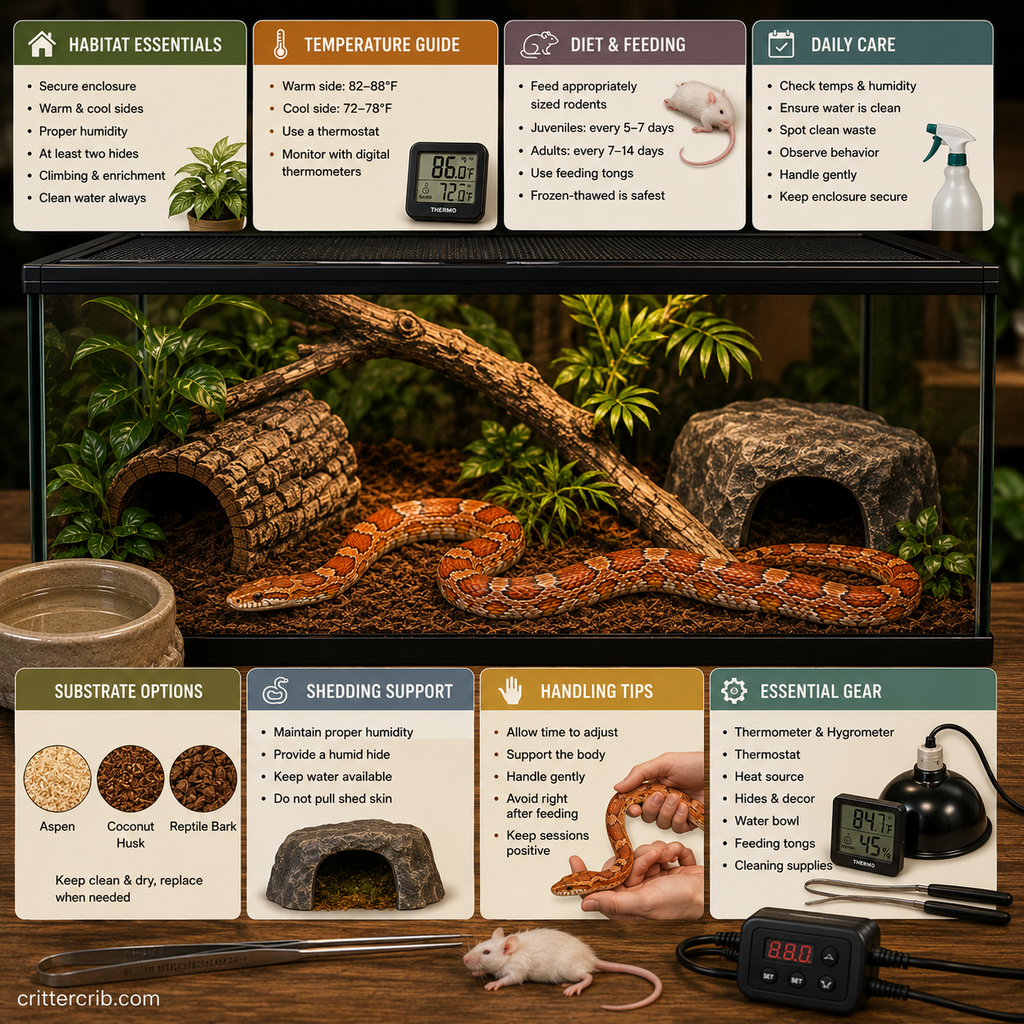
Before getting into the details, here’s a quick overview of what a corn snake needs:
- Secure enclosure with enough room to stretch and explore
- Warm and cool areas for thermoregulation
- Thermostatically controlled heating
- Reliable temperature monitoring
- Appropriate humidity
- At least two secure hides
- Suitable substrate
- Fresh drinking water
- Appropriately sized prey
- Climbing and exploration opportunities
- Regular spot cleaning
- Gentle, appropriate handling
- Access to a reptile veterinarian when needed
The exact setup may vary depending on your snake’s age, enclosure type, room conditions, and climate.
How Big Do Corn Snakes Get?
Knowing the adult size is important before choosing an enclosure.
Most adult corn snakes reach roughly 3 to 5 feet in length, although individual snakes can fall outside that range.
They’re relatively slender snakes rather than heavy-bodied animals.
Hatchlings start out much smaller, but corn snakes grow considerably over their first few years. If you’re buying an enclosure for a young snake, keep its eventual adult size in mind.
With good care, corn snakes can also live for many years, so choosing one should be viewed as a long-term commitment rather than a short-term beginner pet.
Choosing the Right Corn Snake Enclosure
The enclosure needs to do several things at once.
It should:
- Prevent escape
- Provide adequate floor space
- Allow a temperature gradient
- Maintain appropriate humidity
- Provide ventilation
- Accommodate hides and enrichment
- Be easy to inspect and clean
If you’re building an enclosure from scratch, our corn snake habitat setup guide goes deeper into enclosure size, heating, humidity, substrate, hides, climbing opportunities, water, and environmental enrichment.
Glass terrariums and purpose-built reptile enclosures can both work.
PVC and other reptile-specific enclosures may offer advantages in heat and humidity retention, depending on your home environment.
Corn Snake Enclosure Size
For an adult corn snake, an enclosure around 4 feet long by 2 feet wide by 2 feet tall provides useful room for movement, hides, climbing structures, and distinct temperature zones.
Individual snake size matters, so larger corn snakes may benefit from additional space.
A useful principle is that the enclosure should allow the snake to stretch out and move naturally rather than spending its life confined to a small footprint.
Young snakes can be housed in appropriately designed larger enclosures as well.
The concern with a large habitat isn’t the space itself. It’s exposure.
A small corn snake placed in a huge empty enclosure may feel vulnerable. A larger enclosure filled with appropriately sized hides, plants, branches, cork, and visual barriers is very different.
Corn Snakes Are Excellent Escape Artists
Security deserves its own section because corn snakes are remarkably good at finding openings.
A young corn snake can fit through a gap that looks impossibly small.
Before putting your snake into its enclosure, inspect:
- Door gaps
- Lid edges
- Cable openings
- Ventilation openings
- Sliding door tracks
- Corners
- Equipment ports
Top-opening aquariums need a secure lid designed to resist pushing.
Simply placing something heavy on top isn’t a good substitute for a properly secured enclosure.
Check the enclosure regularly as well. Doors, screens, clips, and fittings can loosen over time.
Creating a Temperature Gradient
Corn snakes are ectothermic. They regulate body temperature by moving between different environmental conditions.
That means the enclosure shouldn’t be one temperature from end to end.
Create:
- A warmer side
- A transition area
- A cooler side
Your snake can then choose where to spend its time.
This is one reason adequate enclosure length is important. A very small habitat makes it harder to establish meaningfully different temperature zones.
Corn Snake Temperature Range
Rather than relying on one enclosure-wide number, monitor different areas.
A typical setup provides a warm area in roughly the mid-80s°F, while the cooler portion remains in the 70s°F.
Exact temperatures can vary somewhat depending on where and how they’re measured, so use reliable equipment and evaluate both air and surface temperatures where relevant.
Avoid excessive heat.
Corn snakes need warmth, but they also need somewhere cooler to retreat.
Choosing a Heat Source
Different enclosure designs work with different heating systems.
Overhead heating is commonly used because it can create a natural warm area from above.
Whatever heat source you choose should be appropriate for:
- Enclosure material
- Enclosure dimensions
- Room temperature
- Ventilation
- Installation method
The heat source should be positioned toward one end rather than centered over the entire enclosure.
That helps create the warm-to-cool gradient.
Always Use a Thermostat
A thermostat is one of the most important pieces of equipment in a snake enclosure.
It regulates the heat source.
This is different from a thermometer, which only measures temperature.
Don’t run heating equipment that requires regulation without an appropriate thermostat.
A heat source can become dangerously hot if something goes wrong, and simply buying a particular wattage doesn’t guarantee safe enclosure temperatures.
Follow the thermostat manufacturer’s instructions for probe placement and configuration.
How to Monitor Temperature
Use digital thermometers to monitor the habitat.
It’s useful to measure both the warm and cool portions of the enclosure.
An infrared temperature gun is also helpful for checking surface temperatures on:
- Substrate
- Branches
- Hides
- Basking surfaces
An infrared thermometer doesn’t replace your enclosure thermometers because it measures surfaces rather than ambient air.
Using both gives you a better picture of what’s happening inside the habitat.
Corn Snake Humidity
Corn snakes don’t require the constantly high humidity associated with tropical reptiles, but excessively dry conditions can contribute to shedding problems.
For many setups, moderate humidity around 40–60% works well, with temporary access to higher humidity during shedding.
Your local environment makes a difference.
Someone living in a humid climate may need to do very little to maintain appropriate conditions, while a home with dry indoor air may require more active humidity management.
Use a digital hygrometer rather than guessing.
Providing a Humid Hide
A humid hide can be particularly useful when your corn snake is preparing to shed.
This is a secure hide containing a moisture-retaining material that creates a localized area of higher humidity.
The snake can choose whether to use it.
Keep the material appropriately moist rather than soaking wet.
A humid hide doesn’t replace proper overall husbandry, but it gives the snake another environmental option.
How Many Hides Does a Corn Snake Need?
Provide at least two secure hides:
- One toward the warm side
- One toward the cooler side
Additional hides are welcome, particularly in a larger enclosure.
A good hide should feel secure rather than cavernous.
Corn snakes often appreciate hides where their bodies can contact the interior surfaces when curled up.
Try to provide similarly secure options at different temperatures so the snake doesn’t have to choose between its preferred hide and its preferred temperature.
Best Substrate for Corn Snakes
Several substrates can work for corn snakes.
Common options include:
- Aspen designed for reptile use
- Coconut-based substrates
- Suitable naturalistic substrate mixtures
- Paper towels for temporary situations
Each has advantages and disadvantages.
Aspen
Aspen is popular because it’s easy to find, relatively easy to spot clean, and allows burrowing.
However, it doesn’t handle excessive moisture well and can mold if kept wet.
Coconut-Based Substrate
Coconut-based products can retain more moisture, which may be useful in drier environments.
They shouldn’t remain waterlogged.
Naturalistic Substrate
More natural substrate mixtures can support digging and a more complex habitat.
Make sure any mixture is appropriate for reptiles and doesn’t contain fertilizers, pesticides, or other unsafe additives.
Paper Towels
Paper towels aren’t particularly enriching, but they’re useful for:
- Quarantine
- Monitoring a new snake
- Evaluating abnormal waste
- Certain health situations
They’re inexpensive and easy to replace.
How Deep Should the Substrate Be?
Corn snakes will often burrow when given the opportunity.
Providing a few inches of suitable substrate allows the snake to dig, tunnel, and partially conceal itself.
You don’t necessarily need the substrate to be perfectly level.
Varying depth can create additional environmental complexity.
Make sure heavy decorations are securely supported rather than balancing on loose substrate where the snake can burrow underneath them.
Do Corn Snakes Need UVB?
Corn snakes can benefit from appropriately provided UVB lighting, even though they’re capable of surviving in captivity without it when other aspects of husbandry are properly managed.
If you provide UVB, choose equipment appropriate for the species and enclosure.
Consider:
- Bulb strength
- Fixture
- Distance
- Enclosure height
- Mesh obstruction
- Available shade
The snake should have opportunities to move between brighter and darker areas.
UVB should also follow a normal day-night cycle rather than remaining on constantly.
Corn Snake Day and Night Cycle
A predictable light cycle helps establish a normal rhythm.
Provide a clear daytime period followed by darkness at night.
Timers make this easy.
Avoid leaving bright lights or colored nighttime bulbs on 24 hours a day.
Your snake doesn’t need a red, blue, or purple light shining into the enclosure all night.
If nighttime heating is necessary because your home becomes too cool, use a suitable heat source that doesn’t create visible light.
Water Requirements
Your corn snake should have access to clean drinking water.
Use a sturdy bowl that the snake can’t easily tip over.
The bowl should be:
- Easy to access
- Easy to clean
- Stable
- Made from a safe material
Replace the water regularly and clean the dish whenever it becomes contaminated.
Some corn snakes may occasionally soak, particularly around shedding, although persistent soaking can also be worth investigating.
Check enclosure temperatures, humidity, mites, and general health if soaking becomes unusually frequent.
Furnishing a Corn Snake Habitat
A good corn snake enclosure contains more than two hides and a water bowl.
Corn snakes are active explorers, particularly when they’re comfortable and the environment provides opportunities to move. A well-planned corn snake enclosure setup should give them places to hide, climb, burrow, explore, and choose between different environmental conditions.
Useful furnishings include:
- Branches
- Cork bark
- Artificial plants
- Reptile-safe live plants
- Leaf litter
- Additional hides
- Tunnels
- Stable rocks
- Platforms
- Visual barriers
The goal isn’t to make the enclosure look crowded for decoration’s sake.
You’re creating usable structure.
Do Corn Snakes Climb?
Yes.
Corn snakes are capable climbers and may make good use of vertical space.
Provide sturdy branches, ledges, or other climbing opportunities.
Everything needs to be secure enough to support the snake’s weight.
Check branches periodically to make sure they haven’t loosened.
A corn snake pushing against enclosure furnishings can gradually move objects that initially seemed stable.
What Do Corn Snakes Eat?
Captive corn snakes primarily eat appropriately sized rodents.
Frozen-thawed mice are commonly used.
The size of the prey should be matched to the individual snake rather than selected solely by age.
A growing juvenile and a mature adult have very different nutritional requirements.
How Often Should You Feed a Corn Snake?
Feeding frequency changes as the snake grows.
Young corn snakes generally eat more frequently than adults because they’re actively growing.
Adults usually require meals less often.
Rather than following an inflexible schedule forever, consider:
- Age
- Weight
- Body condition
- Prey size
- Growth rate
- Activity
- Reproductive status
Overfeeding is a real concern in captive snakes.
A snake accepting food doesn’t necessarily mean it needs to be fed more frequently.
How to Choose the Right Prey Size
Prey should be appropriately sized for your individual snake.
Keep records of:
- Snake weight
- Feeding date
- Prey size
- Successful meals
- Refused meals
A digital kitchen scale makes tracking growth much easier.
Don’t dramatically increase prey size just because the snake successfully ate its previous meal.
Gradual adjustment based on growth and body condition is more appropriate.
Frozen-Thawed vs. Live Prey
Frozen-thawed rodents are widely used for captive corn snakes.
One important advantage is that the prey can’t injure the snake.
A live rodent can bite and seriously injure a snake, particularly if it’s left unattended.
If your snake already eats frozen-thawed prey reliably, there’s generally no need to introduce the additional risks associated with live feeding.
How to Feed a Corn Snake
Use long feeding tongs to offer appropriately prepared prey.
Keep your fingers away from the prey item.
After the snake grabs the food, allow it to eat without unnecessary disturbance.
You generally don’t need to move a corn snake into a separate feeding container.
Feeding in the normal enclosure avoids the stress and handling associated with moving a snake immediately before and after a meal.
What If Your Corn Snake Refuses Food?
One refused meal isn’t automatically an emergency.
Corn snakes may occasionally refuse food because of:
- Shedding
- Stress
- Seasonal changes
- Recent relocation
- Incorrect temperatures
- Prey preferences
- Illness
Check husbandry first.
If the snake repeatedly refuses meals, loses weight, or shows other concerning symptoms, consult a reptile veterinarian.
Keeping weight and feeding records makes it much easier to tell whether a feeding issue is becoming significant.
Corn Snake Shedding
Healthy corn snakes periodically shed their outer layer of skin.
Before shedding, you may notice:
- Duller coloration
- Cloudy or bluish eyes
- Reduced activity
- Increased hiding
- Reduced appetite
The eyes may clear again shortly before the actual shed.
Don’t assume the shed is finished just because the eyes look normal again.
Helping Your Corn Snake Shed Properly
Good hydration and appropriate humidity are the foundation of healthy shedding.
Provide:
- Fresh drinking water
- Appropriate enclosure humidity
- A humid hide when useful
- Textured surfaces the snake can rub against
Avoid manually peeling skin from the snake.
After a shed, inspect the discarded skin and the snake.
Pay particular attention to the tail tip and eye area for retained shed.
Repeated shedding problems are often a reason to review husbandry and potentially seek veterinary advice.
Handling a Corn Snake
Corn snakes generally tolerate gentle handling well once accustomed to it.
When picking up your snake:
- Approach calmly
- Support the body
- Avoid squeezing
- Allow the snake to move through your hands
- Keep it away from dangerous heights
- Watch for opportunities to escape
Young corn snakes can be quick.
Handle them over a safe area rather than standing somewhere the snake could fall or disappear behind furniture.
When Shouldn’t You Handle Your Corn Snake?
There are times when it’s better to leave the snake alone.
Avoid unnecessary handling:
- Immediately after feeding
- During obvious stress
- During illness or injury
- When a new snake is still settling in
- During parts of the shedding cycle if the snake seems uncomfortable
After feeding, give the snake time to digest without being handled.
Excessive disturbance soon after a meal can contribute to regurgitation.
How Often Should You Clean a Corn Snake Enclosure?
Most maintenance can be handled through regular spot cleaning.
Remove:
- Feces
- Urates
- Shed skin
- Soiled substrate
- Spilled food material
- Other visible waste
Replace water regularly and clean the bowl as needed.
A complete deep clean doesn’t need to happen every time the snake produces waste.
Periodic deeper cleaning can be performed based on the condition of the enclosure and substrate.
How to Deep Clean the Habitat
When deeper cleaning is necessary:
- Move the snake to a secure temporary container.
- Remove decorations and dishes.
- Remove substrate that needs replacing.
- Clean away visible organic debris.
- Wash enclosure surfaces.
- Disinfect with an appropriate product when needed.
- Follow dilution and contact-time instructions.
- Rinse if required.
- Allow everything to dry appropriately.
- Add fresh substrate and furnishings.
- Return the snake once the habitat is ready.
Never mix cleaning chemicals.
Keep cleaning supplies dedicated to reptile use whenever possible.
Daily and Weekly Corn Snake Care
Corn snakes don’t need hours of attention every day.
Most daily care is simply observation.
Daily Checks
Take a quick look at:
- Water
- Temperature
- Humidity
- Snake behavior
- Enclosure security
- Visible waste
You don’t need to pull the snake out of its hide every day just to confirm it’s there.
Regular Maintenance
Throughout the week, you may need to:
- Replace water
- Spot clean waste
- Clean the water bowl
- Check equipment
- Inspect the enclosure
- Remove shed skin
- Adjust humidity if needed
Periodic Tasks
Less frequent tasks include:
- Weighing the snake
- Replacing substrate
- Deep cleaning
- Inspecting heating equipment
- Checking thermostat operation
- Inspecting branches and decorations
A simple routine makes maintenance much easier than waiting until something becomes a problem.
Understanding Normal Corn Snake Behavior
Corn snakes spend plenty of time hiding, particularly during the day.
That doesn’t necessarily mean something is wrong.
You may also see your snake:
- Exploring in the evening
- Climbing
- Burrowing
- Resting beneath substrate
- Moving between hides
- Investigating enclosure doors
- Becoming less active before shedding
Get familiar with your individual snake’s routine.
Changes from that baseline can sometimes tell you more than any single behavior.
Signs of Stress
Possible stress-related behavior can include:
- Repeated escape attempts
- Constant glass surfing
- Excessive defensive behavior
- Persistent refusal to eat
- Unusual inactivity
- Constantly remaining exposed or restless
Stress can have many causes.
Check:
- Temperatures
- Humidity
- Hide availability
- Enclosure security
- Excessive handling
- Recent environmental changes
- Exposure to other pets
- General health
One unusual day doesn’t necessarily indicate a problem. Persistent behavioral changes deserve more attention.
Common Corn Snake Health Concerns
Good husbandry helps reduce the risk of many health problems, but no setup guarantees that a snake will never become ill.
Problems that can affect captive snakes include:
- Respiratory infections
- External parasites such as mites
- Retained shed
- Injuries
- Regurgitation
- Mouth infections
- Digestive problems
- Obesity
- Dehydration
Establishing care with a veterinarian experienced with reptiles is useful before an emergency occurs.
When to Contact a Reptile Veterinarian
Seek professional advice if your corn snake develops concerning symptoms such as:
- Difficulty breathing
- Wheezing or unusual respiratory sounds
- Bubbles or discharge around the mouth or nose
- Repeated regurgitation
- Significant unexplained weight loss
- Persistent refusal to eat with declining condition
- Swelling
- Wounds
- Severe lethargy
- Neurological symptoms
- Persistent shedding problems
- Signs of parasites
Don’t rely exclusively on internet care guides when your snake appears ill.
Husbandry adjustments are important when something is wrong with the environment, but they aren’t a replacement for veterinary diagnosis and treatment.
Can Corn Snakes Live Together?
Corn snakes are best housed individually.
Keeping multiple snakes together makes it harder to monitor:
- Feeding
- Weight
- Waste
- Shedding
- Health
- Temperature preferences
It can also introduce competition and other risks.
Providing each corn snake with its own properly equipped enclosure makes routine care and health monitoring much easier.
Common Corn Snake Care Mistakes
Many beginner mistakes are easy to avoid once you know what to look for. Our guide to common corn snake care mistakes and how to avoid them goes deeper into problems with heating, humidity, feeding, handling, enclosure setup, and other husbandry issues new owners commonly encounter.
Using an Insecure Lid
Escape prevention should be a priority from day one.
Check every possible gap.
Heating Without a Thermostat
Don’t run appropriate heating equipment uncontrolled.
A thermostat is essential safety equipment.
Providing Only One Hide
Your snake should have secure hiding options at different temperatures.
Keeping the Enclosure Too Empty
Provide cover, climbing opportunities, and visual barriers.
Feeding Too Frequently
More food doesn’t necessarily mean a healthier snake.
Monitor body condition and growth.
Guessing Temperature and Humidity
Use digital monitoring equipment.
Measurements are much more useful than assumptions.
Handling Too Soon After Feeding
Give the snake time to digest its meal.
Keeping the Habitat Too Small
Corn snakes are active animals capable of exploring, climbing, and burrowing.
Give them enough usable space to do those things.
Corn Snake Beginner Supplies Checklist
Before bringing your snake home, have the enclosure completely prepared.
Habitat
- Secure enclosure
- Appropriate substrate
- Warm hide
- Cool hide
- Additional cover
- Climbing branches or structures
- Stable water bowl
Heating and Monitoring
- Appropriate heat source
- Thermostat
- Digital thermometers
- Digital hygrometer
- Infrared temperature gun, recommended
Lighting
- Day-night lighting
- UVB setup if provided
- Timer, recommended
Feeding
- Appropriately sized frozen-thawed prey
- Feeding tongs
- Digital kitchen scale
Maintenance
- Cleaning supplies
- Spare substrate
- Secure temporary container
- Reptile veterinarian contact information
Set up the enclosure and let it operate before the snake arrives.
That gives you time to confirm that temperatures, humidity, lighting, and heating controls are working correctly.
Frequently Asked Questions About Corn Snake Care
Are Corn Snakes Good for Beginners?
Corn snakes are often considered suitable for responsible first-time snake keepers because of their manageable size, relatively straightforward husbandry, and generally manageable temperament.
They still require proper heating, feeding, housing, and long-term care.
How Big of an Enclosure Does a Corn Snake Need?
For an adult, an enclosure around 4 feet long by 2 feet wide by 2 feet tall provides useful space for movement, hides, climbing opportunities, and a temperature gradient.
Larger individuals may benefit from additional room.
What Temperature Does a Corn Snake Need?
Provide a temperature gradient rather than one enclosure-wide temperature. A warm area in approximately the mid-80s°F and a cooler area in the 70s°F allows the snake to thermoregulate.
Always verify conditions with reliable monitoring equipment.
What Humidity Does a Corn Snake Need?
Moderate humidity around 40–60% works well for many corn snake setups, with access to additional humidity during shedding when necessary.
Actual requirements and management can vary with enclosure design and local climate.
How Often Do Corn Snakes Eat?
Young growing corn snakes generally eat more frequently than adults.
Feeding schedules should account for the snake’s age, weight, body condition, prey size, and growth rather than relying on one schedule for every animal.
Do Corn Snakes Need a Heat Lamp?
Corn snakes need appropriate warmth, but the specific heat source depends on the enclosure.
Overhead heating is one option. Whatever system you use should create a safe temperature gradient and be properly controlled.
Do Corn Snakes Need UVB?
Appropriately provided UVB can be beneficial and may be incorporated into a well-designed enclosure. Choose the fixture and output according to enclosure dimensions, distance, and the snake’s ability to move into shaded areas.
How Often Should I Handle My Corn Snake?
Once a healthy snake has settled into its home, gentle handling can be introduced gradually.
You don’t need to handle it every day. Keep sessions manageable and avoid unnecessary handling after meals or when the snake is stressed.
How Long Do Corn Snakes Live?
With appropriate captive care, corn snakes can live well over a decade, and some live considerably longer.
Anyone considering one should be prepared for a long-term commitment.
Final Thoughts
Corn snake care isn’t difficult once you understand how the pieces fit together.
Start with a secure enclosure that gives the snake enough room to move, stretch, climb, hide, and choose between warmer and cooler areas. Add a thermostatically controlled heat source, accurate temperature and humidity monitoring, multiple hides, suitable substrate, fresh water, and plenty of environmental structure.
Feeding is relatively straightforward when you use appropriately sized prey and adjust the schedule as the snake grows. Regular weight checks can help you monitor development without relying solely on appearance.
Daily maintenance is usually simple. Check water, temperature, humidity, enclosure security, and your snake’s general behavior. Spot clean when needed and save disruptive deep cleaning for when the habitat actually requires it.
Most importantly, get to know your individual snake.
A corn snake that spends most afternoons hidden and comes out to explore in the evening may be behaving perfectly normally. Changes in appetite, weight, breathing, shedding, movement, or established behavior are much more informative when you already know what “normal” looks like for your snake.
Build the habitat correctly from the beginning, monitor it consistently, and make adjustments as your corn snake grows. Those fundamentals will do far more for its long-term care than constantly adding new products or making unnecessary changes to the enclosure.