A crested gecko enclosure needs more than food, water, and somewhere to sleep.
In the wild, crested geckos spend their nights climbing through vegetation, navigating branches, searching for food, and exploring their surroundings. A captive gecko doesn’t need to hunt for survival, but it can still benefit from opportunities to move, investigate, climb, hide, and make choices.
That’s where enrichment comes in.
Good enrichment doesn’t mean constantly handling your gecko or filling the enclosure with complicated toys. In fact, some of the best enrichment comes from simply designing the habitat around natural crested gecko behavior.
Here are practical ways to make your crested gecko’s environment more interesting while keeping safety and comfort first.
What Is Enrichment for Crested Geckos?
Enrichment is anything that safely encourages natural behaviors or gives an animal meaningful choices within its environment.
For crested geckos, that can include opportunities to:
- Climb
- Jump
- Explore
- Hide
- Forage
- Lick and investigate food
- Choose different resting locations
- Move between environmental zones
- Interact with different textures
The goal isn’t to keep your gecko constantly busy.
Crested geckos are naturally inactive for portions of the day. They’re primarily active during the evening and night, so a gecko sleeping in foliage during daylight hours isn’t necessarily bored.
Good enrichment works with the animal’s natural rhythm instead of forcing activity.
Start With the Enclosure
Before buying anything marketed as a reptile “toy,” look at the habitat itself.
The enclosure is where your crested gecko spends most of its life.
A well-designed habitat should already provide opportunities for movement, exploration, hiding, and choice.
Crested geckos are arboreal, so vertical space is particularly important.
Rather than leaving the upper half of the enclosure empty, use it.
Create pathways that allow your gecko to move from the bottom to the top and from one side to the other without relying entirely on the glass walls.
1. Add Plenty of Climbing Branches
Branches are one of the simplest and most useful forms of crested gecko enrichment.
Use branches at different:
- Heights
- Angles
- Thicknesses
- Orientations
Horizontal branches are particularly valuable because they provide comfortable resting and traveling surfaces.
Diagonal and vertical branches add additional routes through the enclosure.
Natural-looking options may include reptile-safe wood, cork bark, bamboo, and commercially produced reptile branches.
Whatever you use, make sure it’s clean, appropriate for reptile use, and securely positioned.
A branch that shifts when the gecko jumps onto it isn’t enrichment—it’s a fall hazard.
2. Create Multiple Routes Through the Habitat
Try thinking of your enclosure as a three-dimensional trail system.
Can your gecko move from its favorite hide to its feeding ledge using several different paths?
Or is there only one branch in an otherwise empty enclosure?
Connect different areas using:
- Branches
- Cork tubes
- Vines
- Plants
- Ledges
- Flexible reptile-safe climbing structures
You don’t need to create a jungle so dense that the gecko can’t move.
The goal is a balance between cover and usable pathways.
3. Use Live or Artificial Plants
Plants provide much more than decoration.
Dense foliage gives crested geckos:
- Visual cover
- Resting locations
- Climbing surfaces
- Different textures
- More secure travel routes
Artificial plants can work well when they’re designed for reptile enclosures and don’t have sharp wires, loose pieces, or other hazards.
Live plants can create an even more natural environment.
Common options used in crested gecko habitats include:
- Pothos
- Philodendron
- Bromeliads
- Schefflera
- Some Peperomia species
Before adding any plant, verify that it’s appropriate for your setup and hasn’t been treated with pesticides or harmful chemicals.
Wash and prepare plants before placing them in the enclosure.
4. Add Cork Bark and Cork Tubes
Cork is extremely useful in arboreal reptile habitats.
Cork tubes and flats can function as:
- Hides
- Climbing surfaces
- Elevated resting areas
- Visual barriers
- Pathways
A cork tube positioned above the ground can become a favorite daytime sleeping spot.
Cork also adds texture without making the habitat look artificial.
Secure larger pieces carefully so they can’t fall or shift.
5. Provide Hides at Different Heights
A single hide on the enclosure floor isn’t ideal for an arboreal gecko.
Your crested gecko may feel more secure sleeping several feet—or, in captivity, several inches—above ground.
Provide hiding opportunities at different heights.
These can include:
- Cork tubes
- Dense plant cover
- Coconut hides
- Elevated reptile hides
- Leafy resting areas
Having choices allows the gecko to select a location based on security, temperature, humidity, and personal preference.
6. Use Vines to Connect Open Spaces
Vines are useful for filling gaps between larger branches.
They can create flexible pathways through areas that would otherwise be difficult to access.
Choose vines sturdy enough to support your gecko.
Very thin decorative vines may look good but provide little practical value if they bend excessively under the animal’s weight.
Avoid products with exposed wire or sharp ends.
7. Change the Food Location Occasionally
Your crested gecko doesn’t necessarily need to eat from the exact same spot every night.
Occasionally moving the feeding cup to another easily accessible location can encourage exploration.
Don’t make food unnecessarily difficult to find.
This should be mild enrichment, not a scavenger hunt that prevents the animal from eating.
You might rotate between two feeding ledges or place the cup at slightly different heights.
If your gecko is young, newly acquired, underweight, sick, or struggling to find food, prioritize consistency instead.
8. Offer Safe Feeding Enrichment
Crested geckos are commonly fed a nutritionally complete commercial crested gecko diet.
That should remain the nutritional foundation of the diet when you’re using an appropriate complete formula.
Food enrichment can come from changing how appropriate foods are presented rather than constantly introducing treats.
For example:
- Rotate suitable complete diet flavors
- Occasionally change feeding locations
- Offer appropriate live insects
- Use feeding tongs for occasional insect feeding
- Allow the gecko to hunt insects safely
The idea is variety within a nutritionally appropriate feeding plan.
9. Offer Appropriate Live Insects
Live insects can provide both nutrition and behavioral enrichment.
Watching a crested gecko switch into hunting mode can be fascinating.
Appropriate feeders may include:
- Crickets
- Dubia roaches
- Black soldier fly larvae
- Other suitable captive-raised insects
Choose appropriately sized prey.
Gut-load feeder insects before offering them, and use calcium supplementation when appropriate for your feeding plan.
Don’t collect random insects outdoors. They may carry pesticides, parasites, or toxins.
Also avoid leaving large numbers of uneaten insects in the enclosure.
10. Introduce Different Safe Textures
Crested geckos encounter many textures as they move around their habitat.
You can recreate some of that variety using:
- Cork bark
- Smooth branches
- Rougher natural wood
- Broad leaves
- Moss
- Vines
- Rock-textured backgrounds
Different surfaces encourage different ways of moving and gripping.
Texture can make an enclosure more interesting without taking up additional space.
Avoid abrasive, sharp, sticky, or unstable materials.
11. Add Elevated Ledges
Feeding ledges aren’t only useful for food.
Additional elevated platforms can create resting and observation areas.
Place ledges near:
- Foliage
- Branch intersections
- Hides
- Frequently used travel routes
Make sure they’re designed to support your gecko’s weight and remain securely attached.
A ledge positioned near plant cover may become a favorite nighttime observation spot.
12. Provide Visual Barriers
More visibility isn’t always better.
A crested gecko living in a completely open enclosure may feel exposed.
Plants, cork, branches, and backgrounds can create visual barriers that allow your gecko to move around without always being visible.
This can reduce stress while encouraging exploration.
Your gecko may actually become more active when it knows cover is nearby.
13. Rearrange Small Parts of the Enclosure Occasionally
A small environmental change can encourage investigation.
You might occasionally:
- Reposition a vine
- Move a small branch
- Change a plant location
- Add a new cork piece
- Move an elevated ledge
Don’t completely redesign the enclosure every few days.
Familiarity provides security.
Constant major changes may be stressful rather than enriching.
Think small and occasional.
Give your gecko time to investigate and become comfortable before changing something else.
14. Rotate Enrichment Items
You don’t need every accessory in the enclosure simultaneously.
If you have several safe climbing structures, you can rotate one occasionally.
For example, a vine that’s been out of the enclosure for several weeks may be interesting again when reintroduced in a different location.
This also helps prevent overcrowding.
The enclosure should be complex without becoming impossible to clean or navigate.
15. Build a Naturalistic Background
A three-dimensional background can dramatically increase usable surface area.
Instead of having three smooth glass walls, your gecko may gain additional:
- Climbing surfaces
- Ledges
- Crevices
- Resting spots
Commercial reptile backgrounds are one option.
Experienced keepers may also build custom backgrounds using reptile-safe materials.
Any background should be secure, cleanable, and free of gaps where the gecko could become trapped.
16. Consider a Bioactive Enclosure
A bioactive setup can provide a more complex environment while also creating a naturalistic appearance.
These enclosures typically include:
- Live plants
- Natural substrate
- Leaf litter
- Microorganisms
- Cleanup crew species such as springtails and isopods
A bioactive enclosure isn’t automatically maintenance-free.
You’ll still need to monitor:
- Waste
- Plants
- Humidity
- Substrate
- Drainage
- Cleanup crew health
- Overall enclosure hygiene
Bioactive setups require planning, but when done correctly, they can create a highly engaging habitat.
17. Let Your Gecko Explore Outside the Enclosure Carefully
Supervised exploration can provide occasional enrichment for a gecko that’s comfortable with handling.
This doesn’t mean allowing it to roam freely around a room.
Crested geckos can move very quickly and jump unexpectedly.
A safe exploration session might involve allowing the gecko to move between your hands or explore a controlled reptile-safe area.
Keep the animal:
- Away from other pets
- Away from open doors
- Away from furniture gaps
- Away from fans
- Away from household chemicals
- Away from extreme temperatures
- Close enough to prevent a dangerous fall
Never leave a crested gecko unattended outside its enclosure.
18. Try Hand Walking
Hand walking is a simple way to allow a comfortable crested gecko to move voluntarily during handling.
Place one hand in front of the other and let the gecko walk or hop forward.
Then move your free hand ahead again.
Don’t squeeze or restrain the gecko unless necessary for safety.
Keep your hands relatively close to a soft surface because crested geckos can jump without warning.
If the gecko repeatedly tries to escape, vocalizes, bites, freezes, or otherwise appears highly stressed, return it to the enclosure.
Handling should never be mandatory enrichment.
19. Respect Your Gecko’s Nighttime Schedule
One of the easiest enrichment mistakes is trying to make a crested gecko active when you happen to be awake.
Crested geckos are primarily active during the evening and nighttime.
During the day, yours may spend hours:
- Hiding
- Sleeping
- Resting among leaves
- Remaining almost completely still
That’s normal.
If you want to observe natural behavior, check the enclosure after the room becomes quieter in the evening.
You may be surprised by how much climbing and exploring happens when you’re not watching during the day.
20. Give Your Gecko Choices
This may be the most important enrichment principle of all.
A good habitat gives the animal choices.
Your crested gecko should be able to choose between:
- High and low areas
- Exposed and covered areas
- Different resting surfaces
- Multiple travel routes
- Different humidity zones
- Different temperatures within an appropriate range
Choice allows the gecko to regulate its own behavior.
That’s often more valuable than any individual enrichment product.
Enrichment Ideas for Small Crested Gecko Enclosures
If your gecko is young or temporarily housed in a smaller enclosure, you can still provide enrichment.
Focus on making the available space useful.
Try:
- Small branches
- Compact cork pieces
- Artificial foliage
- Flexible vines
- Small elevated hides
- Appropriately sized ledges
Avoid filling every inch.
The gecko still needs enough open space to jump and reposition itself comfortably.
As the animal grows, upgrade the enclosure appropriately rather than trying to compensate for inadequate space by adding more accessories.
How Often Should You Change Enrichment?
There’s no required enrichment schedule.
You don’t need to introduce something new every Monday.
A stable, well-designed enclosure provides enrichment every day simply by allowing natural behavior.
Small changes can be made occasionally when you want to encourage investigation.
For example, you might alter one element every few weeks rather than constantly rearranging the entire habitat.
Watch how your gecko responds.
Some individuals investigate new objects immediately.
Others are more cautious.
Signs Your Crested Gecko Is Using Its Enrichment
Because crested geckos are often active when their owners are sleeping, you may not see enrichment being used directly.
Look for clues.
You might notice:
- Gecko sleeping in different locations
- Food being eaten from different feeding stations
- Substrate or foliage disturbed overnight
- Droppings in elevated locations
- Gecko occupying different branches
- Regular nighttime movement
- Different resting positions
A small motion-activated or nighttime camera can also reveal how much your gecko moves after dark.
Just avoid bright lights that interfere with its normal nighttime behavior.
What If My Crested Gecko Doesn’t Use a New Item?
That’s normal.
Not every gecko will immediately investigate something new.
Give it time.
A gecko may ignore a new branch for days and then suddenly start sleeping on it every afternoon.
If an item is safe and isn’t interfering with normal movement, food access, or environmental conditions, there’s usually no need to force interaction.
Your gecko decides whether something is useful.
Can You Give Crested Geckos Toys?
Crested geckos don’t need toys in the same way a dog or parrot might.
Some objects sold as reptile toys may provide climbing or exploration opportunities, but the function matters more than the label.
Ask yourself:
Does this object encourage a natural behavior?
A branch that creates a new climbing route may provide excellent enrichment.
A brightly colored plastic object that simply sits on the enclosure floor may provide little benefit.
Choose enrichment based on your gecko’s biology rather than what looks entertaining to a human.
Enrichment Safety Tips
Every enrichment idea should pass a basic safety check.
Before adding something, ask:
- Can the gecko become trapped inside it?
- Can it fall over?
- Does it have sharp edges?
- Are there exposed wires?
- Could small pieces break off and be swallowed?
- Is the material safe in a humid reptile enclosure?
- Can it be cleaned?
- Does it interfere with heating or lighting?
- Does it block access to food or water?
- Does it create a dangerous fall?
If you’re unsure whether an item is safe, don’t put it in the enclosure.
Avoid Overcrowding the Enclosure
More enrichment isn’t automatically better.
A habitat packed so tightly that the gecko can barely move isn’t ideal.
You want a combination of:
- Cover
- Climbing surfaces
- Hides
- Open jumping space
- Accessible feeding areas
Think of the enclosure as a network rather than a storage container for reptile accessories.
Every object should serve a purpose.
Enrichment Doesn’t Fix Poor Husbandry
This is important.
A new vine won’t compensate for incorrect temperatures.
A feeding puzzle won’t fix inappropriate humidity.
Before focusing on enrichment, make sure the basic husbandry is correct.
That includes:
- Appropriate enclosure size
- Correct temperature range
- Proper humidity cycle
- Suitable lighting
- Nutritious diet
- Clean water
- Safe substrate
- Secure hides
- Good hygiene
Enrichment is an additional layer of good care—not a replacement for it.
Frequently Asked Questions
Do Crested Geckos Get Bored?
We can’t know whether crested geckos experience boredom exactly as humans do, but captive animals benefit from opportunities to perform natural behaviors.
A complex enclosure with climbing, hiding, exploring, and feeding opportunities gives your gecko more behavioral choices than an empty habitat.
Do Crested Geckos Like to Climb?
Yes.
Crested geckos are arboreal and naturally spend much of their time above ground.
Branches, vines, cork, plants, and ledges are important parts of a useful enclosure.
Do Crested Geckos Need Toys?
They don’t need conventional toys.
They’re more likely to benefit from functional enrichment such as climbing branches, foliage, hides, cork tubes, live insects, and different travel routes.
How Do I Keep My Crested Gecko Entertained?
Focus on natural behaviors rather than entertainment.
Provide climbing opportunities, dense foliage, multiple hides, safe feeding enrichment, different textures, and occasional small changes to the enclosure.
Should I Rearrange My Crested Gecko’s Enclosure?
Occasional small changes can encourage exploration, but avoid constantly redesigning the entire habitat.
Crested geckos also benefit from familiar, secure surroundings.
Is Handling Enrichment for Crested Geckos?
It can provide additional sensory and movement opportunities for a gecko that’s comfortable with handling.
However, handling shouldn’t be forced.
A gecko that finds handling stressful is better enriched through improvements to its enclosure.
Can Crested Geckos Hunt Live Insects?
Yes.
Appropriately sized captive-raised feeder insects can encourage natural hunting behavior while adding dietary variety.
Make sure insects are suitable for crested geckos and nutritionally appropriate.
How Can I Tell if My Crested Gecko Is Happy?
It’s difficult to label reptile behavior as “happiness” in a human sense.
Instead, look for signs consistent with good welfare, such as normal feeding, regular nighttime activity, healthy body condition, normal shedding, use of different enclosure areas, and the absence of persistent signs of stress or illness.
Final Thoughts
The best crested gecko enrichment usually doesn’t look like a toy.
It looks like a really good crested gecko habitat.
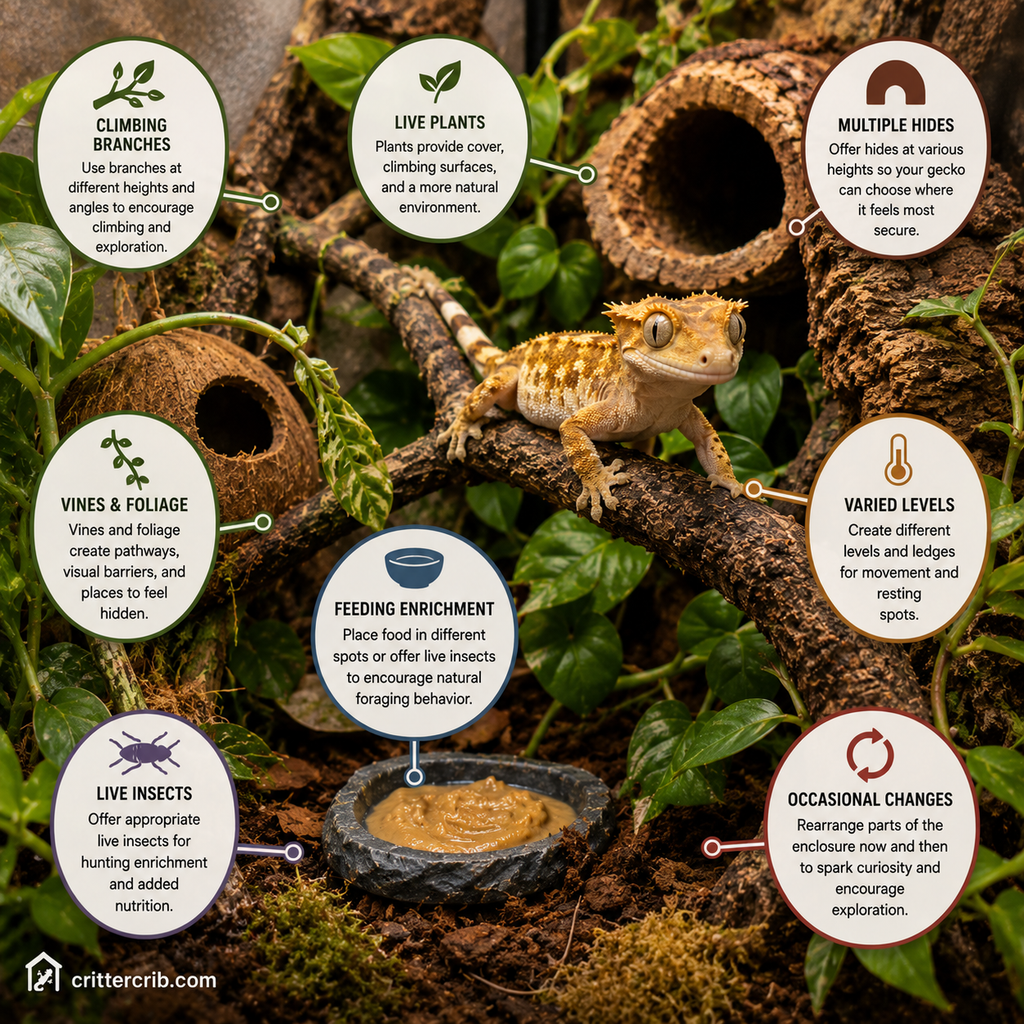
Branches create pathways. Plants provide cover. Cork tubes become elevated hides. Vines connect different areas. Live insects encourage hunting. Different textures and occasional small changes give your gecko new things to investigate.
Most importantly, a complex habitat gives your gecko choices.
It can climb high or move lower. It can sit in the open or disappear behind foliage. It can take one route to the feeding ledge tonight and another route tomorrow.
You don’t need to constantly change the enclosure or buy new accessories to keep a crested gecko stimulated.
Build a safe, three-dimensional environment that encourages natural behavior, then let your gecko decide how to use it.
For an arboreal reptile that spends much of its life climbing and exploring after dark, that’s one of the most useful forms of enrichment you can provide.