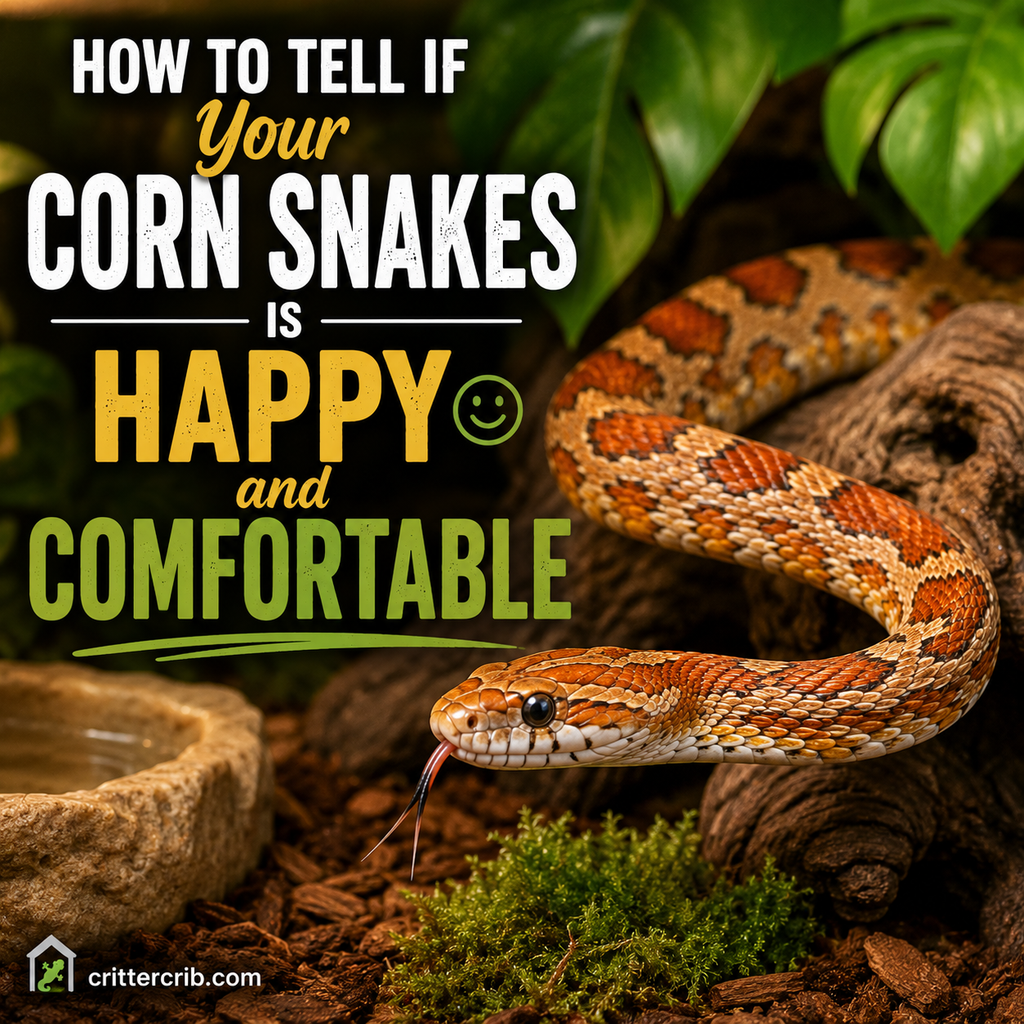
Corn snakes don’t wag their tails when they’re excited to see you or curl up beside you when they’re content. That can make it difficult for new snake owners to know whether their pet is actually happy.
With snakes, “happy” is better understood as comfortable, secure, healthy, and relatively free from stress.
A comfortable corn snake generally eats normally, explores its surroundings, uses different areas of its enclosure, sheds successfully, and doesn’t spend most of its time displaying defensive or frantic behavior.
The trick is learning what’s normal for your individual snake.
Here’s what to watch for and how to tell whether your corn snake is comfortable in its home.
Can Corn Snakes Actually Be Happy?
We can’t know whether a corn snake experiences happiness in exactly the same way people or other highly social animals do.
What we can observe is welfare.
A corn snake that’s healthy and comfortable should be able to perform normal behaviors without showing persistent signs of distress.
That includes:
- Resting securely
- Exploring
- Climbing when opportunities are available
- Thermoregulating
- Drinking
- Eating
- Shedding
- Investigating new smells and objects
So when someone asks whether their corn snake is “happy,” they’re usually asking a more practical question:
Does my snake feel safe and comfortable in its environment?
Fortunately, there are several clues.
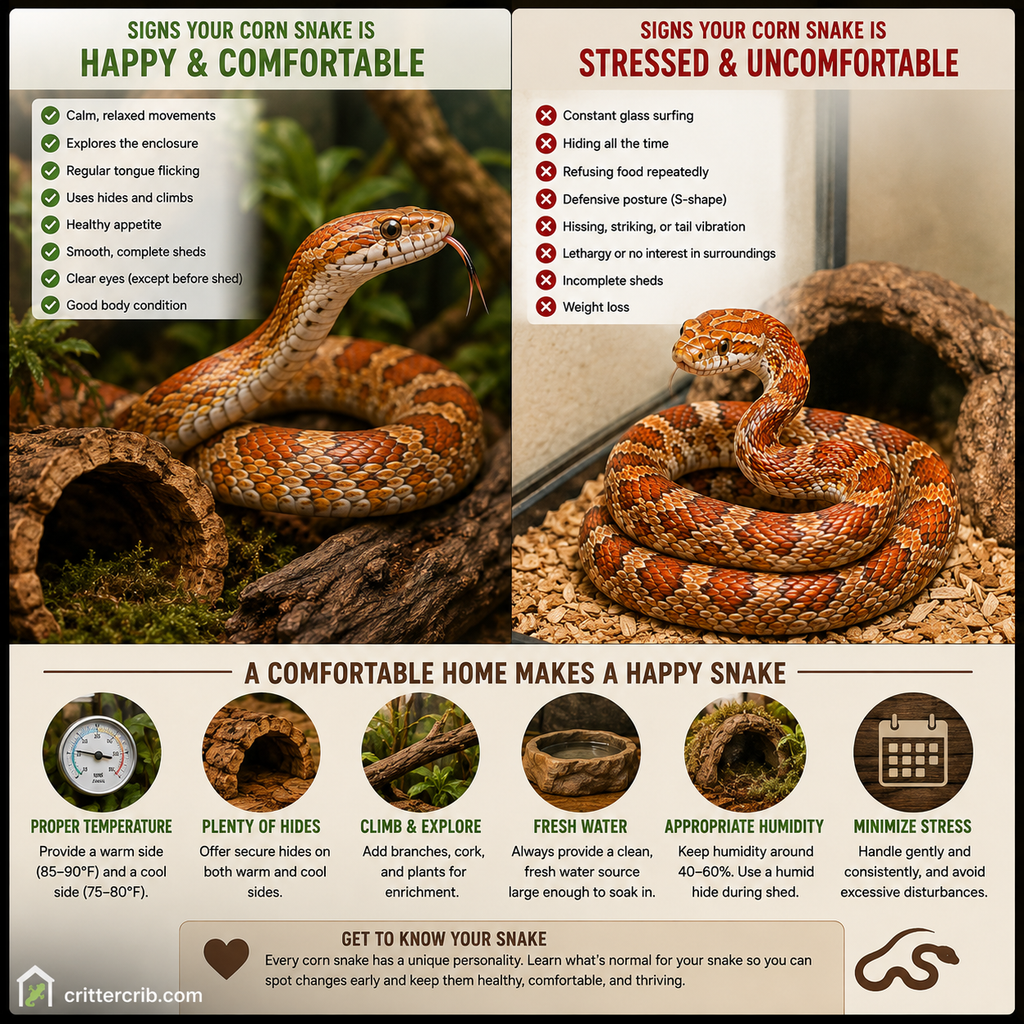
Signs Your Corn Snake Is Happy and Comfortable
No single behavior proves that everything is perfect.
Instead, look at the overall pattern of your snake’s behavior, appetite, appearance, and activity.
Calm, Purposeful Exploration
One of the easiest positive behaviors to recognize is relaxed exploration.
A comfortable corn snake may slowly move around its enclosure, investigate decorations, climb branches, or explore different levels.
You’ll often see regular tongue flicking during this process.
Snakes use their tongues to collect chemical particles from the environment. Those particles are analyzed by the Jacobson’s organ in the roof of the mouth, helping the snake understand what’s around it.
Frequent tongue flicking during calm exploration is therefore perfectly normal.
The important word is “calm.”
A snake moving deliberately around the enclosure is different from one frantically pushing against the glass for hours.
Regular Use of Hides
A corn snake spending time inside a hide isn’t necessarily unhappy.
Quite the opposite.
Hiding is a normal snake behavior.
A well-designed enclosure should provide secure hiding places, including options on both the warmer and cooler sides. Your snake can then stay concealed while still choosing an appropriate temperature.
A comfortable corn snake may spend hours or even much of the day hidden.
This is especially normal because corn snakes often become more active around dusk, dawn, or nighttime.
Don’t repeatedly lift hides just to check whether your snake is okay. Constantly exposing a resting snake can make it feel less secure.
A Healthy Appetite
Regular feeding is another useful sign that your corn snake is doing well.
A healthy snake that’s comfortable with its environment will generally show an appropriate feeding response when hungry.
Appetite can vary, though.
Corn snakes may occasionally refuse food because of:
- Shedding
- Seasonal changes
- Stress
- Recent feeding
- Reproductive behavior
- Illness
- Incorrect enclosure conditions
One refused meal isn’t automatically an emergency.
Repeated refusals, especially when combined with weight loss or behavioral changes, deserve closer attention.
Clean, Complete Sheds
A healthy corn snake should generally shed its skin in one complete or mostly complete piece.
Before shedding, you may notice:
- Duller coloration
- Cloudy or bluish eyes
- Reduced activity
- More time spent hiding
- Reduced appetite
The eyes usually clear again shortly before the actual shed occurs.
Don’t mistake this temporary inactivity for unhappiness.
Your snake is going through a normal biological process.
Repeated incomplete sheds, however, can indicate that humidity, hydration, health, or husbandry needs attention.
Relaxed Body Language
A comfortable corn snake generally looks relatively loose rather than rigid and tense.
During handling, it may move through your hands while regularly flicking its tongue and investigating its surroundings.
Inside the enclosure, you might see it stretched out, partially hidden, loosely coiled, or slowly exploring.
Over time, you’ll become familiar with how your particular snake looks when relaxed.
A Comfortable Corn Snake Won’t Always Be Active
New owners sometimes expect a healthy snake to be visible and active throughout the day.
Corn snakes don’t work that way.
It’s completely normal for your snake to disappear into a hide for long stretches.
You might not see much activity until the evening.
Age matters too.
Individual corn snakes have different activity patterns, and those patterns may change depending on feeding, shedding, season, temperature, and time of day.
Rather than judging your snake based on how entertaining it is, look at its behavior over several days or weeks.
A snake that hides during the day, explores at night, eats normally, and maintains good body condition may be doing perfectly well.
Signs a Corn Snake May Be Stressed
Occasional stress is normal.
A trip to the veterinarian, enclosure cleaning, a new environment, or an unfamiliar handler can temporarily make a snake nervous.
Persistent stress is what deserves attention.
Constant Glass Surfing
“Glass surfing” describes repeated movement along the enclosure walls, often with the snake pushing its nose against the glass.
Occasional exploration along the walls isn’t necessarily concerning.
Constant or frantic glass surfing can indicate that something isn’t right.
Possible causes include:
- Incorrect temperatures
- An enclosure that’s too small
- Insufficient hiding places
- Lack of environmental enrichment
- Excessive disturbance
- Seasonal or reproductive behavior
- A recent move
Before assuming your snake simply wants to come out, check the enclosure conditions.
Repeated Escape Attempts
Corn snakes are naturally curious and famously good at finding small openings.
Even a comfortable corn snake may investigate potential escape routes.
Persistent escape behavior, however, can be a reason to review the enclosure.
Check that:
- Temperatures are appropriate
- Hides are available
- The enclosure provides enough usable space
- The snake isn’t being disturbed constantly
- The habitat has enough cover and enrichment
And regardless of behavior, make sure the enclosure is securely locked. Corn snakes can fit through surprisingly small gaps.
Defensive Posture
A frightened corn snake may pull its head and neck into an S-shaped position.
This posture prepares the snake to strike if necessary.
Other defensive behaviors can include:
- Striking
- Rapid retreat
- Tense body posture
- Tail vibration
- Musking
- Sudden jerky movements
A defensive response doesn’t mean your snake is aggressive or dislikes you.
It’s usually trying to make a perceived threat go away.
Give it some space and determine what triggered the response.
Excessive Hiding Combined With Other Changes
Hiding by itself is normal.
Suddenly hiding much more than usual while also refusing food, losing weight, or showing other behavioral changes is more noteworthy.
Context matters.
That’s why learning your individual snake’s routine is so valuable.
What Does a Relaxed Corn Snake Look Like During Handling?
A comfortable corn snake will typically move rather than remain completely still.
You may notice it:
- Moving slowly through your hands
- Flicking its tongue
- Investigating your clothing
- Loosely wrapping around your hand or arm for support
- Moving without repeatedly trying to flee
- Maintaining a relatively relaxed body posture
Corn snakes are active snakes, so movement doesn’t automatically mean stress.
You need to distinguish exploration from escape behavior.
A relaxed snake usually moves in a controlled, curious manner.
A highly stressed snake may move rapidly and unpredictably, repeatedly attempt to get away, become tense, or adopt defensive postures.
Does Your Corn Snake Trust You?
It’s tempting to describe a comfortable pet snake as trusting its owner.
There’s some truth to that in a practical sense.
Through repeated experiences, your corn snake can become accustomed to your scent, handling routine, and presence.
It can learn that being picked up doesn’t result in harm.
That’s different from assuming the snake has a human-like emotional relationship with you.
A corn snake that has become comfortable with handling may:
- Remain relatively calm when picked up
- Explore your hands rather than immediately fleeing
- Show regular tongue flicking
- Stop becoming defensive whenever the enclosure opens
- Settle into predictable handling behavior
This familiarity develops gradually.
How to Make Your Corn Snake Feel More Comfortable
Good husbandry is the foundation of a comfortable snake.
Handling can’t compensate for an enclosure that doesn’t meet the animal’s needs.
Provide a Proper Temperature Gradient
Corn snakes need access to warmer and cooler areas so they can regulate their body temperature.
Don’t heat the entire enclosure uniformly.
Provide a suitable warm area along with a cooler retreat, and monitor temperatures with reliable digital equipment.
Any heating equipment should be appropriately controlled, ideally with a thermostat.
Your snake should always be able to move away from the heat.
Provide Multiple Hiding Places
At minimum, your corn snake should have secure hiding opportunities on both the warm and cool sides of the enclosure.
Hides should feel snug.
An enormous cave with a wide entrance may look attractive to you but may not provide the same sense of security as a smaller, enclosed hide.
You can also create additional cover using:
- Cork bark
- Artificial or reptile-safe live plants
- Branches
- Leaf litter
- Tunnels
- Other reptile-safe decorations
The enclosure shouldn’t feel like an empty glass box.
Give Your Snake Opportunities to Climb
Corn snakes are capable climbers.
Branches, cork, platforms, and other sturdy structures can increase the usable space inside the enclosure and provide opportunities for natural behavior.
Make sure climbing structures are secure enough that they can’t fall onto the snake.
Maintain Appropriate Humidity
Corn snakes generally don’t require the extremely humid conditions associated with tropical reptiles, but humidity still matters for hydration and shedding.
Monitor enclosure humidity rather than guessing.
During shedding, providing access to a humid hide can be particularly useful.
A humid hide typically contains a moisture-retaining material such as damp sphagnum moss, giving the snake access to higher humidity without making the entire enclosure excessively damp.
Keep Fresh Water Available
Your corn snake should always have access to clean drinking water.
Choose a sturdy bowl that won’t tip easily.
Replace the water regularly and clean the bowl whenever it becomes dirty.
Some corn snakes may occasionally soak in their water dishes. Occasional soaking isn’t necessarily concerning, but frequent soaking can warrant checking temperature, humidity, mites, and overall health.
Give Your Corn Snake Enrichment
A comfortable enclosure shouldn’t provide only food, water, heat, and an empty floor.
Corn snakes benefit from opportunities to explore.
Enrichment doesn’t need to be complicated.
Try adding:
- Branches at different heights
- Cork tubes
- Plants
- Leaf litter
- Multiple hides
- Textured surfaces
- Climbing opportunities
- Occasional changes in enclosure layout
You can occasionally introduce a new reptile-safe object or rearrange part of the habitat.
Don’t completely redesign the enclosure every few days, though.
Some novelty can encourage exploration, while constant environmental changes may have the opposite effect.
Balance enrichment with predictability.
How Often Should You Handle a Corn Snake?
Regular handling can help a corn snake become accustomed to human interaction, but more isn’t always better.
For an established, healthy corn snake, a few handling sessions per week can be plenty.
Start with relatively short sessions.
Around 5–10 minutes may be appropriate when a young or nervous snake is becoming accustomed to handling. Sessions can gradually become longer if the snake remains calm.
Avoid unnecessary handling:
- Immediately after feeding
- When the snake is clearly defensive
- During the sensitive stages of shedding
- When the snake is sick or injured
- Immediately after bringing a new snake home
After feeding, give your snake adequate time to digest before handling. Waiting around 48 hours is a commonly used precaution.
Give a New Corn Snake Time to Adjust
If you’ve just brought your corn snake home, don’t worry if it spends most of its time hiding.
Everything is new.
The enclosure smells different. The room is unfamiliar. You’re unfamiliar.
Give your snake time to settle.
During the first several days:
- Keep unnecessary handling to a minimum.
- Maintain stable enclosure conditions.
- Provide secure hiding places.
- Keep fresh water available.
- Avoid constantly checking under the hides.
- Allow the snake to establish a routine.
Many keepers prefer to wait until a new snake has successfully eaten before beginning regular handling.
Patience at the beginning can make future interactions much easier.
Is It Normal for a Corn Snake to Hide All Day?
Yes.
A corn snake that hides during much of the day isn’t automatically stressed, bored, or unhappy.
Hiding is an important natural behavior.
Your snake may become much more active when the room gets quiet and the lights dim.
If you’re curious about what your corn snake does when you’re asleep, you may be surprised by how much it explores after dark.
The more important question is whether the snake appears healthy and behaves normally when it does emerge.
How Can You Tell if Something Is Wrong?
Behavior can provide clues, but physical health matters too.
Pay attention to changes such as:
- Unexplained weight loss
- Repeated food refusal
- Frequent regurgitation
- Wheezing or unusual breathing sounds
- Bubbles or discharge around the nose or mouth
- Open-mouth breathing
- Swelling
- Wounds
- Mites
- Repeated incomplete sheds
- Unusual lumps
- Persistent lethargy
- Major changes in normal behavior
Some changes are subtle.
Keeping occasional records of your snake’s weight, feeding, and shedding can make patterns easier to recognize.
If you’re concerned about your corn snake’s health, contact a veterinarian experienced with reptiles rather than trying to diagnose the problem from behavior alone.
Common Mistakes That Can Make a Corn Snake Uncomfortable
Sometimes the signs of stress are caused by relatively simple husbandry problems.
Common mistakes include:
An Overly Bare Enclosure
An enclosure can be large without being useful.
Open space with nowhere to hide may make a snake feel exposed.
Fill the habitat with cover and structures that allow your corn snake to move around without always being completely visible.
Incorrect Temperatures
Temperatures that are consistently too hot or too cold can affect activity, digestion, appetite, and health.
Use digital thermometers rather than relying on how the enclosure feels.
Too Much Handling
A corn snake doesn’t need hours of daily interaction.
Give it plenty of uninterrupted time in its enclosure.
Constantly Disturbing Hides
It’s tempting to check on a snake that’s been hiding all day.
Resist the urge.
If enclosure conditions are correct and you don’t have a health reason to inspect the animal, let it rest.
Mistaking Normal Snake Behavior for Boredom
Hiding and resting aren’t necessarily signs of a problem.
Snakes simply don’t behave like dogs, cats, or other animals we’re accustomed to reading emotionally.
Frequently Asked Questions
How Do I Know if My Corn Snake Likes Me?
It’s more accurate to look for familiarity and comfort than affection.
If your corn snake remains calm during handling, explores your hands, flicks its tongue normally, and doesn’t consistently display defensive behavior around you, those are encouraging signs.
Why Does My Corn Snake Stare at Me?
Your corn snake may simply be watching movement or gathering information about its surroundings.
Snakes don’t have eyelids, so their gaze can look unusually intense to humans.
Looking at you doesn’t necessarily mean the snake is frightened, hungry, or affectionate.
Why Does My Corn Snake Flick Its Tongue at Me?
Tongue flicking is how snakes collect chemical information from their environment.
A corn snake flicking its tongue while calmly exploring you is generally doing exactly what a curious snake should do.
Is My Corn Snake Happy if It Eats?
A healthy appetite is a positive sign, but feeding alone doesn’t prove that every aspect of husbandry is correct.
Look at appetite alongside body condition, shedding, behavior, enclosure use, and overall health.
Is It Normal for My Corn Snake to Climb?
Yes.
Corn snakes are capable climbers and may readily use branches, ledges, and other elevated structures when they’re provided.
Climbing opportunities can be a useful form of environmental enrichment.
Why Is My Corn Snake Trying to Escape?
Occasional investigation of enclosure doors, corners, and ventilation openings can simply be exploratory behavior.
Constant or frantic escape attempts deserve more attention.
Check enclosure size, temperature, hides, cover, enrichment, and other environmental conditions.
Does My Corn Snake Get Bored?
We can’t measure boredom in a corn snake the same way we might discuss it in humans.
However, providing opportunities for exploration, climbing, hiding, and other natural behaviors gives your snake a more complex environment in which to interact.
That’s a good reason to provide enrichment regardless of what emotional label we use.
Final Thoughts
Figuring out whether your corn snake is happy isn’t about looking for one magical behavior.
Look at the whole animal.
A comfortable corn snake will generally maintain good body condition, eat appropriately, shed successfully, use its hides, explore its surroundings, thermoregulate, and display relatively relaxed behavior.
Don’t worry if your snake spends hours hidden or isn’t interested in interacting every day. Those behaviors can be completely normal.
The most useful thing you can do is learn your individual snake’s routine.
Once you know what’s normal, changes become much easier to spot.
Provide appropriate temperatures, humidity, hiding places, enrichment, fresh water, and respectful handling. Then give your corn snake something equally important: the freedom to behave like a snake.