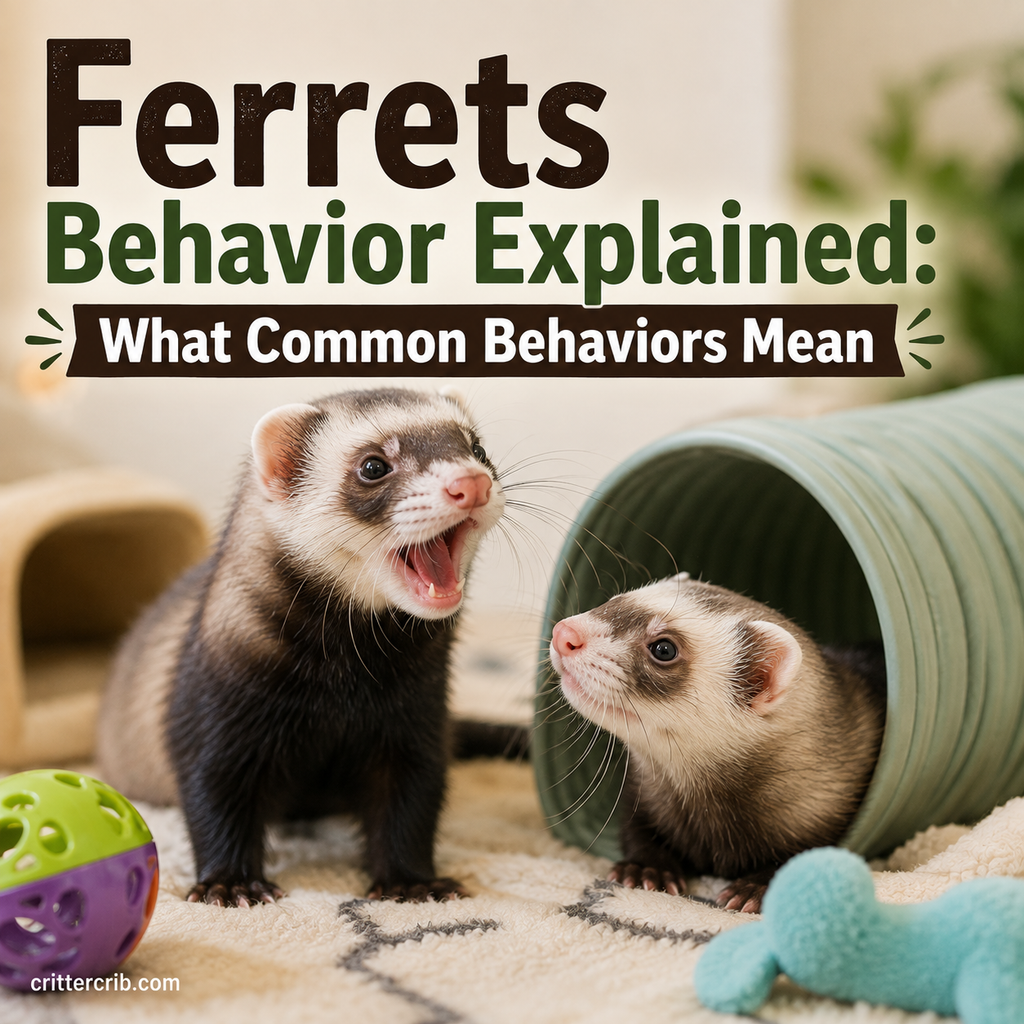
Ferrets have a talent for making perfectly normal behavior look completely ridiculous.
They bounce sideways with their mouths open. They stash toys under furniture. They dig at doors, crawl into places that seem physically impossible to reach, sleep so deeply you may briefly wonder whether they’re okay, and occasionally race through the house as if something invisible is chasing them.
Most of the time, these behaviors are simply part of being a ferret.
Learning how to read ferret behavior can help you understand when your pet is playful, curious, excited, frightened, frustrated, tired, or trying to communicate with you. Just as importantly, knowing what’s normal makes it easier to notice when something has changed.
Here’s what some of the most common ferret behaviors mean.
Understanding Normal Ferret Behavior
Ferrets are curious, social, energetic animals with strong instincts to explore.
Much of their behavior revolves around investigating enclosed spaces, chasing moving objects, digging, hiding things, wrestling, and sleeping.
A healthy ferret may spend part of the day looking completely unconscious and another part behaving like the most energetic animal in the house.
That’s normal.
Individual personalities also vary considerably.
Some ferrets immediately investigate every new person or object. Others are more cautious. One ferret may spend half its playtime wrestling with a companion while another is primarily interested in stealing your socks.
Instead of judging a single action, pay attention to your ferret’s overall behavior and normal routine.
Why Do Ferrets Do the Weasel War Dance?
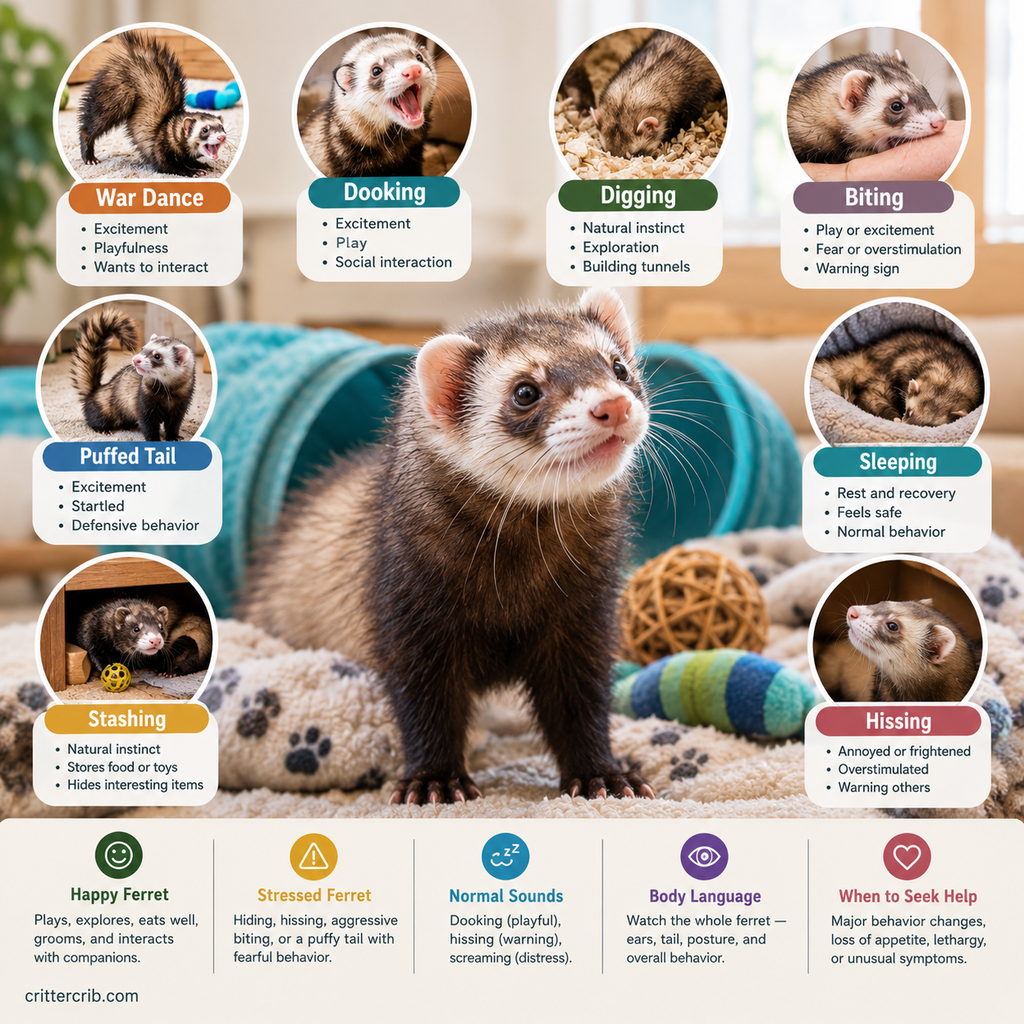
The famous “weasel war dance” is one of the easiest ferret behaviors to recognize.
A ferret may:
- Arch its back
- Bounce sideways
- Hop unpredictably
- Twist its body
- Open its mouth
- Throw itself toward toys or companions
- Suddenly change direction
It looks chaotic because it is.
In most situations, the war dance means your ferret is excited and wants to play.
You might see it after introducing a favorite toy, during play with another ferret, or when your ferret realizes you’re about to interact.
Is the War Dance Aggressive?
Usually, no.
An open mouth and exaggerated movements can look threatening if you’re unfamiliar with ferrets, but playful ferrets frequently behave this way.
Look at the rest of the interaction.
A playful ferret typically bounces back for more, chases, retreats, and reengages.
Aggression or genuine fear tends to involve different body language and context, such as intense attempts to escape, defensive vocalizations, a puffed tail, or serious biting.
Why Do Ferrets Dook?
“Dooking” is the distinctive chattering or clucking sound many ferrets make.
It often sounds something like a rapid series of soft chuckles.
Dooking is commonly associated with:
- Excitement
- Play
- Exploration
- Interaction with other ferrets
- Anticipation
A ferret bouncing around while dooking is generally having a pretty good time.
Some ferrets are extremely vocal.
Others rarely dook at all.
Both can be normal.
Why Does My Ferret Hiss?
Hissing can mean something very different from dooking.
A ferret may hiss when it is:
- Annoyed
- Frustrated
- Overstimulated
- Frightened
- Warning another ferret
- Uncomfortable with an interaction
The situation matters.
A brief hiss during energetic play doesn’t necessarily mean a serious fight is happening. Ferrets can be surprisingly dramatic with each other.
However, repeated hissing combined with avoidance, aggressive biting, screaming, or obvious distress deserves attention.
Give the ferret an opportunity to move away rather than forcing interaction.
Why Does My Ferret Scream?
A ferret scream is much more concerning than normal playful vocalization.
Ferrets may scream when extremely frightened, injured, or involved in a serious conflict.
If you hear an unusual loud scream, investigate immediately.
Check for:
- Injury
- A trapped foot or limb
- A serious fight
- Sudden pain
- Extreme fear
If you can’t identify the cause or your ferret appears physically abnormal afterward, contact a veterinarian.
Why Do Ferrets Bite?
Ferret biting has several possible meanings.
Young ferrets often explore and play with their mouths. Ferrets also have thicker skin than humans and may naturally play more roughly with each other than we appreciate.
A bite could mean:
- Play
- Excitement
- Exploration
- Fear
- Overstimulation
- A warning
- Pain
- Defensive behavior
The intensity and context are important.
A playful nip is very different from a ferret biting hard and refusing to release.
Why Do Young Ferrets Nip So Much?
Young ferrets are still learning how much pressure is appropriate.
Their littermates can tolerate much rougher play than human hands.
With patient, consistent interaction, many young ferrets learn that people need gentler treatment.
Avoid physical punishment.
Punishment can make a frightened ferret more defensive and damage trust.
Instead, redirect inappropriate biting and reward calm interaction.
Sudden Biting Can Mean Something Is Wrong
If a normally gentle ferret suddenly becomes defensive when touched, consider the possibility of pain or illness.
Pay attention to whether the reaction happens when you touch a particular part of the body.
A major unexplained behavioral change warrants veterinary attention.
Why Does My Ferret Lick Me and Then Bite?
This is one of those behaviors that can make you question the relationship.
Your ferret calmly licks your hand several times.
Then—bite.
There isn’t one universal explanation.
The ferret may be grooming, investigating your skin, becoming excited, or transitioning from calm interaction into play.
Some ferrets develop their own quirky interaction patterns.
Watch what happens before and after the behavior.
If the biting becomes too hard, calmly end or redirect the interaction.
Why Do Ferrets Steal and Hide Things?
If something small disappears in a home with ferrets, checking under the furniture is a reasonable first step.
Ferrets frequently carry objects away and create hidden stashes.
Popular targets may include:
- Small toys
- Socks
- Soft objects
- Balls
- Household items
- Anything they have apparently decided belongs to them
This behavior is closely connected to their instinct to carry and cache interesting objects.
Check Ferret Stashes Regularly
Stashing itself can be harmless and entertaining.
The problem is what gets stashed.
A ferret may carry away:
- Food
- Rubber objects
- Foam
- Plastic
- Medication
- Small household items
Some materials can be dangerous if chewed or swallowed.
Regularly inspect favorite hiding places and remove anything unsafe.
Why Does My Ferret Dig?
Digging is a natural ferret behavior.
You may see your ferret digging at:
- Bedding
- Blankets
- Carpet
- Couch cushions
- Doors
- Food bowls
- Litter
- The bottom of an enclosure
Ferrets are naturally interested in burrows and enclosed spaces, so digging and scratching behaviors aren’t surprising.
Give Ferrets Safe Places to Dig
Rather than expecting a ferret never to dig, provide appropriate outlets.
A supervised dig box filled with a safe material can give your ferret somewhere appropriate to satisfy the instinct.
You can also provide tunnels, blankets, boxes, and other safe exploration areas.
If your ferret constantly digs at a particular door or barrier, it may simply be extremely interested in what’s on the other side.
Ferrets don’t have much respect for closed doors.
Why Do Ferrets Tunnel Under Blankets?
Put a blanket on the floor and there’s a good chance a ferret will eventually disappear underneath it.
Ferrets naturally seek narrow, enclosed spaces.
Tunneling under blankets provides:
- Exploration
- Cover
- Play
- A place to sleep
- An ambush location for attacking unsuspecting toys or feet
Blankets and fabric tunnels can make excellent enrichment as long as they’re safe and regularly inspected.
Remove fabrics that have become heavily damaged or contain loose threads or other hazards.
Why Does My Ferret Rub or Scoot on the Floor?
A ferret may briefly drag or rub its rear end against the floor after using the litter box.
Occasional scooting can simply be part of cleaning itself.
Persistent scooting is different.
If the behavior becomes frequent or is accompanied by redness, swelling, difficulty defecating, diarrhea, or obvious discomfort, veterinary evaluation is appropriate.
Why Does My Ferret Back Into a Corner?
Sometimes a ferret backing into a corner is preparing to use the bathroom.
Many ferrets naturally prefer eliminating in corners.
You may notice your ferret:
- Stop exploring.
- Back into a corner.
- Lift its tail.
- Pause.
Once you recognize the pattern, you can sometimes redirect the ferret to a nearby litter box before the accident happens.
This behavior is useful when litter training.
Why Does My Ferret Miss the Litter Box?
Ferrets can learn to use litter boxes, but don’t expect the same precision you might get from a well-trained cat.
Accidents happen.
A ferret may miss the litter box because:
- The box is too far away
- The box is dirty
- The sides are difficult to enter
- The ferret has chosen another corner
- It woke up and needed to go immediately
- The play area is too large for a single box
Providing multiple litter boxes in frequently used corners can help.
Watch where your ferret naturally chooses to go rather than insisting on placing the box somewhere that’s convenient only for you.
Why Do Ferrets Sleep So Much?
Ferrets can sleep for a large portion of the day.
It’s normal for them to have periods of intense activity followed by long stretches of sleep.
A comfortable ferret may sleep:
- Curled into a ball
- Stretched completely flat
- Inside a hammock
- Under a blanket
- Piled on top of another ferret
- In a position that doesn’t look remotely comfortable
Deep sleep is also common.
What Is a Ferret Dead Sleep?
“Dead sleep” is an informal term owners use for especially deep ferret sleep.
A deeply sleeping ferret may be surprisingly difficult to wake.
It may appear completely limp when picked up and take a few moments to respond.
This can be alarming the first time you see it.
If the ferret wakes and immediately returns to normal behavior, deep sleep may simply be the explanation.
However, don’t assume an unresponsive ferret is always sleeping.
If you notice abnormal breathing, unusual body temperature, weakness after waking, difficulty standing, or any other concerning symptoms, seek veterinary care.
Why Does My Ferret Sleep on Me?
A ferret that chooses to curl up on you may feel comfortable and secure.
Your body provides warmth, familiar scent, and a soft sleeping surface.
Not every ferret will do this.
Some prefer hammocks, blankets, or hidden sleeping spots.
A ferret doesn’t have to sleep on you to trust you.
Why Does My Ferret Follow Me Everywhere?
Ferrets are curious.
If you’re walking around, you’re potentially doing something interesting.
Your ferret may follow because it expects:
- Play
- Food
- Exploration
- Access to another room
- Interaction
Some ferrets also simply enjoy staying near familiar people.
Just watch your feet.
A ferret can appear underneath you with very little warning.
Why Does My Ferret Paw at Me?
Pawing can be an attempt to initiate interaction.
Your ferret may want:
- Attention
- Play
- Access to something
- To investigate what you’re holding
As with other behaviors, look at the context.
A ferret pawing at your leg and bouncing away may be inviting you to play.
Why Does My Ferret Run Around Like Crazy?
Sudden bursts of speed are normal.
Your ferret may race across the room, disappear through a tunnel, bounce off a piece of furniture, and return in the opposite direction seconds later.
These bursts often occur during play and excitement.
You can encourage safe activity with:
- Tunnels
- Boxes
- Toys
- Open running space
- Safe hiding places
- Interactive play
Make sure the play area has been thoroughly ferret-proofed first.
Why Does My Ferret Have a Puffy Tail?
A ferret’s tail may suddenly puff up so that the fur stands outward.
This is sometimes called a bottlebrush tail.
A puffy tail can occur when a ferret is:
- Excited
- Startled
- Frightened
- Highly stimulated
- Investigating something unfamiliar
Context matters enormously.
A ferret exploring a new tunnel with a puffed tail may simply be extremely excited.
A ferret backing away, hissing, and puffing its tail may be frightened or defensive.
Look at the whole animal rather than the tail alone.
Why Does My Ferret Wag Its Tail?
Yes, ferrets can wag their tails.
You’ll sometimes see rapid tail movement when a ferret is highly focused or excited, particularly during play or while waiting to ambush another ferret.
For example, a ferret hiding inside a tunnel may wag its tail immediately before launching itself toward a companion.
It can be a sign of anticipation rather than the same social signal associated with a dog’s wagging tail.
Why Does My Ferret Flatten Itself on the Floor?
A ferret may suddenly lie flat with its body stretched against the floor.
Owners sometimes call this a “speed bump.”
After energetic play, a ferret may flatten out briefly to rest.
It may look exhausted one second and then jump up and start running again.
This can be perfectly normal.
However, a ferret that remains flattened, seems weak, has difficulty breathing, or doesn’t resume normal activity should be evaluated more carefully.
Why Does My Ferret Yawn and Stretch?
Like many animals, ferrets commonly yawn and stretch after waking.
You may see your ferret:
- Stretch its front legs
- Extend its back
- Yawn widely
- Roll over
- Scratch
- Begin grooming
This is usually normal waking behavior.
A relaxed ferret may take its time stretching before deciding whether it’s ready to cause trouble.
Why Does My Ferret Groom Itself?
Ferrets regularly groom their coats.
You may see licking, scratching, and nibbling at the fur as part of normal grooming.
They may also groom other ferrets.
Social grooming can be part of the relationship between bonded companions.
When Grooming Becomes Excessive
Pay attention if grooming or scratching becomes intense or produces:
- Bald patches
- Red skin
- Scabs
- Persistent irritation
- Frequent biting at the skin
- Major coat changes
Those signs can have several causes and should be discussed with a veterinarian.
Why Does My Ferret Scratch So Much?
An occasional scratch isn’t automatically a problem.
Ferrets can be itchy during normal grooming and seasonal coat changes.
Persistent scratching is different.
Possible causes range from environmental irritation to parasites or skin problems.
If scratching is frequent or accompanied by visible skin or coat changes, schedule a veterinary examination rather than trying random treatments.
Why Do Ferrets Wrestle With Each Other?
Wrestling is normal social play for many ferrets.
It can look surprisingly rough.
Ferrets may:
- Chase
- Pounce
- Roll
- Grab each other
- Bite during play
- Dook
- Take turns pursuing each other
Healthy play usually involves both animals voluntarily returning to the interaction.
When Ferret Play May Be Too Rough
Intervene if you see signs of genuine distress or injury.
Warning signs can include:
- Persistent attempts by one ferret to escape
- Screaming
- Injury
- Urination or defecation from fear
- One ferret relentlessly attacking another
- Serious biting without normal play breaks
Not every hiss means a fight, but repeated distress shouldn’t be ignored.
Why Does My Ferret Hide Food?
Some ferrets stash food just as enthusiastically as they stash toys.
This can become a problem if perishable food ends up underneath furniture or inside bedding.
Check common stash locations regularly.
Dry food may also be carried away from the feeding area.
Before assuming your ferret isn’t eating, make sure the food hasn’t simply been relocated.
Why Does My Ferret Knock Over the Food or Water Bowl?
Sometimes because it’s fun.
Ferrets investigate objects with their noses, paws, and mouths.
A lightweight bowl can quickly become a toy.
Using stable, heavy bowls can reduce tipping.
Fresh water should remain available at all times, so choose a setup your particular ferret can’t easily empty or contaminate.
Why Does My Ferret Stare at Me?
Your ferret may be watching because you’re interesting—or because you’ve historically been associated with something interesting.
Food, play, open doors, and attention all qualify.
Ferrets use sight, sound, and scent to monitor their surroundings.
A quiet stare doesn’t necessarily have some complicated emotional meaning.
Your ferret may simply be waiting to see what you do next.
Why Does My Ferret Suddenly Stop and Listen?
Ferrets can pause during exploration when they notice an unfamiliar sound.
You may see the head lift and the body become temporarily still.
This gives the ferret a chance to determine where the sound is coming from.
If nothing interesting happens, exploration usually resumes.
Why Does My Ferret Keep Trying to Escape?
Ferrets are natural explorers.
A closed door doesn’t communicate “this area is off-limits.”
It communicates “there is obviously something fascinating behind this.”
A ferret may repeatedly investigate:
- Doors
- Gates
- Cabinet openings
- Gaps beneath furniture
- Cage latches
- Barriers
Escape attempts don’t automatically mean your ferret hates its environment.
However, persistent attempts combined with inadequate exercise or enrichment may indicate that the ferret needs more appropriate activity.
Ferret-Proofing Is Essential
Because ferrets are so curious, their environment needs to be carefully secured.
Check for:
- Electrical cords
- Reclining furniture
- Holes in cabinets
- Gaps around appliances
- Rubber objects
- Foam
- Medication
- Cleaning chemicals
- Houseplants
- Open toilets
- Small objects that can be swallowed
- Access to exterior doors
Recheck the room regularly.
A space that was ferret-proof last month may contain a new hazard today.
What Does a Happy Ferret Look Like?
There’s no single behavior that proves a ferret is happy.
Instead, look for a combination of normal behaviors.
A comfortable ferret may:
- Play enthusiastically
- Explore confidently
- Dook
- Perform the war dance
- Eat normally
- Sleep comfortably
- Groom normally
- Interact with companions
- Investigate enrichment
- Approach familiar people
Not every happy ferret will be extremely vocal or affectionate.
Personality matters.
What Does a Stressed or Frightened Ferret Look Like?
Possible signs of fear or stress can include:
- Hissing
- Defensive biting
- Attempting to escape
- Hiding unusually often
- Puffy tail combined with defensive behavior
- Flattened or tense posture
- Avoidance
- Unusual vocalization
Again, context matters.
A puffy tail during exciting play doesn’t necessarily indicate fear.
Look for several signals together and consider what happened immediately beforehand.
Learn Your Ferret’s Normal Routine
One of the most useful things you can do is observe your ferret when it’s healthy.
Learn:
- When it usually wakes
- How energetic it normally is
- What normal play looks like
- How much it eats
- Where it sleeps
- How it interacts with other ferrets
- Which sounds it normally makes
- What its usual bathroom habits look like
That creates a baseline.
A behavior that’s perfectly normal for one ferret may be unusual for another.
Changes from your individual ferret’s routine are often more informative than comparing every action to a generic checklist.
When a Behavior Change May Mean Your Ferret Is Sick
Ferrets can experience significant health problems, and behavior may sometimes be one of the first things that changes.
Contact a veterinarian experienced with ferrets if you notice concerning behavioral changes along with symptoms such as:
- Severe lethargy
- Loss of appetite
- Unexplained weight loss
- Difficulty breathing
- Persistent coughing or sneezing
- Vomiting
- Diarrhea
- Difficulty walking
- Weakness
- Collapse
- Seizure-like activity
- Straining to urinate or defecate
- Swollen abdomen
- Persistent pain
- Unusual discharge
- Significant hair or skin changes
A ferret that suddenly stops eating, becomes unusually weak, or acts dramatically different from normal shouldn’t simply be assumed to be tired.
When you’re uncertain, veterinary advice is the safer choice.
Frequently Asked Questions About Ferret Behavior
How can you tell if a ferret likes you?
Look for comfort and voluntary interaction rather than one specific sign.
A ferret that approaches you, initiates play, climbs onto you, comfortably sleeps nearby, or follows you around is showing that it feels comfortable interacting with you.
Individual ferrets express this differently.
Why does my ferret lick me?
Your ferret may be grooming you, investigating the taste or scent of your skin, or simply interacting.
Some ferrets lick frequently, while others rarely do.
Why does my ferret bite my feet?
Moving feet make excellent targets from a ferret’s perspective.
Ankle and foot biting is often related to play, attention seeking, or excitement.
Redirect the behavior toward an appropriate toy if the biting becomes uncomfortable.
Why does my ferret sleep in strange positions?
Because ferrets are exceptionally talented at looking uncomfortable while apparently being completely comfortable.
They may sleep twisted, upside down, hanging partly out of a hammock, underneath companions, or stretched flat.
If the ferret wakes normally and moves comfortably, strange sleeping positions alone usually aren’t concerning.
Why does my ferret make noises while playing?
Dooking and other quiet vocalizations can accompany excitement and social interaction.
Hissing may indicate frustration or annoyance, while screaming is much more concerning and should prompt immediate investigation.
Why does my ferret chase me?
Chasing can be part of interactive play.
Some ferrets enjoy running after people and then racing away, apparently expecting you to return the favor.
Do ferrets recognize their owners?
Ferrets can become familiar with people’s scents, voices, routines, and patterns of interaction.
They may respond differently to familiar people than to strangers.
Trust generally develops through predictable, positive interaction.
Why does my ferret keep hiding my things?
Stashing is a natural and common ferret behavior.
Rather than trying to eliminate it completely, provide safe objects your ferret can carry and periodically inspect stash locations for unsafe household items.
How do you know if ferrets are playing or fighting?
Play can involve chasing, wrestling, and biting, but both animals generally remain engaged voluntarily.
Repeated screaming, injuries, fear-related elimination, desperate escape attempts, or relentless attacks are more concerning.
When you’re unsure, supervise closely and separate animals safely if a genuine fight develops.
Final Thoughts on Understanding Ferret Behavior
Ferrets become much easier to understand once you accept that many of their strangest behaviors are completely normal.
The sideways bouncing is play.
The missing sock has probably been stolen.
The frantic digging is instinctive.
The ferret lying completely flat in the middle of the floor may simply be taking a brief break before beginning another round of chaos.
And that mysterious pile of toys underneath the couch?
Your ferret has a collection.
Learning these behaviors does more than make ferret ownership entertaining. It helps you understand how your pet communicates and gives you a baseline for recognizing changes.
Watch the whole situation rather than interpreting one movement or sound on its own. Pay attention to your ferret’s personality, daily routine, body language, appetite, activity, and interactions.
Over time, you’ll become very familiar with what’s normal for your particular ferret.
And when something genuinely isn’t normal, you’ll be much more likely to notice.