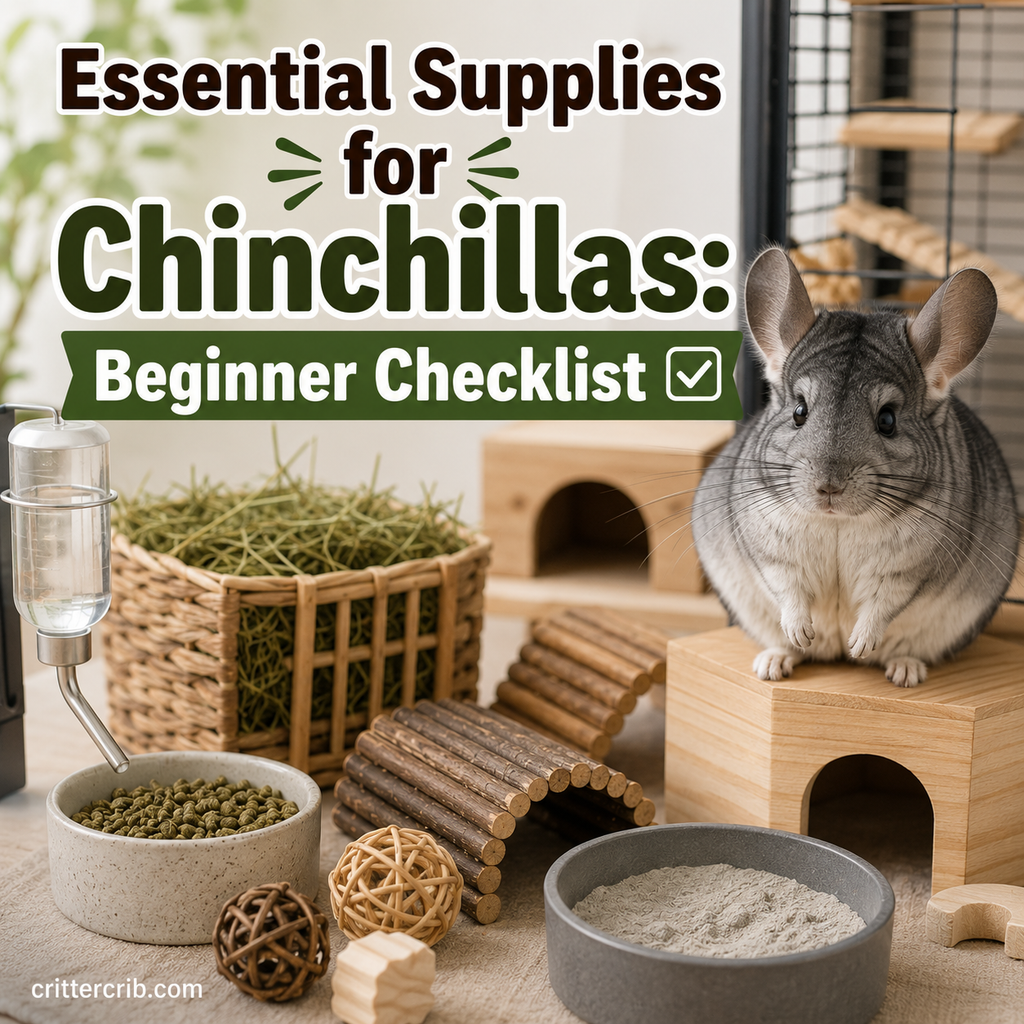
Bringing home a chinchilla involves more preparation than simply buying a cage, adding some food, and picking out a few toys.
Chinchillas have some unusual care requirements. They need plenty of room to move, constant access to hay, safe items to chew, a cool environment, and a dust bath rather than a traditional water bath. Their dense fur and constantly growing teeth also influence which supplies belong in their habitat.
If you’re preparing for your first chinchilla, it’s much easier to have the essentials ready before your new pet arrives.
This beginner chinchilla supply checklist covers what you’ll need for housing, feeding, enrichment, grooming, cleaning, and everyday care, along with a few products you can probably skip.
Chinchilla Supplies Checklist at a Glance
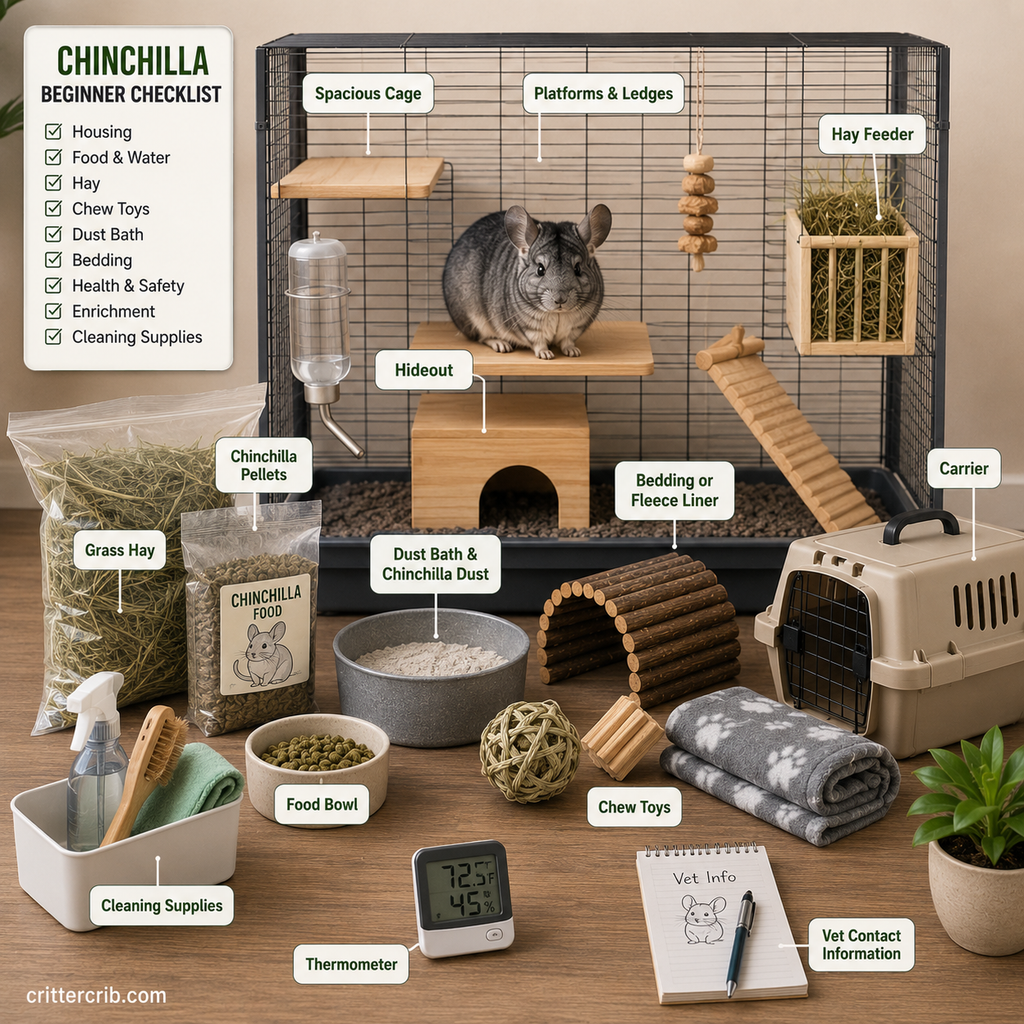
Before getting into the details, here’s a quick overview of the basic supplies most chinchilla owners will need:
- Large, secure chinchilla cage
- Solid shelves and platforms
- Appropriate cage flooring
- Hideout or sleeping shelter
- High-quality grass hay
- Chinchilla pellets
- Hay feeder
- Food bowl
- Water bottle
- Chinchilla-safe chew toys
- Dust bath container
- Chinchilla bathing dust
- Safe bedding or cage liners
- Cleaning supplies
- Carrier
- Enrichment items
- Room thermometer
- Basic grooming and health-monitoring supplies
Some chinchillas will need additional items depending on their enclosure, age, health, and personality.
The important thing is to build the habitat around the chinchilla’s needs rather than buying everything labeled “small animal.”
1. A Large, Secure Chinchilla Cage
The cage is one of the most important purchases you’ll make.
Chinchillas are active animals that can jump surprisingly well. They need enough room to move around, explore different levels, and get away from food and bathroom areas when they want to rest.
Look for a sturdy enclosure designed with chinchilla safety in mind.
Useful features include:
- Plenty of usable space
- Secure doors and latches
- Good ventilation
- Safe bar spacing
- Multiple levels
- Solid resting surfaces
- Easy access for cleaning
Metal construction is often practical because chinchillas are enthusiastic chewers.
Plastic components inside the cage can become a problem if your chinchilla begins gnawing on them.
Avoid Wire Flooring
A wire-bottom cage may make waste cleanup look convenient, but it isn’t an ideal surface for chinchilla feet.
Provide solid surfaces where your chinchilla can comfortably stand and rest.
If the enclosure includes wire shelves or ramps, consider whether they can be safely covered or replaced with appropriate solid alternatives.
2. Solid Shelves and Platforms
Chinchillas enjoy jumping between levels, making platforms an important part of a well-designed habitat.
Wooden ledges are popular because they provide both usable space and something safe to chew when made from an appropriate untreated wood.
Arrange platforms so your chinchilla can move naturally without facing dangerous falls.
Avoid placing a small shelf extremely high above an open cage floor with nothing underneath to interrupt a fall.
A good layout combines:
- Low platforms
- Intermediate ledges
- Resting shelves
- Safe jumping distances
Check wooden shelves regularly for urine saturation, sharp edges, loose hardware, or excessive chewing.
3. Safe Cage Flooring
The bottom of the enclosure should provide secure footing and be easy to maintain.
Depending on your setup, you might use:
- Chinchilla-safe bedding
- Properly fitted fleece liners
- Solid trays
- A combination of different surfaces
Whatever you choose, keep the flooring dry.
Wet or heavily soiled areas should be cleaned promptly.
Choosing Bedding for Chinchillas
If you use loose bedding, choose a product appropriate for chinchillas.
Avoid assuming every small-pet bedding material is automatically safe.
Dusty bedding can be irritating, while heavily scented products aren’t necessary.
The bedding should primarily help absorb waste while providing a clean, dry surface.
4. A Hideout or Sleeping House
Even an outgoing chinchilla needs somewhere to retreat.
A hideout provides a secure area for resting and gives your chinchilla some control over interaction.
Wooden houses are commonly used because they can be sturdy and chewable when constructed from chinchilla-safe materials.
The hide should be:
- Large enough for your chinchilla
- Stable
- Easy to access
- Made from safe materials
- Free of sharp edges
If you have more than one chinchilla, provide enough resting and hiding options so one animal can’t monopolize the only shelter.
5. Unlimited Grass Hay
Hay isn’t an optional cage accessory. It’s a major part of a chinchilla’s diet.
Chinchillas should have consistent access to appropriate grass hay.
Timothy hay is a common choice for healthy adult chinchillas, although other suitable grass hays may also be used depending on individual needs and veterinary recommendations.
Good hay should generally be:
- Dry
- Fresh smelling
- Free from mold
- Free from excessive dust
- Stored somewhere dry
Don’t use hay that smells musty or has become damp.
Buy Hay Before Bringing Your Chinchilla Home
It’s a good idea to find a reliable hay source ahead of time.
Chinchillas can go through more hay than new owners expect, particularly because some will pull pieces out, inspect them, and apparently decide those particular strands are beneath consideration.
A little waste is normal.
6. A Hay Feeder
A hay feeder helps keep hay accessible and can reduce how much becomes mixed with waste.
Choose a design that doesn’t create dangerous gaps where your chinchilla could become trapped.
The feeder should allow your chinchilla to pull hay out comfortably.
You can also provide hay in other safe ways depending on the enclosure layout.
The priority is easy, continuous access.
7. Chinchilla Pellets
In addition to hay, you’ll need a high-quality pellet formulated specifically for chinchillas.
Look for a simple, nutritionally appropriate pellet rather than a colorful mixture filled with seeds, dried fruit, or other treats.
Those mixes may look more interesting to us, but chinchillas don’t need a bowl resembling trail mix.
A consistent pellet also prevents selective feeding, where the animal eats favorite pieces while leaving the more nutritious parts behind.
Don’t Buy a Huge Bag at First
If you’re adopting a chinchilla, find out what food it currently eats.
Suddenly switching diets can cause digestive problems.
You may need enough of the existing food to transition gradually to a different appropriate pellet if a change is necessary.
8. A Heavy Food Bowl
A simple food dish works well for pellets.
Ceramic bowls are popular because they’re relatively heavy and difficult to flip.
Choose a bowl that is:
- Easy to wash
- Stable
- Free from cracks
- Appropriately sized
Avoid filling a giant bowl simply because it fits inside the cage.
Pellets are only one part of the diet, and feeding amounts should be appropriate for the individual chinchilla.
9. A Water Bottle
Fresh drinking water should always be available.
Water bottles are commonly used for chinchillas because they help keep the fur and cage floor dry.
Choose a bottle that attaches securely to the cage and test the drinking mechanism every day.
A full bottle doesn’t guarantee that water is actually coming out.
Check for:
- Blockages
- Leaks
- Loose attachments
- Damage from chewing
- Dirty drinking tubes
Wash the bottle regularly rather than continually refilling it.
Glass vs. Plastic Water Bottles
Glass bottles can be useful because the bottle itself can’t easily be chewed through the cage bars.
If you use plastic, position it so your chinchilla cannot pull the bottle into chewing range.
Regardless of material, reliability matters most.
10. A Dust Bath Container
Chinchillas don’t take traditional water baths.
Their extremely dense fur makes getting soaked problematic because moisture can become trapped close to the skin and the coat can take a long time to dry.
Instead, chinchillas clean their coats by rolling in specialized bathing dust.
You’ll need a container large enough for your chinchilla to roll around comfortably.
A good dust bath container should:
- Be stable
- Have enough room for rolling
- Help contain flying dust
- Be easy to clean
Watching a chinchilla enthusiastically flip around in a dust bath is also one of the more entertaining parts of chinchilla ownership.
11. Chinchilla Bathing Dust
The container is only half of the dust bath setup.
You’ll also need bathing dust specifically intended for chinchillas.
Don’t substitute random sand, household powders, or other materials.
Chinchilla bathing dust is designed to work through the dense coat and absorb oils and moisture.
Should the Dust Bath Stay in the Cage?
Usually, a dust bath is offered for limited periods rather than permanently left inside the cage.
Constant access can encourage excessive bathing, and the bath can quickly become contaminated with urine or droppings.
Your chinchilla’s bathing schedule may depend on climate, coat condition, and individual needs.
If you’re unsure how often to offer it, discuss the routine with an experienced exotic-animal veterinarian.
12. Plenty of Safe Chew Toys
Chinchilla teeth grow continuously.
Chewing is therefore a basic need, not simply entertainment.
Your chinchilla should have access to appropriate chewing materials.
Options may include:
- Chinchilla-safe wooden toys
- Safe untreated wood blocks
- Appropriate sticks
- Wooden ledges
- Other products specifically made from chinchilla-safe materials
Because chinchillas chew almost everything they can reach, knowing what an object is made from is important.
Not Every Wood Is Safe
Avoid grabbing branches from the yard and putting them directly into the cage.
The species of tree matters, and outdoor wood may have been exposed to pesticides, mold, parasites, or other contaminants.
Use wood known to be safe for chinchillas and prepared appropriately for small-animal use.
13. Enrichment and Activity Toys
Chewing is important, but chinchillas also benefit from opportunities to explore and interact with their environment.
Enrichment can include:
- Ledges
- Tunnels
- Safe wooden toys
- Hanging chew toys
- Foraging opportunities
- Rearranged cage-safe objects
- Supervised exploration
You don’t need to pack every inch of the cage with toys.
Chinchillas still need open pathways for moving and jumping.
Rotate some enrichment items occasionally rather than adding everything at once.
14. An Appropriate Exercise Wheel
An exercise wheel can provide additional activity, but this is one item where size and construction matter considerably.
Tiny wheels designed for hamsters aren’t appropriate for chinchillas.
If you choose to provide a wheel, look for one specifically designed to accommodate a chinchilla’s size and movement.
It should have:
- A sufficiently large diameter
- A solid running surface
- Stable construction
- No dangerous gaps
- Secure attachment
Avoid mesh or wire running surfaces that could create a risk to feet or legs.
A wheel is also not a substitute for a properly sized cage and other opportunities to move.
15. A Room Thermometer
This inexpensive item deserves a place on the essential list.
Chinchillas are particularly sensitive to heat.
Their dense fur is excellent insulation in cool environments but makes high temperatures potentially dangerous.
Keep a reliable thermometer near the habitat so you know the actual room temperature rather than guessing based on how comfortable the room feels to you.
Why Temperature Monitoring Matters
Humans and chinchillas don’t experience temperature in the same way.
A room that feels pleasantly warm to you may be uncomfortable or potentially dangerous for a chinchilla.
Heat combined with high humidity can be particularly concerning.
Your chinchilla’s enclosure should be kept in a cool, climate-controlled location away from:
- Direct sunlight
- Heating vents
- Hot windows
- Poorly ventilated rooms
- Areas that become unexpectedly warm
If your home gets hot during summer, have a reliable cooling plan before bringing a chinchilla home.
A fan alone doesn’t cool a chinchilla the same way it cools a sweating human.
16. Cooling Options for Warm Weather
Air conditioning is often the most reliable way to keep a chinchilla’s environment appropriately cool during hot weather.
Depending on your climate and home, you may also want an appropriate stone or cooling surface where your chinchilla can rest.
These should be viewed as supplemental comfort items rather than replacements for controlling dangerous room temperatures.
The entire environment needs to remain safe.
Don’t wait until a heat wave arrives to figure out how you’ll cool the room.
17. A Safe Pet Carrier
A carrier is easy to forget until you suddenly need one.
Buy one before an emergency happens.
You’ll need it for:
- Veterinary appointments
- Moving
- Emergencies
- Evacuations
- Transportation
Choose a carrier that is secure, well ventilated, and appropriately sized.
Make sure doors and latches can’t easily be pushed open.
A little hay can help provide familiarity during transport, depending on the circumstances.
18. Basic Cleaning Supplies
Chinchillas may be relatively tidy, but their habitats still need regular maintenance.
Useful cleaning supplies include:
- Small broom and dustpan
- Handheld vacuum if appropriate
- Paper towels or reusable cloths
- Dedicated scrub brush
- Trash bags
- Appropriate pet-safe cleaner
- White vinegar for suitable surfaces
- Spare cage liners or bedding
Daily spot cleaning makes larger cleanups much easier.
Remove wet bedding, dirty hay, and obvious waste before it accumulates.
Keep Cleaning Products Away From the Cage
Store sprays, chemicals, and cleaning solutions somewhere your chinchilla can’t reach.
During major cleaning, move your chinchilla to a safe temporary area until surfaces are clean and dry.
19. Spare Bedding or Cage Liners
Don’t buy only one set of washable cage liners.
If that’s your chosen flooring system, having a spare set means you can rebuild the cage immediately while the dirty set is being washed.
The same principle applies to other washable accessories.
A backup makes cleaning much less inconvenient.
If you use disposable bedding instead, keep enough on hand that you’re not forced to leave soiled material in the cage because you unexpectedly ran out.
20. A Small Digital Scale
A digital scale that accurately measures your chinchilla’s weight can be a useful health-monitoring tool.
Small animals can sometimes lose weight before other signs of illness become obvious.
Regularly tracking weight gives you a baseline for your individual chinchilla.
You don’t need to obsess over tiny day-to-day fluctuations. You’re looking for meaningful changes or trends.
Record the measurements somewhere so you can compare them over time.
Unexplained or significant weight loss should be discussed with a veterinarian.
21. A Basic Chinchilla Grooming Kit
Chinchillas handle much of their own coat maintenance through dust bathing.
They generally don’t require the same grooming routine as a long-haired dog or cat.
Still, it’s helpful to keep a few basic supplies available.
Depending on your chinchilla, these might include:
- Dust bath supplies
- Clean towels for emergencies
- Appropriate grooming tools if recommended
- A carrier for veterinary care
- A scale for weight monitoring
Never routinely wet a chinchilla’s coat as a substitute for dust bathing.
If the fur becomes contaminated with something that can’t be safely removed through normal grooming, ask a veterinarian how to handle it.
22. Hay and Food Storage Containers
Hay and pellets need proper storage.
Pellets should be kept dry and protected from pests.
A sealed food-safe container can help, although keeping the original packaging or label information is useful so you retain feeding instructions, expiration dates, and lot information.
Hay also needs a dry storage area with appropriate airflow.
Avoid sealing damp hay into a container.
Any hay showing signs of mold should be discarded.
23. A Chinchilla-Proofed Exercise Area
Supervised time outside the cage can provide valuable enrichment.
But the room needs to be prepared first.
Chinchillas are fast, curious, and very good at discovering exactly the object you hoped they wouldn’t chew.
Before allowing exploration, remove or protect:
- Electrical cords
- Houseplants
- Plastic objects
- Medications
- Cleaning chemicals
- Small objects
- Unsafe furniture gaps
- Anything painted or coated that could be chewed
- Access to other pets
Block areas where your chinchilla could disappear behind furniture or appliances.
Supervision is essential.
24. Contact Information for an Exotic-Animal Veterinarian
This isn’t technically a physical supply, but it belongs on every beginner checklist.
Find a veterinarian who treats chinchillas before bringing your pet home.
Not every general dog-and-cat veterinary practice is equipped to provide chinchilla care.
Save the clinic’s:
- Phone number
- Address
- Regular hours
- Emergency instructions
Also find out where you would go for an after-hours emergency.
Trying to locate an appropriate veterinarian for the first time while your chinchilla is already sick adds unnecessary stress.
What Supplies Do You Not Need for a Chinchilla?
Pet stores contain plenty of products marketed toward small animals that aren’t necessarily suitable for chinchillas.
You can generally skip items such as:
Exercise Balls
Large plastic exercise balls aren’t a good way to exercise a chinchilla.
They can create ventilation and heat concerns while forcing the animal to move inside an enclosed plastic space.
A safe, supervised exercise area is a better option.
Small Hamster Wheels
Chinchillas require much larger equipment than hamsters.
A small wheel can force the spine into an unnatural position.
Water Bath Supplies
Chinchillas don’t need shampoo and routine water baths.
Their normal grooming method is dust bathing.
Sugary Treat Mixes
Chinchillas have sensitive digestive systems and don’t need a collection of sugary snacks.
Avoid making treats a major part of the diet.
Plastic Cage Furniture
Because chinchillas chew so readily, plastic furniture and accessories can become problematic.
Choose durable, chinchilla-appropriate materials whenever possible.
Mineral or Salt Wheels
Don’t automatically add supplements simply because they’re sold beside chinchilla supplies.
A healthy chinchilla eating an appropriate diet shouldn’t receive random supplements without a reason.
Ask your veterinarian if you’re unsure whether your particular animal needs anything additional.
How to Set Up Your Chinchilla Cage Before Bringing Your Pet Home
Try to have the entire habitat assembled before arrival day.
A basic setup process might look like this:
- Place the cage in a cool, quiet, climate-controlled room.
- Install solid shelves and safe platforms.
- Add appropriate flooring or bedding.
- Position a secure hideout.
- Fill the hay area with fresh grass hay.
- Add the food bowl and appropriate pellets.
- Fill and test the water bottle.
- Add several safe chewing options.
- Include a few enrichment items.
- Check the room temperature.
- Inspect the entire cage for gaps, sharp edges, or loose hardware.
Then look at the enclosure from your chinchilla’s perspective.
Could a foot become trapped anywhere?
Is there plastic within chewing distance?
Could the chinchilla fall a long distance from a high platform?
Can it access hay and water easily?
Can it hide when it wants privacy?
Making adjustments now is much easier than discovering problems after your chinchilla moves in.
How Much Do Chinchilla Supplies Cost?
Startup costs vary considerably depending on the enclosure and accessories you choose.
The cage is often the largest initial expense.
After that, costs may include:
- Shelves and ledges
- Hideouts
- Food and hay
- Water bottle
- Dust bath supplies
- Bedding or liners
- Chew toys
- Carrier
- Thermometer
- Exercise equipment
- Cleaning supplies
There are also ongoing costs.
Hay, pellets, bathing dust, bedding, chew toys, replacement wooden accessories, and veterinary care all need to be included in your long-term budget.
Buying a chinchilla itself is only one part of the financial commitment.
What Should You Buy First?
If you’re building your setup gradually, prioritize the items that affect health and basic daily care.
Start with:
- Appropriate housing
- Temperature control
- Hay
- Chinchilla pellets
- Water setup
- Safe flooring
- Hideout
- Chewing materials
- Dust bath supplies
- Carrier
Once the essentials are covered, you can add additional toys, ledges, and enrichment.
A simple, safe habitat is better than an elaborate enclosure filled with questionable accessories.
Beginner Chinchilla Supply Checklist
Before bringing your chinchilla home, use this final checklist.
Housing
- Large, secure cage
- Solid flooring
- Safe shelves and ledges
- Hideout
- Appropriate bedding or liners
- Spare bedding or liners
Food and Water
- Fresh grass hay
- Chinchilla pellets
- Hay feeder
- Food bowl
- Water bottle
- Food storage containers
Grooming
- Chinchilla bathing dust
- Dust bath container
- Basic grooming supplies as needed
Exercise and Enrichment
- Safe chew toys
- Wooden chews
- Tunnels or enrichment toys
- Appropriate large exercise wheel if desired
- Chinchilla-proofed exercise area
Environment
- Room thermometer
- Reliable climate control
- Appropriate supplemental cooling surface if desired
Cleaning
- Small broom and dustpan
- Cleaning cloths
- Scrub brush
- Pet-appropriate cleaning products
- Spare liners or bedding
Health and Transportation
- Secure carrier
- Digital scale
- Exotic-animal veterinarian contact information
- Emergency veterinary plan
If you can check off the essentials before your chinchilla arrives, you’ll be in a much better position to focus on helping your new pet settle in.
Frequently Asked Questions About Chinchilla Supplies
What do I need before getting a chinchilla?
At minimum, prepare an appropriate cage, hay, chinchilla pellets, fresh water setup, safe flooring, a hideout, chew materials, dust bath supplies, temperature monitoring, and a secure carrier.
You should also identify a veterinarian who treats chinchillas.
Do chinchillas need bedding?
It depends on the cage setup.
Some owners use appropriate loose bedding, while others use washable liners over solid cage surfaces.
Whichever system you choose, it should provide safe footing and remain clean and dry.
Do chinchillas need a litter box?
Some chinchillas develop consistent bathroom habits, particularly for urination, but litter training isn’t guaranteed.
A litter box may be useful depending on the individual chinchilla and cage arrangement.
Do chinchillas need toys?
Yes, but enrichment should focus on safe natural behaviors such as chewing, jumping, exploring, and foraging.
Toys don’t need to be complicated.
Safe wooden chews and a thoughtfully arranged cage can provide plenty of activity.
Do chinchillas need a wheel?
A wheel isn’t an absolute requirement if your chinchilla has adequate space and exercise opportunities.
If you provide one, it must be appropriately large, sturdy, and designed with a solid running surface.
Small hamster wheels aren’t suitable.
Do chinchillas need a dust bath?
Yes. Dust bathing is an important part of normal chinchilla coat care.
Use bathing dust specifically intended for chinchillas and an appropriately sized container.
Can chinchillas drink from a bowl?
A water bottle is generally a practical choice because it reduces the chance of a chinchilla getting its dense fur wet or contaminating the water with bedding and debris.
Whatever system you use must provide constant access to clean drinking water.
What is the most important chinchilla supply?
It’s difficult to name only one because proper housing, diet, water, and temperature control all work together.
However, new owners should pay particular attention to climate control.
A beautiful cage filled with toys won’t protect a chinchilla from an environment that becomes dangerously hot.
Final Thoughts: Start With the Chinchilla Essentials
It’s easy to get carried away when shopping for a new pet.
You see colorful toys, elaborate cage accessories, treats in every imaginable shape, and dozens of products claiming to be essential.
Your chinchilla doesn’t need all of them.
Start with the basics: a spacious and secure habitat, a cool environment, plenty of appropriate hay, quality pellets, fresh water, safe places to hide and chew, and proper dust bath supplies.
Then build from there.
Watch how your chinchilla uses the enclosure. You may discover that the simple wooden ledge you bought is far more exciting than the expensive toy beside it.
A good chinchilla setup isn’t about owning the most supplies. It’s about choosing the right ones.
Get those essentials in place before your chinchilla arrives, and you’ll have a safer, easier starting point for both of you.