
Land snails probably aren’t the first animals that come to mind when someone mentions pets. They’re quiet, slow, small, and unlikely to greet you when you walk through the door.
That’s also part of their appeal.
A land snail can be fascinating to observe as it explores its enclosure, climbs glass, searches for food, and uses its surprisingly expressive-looking tentacles to investigate its surroundings. They don’t need walks, they don’t make noise, and a thoughtfully designed habitat can fit into a relatively small space.
But snails aren’t maintenance-free decorations.
They need appropriate humidity, ventilation, nutritious food, a reliable calcium source, and an enclosure that protects their delicate shells. There are also important legal and environmental considerations because some land snail species are invasive and may be restricted where you live.
If you’re considering your first pet snail, here’s what you should know before bringing one home.
Are Land Snails Good Pets for Beginners?
Land snails can be good pets for beginners who enjoy observing small animals rather than constantly handling them.
Their daily care is generally manageable. You won’t need to exercise or train them, and feeding is relatively straightforward once you understand their nutritional needs.
A typical routine involves:
- Providing fresh food
- Maintaining appropriate moisture
- Keeping calcium available
- Removing old food
- Spot-cleaning waste
- Checking the enclosure
- Monitoring the snails and their shells
The challenge is creating the right environment.
A snail enclosure that’s too dry can cause problems, while one that’s constantly soaked and poorly ventilated isn’t ideal either.
Species identification matters as well. Don’t buy or collect a snail and assume every land snail requires exactly the same care.
What Is It Like to Keep a Pet Snail?
Snail keeping is mostly an observational hobby.
You might find your snail hanging upside down from the enclosure lid one day and buried beneath the substrate the next.
At night, you may see considerably more activity.
Many land snails are most active during the evening, at night, or during humid conditions. They’ll explore the enclosure, climb surfaces, feed, and investigate their surroundings.
During the day, they may spend long periods resting.
If you want an active companion that seeks human interaction, a snail probably isn’t the right choice.
If you enjoy creating small naturalistic habitats and observing tiny details of animal behavior, keeping snails can be surprisingly rewarding.
Pros of Keeping Land Snails as Pets
Snails have several qualities that make them appealing to first-time invertebrate keepers.
They’re Quiet
A pet snail isn’t going to bark when someone walks past the house or start running on a squeaky wheel at 2 a.m.
They’re essentially silent pets.
That can make them suitable for apartments, bedrooms, offices, and other places where noise is a concern.
They Don’t Require Much Space
Depending on the species and number of snails, you can create a suitable habitat without dedicating an entire room to your pet.
That doesn’t mean the smallest container possible is acceptable.
Snails still need enough space to explore, feed, burrow, and behave naturally.
They’re Interesting to Observe
Snails become much more interesting once you start paying attention to them.
You may observe:
- Climbing
- Burrowing
- Feeding
- Exploring with their tentacles
- Resting in sheltered areas
- Interacting with environmental moisture
- Laying eggs
- Moving across surfaces using their muscular foot
Even watching a snail eat can be fascinating when viewed up close.
Feeding Is Relatively Simple
Many commonly kept land snails eat a variety of plant-based foods.
Their diet still needs to be balanced, but you don’t typically need to maintain colonies of live feeder insects as you would for many predatory invertebrates.
They Can Be Good Display Pets
A properly designed snail enclosure can be attractive.
Natural substrate, leaf litter, cork bark, moss, and safe plants can create a miniature woodland-style environment that’s enjoyable to look at even when the snail is hiding.
Downsides of Keeping Pet Snails
There are also reasons snails won’t suit everyone.
They Aren’t Social Companion Animals
Your snail isn’t going to bond with you in the way a dog or cat might.
It may become accustomed to routine disturbances, but it’s better not to interpret normal snail behavior as affection.
These are animals to observe and care for rather than cuddle.
They Can Be Messier Than You Expect
Snails produce waste, drag food around, climb the enclosure walls, and leave mucus trails.
Fresh foods can also spoil quickly in a warm, humid enclosure.
Regular cleaning is part of snail ownership.
Humidity Requires Attention
Land snails need moisture.
If the habitat dries excessively, your snail may become inactive and struggle to maintain normal hydration.
At the same time, the enclosure shouldn’t be a stagnant swamp.
Balancing moisture with ventilation is an important part of good snail husbandry.
They May Produce Eggs
This is something beginners often overlook.
Many land snails are hermaphrodites, meaning an individual possesses both male and female reproductive organs. Depending on the species, snails may store sperm after mating for a considerable period.
Some species may also be capable of self-fertilization.
That means eggs can sometimes appear even when you weren’t planning to breed your pets.
Are Pet Land Snails Legal?
Before getting a snail, check the laws that apply where you live.
This is especially important with non-native species.
Some land snails are serious agricultural pests and invasive species. Their possession, transport, importation, or sale may be restricted or prohibited in certain locations.
Giant African land snails are a well-known example of animals subject to strict controls in the United States.
Don’t assume that because a snail is advertised online, it’s automatically legal for you to own.
Check current federal, state, and local regulations before obtaining one.
Never release a pet snail, its eggs, or enclosure material containing possible eggs into the wild.
Can You Keep a Snail You Find Outside?
Keeping a locally found snail may seem like the easiest way to start, but there are a few things to consider first.
You need to know:
- What species it is
- Whether collection is legal
- Whether the location allows animal collection
- What environmental conditions it requires
- Whether you can provide an appropriate diet
Wild snails may also carry parasites or other organisms.
If you already keep captive snails, don’t immediately place a wild individual into the same enclosure.
Species identification and responsible sourcing should come before convenience.
What Kind of Enclosure Does a Land Snail Need?
A snail enclosure should retain enough moisture for the species while still allowing airflow.
Plastic terrariums, glass tanks with modified lids, and other secure containers can work.
The enclosure needs to be escape-proof.
Snails are excellent climbers and may spend plenty of time on the walls or lid.
Ventilation holes should allow airflow without being large enough for small snails to escape.
How Big Should a Snail Enclosure Be?
There isn’t one enclosure size that works for every land snail.
Adult size, species, and the number of snails all matter.
The habitat should provide enough floor area for normal movement and feeding, plus sufficient substrate depth for burrowing and egg laying.
Avoid overcrowding.
Keeping too many snails in a small enclosure makes it harder to maintain cleanliness and can increase competition for food and resting areas.
What Substrate Is Best for Land Snails?
The substrate needs to retain moisture and allow the snail to burrow.
Depending on the species, suitable materials may include pesticide-free organic topsoil, coconut fiber, or carefully prepared mixtures designed for terrestrial invertebrates.
Whatever you use should be free from:
- Pesticides
- Synthetic fertilizers
- Harsh chemicals
- Fragrances
- Sharp materials
Provide enough depth for your snail to partially or completely bury itself where appropriate.
The substrate should generally remain moist rather than waterlogged.
Avoid Hard Decorations
A snail shell provides protection, but it isn’t indestructible.
Snails sometimes lose their grip while climbing the enclosure walls or ceiling.
If one falls onto a hard rock, ceramic decoration, or other rigid object, its shell can crack.
Choose softer enclosure furnishings whenever possible.
Cork bark, leaf litter, moss, and lightweight hides are generally safer choices than large exposed stones.
If you use a food dish, consider whether its hardness and placement could create a fall hazard.
Do Land Snails Need High Humidity?
Land snails generally need a humid environment, but the exact level depends on the species.
Instead of chasing one universal humidity percentage, pay attention to the habitat itself.
The substrate should maintain appropriate moisture without remaining saturated.
Your snail’s behavior can also provide clues.
A snail that remains sealed inside its shell for extended periods may be responding to environmental conditions, although inactivity can have several causes.
Research the humidity requirements of your specific species.
Should You Mist a Snail Enclosure?
Misting is commonly used to maintain moisture and provide droplets.
How frequently you need to mist depends on:
- Species
- Enclosure ventilation
- Room humidity
- Temperature
- Substrate
- Enclosure size
A heavily ventilated enclosure in a dry room may need moisture more often than a container that retains humidity well.
Don’t follow a schedule blindly.
Check the substrate and overall enclosure conditions and adjust accordingly.
Do Land Snails Need a Water Dish?
Many land snails obtain moisture from their environment and food.
If you provide a water dish, it should be extremely shallow and appropriate for the size of the snail.
Deep water isn’t necessary and may create a drowning hazard, particularly for very small snails.
Keeping the enclosure properly hydrated is generally more important than adding a large water container.
What Temperature Do Pet Snails Need?
Temperature requirements vary by species.
Many commonly encountered temperate land snails can tolerate normal indoor conditions, while tropical species may require warmer temperatures.
Don’t use a generic temperature recommendation without identifying your snail.
Avoid placing the enclosure:
- In direct sunlight
- Against a radiator
- Beside a heating vent
- Directly under air conditioning
- In an area with large temperature swings
Direct sunlight can quickly overheat a small terrarium.
If supplemental heating is genuinely necessary, use an appropriate controlled heat source and monitor temperatures rather than guessing.
What Do Pet Land Snails Eat?
Many land snails eat a variety of vegetables, leafy greens, and other plant materials.
Depending on the species, appropriate foods may include items such as:
- Leafy greens
- Carrot
- Squash
- Sweet potato
- Zucchini
- Broccoli
- Other species-appropriate vegetables
Variety is better than relying on one food indefinitely.
Fruit may be offered to appropriate species, but it shouldn’t necessarily form the majority of the diet.
Research your particular snail because dietary requirements can vary.
Remove uneaten fresh food before it spoils.
Calcium Is Essential for Snails
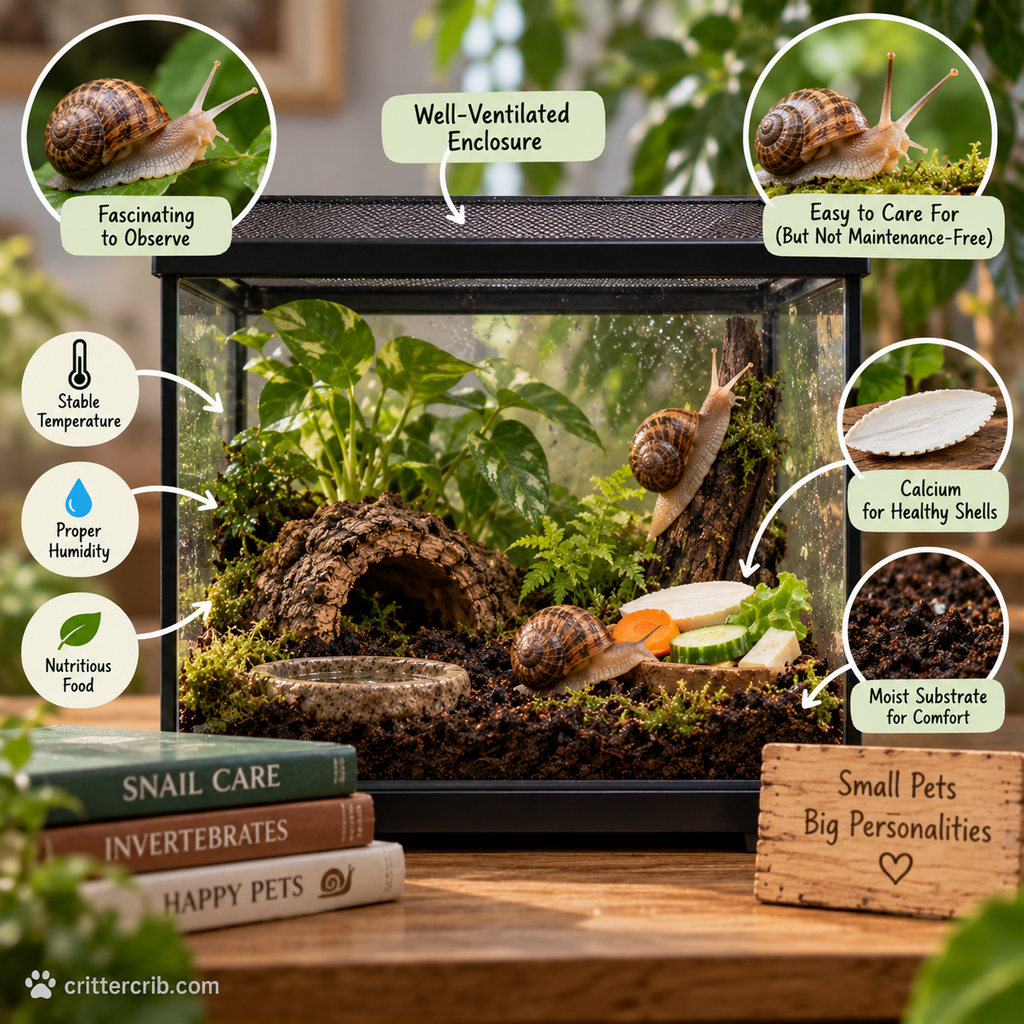
Calcium is one of the most important parts of land snail care.
Snails need calcium to build and maintain their shells.
A commonly used calcium source is cuttlebone.
Place a plain cuttlebone in the enclosure so the snail can access calcium when needed.
Avoid assuming that sprinkling random calcium products onto every meal is better. Products containing inappropriate additives may not be suitable.
A safe calcium source should remain readily available.
Foods and Materials to Avoid
Not everything in your kitchen belongs in a snail enclosure.
Avoid feeding heavily processed foods and foods containing added salt.
Salt is particularly dangerous to snails.
Also be cautious with plants or vegetables that may have pesticide residues.
Wash produce appropriately before offering it and remove spoiled food promptly.
When in doubt about a particular food, research whether it’s suitable for your species rather than experimenting.
Can You Handle a Pet Snail?
Pet snails can be handled occasionally, but handling should be gentle and limited.
Your hands should be clean and free from:
- Soap residue
- Hand sanitizer
- Lotion
- Perfume
- Cleaning chemicals
- Salt
Slightly damp hands are preferable to very dry ones.
Whenever possible, allow the snail to crawl onto your hand.
Never Pull a Snail From a Surface
This is one of the most important handling rules.
A snail can create a strong seal against glass or another surface.
Don’t grab the shell and pull.
Forcing a snail away from a surface can injure its body or shell.
Instead, gently encourage it to move onto your hand or wait until it releases its grip naturally.
Wash your hands after handling the snail or working inside the enclosure.
Do Snails Like Being Handled?
It’s better to assume that handling is for your benefit rather than the snail’s.
A snail calmly moving across your hand may tolerate the experience, but that doesn’t necessarily mean it wants human interaction.
Snails don’t need daily handling to live well.
A properly maintained enclosure that allows natural behavior is much more important.
How Often Should You Clean a Snail Enclosure?
Spot-clean regularly.
Remove:
- Old food
- Visible waste
- Moldy material
- Decaying food scraps
- Anything producing an unusual odor
You may also need to wipe excess mucus from enclosure walls occasionally.
Avoid completely sterilizing the enclosure every few days.
A stable habitat is generally preferable to repeatedly replacing everything.
How often deeper cleaning is necessary depends on the enclosure, substrate, species, and number of snails.
Be Careful When Changing Substrate
If you have mature snails, inspect the substrate before throwing it away.
Eggs may be buried beneath the surface.
Depending on the species, a clutch can contain many eggs.
This means snail owners need a plan for responsible egg management before breeding happens—not afterward.
Never dump potentially viable eggs or unwanted captive snails outdoors.
How Long Do Pet Land Snails Live?
Lifespan varies considerably between species.
Some land snails may live only a few years, while others can live substantially longer under appropriate captive conditions.
Before getting a snail, research the expected lifespan of the species you’re considering.
Small doesn’t necessarily mean short-term.
Even an inexpensive invertebrate deserves a commitment to proper care throughout its life.
Can You Keep Multiple Snails Together?
Many land snail species can be housed with others of the same species when enough space and resources are provided.
But keeping multiple snails also increases the likelihood of reproduction.
More snails also means:
- More waste
- More food
- More cleaning
- Greater space requirements
- More eggs to manage
If you don’t want offspring, research the reproductive biology of the species before keeping multiple individuals.
Are Land Snails Good Pets for Kids?
Snails can be interesting animals for children to observe, but adult supervision is important.
Children should learn not to:
- Pull a snail from a surface
- Squeeze the shell
- Drop the snail
- Touch it with dirty or salty hands
- Leave the enclosure open
- Release it outdoors
A snail can be a useful introduction to observing animal behavior and caring for a small habitat.
However, an adult should remain responsible for making sure the animal receives proper care.
Common Beginner Snail-Keeping Mistakes
Most problems can be prevented with some basic preparation.
Watch out for these common mistakes:
- Getting a snail without identifying the species.
- Assuming the species is legal to own.
- Letting the enclosure dry out completely.
- Keeping the habitat constantly waterlogged.
- Providing poor ventilation.
- Forgetting to provide a reliable calcium source.
- Feeding the same food every day.
- Using hard decorations that can damage the shell during a fall.
- Pulling a snail off the enclosure wall.
- Ignoring eggs in the substrate.
- Using soil or plants treated with pesticides.
- Releasing unwanted snails or eggs outdoors.
A simple, well-researched setup is usually safer than an elaborate enclosure built before you understand the species.
What Does a Healthy Pet Snail Look Like?
Healthy behavior varies, but encouraging signs generally include:
- Regular activity during appropriate times
- Normal climbing
- Feeding
- Exploring
- Responsive tentacles
- A shell without obvious new damage
- Burrowing when appropriate
- Normal attachment to surfaces
Snails naturally rest for long periods, so inactivity alone doesn’t necessarily mean something is wrong.
Learn your individual snail’s normal routine.
Changes become easier to recognize once you know what typical behavior looks like.
Who Should Consider Keeping Land Snails?
A pet snail might be a good choice if you:
- Enjoy observing small animals
- Want a quiet pet
- Have limited space
- Don’t need frequent physical interaction
- Enjoy maintaining terrariums
- Don’t mind preparing fresh food
- Can maintain humidity consistently
- Are comfortable managing possible eggs
- Are willing to research species-specific care
They’re especially appealing to people who enjoy invertebrates and miniature natural environments.
Who Probably Shouldn’t Get a Pet Snail?
Snails may not be ideal if you’re looking for an affectionate or highly interactive companion.
They’re also not maintenance-free.
If you don’t want to monitor moisture, clean fresh food regularly, or deal with the possibility of eggs, another type of pet may be a better fit.
And if the species you’re interested in is prohibited where you live, choose a legal alternative rather than attempting to obtain it anyway.
Are Land Snails Good Pets? The Bottom Line
For the right person, land snails can make excellent small pets.
They’re quiet, fascinating to observe, relatively inexpensive to feed, and don’t require the space or daily attention associated with many traditional pets.
Their simplicity can be misleading, though.
A healthy snail still needs a properly ventilated enclosure, moist substrate, suitable temperatures, a varied diet, dependable calcium, safe furnishings, and regular maintenance.
You’ll also need to think about reproduction and legality before bringing one home.
The best approach is to start by choosing a legal species and learning exactly what it needs. Build the enclosure around those requirements rather than trying to make the snail fit a generic setup.
If you’re happy watching a tiny animal climb, eat, burrow, and slowly explore its own little world, a land snail might be a surprisingly enjoyable pet.