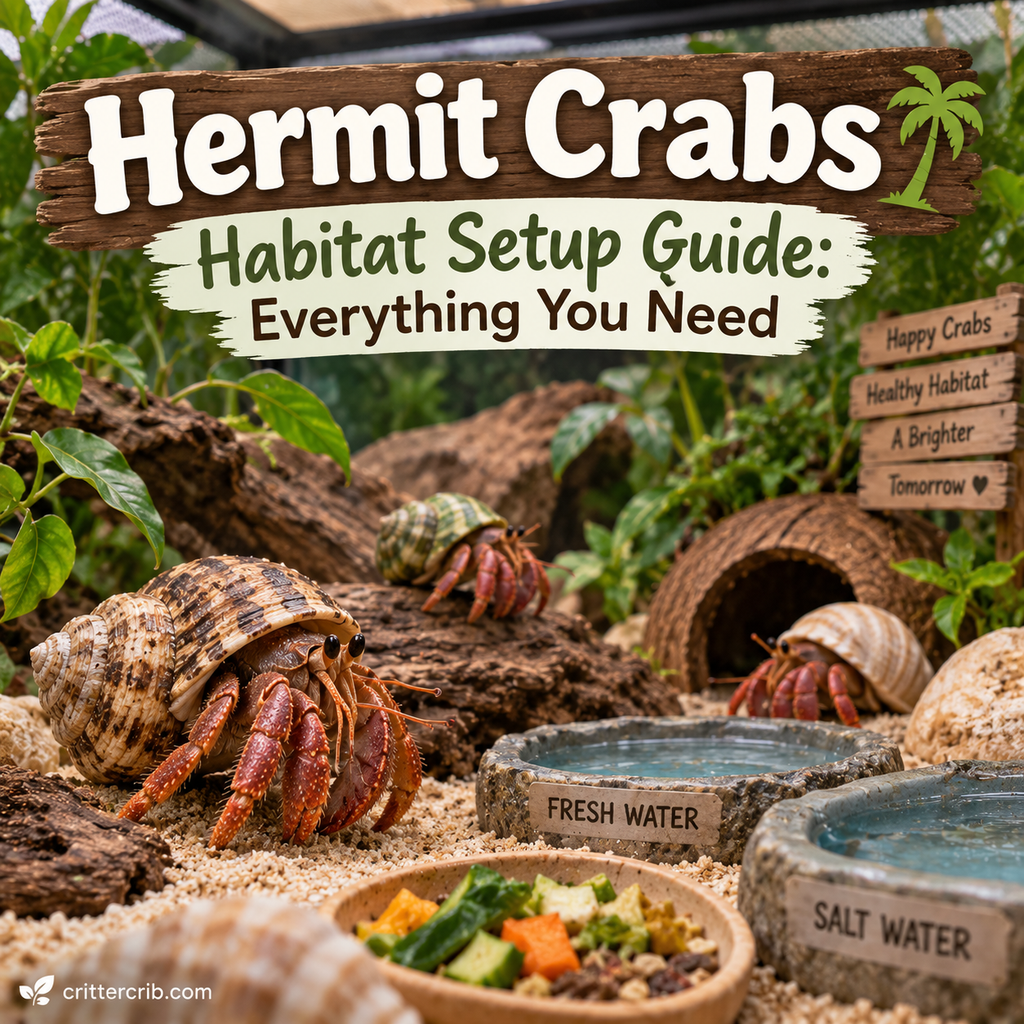
Setting up a hermit crab habitat takes more planning than putting sand in a tank and adding a water dish.
Land hermit crabs have some unusual needs. They breathe through modified gills, so humidity matters. They dig deep underground to molt, which means substrate depth matters. They need access to both fresh and marine-strength salt water, appropriately sized spare shells, warmth, hiding places, and enough room to explore.
Get those basics right and the habitat becomes much easier to maintain.
This guide walks through everything you need to set up a land hermit crab enclosure from the ground up, whether you’re preparing for your first crabs or improving an existing habitat.
Hermit Crab Habitat Essentials at a Glance
A properly prepared land hermit crab habitat should include:
- Appropriately sized glass or acrylic enclosure
- Secure lid
- Deep, molt-friendly substrate
- Warm temperatures
- High, stable humidity
- Thermometer and hygrometer
- Freshwater pool
- Saltwater pool
- Water conditioner
- Marine aquarium salt mix
- Multiple appropriately sized spare shells
- Hides
- Climbing structures
- Leaf litter and enrichment
- Food dishes
- Appropriate lighting cycle
You don’t need to make the habitat elaborate on day one.
Focus first on the conditions the crabs depend on, then add enrichment and decorative elements.
How Big Should a Hermit Crab Tank Be?
Land hermit crabs need more room than their small size suggests.
They walk, climb, forage, interact with other crabs, change shells, and spend long periods underground while molting.
For a small group of commonly kept hermit crabs, a 20-gallon tank is a much more practical starting point than the tiny plastic habitats often sold for them.
Larger is better when you’re keeping several crabs or larger species.
Tank size should account for:
- Number of crabs
- Adult size of the species
- Deep substrate
- Two water pools
- Shell shop
- Hides
- Climbing areas
- Feeding space
- Molting space
A habitat can become crowded surprisingly quickly once all the necessary equipment is inside.
Why Tiny Plastic Hermit Crab Cages Don’t Work Well
Small plastic carriers may be useful for short-term transport, but they make poor permanent homes.
They’re difficult to use for:
- Deep substrate
- Stable humidity
- Proper heating
- Large water pools
- Multiple hides
- Climbing enrichment
- Natural behavior
Hermit crabs benefit from a stable environment, and larger enclosures are generally easier to keep stable than tiny containers.
Do Hermit Crabs Need to Live Together?
Many commonly kept land hermit crabs are social and naturally occur around other hermit crabs.
Keeping compatible hermit crabs in appropriately sized groups can allow normal social behavior.
That makes enclosure size even more important.
A group needs enough space and resources to reduce unnecessary competition.
Provide multiple:
- Hiding areas
- Feeding locations
- Shell choices
- Climbing opportunities
Don’t overcrowd a small enclosure simply to provide companionship.
Choosing the Best Hermit Crab Tank
Glass aquariums are popular because they’re easy to find, easy to clean, and good at retaining humidity when paired with an appropriate lid.
A suitable enclosure should:
- Hold deep substrate
- Retain humidity
- Allow controlled ventilation
- Accommodate heating equipment
- Close securely
- Provide plenty of horizontal and vertical space
Front-opening terrariums can also work, but check how much substrate they can physically hold. Some have doors positioned too low for the deep substrate hermit crabs require.
Why the Lid Matters
An open screen top can allow humidity to escape rapidly.
For land hermit crabs, that’s a problem.
A secure glass, acrylic, or otherwise humidity-retaining lid can make environmental control much easier.
The enclosure shouldn’t be completely neglected just because it’s covered. You still need to monitor conditions and make adjustments when necessary.
A secure lid also prevents escapes.
Hermit crabs are surprisingly capable climbers.
Best Substrate for Hermit Crabs
Substrate is one of the most important parts of the entire setup.
Land hermit crabs burrow underground to molt.
During a molt, the crab sheds its exoskeleton and remains vulnerable while its new one hardens.
The substrate must therefore:
- Be deep enough
- Hold a burrow
- Retain appropriate moisture
- Be safe for digging
- Remain stable
A commonly used substrate combines play sand with coconut fiber.
The mixture should be moist enough to hold its shape when compressed without being waterlogged.
Think of the consistency of sand that’s suitable for building a sandcastle.
Avoid Calcium Sand
Calcium-based sand is frequently marketed for small pets and reptiles, but it isn’t an ideal choice for a hermit crab’s deep molting substrate.
Use appropriate play sand and species-safe substrate materials instead.
How Deep Should Hermit Crab Substrate Be?
For many commonly kept land hermit crabs, aim for at least around 6 inches of substrate, with deeper substrate provided for larger crabs.
Another useful approach is to provide substrate at least several times deeper than the height of your largest crab.
More depth gives crabs additional room to create stable molt tunnels.
Remember that six inches is a starting point, not a reason to stop adding substrate if you’re keeping large animals in a tall enclosure.
Don’t Dig Up a Molting Hermit Crab
Once a hermit crab disappears underground, resist the urge to search for it.
Molting crabs may remain buried for weeks or even longer depending on size and circumstances.
Digging can collapse a molt cave or injure a vulnerable crab.
Unless there’s a genuine emergency, leave buried crabs alone.
Hermit Crab Temperature
Land hermit crabs are tropical animals and generally need a warm environment.
For many commonly kept species, temperatures in roughly the mid-70s to low-80s°F can provide a useful general range, although exact requirements depend on species.
Use a digital thermometer rather than judging temperature by how the room feels.
The habitat may be warmer or cooler than the surrounding room.
Creating a Temperature Gradient
Rather than making every part of the enclosure exactly the same temperature, providing some variation allows crabs to choose where they’re comfortable.
One area may be somewhat warmer while another remains slightly cooler.
Avoid extreme differences.
The goal is a usable gradient within an appropriate overall range.
How to Heat a Hermit Crab Tank
If your room isn’t warm enough, supplemental heating may be necessary.
An external heat mat can be used on the side or back of the enclosure above the substrate line.
This is important.
Heating beneath deep substrate can warm the areas where crabs are trying to molt.
Instead, heating the air space helps raise enclosure temperature without directly heating underground molt caves.
Always monitor the actual temperature.
If heating equipment is capable of raising temperatures excessively, use an appropriate controller or thermostat.
Do Hermit Crabs Need a Heat Lamp?
Usually, a heat lamp isn’t the first choice for heating a land hermit crab habitat.
Lamps can dry the enclosure and make maintaining humidity more difficult.
If supplemental heat is needed, side-mounted external heating is commonly easier to manage.
Whatever heating method you use, measure the result rather than assuming it’s safe.
Hermit Crab Humidity
Humidity is critical because land hermit crabs breathe through modified gills.
For commonly kept species, relative humidity of around 70–80% or higher depending on species is often used as a general target.
The goal is stable, appropriately humid air—not a constantly flooded tank.
A digital hygrometer helps you monitor conditions.
Place it where it measures the general enclosure environment rather than directly over a water pool.
How to Maintain Hermit Crab Humidity
If humidity is consistently too low, look at the enclosure setup before constantly spraying more water.
Helpful factors include:
- Humidity-retaining lid
- Proper substrate
- Large water pools
- Appropriate heating
- Live or safe natural materials
- Reduced unnecessary ventilation
Large pools naturally contribute moisture to the air.
A well-designed enclosure may maintain humidity without constant misting.
Can a Hermit Crab Tank Be Too Humid?
Very high humidity by itself isn’t necessarily the same problem it would be for some arid animals, but stagnant, constantly wet conditions can still indicate poor habitat management.
Watch for:
- Waterlogged substrate
- Persistent flooding
- Excessive condensation
- Mold problems
- Stagnant air
Focus on stable environmental conditions rather than chasing a single number.
Hermit Crabs Need Two Water Pools
Land hermit crabs should have access to both:
- Fresh water
- Properly prepared salt water
A single shallow drinking dish isn’t enough for an ideal setup.
The pools should allow the crabs to submerge sufficiently while still providing an easy way to climb out.
Freshwater Pool
Use water treated with a conditioner appropriate for removing chlorine and chloramine when necessary.
Avoid assuming tap water is safe untreated.
Saltwater Pool
Prepare salt water using a marine aquarium salt mix, following the product’s instructions.
Don’t substitute ordinary table salt.
Products designed for marine aquariums provide the mineral composition needed to make artificial seawater.
Making Hermit Crab Pools Safe
Pools should be accessible to every crab in the enclosure.
Add safe exit structures such as:
- Plastic craft mesh
- Textured ramps
- Secure climbing surfaces
A crab should be able to enter and leave without struggling.
Check that ramps remain secure after digging activity.
Hermit crabs are talented interior decorators and may move things you thought were permanently positioned.
Do Hermit Crabs Need a Sponge in Their Water?
Sponges were traditionally recommended for hermit crab dishes, but they aren’t necessary for providing drinking water.
A properly designed pool with a safe entrance and exit is more useful.
Sponges can also collect debris and require regular cleaning.
If your pools are set up safely, the crabs can access the water directly.
Choosing a Hygrometer and Thermometer
A digital thermometer/hygrometer combination is one of the most useful pieces of equipment you can buy.
It lets you monitor:
- Temperature
- Relative humidity
Digital models are generally easier to read than inexpensive analog gauges.
Position the sensor around the middle of the enclosure’s usable air space rather than burying it in substrate or placing it directly against the heater.
Check it daily.
Small environmental changes are much easier to correct before they become large ones.
Hermit Crabs Need Extra Shells
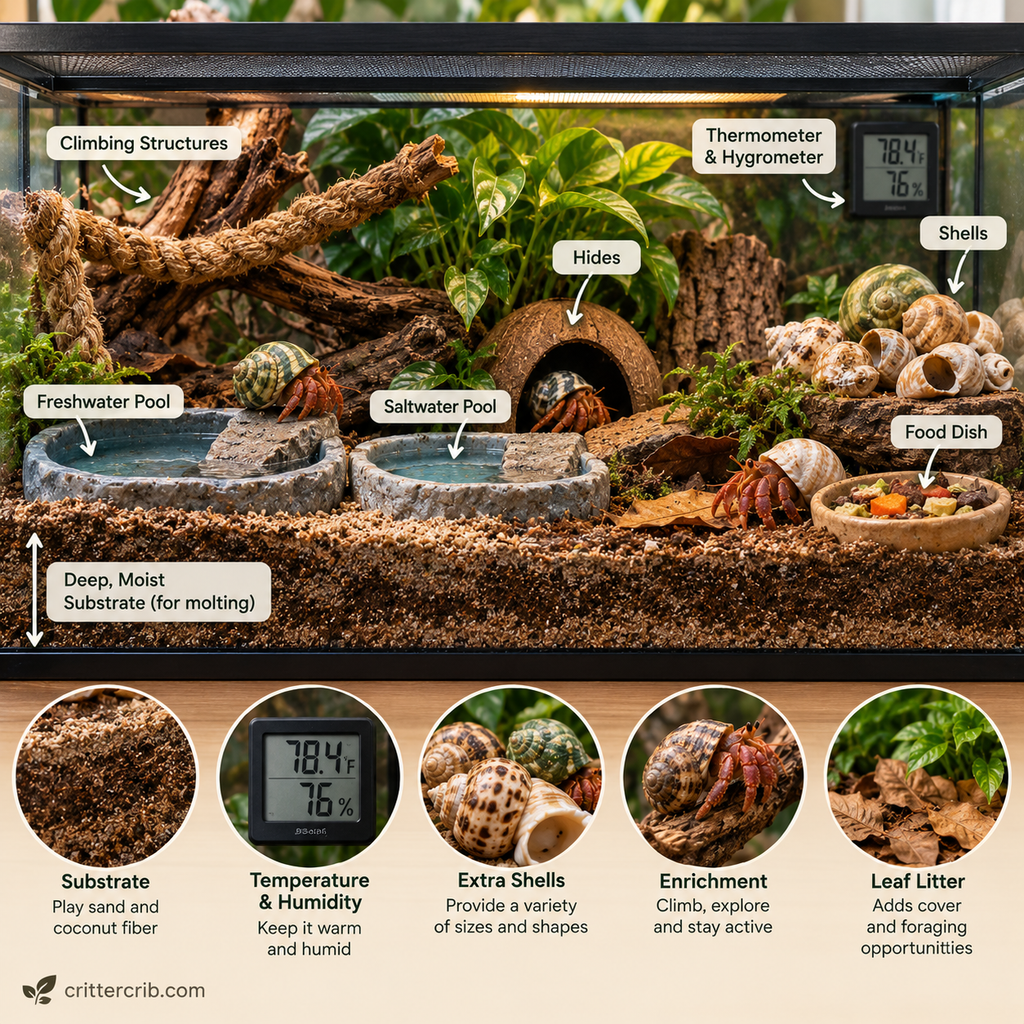
A hermit crab doesn’t grow its own protective shell.
As it grows, it needs to move into larger empty gastropod shells.
Shell availability is therefore part of habitat setup, not optional decoration.
Provide several appropriately sized natural shells for each crab.
The shell shop should include:
- Suitable opening sizes
- Preferred shell shapes
- Multiple choices
- Clean natural shells
Different hermit crab species may prefer different shell types.
Research the species you’re keeping before buying replacements.
Avoid Painted Shells
Painted and decorated shells may look fun, but natural unpainted shells are the safer choice.
Paint can chip or deteriorate, and decorative coatings provide no benefit to the crab.
The crab cares about fit and shell shape, not whether its home has a cartoon painted on it.
How to Measure Hermit Crab Shells
Shell size is generally compared using the diameter and shape of the shell opening.
When buying replacements, provide options near the crab’s current shell size as well as somewhat larger choices.
Don’t offer only one “perfect” replacement.
Hermit crabs can be surprisingly selective.
A shell that looks ideal to you may be completely ignored while the crab chooses another.
Variety helps.
Hiding Places
Hermit crabs need places where they can retreat and feel secure.
Good hides may include:
- Cork bark
- Coconut huts
- Safe wood structures
- Natural caves
- Other crab-safe shelters
Provide enough hiding space for multiple crabs.
Avoid extremely heavy decorations that could collapse into burrows or crush a crab if the substrate shifts.
Secure large objects carefully.
Climbing Opportunities
Land hermit crabs are active climbers.
A good habitat should make use of vertical space.
You can add:
- Cork bark
- Cholla wood
- Safe branches
- Climbing nets
- Plastic craft mesh
- Artificial plants
- Safe natural wood
Climbing provides exercise and enrichment while increasing the amount of usable space inside the enclosure.
Make sure everything is stable.
If a crab can move it, assume it eventually will.
Leaf Litter and Natural Enrichment
Leaf litter can make the enclosure feel more like a natural forest-floor environment.
Depending on the species and materials used, leaves can provide:
- Cover
- Foraging opportunities
- Climbing texture
- Edible organic material
Use safe leaves from areas free from pesticides and chemical contamination.
Suitable hardwood leaves are often prepared before being added to captive habitats.
Avoid introducing random outdoor materials without considering pesticides, pests, and contamination.
Food Dishes
Hermit crabs are opportunistic omnivores and benefit from a varied diet.
Small, shallow dishes make it easier to offer foods without mixing everything directly into the substrate.
You can use separate dishes for different food types or rotate foods regularly.
The habitat should allow easy access without forcing crabs to cross deep water or unstable decorations.
Remove foods that spoil before they become a moldy mess.
What Should Be in a Hermit Crab Diet?
A varied diet can include appropriate sources of:
- Protein
- Healthy fats
- Carbohydrates
- Fruits
- Vegetables
- Leaf litter and plant material
- Calcium
- Other minerals
Avoid relying entirely on one commercial pellet food.
Hermit crabs naturally consume a wide range of materials.
Research safe individual foods before adding them to the enclosure.
Avoid foods treated with pesticides, heavily processed foods, and ingredients that may be unsafe for invertebrates.
Do Hermit Crabs Need Calcium?
Calcium is important for exoskeleton health.
Suitable calcium sources can be offered as part of a varied diet.
Depending on your feeding approach, commonly used options may include:
- Cuttlebone
- Crushed oyster shell
- Other safe calcium-rich foods or materials
Calcium should complement a balanced diet rather than replace dietary variety.
Lighting for Hermit Crabs
Hermit crabs benefit from a normal day-night cycle.
The enclosure doesn’t need to remain brightly illuminated around the clock.
A regular schedule of light and darkness helps maintain a natural rhythm.
If you use enclosure lighting, choose something that doesn’t significantly overheat or dry the habitat.
Turn lights off at night.
Avoid colored “night” bulbs simply for viewing.
Darkness is part of the animal’s normal environment.
Do Hermit Crabs Need UVB?
UVB isn’t universally treated as an essential requirement for commonly kept land hermit crabs in the same way it is for many reptiles.
A consistent day-night cycle is more important for a basic setup.
If you choose specialized lighting, make sure it doesn’t interfere with temperature or humidity.
Adding Plants to a Hermit Crab Habitat
Plants can make a crabitat look fantastic, but hermit crabs aren’t always gentle gardeners.
They may:
- Climb plants
- Dig around roots
- Break stems
- Eat leaves
- Rearrange everything
Artificial plants can provide cover and climbing surfaces without requiring plant care.
If using live plants, confirm that the species is safe and hasn’t been treated with pesticides or fertilizers that could harm the crabs.
Also expect some landscaping changes courtesy of your residents.
How to Set Up a Hermit Crab Habitat Step by Step
Once you’ve gathered the supplies, build the habitat before bringing the crabs home.
1. Choose the Enclosure
Select a tank large enough for your current crabs plus their pools, shells, hides, and climbing structures.
Leave room for growth.
2. Install Heating Equipment
Position external heating on the side or back above the future substrate line.
Install your thermometer and hygrometer.
3. Prepare the Substrate
Mix appropriate play sand and coconut fiber until it holds its shape without becoming saturated.
Add enough depth for safe molting.
4. Add Freshwater and Saltwater Pools
Place both pools where they’re stable and easy to access.
Install ramps or climbing mesh.
5. Create a Shell Shop
Offer multiple natural shells in appropriate sizes and shapes.
Keep them accessible.
6. Add Hides
Create secure retreats in different parts of the enclosure.
7. Add Climbing Structures
Use vertical space with branches, cork, nets, and other safe materials.
8. Add Leaf Litter and Enrichment
Provide cover and opportunities to explore and forage.
9. Add Food Dishes
Place them where they’re easy to remove and clean.
10. Stabilize the Habitat
Before adding the crabs, check:
- Temperature
- Humidity
- Pool safety
- Substrate condition
- Heater operation
- Lid security
It’s easier to correct problems before animals are inside.
Daily Hermit Crab Habitat Care
Once the habitat is established, everyday maintenance is relatively simple.
Each day:
- Check temperature
- Check humidity
- Check both water pools
- Remove spoiled food
- Add fresh food
- Make sure exits from pools are secure
- Check for escaped or trapped crabs
- Observe the enclosure without disturbing buried crabs
You don’t need to rearrange the habitat constantly.
Stability is useful, particularly when animals are underground.
Weekly and Periodic Maintenance
Depending on your setup, periodically:
- Clean food dishes
- Maintain water pools
- Remove obvious spoiled material
- Inspect climbing structures
- Check heating equipment
- Add leaf litter
- Check available shells
- Clean viewing glass
- Inspect the lid
- Look for mold or pest problems
Avoid digging through substrate during routine maintenance.
A crab may be molting beneath the surface.
Should You Completely Replace Hermit Crab Substrate?
Routine complete substrate changes aren’t usually necessary in a stable enclosure.
Deep substrate is difficult to replace without disturbing underground crabs.
Spot-cleaning and good food management can reduce the need for major disruption.
A complete substrate replacement may become necessary after serious contamination, flooding, pest problems, or another genuine habitat failure.
Don’t perform one simply because a calendar says it’s “cleaning day.”
Common Hermit Crab Habitat Mistakes
A few setup problems appear again and again.
Using a Tiny Enclosure
Small tanks are difficult to equip properly.
Start with enough room for deep substrate, two pools, hides, shells, and enrichment.
Using Shallow Substrate
Hermit crabs need to molt underground.
Give them real digging depth.
Heating From Underneath
Avoid heating the molting substrate from below.
Heat the enclosure’s air space from the side or back instead.
Providing Only Fresh Water
Land hermit crabs should have access to both fresh and properly prepared salt water.
Using Table Salt for Salt Water
Use marine aquarium salt mix.
Providing Only One Spare Shell
Give each crab several choices.
Using Painted Shells
Natural shells are preferable.
Letting Humidity Drop Too Low
Land hermit crabs rely on humid air for their modified gills.
Monitor humidity with a reliable gauge.
Constantly Misting to Fix Humidity
If humidity falls rapidly every day, address the enclosure design rather than endlessly spraying water.
Digging Up Buried Crabs
A buried crab may be molting.
Leave it alone.
Using Heavy Unsecured Decorations
Crabs dig beneath objects.
Secure heavy furnishings so they can’t collapse into burrows.
Hermit Crab Habitat Shopping Checklist
Before bringing your crabs home, make sure you have:
Essential Equipment
- Appropriately sized tank
- Secure humidity-retaining lid
- Play sand
- Coconut fiber
- Digital thermometer
- Digital hygrometer
- Appropriate heating equipment if needed
- Thermostat or controller when appropriate
- Freshwater pool
- Saltwater pool
- Safe pool ramps
- Water conditioner
- Marine aquarium salt mix
- Several natural spare shells per crab
- Hiding places
- Climbing structures
- Food dishes
- Suitable food
- Calcium source
Useful Enrichment
- Cork bark
- Cholla wood
- Leaf litter
- Artificial or safe live plants
- Climbing nets
- Foraging materials
You can make the habitat prettier later.
Make it functional first.
Frequently Asked Questions About Hermit Crab Habitats
What Size Tank Do Hermit Crabs Need?
Tank size depends on species, crab size, and number of animals, but a 20-gallon enclosure is a practical starting point for a small group of commonly kept land hermit crabs.
Larger groups and larger species need more room.
How Deep Should Hermit Crab Substrate Be?
Around six inches is a useful minimum starting point for many commonly kept hermit crabs, with deeper substrate needed for larger animals.
The substrate must be deep and stable enough for underground molting.
Do Hermit Crabs Need Sand?
A sand-based substrate is commonly used.
Many setups combine play sand with coconut fiber to create a substrate capable of holding stable burrows.
Do Hermit Crabs Need Salt Water?
Yes. Land hermit crabs should have access to both fresh water and appropriately prepared marine salt water.
Do Hermit Crabs Need a Heater?
If the enclosure remains below the appropriate temperature range for the species, supplemental heating may be needed.
Monitor temperature before deciding.
Do Hermit Crabs Need a Humidifier?
Usually not.
A properly designed enclosure with a humidity-retaining lid, suitable substrate, water pools, and appropriate heating can often maintain humidity without a separate humidifier.
Do Hermit Crabs Need Light at Night?
No.
Provide a regular day-night cycle and allow darkness at night.
How Many Extra Shells Should I Provide?
Offer several appropriately sized natural shells per crab, including choices close to the crab’s current shell size and slightly larger options.
Can I Use Tap Water for Hermit Crabs?
Tap water may contain chlorine or chloramine.
Treat water appropriately before using it in the habitat.
Why Is My Hermit Crab Digging?
Digging is normal behavior.
Hermit crabs may dig to explore, regulate conditions, hide, or prepare to molt.
Don’t automatically dig up a crab that disappears underground.
Final Thoughts on Setting Up a Hermit Crab Habitat
A good hermit crab habitat isn’t defined by how many decorations you can fit into the tank.
It’s defined by whether the crabs can behave like hermit crabs.
They should be able to dig deep underground, molt safely, submerge in fresh and salt water, choose new shells, climb, hide, forage, and move between slightly different conditions within the enclosure.
Start with the fundamentals: enough space, deep substrate, warmth, humidity, two proper water pools, spare natural shells, hides, and climbing opportunities.
Then add enrichment.
It may take more work to set up than the tiny plastic “hermit crab kits” suggest, but once a proper crabitat is stable, everyday maintenance becomes much easier.
More importantly, you’ll have an enclosure built around the animals’ actual needs rather than the limitations of a starter kit.