

Fire-bellied newts are small, striking amphibians known for their dark bodies and vivid orange or red undersides. They’re fascinating to watch, relatively quiet, and don’t require the enormous enclosures associated with many exotic pets.
That doesn’t mean they’re maintenance-free.
Fire-bellied newts are semi-aquatic to highly aquatic animals that depend on clean, cool water and a carefully designed habitat. Water quality is particularly important. A beautiful aquarium won’t do your newts much good if ammonia is accumulating or the temperature regularly becomes too warm.
They’re also long-lived compared with many small pets, so bringing one home should be viewed as a long-term commitment rather than a temporary aquarium project.
This fire-bellied newt care guide covers the essentials, including habitat setup, water conditions, temperature, feeding, daily care, cleaning, behavior, and common mistakes to avoid.
What Is a Fire-Bellied Newt?
“Fire-bellied newt” is a common name used for several small Asian newts historically seen in the pet trade.
Two names frequently associated with fire-bellied newts are:
- Chinese fire-bellied newt
- Japanese fire-bellied newt
They aren’t simply different names for exactly the same animal. Different species can vary in size, appearance, behavior, and habitat preferences.
This matters because you should identify the species you’re keeping whenever possible rather than assuming every animal sold as a “fire-bellied newt” has identical requirements.
For this guide, we’ll focus on the general husbandry principles commonly associated with the small aquatic and semi-aquatic newts traditionally kept under the fire-bellied newt name.
What Do Fire-Bellied Newts Look Like?
The name gives away their most memorable feature.
Fire-bellied newts typically have dark brown to black coloration across the upper body with a brightly colored underside that may be orange or red with darker markings.
That bright belly isn’t just decorative.
In nature, vivid coloration can serve as a warning to predators that an animal may be unpleasant or toxic to eat.
Their overall appearance includes:
- Slender body
- Long tail
- Short legs
- Dark dorsal coloration
- Bright orange or red belly
- Smooth to somewhat textured skin depending on species
Adults remain relatively small compared with larger salamanders.
How Long Do Fire-Bellied Newts Live?
Fire-bellied newts shouldn’t be treated as short-lived starter pets.
With appropriate care, newts can live for many years, and some individuals may reach well beyond a decade.
Exact lifespan depends on species, genetics, environmental conditions, diet, and overall husbandry.
Before getting one, ask yourself whether you’re prepared to maintain an aquatic amphibian habitat for the long term.
The aquarium may change over the years.
The newt may still be there.
Are Fire-Bellied Newts Good Pets for Beginners?
They can be suitable for a careful beginner, particularly someone already comfortable with aquarium maintenance.
However, they’re not ideal for someone looking for an animal that enjoys handling.
Fire-bellied newts are primarily display pets.
They are best suited to an owner willing to:
- Maintain excellent water quality
- Keep temperatures appropriately cool
- Feed suitable foods
- Perform regular aquarium maintenance
- Minimize handling
- Monitor the animals closely
- Maintain the habitat for many years
If you enjoy watching natural behavior rather than physically interacting with your pet, a fire-bellied newt can be very rewarding.
Fire-Bellied Newt Habitat Setup
The enclosure is the foundation of good newt care.
Many fire-bellied newts spend a substantial amount of time in water, although the exact balance between aquatic and terrestrial areas depends on species, age, season, and individual behavior.
A good setup generally provides a generous aquatic area along with easy access to land or resting areas above the water.
If you’re building the enclosure from scratch, our fire-bellied newt habitat setup guide goes deeper into tank size, water depth, filtration, cycling, substrate, plants, land areas, temperature, lighting, and keeping the enclosure secure.
What Size Tank Does a Fire-Bellied Newt Need?
A small group of fire-bellied newts can often be maintained in a modest aquarium, but avoid extremely small tanks.
Something around 10 gallons can serve as a starting point for a small setup, while larger enclosures provide several advantages.
More water volume generally means:
- More stable water parameters
- More room for plants
- Easier creation of naturalistic areas
- More swimming space
- Greater flexibility when arranging land areas
- More dilution of waste between maintenance sessions
A 20-gallon-long-style aquarium can make an excellent habitat for multiple small newts because it provides generous horizontal space without excessive height.
Stocking should always take species, adult size, filtration, and individual behavior into account.
More animals mean more waste.
Don’t overcrowd the aquarium simply because the newts themselves look small.
Do Fire-Bellied Newts Need Land and Water?
Providing both is a sensible approach for many fire-bellied newt setups.
Some individuals may spend most of their time underwater, while others occasionally climb onto land, floating plants, cork bark, rocks, or other structures.
The transition between water and land should be easy.
Avoid steep barriers that force the newt to struggle to leave the water.
Possible land or resting areas include:
- Cork bark
- Smooth rocks positioned securely
- Floating platforms
- Dense floating plants
- Purpose-built aquarium land areas
- Sloped naturalistic sections
Make sure everything is stable.
A newt should never be able to become trapped beneath a rock or heavy decoration.
How Deep Should the Water Be?
Healthy aquatic adult newts are capable swimmers, so the water doesn’t need to be extremely shallow.
However, the setup should provide easy routes to the surface and access to resting areas.
Water depth can vary depending on species and enclosure design.
Rather than choosing depth based on appearance alone, ask whether your newt can:
- Swim comfortably
- Reach the surface easily
- Rest near the surface
- Leave the water if it chooses
- Move without fighting strong currents
Plants and structures at different heights can make a deeper aquatic section much more usable.
Do Fire-Bellied Newts Need a Filter?
Filtration is highly useful in an aquatic newt habitat.
A filter provides mechanical filtration while also creating surfaces for beneficial bacteria involved in the aquarium nitrogen cycle.
However, fire-bellied newts generally don’t need powerful water movement.
Strong currents can make an otherwise suitable aquarium uncomfortable.
Good options may include:
- Sponge filters
- Small adjustable internal filters
- Gently baffled aquarium filters
Choose filtration appropriate for the tank volume and animal load.
The goal is clean, biologically stable water—not a miniature whitewater river.
Cycle the Aquarium Before Adding Newts
This is one of the most important parts of setting up a fire-bellied newt habitat.
Aquatic animals produce waste.
That waste contributes to ammonia, which can be dangerous. In a cycled aquarium, beneficial bacteria process ammonia into nitrite and then nitrate.
Ammonia and nitrite should remain at zero in an established aquarium.
Nitrate is controlled through water changes, plants, and other aquarium-management practices.
A newly filled aquarium isn’t automatically cycled just because the water looks clean.
Establish the nitrogen cycle before adding your newts and verify conditions with a freshwater test kit.
Fire-Bellied Newt Water Quality
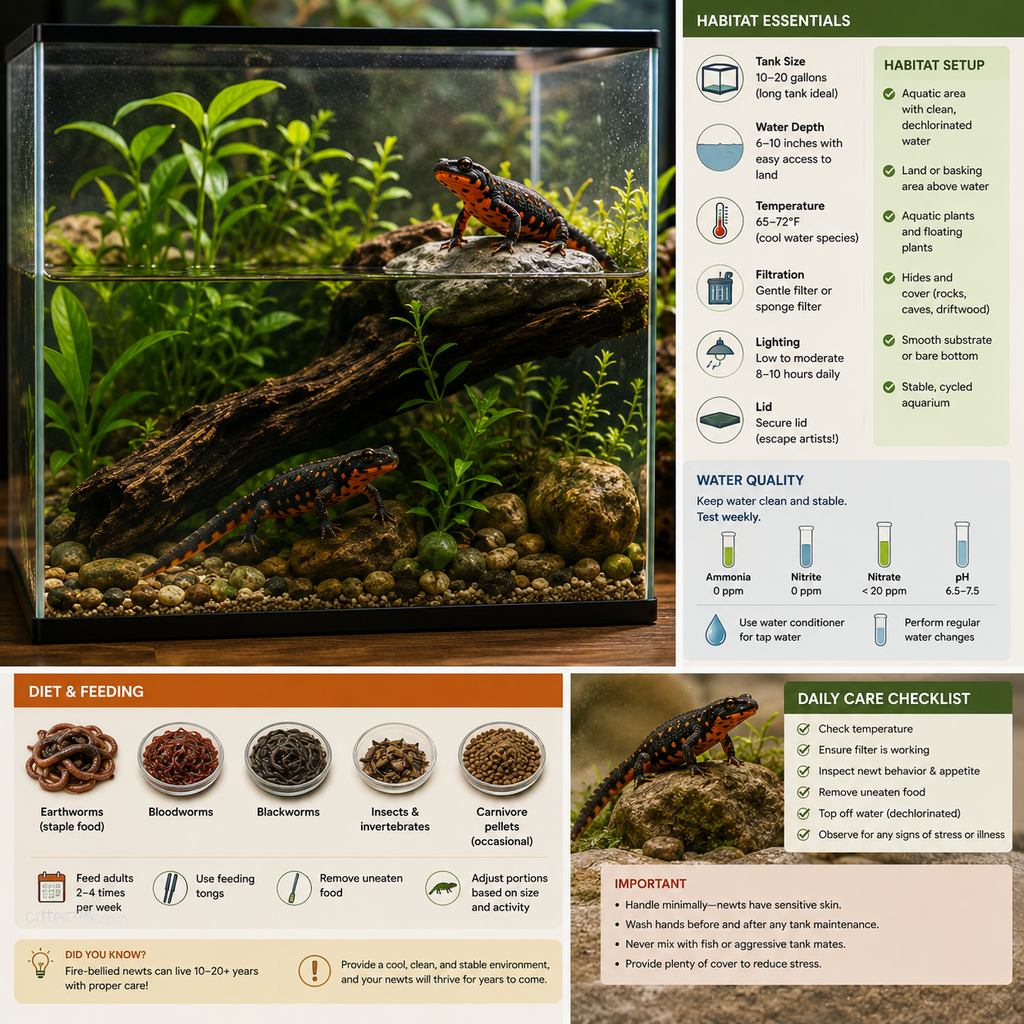
Clear water and safe water aren’t necessarily the same thing.
Regular testing is the only reliable way to know what’s happening with important water parameters.
Monitor:
- Ammonia
- Nitrite
- Nitrate
- pH
- Temperature
Water chemistry should remain stable rather than changing dramatically from one maintenance session to another.
Avoid attempting to constantly adjust pH with chemicals unless there’s a genuine reason to do so.
Stability is often more valuable than chasing a supposedly perfect number.
Should You Use Tap Water?
Tap water may contain chlorine or chloramine.
Use an appropriate aquarium water conditioner when preparing tap water for the enclosure.
Follow the manufacturer’s dosing directions.
Don’t assume that leaving tap water sitting overnight will solve every water-treatment issue. Chloramine, for example, doesn’t behave the same way as chlorine.
A reliable conditioner is a simple solution.
What Temperature Do Fire-Bellied Newts Need?
Fire-bellied newts generally prefer cooler conditions than tropical aquarium animals.
For many commonly kept fire-bellied newts, temperatures in roughly the mid-60s to low-70s Fahrenheit are often appropriate, depending on the species.
This is important because overheating can become a serious husbandry problem.
Many owners spend more time worrying about keeping the aquarium cool than keeping it warm.
Do Fire-Bellied Newts Need a Heater?
Often, no.
If your room naturally remains within an appropriate temperature range, an aquarium heater may be unnecessary and could create more risk than benefit.
Always base this decision on measured water temperature rather than assumptions.
Use a reliable aquarium thermometer.
What If the Tank Gets Too Warm?
Warm weather can be challenging.
Possible strategies include:
- Moving the aquarium away from direct sunlight
- Keeping it away from heat-producing appliances
- Increasing room air conditioning
- Using appropriate aquarium cooling equipment
- Managing aquarium lighting
- Monitoring temperatures throughout hot weather
Don’t rely on dramatic, sudden temperature changes.
Stable cooling is preferable to repeatedly shocking the aquarium with extreme temperature swings.
Do Fire-Bellied Newts Need UVB?
UVB practices for newts are more nuanced than simply saying every enclosure absolutely requires it or none ever benefit from it.
Many fire-bellied newts have historically been maintained without strong UVB lighting, particularly when provided with an appropriate diet and environment.
Low-level UVB may be considered in some naturalistic setups, but the enclosure should always provide shaded areas where the animals can move away from the light.
If you use UVB:
- Choose equipment appropriate for amphibians and the enclosure
- Provide shade and cover
- Follow safe positioning guidelines
- Replace bulbs according to manufacturer recommendations
- Avoid excessive heat
Lighting should never turn a cool newt habitat into a warm one.
What Substrate Is Best for Fire-Bellied Newts?
You have several options.
Bare Bottom
A bare-bottom aquatic section is easy to clean and makes waste easy to see.
It isn’t particularly natural-looking, but it can be practical.
Fine Sand
Aquarium-safe fine sand creates a more natural appearance and can work well in planted setups.
Large Smooth Stones
Large smooth stones may also be used in certain areas, provided they’re stable and too large to be swallowed.
Substrates to Avoid
Be cautious with small gravel.
Newts can accidentally ingest small pieces while feeding.
Also avoid:
- Sharp stones
- Rough materials
- Unstable rock piles
- Substrate contaminated with chemicals
- Random outdoor material that hasn’t been evaluated for aquarium safety
A beautiful substrate isn’t worth an unnecessary ingestion or injury risk.
Plants for a Fire-Bellied Newt Aquarium
Plants are extremely useful in newt habitats.
They provide:
- Cover
- Resting areas
- Visual barriers
- Natural appearance
- Surfaces for exploration
- Potential assistance with nutrient management
Live aquatic plants can be particularly valuable.
Plants that grow toward or across the water surface can provide convenient resting locations where a newt can sit just beneath or above the surface.
Floating plants can serve a similar purpose.
Artificial plants are another option, but choose soft aquarium-safe products without sharp plastic edges.
Hides and Enclosure Enrichment
Fire-bellied newts should have plenty of cover.
An empty glass tank may technically contain enough water, but it doesn’t provide much environmental complexity.
You can add:
- Aquatic plants
- Cork bark
- Smooth caves
- Driftwood
- Secure rocks
- Leaf litter where appropriate
- Shaded areas
Arrange the habitat so that you can still observe the newts and maintain the enclosure.
More décor isn’t always better.
Avoid creating inaccessible pockets where waste accumulates or newts could become trapped.
Do Fire-Bellied Newts Need a Lid?
Yes, use a secure lid.
Newts are surprisingly capable of finding escape routes.
Small gaps around filter cables, tubing, and equipment may be larger than they appear when viewed from the perspective of a determined amphibian.
Check the enclosure carefully for openings.
A secure lid should still allow appropriate ventilation.
Escaped amphibians can quickly become dehydrated or injured, so prevention is much easier than trying to find a tiny newt somewhere behind your furniture.
What Do Fire-Bellied Newts Eat?
Fire-bellied newts are carnivorous.
Their diet should focus on appropriately sized animal-based foods rather than generic tropical fish flakes.
Depending on the species and individual, suitable foods may include:
- Earthworms
- Chopped earthworms
- Bloodworms
- Blackworms
- Small aquatic invertebrates
- Appropriate frozen foods
- Quality carnivorous amphibian foods
- Other suitable small prey
Earthworms are particularly useful because they’re nutritious and can be cut into appropriate sizes.
Food should be small enough for the newt to eat comfortably.
How Often Should You Feed a Fire-Bellied Newt?
Feeding frequency depends on age, body condition, food type, temperature, and individual metabolism.
Juveniles generally require more frequent feeding than healthy adults.
Adult newts may be fed several times per week rather than necessarily every day.
Instead of relying entirely on a rigid schedule, monitor:
- Body condition
- Appetite
- Growth
- Activity
- Leftover food
Remove uneaten food so it doesn’t decay and affect water quality.
How Do You Feed Fire-Bellied Newts?
Some newts quickly learn to associate feeding tools with food.
Long aquarium tweezers or feeding tongs can be useful for offering worms and other foods directly.
Target feeding has several advantages.
It allows you to:
- Confirm each newt eats
- Monitor appetite
- Reduce wasted food
- Prevent food from disappearing into substrate
- Feed slower individuals separately
Don’t force food into the animal’s mouth.
Offer it within easy reach and allow the newt to respond.
Can Fire-Bellied Newts Eat Pellets?
Some individuals may accept appropriately formulated pellets or prepared amphibian foods.
However, don’t assume every newt will recognize pellets immediately.
Prepared foods can be useful as part of a varied diet when nutritionally appropriate, but whole animal-based foods are commonly used as important components of newt diets.
Variety is preferable to relying on one treat food indefinitely.
Can Fire-Bellied Newts Live Together?
Compatible fire-bellied newts of the same species can often be housed in groups when the enclosure is appropriately sized.
However, monitor individuals.
Make sure:
- Everyone gets food
- No animal is being persistently harassed
- There is adequate space
- Hiding areas are plentiful
- Animals are similar enough in size to coexist safely
New animals should be quarantined appropriately before introduction to an established group.
Mixing different newt or salamander species in one enclosure is generally best avoided.
Different species can have different environmental requirements and may expose one another to pathogens.
Can Fire-Bellied Newts Live With Fish?
A newt-only setup is generally the safest and simplest approach.
Fish can create several potential problems.
They may:
- Compete for food
- Stress the newts
- Nip at them
- Require warmer temperatures
- Introduce disease
- Become prey
- Produce additional waste
The fact that two animals can physically occupy the same aquarium doesn’t mean they make good tank mates.
Design the enclosure around the newts first.
Can You Handle Fire-Bellied Newts?
Handling should be kept to a minimum.
Amphibian skin is delicate and can interact directly with substances in the environment.
Oils, lotions, soap residue, and other substances on human hands aren’t things you want transferring to your newt.
Fire-bellied newts can also produce defensive skin secretions.
Avoid touching your eyes or mouth after contact with the animal or enclosure and wash your hands thoroughly afterward.
Children should be supervised around the habitat.
Never allow anyone to put a newt in their mouth or handle one casually like a toy.
These are animals to observe, not cuddle.
Daily Fire-Bellied Newt Care
One advantage of a well-established aquarium is that daily maintenance is fairly quick.
A basic daily check can include:
- Observe each newt.
- Make sure no animal has escaped.
- Check water temperature.
- Inspect the aquarium for uneaten food.
- Look for obvious waste or dead plant material.
- Confirm the filter is operating normally.
- Check the water level.
- Feed according to your schedule.
You don’t need to dismantle the aquarium every day.
Most of the time, careful observation is the most important task.
Weekly and Routine Maintenance
Regular maintenance keeps water quality stable.
Your routine may include:
- Testing water parameters
- Performing partial water changes
- Removing waste
- Cleaning the filter when necessary
- Trimming plants
- Cleaning algae from viewing areas
- Inspecting decorations
- Checking equipment
Avoid replacing all filter media at once unless there’s a specific reason.
Beneficial bacteria live on filter media and other aquarium surfaces.
Destroying too much of the biological filtration at the same time can destabilize the aquarium.
When cleaning reusable filter media, follow an approach that preserves biological filtration whenever possible.
How Often Should You Change the Water?
There’s no universal water-change schedule that works for every aquarium.
Frequency depends on:
- Tank size
- Number of newts
- Filtration
- Feeding
- Plant growth
- Nitrate accumulation
- Overall water quality
Partial water changes are generally preferable to repeatedly replacing all the water.
Testing helps determine what your particular aquarium needs.
The goal isn’t to make the aquarium “sterile.”
The goal is stable, clean water.
Signs of a Healthy Fire-Bellied Newt
Once you’ve observed your newts regularly, you’ll become familiar with their normal behavior.
A healthy animal generally has:
- Clear skin
- Normal body condition
- Regular appetite
- Normal movement
- Appropriate use of water and land areas
- No obvious wounds or abnormal growths
Some newts are naturally more active than others.
Behavior may also vary depending on time of day, temperature, feeding, and season.
Learn what is normal for each individual.
Signs Something May Be Wrong
Behavioral or physical changes deserve attention.
Possible warning signs include:
- Persistent refusal to eat
- Significant weight loss
- Skin sores
- Unusual swelling
- Difficulty swimming
- Persistent floating problems
- Abnormal posture
- Severe lethargy
- Visible fungal-looking growth
- Wounds
- Difficulty shedding normally
- Sudden change in aquatic or terrestrial behavior
Poor water quality and inappropriate temperatures can contribute to health problems, so check the environment whenever something changes.
If your newt appears ill or injured, seek a veterinarian experienced with amphibians or exotic animals.
Why Is My Fire-Bellied Newt Staying on Land?
A newt spending time on land isn’t automatically sick.
Some individuals naturally use terrestrial areas more than others, and behavior can vary with species and life stage.
However, a sudden refusal to enter the water deserves investigation.
Check:
- Ammonia
- Nitrite
- Nitrate
- Water temperature
- Current strength
- Water treatment
- Recent aquarium changes
If an aquatic newt suddenly starts avoiding water it previously used normally, don’t assume it simply decided to become terrestrial overnight.
Look for environmental causes.
Why Is My Fire-Bellied Newt Always in the Water?
That can also be completely normal.
Many adult fire-bellied newts become highly aquatic under suitable conditions.
As long as the newt can easily reach land or resting areas and appears healthy, spending most of its time underwater isn’t necessarily a concern.
The important thing is giving the animal options.
Do Fire-Bellied Newts Hibernate?
Seasonal behavior varies by species and environment.
Captive newts may respond to seasonal changes in temperature and daylight, but deliberately attempting to hibernate an animal isn’t something a beginner should improvise.
If you’re maintaining or breeding a specific species that requires seasonal cycling, research that species in detail.
General pet care and intentional reproductive conditioning aren’t always the same thing.
Common Fire-Bellied Newt Care Mistakes
Most husbandry problems come back to a few recurring issues. Our guide to common fire-bellied newt care mistakes and how to avoid them goes deeper into problems involving water quality, excessive temperatures, filtration, feeding, substrate, handling, tank mates, and habitat setup.
Keeping the Water Too Warm
These aren’t tropical fish.
Don’t automatically install a heater simply because the animal lives in an aquarium.
Adding Newts to an Uncycled Tank
Clear water doesn’t guarantee safe water.
Establish biological filtration before adding animals.
Using Strong Filtration
Choose gentle water movement.
The filter should improve the environment, not make the newts constantly fight the current.
Handling Too Frequently
Fire-bellied newts are display animals.
Leave them in their habitat whenever possible.
Using Small Gravel
Avoid substrate that could be swallowed during feeding.
Overfeeding
Extra food doesn’t simply disappear.
It decomposes and contributes to poor water quality.
Keeping Them With Random Fish
Build the habitat around the newts rather than trying to turn it into a mixed-species community aquarium.
Leaving Escape Gaps
Check around cables, tubing, filters, and lid edges.
Newts can exploit surprisingly small openings.
Ignoring Hot Summer Temperatures
A tank that’s perfect in January may become dangerously warm in July.
Plan for seasonal changes before they happen.
Fire-Bellied Newt Beginner Supply Checklist
Before bringing your newts home, make sure you have the essentials. Our fire-bellied newt beginner supplies checklist goes into more detail about the aquarium, filtration, water-testing equipment, hides, plants, feeding supplies, and maintenance tools you’ll want to have ready.
Habitat
- Appropriately sized aquarium
- Secure lid
- Gentle filter
- Land or resting area
- Safe substrate
- Plants
- Hides and cover
Water Care
- Water conditioner
- Freshwater test kit
- Thermometer
- Aquarium siphon
- Dedicated bucket
Feeding
- Appropriate animal-based foods
- Feeding tongs or tweezers
- Container for frozen or live foods when necessary
Maintenance
- Algae scraper
- Dedicated aquarium cleaning tools
- Replacement filter supplies
- Plant-maintenance tools if needed
Set everything up before purchasing the newts.
The aquarium should be cycled, stable, and operating normally before the animals arrive.
Frequently Asked Questions About Fire-Bellied Newt Care
Are fire-bellied newts fully aquatic?
Many adult fire-bellied newts spend substantial amounts of time underwater, but providing easy access to a land or surface-resting area is appropriate. Exact aquatic behavior varies by species and individual.
What size tank does a fire-bellied newt need?
A 10-gallon aquarium can be a starting point for a small setup, while larger tanks—such as a 20-gallon long—provide more water volume and usable horizontal space for groups. Stocking should be based on species, adult size, filtration, and water quality.
Do fire-bellied newts need a heater?
Often they don’t. Many fire-bellied newts prefer cool water, and typical tropical aquarium temperatures may be warmer than ideal. Monitor the actual water temperature before deciding whether heating is necessary.
Do fire-bellied newts need a filter?
Filtration is highly useful for maintaining water quality, but the flow should remain gentle. Sponge filters and adjustable filters can work well.
What do fire-bellied newts eat?
Fire-bellied newts are carnivorous and can eat appropriately sized animal-based foods such as earthworms, blackworms, bloodworms, suitable frozen foods, and certain prepared amphibian foods.
How often should fire-bellied newts eat?
Healthy adults may eat several times per week, while juveniles generally require more frequent feeding. Adjust feeding according to age, body condition, temperature, and the type of food offered.
Can you hold a fire-bellied newt?
Handling should be minimized. Amphibians have delicate skin, and fire-bellied newts may produce defensive skin secretions. They’re better suited to observation than frequent physical interaction.
Can fire-bellied newts live with fish?
A species-focused newt setup is generally safer. Fish may compete for food, require different temperatures, increase waste, nip at newts, or introduce pathogens.
Why is my fire-bellied newt trying to escape?
Check water quality, temperature, filtration strength, and overall habitat conditions. Also make sure the enclosure has a secure lid because newts can climb and find small escape routes even in an otherwise appropriate setup.
Are fire-bellied newts poisonous?
Fire-bellied newts can produce defensive skin secretions containing toxins. They should never be ingested, and handling should be minimized. Wash your hands after contact with the newt or its habitat and supervise children carefully.
Are Fire-Bellied Newts the Right Pet for You?
Fire-bellied newts can make fascinating pets for someone who enjoys maintaining naturalistic aquariums and observing amphibian behavior.
They don’t need daily walks.
They won’t destroy your furniture.
And they certainly aren’t going to wake the neighbors.
What they do need is consistent environmental care.
Clean, cool water is at the center of successful fire-bellied newt husbandry. Add gentle filtration, appropriate food, plenty of plants and cover, a secure enclosure, and regular monitoring, and you’ve addressed most of their fundamental needs.
The biggest adjustment for some new owners is realizing that keeping an aquatic amphibian is partly about keeping an aquarium.
You’re not only caring for the newt.
You’re maintaining the entire environment that keeps the newt healthy.
Get that environment right, and fire-bellied newts can be captivating animals to watch for many years.