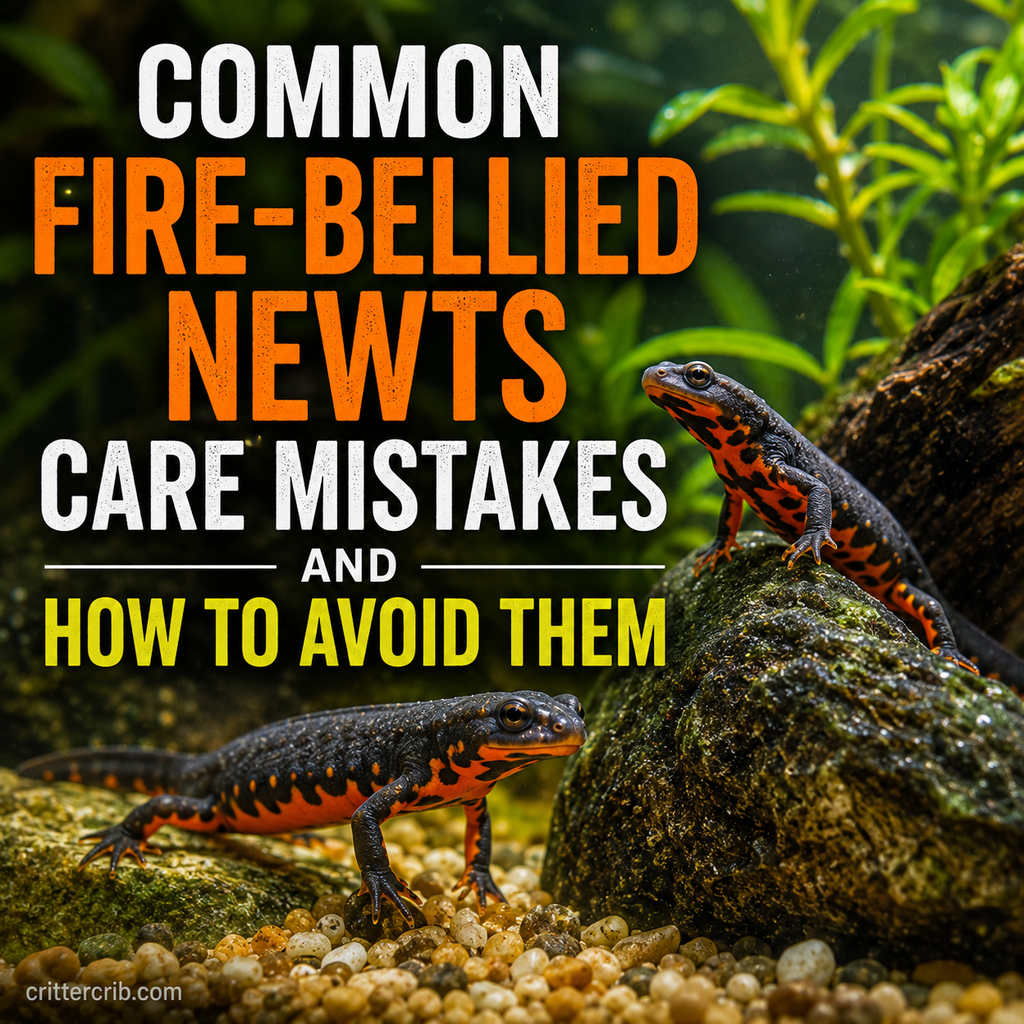
Fire-bellied newts are small, colorful amphibians with dark bodies and striking orange or red bellies. They can also be surprisingly long-lived pets, which makes getting their care right especially important.
Unfortunately, some of the most common fire-bellied newt care mistakes happen because people treat them like tropical fish, fully terrestrial salamanders, or generic “easy” aquarium pets.
They aren’t any of those things.
Fire-bellied newts need cool temperatures, clean water, appropriate access to land or resting areas, a nutritious carnivorous diet, and minimal handling. Their permeable amphibian skin also makes them particularly sensitive to poor water quality and environmental contaminants.
Whether you already keep fire-bellied newts or you’re planning an enclosure, avoiding the following mistakes can help create a healthier, more stable environment.
First, Know Which Fire-Bellied Newt You Have
Before getting into specific care mistakes, it’s worth clarifying the name “fire-bellied newt.”
Several Asian newts have historically been sold under similar common names. Species that have appeared in the pet trade include Chinese fire-bellied newts and Japanese fire-bellied newts, along with animals that may be incorrectly labeled.
That’s important because care requirements aren’t necessarily identical between every species.
If possible, identify your newt by its scientific name and learn about that particular species rather than relying entirely on a pet-store label.
Knowing exactly what animal you have makes everything else easier.
Mistake #1: Keeping Fire-Bellied Newts Too Warm
One of the easiest mistakes to make is assuming that an exotic amphibian needs tropical temperatures.
Fire-bellied newts generally prefer cool conditions.
An aquarium that feels slightly cool to you may be perfectly comfortable for a newt.
Consistently high temperatures can cause stress and may contribute to health problems. Warm water also holds less dissolved oxygen and can encourage faster microbial growth.
How to Avoid It
Use an aquarium thermometer rather than estimating temperature by touch.
Keep the enclosure away from:
- Direct sunlight
- Radiators
- Heating vents
- Hot electronics
- Warm windows
- Other major heat sources
In many homes, a heater isn’t necessary for fire-bellied newts.
Depending on your climate, keeping the enclosure cool enough during summer may actually be more challenging than warming it during winter.
Monitor temperatures throughout the year.
Mistake #2: Putting Newts Into an Uncycled Aquarium
A newly filled aquarium isn’t automatically ready for amphibians.
Aquariums develop biological filtration through the nitrogen cycle. Beneficial microorganisms process toxic waste products produced by animals, uneaten food, and decaying organic matter.
Without an established biological filter, ammonia can accumulate.
Ammonia and nitrite are dangerous to aquatic animals, and amphibians can be particularly sensitive to poor water conditions.
How to Avoid It
Cycle the aquarium before introducing newts.
Learn how the nitrogen cycle works and use a reliable freshwater test kit to monitor:
- Ammonia
- Nitrite
- Nitrate
- pH
In a properly established aquarium, ammonia and nitrite should remain at zero.
Don’t judge water quality by appearance alone.
Crystal-clear water can still contain harmful dissolved compounds.
Mistake #3: Ignoring Water Quality
Even a cycled aquarium needs regular maintenance.
Newts produce waste. Leftover food decomposes. Plants shed leaves. Organic material accumulates.
Over time, water quality can deteriorate.
Poor water conditions may contribute to stress, skin problems, loss of appetite, and illness.
How to Avoid It
Develop a consistent maintenance routine.
That typically includes:
- Regular water testing
- Partial water changes
- Removing uneaten food
- Removing obvious waste
- Cleaning debris from accessible areas
- Maintaining the filter appropriately
Avoid replacing all filter media at once unless there’s a specific reason.
Much of your biological filtration lives on filter media, and removing everything can disrupt the aquarium’s nitrogen cycle.
Mistake #4: Using Untreated Tap Water
Water coming from your faucet may look perfectly clean, but municipal water commonly contains disinfectants such as chlorine or chloramine.
These substances help make drinking water safe for people but aren’t appropriate for an amphibian aquarium.
How to Avoid It
Use a water conditioner suitable for treating the disinfectants present in your local tap water.
Treat replacement water before adding it to the enclosure.
Follow the manufacturer’s directions rather than guessing at the amount.
Because amphibians have highly permeable skin, water quality should always be treated as a central part of their care.
Mistake #5: Creating Too Much Water Current
Fire-bellied newts aren’t river fish.
A powerful aquarium filter can turn an otherwise suitable enclosure into an exhausting environment.
Constantly fighting against a strong current may stress the animals and discourage them from using portions of the tank.
How to Avoid It
Choose gentle filtration.
Depending on the enclosure, options may include:
- Sponge filters
- Low-flow internal filters
- Adjustable filters
- Filters with baffled outlets
Watch the animals.
If plants are being pushed sideways and your newts are constantly being moved by the current, the flow is probably stronger than necessary.
Filtration should support water quality without turning the aquarium into a washing machine.
Mistake #6: Providing No Easy Way Out of the Water
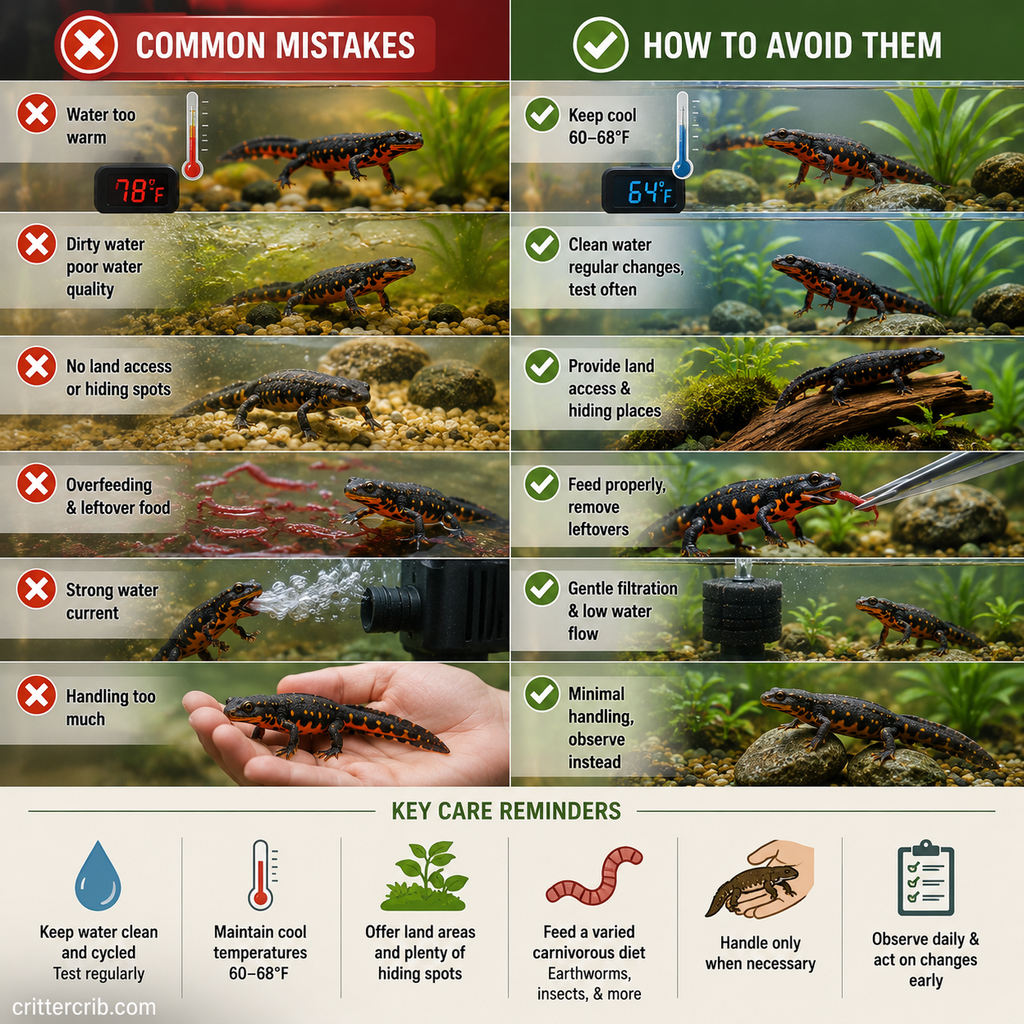
Many fire-bellied newts are highly aquatic, but that doesn’t mean every enclosure should be nothing but open water.
Providing easy access to the surface and suitable resting or terrestrial areas gives the animals more choice.
This becomes particularly useful if a newt wants to leave the water temporarily.
How to Avoid It
Depending on the species and setup, provide features such as:
- Floating cork bark
- Sloped land areas
- Rocks that safely emerge above the water
- Dense floating vegetation
- Secure platforms
- Easy-to-climb driftwood
Make sure the newt can move between water and resting areas without struggling.
Avoid steep, slippery structures that look attractive but aren’t actually usable.
Mistake #7: Using an Insecure Lid
Never underestimate a newt’s ability to escape.
Fire-bellied newts can climb surprisingly well, and a small opening around a filter or cable may be enough for an adventurous animal to leave the aquarium.
An escaped newt can quickly become dehydrated or injured.
How to Avoid It
Use a secure, well-fitting lid.
Check carefully around:
- Filter openings
- Airline tubing
- Electrical cables
- Corners
- Hinges
- Feeding openings
If there’s a gap, assume a determined newt may eventually investigate it.
At the same time, maintain appropriate ventilation.
Secure doesn’t mean completely airtight.
Mistake #8: Choosing the Wrong Substrate
Tiny gravel can create unnecessary problems.
Fire-bellied newts may accidentally swallow loose substrate while capturing food.
Material small enough to enter the mouth may potentially cause digestive problems if ingested.
How to Avoid It
Choose substrate carefully.
Possible approaches include:
- Bare-bottom sections
- Fine sand suitable for aquarium use
- Large smooth stones that can’t be swallowed
- Other species-appropriate aquarium substrates
Avoid sharp materials.
Newts spend plenty of time moving along the bottom, so substrate should be gentle on their skin.
If using large stones, make sure waste and uneaten food aren’t accumulating unnoticed between them.
Mistake #9: Using Sharp or Unsafe Decorations
Decorations designed for aquariums aren’t automatically ideal for amphibians.
Rough artificial rocks, sharp plastic plants, jagged wood, and decorations with small holes can potentially injure or trap a newt.
How to Avoid It
Inspect every object before putting it into the enclosure.
Look for:
- Sharp edges
- Rough surfaces
- Narrow holes
- Exposed wire
- Loose pieces
- Peeling coatings
- Areas where a newt could become wedged
Natural-looking doesn’t always mean safe.
Smooth, simple structures are often better than complicated decorations filled with tiny openings.
Mistake #10: Feeding an Unbalanced Diet
Fire-bellied newts are carnivores.
They need animal-based foods rather than generic tropical fish flakes or plant-based diets.
Suitable foods can vary according to species, size, and individual preferences.
Common options may include:
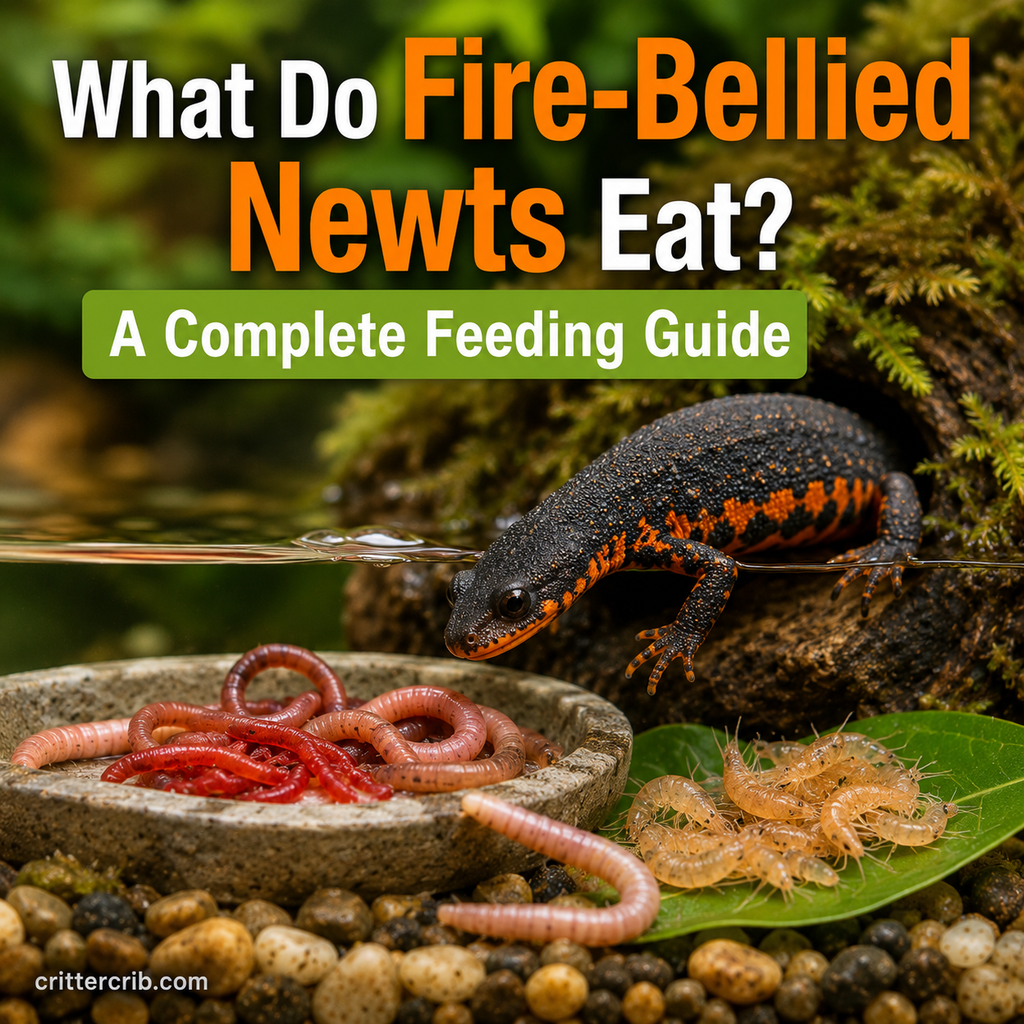
- Earthworms
- Chopped nightcrawlers
- Blackworms
- Appropriate frozen aquatic foods
- Small invertebrates from reliable sources
- Species-appropriate prepared foods
Earthworms are especially useful for many salamanders and newts because they’re nutritious and easy to portion.
How to Avoid It
Build the diet around nutritious staple foods rather than treats.
Offer appropriate variety and adjust food size to the animal.
Remove leftovers before they begin decomposing.
Don’t assume a food is nutritionally complete simply because the newt enthusiastically eats it.
Mistake #11: Relying Too Heavily on Bloodworms
Bloodworms are widely sold and easy to feed, so they often become the default newt food.
They can be useful as part of a varied diet, but relying on one food indefinitely isn’t ideal.
How to Avoid It
Use bloodworms as one option rather than automatically making them the entire diet.
Rotate suitable foods such as earthworms and other appropriate invertebrates.
Variety can help provide a broader nutritional profile.
It also creates different feeding experiences for the newts.
Mistake #12: Overfeeding
Watching a newt eat is one of the most interesting parts of keeping one.
That makes overfeeding easy.
Excess food creates two problems: the animal may consume more than necessary, and uneaten food begins breaking down in the aquarium.
The second problem can quickly become a water-quality issue.
How to Avoid It
Feed according to the newt’s age, size, body condition, and appetite.
Young animals may require more frequent feeding than adults.
Pay attention to:
- Body condition
- Whether food is consistently left behind
- How quickly food is eaten
- Waste accumulation
Remove leftovers promptly.
A turkey baster can be useful for picking up small pieces of food without performing an entire water change.
Mistake #13: Leaving Uneaten Food in the Tank
Even if you aren’t technically overfeeding, food that isn’t eaten shouldn’t stay in the aquarium indefinitely.
Frozen foods can be especially messy because small pieces spread around the tank.
As leftovers decompose, they contribute to organic waste and potentially rising ammonia.
How to Avoid It
Use feeding tongs, dishes, or targeted feeding when appropriate.
After feeding, check the enclosure and remove obvious leftovers.
This simple habit can make maintaining good water quality much easier.
Mistake #14: Keeping Newts With Fish
A mixed-species aquarium may look appealing, but combining fish and fire-bellied newts introduces several complications.
Fish may:
- Compete for food
- Nip at newts
- Create additional waste
- Require warmer temperatures
- Stress the newts through constant activity
Small fish may also become prey.
Another issue is that fish medications aren’t necessarily safe for amphibians.
How to Avoid It
A species-focused setup is usually the simplest and safest approach.
Design the aquarium around the newts rather than trying to make them fit into a community fish tank.
If considering any tank mate, research compatibility carefully instead of relying on whether the animals appear peaceful at the pet store.
Mistake #15: Mixing Different Amphibian Species
A tank containing several types of salamanders, frogs, or newts might sound like an impressive display.
In practice, it’s usually unnecessary and potentially risky.
Different amphibians may have different requirements for:
- Temperature
- Water depth
- Humidity
- Diet
- Water chemistry
- Land access
They may also carry microorganisms that don’t affect one species but cause problems for another.
How to Avoid It
Keep different amphibian species separately unless you have advanced experience and a very specific reason for attempting mixed-species housing.
For most pet owners, species-specific enclosures are easier to manage and safer for the animals.
Mistake #16: Handling Fire-Bellied Newts Too Much
Fire-bellied newts are animals to observe, not regularly hold.
Amphibian skin is delicate and permeable.
Your hands can carry:
- Natural skin oils
- Soap residue
- Lotion
- Hand sanitizer
- Household chemicals
- Other contaminants
Handling also creates unnecessary stress.
How to Avoid It
Keep direct handling to a minimum.
If you need to move a newt for enclosure maintenance or another necessary reason, use an amphibian-safe method and keep the interaction brief.
Never handle a newt and then touch your eyes, mouth, or food.
Fire-bellied newts can produce defensive skin secretions, so good hygiene is important.
Wash your hands thoroughly after enclosure maintenance or contact with aquarium equipment.
Mistake #17: Treating the Newt Like an Interactive Pet
This is closely related to handling but worth mentioning separately.
A fire-bellied newt doesn’t need to leave its enclosure to “play.”
It doesn’t need couch time, floor exploration, or regular physical interaction with its owner.
Outside the aquarium, the animal can encounter:
- Dry surfaces
- Temperature changes
- Household chemicals
- Other pets
- Dirt and contaminants
- Escape hazards
How to Avoid It
Provide enrichment inside the enclosure.
Useful environmental features include:
- Live plants
- Hiding places
- Driftwood
- Different underwater resting areas
- Floating vegetation
- Varied appropriate foods
A well-designed habitat is much more meaningful to a newt than being handled.
Mistake #18: Overcleaning the Aquarium
Clean water is essential, but that doesn’t mean the aquarium needs to be sterilized.
New owners sometimes scrub everything, replace all the filter media, remove all substrate, and change nearly all the water at once.
That can disrupt the biological stability you’ve worked to establish.
How to Avoid It
Think maintenance rather than sterilization.
Perform regular partial water changes, remove waste, maintain the filter appropriately, and clean individual items when needed.
Don’t destroy beneficial biological filtration in pursuit of making the aquarium look spotless.
An established aquarium is an ecosystem, even if it’s a small one.
Mistake #19: Using Household Cleaning Products
Soap, disinfectants, glass cleaners, scented sprays, and household detergents have no place inside an amphibian enclosure.
Residues that seem insignificant to us can be dangerous to sensitive aquatic animals.
How to Avoid It
Keep dedicated aquarium-cleaning equipment.
That might include:
- Buckets
- Sponges
- Siphons
- Scrapers
- Towels
- Feeding tools
Don’t use a bucket for mopping the floor one day and changing newt water the next.
If an item needs disinfecting, use a method known to be appropriate for amphibian equipment and rinse or neutralize it correctly.
Mistake #20: Buying Wild-Caught or Poorly Sourced Newts
Historically, many fire-bellied newts in the pet trade were imported animals.
Wild-caught animals may experience considerable stress during capture, transportation, and repeated movement through the supply chain.
They may also arrive with health problems or parasites.
How to Avoid It
When possible, look for captive-bred animals from reputable breeders or specialty sellers.
Ask questions about:
- Exact species
- Captive-bred status
- Age
- Current diet
- Water conditions
- Health history
Captive-bred animals may cost more, but price shouldn’t be the only consideration.
Responsible sourcing matters.
Mistake #21: Not Quarantining New Animals
Adding a new amphibian directly to an established enclosure can introduce disease or parasites.
A newt may appear healthy while still carrying a problem.
How to Avoid It
Use an appropriate quarantine procedure before introducing new animals to an established group.
Keep quarantine equipment separate when possible.
Avoid transferring:
- Water
- Substrate
- Nets
- Decorations
- Feeding equipment
between quarantine and established enclosures without appropriate cleaning or disinfection.
If you’re uncertain about amphibian quarantine procedures, consult an experienced exotic-animal veterinarian.
Mistake #22: Ignoring Changes in Behavior
Amphibians can hide illness surprisingly well.
Waiting until a newt is obviously very sick may mean the problem has already progressed.
Learn what normal behavior looks like for your animals.
Warning Signs to Watch For
Potential signs of trouble include:
- Persistent refusal to eat
- Significant weight loss
- Unusual bloating
- Skin sores or lesions
- Redness
- Abnormal shedding
- Difficulty swimming
- Loss of balance
- Unusual floating
- Persistent attempts to leave the water
- Weakness
- Changes in normal activity
One unusual behavior doesn’t automatically mean your newt is seriously ill.
Look at the entire situation.
Check temperature and water parameters first because environmental problems can produce behavioral changes.
If symptoms persist or appear severe, contact a veterinarian experienced with amphibians or exotic animals.
Mistake #23: Trying Random Treatments Before Checking the Environment
When a newt looks unwell, it’s tempting to immediately reach for aquarium medications.
That’s risky.
Products intended for fish may contain ingredients or concentrations that aren’t appropriate for amphibians.
And medication won’t solve an environmental problem such as ammonia exposure or excessive temperature.
How to Avoid It
When you notice a problem:
- Check the water temperature.
- Test ammonia.
- Test nitrite.
- Check nitrate and other relevant water parameters.
- Look for obvious sources of contamination.
- Review recent feeding and maintenance.
- Observe the animal for physical symptoms.
If the newt appears sick, seek veterinary advice rather than experimenting with random fish medications.
Mistake #24: Assuming Low Maintenance Means No Maintenance
Fire-bellied newts can become relatively straightforward pets once their aquarium is established.
That’s different from being maintenance-free.
They still need:
- Regular feeding
- Water testing
- Partial water changes
- Filter maintenance
- Temperature monitoring
- Waste removal
- Observation
- Occasional equipment replacement
Their enclosure should be checked regularly even when everything appears normal.
Good amphibian care is often about preventing problems rather than reacting to them.
A Simple Fire-Bellied Newt Care Checklist
Avoiding common mistakes becomes much easier when you establish a routine.
Daily
- Check the animals visually.
- Confirm equipment is functioning.
- Check temperature.
- Remove obvious uneaten food or waste.
- Make sure the lid is secure.
During Feeding
- Offer appropriately sized, nutritious food.
- Watch that each newt gets access to food.
- Remove significant leftovers.
Weekly or as Needed
- Test water parameters.
- Perform appropriate partial water changes.
- Remove accumulated debris.
- Inspect plants and decorations.
- Check filter flow.
Periodically
- Maintain filter equipment.
- Inspect the lid for gaps.
- Examine electrical equipment.
- Review each newt’s body condition.
- Replace worn or unsafe equipment.
A few minutes of observation can catch problems long before they become emergencies.
Frequently Asked Questions About Fire-Bellied Newt Care
Are fire-bellied newts easy to care for?
They can be manageable for keepers who understand basic aquarium maintenance and amphibian care.
The biggest learning curve is usually maintaining cool, clean, stable water.
Once the aquarium is properly cycled and established, routine care can be relatively straightforward.
Do fire-bellied newts need a heater?
Often, no.
Fire-bellied newts generally prefer cooler conditions than tropical aquarium fish. Depending on your home’s temperature and the exact species, adding a heater may actually make the enclosure too warm.
Always research the requirements of your particular species and monitor the aquarium with a thermometer.
Do fire-bellied newts need land?
Many fire-bellied newts are highly aquatic as adults, but providing easily accessible resting or terrestrial areas gives them environmental choice.
The amount and type of land area may vary according to species, age, and individual behavior.
Can fire-bellied newts live with fish?
A species-only enclosure is generally easier and safer.
Fish may compete for food, nip at newts, increase waste, require warmer water, or create other compatibility problems.
Can you hold a fire-bellied newt?
Routine handling isn’t recommended.
Handling can stress the newt and exposes its permeable skin to substances on your hands. Newts may also produce defensive skin secretions.
Handle only when necessary and practice good hygiene afterward.
What is the biggest fire-bellied newt care mistake?
Poor water quality is one of the most important problems to avoid.
Temperature, diet, and habitat design all matter, but an aquatic newt spends most of its life directly exposed to its water.
Maintaining a properly cycled aquarium with appropriate temperature and clean, treated water should be a top priority.
Why does my fire-bellied newt keep trying to leave the water?
There can be several reasons.
Some individuals naturally spend more time on land, but persistent attempts to leave the water can also indicate inappropriate temperature, poor water quality, excessive current, stress, or health problems.
Test the water and check the temperature before assuming the behavior is simply a personality quirk.
Final Thoughts
Most fire-bellied newt care mistakes aren’t dramatic.
They’re small husbandry problems that become significant because they happen every day.
Water that’s consistently a little too warm, a filter that’s too powerful, leftover food that isn’t removed, untreated tap water, an unsecured lid, or an unbalanced diet can gradually create an unhealthy environment.
Fortunately, these problems are also largely preventable.
Identify your exact species, establish the aquarium before introducing animals, keep the water cool and clean, provide gentle filtration and safe resting areas, feed a nutritious diet, and keep handling to a minimum.
Then pay attention.
Knowing what your newts normally look like and how they behave is one of the most useful tools you have. When something changes, check the environment early rather than waiting for the problem to become obvious.
Fire-bellied newts don’t need constant attention or complicated care. What they need is a stable, well-maintained habitat designed around the needs of an amphibian rather than the convenience of its owner.
Get those basics right, and you’ll avoid many of the problems that cause new keepers trouble.