
Pacman frogs have a lot going for them as pets. They’re colorful, don’t require a huge enclosure, and have relatively straightforward care once their habitat is set up correctly.
They’re also frogs that spend an impressive amount of time doing absolutely nothing.
For the right person, that’s part of their charm.
Pacman frogs are ambush predators. Rather than climbing around or constantly exploring, they often bury themselves in the substrate and wait for food to come within striking distance. A healthy frog may remain in essentially the same place for long stretches.
So, are Pacman frogs good pets?
Yes, Pacman frogs can be good pets for beginners who want an interesting amphibian to observe and are willing to maintain proper temperature, humidity, substrate, and feeding. They aren’t a good choice if you’re looking for a pet you can frequently handle, play with, or watch moving around all day.
Before bringing one home, here’s what you should know.
Are Pacman Frogs Good Beginner Pets?
Pacman frogs are often considered relatively beginner-friendly amphibians.
Their basic requirements aren’t especially complicated:
- A secure terrestrial enclosure
- Deep, moisture-retaining substrate
- Appropriate temperature
- Suitable humidity
- Clean, treated water
- Nutritious feeder animals
- Regular spot cleaning
They also don’t require an enormous habitat.
But “beginner-friendly” shouldn’t be confused with maintenance-free.
Pacman frogs are amphibians, and amphibians can be sensitive to poor environmental conditions. You’ll need to monitor their enclosure rather than simply feeding the frog a few insects every week.
For someone willing to learn basic amphibian husbandry, they’re a manageable first frog.
What Are Pacman Frogs?
“Pacman frog” is the common name given to several horned frog species in the genus Ceratophrys.
The nickname makes sense the first time you watch one eat.
They have enormous mouths relative to their bodies and a feeding strategy that essentially involves sitting still until something edible gets close enough to grab.
Adult Pacman frogs are round, heavy-bodied animals.
Females generally grow substantially larger than males, with some reaching around 6–7 inches in length. Males usually remain smaller.
Captive-bred Pacman frogs are available in a wide range of colors and patterns, which is one reason they’ve become popular amphibian pets.
What Is It Like Owning a Pacman Frog?
Owning a Pacman frog is very different from owning a dog, cat, or even many reptiles.
Most of your interaction revolves around:
- Feeding
- Misting or maintaining moisture
- Checking temperature and humidity
- Changing water
- Spot cleaning
- Observing the frog
You’re creating and maintaining an environment rather than directly interacting with the animal.
Some days your frog may be sitting in plain sight.
Other times, you’ll see little more than a pair of eyes poking out of the substrate.
And sometimes the frog may bury itself almost completely.
That’s normal Pacman frog behavior.
The Pros of Keeping a Pacman Frog
There are several reasons these frogs have become popular pets.
1. They Don’t Need a Huge Enclosure
One of the biggest advantages is their relatively modest space requirement.
Pacman frogs are terrestrial ambush predators and don’t need a tall climbing enclosure.
For an adult, an appropriately sized terrestrial habitat provides room for:
- Deep substrate
- A water dish
- A hide
- Plants or cover
- Normal movement
You don’t need to dedicate half a room to the enclosure.
That can make Pacman frogs practical for apartments and smaller homes.
However, “doesn’t need a huge tank” shouldn’t become an excuse to use the smallest possible container.
The frog still needs enough room to move and choose between different areas of its habitat.
2. Their Daily Care Is Fairly Simple
Once the habitat is established, routine care doesn’t take much time.
A normal day might involve:
- Checking temperature
- Checking substrate moisture
- Inspecting the water dish
- Removing waste
- Feeding when scheduled
- Briefly observing the frog
More thorough cleaning can be performed as necessary.
The challenge isn’t the amount of work.
It’s consistency.
A frog living in inappropriate temperatures or chronically dry substrate doesn’t benefit from the fact that its owner only spends five minutes a day on maintenance.
3. Pacman Frogs Are Fascinating Feeders
Feeding is often the highlight of owning one.
Pacman frogs are ambush predators with powerful feeding responses.
A frog that looked like a motionless lump of dirt seconds earlier can suddenly lunge at prey with surprising speed.
Depending on the frog’s size, appropriate foods may include:
- Earthworms
- Nightcrawlers
- Crickets
- Dubia roaches where legal
- Other suitable captive-raised feeder insects
A varied, nutritionally appropriate diet is better than relying exclusively on one type of feeder.
4. They’re Available in Many Colors
Captive breeding has produced Pacman frogs in numerous colors and patterns.
Depending on availability, you may encounter frogs described as:
- Green
- Albino
- Apricot
- Strawberry
- Brown
- Patternless
- High-red or orange varieties
Color doesn’t change the basic responsibility of caring for the animal, of course.
But for people who enjoy visually distinctive amphibians, there’s plenty of variety.
5. They’re Usually Quiet
Pacman frogs aren’t completely silent.
Males can call, particularly during certain times or environmental conditions.
Still, they’re generally much quieter than many traditional pets.
There’s no barking, running wheel, or aquarium pump necessarily operating loudly beside your bed.
If you’re looking for a relatively quiet animal, a Pacman frog can be appealing.
6. They Can Live for Years
A Pacman frog isn’t a short-term pet.
With appropriate husbandry, captive individuals may live around 10 years, sometimes longer.
That longevity is a benefit if you’re looking for a long-term amphibian companion.
It’s also something to think seriously about before buying one.
A frog purchased today may still depend on you a decade from now.
The Cons of Keeping a Pacman Frog
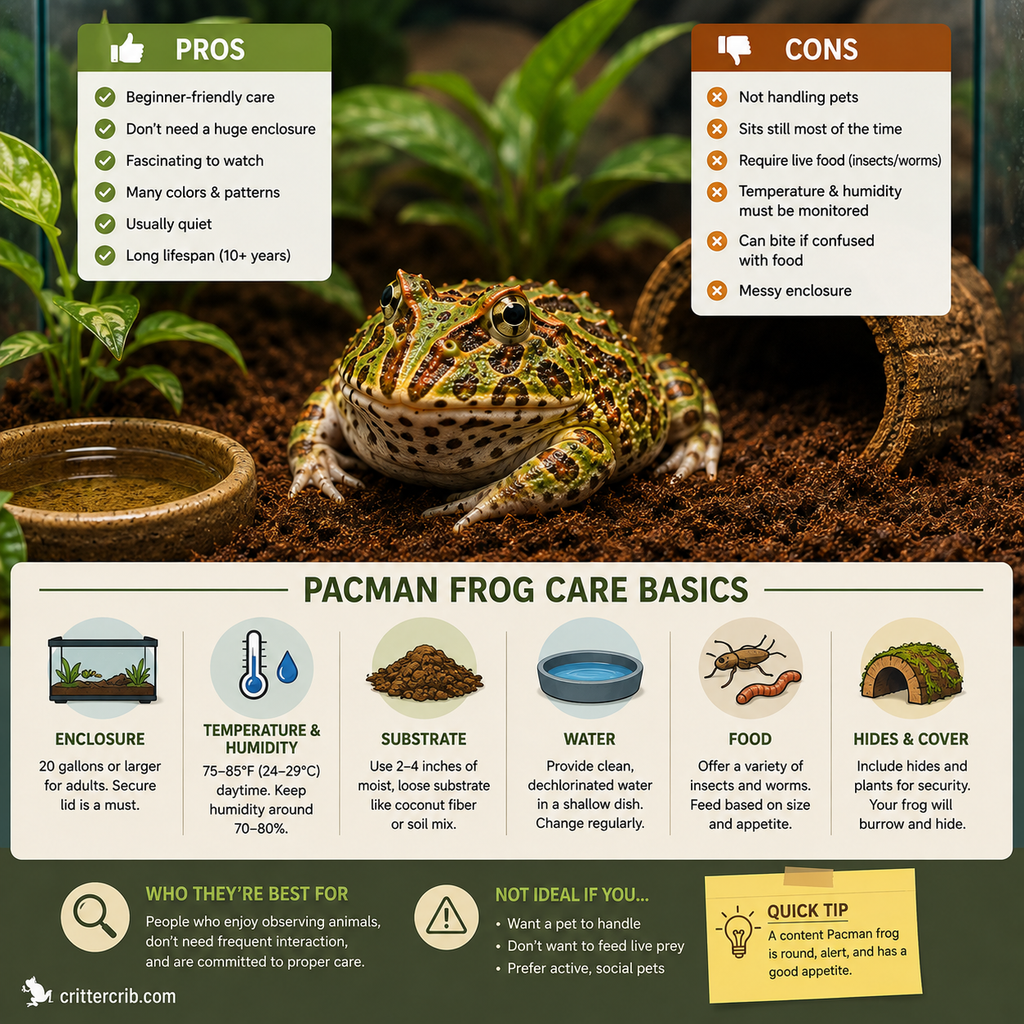
Pacman frogs aren’t ideal for everyone.
Understanding their disadvantages before buying one can prevent disappointment later.
1. They’re Not Handling Pets
This is probably the biggest issue for beginners expecting an interactive animal.
Pacman frogs shouldn’t be handled routinely.
Amphibian skin is delicate and permeable. Substances on human hands—including soap residue, lotion, sanitizer, oils, and other chemicals—can irritate or harm them.
Handling can also be stressful.
If handling is necessary, clean, damp, powder-free gloves are generally a better option.
Think of a Pacman frog as a display and observation animal rather than a pet you take out of its enclosure.
2. They Spend a Lot of Time Sitting Still
If you want constant activity, look elsewhere.
Pacman frogs are designed to wait.
They may:
- Sit motionless for hours
- Remain in one location for days
- Partially bury themselves
- Completely disappear beneath the substrate
That’s not necessarily boredom or poor health.
It’s how an ambush predator behaves.
For some owners, watching a frog sit in dirt isn’t particularly exciting.
For others, the anticipation of feeding and occasional nighttime activity is exactly what makes them interesting.
3. You Have to Feed Them Animal Prey
If you’re uncomfortable handling worms or insects, consider that before buying the frog.
A Pacman frog isn’t going to thrive on vegetables or ordinary household food.
You’ll need access to suitable feeders.
That means you may find yourself:
- Storing worms in the refrigerator
- Keeping feeder insects
- Gut-loading insects
- Dusting feeders with supplements
- Cutting large worms into smaller portions
For amphibian keepers, this quickly becomes routine.
For someone who hates bugs, it may be a deal-breaker.
4. Temperature and Humidity Need Monitoring
A Pacman frog can’t simply live at whatever conditions happen to exist in your room.
The enclosure needs suitable temperature and moisture.
Depending on your home, that may require:
- Thermometer
- Hygrometer
- Misting
- Moisture-retaining substrate
- Carefully controlled supplemental heat
- Thermostat when heating equipment is used
Environmental requirements can vary somewhat among species and life stages, so research the particular frog you’re keeping.
Guessing isn’t a good strategy.
5. They’re Messier Than Their Lifestyle Suggests
A frog that spends most of its time sitting still might sound exceptionally clean.
Not exactly.
Pacman frogs can produce surprisingly substantial waste.
You’ll need to:
- Spot-clean feces
- Replace dirty substrate
- Clean the water dish
- Remove uneaten food
- Monitor for mold
Deep, moist substrate also needs attention because overly wet or dirty conditions can become unhealthy.
6. They Can Bite
Pacman frogs have large mouths and strong feeding responses.
A hungry frog may mistake a moving finger for food.
A bite from a larger adult can hurt and may break the skin.
Feeding tongs can help keep your fingers away from the business end of the frog.
This isn’t usually aggressive behavior in the way people think of an angry mammal.
The frog sees movement and thinks: food.
How Much Space Does a Pacman Frog Need?
Pacman frogs don’t need arboreal height, but they do need adequate floor space.
For an adult, an enclosure around 20 gallons can provide a useful starting point, especially for a large female, while smaller individuals may sometimes be kept in appropriately sized terrestrial setups.
Floor dimensions matter more than height.
The habitat needs enough space for:
- Deep substrate
- Water dish
- Hide or cover
- Plants
- Feeding
- Movement
Avoid tiny containers simply because the frog doesn’t move very often.
The animal should still be able to choose where it rests.
What Does a Pacman Frog Habitat Need?
A basic setup should include:
- Secure enclosure
- Several inches of appropriate substrate
- Clean water dish
- Hide or visual cover
- Thermometer
- Hygrometer
- Appropriate heating equipment if needed
- Thermostat for heat sources when applicable
- Plants or other safe cover
The substrate should be deep enough for burrowing.
Coconut fiber and appropriate amphibian-safe soil mixtures are commonly used.
Avoid gravel and other loose materials that could cause problems if swallowed.
How Much Do Pacman Frogs Cost?
The frog itself is only part of the cost.
Depending on color, species, breeder, and availability, the purchase price can vary considerably.
The initial setup may include:
- Frog
- Enclosure
- Lid
- Substrate
- Water dish
- Hides
- Thermometer
- Hygrometer
- Heating equipment if needed
- Thermostat
- Feeding tongs
- Supplements
- Feeder animals
- Water conditioner
After setup, ongoing costs are usually manageable.
You’ll continue purchasing food, substrate, supplements, and other replacement supplies.
Veterinary expenses are another possibility and shouldn’t be ignored simply because the animal is small.
What Do Pacman Frogs Eat?
Pacman frogs are carnivores.
Earthworms and nightcrawlers can make excellent staple foods for many individuals.
Other appropriate feeders may include:
- Crickets
- Dubia roaches where legal
- Silkworms
- Hornworms as part of a varied diet
- Other appropriately sized captive-raised invertebrates
Feeder insects should be nutritionally appropriate and gut-loaded when applicable.
Supplementation may also be necessary.
Avoid making fatty or nutritionally poor foods the foundation of the diet.
How Often Do Pacman Frogs Eat?
Feeding frequency depends heavily on age and size.
Growing juveniles generally eat more frequently than adults.
Adults may eat every few days rather than every day.
Body condition matters too.
Pacman frogs are naturally round, which can make excessive weight difficult for inexperienced owners to recognize.
Don’t interpret every feeding response as proof that the frog needs more food.
These frogs are built to eat when an opportunity appears.
Are Pacman Frogs Smelly?
A properly maintained Pacman frog enclosure shouldn’t produce a strong foul odor.
If the habitat smells bad, investigate.
Common causes include:
- Feces left in the enclosure
- Uneaten food
- Waterlogged substrate
- Mold
- Dirty water
- Poor ventilation
- Decaying organic material
Routine spot cleaning and proper moisture management should keep odor under control.
Are Pacman Frogs Loud?
Usually not.
Male Pacman frogs may call.
The sound can be surprising if you’ve never heard it before, particularly at night, but they’re generally not considered extremely noisy pets.
Females typically don’t produce the same mating calls as males.
If silence is absolutely essential, though, remember that an individual male may decide nighttime is an excellent opportunity to announce himself.
Are Pacman Frogs Aggressive?
They’re better described as enthusiastic predators than aggressive pets.
Pacman frogs may bite:
- Prey
- Feeding tongs
- Moving fingers
- Potential tankmates
Their large mouths are designed to capture food.
This is one reason Pacman frogs should generally be housed individually.
Don’t expect them to socialize with another frog.
Can Pacman Frogs Live Together?
Pacman frogs should generally be housed alone.
They’re opportunistic predators and may bite, injure, or attempt to eat another frog.
A larger frog may view a smaller frog as potential prey.
They don’t need companionship.
One frog per enclosure is the simplest and safest approach.
Are Pacman Frogs Good Pets for Children?
This depends on the child and, more importantly, the adult supervising the care.
Pacman frogs aren’t ideal pets for young children who want something they can hold.
They’re delicate amphibians with specific environmental requirements.
A responsible older child or teenager may enjoy caring for one with adult supervision, particularly if they’re interested in amphibians and natural behavior.
An adult should ultimately be prepared to take responsibility for:
- Feeding
- Temperature
- Humidity
- Cleaning
- Purchasing supplies
- Veterinary care
A Pacman frog shouldn’t become neglected because a child loses interest.
Are Pacman Frogs Good Apartment Pets?
They can be excellent apartment pets.
Advantages include:
- Relatively compact enclosure
- Little noise
- No need for outdoor exercise
- Minimal odor when maintained properly
- No fur or feathers around the home
Before getting one, make sure your apartment remains within a temperature range that allows you to maintain the enclosure properly.
Moving also requires planning because the frog and habitat need to be transported safely.
How Much Daily Attention Does a Pacman Frog Need?
Not much direct attention.
That’s different from saying it doesn’t need care.
Most days you’ll spend a few minutes checking the habitat and animal.
Depending on the day, you might:
- Check temperature and humidity.
- Inspect substrate moisture.
- Check and refresh the water.
- Remove waste.
- Feed if scheduled.
- Observe the frog for anything unusual.
You don’t need to entertain a Pacman frog.
Maintaining the correct environment is the important part.
What Are Pacman Frogs Like During Feeding?
This is when the “Pacman” name really makes sense.
A frog that barely moved all afternoon can suddenly lunge forward with its mouth wide open.
Some individuals readily take food from blunt feeding tongs.
Others respond better to prey moving naturally nearby.
Feeding also gives you an opportunity to observe:
- Appetite
- Body condition
- Movement
- Coordination
- General appearance
Changes in feeding behavior can sometimes be one of the first signs that something in the habitat or animal needs attention.
How Long Can You Leave a Pacman Frog Alone?
Pacman frogs don’t require constant social interaction, but they shouldn’t simply be abandoned for extended periods.
Even when they aren’t eating daily, someone still needs to monitor:
- Temperature
- Humidity
- Water
- Equipment
- Substrate condition
- The frog itself
If you’re traveling, arrange for a responsible person who understands the basic care routine to check the enclosure.
Automatic equipment can help maintain conditions, but it doesn’t replace observation.
What Kind of Person Is a Pacman Frog Best For?
A Pacman frog may be a good match if you:
- Enjoy observing animals
- Like amphibians
- Don’t need frequent physical interaction
- Have limited space
- Don’t mind feeding insects or worms
- Can maintain temperature and humidity
- Want a relatively quiet pet
- Are comfortable with a long-term commitment
- Enjoy building naturalistic habitats
They’re especially appealing to people who find unusual animal behavior interesting.
Who Should Probably Choose a Different Pet?
A Pacman frog may not be ideal if you:
- Want a pet you can hold regularly
- Want an animal that’s constantly active
- Don’t want live or whole-prey foods in your home
- Don’t want to monitor environmental conditions
- Expect the pet to interact socially with you
- Want multiple animals living together
- Aren’t prepared for years of care
There’s nothing wrong with deciding that another animal better matches what you want from a pet.
That’s much better than discovering the mismatch after bringing the frog home.
Questions to Ask Before Getting a Pacman Frog
Before buying one, ask yourself:
- Am I comfortable keeping feeder insects or worms?
- Can I maintain the correct temperature year-round?
- Am I willing to monitor humidity and substrate moisture?
- Am I okay with rarely handling the frog?
- Will I still enjoy the pet if it spends most of the day buried?
- Do I have space for an appropriate enclosure?
- Can I care for it for potentially 10 years or longer?
- Do I have access to an exotic veterinarian if necessary?
- Who will care for it when I travel?
- Am I interested in the animal itself, or do I mainly like how it looks?
If those answers line up with Pacman frog ownership, you’re probably looking at a good match.
Frequently Asked Questions About Pacman Frogs as Pets
Are Pacman Frogs Easy to Take Care Of?
Their routine care is relatively straightforward once the enclosure is set up properly.
However, you still need to maintain appropriate temperature, moisture, cleanliness, water, and nutrition.
Are Pacman Frogs Good First Frogs?
They can be.
Their terrestrial setup and relatively simple daily routine make them approachable for beginners who are willing to learn proper amphibian husbandry.
Do Pacman Frogs Like Their Owners?
Pacman frogs don’t form relationships with people in the same way dogs or other social animals do.
They may become accustomed to feeding routines and activity around their enclosure, but they should primarily be appreciated as observation animals.
Do Pacman Frogs Like Being Held?
Regular handling isn’t recommended.
Their sensitive, permeable skin can be exposed to substances on human hands, and handling can cause stress.
Do Pacman Frogs Bite?
Yes, they can.
Their strong feeding response means fingers may occasionally be mistaken for food.
Use feeding tongs and avoid putting your fingers directly in front of a hungry frog.
Are Pacman Frogs Active?
Not particularly.
They are ambush predators and naturally spend substantial periods sitting still or buried in substrate.
Do Pacman Frogs Need a Friend?
No.
They should generally be housed individually and don’t require companionship from another frog.
Are Pacman Frogs Expensive to Keep?
After the initial habitat is established, routine costs are generally moderate.
You’ll still need to budget for feeder animals, substrate, supplements, water treatment, replacement equipment, and potential veterinary care.
How Long Do Pacman Frogs Live?
With appropriate captive care, Pacman frogs may live around 10 years and sometimes longer.
Think of getting one as a long-term commitment rather than a temporary hobby.
So, Are Pacman Frogs Good Pets?
For the right owner, absolutely.
Pacman frogs combine unusual appearance, fascinating feeding behavior, relatively modest space requirements, and a straightforward daily routine.
But they’re not miniature dogs.
They won’t follow you around, enjoy being held, or spend the afternoon entertaining you with constant activity.
Most of the relationship involves observing the frog and maintaining the small environment it depends on.
If you’re happy with a pet that spends much of its time partially buried in damp substrate—and you’re strangely excited by the prospect of watching that same motionless frog suddenly inhale an earthworm—there’s a good chance you’ll enjoy keeping a Pacman frog.
If you want frequent interaction and handling, another pet will probably make you happier.
Knowing that before you buy one is exactly what responsible pet ownership should look like.