Bringing home a fire-bellied newt isn’t quite as simple as buying an aquarium, filling it with water, and adding the newt.
These small amphibians spend much of their lives in water, but they also benefit from access to land or easy resting areas near the surface. They need clean, cool water, gentle filtration, secure hiding places, and an enclosure they can’t escape from.
Getting those basics right is much easier when you gather everything before the newt comes home.
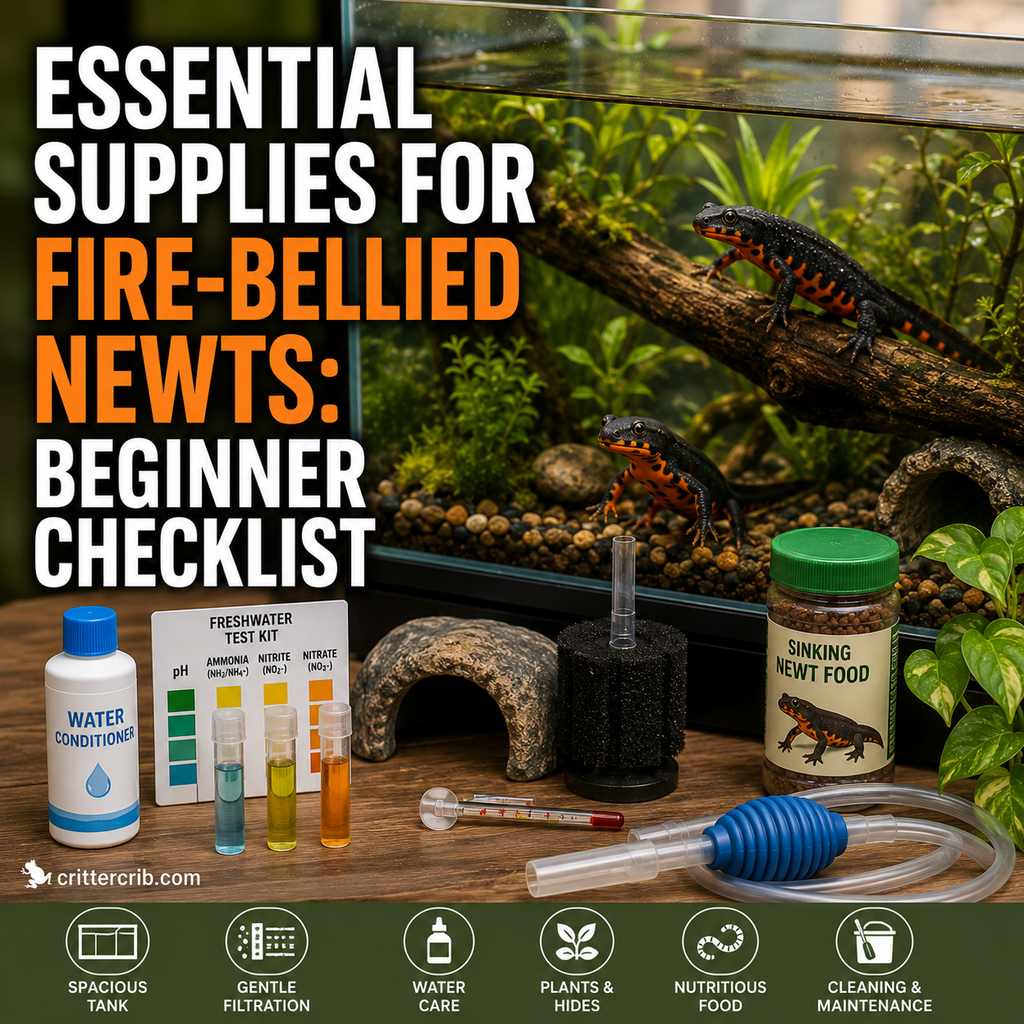
This beginner checklist covers the essential supplies for a fire-bellied newt habitat, what each item is for, and which products you probably don’t need.
Fire-Bellied Newt Supplies at a Glance
A basic setup will usually require:
- Appropriately sized aquarium
- Secure lid
- Gentle aquarium filter
- Water conditioner
- Aquarium thermometer
- Water test kit
- Aquatic or semi-aquatic habitat furnishings
- Land or resting area
- Appropriate substrate or bare-bottom setup
- Aquatic plants
- Hides
- Aquarium siphon
- Dedicated maintenance bucket
- Appropriate food
- Feeding tools
- Cleaning supplies
You may need additional equipment depending on your home’s temperature and the way you design the habitat.
The enclosure itself should be established and stable before adding the newt.
1. An Appropriately Sized Aquarium
The aquarium is naturally the first item on the list.
Fire-bellied newts are relatively small, but that doesn’t mean they should live in a tiny container.
A larger aquarium provides:
- More swimming space
- More room for plants and hides
- Greater water volume
- More stable water conditions
- Better opportunities to create different habitat areas
For a small number of adult fire-bellied newts, an aquarium in the neighborhood of 20 gallons can provide a useful starting point, with larger setups offering more flexibility.
Exact requirements depend on the species, number of animals, and habitat design.
When possible, choose the adult enclosure from the beginning rather than buying several increasingly larger tanks as the animal grows.
2. A Secure Aquarium Lid
Don’t overlook the lid.
Newts can climb surprisingly well, and small gaps around equipment may become escape routes.
A secure lid should cover the aquarium while still allowing appropriate ventilation.
Pay particular attention to openings around:
- Filter tubing
- Electrical cords
- Airline tubing
- Heater cables
- Aquarium accessories
An opening that looks too small to matter may still be worth securing.
Escaped amphibians can quickly become dehydrated or injured, so preventing escapes is far easier than trying to find a newt somewhere in the house.
3. Gentle Aquarium Filtration
Fire-bellied newts need clean water, but they generally don’t need a powerful current.
Strong water movement can make the aquarium uncomfortable and reduce the amount of calm swimming and resting space available.
Good filtration options may include:
- Sponge filters
- Small internal filters with adjustable flow
- Hang-on-back filters with diffused output
- Canister filters adjusted for gentle circulation in larger setups
Sponge filters are especially popular for simple amphibian aquariums because they provide biological filtration while producing relatively mild water movement.
Whatever filter you choose, make sure it’s appropriate for the aquarium’s water volume and waste load.
Why Biological Filtration Matters
A filter does more than trap visible dirt.
Beneficial bacteria colonize filter media and other aquarium surfaces. These bacteria help convert toxic waste products through the aquarium nitrogen cycle.
In a properly cycled aquarium:
- Waste produces ammonia.
- Beneficial bacteria convert ammonia into nitrite.
- Additional bacteria convert nitrite into nitrate.
- Partial water changes help control nitrate.
That biological filtration is one reason you shouldn’t routinely replace or sterilize all filter media.
4. Aquarium Water Conditioner
If you use municipal tap water, an aquarium water conditioner is an essential supply.
Tap water may contain chlorine or chloramine.
Both can be harmful to aquatic animals and may interfere with the beneficial bacteria supporting the aquarium’s biological filtration.
Choose a conditioner designed for aquarium use and follow the manufacturer’s dosing instructions.
Keep the bottle with your maintenance supplies so it’s available every time you prepare replacement water.
Never assume tap water is safe simply because it looks and smells clean.
5. A Reliable Aquarium Thermometer
Fire-bellied newts generally prefer cool conditions.
That’s one of the reasons a thermometer is essential.
Don’t rely on room temperature alone.
Aquarium water temperature can differ from the surrounding air, particularly near windows, electronics, heating vents, or during hot weather.
A simple aquarium thermometer allows you to monitor conditions throughout the year.
Do Fire-Bellied Newts Need a Heater?
In many homes, a heater isn’t necessary.
In fact, overheating is often a greater concern than the aquarium becoming slightly cool.
Whether additional temperature control is needed depends on:
- Species
- Room temperature
- Season
- Climate
- Aquarium location
Avoid automatically buying a tropical aquarium heater without first determining the temperature requirements of the particular newt species you’re keeping.
6. A Water Test Kit
A water test kit may not be the most exciting item on your shopping list, but it’s one of the most important.
Clear water isn’t automatically safe water.
A test kit allows you to monitor important parameters such as:
- Ammonia
- Nitrite
- Nitrate
- pH
In an established, cycled aquarium, ammonia and nitrite should remain at 0 ppm.
Nitrate gradually accumulates and is controlled through water changes, plants, and routine aquarium maintenance.
Testing is particularly important while establishing a new aquarium.
7. An Established Aquarium Cycle
Technically, the nitrogen cycle isn’t something you can buy.
But it absolutely belongs on a beginner setup checklist.
Don’t plan to purchase the aquarium and the newt on the same afternoon.
The aquarium should ideally be cycled before the animal moves in.
Cycling allows beneficial bacteria to become established so they can process waste.
This process takes time.
You’ll need:
- A filter
- A water test kit
- A source of ammonia appropriate for fishless cycling
- Patience
Research fishless aquarium cycling before bringing the newt home.
A beautiful aquarium with uncycled water can still be dangerous.
8. Appropriate Substrate
You have several options for the bottom of a fire-bellied newt aquarium.
Depending on the setup, you might use:
- Bare bottom
- Fine aquarium sand
- Large smooth stones that cannot be swallowed
- Substrate designed around planted aquarium needs
Avoid loose gravel small enough for the newt to accidentally ingest while feeding.
Bare-Bottom Setup
A bare-bottom aquarium is easy to clean.
Food and waste remain visible, making them simple to remove with a siphon or turkey baster.
The appearance isn’t especially natural, but functionally it can work well.
Fine Sand
Fine aquarium sand creates a more natural appearance and works well with many aquatic setups.
Choose an aquarium-safe product and avoid sharp or coarse material.
Large Stones
Large, smooth stones can create an attractive river-like appearance.
They need to be genuinely too large for the newt to swallow.
Keep in mind that food and waste may become trapped between stones, making cleaning more difficult.
9. A Land or Resting Area
Fire-bellied newts are highly aquatic, but providing access to a dry or partially emerged resting area is useful.
Depending on the enclosure design, this might be:
- Cork bark
- A floating platform
- Smooth rocks extending above the water
- Driftwood
- A planted land section
- An aquarium-safe amphibian platform
The newt should be able to climb onto the area easily.
Avoid steep, slippery structures that are difficult to access.
You don’t necessarily need to divide half the aquarium into land. Many fire-bellied newts spend most of their time in the water.
The goal is simply to provide a choice.
10. Aquatic Plants
Plants are among the most useful additions to a fire-bellied newt aquarium.
They provide:
- Cover
- Resting areas
- Visual barriers
- Natural climbing surfaces
- Places to explore
- Additional environmental complexity
Newts may rest on leaves close to the water’s surface.
Live plants can also use nutrients from the water.
Good options may include hardy cool-water aquarium plants such as:
- Java fern
- Anubias
- Java moss
- Hornwort
- Elodea or similar aquatic plants where appropriate
Always verify that plants are safe for amphibian habitats and compatible with your aquarium conditions.
Artificial plants can also provide cover, but choose soft products without sharp edges.
11. Hides and Cover
Fire-bellied newts should have places where they can retreat.
A completely open aquarium can leave an amphibian feeling exposed.
Useful hides include:
- Aquarium caves
- Cork bark
- Driftwood
- Dense plants
- Smooth rock formations
- Aquarium-safe ceramic hides
Inspect every decoration before adding it.
Avoid:
- Sharp edges
- Rough openings
- Small holes where the newt could become trapped
- Flaking paint
- Unknown metals
- Decorations not designed for aquarium use
Natural-looking doesn’t automatically mean safe.
12. Driftwood and Climbing Structures
Driftwood can help connect the aquatic and terrestrial portions of the habitat.
A carefully positioned piece may allow the newt to:
- Climb
- Rest near the surface
- Hide beneath it
- Leave the water
- Explore different levels
Use wood intended for aquarium use.
Some wood may initially release tannins that tint the water brown. This isn’t necessarily harmful, but preparation requirements vary depending on the product.
Make sure every piece is stable.
A heavy decoration shouldn’t be able to shift and trap an animal underneath.
13. Appropriate Lighting
Fire-bellied newts don’t require intense lighting.
If you’re growing live plants, however, an aquarium light can be useful.
Choose lighting appropriate for the plants rather than trying to create an extremely bright display.
The habitat should include shaded and covered areas where the newts can retreat.
A timer can make maintaining a regular day-and-night cycle much easier.
There’s no need to leave aquarium lights on late into the night.
14. Aquarium Siphon or Gravel Vacuum
You’ll need a way to perform partial water changes.
An aquarium siphon makes the job considerably easier.
It allows you to remove old water while simultaneously collecting debris from the bottom.
Choose a siphon appropriately sized for your aquarium.
An oversized gravel vacuum can be awkward in a small newt setup and may create more suction than you want around a small amphibian.
Always watch where the newts are while siphoning.
15. A Dedicated Aquarium Bucket
A basic bucket is surprisingly important.
Use it for:
- Removing aquarium water
- Preparing replacement water
- Rinsing filter media
- Carrying maintenance supplies
The important part is that it should be dedicated exclusively to aquarium use.
Don’t use the same bucket for:
- Mopping
- Household cleaning
- Car washing
- Detergents
- Bleach
- Other chemicals
Labeling the bucket “AQUARIUM ONLY” can prevent someone else in the household from accidentally using it.
16. A Turkey Baster for Spot Cleaning
This inexpensive tool can make everyday maintenance much easier.
A turkey baster dedicated to aquarium use allows you to quickly remove:
- Waste
- Uneaten food
- Small debris
- Dead plant material
You don’t need to perform a water change every time you see one piece of waste.
Simply remove it.
Spot cleaning prevents organic material from sitting in the aquarium and decomposing.
17. Appropriate Fire-Bellied Newt Food
Fire-bellied newts are carnivorous.
Their diet should consist primarily of suitable animal-based foods.
Depending on species, size, and individual preference, appropriate foods may include:
- Earthworms
- Chopped nightcrawlers
- Blackworms from safe sources
- Appropriate frozen foods
- Suitable aquatic invertebrates
- Quality amphibian or carnivore pellets when accepted
Earthworms are particularly useful because they’re nutritious and easy to portion according to the size of the newt.
Avoid relying entirely on one food if you can provide an appropriately varied, balanced diet.
18. Feeding Tongs
Feeding tongs aren’t absolutely necessary, but they can be extremely useful.
They allow you to:
- Offer individual pieces of food
- Monitor how much each newt eats
- Keep food from disappearing into the substrate
- Remove uneaten pieces
- Feed shy individuals more precisely
Choose blunt, aquarium-safe tongs.
Avoid sharp tips that could injure the newt if it lunges at the food.
19. Food Storage Supplies
Depending on what you feed, you’ll also need somewhere appropriate to keep the food.
For example:
- Earthworm container
- Refrigerator storage
- Frozen food storage
- Small feeding dish
- Dedicated food preparation scissors
Don’t use kitchen utensils for amphibian food and then immediately return them to normal food preparation.
Keeping dedicated feeding tools makes the routine cleaner and simpler.
20. Aquarium-Safe Cleaning Tools
You don’t need many cleaning products.
In fact, the fewer chemicals around an amphibian aquarium, the better.
Useful cleaning tools include:
- Algae scraper
- Aquarium-safe sponge
- Small aquarium brush
- Siphon
- Turkey baster
- Dedicated towels
Avoid ordinary household cleaners inside the aquarium.
Never use dish soap for routine tank cleaning.
21. Water-Change Supplies
Once the aquarium is running, regular partial water changes will become part of your routine.
Keep these supplies together:
- Water conditioner
- Bucket
- Siphon
- Thermometer
- Water test kit
- Towels
Having everything in one place makes maintenance faster and reduces the chance you’ll forget an important step.
22. Cooling Equipment if Necessary
Depending on where you live, summer temperatures may become a challenge.
Fire-bellied newts generally prefer cooler conditions than tropical aquarium animals.
Possible cooling strategies include:
- Keeping the aquarium in a cool room
- Avoiding direct sunlight
- Using aquarium fans
- Improving airflow
- Using air conditioning
- Using an aquarium chiller in situations where it’s genuinely necessary
Don’t wait for the first major heat wave to figure out how you’ll keep the aquarium cool.
Monitor temperatures in advance.
23. A Secure Transport Container
It’s useful to have a small, secure amphibian-safe container available even if you don’t need it every day.
You may eventually need to temporarily move a newt for:
- Veterinary care
- Aquarium repairs
- Moving house
- Emergencies
- Habitat changes
Choose something escape-proof and appropriately ventilated when used outside the aquarium.
Don’t wait until an emergency to start looking for a suitable container.
Optional Fire-Bellied Newt Supplies
Once the essentials are covered, a few optional items can make care easier or improve the habitat.
Aquarium Timer
A timer automatically turns aquarium lighting on and off.
This provides a consistent light cycle without requiring you to remember every morning and evening.
Digital Thermometer
A basic thermometer works, but a digital model may make monitoring temperature more convenient.
Some models can record minimum and maximum temperatures, which is useful during summer.
Feeding Dish
A shallow feeding dish can prevent worms and other foods from disappearing into the substrate.
Whether your newts actually use it consistently is another question.
Aquascaping Tools
Long tweezers and plant scissors can make maintaining a planted aquarium easier.
They’re optional but useful in heavily planted setups.
Supplies Fire-Bellied Newts Usually Don’t Need
Pet stores sell a lot of aquarium equipment.
You don’t need all of it.
Powerful Water Pumps
Strong currents generally aren’t necessary.
Prioritize gentle filtration.
Bright, Intense Lighting
Unless demanding plants require specialized lighting, extremely bright illumination isn’t needed.
Tropical Aquarium Heater
Don’t automatically add a heater simply because the newts live in an aquarium.
Monitor actual water temperature first.
Tiny Decorative Gravel
Small gravel can potentially be swallowed during feeding.
Choose safer substrate options.
Household Cleaning Chemicals
Keep soaps, disinfectants, sprays, and scented cleaners away from the habitat.
Complicated Decorations
Your newt doesn’t care whether its cave looks like a pirate ship.
Simple, safe structures are often better than elaborate decorations with sharp edges or small openings.
Fire-Bellied Newt Beginner Shopping Checklist
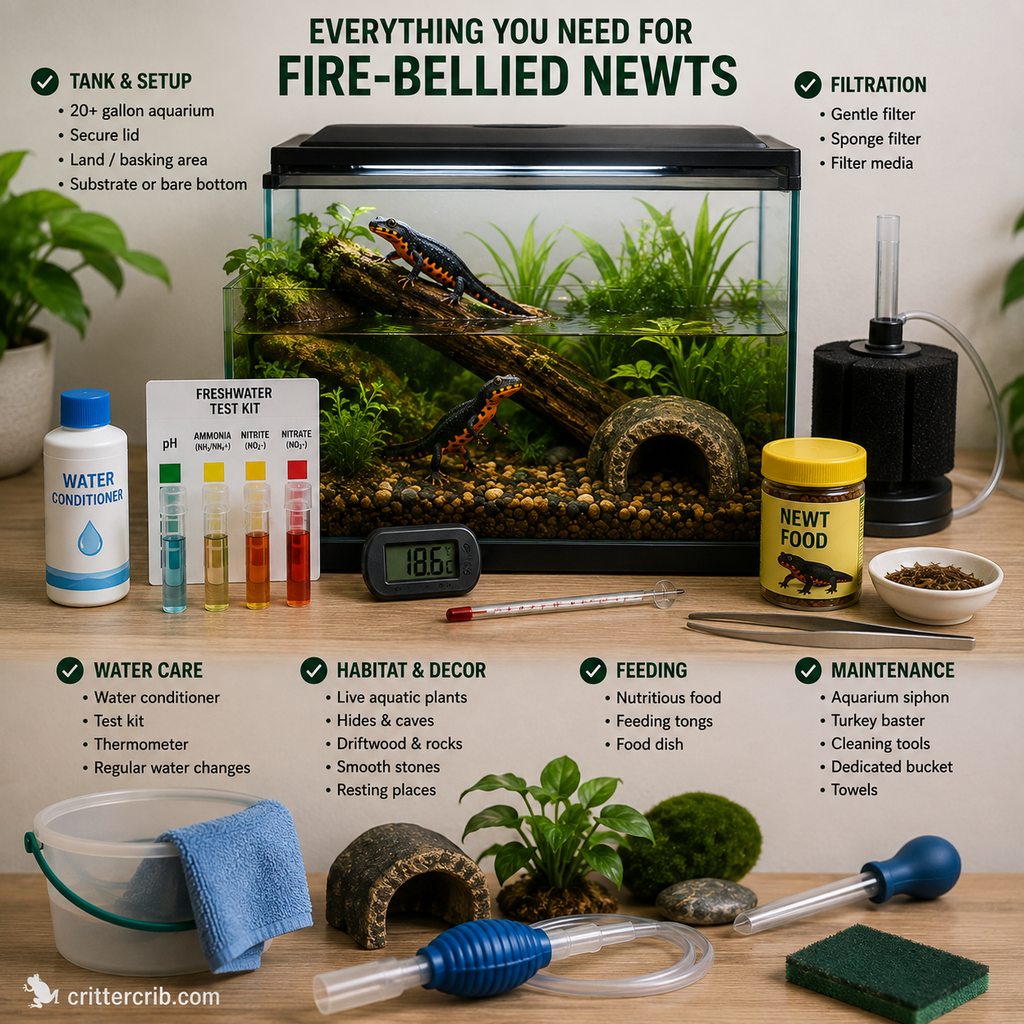
Before bringing your newt home, work through this checklist.
Habitat
- Appropriately sized aquarium
- Secure lid
- Gentle filter
- Appropriate substrate
- Land or resting area
- Hides
- Aquatic plants
- Driftwood or climbing structures
Water Care
- Water conditioner
- Water test kit
- Aquarium thermometer
- Siphon
- Dedicated bucket
- Turkey baster
Feeding
- Appropriate food
- Blunt feeding tongs
- Food storage container
- Dedicated food preparation tools
Maintenance
- Algae scraper
- Aquarium-safe sponge
- Aquarium brush
- Towels
Optional Equipment
- Aquarium light
- Light timer
- Digital thermometer
- Cooling fan
- Aquarium chiller when necessary
- Aquascaping tools
- Feeding dish
- Transport container
What Should You Buy First?
If you’re building the habitat from scratch, don’t buy everything randomly.
A sensible order is:
- Aquarium and secure lid
- Filter
- Water conditioner
- Water test kit
- Thermometer
- Substrate
- Plants, hides, and habitat furnishings
- Siphon and maintenance supplies
- Food and feeding tools
- The newt
Notice where the animal appears on that list.
Last.
Buying the newt first and figuring out the habitat afterward creates unnecessary pressure and increases the chance of mistakes.
Set Up the Aquarium Before Buying the Newt
Ideally, the aquarium should already be established before your fire-bellied newt arrives.
That gives you time to:
- Cycle the aquarium
- Test the water
- Monitor temperature
- Adjust filter flow
- Check the lid for escape routes
- Make sure decorations are stable
- Confirm plants are doing well
- Practice water changes
You’ll also discover practical problems before an animal depends on the habitat.
Maybe the filter creates too much current.
Perhaps the room becomes warmer than expected during the afternoon.
Maybe your floating land area doesn’t stay in place.
Those issues are much easier to solve before bringing the newt home.
Frequently Asked Questions About Fire-Bellied Newt Supplies
Do Fire-Bellied Newts Need a Filter?
A suitable filter is strongly recommended for most setups.
Filtration helps remove debris and provides surface area for beneficial bacteria involved in the aquarium nitrogen cycle.
Choose gentle filtration rather than creating strong water movement.
Do Fire-Bellied Newts Need a Heater?
Often, no.
Fire-bellied newts generally prefer cooler conditions than tropical aquarium species.
Monitor the actual water temperature and research the needs of your specific species before adding heating equipment.
Do Fire-Bellied Newts Need a Land Area?
Providing an accessible land or above-water resting area gives the newt the option to leave the water when desired.
It doesn’t necessarily need to occupy half of the enclosure.
Do Fire-Bellied Newts Need a Light?
The newts themselves don’t require intense aquarium lighting.
Lighting may be useful for live plants and maintaining a regular day-night cycle.
Do Fire-Bellied Newts Need Live Plants?
Live plants aren’t absolutely required, but they can be very beneficial.
They provide cover, resting surfaces, visual barriers, and a more natural environment.
What Is the Most Important Supply for a Fire-Bellied Newt?
There isn’t one single item that replaces proper husbandry.
However, an appropriately sized, fully cycled aquarium with clean, cool water is the foundation of the entire setup.
The filter, water conditioner, test kit, and thermometer are therefore every bit as important as the visible decorations.
Can I Set Up the Tank the Same Day I Get My Newt?
It’s much better to establish the aquarium beforehand.
A new aquarium needs time to develop biological filtration, and you’ll want to confirm that temperature, water quality, filtration, and habitat design are appropriate before introducing the animal.
Final Thoughts on Fire-Bellied Newt Supplies
A good fire-bellied newt setup doesn’t require buying every amphibian accessory on the pet-store shelf.
Focus on the things that actually matter.
Start with an appropriately sized aquarium, secure lid, gentle filtration, conditioned water, a reliable thermometer, and a water test kit. Then create a habitat with plants, hiding places, resting areas, and plenty of usable aquatic space.
Add basic maintenance equipment and nutritious food, and you’ll have most of what you need.
More importantly, set everything up before bringing the newt home.
A fully prepared and cycled habitat makes those first few weeks far less stressful for both you and the animal—and gives your new fire-bellied newt a much better start.