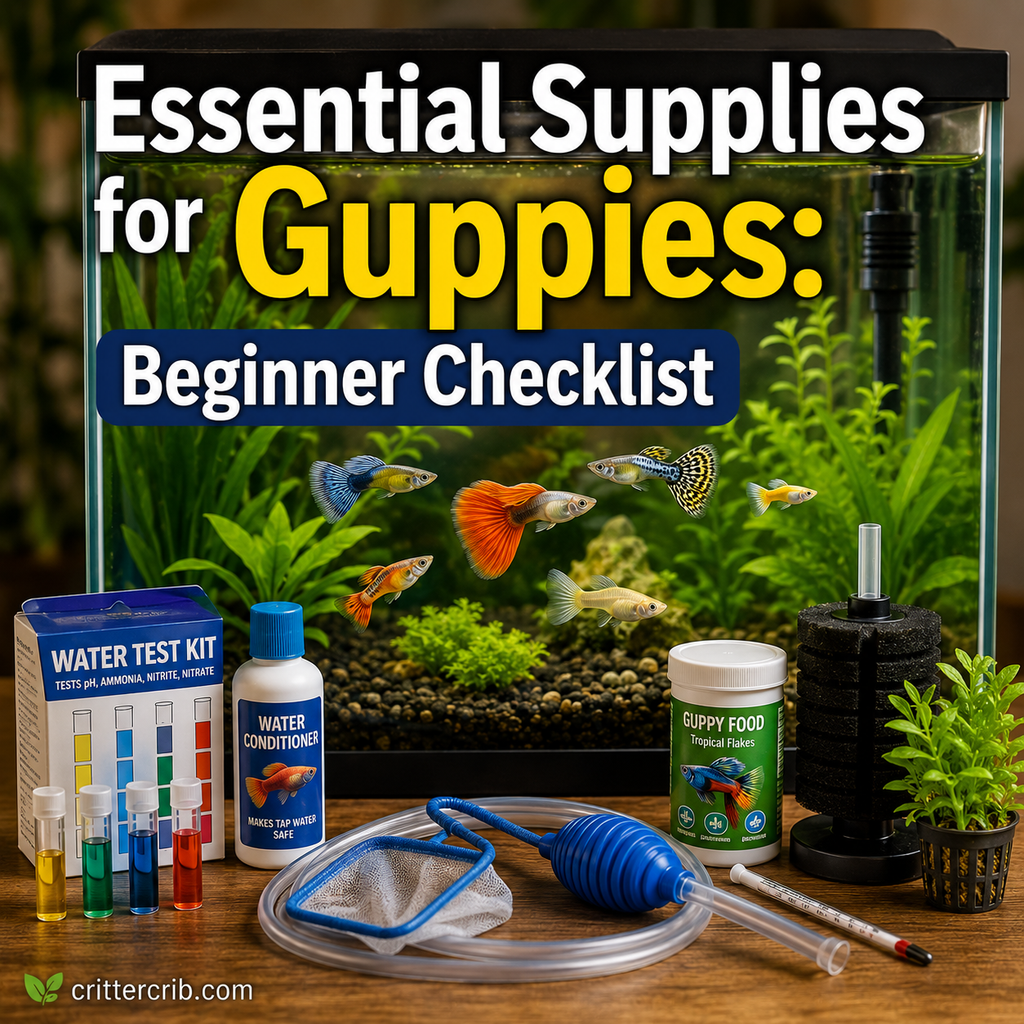
Guppies are colorful, active, and relatively approachable fish for someone setting up their first aquarium. The fish themselves don’t require a room full of specialized equipment, but they do need more than a tank, some water, and a container of flakes.
A good guppy setup starts with the basics: an appropriately sized aquarium, reliable filtration, stable temperature, conditioned water, testing supplies, nutritious food, and an environment that gives the fish room to swim and explore.
Buying the right supplies before bringing your guppies home also makes those first few weeks much easier. Instead of discovering at 9 p.m. that you need a water conditioner or thermometer, you’ll already have everything ready.
This beginner guppy checklist covers the essentials, the useful extras, and a few things you probably don’t need.
Quick Guppy Supply Checklist
If you’re heading to the aquarium store, here’s the short version.
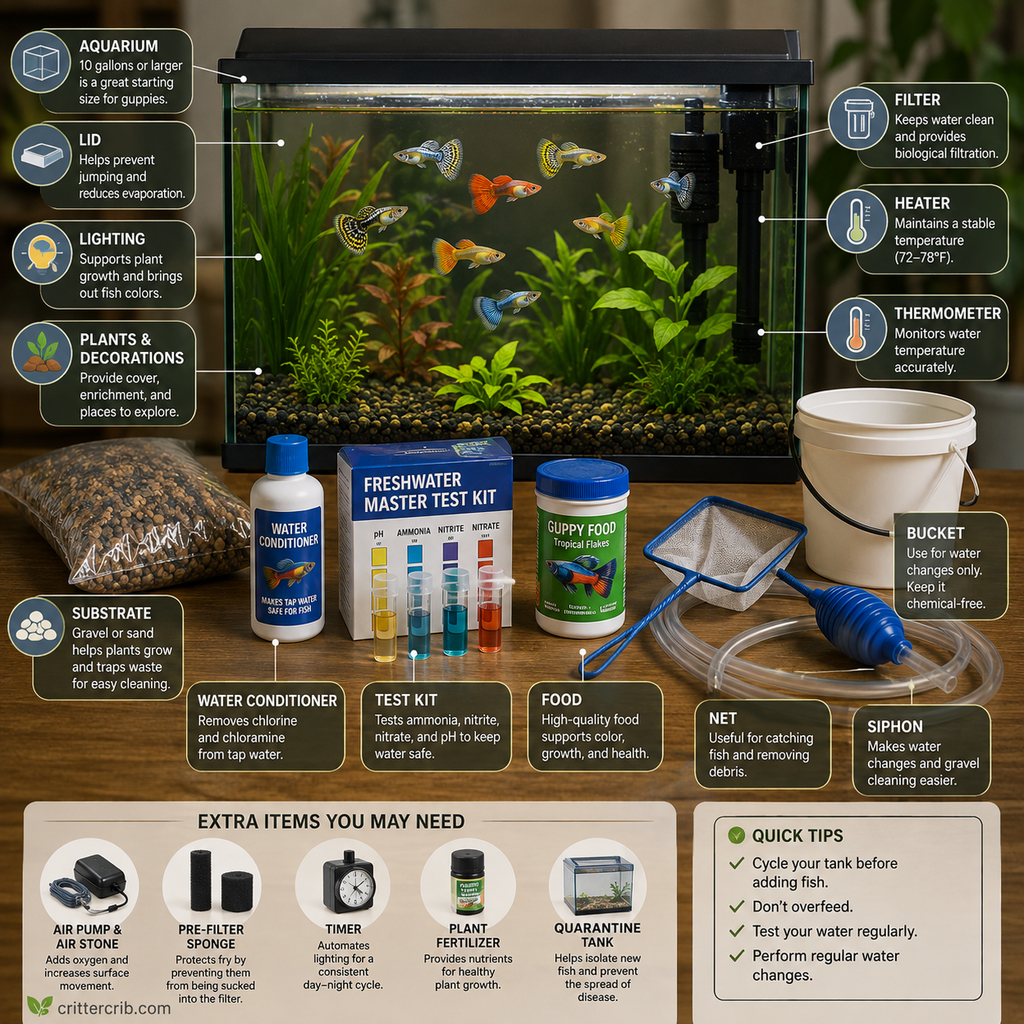
Essential guppy supplies include:
- Appropriately sized aquarium
- Aquarium lid
- Filter
- Heater
- Thermometer
- Aquarium light
- Water conditioner
- Freshwater test kit
- Substrate
- Plants and hiding areas
- Quality fish food
- Aquarium siphon or gravel vacuum
- Dedicated aquarium bucket
- Fish net
- Algae scraper
Depending on your setup, you may also need an air pump, airline tubing, timer, plant fertilizer, or other accessories.
Let’s look at what each item actually does.
1. An Appropriately Sized Aquarium
Your aquarium is the foundation of the entire setup.
Although guppies are small, they’re active fish and are normally kept in groups. They need enough room to swim while also having adequate water volume for stable conditions.
For a small group of guppies, a 10-gallon aquarium is a practical starting point, although larger tanks provide additional space and flexibility.
A 20-gallon aquarium can be especially useful if you plan to keep a larger group or expect breeding.
Remember that guppies reproduce readily.
A tank that feels spacious when you start with six fish can become crowded surprisingly quickly if males and females are housed together.
Why Bigger Can Be Easier
New aquarium keepers sometimes assume the smallest possible tank will be easiest to maintain.
Often, the opposite is true.
Greater water volume can make changes happen more gradually.
In a larger aquarium:
- Waste is more diluted
- Temperature tends to be more stable
- There’s more room for filtration
- Fish have more swimming space
- You have greater flexibility with plants and decorations
A larger tank still needs maintenance, but it can be more forgiving than a tiny desktop aquarium.
2. A Secure Aquarium Lid
Guppies can jump.
A lid helps prevent an unexpected escape while also reducing evaporation.
Choose a lid or hood that fits the aquarium properly.
Check openings around:
- Filters
- Heater cords
- Airline tubing
- Lighting
- Other equipment
You still need appropriate ventilation, but large gaps that allow fish to jump out should be avoided.
3. A Reliable Aquarium Filter
Filtration is one of the most important pieces of guppy equipment.
A filter helps remove suspended debris while providing surfaces where beneficial bacteria can live.
These bacteria are essential to the aquarium’s nitrogen cycle.
Common filtration options include:
- Sponge filters
- Hang-on-back filters
- Internal filters
- Canister filters for larger setups
For a straightforward guppy tank, you don’t need an enormous filtration system.
Choose a reliable filter appropriate for your aquarium size and stocking level.
Sponge Filters
Sponge filters are particularly popular for guppy tanks.
They’re inexpensive, provide gentle filtration, and are useful in aquariums containing fry because they don’t have powerful intake suction.
You’ll usually need:
- Sponge filter
- Air pump
- Airline tubing
- Check valve
An air-control valve can also help adjust airflow.
Hang-on-Back Filters
Hang-on-back filters are another common choice.
They’re easy to find and can provide mechanical, biological, and sometimes chemical filtration.
If the intake is strong, a pre-filter sponge can help protect small guppy fry.
4. An Aquarium Heater
Guppies are tropical fish and generally do best in warm, stable water.
A heater helps maintain consistent temperature even when the room cools overnight or during winter.
Choose a heater rated for the aquarium’s size.
Adjustable heaters are useful because they give you greater control over the target temperature.
For many guppies, a temperature around 72–78°F (22–26°C) can work well, depending on the particular fish and setup.
Consistency matters.
Avoid rapid temperature swings.
5. A Thermometer
Don’t rely exclusively on the heater’s dial.
An aquarium thermometer lets you verify the actual water temperature.
Options include:
- Glass thermometers
- Digital thermometers
- Probe-style thermometers
Place it where you can easily check it.
A thermometer is inexpensive and can quickly alert you to heater problems before they become serious.
6. Water Conditioner
Tap water commonly contains chlorine or chloramine used to make drinking water safe.
Those chemicals can be harmful to aquarium animals and beneficial bacteria.
A water conditioner neutralizes them before tap water enters the aquarium.
Always follow the product’s dosing instructions.
You’ll use conditioner when:
- Initially filling the aquarium
- Performing water changes
- Adding untreated tap water
One bottle often lasts quite a while with a smaller aquarium.
Don’t skip it.
7. A Freshwater Test Kit
Clear water isn’t necessarily safe water.
A test kit allows you to see what’s happening chemically in the aquarium.
At minimum, it’s useful to test:
- Ammonia
- Nitrite
- Nitrate
- pH
Some tests also measure:
- General hardness (GH)
- Carbonate hardness (KH)
Guppies generally appreciate mineral-rich water, so GH and KH can be useful measurements depending on your local water supply.
What Should Ammonia and Nitrite Be?
In an established, properly cycled aquarium, ammonia and nitrite should generally remain at:
0 ppm
Detectable ammonia or nitrite can indicate a problem with biological filtration, overstocking, excessive waste, or an aquarium that hasn’t fully cycled.
Testing removes the guesswork.
8. Supplies for Cycling the Aquarium
Ideally, your aquarium should complete the nitrogen cycle before guppies are introduced.
Cycling establishes beneficial bacteria capable of processing fish waste.
You’ll typically need:
- Aquarium
- Filter
- Dechlorinated water
- Ammonia source appropriate for fishless cycling
- Water test kit
The simplified nitrogen cycle works like this:
- Ammonia enters the system.
- Beneficial bacteria convert ammonia into nitrite.
- Other bacteria convert nitrite into nitrate.
- Water changes help control nitrate accumulation.
Cycling takes patience.
But waiting before purchasing fish is much easier than trying to manage toxic ammonia while fish are already living in the aquarium.
9. Aquarium Substrate
Gravel and sand are both common options for guppy tanks.
Substrate provides:
- A more natural appearance
- Surface area for microorganisms
- Support for some live plants
- Places for organic debris to collect where it can be vacuumed
The amount you need depends on the aquarium dimensions and whether you’re growing rooted plants.
If you plan to keep live plants, consider their substrate requirements before purchasing several bags of decorative gravel.
10. Plants
Guppies can live in an aquarium without a dense underwater garden, but plants provide several benefits.
They create:
- Cover
- Visual barriers
- Areas to explore
- Resting locations
- Shelter for fry
- Additional surfaces for biofilm
Live plants can also absorb some nutrients from the water.
Beginner-friendly choices may include:
- Anubias
- Java fern
- Java moss
- Water sprite
- Guppy grass
- Other hardy aquarium plants
Research each plant’s lighting and planting requirements.
For example, some plants shouldn’t have their rhizomes buried in substrate.
Live vs. Artificial Plants
Artificial plants can work too.
Choose soft materials without sharp edges that could injure fish.
Live plants offer additional biological benefits, but there’s nothing wrong with starting simple and adding plants as your confidence grows.
11. Aquarium Decorations and Hiding Areas
You don’t need to fill the tank with decorations.
Guppies need swimming space too.
A few carefully chosen items can create an interesting environment:
- Smooth rocks
- Aquarium-safe driftwood
- Caves
- Natural-looking ornaments
- Planted areas
Avoid decorations with sharp edges or openings where fish could become trapped.
Try to create a balance between cover and open swimming areas.
12. Aquarium Lighting
If your aquarium kit includes a light, you may already have what you need.
Lighting helps you see the fish and supports live plant growth.
You don’t need to leave the light on all day and night.
A consistent day-and-night cycle is healthier and can also help control excessive algae growth.
An inexpensive timer makes lighting much easier to manage.
13. Quality Guppy Food
Food is obviously essential, but you don’t need ten different containers on day one.
Start with a quality food designed for small tropical fish or guppies.
Depending on your feeding plan, you might use:
- Quality flakes
- Small pellets
- Brine shrimp
- Daphnia
- Appropriate frozen foods
- Other suitable supplemental foods
A varied diet can provide nutritional diversity and encourage natural feeding behavior.
Feed small portions.
Excess food eventually becomes excess waste.
14. Gravel Vacuum or Aquarium Siphon
A siphon makes routine water changes much easier.
For gravel tanks, a gravel vacuum allows you to remove debris trapped between pieces of substrate while draining water.
If you’re using sand, hold the siphon slightly above the surface to pick up waste without removing large amounts of sand.
Choose a siphon appropriate for your aquarium size.
A giant gravel vacuum designed for a 100-gallon aquarium isn’t particularly convenient in a 10-gallon guppy tank.
15. A Dedicated Aquarium Bucket
Buy a bucket and make it an aquarium-only bucket.
Don’t borrow the same bucket used for:
- Mopping
- Washing cars
- Household cleaners
- Gardening chemicals
- Detergents
Even small chemical residues can be dangerous in an aquarium.
Clearly labeling the bucket “AQUARIUM ONLY” isn’t a bad idea.
You’ll use it for water changes, filter maintenance, and other routine tasks.
16. Fish Net
A small fish net is useful even if you don’t plan on catching your guppies regularly.
It may be needed for:
- Moving fish
- Quarantine
- Removing debris
- Emergencies
Choose a size appropriate for your aquarium and fish.
Avoid unnecessarily chasing guppies around the tank. Catching can be stressful, so use the net only when there’s a reason.
17. Algae Scraper
Some algae growth is normal.
An algae scraper or magnetic glass cleaner makes it easy to keep the front viewing panel clear.
Choose a product intended for your aquarium material.
Acrylic aquariums scratch more easily than glass.
Never use a household sponge that has been exposed to soap or cleaning chemicals.
18. Air Pump and Air Stone
An air pump isn’t mandatory in every filtered aquarium, but it can be useful.
Air-driven equipment can increase surface movement and improve gas exchange.
You may need an air pump if you’re using:
- Sponge filter
- Air stone
- Certain decorations
- Additional aeration
If the air pump sits below the aquarium’s water level, install an appropriate check valve to reduce the risk of water siphoning backward during a power outage.
19. Filter Media
It’s useful to understand filter media before your first cleaning.
Filters may contain:
- Sponges
- Foam
- Ceramic biological media
- Floss
- Cartridges
- Chemical media
Reusable biological media shouldn’t automatically be thrown away every few weeks.
Beneficial bacteria colonize these surfaces.
When reusable sponge media becomes dirty, it can often be gently rinsed in removed aquarium water during maintenance.
Avoid replacing all established biological media simultaneously unless there’s a specific reason.
20. Quarantine Supplies
A quarantine tank isn’t always included on beginner shopping lists, but it’s extremely useful if you plan to keep fish long term.
New fish can carry diseases or parasites even when they look healthy at the store.
A simple quarantine setup may include:
- Small appropriately sized aquarium
- Heater
- Thermometer
- Established sponge filter
- Lid
- Simple hiding areas
Keeping the setup simple makes observation easier.
You don’t necessarily need to keep an empty quarantine aquarium running permanently. Some aquarists maintain spare seeded filter media in an established tank so biological filtration is available when needed.
Optional Guppy Supplies Worth Considering
Once the essentials are covered, several extras can make aquarium keeping easier.
Aquarium Light Timer
Automatically turns the light on and off at consistent times.
Pre-Filter Sponge
Fits over certain filter intakes and can help prevent fry from being pulled into the filter.
Feeding Ring
Keeps floating foods in a particular area and can make feeding easier to observe.
Aquascaping Tools
Long tweezers and scissors are useful if you keep live plants.
Backup Heater
A spare heater can be extremely useful if your main heater suddenly fails.
Battery-Powered Air Pump
Useful during power outages, especially when filtration and water circulation stop.
You don’t need every optional accessory immediately.
Add equipment as you discover what makes sense for your particular aquarium.
Supplies You Probably Don’t Need
Aquarium stores contain shelves full of products promising cleaner water, healthier fish, perfect pH, and instant solutions.
Many aren’t necessary for a basic guppy setup.
You usually don’t need to automatically purchase:
- Routine aquarium salt
- pH-adjusting chemicals
- Algae-killing chemicals
- Multiple medications “just in case”
- Decorative gadgets with no practical purpose
- Replacement filter cartridges every few weeks
That doesn’t mean these products never have legitimate uses.
It means you shouldn’t add chemicals simply because they’re marketed next to guppies.
Stable water is generally preferable to constantly adjusting parameters.
What Should You Buy Before Getting Guppies?
Ideally, don’t buy the aquarium and fish on the same day.
Get the setup first.
A good order is:
- Aquarium and lid
- Filter
- Heater and thermometer
- Substrate
- Plants and decorations
- Water conditioner
- Water test kit
- Maintenance supplies
- Fish food
- Guppies—after the aquarium is properly cycled
This gives you time to learn how the equipment works before animals depend on it.
How Much Does a Complete Guppy Setup Cost?
Costs vary widely depending on aquarium size, brand, equipment, plants, and where you shop.
A basic guppy setup might cost somewhere around $150 to $400 when you’re starting from scratch.
The fish themselves are often one of the least expensive parts.
You can save money by:
- Buying aquarium kits during sales
- Purchasing suitable used tanks
- Using sponge filtration
- Starting with easy plants
- Avoiding unnecessary chemicals and accessories
Spend first on the things that directly affect your fish: adequate space, reliable filtration, temperature control, water testing, and quality food.
Decorative extras can come later.
Common Beginner Guppy Setup Mistakes
Having the right equipment doesn’t automatically guarantee a healthy aquarium.
Avoid these common mistakes:
- Buying fish before cycling the tank
- Starting with an aquarium that’s too small
- Overstocking
- Keeping males and females together without planning for fry
- Forgetting water conditioner
- Skipping water testing
- Overfeeding
- Replacing all filter media at once
- Using untreated tap water on biological filter media
- Making sudden temperature or water-chemistry changes
- Adding incompatible tank mates
Most early aquarium problems aren’t caused by a missing fancy gadget.
They’re caused by overlooking one of the fundamentals.
Frequently Asked Questions About Guppy Supplies
What do I need for a guppy tank?
At minimum, you’ll need an appropriately sized aquarium, secure lid, filter, heater, thermometer, water conditioner, water-testing supplies, food, and basic maintenance equipment. Substrate, plants, and appropriate decorations help create a more complete habitat.
Do guppies need a heater?
Guppies are tropical fish and benefit from stable, appropriately warm water. A heater is generally useful unless the aquarium naturally remains within a suitable temperature range throughout the day and year.
Do guppies need a filter?
Filtration is strongly recommended for a typical guppy aquarium. A filter provides mechanical filtration and valuable surface area for beneficial bacteria.
Do guppies need an air pump?
Not necessarily. If your filter provides sufficient surface movement, additional aeration may not be required. An air pump is necessary when using an air-driven sponge filter.
Do guppies need live plants?
Live plants aren’t strictly required, but they can provide cover, enrichment, surfaces for biofilm, and shelter for fry. Soft artificial plants are another option.
Is a 10-gallon tank enough for guppies?
A 10-gallon aquarium can be a practical starting point for a small group of guppies when properly filtered and maintained. Larger aquariums provide more room and are especially useful if the fish reproduce.
What should I buy first for guppies?
Buy and set up the aquarium, filtration, heater, water conditioner, testing supplies, substrate, and other equipment before purchasing the fish. Ideally, complete a fishless aquarium cycle before introducing guppies.
Final Thoughts
A beginner guppy setup doesn’t need to be complicated or expensive.
Focus on the essentials first: enough aquarium space, reliable filtration, stable temperature, conditioned water, testing equipment, good food, and basic maintenance supplies.
Plants, decorations, timers, aquascaping tools, and other accessories can be added as you learn what you enjoy about the hobby.
Most importantly, set everything up before bringing your guppies home.
It’s much easier to troubleshoot a new filter, adjust a heater, or wait for an aquarium to cycle when there aren’t six tiny fish staring at you through the glass wondering why you didn’t figure this out last week.