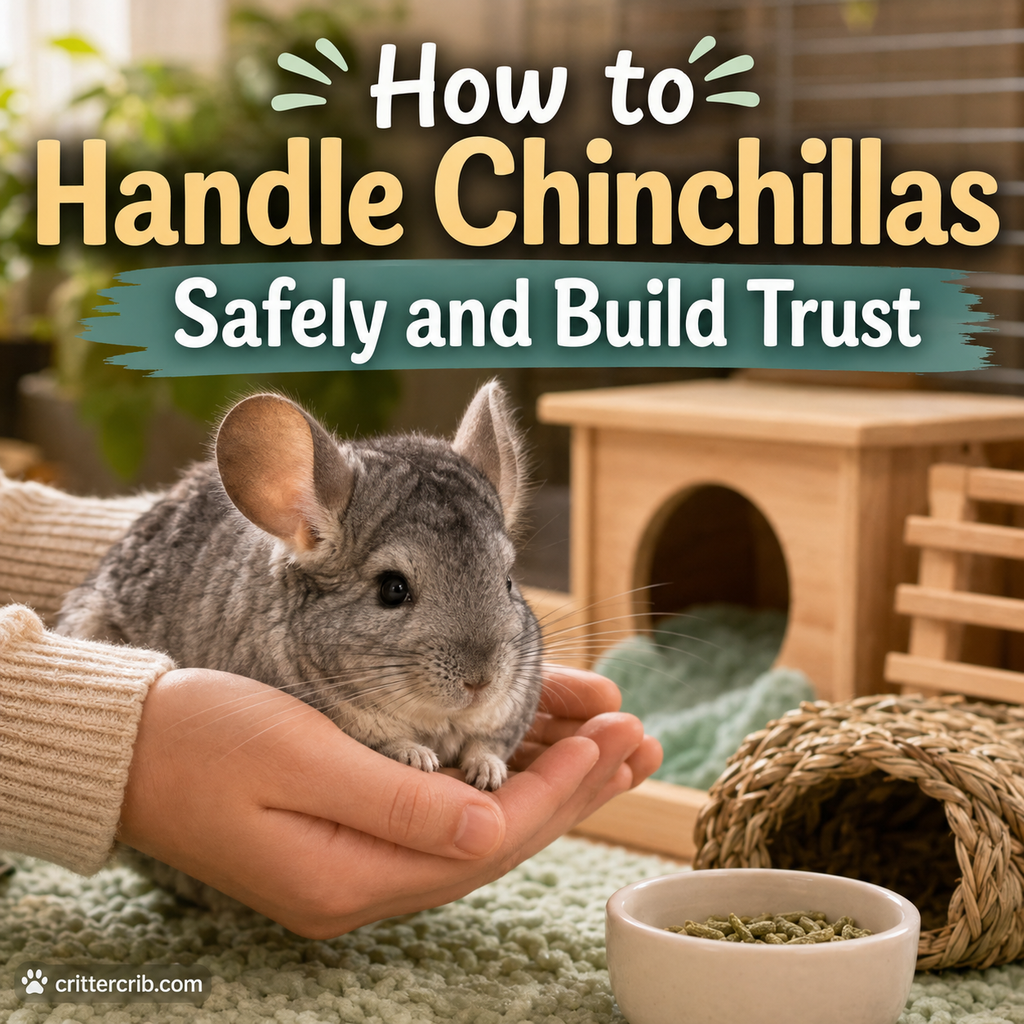
Chinchillas are soft, curious, and surprisingly expressive little animals, but that doesn’t necessarily mean they want to be picked up and cuddled.
For many chinchillas, trust has to be earned.
They’re prey animals by nature, and being grabbed or lifted can initially feel threatening. Some eventually become comfortable sitting on their owner’s hands, arms, or lap. Others prefer interacting without being held very much at all.
Both are perfectly normal.
The best approach is to let your chinchilla set the pace while you create positive, predictable interactions. With patience and the right handling technique, you can build a relationship without making every encounter stressful.
Here’s how to handle a chinchilla safely, earn its trust, recognize when it needs space, and avoid some of the most common mistakes new owners make.
Do Chinchillas Like Being Held?
Some chinchillas tolerate or even enjoy being held once they trust their owner. Others never become particularly enthusiastic about it.
Individual personality matters.
A confident chinchilla may willingly climb onto your hands after getting to know you. A more cautious animal might happily approach for treats but retreat the moment you try to lift it.
Don’t measure your relationship by how long your chinchilla allows you to hold it.
Trust can also look like:
- Approaching when you enter the room
- Taking food from your hand
- Sitting beside you
- Climbing onto your lap
- Allowing gentle scratches
- Exploring around you without hiding
- Remaining relaxed while you’re nearby
A chinchilla that voluntarily chooses to interact with you is showing meaningful trust, even if it doesn’t want to cuddle.
Why Chinchillas Can Be Nervous About Handling
In the wild, chinchillas survive partly by staying alert to potential predators.
Being suddenly approached from above, chased, cornered, or grabbed can trigger that instinctive response.
Imagine being a small animal and seeing two enormous hands reaching down toward you.
Running makes sense.
This is why the early goal shouldn’t be “How quickly can I hold my chinchilla?”
A better question is, “How can I teach my chinchilla that my hands are safe?”
That shift makes the entire process easier.
Give a New Chinchilla Time to Settle In
When you first bring a chinchilla home, resist the temptation to start handling immediately.
Everything has changed at once.
There are new smells, sounds, people, routines, and surroundings. Your chinchilla needs time to explore its enclosure and establish places where it feels secure.
During the first few days, focus on essentials:
- Keep the environment calm.
- Provide food, hay, and fresh water.
- Maintain a comfortable temperature.
- Avoid unnecessary handling.
- Speak quietly when you’re nearby.
- Allow your chinchilla to hide when it wants to.
You can sit near the enclosure and talk softly without demanding interaction.
Simply becoming a predictable part of the environment is the first step toward building trust.
Start by Letting Your Chinchilla Approach You
Once your chinchilla appears comfortable in its new surroundings, begin introducing your hand.
Don’t immediately reach for the animal.
Instead, place your hand inside or near the enclosure and keep it relatively still. Allow your chinchilla to investigate when it feels ready.
It may sniff your fingers.
It may put its front paws on your hand.
It may run away and return several times.
All of those reactions are useful.
The important part is giving the chinchilla control over the interaction.
Keep Early Sessions Short
You don’t need hour-long bonding sessions.
A few calm minutes can be more productive than a long interaction that eventually becomes stressful.
Try short sessions regularly and end on a positive note.
As your chinchilla becomes more confident, you can gradually increase the amount of interaction.
Use Treats Carefully to Build Positive Associations
Food can be a useful trust-building tool.
Offering a small chinchilla-safe treat from your fingers can teach your pet that approaching your hand leads to something positive.
At first, your chinchilla may stretch as far as physically possible to grab the treat without actually coming close.
That’s fine.
Don’t use the treat to trick the animal into being grabbed.
Instead, allow it to take the food and retreat if it wants.
Over time, you can encourage your chinchilla to approach more comfortably.
Treats should remain small and appropriate for chinchillas. Their digestive systems are sensitive, so trust-building shouldn’t turn into constant snacking.
Learn Your Chinchilla’s Body Language
Successful handling becomes much easier when you recognize the difference between curiosity and discomfort.
A relaxed chinchilla may:
- Approach voluntarily
- Sniff your hands
- Sit normally rather than crouching defensively
- Explore around you
- Accept gentle contact
- Return after briefly moving away
A chinchilla that wants space may:
- Run away repeatedly
- Hide
- Freeze
- Press itself into a corner
- Attempt to escape
- Make warning sounds
- Push your hand away
- Nip
- Release urine as a defensive response
If your chinchilla repeatedly moves away, listen to what it’s telling you.
Continuing to chase it usually doesn’t make the animal realize you’re friendly. It teaches the opposite lesson.
How to Pick Up a Chinchilla Safely
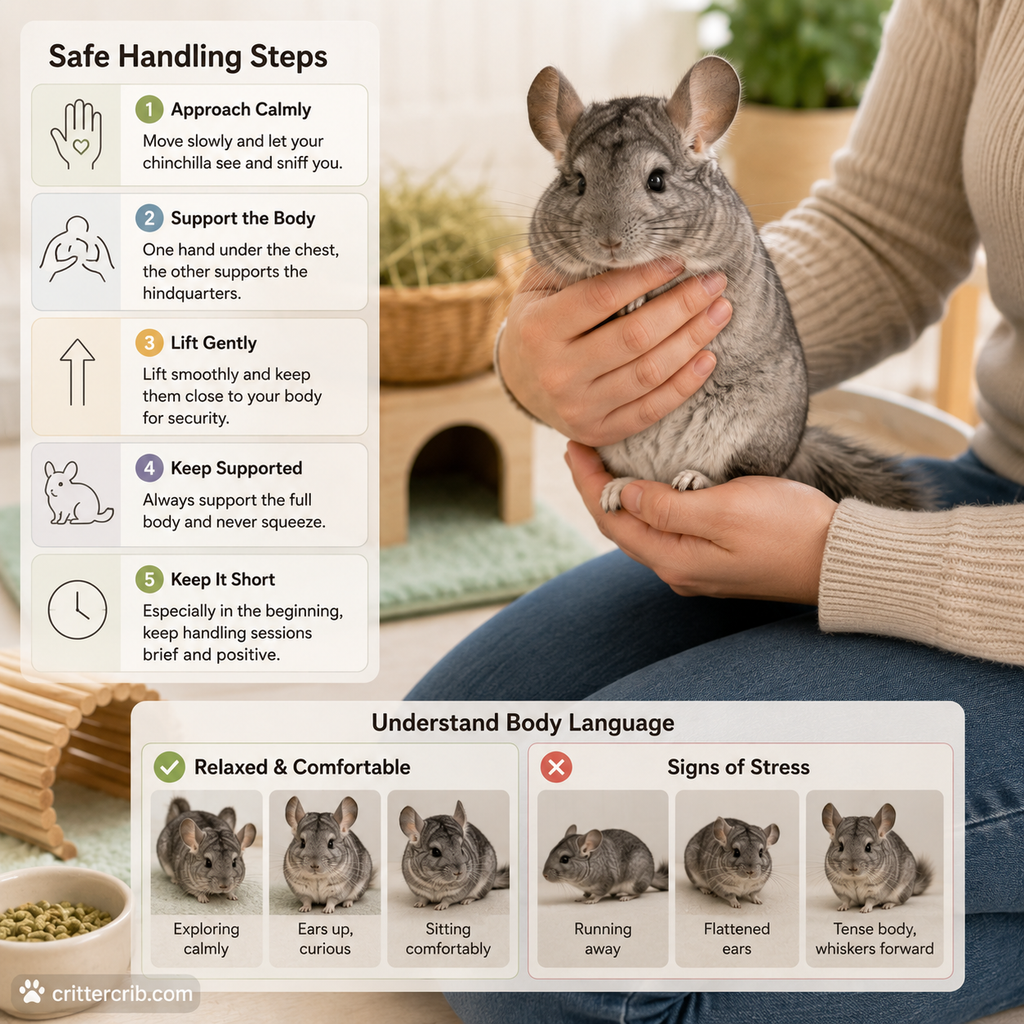
Once your chinchilla is comfortable with your hands, you can begin practicing gentle lifting.
The goal is to support the animal securely without squeezing it.
Step 1: Approach Calmly
Move slowly and let your chinchilla see you coming.
Avoid suddenly reaching down from directly overhead whenever possible.
Allow the chinchilla to sniff or investigate your hands first.
Step 2: Support the Body
Place one hand underneath the chest and front portion of the body while using your other hand to support the hindquarters.
A chinchilla should never be left dangling.
The body needs secure support during the entire lift.
Step 3: Lift Gently
Lift slowly and smoothly.
Keep the chinchilla close to your body rather than holding it far away from you. This provides additional security and reduces the distance it could fall if it suddenly struggles.
Step 4: Maintain Support
Continue supporting the chest, body, and hindquarters.
Don’t squeeze.
Your grip should prevent an accidental fall while still allowing the animal to breathe and remain comfortable.
Step 5: Keep Early Holds Brief
At first, you may only hold your chinchilla for a few seconds.
That’s enough.
Set it down calmly before it begins struggling.
Gradually increasing the duration can be much more effective than forcing a frightened animal to remain in your arms.
Sit on the Floor During Early Handling
One of the simplest ways to make early handling safer is to sit on the floor.
Chinchillas are quick.
A calm animal can suddenly decide it has somewhere else to be and launch itself out of your hands.
If you’re standing, that’s a significant fall.
Sitting on the floor or another low, secure surface reduces the potential drop distance while both of you learn how handling sessions will work.
Use a chinchilla-proofed room with doors and escape routes secured.
Never Pick a Chinchilla Up by the Ears
A chinchilla should never be lifted by its ears.
The ears are delicate and aren’t handles.
Likewise, don’t lift a chinchilla by a leg or pull it by loose fur.
Handling should always prioritize supporting the body.
What About Holding a Chinchilla by the Tail?
You may encounter advice about using the base of a chinchilla’s tail during restraint.
Experienced handlers or veterinary professionals may use specific restraint techniques involving the base of the tail when necessary. That’s very different from casually grabbing or lifting a pet by its tail.
For everyday handling, beginners should focus on securely supporting the chinchilla’s body with both hands.
Never grab or pull the end of the tail.
If your chinchilla needs medical restraint or you’re unsure how to handle it safely, ask an experienced exotic-animal veterinarian to demonstrate the appropriate technique.
Be Careful With a Chinchilla’s Fur
Chinchillas have exceptionally dense fur.
It’s one of their most distinctive features, but it also means they require careful handling.
When frightened or restrained incorrectly, a chinchilla may experience what’s commonly called “fur slip,” where patches of fur release from the skin.
This is a defensive mechanism.
Although the fur can grow back, fur slip is a clear sign that handling needs to be gentler.
Avoid:
- Grabbing handfuls of fur
- Squeezing the body
- Chasing and cornering the chinchilla
- Holding tightly when it panics
- Pulling the animal from a hiding place
The goal should always be cooperation whenever circumstances allow.
Don’t Chase Your Chinchilla Around the Cage
Few things undermine trust faster than turning every interaction into a chase.
If your chinchilla runs away and you follow it around the enclosure with your hands, you’re reinforcing the idea that your hands are something to escape.
Instead, encourage voluntary interaction.
Use patience, familiar routines, and appropriate rewards.
There will occasionally be situations when you need to move your chinchilla whether it feels cooperative or not. Medical emergencies are an obvious example.
But routine handling should involve as little chasing as possible.
Let Your Chinchilla Climb Onto You
Handling doesn’t always have to involve picking the animal up.
During supervised playtime, sit quietly on the floor and allow your chinchilla to investigate you.
You may quickly become part of the playground.
A confident chinchilla might:
- Jump onto your legs
- Sit on your lap
- Climb onto your arms
- Sniff your clothing
- Use you as a launch platform
This type of voluntary interaction can be excellent for building trust because the chinchilla remains in control.
Try not to grab it the moment it climbs onto you.
Otherwise, it may learn that approaching you results in losing its freedom.
Create a Safe Area for Bonding
A secure play area makes trust-building much easier.
Before allowing your chinchilla outside its enclosure, chinchilla-proof the space carefully.
Remove or secure:
- Electrical cords
- Houseplants
- Small objects that could be swallowed
- Unsafe wood or furniture
- Cleaning products
- Open doors
- Gaps behind appliances
- Reclining furniture
- Accessible wires
- Anything else that can be chewed or climbed into
Chinchillas are extremely good at finding the one opening you didn’t notice.
Check at floor level before playtime begins.
Keep Other Pets Away During Handling
Dogs and cats should generally be kept out of the room during chinchilla handling and playtime.
Even a friendly dog or cat can frighten a prey animal.
Predatory behavior can also appear unexpectedly when a small animal begins running or jumping.
Your chinchilla should have a secure area where it can interact with you without worrying about another animal watching, chasing, or pawing at it.
A closed door is much safer than relying on everyone to behave.
Handle Chinchillas in a Cool Environment
Temperature deserves special attention with chinchillas.
Their extraordinarily dense coats make them susceptible to overheating.
Handling, exercise, and stress can all increase body heat, so bonding sessions should take place in a comfortably cool environment.
Avoid extended handling when the room is unusually warm.
If your chinchilla appears overheated, lethargic, distressed, or is breathing abnormally, stop the activity and seek veterinary guidance if needed.
Don’t Wake a Sleeping Chinchilla Just to Handle It
Chinchillas are most active during evening, nighttime, and twilight periods.
Your chinchilla may spend a large portion of the day sleeping.
Regularly waking it simply because that’s when you want to play can create unnecessary stress.
Whenever possible, schedule interactions around the times your chinchilla naturally becomes active.
You’ll often get a much more interested participant.
Can Children Hold Chinchillas?
Children can interact with chinchillas, but handling should be closely supervised.
Chinchillas are fast, relatively delicate, and capable of jumping unexpectedly.
Young children may accidentally squeeze an animal when it struggles or drop it when startled.
For younger children, sitting on the floor and allowing the chinchilla to approach may be safer than carrying it around.
An adult should remain responsible for the chinchilla’s care and handling.
What If Your Chinchilla Bites?
Chinchillas may nibble gently while investigating something, and that’s different from an aggressive or defensive bite.
A frightened chinchilla can bite harder.
If biting occurs, think about what happened immediately beforehand.
Was the chinchilla:
- Cornered?
- Woken suddenly?
- Grabbed?
- Prevented from escaping?
- Protecting a hiding place?
- Showing signs of fear that were ignored?
Understanding the trigger is more useful than punishing the animal.
Never hit, yell at, or physically punish a chinchilla for biting.
That will damage trust and may increase defensive behavior.
How Long Does It Take for a Chinchilla to Trust You?
There’s no universal timeline.
One chinchilla may begin climbing onto your hand relatively quickly. Another may require weeks or months before it becomes comfortable with close interaction.
Factors can include:
- Individual personality
- Age
- Previous handling
- Previous negative experiences
- How frequently you interact
- The consistency of your routine
- The environment
- Your handling technique
Progress isn’t always linear either.
A chinchilla may seem extremely confident one evening and decide it wants nothing to do with you the next.
Don’t interpret every retreat as lost progress.
A Simple Chinchilla Trust-Building Routine
If you’re not sure where to begin, work through the process gradually.
Stage 1: Become Familiar
Spend time near the enclosure without trying to touch your chinchilla.
Talk quietly and perform normal feeding and cleaning routines.
Stage 2: Introduce Your Hand
Place your hand nearby and allow your chinchilla to investigate voluntarily.
Don’t chase.
Stage 3: Offer Appropriate Rewards
Use occasional chinchilla-safe treats to create positive associations with your presence.
Stage 4: Encourage Climbing
Allow your chinchilla to place its paws on your hand or climb onto you without immediately restraining it.
Stage 5: Practice Gentle Touch
Introduce brief scratches or petting when your chinchilla appears comfortable.
Stage 6: Practice Short Lifts
Support the body properly and lift only briefly before placing your chinchilla back down.
Stage 7: Gradually Increase Handling
Increase duration only when the chinchilla remains relaxed.
There’s no need to rush from one stage to another.
Your chinchilla decides when it’s ready.
Where Do Chinchillas Like to Be Petted?
Preferences vary, but many chinchillas tolerate gentle scratches around the head, chin, neck, or behind the ears once they’re comfortable with a person.
Start slowly.
Offer your fingers and see whether your chinchilla leans toward the contact or moves away.
Avoid assuming that because your chinchilla enjoyed being scratched yesterday, it wants the same thing right now.
Consent can be surprisingly easy to read when you give the animal an opportunity to leave.
Common Chinchilla Handling Mistakes
New owners usually mean well, but enthusiasm can move faster than trust.
Common mistakes include:
- Picking up a new chinchilla immediately
- Reaching suddenly from above
- Chasing the chinchilla around its enclosure
- Cornering it before attempting to pick it up
- Holding it too tightly
- Failing to support the hindquarters
- Carrying it while standing during early sessions
- Grabbing fur
- Pulling the tail
- Lifting by the ears
- Allowing young children to handle unsupervised
- Handling around dogs or cats
- Continuing when the chinchilla is clearly frightened
- Expecting every chinchilla to become cuddly
- Using too many treats to encourage interaction
Avoiding these mistakes gives your chinchilla a much better reason to trust you.
How to Move a Chinchilla That Doesn’t Want to Be Held
Sometimes handling isn’t optional.
You may need to move your chinchilla for cage maintenance, transportation, or veterinary care.
If possible, avoid chasing it until it’s exhausted.
A carrier can be useful.
You may be able to encourage your chinchilla to enter a secure carrier or transport container voluntarily using familiar bedding, hay, or an appropriate reward.
Practicing this when there isn’t an emergency can make future trips considerably easier.
Leave the carrier available occasionally during supervised interaction so it doesn’t automatically mean something unpleasant is about to happen.
Handling Your Chinchilla for Health Checks
Getting your chinchilla comfortable with gentle handling has practical benefits beyond bonding.
Regular interaction gives you opportunities to notice changes in:
- Body condition
- Fur
- Eyes
- Ears
- Feet
- Movement
- Eating behavior
- Droppings
- Activity level
You can also weigh your chinchilla regularly using an appropriate scale.
Weight changes may reveal a developing problem before it becomes visually obvious.
If you notice unexplained weight loss, reduced appetite, unusual droppings, lethargy, difficulty breathing, abnormal movement, or another significant change, contact a veterinarian experienced with chinchillas.
Building Trust Is More Important Than Holding
It’s easy to imagine successful chinchilla ownership as sitting on the couch with a fluffy animal happily curled in your lap.
Sometimes that happens.
Sometimes it doesn’t.
A chinchilla that runs toward you, climbs onto your legs, accepts scratches, and voluntarily spends time nearby may trust you completely while still disliking being restrained.
Respecting that preference can actually strengthen your relationship.
Instead of trying to turn your chinchilla into a pet it isn’t, learn how your individual animal prefers to interact.
Frequently Asked Questions About Handling Chinchillas
Can You Hold a Chinchilla?
Yes. Chinchillas can be held when handled properly, although individual animals vary considerably in how much they enjoy it.
Support the body and hindquarters securely and keep the chinchilla close to you.
How Do You Get a Chinchilla to Trust You?
Start with calm, predictable interactions.
Spend time near the enclosure, allow the chinchilla to approach your hands voluntarily, offer occasional appropriate rewards, and gradually introduce touching and lifting.
Avoid chasing or forcing interaction.
How Often Should You Handle a Chinchilla?
Regular positive interaction can help maintain familiarity, but there isn’t a required amount of holding time.
Quality matters more than duration.
Short, relaxed interactions are preferable to long sessions that leave your chinchilla frightened or struggling.
How Do You Know If a Chinchilla Likes You?
A trusting chinchilla may approach voluntarily, take food from your hand, climb onto you, remain relaxed nearby, or allow gentle scratching.
Not every chinchilla expresses trust through cuddling.
Why Does My Chinchilla Run Away From Me?
Running away doesn’t necessarily mean your chinchilla dislikes you.
It may be frightened, startled, not yet accustomed to handling, or simply uninterested in interaction at that moment.
Give it space and continue building positive associations gradually.
Should You Grab a Chinchilla If It Runs Away?
Avoid chasing and grabbing during normal interaction.
Repeatedly pursuing a frightened chinchilla can make it more fearful of your hands.
If you need to move the animal for safety or medical reasons, use calm, secure handling and minimize unnecessary pursuit.
Can Chinchillas Be Cuddly?
Some can become quite affectionate and comfortable with physical interaction.
Others prefer brief scratches, climbing on their owner, or simply being nearby.
Personality plays a major role.
Can Chinchillas Recognize Their Owners?
Chinchillas can become familiar with the people who regularly care for them and may learn to associate familiar voices, scents, routines, and sounds with feeding or positive interaction.
Their behavior often becomes noticeably more confident around people they know.
Patience Creates a Better Relationship
The safest way to handle a chinchilla begins before you ever pick it up.
Build trust first.
Give your chinchilla time to settle in, allow it to investigate your hands, keep interactions predictable, and reward voluntary contact. When you eventually begin lifting, support the entire body and keep early sessions short and close to the ground.
Most importantly, pay attention to what your chinchilla is telling you.
If it approaches, give it an opportunity to interact. If it retreats, give it space.
Over time, those small decisions teach your chinchilla something important: being around you doesn’t mean losing control or being frightened.
And once a cautious animal begins choosing to spend time with you on its own, that’s a much better sign of trust than simply being able to hold it.