
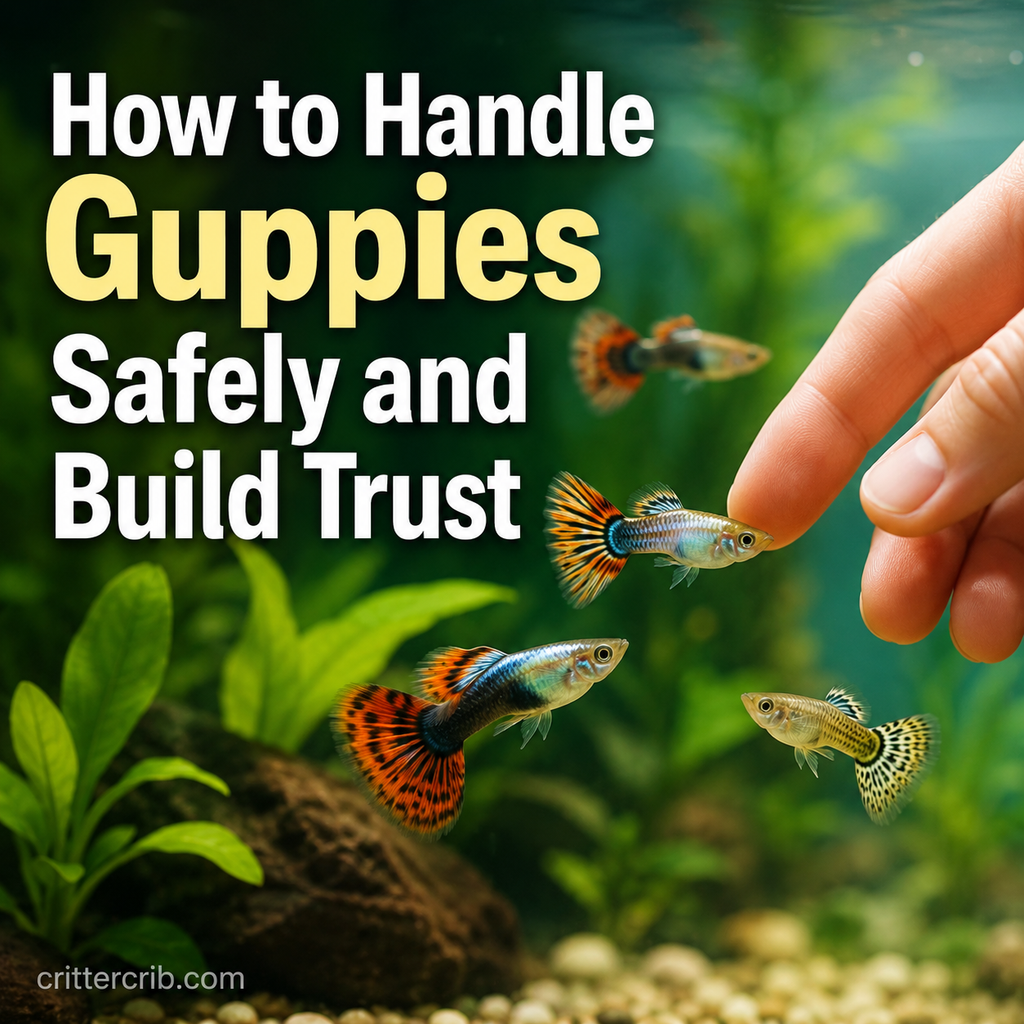
Guppies are active, curious little fish, and it’s easy to feel like they recognize you when they swim toward the front of the aquarium. Over time, they may even gather near your hand during feeding or follow your movements along the glass.
But building trust with a guppy is different from bonding with a dog, cat, or other pet you can physically handle.
In fact, one of the most important parts of learning how to handle guppies safely is knowing when not to touch them. Guppies have delicate bodies and a protective slime coat that can be damaged through unnecessary handling.
Fortunately, you don’t need to pick up your guppies to interact with them. With patience, predictable routines, and gentle movements, you can help them become comfortable around you while keeping stress to a minimum.
Should You Handle Guppies With Your Hands?
In most situations, no.
Guppies are not designed to be regularly picked up or petted. Their bodies are supported by water, and removing them from that environment can quickly cause stress and potentially lead to injury.
Their skin is also covered by a thin layer of protective mucus commonly called a slime coat. This coating helps protect fish from pathogens and physical irritation.
Touching a guppy with dry hands can disturb this protective layer. Even wet hands aren’t a good reason to routinely handle a fish.
For everyday interaction, it’s much safer to keep your guppies in the aquarium and allow them to approach you on their own terms.
Physical handling should generally be reserved for situations where it’s genuinely necessary, such as moving a fish when another safer method isn’t practical.
Why Guppies Can Become Comfortable Around People
Guppies may be small, but that doesn’t mean they simply ignore everything happening outside their aquarium.
They can learn associations between certain sights, movements, and events. If you approach the tank at roughly the same time each day and food regularly follows, your guppies may begin swimming toward you as soon as they see you.
That doesn’t necessarily mean a guppy trusts you in the same emotional sense that a domesticated mammal might. However, it can learn that your presence isn’t threatening.
A comfortable guppy may:
- Swim toward the front when you approach
- Gather near its usual feeding area
- Remain visible instead of immediately hiding
- Follow your finger outside the glass
- Approach aquarium tools or your submerged hand with curiosity
- Resume normal swimming soon after routine maintenance
These behaviors are better indicators of comfort than whether a fish allows itself to be touched.
How to Build Trust With Your Guppies
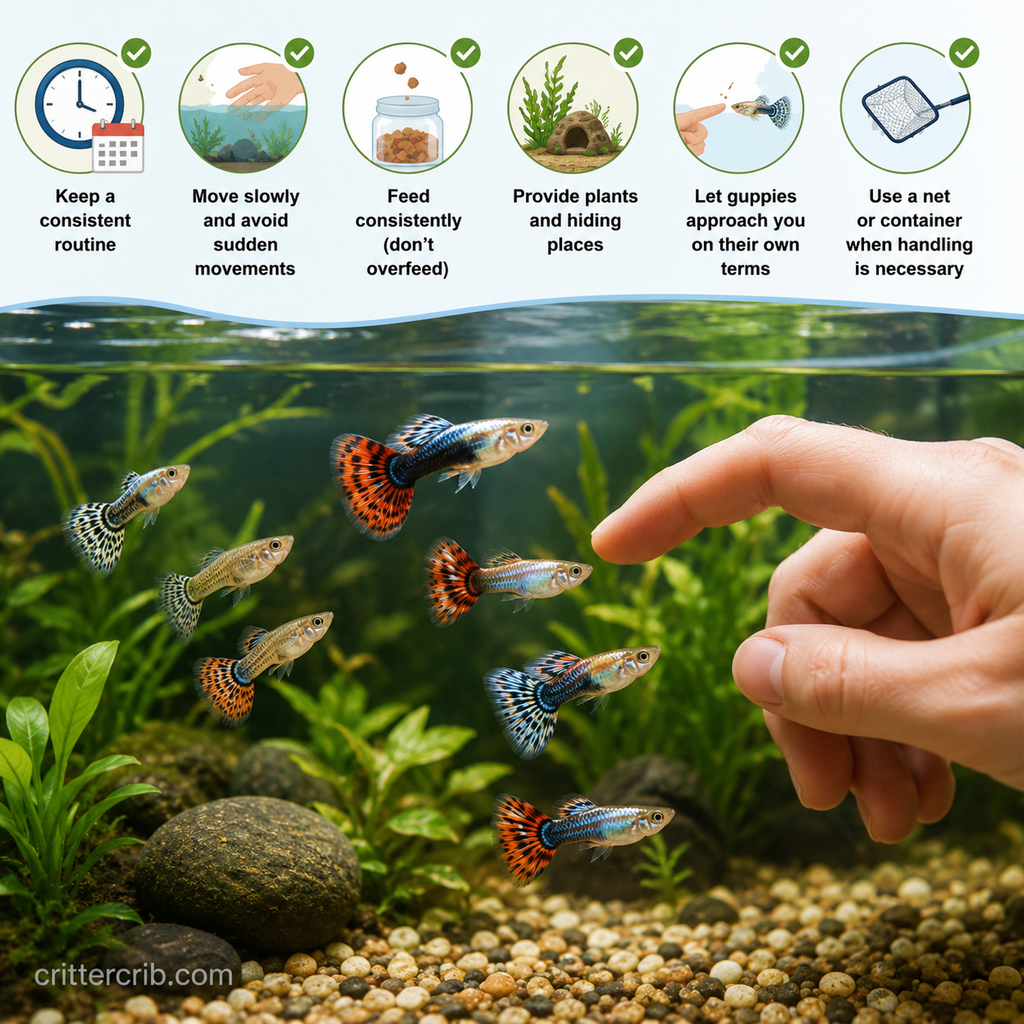
Building trust isn’t about forcing interaction. Your goal is to make your presence predictable and nonthreatening.
1. Give New Guppies Time to Settle In
Don’t expect newly introduced guppies to immediately swim up to you.
Moving from one environment to another can be stressful. They have to adjust to different water conditions, surroundings, lighting, tank mates, and routines.
During the first few days, focus on providing a stable environment rather than encouraging close interaction.
Keep sudden disturbances around the aquarium to a minimum and observe the fish from a comfortable distance.
Once they begin exploring, eating normally, and swimming confidently, you can gradually become more involved.
2. Approach the Aquarium Slowly
Imagine being a two-inch fish and seeing something many times your size suddenly move toward you.
Quick movements can be startling.
When approaching the aquarium, move normally but avoid suddenly tapping the glass, waving objects directly in front of the fish, or making abrupt movements near the tank.
Over time, guppies can become accustomed to normal activity around their aquarium.
3. Create a Consistent Feeding Routine
Food is one of the easiest ways to create a positive association with your presence.
Try feeding your guppies on a reasonably consistent schedule. They may soon learn when feeding time is approaching and begin gathering near the surface when they see you.
You don’t need to feed them every time you walk past the tank, though.
Doing so can encourage overfeeding and create water-quality problems. Stick to an appropriate feeding schedule rather than using extra food simply to make the fish interact with you.
4. Spend Time Near the Tank
Sometimes the easiest way to make fish comfortable with you is simply to be around.
Sit near the aquarium while reading, working, or relaxing. Walk past it normally throughout the day.
The goal isn’t to constantly get the guppies’ attention. You’re allowing them to become familiar with your presence without anything stressful happening.
Eventually, they may stop reacting to your movements as potential threats and instead become curious about what you’re doing.
5. Try Finger-Following Through the Glass
One of the safest ways to interact with guppies requires no physical contact at all.
Place your finger against the outside of the aquarium and slowly move it along the glass.
Some guppies may investigate and eventually follow it.
Don’t rapidly chase a fish around the aquarium with your finger. If a guppy swims away or hides, stop and try again another time.
Think of this as enrichment rather than training that the fish has to perform.
6. Let Guppies Approach Your Hand During Maintenance
Your guppies may eventually become curious when your hand is inside the aquarium for legitimate maintenance.
When you’re adjusting plants, moving decorations, or performing other necessary tasks, some fish may swim nearby to investigate.
Let them.
You don’t need to reach toward them or try to touch them. Allowing the fish to control the distance makes the interaction much less stressful.
Some confident guppies may come surprisingly close.
Can You Hand-Feed Guppies?
Guppies can sometimes learn to take food very close to your fingers, but hand-feeding should be approached carefully.
You don’t need to hand-feed them to build trust. Dropping food into their normal feeding area while you’re nearby can create the same positive association without physical contact.
If you choose to experiment with closer feeding, start gradually.
- Feed the guppies normally so they’re comfortable eating in your presence.
- Begin releasing food closer to your fingers.
- Keep your hand still rather than chasing fish with the food.
- Allow the guppies to decide whether to approach.
- Stop if they appear frightened or repeatedly dart away.
Never withhold food in an attempt to force a guppy to approach your hand.
And remember that anything introduced into an aquarium can potentially affect the water. Your hands should be thoroughly rinsed and free from soap, lotion, sanitizer, perfume, cleaning products, and other residues before they enter the tank.
Why You Shouldn’t Pet Your Guppies
A guppy swimming close to your hand can make touching it seem harmless.
It’s still better not to pet the fish.
A fish’s slime coat serves as an important protective barrier. Repeated touching can potentially damage that coating, while physical contact can also injure delicate scales and fins.
There’s another problem: the guppy can’t understand why you’re touching it.
What feels like gentle petting to a person may simply feel like being trapped or contacted by a large potential predator.
If your guppy willingly swims around your hand, enjoy the interaction without turning it into physical contact.
When Might You Need to Handle a Guppy?
Occasionally, you may need to move a guppy.
Common situations include:
- Transferring a fish between appropriate tanks
- Moving fish during an emergency
- Separating an injured or sick fish when necessary
- Relocating fish during aquarium work
- Transporting guppies
Whenever possible, avoid directly holding the fish in your hand.
A suitable aquarium net or container can usually move a guppy while reducing direct skin contact.
How to Move a Guppy Safely
If you need to catch a guppy, prepare everything before you start.
Repeatedly chasing a fish around the aquarium can be highly stressful, so you want the process to be as controlled and efficient as possible.
Prepare the Destination First
Make sure the guppy’s destination is ready before catching it.
If you’re transferring the fish to another aquarium, confirm that the new environment has appropriate water conditions and temperature.
You don’t want to catch the guppy and then realize you still need to prepare its destination.
Use an Appropriate Fish Net
Choose a clean aquarium net that’s appropriately sized for guppies.
Move the net slowly rather than repeatedly sweeping it through the aquarium at high speed.
It can sometimes help to use the aquarium’s layout to gently guide the fish rather than aggressively pursuing it.
Be particularly careful with long-finned guppies. Their fins can be delicate and may snag or become damaged.
Consider Using a Container
In some situations, guiding the guppy into a clean aquarium-safe container can be preferable to lifting it in a net.
Keeping the fish submerged reduces the amount of time its body is unsupported by water.
The best method depends on the aquarium setup and why you’re moving the fish, but minimizing chasing and time out of water should always be priorities.
Keep the Transfer Short
Have the destination close by and ready.
Once the guppy has been caught, complete the necessary transfer promptly and calmly.
Don’t leave a fish sitting in a net while you rearrange the aquarium or search for equipment.
What If You Absolutely Must Touch a Guppy?
Direct hand contact should be a last resort rather than your normal method of moving a fish.
If an emergency makes contact unavoidable, minimize both the duration and amount of handling.
Make sure your hands are thoroughly rinsed and free from soap, lotion, sanitizer, oils, cleaning products, or other contaminants. Wetting clean hands with aquarium water before contact may also reduce friction compared with touching the fish with dry skin.
Never squeeze or tightly grip a guppy.
Support it as gently as possible and return it to the water immediately.
If the situation can be handled safely with a net or container instead, choose that option.
Signs Your Guppy Is Stressed
Learning your guppies’ normal behavior will make it easier to notice when something changes.
Possible signs of stress can include:
- Persistent hiding
- Clamped fins
- Unusual darting
- Loss of appetite
- Gasping or spending unusual amounts of time near the surface
- Reduced activity
- Erratic swimming
- Rubbing against objects
- Unusual isolation from other fish
These signs don’t automatically mean you’ve frightened your guppy. Water-quality problems, illness, aggression, temperature issues, and other environmental factors can produce similar behavior.
If several fish suddenly begin acting differently, check the aquarium conditions rather than assuming they simply need more time to trust you.
Good Water Quality Matters More Than Physical Interaction
If you want guppies that behave confidently around you, start with their environment.
A fish dealing with poor water quality, inappropriate temperature, bullying, or constant disturbances isn’t likely to behave normally regardless of how carefully you approach the aquarium.
Regularly monitor important water parameters and maintain a stable, properly cycled aquarium.
Good husbandry includes:
- Appropriate aquarium size and stocking
- Stable temperature
- Proper filtration
- Regular partial water changes
- Appropriate feeding
- Suitable tank mates
- Places to explore and take cover
- Monitoring ammonia, nitrite, nitrate, and other relevant water parameters
Trust-building should always come after meeting the fish’s basic needs.
Avoid Tapping on the Aquarium Glass
Tapping on the glass is sometimes used to get a fish’s attention, but it’s not a good way to interact with guppies.
Fish are sensitive to vibrations and changes in their environment. Repeated tapping can startle them and accomplish the opposite of what you’re trying to do.
If you want their attention, simply approach the aquarium slowly or use feeding time as an opportunity for interaction.
Don’t Chase Guppies for Fun
A guppy rapidly swimming away from your hand isn’t playing a game of chase.
It’s trying to create distance.
This is an important distinction when building trust with any aquarium fish. Human intentions don’t necessarily match how the animal experiences the interaction.
Avoid:
- Chasing guppies with your hand
- Following them aggressively with a net
- Cornering them unnecessarily
- Repeatedly attempting to touch them
- Removing them from the water for entertainment
- Tapping the aquarium to make them move
Let curiosity bring the fish toward you instead.
How Long Does It Take for Guppies to Trust You?
There’s no exact timeline.
Some guppies are naturally bold and may begin approaching their owner fairly quickly. Others can be more cautious.
Their behavior may also be influenced by their previous environment, aquarium setup, tank mates, feeding routine, and the amount of activity around the tank.
Rather than counting days, watch for gradual changes.
A shy guppy might initially hide when you approach. Later, it may remain in the open. Eventually, it may swim toward the front because it associates you with feeding time.
That’s meaningful progress.
Can Guppies Recognize Their Owners?
It’s safer to say that guppies can learn to associate people, visual cues, locations, and routines with predictable events such as feeding.
Whether they understand the concept of an “owner” in the way people typically mean it is another question.
You don’t need to assign human emotions to their behavior to appreciate it.
When your guppies stop hiding, swim toward you, and eagerly gather at their feeding spot, they’ve learned that your presence is associated with something familiar rather than an immediate threat.
For such small animals, that’s an interesting relationship in its own right.
How to Make Guppies More Comfortable Around You
If your guppies still hide whenever you approach, don’t try to accelerate the process through more intense interaction.
Instead, make their environment feel safer.
You can:
- Maintain a predictable daily routine
- Approach the aquarium without sudden movements
- Provide plants and appropriate hiding areas
- Keep water conditions stable
- Avoid unnecessary rearranging of the aquarium
- Feed consistently without overfeeding
- Keep disruptive noise and vibration around the tank reasonable
- Allow shy fish to approach you voluntarily
Ironically, giving guppies the ability to retreat can help them become more confident. A fish that knows it has somewhere safe to go may be more willing to explore.
Frequently Asked Questions About Handling Guppies
Can I Pick Up My Guppy?
You generally shouldn’t pick up a guppy with your bare hands. Direct handling can cause stress and potentially damage its protective slime coat or delicate body. Use an appropriate aquarium net or container when a guppy genuinely needs to be moved.
Can I Touch My Guppy With Wet Hands?
Wet, clean hands are preferable to dry hands if direct contact is unavoidable, but that doesn’t make routine touching a good idea. Guppies are better observed and interacted with while they remain in the water.
Do Guppies Like Being Petted?
There isn’t a good reason to assume guppies experience petting the way a dog or cat does. Touching may cause stress or interfere with their protective slime coat, so it’s better to let them swim around your hand without intentionally petting them.
Why Do My Guppies Swim Toward Me?
They may have learned to associate your presence with feeding. Guppies can become familiar with routines and visual cues, which is why they often gather near the front of the aquarium when their caretaker approaches.
Why Does My Guppy Follow My Finger?
Your moving finger may simply be an interesting visual stimulus. If your guppy follows calmly, finger-following through the glass can be a simple form of interaction that doesn’t require touching the fish.
Why Are My Guppies Suddenly Afraid of Me?
A sudden behavioral change deserves attention. Consider whether anything in or around the aquarium has changed, including water quality, temperature, lighting, tank mates, decorations, maintenance routines, or activity near the tank.
If multiple fish show signs of stress, test the water and investigate environmental or health problems.
Is Hand-Feeding Guppies Safe?
It can be done cautiously, but it isn’t necessary. If your hands enter the aquarium, they should be thoroughly rinsed and free from soap, sanitizer, lotion, perfume, and other residues. Never chase or corner guppies to make them take food from your fingers.
The Best Way to Build Trust With Guppies
The safest relationship with a guppy is mostly hands-off.
Instead of trying to pet or hold your fish, concentrate on becoming a predictable part of its environment. Feed on a consistent schedule, approach the aquarium calmly, maintain excellent water conditions, and allow your guppies to investigate you when they’re ready.
Eventually, you may notice them rushing toward the front of the aquarium when you enter the room or curiously following your movements.
That’s the kind of interaction worth encouraging.
A guppy doesn’t need to sit in your hand to become comfortable around you. In fact, respecting its need to remain in the water is one of the best ways you can care for it.