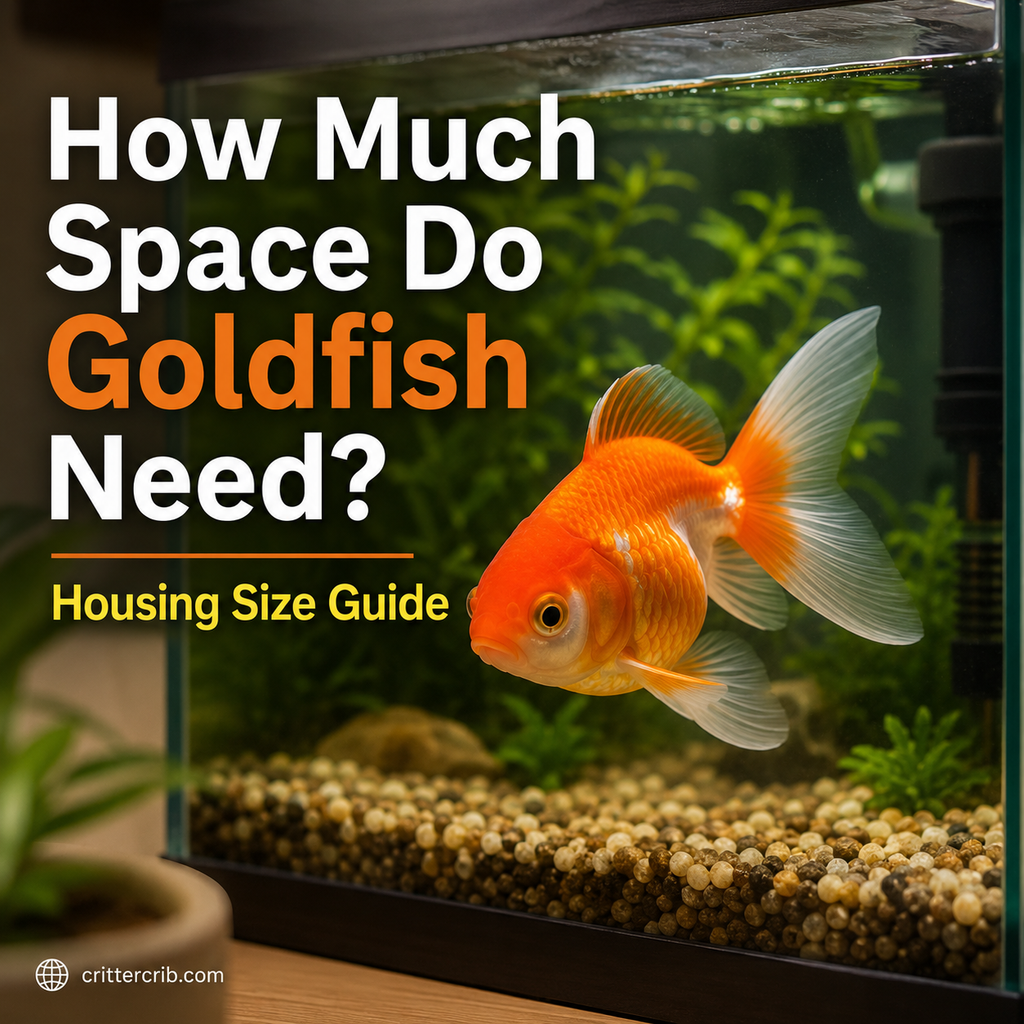
Goldfish have a reputation for being easy pets that can live in small bowls. Walk through almost any pet store, and you’ll probably still see tiny containers marketed with goldfish in mind.
The reality is very different.
Goldfish can grow surprisingly large, produce a lot of waste, and live for many years when properly cared for. Giving them enough room isn’t simply about providing space to swim. Aquarium size affects water quality, oxygen availability, filtration, maintenance, and ultimately how practical it is to keep your fish healthy.
So, how much space does a goldfish actually need?
There isn’t one perfect tank size for every goldfish. The answer depends heavily on whether you’re keeping fancy goldfish or larger, faster-swimming varieties such as common and comet goldfish.
This guide explains how much space goldfish need, why aquarium size matters, and how to choose housing that works for your fish over the long term.
How Much Space Does a Goldfish Need?
As a practical starting point, plan on a spacious aquarium rather than a small bowl or desktop tank.
For fancy goldfish, many keepers start with an aquarium in roughly the 20- to 30-gallon range for one fish, with additional capacity needed for each additional goldfish.
Common, comet, and shubunkin goldfish generally need substantially more space. Because they can become large and are strong, active swimmers, they are often better suited to very large aquariums or appropriately designed outdoor ponds as adults.
These numbers should be treated as starting points rather than rigid formulas.
Tank dimensions, filtration, number and type of fish, maintenance routine, and the adult size of your goldfish all matter.
Most importantly, choose housing based on the fish’s long-term needs rather than the size of the juvenile goldfish you bring home.
Why Do Goldfish Need So Much Space?
A young goldfish at a pet store may only be a couple of inches long. That makes a small aquarium look enormous by comparison.
But that fish isn’t going to stay that size.
Goldfish need room for several reasons.
Goldfish Can Grow Much Larger Than People Expect
One of the biggest misconceptions about goldfish is that they naturally remain tiny.
They don’t.
Adult size varies by variety and individual fish, but common-bodied goldfish can potentially grow well beyond the little fish you see in pet store tanks. Fancy goldfish are generally shorter and rounder but can still become substantial aquarium fish.
Buying an aquarium based on the fish’s current size can leave you needing an upgrade much sooner than expected.
Planning for adult size from the beginning is usually easier for both you and your fish.
Goldfish Produce a Lot of Waste
Goldfish eat frequently and produce plenty of waste.
In an aquarium, that waste eventually contributes to ammonia production. A properly cycled biological filter processes ammonia and nitrite, but the aquarium still requires adequate filtration and routine maintenance.
A larger volume of water doesn’t eliminate the need for water changes, but it generally gives you more dilution and makes sudden changes in water chemistry less dramatic.
In a tiny container, conditions can deteriorate much faster.
Goldfish Need Swimming Room
Goldfish don’t spend their lives sitting in one place.
Healthy fish explore their surroundings, search for food, interact with one another, and swim throughout the aquarium.
Long-bodied goldfish such as comets are particularly active swimmers.
A tank should therefore provide usable horizontal swimming space rather than simply meeting an arbitrary volume requirement.
Fancy Goldfish vs. Common Goldfish Space Requirements
Not all goldfish have the same body shape or swimming ability.
Understanding the difference between fancy and single-tailed varieties is important when choosing housing.
How Much Space Do Fancy Goldfish Need?
Fancy goldfish include varieties such as:
- Fantails
- Orandas
- Ranchus
- Ryukins
- Black moors
- Pearlscales
- Telescope-eye goldfish
These fish generally have shorter, deeper bodies and double tails.
Many aren’t as fast or efficient at swimming as common-bodied goldfish.
For one fancy goldfish, an aquarium around 20 to 30 gallons or larger is a much more realistic starting point than a bowl or tiny starter tank.
If you’re keeping multiple fancy goldfish, increase the aquarium size accordingly.
Rather than focusing exclusively on gallons per fish, consider whether the aquarium provides:
- Adequate swimming room
- Strong biological filtration
- Stable water parameters
- Enough surface area for gas exchange
- Space for each fish to move comfortably
- A manageable maintenance schedule
Bigger is often easier to maintain than trying to keep several goldfish in the smallest possible aquarium.
How Much Space Do Common Goldfish Need?
Common goldfish have a more streamlined body and a single tail.
Comets and shubunkins have similar body shapes and housing requirements.
These fish can become significantly larger than many people realize and are powerful swimmers.
Examples include:
- Common goldfish
- Comet goldfish
- Shubunkins
A small indoor aquarium isn’t an ideal permanent home for these varieties.
A very large aquarium can work when appropriately sized and maintained, but adult common-bodied goldfish are often excellent candidates for outdoor ponds.
Ponds provide much more horizontal swimming space and can accommodate their adult size more naturally.
If you want an indoor goldfish aquarium but have limited space, fancy goldfish are generally more practical than comets or common goldfish.
Do Goldfish Grow to the Size of Their Tank?
You’ve probably heard that a goldfish only grows as large as its aquarium allows.
This is a misleading way to think about goldfish growth.
A goldfish kept in poor or cramped conditions may not reach the same size as a fish raised under excellent conditions, but restricting its environment isn’t a healthy method of controlling its size.
Growth is influenced by multiple factors, including:
- Genetics
- Nutrition
- Water quality
- Temperature
- Health
- Age
- Environmental conditions
The goal should be to provide appropriate housing that allows normal development, not to use a small container as a way of keeping a fish small.
Can Goldfish Live in a Bowl?
A traditional goldfish bowl is not appropriate long-term housing for a goldfish.
Bowls create several problems.
They typically have:
- Very little water volume
- Limited swimming space
- Little room for adequate filtration
- Rapid waste accumulation
- Greater temperature instability
- Limited surface area depending on their shape
Even if the water looks clear, harmful compounds can accumulate.
Goldfish bowls became culturally associated with goldfish, but that doesn’t make them suitable habitats.
A properly sized, filtered aquarium or pond is a much better choice.
Is a 5-Gallon Tank Big Enough for a Goldfish?
No, a 5-gallon aquarium isn’t suitable as a permanent home for a goldfish.
It may look spacious when a goldfish is extremely young, but the fish can quickly outgrow it.
Small aquariums also give you less margin for maintaining stable water quality.
A 5-gallon tank can be excellent for certain small aquatic animals, but goldfish aren’t small-bodied nano fish.
Is a 10-Gallon Tank Big Enough for a Goldfish?
A 10-gallon aquarium is still too small for the long-term care of an adult goldfish.
This is another common situation because 10-gallon tanks are inexpensive, widely available, and frequently sold as beginner aquariums.
The problem isn’t that a goldfish physically cannot fit inside one.
The problem is providing appropriate long-term swimming room and maintaining suitable conditions as the fish grows.
If you already have a goldfish in a 10-gallon tank, you don’t need to panic. Concentrate on maintaining good water quality while planning an appropriate upgrade.
Is a 20-Gallon Tank Big Enough for a Goldfish?
A 20-gallon aquarium is much closer to an appropriate starting point for a single fancy goldfish than a 5- or 10-gallon setup.
However, dimensions matter.
A standard 20-gallon long aquarium offers more horizontal swimming space than some taller tanks of similar volume.
For larger fancy varieties or multiple fish, moving beyond 20 gallons gives you additional room to work with.
For common, comet, or shubunkin goldfish, a 20-gallon tank shouldn’t be considered an ideal permanent adult home.
Is a 30-Gallon Tank Good for Goldfish?
A 30-gallon aquarium can make a comfortable starting setup for a fancy goldfish and provides considerably more flexibility than a small starter aquarium.
Depending on the tank dimensions, filtration, fish size, and maintenance routine, it may also provide options for keeping more than one fancy goldfish.
Don’t use volume alone to decide stocking, though.
Two aquariums containing the same number of gallons can have very different shapes.
For goldfish, a longer tank generally provides more useful swimming space than a narrow, tall aquarium.
What About a 40-Gallon Tank?
A 40-gallon aquarium can be an excellent option for fancy goldfish.
A 40-gallon breeder-style aquarium is particularly popular because of its broad footprint.
That additional horizontal area gives fish room to swim while also providing space for:
- Plants
- Smooth decorations
- Feeding areas
- Filtration equipment
- Open swimming zones
The larger water volume also provides more flexibility when keeping multiple fancy goldfish.
You still need proper filtration and regular water changes. A larger aquarium isn’t maintenance-free.
How Much Space Do Two Goldfish Need?
This depends heavily on what type of goldfish you’re keeping.
Two fancy goldfish require significantly more room than one, but you don’t necessarily need to double the tank size exactly.
A larger aquarium provides shared water volume and swimming space.
For two fancy goldfish, many keepers look toward aquariums in approximately the 30- to 40-gallon range or larger, with 40 gallons providing more flexibility.
For two common or comet goldfish, think much bigger.
These active fish can eventually require very large tanks or pond-style housing.
When deciding whether to add another goldfish, ask:
- What variety am I keeping?
- How large will each fish become?
- Does the tank have enough horizontal swimming room?
- Can the filtration handle the increased biological load?
- Can I keep nitrate under control with a realistic maintenance schedule?
Adding a second fish means adding more than another body. You’re also adding more food consumption and waste production.
How Much Space Do Three or More Goldfish Need?
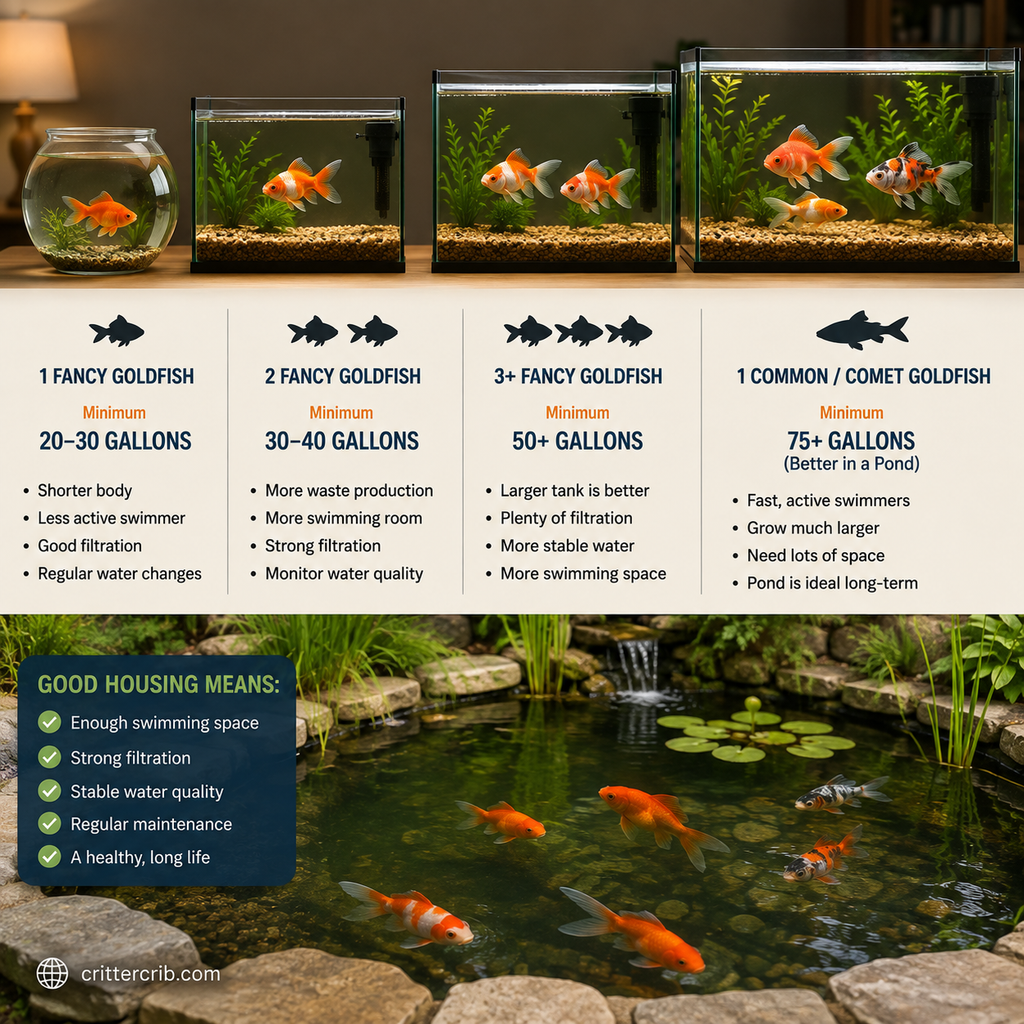
Once you begin keeping a group, larger aquariums become increasingly important.
Trying to calculate the absolute minimum number of gallons for each additional fish can become misleading.
Instead, consider the aquarium as an entire system.
A suitable setup needs enough capacity to support:
- The combined adult size of the fish
- Their swimming behavior
- Their waste production
- Adequate filtration
- Oxygen exchange
- Regular feeding
- Practical water changes
If you want a group of goldfish, buying a larger aquarium from the beginning can save you from repeatedly replacing smaller tanks.
For common-bodied varieties, a properly designed pond may eventually become much more practical than an indoor aquarium.
Tank Shape Matters as Much as Gallons
Imagine two aquariums that both hold 40 gallons.
One is long and relatively shallow. The other is narrow and very tall.
For goldfish, the longer aquarium usually provides more useful swimming space.
Goldfish primarily benefit from horizontal room.
A wider surface also helps with gas exchange, although filtration and water movement remain important.
When comparing tanks, look at:
- Length
- Width
- Surface area
- Overall footprint
- Usable swimming space
Don’t choose an aquarium solely because it holds a certain number of gallons.
How Much Swimming Space Should Goldfish Have?
There isn’t a universal measurement that says a goldfish must have exactly a certain number of inches of swimming space.
The important thing is that the fish can move freely and naturally.
Your goldfish should be able to:
- Swim across the aquarium without immediately turning around
- Forage along the substrate
- Move around decorations easily
- Interact with other fish without constant crowding
- Reach feeding areas without competition becoming excessive
As your goldfish grows, look at the aquarium from the fish’s perspective.
A tank that seemed enormous when the fish was two inches long can look very different once that fish becomes several times larger.
Goldfish Tank Size and Water Quality
Aquarium size and water quality are closely connected.
Fish waste and uneaten food eventually contribute to nitrogenous waste within the aquarium.
In a properly cycled tank, beneficial bacteria convert toxic ammonia into nitrite and then nitrate.
Regular partial water changes help keep nitrate and other accumulated substances under control.
A larger aquarium gives these compounds a greater volume of water in which to disperse.
That doesn’t mean you can skip maintenance.
Even a large goldfish aquarium can develop poor water quality if it’s overcrowded or neglected.
Regularly test for:
- Ammonia
- Nitrite
- Nitrate
- pH
Ammonia and nitrite should remain at safe, effectively zero levels in an established aquarium.
Your maintenance routine should be based on actual water conditions rather than waiting until the aquarium looks dirty.
Goldfish Need Good Filtration Too
Tank size alone isn’t enough.
Goldfish require effective filtration because of the amount of waste they produce.
A good filter performs several jobs.
It provides:
- Mechanical filtration to capture debris
- Biological filtration to support beneficial bacteria
- Water circulation
- Surface movement that supports gas exchange
Some filters also provide chemical filtration, although this isn’t always necessary for everyday aquarium maintenance.
When choosing filtration, don’t simply buy the smallest filter rated for your tank size.
Goldfish aquariums often benefit from generous filtration capacity.
At the same time, make sure the water flow isn’t so extreme that fancy goldfish struggle to swim comfortably.
Does a Bigger Goldfish Tank Mean Less Maintenance?
Not necessarily less maintenance, but it can make conditions easier to keep stable.
A larger aquarium still needs:
- Water changes
- Filter maintenance
- Substrate cleaning
- Water testing
- Algae management
- Equipment checks
The advantage is that changes generally occur less dramatically in a larger volume of water.
Overfeeding one meal in a tiny tank can have a greater impact than the same mistake in a much larger, properly filtered aquarium.
However, larger tanks also mean larger water changes.
A 50% water change on a 75-gallon aquarium is obviously more water than the same percentage on a 20-gallon tank.
Using an aquarium water-change hose or similar system can make maintaining larger goldfish tanks much easier.
Should Goldfish Live Alone or With Other Goldfish?
Goldfish can be social and often do well with other compatible goldfish when adequate space is available.
However, you shouldn’t add another fish simply because you’re worried that a single goldfish is lonely if your aquarium cannot support another adult fish.
Proper housing comes first.
Compatibility matters too.
Fancy goldfish are often best housed with other fancy goldfish because their slower swimming speeds can make competing with fast common-bodied varieties difficult.
Common, comet, and shubunkin goldfish are generally better matched with similarly active goldfish.
When Should You Upgrade a Goldfish Tank?
Ideally, choose an aquarium large enough to accommodate your planned fish before you bring them home.
If you already own a smaller setup, watch for signs that an upgrade is becoming necessary.
These can include:
- The fish has little room to swim
- Nitrate rises very quickly between water changes
- The aquarium requires unusually frequent maintenance
- Fish appear crowded
- The goldfish is rapidly outgrowing the tank
- You want to add additional goldfish
- Filtration is struggling to keep up with waste
Don’t wait until the fish can barely turn around.
Upgrading early gives you time to establish and cycle the new aquarium properly.
Aquarium or Pond: Which Is Better for Goldfish?
Both can work, depending on the type of goldfish and your situation.
Aquariums
Aquariums are particularly practical for fancy goldfish.
They make it easy to observe the fish closely and control:
- Water conditions
- Feeding
- Filtration
- Tank mates
- Temperature
- Health monitoring
A large indoor aquarium can make a beautiful goldfish habitat.
Ponds
Ponds can be excellent homes for common, comet, and shubunkin goldfish because they provide considerably more swimming room.
However, a pond needs to be designed for fish.
Consider:
- Pond volume and depth
- Local climate
- Predators
- Filtration
- Water circulation
- Seasonal temperature changes
- Shade
- Safe overwintering
Simply placing a goldfish into a small decorative garden pond isn’t automatically better than keeping it in an aquarium.
The entire habitat needs to meet the fish’s needs.
Common Goldfish Housing Mistakes
Many goldfish housing problems begin with outdated information rather than bad intentions.
Some of the most common mistakes include:
- Keeping goldfish permanently in bowls
- Buying an aquarium based only on the fish’s current size
- Assuming goldfish stay small
- Keeping common goldfish in tiny indoor tanks
- Adding too many fish too quickly
- Using inadequate filtration
- Choosing tall tanks with little horizontal swimming room
- Assuming a large aquarium doesn’t require water changes
- Overstocking because water still looks clear
Planning for adult fish makes most of these problems easier to avoid.
How to Choose the Right Goldfish Tank
Before buying an aquarium, work through these steps.
1. Identify Your Goldfish Variety
First determine whether you want fancy or common-bodied goldfish.
This dramatically changes the amount of space you’ll eventually need.
2. Decide How Many Goldfish You Want
Plan your aquarium around your intended adult stocking level, not just your first fish.
If you eventually want three fancy goldfish, purchasing a tank intended only for one means an upgrade is already built into your plan.
3. Choose a Long, Wide Aquarium
Prioritize usable swimming space.
For goldfish, footprint is generally more useful than excessive height.
4. Plan for Adult Size
Ignore how tiny the fish looks at the pet store.
Ask yourself whether the aquarium will still make sense once that fish is several times larger.
5. Add Adequate Filtration
Choose filtration capable of handling a goldfish aquarium’s relatively high waste production.
Provide plenty of biological filtration while maintaining comfortable water movement.
6. Leave Room for Maintenance
Think about where the aquarium will be placed and how you’ll perform water changes.
Large aquariums become much easier to own when routine maintenance is convenient.
Frequently Asked Questions About Goldfish Tank Size
What Is the Minimum Tank Size for One Goldfish?
For a single fancy goldfish, approximately 20 to 30 gallons is a commonly used starting range, with larger tanks providing more flexibility.
Common, comet, and shubunkin goldfish need considerably more room as they mature and may be better suited to very large aquariums or ponds.
Avoid treating any gallon figure as an automatic guarantee that a setup is appropriate. Tank dimensions, filtration, fish size, and water quality all matter.
Can One Goldfish Live in a 10-Gallon Tank?
A 10-gallon aquarium isn’t appropriate permanent housing for an adult goldfish.
A juvenile may physically fit, but goldfish grow and produce enough waste that a larger setup should be planned.
How Big of a Tank Do I Need for Two Fancy Goldfish?
A tank in roughly the 30- to 40-gallon range or larger is a more practical starting point for two fancy goldfish, with 40 gallons offering useful additional room.
Choose a tank with a generous horizontal footprint and adequate filtration.
How Big of a Tank Do I Need for a Comet Goldfish?
Comet goldfish are active, streamlined fish that can grow large.
They need substantially more room than fancy goldfish and are often better suited to very large aquariums or properly designed outdoor ponds as adults.
Can Goldfish Live in a 1-Gallon Bowl?
No. A 1-gallon bowl doesn’t provide appropriate long-term housing for a goldfish.
It lacks sufficient swimming space and makes maintaining stable water quality extremely difficult.
Are Tall Tanks Good for Goldfish?
A tall aquarium isn’t necessarily harmful, but when choosing between similarly sized tanks, a longer and wider footprint usually provides more useful space for goldfish.
Prioritize horizontal swimming room and surface area.
Is a Bigger Tank Always Better for Goldfish?
Within reason, additional space generally gives you more flexibility.
A bigger aquarium provides more swimming room and water volume, but it still needs appropriate filtration, maintenance, and stocking.
Simply owning a large tank doesn’t compensate for overcrowding or poor water quality.
Final Thoughts
Goldfish need far more space than the traditional fish bowl suggests.
For fancy goldfish, think in terms of spacious aquariums starting around the 20- to 30-gallon range for a single fish, with larger tanks needed as you add more goldfish.
For common, comet, and shubunkin goldfish, think much bigger. Their adult size and active swimming style make very large aquariums or appropriately designed ponds better long-term options.
Most importantly, don’t choose a home based on the tiny goldfish you see at the pet store.
Plan for the adult fish.
A roomy aquarium with adequate filtration, good water quality, open swimming space, and a sensible maintenance routine gives your goldfish a much better environment while making fishkeeping more manageable for you as well.