Betta fish may be small, but they have surprisingly expressive personalities. Spend enough time watching one and you’ll probably notice your betta flaring at its reflection, swimming excitedly when you approach, resting on a leaf, building bubbles at the surface, or suddenly darting across the aquarium.
Some of these behaviors are completely normal. Others can be signs that something in the tank isn’t quite right.
Learning how to read your betta’s behavior can help you understand when your fish is comfortable, stressed, hungry, territorial, resting, or potentially sick. It can also make keeping a betta more interesting because you begin to recognize individual habits and personality traits.
This guide explains common betta fish behaviors, what they usually mean, and when a change in behavior deserves closer attention.
Understanding Normal Betta Fish Behavior
Betta fish, also known as Siamese fighting fish, are naturally territorial fish. Males in particular are famous for reacting aggressively toward other male bettas, but territorial behavior is only one part of their personality.
A healthy betta may spend its day:
- Exploring different areas of the aquarium
- Investigating plants and decorations
- Swimming toward you at feeding time
- Resting near the surface
- Flaring occasionally
- Searching for food
- Building bubble nests
- Watching activity outside the aquarium
Not every betta behaves exactly the same way. Some are energetic and curious, while others are relatively calm.
That’s why your fish’s normal routine matters. A behavior that seems unusual for one betta may be completely typical for another.
Sudden changes are often more useful warning signs than any single behavior by itself.
Why Does My Betta Fish Flare?
Flaring is one of the most recognizable betta behaviors.
When a betta flares, it spreads its fins and extends its gill covers, making itself appear larger and more intimidating.
This is primarily a territorial display.
Your betta might flare at:
- Its reflection in the aquarium glass
- Another betta
- Other fish
- A brightly colored object
- Movement outside the aquarium
- Occasionally, its owner
Brief periods of flaring are generally normal. Bettas naturally use this behavior to defend their territory.
Constant flaring, however, can become stressful. If your betta spends large portions of the day fighting its reflection, changing the tank lighting, background, or surrounding light may help reduce reflections.
Does Flaring Mean My Betta Is Angry?
Not necessarily in the human sense.
Flaring is better understood as a territorial or defensive response. Your betta has noticed something it perceives as another fish or possible threat and is trying to look intimidating.
An occasional flare isn’t usually something to worry about.
Why Does My Betta Swim Up to Me?
If your betta quickly swims toward the front of the aquarium whenever you enter the room, there’s a good chance it has learned to associate you with food.
Bettas can become very responsive to routines.
Your fish may recognize that certain movements usually happen before feeding, such as:
- You approaching the aquarium
- The tank lid opening
- A food container appearing
- Movement near a particular side of the tank
Over time, your betta may begin waiting near its usual feeding area before you’ve even opened the food.
This doesn’t necessarily mean your fish is starving. Bettas can be enthusiastic eaters even when they’re receiving enough food.
Avoid giving extra food simply because your betta appears to be begging.
Why Is My Betta Swimming Back and Forth Along the Glass?
Repeatedly swimming along the aquarium walls is sometimes called glass surfing.
Occasional swimming near the glass is normal, especially when a betta is exploring a new environment. Persistent pacing can indicate that something is bothering the fish.
Possible causes include:
- Seeing its reflection
- Stress after being introduced to a new tank
- Poor water conditions
- An aquarium that’s too small or lacks enrichment
- Excessively bright lighting
- Incompatible tank mates
- Activity outside the aquarium
A newly introduced betta may need some time to settle into its surroundings.
If glass surfing continues, check the aquarium conditions rather than assuming your fish is simply energetic.
Why Does My Betta Dart Around the Tank?
A betta occasionally making a quick burst across the aquarium isn’t automatically a problem.
Fish sometimes dart while exploring, chasing food, or reacting to sudden movement.
Repeated frantic darting is different.
If your betta suddenly races around the aquarium, crashes into decorations, or repeatedly makes erratic movements, investigate possible sources of irritation or stress.
Check:
- Water temperature
- Ammonia and nitrite levels
- Nitrate levels
- Recent water changes
- New decorations or chemicals
- Filter flow
- Signs of external irritation
Rapid behavioral changes following aquarium maintenance can be especially important clues.
Why Does My Betta Wiggle When It Sees Me?
Some bettas perform what owners describe as a little “wiggle” or excited swimming motion when someone approaches.
In many cases, this is simply anticipation.
Your betta may have learned that seeing you means food is coming.
The fish might:
- Swim rapidly toward the front
- Wiggle its body
- Follow your movement
- Swim toward its feeding area
- Wait near the surface
As long as the fish otherwise appears healthy and isn’t swimming uncontrollably, this behavior is usually nothing to worry about.
Why Is My Betta Following My Finger?
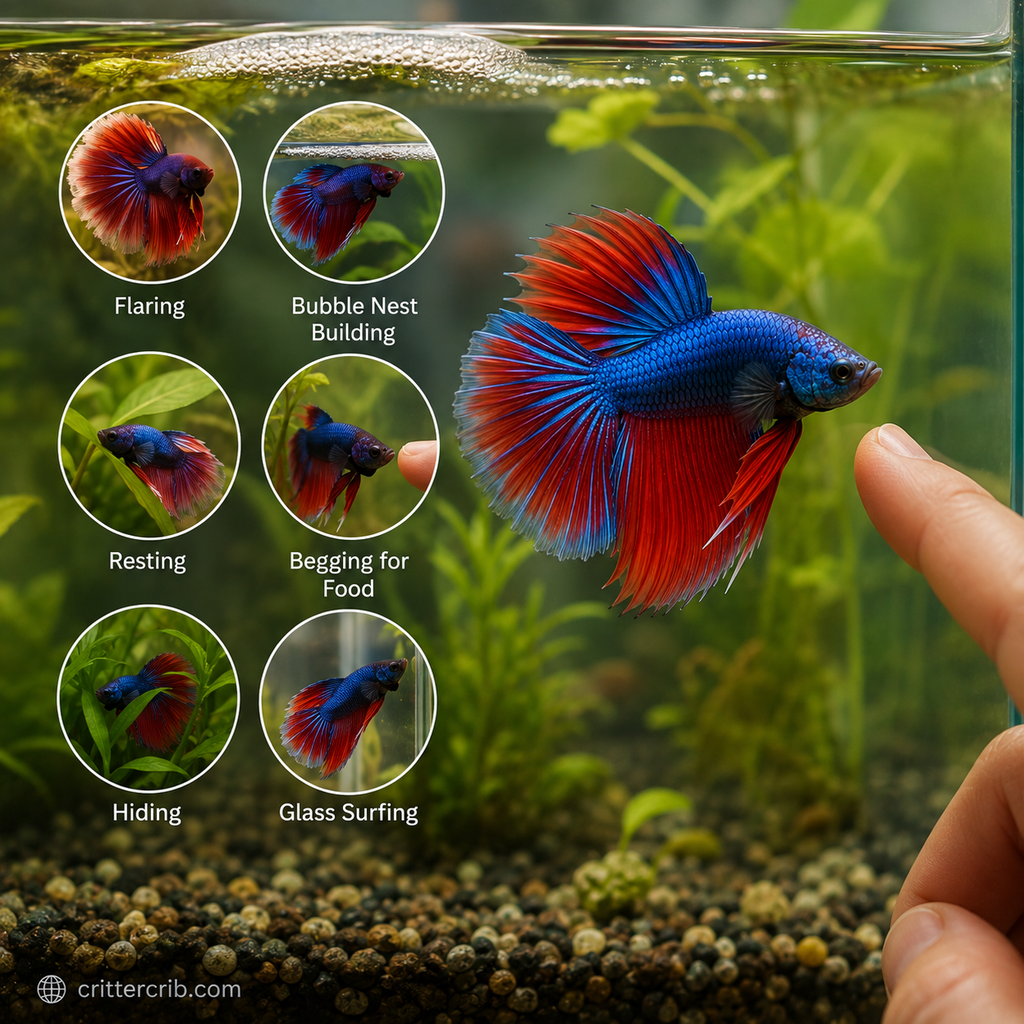
Bettas are naturally curious and visually oriented.
Some will follow a finger moving slowly along the outside of the aquarium. Others investigate feeding tools or objects placed near the glass.
This can provide simple enrichment.
Move your finger slowly and allow your betta to choose whether it wants to follow. Avoid repeatedly tapping on the aquarium glass, since sudden vibrations can startle fish.
Why Is My Betta Making a Bubble Nest?
One of the most interesting behaviors you’ll see from a male betta is bubble nest building.
A bubble nest looks like a patch or cluster of tiny bubbles floating at the water’s surface. Male bettas create these nests as part of their reproductive behavior.
The male produces bubbles coated with saliva, which helps them remain together at the surface.
You may find a bubble nest:
- In a corner of the aquarium
- Beneath floating plants
- Around floating leaves
- Along the edge of the tank
- Near other calm areas of the surface
Does a Bubble Nest Mean My Betta Is Happy?
A bubble nest can be a normal sign that a male betta is displaying natural reproductive behavior, but it shouldn’t be treated as a perfect measurement of happiness or health.
Some healthy bettas build large nests frequently. Others rarely build them.
A betta that doesn’t make bubble nests isn’t automatically unhappy.
Why Does My Betta Rest on Leaves?
Resting on broad plant leaves is very common betta behavior.
Bettas aren’t constantly active swimmers. They regularly stop and rest, especially when they have comfortable places near the surface.
Plants with broad leaves can act almost like underwater hammocks.
A resting betta may:
- Lie across a leaf
- Hover between plant stems
- Rest near the aquarium wall
- Sit on decorations
- Remain close to the surface
This can look alarming the first time you see it, particularly if your fish is barely moving.
If the betta becomes alert when you approach or resumes normal swimming later, it may simply have been resting.
Live plants and smooth artificial plants can provide useful resting areas throughout the aquarium.
Why Is My Betta Lying on the Bottom of the Tank?
A betta occasionally resting on the bottom isn’t necessarily sick.
Some bettas simply choose unusual sleeping spots.
However, spending much of the day on the substrate deserves closer attention, especially if it’s a new behavior.
Possible explanations include:
- Sleeping or resting
- Water that’s too cold
- Poor water quality
- Stress
- Exhaustion from strong filter flow
- Illness
- Age-related reduction in activity
Look at the entire picture.
A betta that rests on the bottom occasionally but eagerly swims up for food is very different from one that remains there all day, refuses food, and struggles to swim.
Do Betta Fish Sleep?
Yes. Betta fish sleep and rest regularly.
Because fish don’t have eyelids, a sleeping betta can look awake even when it isn’t actively responding to its surroundings.
Bettas may sleep:
- On plant leaves
- Near the bottom
- Inside aquarium caves
- Behind decorations
- Near the surface
- In sheltered corners
They often become much less active after the aquarium lights are turned off.
Providing a consistent day-and-night lighting schedule helps establish a predictable routine. Bettas shouldn’t be kept under bright aquarium lights around the clock.
Why Is My Betta Hiding?
Every betta needs access to places where it can retreat.
Occasional hiding is normal, particularly when sleeping or resting. Bettas may enjoy caves, plants, driftwood, and other sheltered areas.
A fish that suddenly begins hiding constantly may be experiencing stress.
Possible causes include:
- New surroundings
- Aggressive tank mates
- Excessive aquarium activity
- Bright lighting
- Poor water conditions
- Illness
- Lack of adequate cover
Consider what changed shortly before the hiding began.
If you’ve recently moved the fish or rearranged the aquarium, temporary hiding may simply be part of adjusting.
Why Does My Betta Spit Out Its Food?
Watching a betta grab a pellet and immediately spit it out can be confusing.
Sometimes the food is simply too large or difficult to eat.
The fish may grab it, spit it out, reposition it, and try again.
Other possibilities include:
- The pellet is too large
- The food is unusually hard
- Your betta doesn’t like that particular food
- The fish is already full
- Appetite has decreased because of stress or illness
Occasionally spitting out food isn’t necessarily concerning.
Repeatedly refusing food, especially when accompanied by lethargy or other physical changes, deserves more attention.
Why Is My Betta Always Acting Hungry?
Many bettas seem convinced that they haven’t eaten in weeks, even shortly after feeding.
This behavior doesn’t mean you should continue feeding them.
In nature, fish can’t depend on meals arriving at exactly the same time each day. When food becomes available, taking advantage of the opportunity can be beneficial.
In an aquarium, however, the owner controls how much food is available.
Overfeeding can contribute to digestive problems and deteriorating water quality.
Follow an appropriate feeding routine rather than judging portions based entirely on your betta’s enthusiasm.
Why Does My Betta Stare at Me?
Sometimes bettas appear to stop and watch people through the aquarium glass.
They aren’t necessarily contemplating life’s mysteries, but they can notice movement outside the tank and respond to familiar routines.
If you’ve become associated with feeding, your betta has even more reason to keep an eye on you.
This curiosity is one reason many people find bettas more interactive than they expected.
Why Does My Betta Attack Its Reflection?
To your betta, its reflection may look like another fish invading its territory.
The fish doesn’t understand that it’s looking at itself.
It may:
- Flare
- Charge the glass
- Spread its fins
- Follow the reflection
- Repeatedly patrol one section of the tank
Reflections often become more noticeable when the aquarium interior is brightly lit while the room outside is relatively dark.
If your betta obsessively fights the glass, try adjusting the lighting or aquarium background.
Why Are My Betta’s Fins Clamped?
A comfortable betta generally carries its fins naturally rather than holding them tightly against its body.
When the fins remain unusually close to the body, they’re often described as clamped.
Clamped fins can be associated with stress or illness.
Possible causes include:
- Poor water quality
- Incorrect water temperature
- Sudden environmental changes
- Illness
- Stress from tank mates
- General discomfort
Clamped fins aren’t a diagnosis by themselves. They’re a sign that you should examine the fish and its environment more carefully.
Why Is My Betta Breathing at the Surface?
Bettas have a specialized labyrinth organ that allows them to breathe atmospheric oxygen.
Because of this, periodically swimming to the surface and taking a gulp of air is normal.
This adaptation helps bettas survive in warm, shallow environments where dissolved oxygen can fluctuate.
However, there’s a difference between occasionally breathing from the surface and appearing distressed.
A betta that stays at the surface constantly while breathing rapidly may be experiencing a problem.
Check water quality and temperature and watch for other symptoms.
Why Does My Betta Stay Near the Filter?
There are several possible reasons.
Some bettas discover that parts of a filter provide convenient resting spots. Others may be attracted to water movement or areas where food tends to collect.
But filter flow can also be too strong for bettas.
Bettas have relatively elaborate fins, particularly long-finned varieties, and constantly fighting a strong current can be exhausting.
Signs that the current may be excessive include:
- Being pushed around the aquarium
- Avoiding large sections of the tank
- Difficulty reaching the surface
- Constantly hiding behind objects
- Struggling to remain in one position
A gentle flow is generally more suitable for bettas than a powerful current.
Why Is My Betta Chasing Other Fish?
Bettas are territorial, and individual temperament varies considerably.
Some tolerate carefully selected tank mates. Others don’t.
Chasing can be a warning that your betta isn’t comfortable sharing its space.
Watch for:
- Persistent chasing
- Flaring
- Biting
- Torn fins
- One fish constantly hiding
- Preventing another fish from eating
Don’t assume the fish will eventually “work it out” if aggression is ongoing.
Chronic aggression can cause stress and physical injuries.
Why Does My Betta Flare at Other Fish but Not Attack?
Flaring can function as a warning display.
Your betta is essentially communicating that another fish has entered its territory.
Occasional displays may occur without escalating into physical aggression.
However, repeated flaring and chasing can still create chronic stress even when you don’t see obvious injuries.
Observe the behavior over time rather than judging compatibility based on a single interaction.
Why Is My Betta Suddenly Less Active?
Bettas have periods of activity and rest, so a quiet afternoon isn’t necessarily concerning.
A sudden and persistent decrease in activity is more significant.
Consider whether anything recently changed.
Ask yourself:
- Is the water temperature appropriate and stable?
- Have ammonia, nitrite, and nitrate been checked?
- Was there a recent water change?
- Has the fish stopped eating?
- Are the fins clamped?
- Is breathing faster than usual?
- Are there visible spots, swelling, discoloration, wounds, or fin damage?
- Has new livestock or aquarium equipment recently been added?
Behavior is often one of the earliest ways fish owners notice something is wrong.
How Can You Tell If a Betta Is Stressed?
Stress doesn’t always produce one specific behavior.
Instead, you may notice several changes happening together.
Possible signs of stress include:
- Persistent hiding
- Frantic glass surfing
- Clamped fins
- Reduced appetite
- Unusual lethargy
- Frequent frantic darting
- Changes in coloration
- Excessive aggression
- Abnormal breathing
- Spending unusual amounts of time at the surface or bottom
These behaviors can have multiple causes, including illness, so avoid diagnosing a problem from behavior alone.
Start by checking the aquarium environment.
What Does Healthy Betta Behavior Look Like?
Although individual personalities vary, a healthy and comfortable betta will generally show a mixture of activity and rest.
You may see your fish:
- Exploring the aquarium
- Reacting when you approach
- Eating normally
- Swimming without obvious difficulty
- Resting periodically
- Investigating plants and decorations
- Coming to the surface for air
- Displaying natural territorial behavior occasionally
You don’t need your betta to swim constantly.
Resting is normal.
The goal is consistency. When you know what your fish normally does, unusual behavior becomes much easier to recognize.
How to Encourage Natural Betta Behavior
A suitable aquarium environment gives your betta opportunities to explore, rest, hide, and behave naturally.
Provide Plenty of Cover
Plants and aquarium-safe decorations create sheltered spaces.
Consider providing a mixture of:
- Live or soft artificial plants
- Broad leaves for resting
- Smooth caves
- Floating vegetation
- Open swimming areas
Avoid sharp decorations that could damage delicate fins.
Keep the Water Warm and Stable
Bettas are tropical fish.
A stable, appropriately heated aquarium allows them to remain active without constantly adjusting to temperature fluctuations.
Use an aquarium thermometer rather than guessing the water temperature based on room temperature.
Maintain Good Water Quality
Behavioral changes can sometimes be connected to deteriorating water conditions.
Regular aquarium maintenance should include:
- Testing water parameters
- Performing appropriate partial water changes
- Removing uneaten food and waste
- Maintaining the filter
- Avoiding sudden changes in water chemistry
Never assume clear-looking water is automatically healthy water.
Use Gentle Filtration
Filtration is important, but bettas generally don’t need powerful currents.
Watch your fish rather than judging the filter solely by its advertised flow rate.
If the betta is repeatedly blown across the aquarium or avoids the current, the flow may need to be reduced or diffused.
Give Your Betta a Day-and-Night Cycle
Keep the aquarium light on during the day and provide darkness at night.
A regular schedule helps your fish establish normal periods of activity and rest.
Provide Enrichment
A well-arranged aquarium naturally provides enrichment.
Plants, hiding places, floating objects, and occasional interaction outside the glass can encourage exploration.
You can also occasionally rearrange small elements of the aquarium, provided you don’t disrupt the fish unnecessarily or compromise established biological filtration.
Normal Betta Behavior vs. Warning Signs
Some behaviors look strange but are completely normal.
Usually normal behaviors include:
- Resting on leaves
- Sleeping near the bottom
- Occasionally flaring
- Building bubble nests
- Following you
- Begging for food
- Taking air from the surface
- Brief bursts of fast swimming
Behaviors worth investigating include:
- Persistent frantic swimming
- Constant glass surfing
- Refusing food for an extended period
- Remaining motionless most of the day
- Struggling to swim
- Constantly gasping or breathing rapidly
- Persistent clamped fins
- Sudden extreme aggression
- Constant hiding
- Major changes from the fish’s normal routine
The key word is often “persistent.”
A single unusual moment rarely tells you everything. A behavior that continues or appears alongside other symptoms provides much more useful information.
Frequently Asked Questions About Betta Fish Behavior
Do Betta Fish Recognize Their Owners?
Bettas can learn routines and associate people or movement outside their aquarium with feeding and other regular activities.
This can make it seem as though your betta recognizes you specifically.
Many bettas become noticeably responsive when their keeper approaches the aquarium.
Why Does My Betta Get Excited When I Walk Into the Room?
Food is one of the most likely explanations.
Your betta may have learned that your appearance predicts feeding time.
Curiosity can also play a role, especially in fish that regularly interact with activity outside their aquarium.
Is It Normal for a Betta to Rest a Lot?
Yes. Bettas regularly rest throughout the day and sleep at night.
What matters is whether the fish also has normal periods of activity.
A sudden increase in resting combined with poor appetite, abnormal breathing, or difficulty swimming is more concerning than resting alone.
Why Does My Betta Swim in Circles?
An occasional circle while exploring isn’t necessarily unusual.
Repeated or uncontrolled circling can indicate stress, environmental problems, or potentially a health issue.
Check the aquarium conditions and observe whether other symptoms are present.
Why Does My Betta Open Its Mouth at Me?
Your fish may be anticipating food, taking in water normally, or reacting to something outside the aquarium.
Repeated rapid mouth movements combined with heavy breathing are different and should prompt a closer look at water conditions and the fish’s overall health.
Do Female Bettas Flare?
Yes.
Female bettas can display territorial and aggressive behavior too, including flaring. Although males are especially well known for dramatic displays, territorial behavior isn’t exclusive to them.
Is My Betta Bored?
It’s difficult to determine boredom in a fish the same way we might in a human or other pet.
However, bettas benefit from an environment that allows them to explore, hide, rest, and interact with different features of their surroundings.
A bare aquarium offers fewer opportunities for these natural behaviors.
When a Behavior Change May Mean Something Is Wrong
Knowing your betta’s normal personality is one of the most useful tools you have as an owner.
Pay particular attention when several changes occur together.
For example, a betta that suddenly stops eating, hides continuously, keeps its fins clamped, and becomes unusually lethargic deserves more attention than a fish that simply spends an afternoon resting on a leaf.
Start with the basics:
- Check water parameters.
- Confirm the aquarium temperature.
- Look for visible physical changes.
- Consider anything recently added or changed.
- Observe breathing, swimming, and appetite.
If concerning symptoms continue, become severe, or your fish appears unable to swim or breathe normally, seek guidance from a veterinarian experienced with fish when available.
Final Thoughts
Betta fish behavior becomes much easier to understand once you’ve spent some time observing your individual fish.
Flaring, bubble nest building, resting on leaves, following you around the aquarium, begging for food, and occasionally darting through the water can all be perfectly normal behaviors.
The most important thing to learn is your betta’s baseline.
When you know where your fish normally sleeps, how eagerly it eats, how active it tends to be, and how it responds when you approach the aquarium, sudden changes become much easier to spot.
Rather than worrying about every unusual movement, look for patterns. Healthy bettas naturally alternate between exploring, eating, resting, and interacting with their surroundings.
And once you understand what those behaviors mean, watching your betta becomes one of the most interesting parts of keeping one.