

Mice are tiny, but their housing needs are bigger than their body size might suggest.
A pet mouse doesn’t just need enough room to turn around, eat, and sleep. Mice are active animals that spend their waking hours climbing, digging, nesting, foraging, chewing, exploring, and interacting with their environment. If you keep compatible mice together, the enclosure also needs enough space and resources for normal social behavior.
That’s why choosing a mouse habitat based solely on whether a cage is marketed for “mice” isn’t a great approach. Some small-animal cages simply don’t provide much usable space.
So, how much space do mice actually need?
There isn’t one perfect enclosure size for every situation. The number and sex of the mice, enclosure design, ventilation, bedding depth, enrichment, and usable floor space all matter. In general, providing more well-designed space is better than trying to meet the smallest possible minimum.
This guide explains how to choose an appropriately sized mouse habitat, what makes that space usable, and how to create an enclosure that gives pet mice plenty of opportunities to behave naturally.
Why Mouse Housing Size Matters
It’s easy to look at a mouse and assume a small cage should be enough.
After all, the animal itself may only weigh a few dozen grams.
But body size isn’t the best way to determine how much living space an animal needs.
Mice are busy.
A well-designed habitat allows them to:
- Run
- Climb
- Dig
- Burrow
- Build nests
- Hide
- Forage
- Chew
- Explore
- Rest
- Interact with compatible companions
Providing sufficient room also allows you to create different functional areas inside the enclosure.
For example, one section might contain deep bedding for burrowing while another supports a wheel. You can provide several hides, feeding locations, climbing structures, and nesting areas without everything being crowded together.
Space becomes particularly valuable once enrichment is added.
Is There a Minimum Cage Size for Mice?
You’ll find many different minimum mouse cage recommendations online.
Unfortunately, there’s no universally agreed-upon number that applies to every pet mouse and every enclosure.
Regulations and welfare recommendations can also differ between countries and organizations.
Instead of asking, “What’s the smallest cage I can use?” a better question is:
“How much usable space can I reasonably provide?”
Choose a habitat large enough to accommodate all of the essentials while still leaving room for movement and exploration.
The enclosure should comfortably fit:
- Deep bedding
- An appropriately sized wheel
- Multiple hides
- Food and water
- Nesting areas
- Tunnels
- Chewing materials
- Climbing opportunities
- Foraging activities
If adding basic enrichment makes the enclosure feel packed, that’s a strong indication that more space would be useful.
Floor Space Matters More Than It Looks
When comparing mouse enclosures, pay attention to the dimensions rather than relying only on the advertised capacity.
An enclosure can look large because it’s tall while providing relatively little floor space.
Height is useful because mice enjoy climbing, but vertical space shouldn’t completely replace horizontal living space.
Think of the enclosure as having two complementary dimensions:
Horizontal Space
The base gives mice room for:
- Running
- Foraging
- Burrowing
- Moving between resources
- Exploring
Vertical Space
Height allows you to add:
- Ropes
- Branches
- Platforms
- Hammocks
- Hanging enrichment
- Climbing structures
A good mouse habitat makes use of both.
Bigger Is Usually Better—With One Important Condition
Giving mice more room generally creates more opportunities for enrichment.
But simply purchasing the largest empty enclosure you can find isn’t enough.
Mice tend to appreciate environments with plenty of cover and structure.
A huge enclosure containing nothing but a food bowl and wheel may provide less meaningful stimulation than a thoughtfully arranged habitat with:
- Deep substrate
- Hides
- Tunnels
- Climbing areas
- Nesting material
- Foraging opportunities
Think in terms of usable space rather than empty space.
The goal isn’t to create a mouse-sized warehouse.
It’s to create an interesting environment.
How Many Mice Will Live in the Enclosure?
The number of mice matters when choosing a habitat.
More animals mean:
- More activity
- More waste
- More competition for resources
- More sleeping preferences
- More feeding activity
- More need for hiding areas
Adding mice shouldn’t mean simply squeezing another animal into an enclosure that was already full.
Provide enough space and resources for the group.
Female Mice
Female mice are social and are generally housed with compatible female companions.
That means new owners planning to keep female mice should design the habitat for a group rather than a single animal.
Male Mice
Male mouse social housing is more complicated.
Adult male mice can be territorial and may fight seriously with other males.
Don’t assume that two unfamiliar males can safely share an enclosure simply because females often live socially.
Housing decisions for males should account for the individual animals, their history, and appropriate expert or veterinary guidance.
What Makes a Good Mouse Enclosure?
Size is important, but enclosure design matters too.
Common options include:
- Wire cages
- Glass tanks
- Large plastic-based cages
- Appropriately constructed bin-style habitats
- Hybrid setups
Each has advantages and disadvantages.
Wire Cages
Wire cages can provide excellent ventilation and plenty of attachment points for climbing accessories.
However, check the bar spacing carefully.
Mice can squeeze through surprisingly small openings.
Young or particularly small mice may escape through gaps that appear secure.
Advantages
- Good airflow
- Easy to attach accessories
- Lots of climbing opportunities
- Convenient access
Potential Drawbacks
- Bedding can scatter outside
- Bar spacing may allow escapes
- Deep substrate can be difficult to contain
- Some designs have unsuitable wire flooring
Choose an enclosure with a solid base.
Glass Tanks
Tank-style habitats are popular because they hold deep bedding well.
They also make it easy to watch mice burrow.
A secure mesh top is essential for ventilation and escape prevention.
Advantages
- Excellent bedding containment
- Good visibility
- Supports deep substrate
- Fewer opportunities to chew through enclosure walls
Potential Drawbacks
- Heavier to move
- Fewer built-in attachment points
- Ventilation depends heavily on the top design
- Can require creativity for hanging enrichment
Never use a solid lid that severely restricts ventilation.
Bin-Style Mouse Habitats
Large plastic storage containers are sometimes modified into mouse habitats.
A properly constructed bin enclosure can provide substantial space for relatively little money.
However, simply drilling a few small holes into a storage tub isn’t necessarily adequate.
Good ventilation generally requires substantial securely meshed areas.
Also consider chewing.
Any exposed edges around modifications should be constructed so mice can’t enlarge an opening and escape.
Bar Spacing for Mouse Cages
Escape prevention deserves special attention.
Mice are masters of making you question the laws of geometry.
If an opening looks almost small enough, assume your mouse will investigate it.
Appropriate bar spacing depends partly on the size and age of the mice.
Young mice can fit through particularly small gaps.
Before using a wire enclosure:
- Inspect every side.
- Check corners.
- Check door gaps.
- Look around feeding openings.
- Examine the roof.
- Check where panels connect.
Don’t focus only on the obvious cage bars.
The largest escape route may be around a door or accessory opening.
Mice Need Deep Bedding
Floor dimensions are only part of the housing equation.
Mice are natural diggers and burrowers.
A deep layer of suitable bedding allows them to create tunnels and nesting chambers instead of simply walking around on top of a thin substrate.
Suitable bedding options may include safe paper-based products, aspen, or combinations of appropriate materials.
Hay and shredded paper can sometimes be incorporated to provide additional structure and nesting material.
How Deep Should Mouse Bedding Be?
Rather than covering the floor with the thinnest possible layer, provide a genuinely deep area that allows meaningful digging.
The exact depth you can provide depends on your enclosure.
One useful approach is creating a deep-bedding section while keeping equipment such as the wheel and water source on more stable surfaces.
Watch what happens after setup.
If your mice are constructing tunnels that hold their shape and disappear beneath the surface to sleep and explore, you’re supporting natural behavior.
Don’t Sacrifice Bedding for Accessories
A common mistake is filling the entire enclosure with toys while leaving almost no room for substrate.
Mice don’t need every inch covered with store-bought accessories.
Deep bedding itself is enrichment.
Given suitable material, mice can spend substantial amounts of time:
- Digging
- Rearranging
- Carrying nesting material
- Creating tunnels
- Building sleeping areas
Sometimes the best thing you can add to a mouse enclosure isn’t another plastic toy.
It’s more substrate.
Mice Need an Appropriately Sized Wheel
A running wheel takes up considerable habitat space, which is another reason very small cages become impractical.
Choose a solid-surface wheel that’s large enough for your mouse to run naturally without its spine being forced into an exaggerated curve.
Avoid wheels with unsafe open rungs or mesh running surfaces.
Where Should the Wheel Go?
Place the wheel on a stable surface where bedding won’t constantly prevent it from turning.
You might:
- Place it on a platform
- Create a shallower bedding section
- Use an enclosure layout with separate zones
Check the wheel daily.
Mice are talented interior designers and may bury it overnight.
Provide Multiple Hiding Places
Mice are prey animals and need somewhere to retreat.
A good enclosure includes several covered areas.
Hides can include:
- Wooden houses
- Cardboard boxes
- Cork structures
- Ceramic hides
- Tunnels
- Buried shelters
You don’t have to spend much money.
A plain cardboard box can be excellent mouse enrichment.
It may not remain recognizable as a box for long, but that’s part of the entertainment.
Use Vertical Space for Climbing
Mice are excellent climbers.
If your enclosure has sufficient height, use it.
Consider adding:
- Ropes
- Branches
- Wooden climbing structures
- Platforms
- Hammocks
- Hanging toys
Arrange elevated items carefully.
A mouse shouldn’t be able to fall from a high platform onto a hard object below.
Deep bedding can provide some cushioning, but thoughtful placement is still important.
Add Tunnels and Covered Routes
Open space can feel exposed to a prey animal.
Tunnels create sheltered pathways around the habitat.
You can use:
- Cardboard tubes
- Cork tunnels
- Wooden tunnels
- Buried tubes
- Connected hides
Partially burying tunnels can also encourage mice to incorporate them into their own burrow systems.
Provide Nesting Material
Mice are enthusiastic nest builders.
Give them safe materials they can collect and arrange themselves.
Simple options include:
- Unscented toilet tissue
- Plain paper
- Appropriate paper nesting material
Avoid fluffy cotton-like nesting products with long fibers that could potentially become tangled around limbs.
Let your mice decide where the bedroom belongs.
They may ignore the expensive house you purchased and construct a nest underneath the water platform instead.
That’s normal.
Food Placement and Foraging Space
A mouse habitat should provide opportunities for more than eating from a bowl.
Scatter feeding some appropriate dry food around clean parts of the enclosure encourages natural foraging.
You can also hide food inside:
- Cardboard tubes
- Paper parcels
- Foraging toys
- Bedding
- Boxes
This makes the enclosure itself more interesting.
Don’t Create Resource Bottlenecks
When keeping multiple compatible mice, consider providing more than one location for important resources.
Depending on the group, you may want multiple:
- Hides
- Feeding locations
- Water sources
- Nesting options
This gives individuals choices and can reduce competition.
Water Needs to Stay Accessible
Whether you use a bottle or appropriate water bowl, placement matters.
Mice will rearrange their bedding.
Constantly.
A perfectly positioned water bottle on Monday may have a mountain of substrate underneath it by Tuesday.
Check daily that:
- The water is clean.
- The nozzle works.
- The bottle isn’t leaking.
- Bedding isn’t blocking access.
- All mice can reach it.
If using a bowl, choose one that’s stable and positioned where it won’t immediately fill with bedding.
Separate the Habitat Into Zones
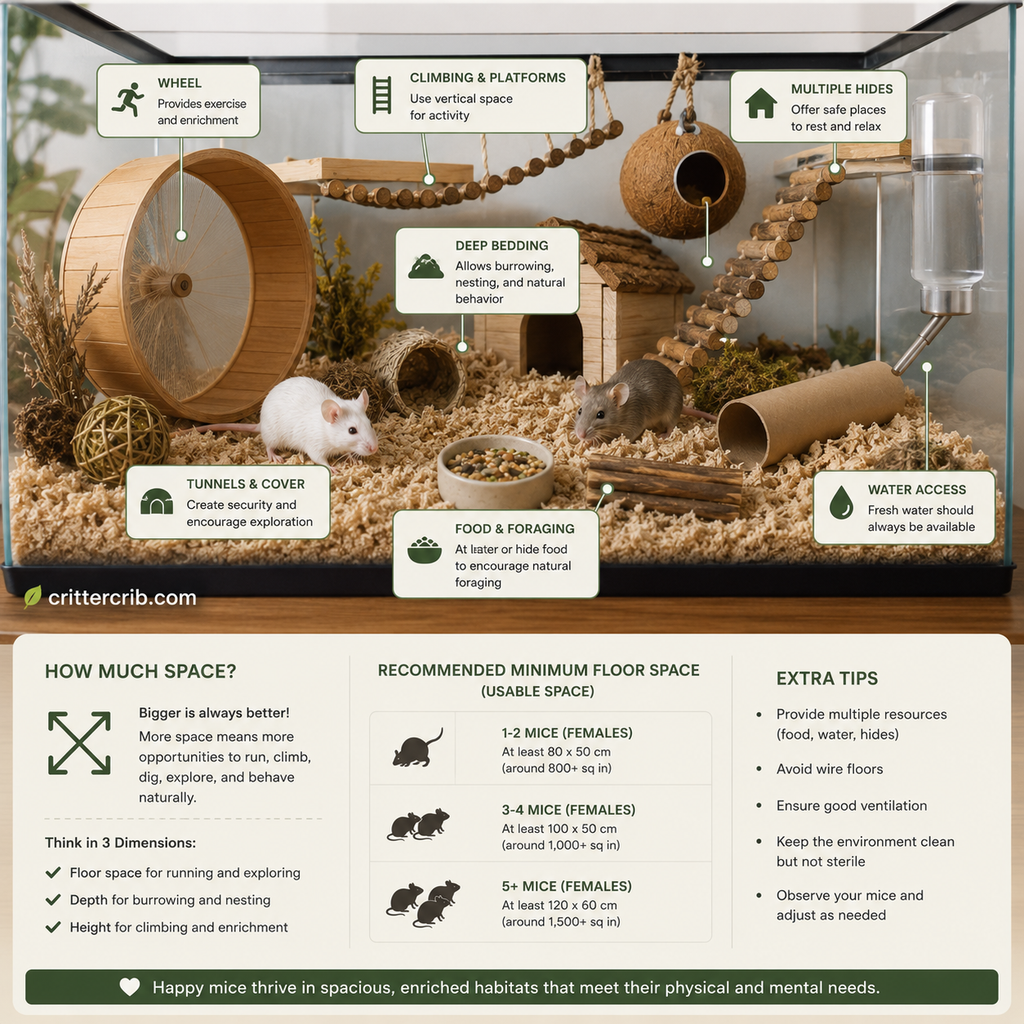
You don’t need literal walls between each section, but thinking in zones can make designing the habitat easier.
Deep Burrowing Zone
Include:
- Deep substrate
- Nesting material
- Buried tunnels
- Cardboard
- Hay
This area can take up a substantial portion of the enclosure.
Exercise Zone
Provide a stable surface for the wheel and other active equipment.
Feeding and Water Zone
Keep food and water accessible and easy to inspect.
Climbing Zone
Use safe vertical structures to make use of the enclosure’s height.
Hiding and Sleeping Areas
Provide several options at different points throughout the habitat.
Your mice will blur these boundaries almost immediately.
That’s okay.
The zones are for your planning, not theirs.
How Much Space Do Two Mice Need?
For two compatible female mice, choose an enclosure that comfortably supports deep bedding, an appropriate wheel, multiple hides, climbing opportunities, food, water, and enrichment while leaving plenty of usable room.
Avoid shopping for the absolute smallest habitat advertised for two mice.
Starting larger has several advantages.
It gives you more flexibility to:
- Add enrichment
- Create deeper substrate
- Separate resources
- Introduce new activities
- Provide multiple sleeping areas
It can also make habitat design much easier.
How Much Space Do Three or More Mice Need?
As group size increases, so should usable space and resource availability.
Don’t simply calculate cage capacity by adding another mouse to the manufacturer’s label.
Observe the group.
Ask whether every mouse can comfortably:
- Eat
- Drink
- Rest
- Hide
- Exercise
- Explore
- Move away from another mouse
For larger groups, multiple resources become increasingly useful.
Can a Mouse Cage Be Too Big?
A large enclosure isn’t inherently a problem simply because it’s large.
However, a huge, exposed habitat with very little cover may make mice feel vulnerable.
The solution isn’t necessarily making the enclosure smaller.
Make the space more usable.
Add:
- Cover
- Hides
- Tunnels
- Bedding
- Climbing structures
- Nesting areas
- Foraging opportunities
Large spaces work best when they’re filled with meaningful structure.
Can Mice Live in a Small Starter Cage?
Tiny starter cages may be convenient for retailers, transportation, or temporary situations, but many aren’t suitable as permanent homes.
Before buying one, ask whether it can realistically accommodate:
- Deep bedding
- A properly sized wheel
- Several hides
- Food and water
- Climbing structures
- Foraging opportunities
- Normal movement
If everything barely fits, consider a larger habitat.
Buying a small cage and replacing it a few weeks later usually costs more than starting with an appropriate enclosure.
Why Modular Tube Cages Aren’t Automatically Better
Colorful modular habitats with lots of plastic tubes can look enormous.
But appearance can be misleading.
Long tubes don’t necessarily provide the same usable living space as a large main enclosure.
They can also:
- Be difficult to clean
- Have limited ventilation in certain sections
- Create cramped areas
- Provide substantial chewable plastic
- Be difficult to access quickly
Tubes can be enrichment, but they shouldn’t compensate for an undersized main habitat.
Signs Your Mouse Habitat May Be Too Small
There’s no single behavior that proves an enclosure is undersized.
However, the physical setup itself can reveal problems.
Consider upgrading if:
- There’s little room after adding basic equipment.
- You can’t provide meaningful bedding depth.
- The wheel dominates the enclosure.
- Hides block most movement.
- Multiple mice can’t comfortably use resources.
- There’s almost no opportunity for foraging.
- You can’t create both horizontal and vertical enrichment.
- The habitat becomes dirty very quickly.
- There’s nowhere to add new enrichment.
Behavioral changes such as persistent stereotypic activity or excessive attempts to escape should also prompt you to review the entire environment, although behavior can have multiple causes.
Don’t Rely on Cage Size Alone
A large enclosure doesn’t automatically guarantee good welfare.
Imagine two habitats.
One is moderately sized but contains deep bedding, several hides, climbing structures, tunnels, a suitable wheel, chewable materials, and changing foraging activities.
The other is enormous but almost empty.
Square footage alone doesn’t tell the whole story.
Your goal should be adequate space plus environmental complexity.
Enrichment Makes Space More Valuable
Once you’ve chosen a suitable enclosure, make that space interesting.
Rotate safe enrichment rather than leaving the environment exactly the same indefinitely.
Ideas include:
- New cardboard boxes
- Paper tubes
- Safe branches
- Different nesting materials
- Foraging activities
- Digging areas
- New tunnel arrangements
- Hanging enrichment
You don’t need to completely redesign the habitat every week.
Small changes are enough.
How Often Should You Clean a Mouse Enclosure?
More space can make maintaining clean areas easier, but every habitat needs regular attention.
Spot-clean obvious wet or heavily soiled areas as needed.
Remove spoiled fresh food and check water daily.
More thorough cleaning frequency depends on:
- Number of mice
- Enclosure size
- Bedding type
- Ventilation
- Where the mice urinate
- How quickly areas become soiled
Avoid Overcleaning
Completely removing every familiar scent too frequently can be disruptive.
Mice rely heavily on scent communication.
Instead of automatically stripping the entire habitat on a rigid schedule, maintain hygiene while preserving a stable environment where practical.
Remove genuinely dirty material, but don’t assume “smells like absolutely nothing” is the goal.
Ventilation Matters as Much as Space
A large enclosure with poor ventilation can still be unsuitable.
Mouse urine contributes to ammonia buildup as waste accumulates.
Good ventilation combined with appropriate cleaning helps maintain air quality.
This is especially important with tank-style and bin-style enclosures.
Don’t sacrifice ventilation simply to keep bedding inside.
Where Should You Put a Mouse Enclosure?
Choose a stable indoor location.
Avoid placing the habitat:
- In direct sunlight
- Beside heating vents
- In strong drafts
- Near smoke
- Around aerosols
- Near heavily fragranced products
- In areas with extreme temperature fluctuations
Mice have sensitive respiratory systems.
Good ventilation and a clean environment are important.
The enclosure should also be somewhere you can conveniently observe the mice every day.
Housing Mice With Other Animals
Don’t house mice with other species.
Even if two small animals appear similar in size, they may have completely different:
- Social behavior
- Diets
- communication
- Housing requirements
Mice should live only with compatible members of their own species when social housing is appropriate.
Keep their enclosure securely separated from predators such as cats, dogs, ferrets, and reptiles.
A predator doesn’t need to physically enter the enclosure to cause stress.
Setting Up a Mouse Habitat Step by Step
If you’re starting from scratch, build the enclosure in this order.
1. Choose the Enclosure
Prioritize generous usable floor space, adequate height, ventilation, and escape prevention.
2. Add Deep Bedding
Create enough depth for meaningful burrowing.
3. Add Nesting Material
Provide safe material the mice can arrange themselves.
4. Install the Wheel
Keep it stable and unobstructed.
5. Add Hides
Provide several secure resting locations.
6. Add Climbing Structures
Use vertical space safely.
7. Add Tunnels
Create covered routes above and below the bedding.
8. Position Food and Water
Make sure they’re easy for every mouse to access.
9. Add Chewing and Foraging Materials
Give the mice activities from the beginning.
10. Check for Hazards
Before introducing your mice, inspect:
- Doors
- Bar spacing
- Lids
- Gaps
- Sharp edges
- Unstable objects
- Fall risks
- Exposed plastic edges
- Water access
Then check again.
Mice are excellent at finding the one escape route you missed.
A Simple Mouse Housing Checklist
Before considering your habitat finished, ask:
- Is there plenty of usable floor space?
- Can the mice burrow deeply?
- Is there an appropriately sized wheel?
- Are there multiple hiding places?
- Can they climb safely?
- Is nesting material available?
- Can they forage?
- Do they have safe things to chew?
- Is fresh water always accessible?
- Is ventilation adequate?
- Is the enclosure escape-proof?
- Can every mouse access important resources?
- Can I clean dirty areas easily?
- Is there room to add or rotate enrichment?
If several answers are no, the enclosure probably needs improvement.
Frequently Asked Questions About Mouse Housing
How Big Should a Mouse Cage Be?
Choose an enclosure with generous usable floor space and enough height to provide deep bedding, a suitable wheel, multiple hides, climbing structures, food, water, and enrichment.
Rather than aiming for the smallest acceptable dimensions, provide as much appropriately designed space as practical.
Do Mice Need More Floor Space or Height?
Both are valuable, but height shouldn’t replace adequate floor space.
The base supports running, burrowing, foraging, and movement, while height allows climbing and hanging enrichment.
A good habitat provides both.
Do Mice Need Deep Bedding?
Yes. Mice are natural burrowers and benefit from enough safe substrate to dig and construct tunnels.
A very shallow layer doesn’t allow the same behavior.
Can Mice Live in Glass Tanks?
A suitably sized glass tank can work well when it has a secure, highly ventilated mesh top.
Tanks are particularly useful for containing deep bedding.
Can Mice Live in Wire Cages?
Yes, provided the cage is appropriately sized, has safe bar spacing, solid flooring, and enough base depth to accommodate suitable bedding.
Escape prevention is especially important.
Do Mice Need Multiple Levels?
Multiple levels aren’t mandatory if the enclosure already provides sufficient usable space.
However, platforms, branches, ropes, and other safe structures can make vertical space more useful.
Do Mice Need a Wheel?
An appropriately sized solid-surface wheel is a valuable exercise option for pet mice.
Make sure the mouse can run comfortably and the wheel remains stable.
How Many Hides Do Mice Need?
Provide multiple hiding and sleeping options, especially for groups.
There isn’t a magic number that fits every setup.
The goal is to give mice choices and prevent one hide from becoming the only secure location.
Can Female Mice Live Together?
Female mice are social and are generally kept with compatible female companions.
Introduce unfamiliar animals appropriately and monitor their interactions.
Can Male Mice Live Together?
Adult males can show serious territorial aggression toward other males, making male social housing more complicated than female group housing.
Don’t combine unfamiliar adult males without appropriate guidance.
Can a Mouse Live Alone?
Female mice generally benefit from compatible same-species companionship.
Individual males may require different housing arrangements because of territorial aggression between males.
If you’re uncertain about the appropriate social setup for your mouse, seek advice from a veterinarian or knowledgeable small-animal welfare professional.
Is a Bigger Cage Always Better for Mice?
More appropriately designed space generally provides additional opportunities for enrichment.
However, make sure a large habitat also includes sufficient cover, bedding, hides, and environmental complexity.
Large and empty isn’t the goal.
Large and enriching is.
Give Mice Room to Be Mice
The best mouse habitat isn’t determined by how little space an animal can survive in.
It’s about what the mouse can actually do with the space you provide.
Can it disappear into a burrow?
Can it run comfortably on its wheel?
Can it climb?
Can it choose between different hiding places?
Can it gather nesting material, search for food, chew something safe, and explore without every accessory being piled on top of another?
Those questions tell you much more about an enclosure than the picture printed on the cage packaging.
Start with generous usable floor space. Add substantial bedding depth and safe vertical enrichment. Provide an appropriately sized wheel, multiple hides, tunnels, nesting materials, chewing opportunities, and places to forage.
For groups of compatible mice, make sure resources aren’t so limited that every animal has to compete for the same sleeping, feeding, or drinking location.
Then observe.
Mice will quickly show you how they use their home. They’ll move bedding, construct tunnels, relocate nesting material, stash food, and rearrange anything light enough to carry.
That’s exactly what you want.
A thoughtfully designed habitat gives them enough space not just to live, but to actually behave like mice.